Home Blog Page 6830

Reissued 10-year Treasury bonds fully awarded

BW FILE PHOTO

THE GOVERNMENT fully awarded the Treasury bonds (T-bonds) it auctioned off on Tuesday even as the average rate was higher than the coupon to track the increase in US benchmark yields.

The Bureau of the Treasury (BTr) on Tuesday raised P35 billion as planned via the reissued 10-year T-bonds it auctioned off, which have a remaining life of nine years and 11 months. The tenor fetched bids amounting to P51.077 billion.

The reissued 10-year papers fetched an average rate of 5.093%. This was 21.8 basis points (bps) higher than the 4.875% coupon rate quoted when the papers were first offered on Jan. 18.

The average yield was also higher by 11.72 bps than the 4.9758% quoted for the 10-year tenor on Monday at the secondary market, based on the PHP Bloomberg Valuation Service Reference Rates published on the Philippine Dealing System’s website.

“The average rate [was] marginally higher than secondary level as local rate tracked [the] climb in US Treasuries,” National Treasurer Rosalia V. de Leon said in a Viber message to reporters.

The prospect of rate hikes has bond markets reeling, and in Asia both Treasuries and Japanese government bond yields rose, with the rate of benchmark 10-year Treasuries were up about 3 basis points to 1.95% on Tuesday, Reuters reported.

“The range as to where it was awarded just reflects where the demand is given the backdrop of higher yields due to hawkish shift by major central banks,” a trader said in a Viber message.

The US Federal Reserve last month said it may start increasing interest rates by March to quell elevated inflation and as the economy recovers.

Over the weekend, Dutch Central Bank President Klaas Knot, who is also a member of the European Central Bank’s (ECB) governing council, said he expects the ECB to start hiking rates by the fourth quarter of 2022.

ECB President Christine Lagarde last week said they would not explicitly rule out the possibility of a hike within the year, a change from her previous stance that such move will be unlikely.

For this month, the BTr is looking to raise P200 billion from the domestic market, or P60 billion through Treasury bills and P140 billion via T-bonds.

The government borrows from local and external sources to help fund a budget deficit capped at 7.7% of gross domestic product in 2022. — L.W.T. Noble with Reuters

COVID-19 vaccination protects children from getting seriously ill

PHILSTAR

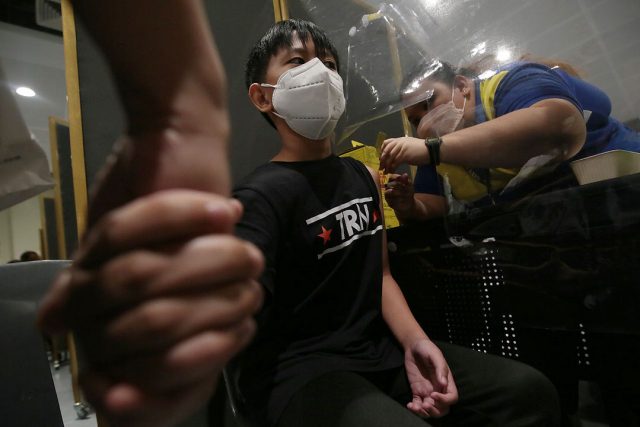
The Department of Health (DoH) and the National Task Force Against COVID-19 (coronavirus disease 2019) said that the policy to vaccinate children in the 5 to 11 age group is the result of careful study by health experts and has been approved in many countries.  

In a joint statement, they said that more than 8.1 million children have been vaccinated worldwide, with no reports of deaths and serious adverse events among those vaccinated. 

Vaccinating children aged 5 to 11 years old prevents severe COVID-19, hospitalization, and serious and long-term complications. 

Citing modeling data from the European Center for Disease Prevention and Control, the Philippine Pediatric Society (PPS) and the Pediatric Infectious Disease Society of the Philippines (PIDSP) stated in their joint statement that vaccinating children aged 5 to 11 years old could also reduce COVID-19 transmission in the whole population, lower the likelihood of school absences and closures, lessen interference with social activities, and ease stress on families affected by COVID-19 and its associated disruptions. 

PIDSP president Dr. Mary Ann Bunyi, also a member of the National Immunization Technical Advisory Group (NITAG), urged parents to have their children in this age group vaccinated when the government’s pediatric vaccination program, which started on Feb. 7. With parental consent, the DoH has received at least 100,000 pre-registrations for the vaccination rollout for the said age group. 

“The vaccine is safe and effective. This is an opportunity for your family and children to be protected against COVID-19. Getting fully vaccinated will enable your children to go outside the house, attend face-to-face classes, and play with their friends,” she said. 

In December 2021, the Philippine Food and Drug Administration issued an emergency use authorization for the Pfizer-BioNTech COVID-19 vaccine for children aged 5 to 11 years. The vaccine for this age group has a lower dosage than the vaccine for the 12 to 17 age category and adults. The government aims to vaccinate at least 13.5 million children aged 5 to 11 against COVID-19. 

“Published data from randomized clinical trials for the Pfizer-BioNTech vaccine showed that a vaccination regimen consisting of two 10-μg doses of the vaccine administered 21 days apart among 5–11-year-olds had a favorable safety profile and antibody levels comparable to those in 16-to-25-year-olds. A vaccine efficacy of 90.7% has formed the basis of approval for use of the vaccine in the Philippines and in other countries,” according to the PIDSP and PPS joint statement. 

It added that safety data from United States surveillance showed that serious adverse events following Pfizer-BioNTech vaccination in children ages 5 to 11 years occurred in only 2% of recipients, with fever and vomiting as the most frequently reported. In the latest Philippine safety data for the 12-17 age group, dizziness, injection site pain, fever, increased blood pressure, and headache were the most commonly reported adverse reactions. 

Protecting children from COVID-19 is crucial. The PPS and PIDSP noted that in the Philippines, around 3% of COVID-19 cases and 0.5% of deaths are among children aged 5 to 11 years old, which is similar to the worldwide trend. “Although COVID-19 cases in children remain less severe compared to older adults, children can still be hospitalized and even require admission to the intensive care unit (ICU).” 

Moreover, the two societies said that between 0.5% and 3.1% of all children diagnosed with COVID-19 and between 0.9% and 7.6% of hospitalized pediatric COVID-19 patients may be at risk of developing multisystem inflammatory syndrome in children (MISC). MISC is a condition where different body parts can become inflamed, including the heart, lungs, kidneys, brain, skin, eyes, or gastrointestinal organs. 

“[Children] may also be at risk of developing ‘long COVID’,” the PPS and PIDSP stated. Also known as long-haul COVID or post-acute COVID-19, long COVID refers to a wide range of new, returning, or ongoing health problems people can experience four or more weeks after first being infected with the virus that causes COVID-19. 

The US Centers for Disease Control and Prevention said that people with long COVID commonly report experiencing different combinations of the following symptoms: difficulty breathing or shortness of breath, fatigue, symptoms that get worse after physical or mental activities (post-exertional malaise), difficulty thinking or concentrating (sometimes referred to as “brain fog”), cough, chest or stomach pain, headache, fast-beating or pounding heart (heart palpitations), joint or muscle pain, pins-and-needles feeling, diarrhea, sleep problems, fever, dizziness on standing (lightheadedness), rash, mood changes, change in smell or taste, and changes in menstrual period cycles. 


Teodoro B. Padilla is the executive director of the Pharmaceutical and Healthcare Association of the Philippines (PHAP), which represents the biopharmaceutical medicines and vaccines industry in the country. Its members are at the forefront of research and development efforts for COVID-19 and other diseases that affect Filipinos.


Arts & Culture (02/09/22)

‘1945: In Memoriam’ online tour

To commemorate the Battle of Manila, The Heritage Collective, Renacimiento Manila, Don’t Skip Manila, and WanderManila present an online experimental tour “1945: In Memoriam,” a multimedia experience that will detail how the Battle of Manila unfolded, how the City of Manila fell, and how so many lives were lost. It will stream live on Feb. 26, 7 p.m., at the Facebook pages of Don’t Skip Manila, The Heritage Collective, Renacimiento Manila, and WanderManila. For more information, visit www.facebook.com/WanderManila/.

Group show at ARTablado

A POET once said, “You must first be grounded before you can soar.” That’s the philosophy behind the Robinsons Land ARTablado group show titled “From My Roots,” which will go on view from Feb. 16 to 28, at Level 3 of Robinsons Galleria. The participating artists will share tableaus and thoughts about their home in Quezon province. “From My Roots” will features the works of Avie Abadilla, Frank Hari, Glenmore Lawig, Jake Alano, Joel Reglos, Melo Valencia, Nelle Amador, Raffa Dala, Tres Roman, and Tristan Bamba.

Young piano virtuosos in a virtual concert series

FIVE young pianists will have an opportunity to showcase their talents in a special virtual concert series, dubbed Special Concert Series: Young Virtuosos Play on the Fazioli Piano, on February 9 to 13, to be live streamed at the CCP YouTube Channel and Facebook Page. Nathan Samuel Gemina, Michael Angelo Valenciano, Aidan Ezra Baracol, Inna Montesclaros, and Ella Gabrielle Gaw will each perform a classical piece in a 15-minute solo recital, exhibiting their musicality and piano skills using the CCP Fazioli piano, one of but a rare few in the country. The concert series — which was pre-recorded at the Tanghalang Nicanor Abelardo (CCP Main Theater) — will be hosted by Raul Sunico. The concert is organized with the cooperation of the National Music Competitions for Young Artists (NAMCYA). For more updates, follow the CCP and NAMCYA Facebook Pages.

‘Saan Ka Lulugar’ webinar series

IN CELEBRATION of National Arts Month, the National Commission for Culture and the Arts (NCCA), through the National Committee on Architecture and the Allied Arts (NCAAA), invites planning and design professionals, academicians, students, and the general public to a series of conversations that will highlight how creativity in planning, designing, and constructing of built environment can hasten recovery from the impacts of the pandemic. With the theme “Creativity as a Catalyst for Recovery,” the four-part webinar series, “Saan Ka Lulugar,” aims to promote culture-based and gender-responsive planning and design of public and private spaces by discussing creative innovations in planning and design. The first session, on Feb. 11, 2 p.m., will focus on building creative cities; the second session, on Feb. 18, 2 p.m., will focus on public art spaces; the third session, on Feb. 25, 2 p.m., will focus on continuing community projects in the time of quarantine; and the fourth session, on March 4, 2 p.m., will focus on creative innovations. Register at http://bit.ly/SaanKaLulugar2022. For more information, visit www.facebook.com/NCAAAexecon

Eala beats Italy’s Rubini to book slot in W60 Grenoble main draw

SIXTEEN-YEAR-OLD ALEX EALA — GRENOBLE TENNIS

ALEX M. Eala netted a ticket to the main draw of the W60 Grenoble in France after carving out a gritty 4-6, 6-4, 10-4 victory over Italy’s Stefania Rubini in the finals of the qualifying round.

Up against a 29-year-old foe, the 16-year-old Filipina wunderkind relied on fresher legs and ran away in the rubber match after shaking off a sluggish start in the duel that lasted almost two hours.

She broke serve in the fifth game of the decider after a back-and-forth rally to ignite a five-game spree for a comfortable 7-2 cushion that pretty much sealed her victory heading home.

Ms. Eala, who bested France’s Thanh Lan Truong in the first qualifying phase, collides next against Joanne Zuger of Switzerland in the first round of the main tilt for a chance at her first deep run this year.

She absorbed quick exits in her first two tournaments this season, a qualifying loss in the W25 Manacor first leg and a first-round defeat in the third leg last week. She did not participate in the second leg due to illness.

Against the 21-year-old Ms. Zuger boasting a solid resume though, Ms. Eala is in for a serious business.

The Swiss ace is currently No. 264 in the Women’s Tennis Association (WTA) rankings and holder of two pro titles as an automatic entry in the 32-strong W60 Grenoble main draw.

Ms. Eala, who is the world junior No. 12 player, is at No. 587 of the WTA list with only one championship so far. — John Bryan Ulanday

Cebu Pacific sees high passenger acceptance of airline’s digital pivot

CEBUPACIFICAIR.COM

BUDGET carrier Cebu Pacific (CEB) on Tuesday said it saw 96% take-up of flexible options through its self-manage portal, indicating high acceptance of the airline’s digital self-service capabilities.

The airline said it provided flexible options to its customers with flights from Jan. 10 to 31 to allow them to conveniently adjust their travel dates as needed.

“This shift is in line with CEB’s direction to have all-digital customer service operations after it announced the closure of its call centers in May 2021,” the budget carrier said in a statement.

Candice A. Iyog, vice-president for marketing and customer experience at Cebu Pacific, said the company believes this is the way forward for travel.

“We are very happy to see that majority of our guests have accepted our digital self-service platforms,” she added.

It was during the pandemic when the airline made some changes to its online platforms as part of its efforts to implement contactless transactions.

These improvements include correcting misspelled names within 24 hours from flight booking, birthdate, nationality, and salutations.

“Even contact details can now be upgraded by guests on their own,” the airline noted.

“The airline has also deployed self-bag tagging kiosks in some of its key domestic destinations in support of its existing contactless flight guidelines to further minimize physical interactions between passengers and staff,” it added. — Arjay L. Balinbin

BoJ set to face off with traders as yields near limit

WIKIPEDIA.ORG

JAPAN’S government bond yields are edging toward the upper limit of the central bank’s tolerance level, raising questions over how policy makers will respond to the challenge.

As the 10-year yield approaches the 0.25% mark, the Bank of Japan (BoJ) could boost scheduled purchases, buy debt outside of its normal operations, as well as offer to secure an unlimited amount of bonds at a fixed rate in a repeat of what happened in July 2018.

The BoJ’s response will determine whether Japan can defy the worldwide rise in yields as traders ramp up bets for policy normalization. Governor Haruhiko Kuroda has dismissed talk of a rate hike and domestic inflation remains anemic but the global repricing is still altering expectations for Japan’s bond market.

“It’s hard to expect JGB yields to defy BoJ’s aggressive buying and continue their climb as the rise is driven by external factors,” said Naomi Muguruma, a senior market economist at Mitsubishi UFJ Morgan Stanley Securities Co. in Tokyo. “The BoJ has the option to conduct fixed-rate operations broadly, not just the 10-year zone, to counter a surge in yields.”

Japan’s 10-year yield has risen for two straight months and hit 0.21%, its highest since January 2016 on Tuesday. Under its curve control policy, the BoJ has a desired trading range for the benchmark of 0.25% either side of zero.

Here’s a closer look at the various bond-purchase operations the BoJ can deploy to curb the advance:

UNSCHEDULED OPERATIONS
The BoJ regularly buys set amounts of government bonds from the secondary market on scheduled dates, but it can act at any time. The last time it stepped in unannounced was during the height of the pandemic in March 2020, when the benchmark yield surged about 30 basis points in 10 days.

Given that inflation remains far below the central bank’s 2% target and wage growth is subdued, a shift in policy doesn’t seem imminent, though market expectations look to be shifting.

“Investors’ target levels may be rising a bit, such as 0.1% to 0.2% for 10-year yields from between zero and 0.1% previously, and the 30-year closer to 1%,” Mitsubishi UFJ’s Ms. Muguruma said.

FIXED-RATE BUYING
This method lets the BoJ buy unlimited amounts of debt at pre-determined yields. If it decides to do so for consecutive days, it is expected to announce details of the operation ahead of time.

Some strategists say the BoJ will likely to resort to this before the 10-year yield rises to 0.25%, unlike in July 2018 when it stepped in after the yield rose above the 0.10% limit allowed back then.

“Unscheduled bond operations could just encourage market participants to speculate the BoJ will keep buying, so they aren’t very effective,” said Eiji Dohke, chief bond strategist in Tokyo at SBI Securities Co. in Tokyo. “The BoJ is more likely to use the fixed-rate operation. It could offer to buy 10-year notes at 0.25% when the yield in the secondary market is around 0.22% to 0.23%.”

While such a level below the market price of the bonds would be unlikely to generate any takers, it would mark a line in the sand for the BoJ and could ease the upward pressure on yields.

SCHEDULED OPERATIONS
Alternatively, the BoJ could use its scheduled buying operations to adjust the shape of the yield curve if it sees distortions, said Mari Iwashita, chief market economist at Daiwa Securities Co.

The BoJ has abandoned its monthly purchase schedule in favor of a quarterly plan since July, where it announces fixed amounts for each maturity with set dates for the operations. The next plan will be released on March 31.

“The BoJ could flexibly change the amounts during a month if needed, if it sees some issues in yield levels after conducting fixed-rate operations,” said  Ms. Iwashita. If necessary, the BoJ could decide to change the amount or frequencies for the April-June quarter, she added.

Japan’s bond yields look unlikely to drop back to levels seen late last year, given the aggressive pricing for rate hikes by the Federal Reserve and European Central Bank, according to strategists.

Furthermore, markets may factor in a potential policy shift after Mr. Kuroda’s term ends in April 2023, said Eiichiro Miura, general manager of the fixed-income department at Nissay Asset Management Corp.

“Even if the 10-year yield is contained by BoJ operations, super-long sectors will remain volatile as investors won’t rush to buy when there is potential for a future change in BoJ policy,” he said. — Bloomberg

Philippine factory output growth eases in December

FACTORY PRODUCTION grew at a slower pace in December but remained in the positive territory for the ninth straight month despite the supply chain disruption in the aftermath of Typhoon Odette. Read the full story.

Philippine factory output growth eases in December

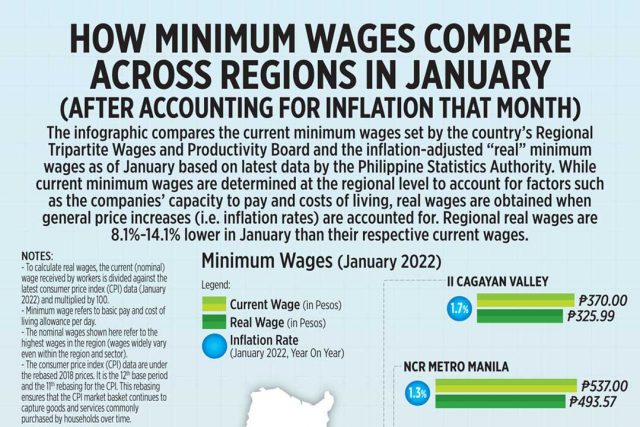
How minimum wages compare across regions in January

How minimum wages compare across regions in January

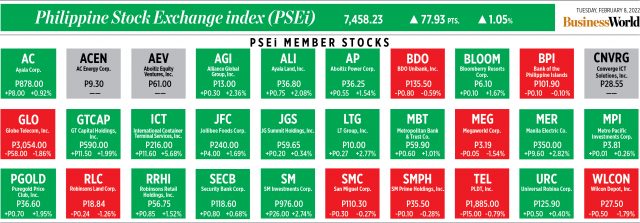
How PSEi member stocks performed — February 8, 2022

Here’s a quick glance at how PSEi stocks fared on Tuesday, February 8, 2022.


DTI expecting investment boost from bill amending PSA

BW FILE PHOTO

THE proposed amendments to the Public Service Act (PSA) will help drive the economic recovery by attracting more investment, according to the Department of Trade and Industry (DTI).

Trade Secretary Ramon M. Lopez said in a statement on Tuesday that the bill amending the PSA will help improve the investment climate.

“Once President Rodrigo R. Duterte signs the bill into law, foreign equity restrictions will be eased which shall attract more global players (to) modernize several sectors such as telecommunications, shipping, air carriers, railways, and subways,” Mr. Lopez said.

“Similarly, there will be increased competition in terms of services and products which will generate better-quality services and competitive pricing to the benefit of the consumers. Higher investments will also generate more jobs and income for the people,” he added.

On Feb. 2, Congress ratified the bicameral conference committee report of the bill amending the PSA, which would permit 100% foreign ownership in telecommunications, domestic shipping, railways and subways, airlines, expressways and tollways, and airports.  

These will not be covered by the 40% foreign ownership limit provided under the 1987 Constitution. Currently, the bill is awaiting Mr. Duterte’s signature.

The bill retained the “public utility” classification only for the distribution and transmission of electricity, petroleum and petroleum products pipeline transmission systems, water pipeline distribution systems and wastewater pipeline systems; sewerage pipeline systems; seaports; and public utility vehicles.

Any industry not included in the list of “public utilities” will be considered a “public service” and can be liberalized and fully owned by foreigners.

“I am confident that we can make an economic recovery happen in the Philippines this year. With the amended PSA, we expect the entry of new foreign investors and the introduction of modern and new technologies in the aforementioned sectors,” Mr. Lopez said.

Trade Undersecretary Rafaelita M. Aldaba said the proposed amendments to the PSA will boost the competitiveness of the services sector.

“A more competitive services sector will have indirect consequences toward economic growth. High-quality transport or telecommunication infrastructure, for example, could influence the production costs and competitiveness of all firms across all sectors of the economy,” Ms. Aldaba said.  

The DTI said the bill still bars foreign nationals from owning more than 50% of companies involved in the operation and management of critical infrastructure if their home country does not provide reciprocal rights to Philippine nationals.

“The President is granted the authority to suspend or forbid any proposed merger or acquisition, or investment in a public service that effectively results in the grant of control to a foreigner or a foreign corporation,” the DTI said.  

“With the economic headwinds brought by the prevailing pandemic, the amended PSA, the Retail Trade Liberalization Act, as well as the Foreign Investment Act are expected to hasten the country’s recovery from the present global health crisis,” it added. — Revin Mikhael D. Ochave

Rice tariff collections hit P18.9 billion in 2021

REUTERS

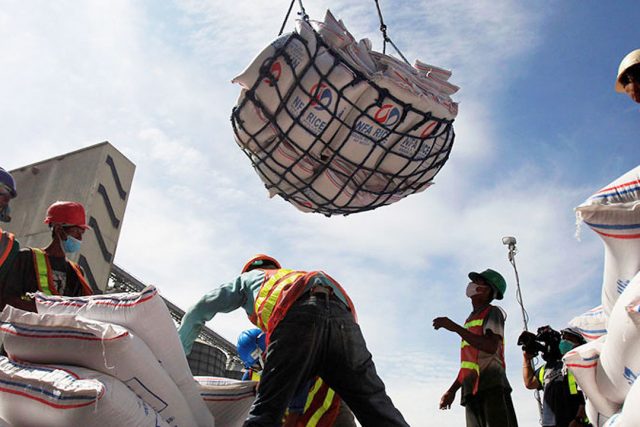
RICE TARIFF collections amounted to P18.9 billion in 2021, the Department of Finance (DoF) said on Tuesday, giving the government a surplus of P8.9 billion over and above the P10 billion that must be automatically appropriated from tariffs for farm modernization.

The 2021 total was up 22% from a year earlier, Customs Commissioner Rey Leonardo B. Guerrero said in a report to the DoF.

The government deregulated the rice market, allowing private parties to import rice while paying a 35% tariff on Southeast Asian grain. The tariffs generated provide P10 billion a year to the Rice Competitiveness Enhancement Fund, a modernization program authorized by Republic Act 11203 or the Rice Tariffication Law.

Collections beyond P10 billion will be added to the national budget of the following year. The authorized uses of the surplus include financial aid to rice farmers, the titling of agricultural land, the expansion of crop insurance coverage and the promotion of crop diversification.

The Department of Agriculture has reported that RCEF has helped boost rice farmer earnings while reducing production costs.

“We have posted record harvests for the last two years at 19.2 million metric tons (MMT) in 2020 and 19.96 MMT in 2021,” Agriculture Secretary William D. Dar said in a statement on Tuesday.

Mr. Guerrero said collections from pork imports between April 9, 2021 and Jan. 28 totaled P3.75 billion. Pork import volume was 242 million kilograms.

“The bureau, however, estimates that it had foregone P4 billion in revenue during this period as a result of the Presidential directives lowering the import tariffs on pork,” the DoF said.

In April, the government temporarily lowered pork import tariffs and increased the allowable import volumes of the meat to quell elevated inflation levels after the hog population was decimated by an outbreak of African Swine Fever.

The Bureau of Customs collected P645.77 billion in 2021, exceeding its goal by 4.7%. — Luz Wendy T. Noble

Metro Manila water shortage projected for April or May

PHILSTAR

THE National Water Resources Board (NWRB) said that Metro Manila may experience a water shortage by April or May as Angat Dam levels continue to decline.

“The level of Angat Dam is already at 196 meters. The ideal level would be somewhere past 200 meters,” NWRB Executive Director Sevillo D. David, Jr. said in a radio-television interview.

“We are (trying to avoid) reaching 180 meters, which is the minimum operating level. But based on the projections and rainfall forecasts, we may reach this in April or May,” he said.

On Dec. 31, the water elevation at the dam was 202.80 meters, which was below the target level of 212 meters.

“Before the year ended, there was not much rainfall in the watershed. Right now, our water levels continue to decrease. We need to manage the release of water and take care of this supply these coming months, particularly in the summer,” he added.

Mr. David said that the NWRB is planning measures with water concessionaires to ready deep wells and treatment facilities to make up for the potential shortage.

“Maynilad has supply augmentation measures in place to prepare for the summer months given the low water level in Angat Dam. These include the construction of four modular treatment plants that will get raw water from rivers, reactivation of deep wells in various points of our concession area, management of pressure across the pipe network, and sustained leak repair and pipe replacement activities,” Maynilad Spokesperson Jennifer C. Rufo said in a Viber message.

“We are proactively working on solutions that will provide additional and augmentation sources of water especially during the coming summer months,” Manila Water Group Head of Corporate Communications Nestor Eric T. Sevilla said in a Viber message.

Manila Water is working on projects to augment supply, such as maximizing the capacity of the Cardona Water Treatment Plant, continuing the operation of deep wells, drawing water from the Marikina River, and tapping the Alat Dam, according to Mr. Sevilla.

The water concessionaires encouraged the public to conserve water to head off possible shortages.

“While we work with the Metropolitan Waterworks and Sewerage System (MWSS) and NWRB on providing the needed supply, we also encourage consumers to use water responsibly so we can maximize the available supply and avoid wastage,” Ms. Rufo said.

“We believe that the conservation of our water resources is a shared responsibility of the government and the concessionaires who closely coordinate with each other to provide the needed water supply, and the public to ensure that water distributed is used wisely and responsibly,” Mr. Sevilla added.

Meanwhile the National Irrigation Administration (NIA) said that it is also working to secure water for farmers in anticipation of the shortage.

“We distributed 500 shallow tubewell pumps to the farmers in Bulacan and Pampanga last Jan. 28 in cooperation with MWSS and their concessionaires. These include subsidies for gasoline,” NIA Administrator Ricardo R. Visaya said in a Viber message.

“In the long term, we are fast tracking the construction of Bayabas Dam in Bulacan so that Angat Dam can best serve the water needs of Manila and that farmers in Bulacan and Pampanga will be assured of a 24/7 supply of water for irrigation purposes,” he added. — Luisa Maria Jacinta C. Jocson