Home Blog Page 681

A matter of kindness

STOCK PHOTO | Image by Jcomp from Freepik

In the cyberage of materialism, speed, and convenience, the concept of spirituality is dismissed as irrelevant, obsolete, and archaic.

The Dalai Lama once described the essence of spirituality in one word — Kindness.

We now live in the future, the brave new world that Aldous Huxley wrote about decades ago. Scientists are preoccupied with genetic engineering, fine tuning the process of cloning, improving humanity, stem cell, gene therapy, and the manipulation of chromosomes and DNA.

Most people are obsessed with power, progress, success, wealth, and fame (or notoriety). Material and commercial concerns such as globalization, being “number one,” and winning wars take precedence over what has always been the essential — the intrinsic, ethereal, natural, and spiritual.

It is material might, prowess, and brute strength versus wisdom, grace and goodness.

In childhood and adolescence, in the era of gentility, we learned our prayers and important religious rites of passage. There were so many lessons learned at home and in school. It seemed so structured and strict at that time. But there were reasons (that we could not grasp back then) for the discipline and rigid rules. We could not question our parents and superiors. We had to obey.

The foundation was set for a young adult to face the world and tackle its myriad challenges — physical, mental, and emotional.

With the passing years, the rigidity of that foundation wavers or erodes. Young adults begin to develop their individual ideas. The early impressions and idealism are altered in the context of the real world. It is one filled with pressure, anger, greed, self-gratification, and angst.

Matters of tradition, principles, faith, doctrine, and rituals recede to the background. Focus shifts to a more pragmatic sensibility.

Many people flow with the tide and choose the path of least resistance. They go through the motions of observing and practicing rites and rituals for convenience and convention. It is driven by a desire to belong, to appear to fit in or to conform (on the surface).

Free spirits and liberal thinkers take the more difficult path. To defy convention, they do their own thing, in their own time. They flout convention and common beliefs.

The brave ones denounce the pretense of society and the hypocrisy of the righteous judgmental do-gooders. There are too many prayer-perfect, pseudo-pharisees who act holier-than-thou. The pretense is just for show. They could be nasty and shadowy within.

A simple act of kindness is like a small light that slowly illuminates the darkness. It is an antidote to dispel the toxic meanness in others.


Maria Victoria Rufino is an artist, writer and businesswoman. She is president and executive producer of Maverick Productions.


mavrufino@gmail.com

First Gen to supply 47 MW of renewable energy to WalterMart malls

WALTERMART.COM.PH

WM SHOPPING CENTER Management, Inc., the developer of WalterMart malls, is expanding its partnership with First Gen Corp. to power its malls with renewable energy (RE).

In a statement on Thursday, the mall chain developer said it tapped the energy producer to supply electricity to its 47 WalterMart malls, including W Department Store, WalterMart Supermarket, and Abenson outlets across Metro Manila, central, and southern Luzon.

The agreement also covers Citadines Bay City Manila Hotel in Pasay City and Ascott Bonifacio Global City Mall — both owned by the WalterMart group.

Under the deal, First Gen will supply 47 megawatts (MW) of electricity sourced from its Unified Leyte Geothermal Power plant, operated by its subsidiary, Energy Development Corp.

The partnership between the two companies began in 2019 with the installation of on-site solar facilities in WalterMart community malls across Luzon.

“The commitment to clean power enables our malls to operate responsibly and efficiently, reducing our carbon footprint while creating a greener future for the communities we serve,” WM Shopping Center Chairman Abraham Uypeckcuat said.

Currently, WalterMart has 45 community malls in the Philippines. By yearend, 25 of these malls will be equipped with solar power facilities with a combined capacity of 27 MW.

“As WalterMart continues to grow and open new community spaces across the country, First Gen will be ready to power every expansion and deliver what is truly a baseload source of renewable energy, while continuing to support its solar and energy efficiency initiatives,” First Gen President Giles B. Puno said.

First Gen is an independent power producer with a total installed capacity of 3,696 MW across natural gas, geothermal, hydroelectric, wind, and solar technologies. — Sheldeen Joy Talavera

Why paying above minimum wage makes sense

We’re a medium-sized business trying to attract and retain the brightest workers. Our newly hired chief executive officer (CEO) is planning to offer competitive pay and perks. As the human resources (HR) manager, I’m tasked with studying the matter carefully. Please help me navigate this. — Flower Girl.

Good for you and your CEO. Many organizations treat the minimum wage like a sacred ceiling rather than a legal floor. They pay workers just enough to keep them from leaving and expect them to work hard enough not to get fired. But that’s a false economy.

However, payroll savings don’t automatically mean saving money. In reality, the logic of paying above the minimum wage can be summarized in one line: you either pay for performance or pay for problems.

In 1914, Henry Ford shocked the business world by doubling his workers’ wages. Competitors thought he was crazy. Within months, turnover dropped, output soared, and the Ford Motor Co. became a productivity legend.

Ford’s logic was simple: paying well is not charity; it’s strategy. He understood that happy workers make better cars — and eventually, more profits. More than a century later, his lesson still applies in factories, offices, even fast-food restaurants.

When you pay only the bare minimum, you attract applicants with the bare minimum credentials. There’s nothing wrong with that — unless you’re in business to win, not just survive. For example, a salary that’s at least 50% higher than the minimum sends a strong message:

We want the best and the brightest workers, not the cheapest.

Let’s say the minimum daily wage in Metro Manila is P700. If your company offers at least P1,100 for the same job, your job ad suddenly becomes more attractive than 80% of other companies. You won’t just get more applicants; you’ll get better ones.

In HR math, better input equal better output.

Low pay leads to high turnover. High turnover leads to high replacement costs. It’s a vicious cycle where you keep hiring, training, and losing people. It’s like filling a leaking bucket with water.

A competitive pay structure is better than a constant hiring headache. Choose wisely — pay 50% more to keep a worker, or spend 100% more while finding, training, and breaking in a new one. You may not realize the total cost yet, until you do the HR math.

When you pay decently, workers stick around — as long as you treat them kindly. They develop loyalty, competence, and that priceless thing called institutional memory that you can’t get from new hires.

MOTIVATIONAL SPEAKERS
Organizations spend at least P150,000 per engagement to hire popular motivational speakers to boost employee morale for few hours. But a fair and decent wage motivates every single day. That’s not all. Motivating people is job number one for line supervisors and managers, not motivational speakers.

You don’t need fireworks in the form of motivational seminars. People who feel respected don’t need to be reminded to work hard. They do it naturally — and productivity rises not because of slogans or inspiring stories, but because of management sincerity expressed through daily employee engagement.

Further, underpaid workers often require constant supervision. They look busy when the boss is around and vanish as soon as they’re gone. Over time, the company spends more on close monitoring than on actual management.

Higher-paid employees, on the other hand, value the trust given to them. They need guidance, not babysitting. They’re self-motivated because they feel invested in. The result? Managers can focus on bigger strategic things, not surveillance.

Employees who earn above-market wages carry themselves differently — with pride and professionalism. That attitude spills over to customer service, teamwork, and product quality.

DOING IT RIGHT
It’s not easy. You have to do it systematically through an intelligent process. You don’t simply follow the advice that people must be paid at least 50% above the minimum wage; you must do it properly with the following steps:

One, compare notes with industry leaders. Benchmark with friendly organizations within your location — in an export-processing zone, perhaps. If not, buy the latest salary survey report. That will help you determine whether 50% above the minimum is enough.

Two, establish or review your salary structure. This covers job analysis, job descriptions, job grade levels, and salary ranges (minimum to maximum) for each level. This must be supported by a robust policy and regular internal equity checks.

Three, design merit-based incentives. People should compete not out of desperation but aspiration. They should aim for promotions and pay increases because they want growth — not just survival — done through an objective performance appraisal system.

Four, have competent line leaders. Train your supervisors and managers to become effective coaches. Clarify their roles. Give them proper and right exposure. Build a culture of thinking with the help of their workers.

In conclusion, understand that the cheapest labor often becomes the most expensive mistake. Saving hundreds of pesos upfront can cost you far more in errors, delays, and rework — proof that bargain hiring is rarely a bargain in the long run.


Consult your workplace issues for free. E-mail Rey Elbo at elbonomics@gmail.com or DM him on Facebook, LinkedIn, X or via https://reyelbo.com. Anonymity is guaranteed.

Louvre museum to add 100 external cameras by 2026 after heist exposed security flaws

LOUVRE Museum — WIKIPEDIA

PARIS – France’s Louvre Museum will install 100 external cameras by the end of 2026 as part of measures to tighten security after last month’s spectacular heist, its director said on Wednesday.

Laurence Des Cars also told a National Assembly hearing that ties with Paris police would be tightened with the installation of an “advanced police station within the Louvre’s estate.”

The daylight Oct. 19 robbery, in which four robbers made off with jewels worth $102 million, has raised doubts over the credibility of the world’s most-visited museum as a guardian for its myriad works.

While investigators have charged four suspects accused of involvement in the raid, the treasures have yet to be recovered.

Officials have admitted there was inadequate security camera coverage of the outside walls of the museum and no cover of the balcony involved in the break-in.

After the robbery, French officials said the Louvre would introduce extra security, including anti-intrusion devices and anti-vehicle ramming barriers on nearby public roads, by the end of the year.

A report published last month by France’s public audit body, known as the Cour des Comptes, said the museum’s inability to update its infrastructure was exacerbated by excessive spending on artwork.

Ms. Des Cars, however, told lawmakers: “I fully take responsibility for these acquisitions, which are the pride of our country and our collections. Work at the Louvre should not be seen as competing with the enrichment of national collections.” Reuters

‘While the Guitar Weeps’ for the nation

“I look at the world and I notice it’s turning/While my guitar gently weeps…”

— George Harrison, The Beatles

The Philippines today feels like a land in quiet sorrow —  deeply disillusioned. The headlines on corruption, abuse of power and cynical manipulation of public sentiment weigh heavily on the nation’s moral fabric. People sense the need for change, yet a group seeks to hijack that yearning for their own political gain.

George Harrison’s “While My Guitar Gently Weeps” emerged from a similar mood — a blend of love, frustration and hope amid the human capacity for folly. Written in 1968, the song was Harrison’s lament that people fail to love one another and to learn from their mistakes.

That same year, The Beatles, which once symbolized unity and creativity, was unraveling. Lennon and McCartney were quarreling over control; Ringo had briefly quit; and Harrison, often overshadowed, struggled to be heard. Out of this tension came a quiet masterpiece — a weeping guitar echoing both his personal alienation and his yearning for harmony.

OBSERVATION AND DISILLUSIONMENT
Harrison’s opening lines capture the pain of the observer: “I look at you all, see the love there that’s sleeping…” He saw the potential for goodness buried under ego and pride — in his bandmates, in humanity and in himself. The Philippines, too, is a nation full of sleeping love. We are compassionate, resourceful and resilient, yet we allow corruption and division to dull our moral imagination.

Jose Rizal saw the same paradox. He loved his people but lamented their tolerance for mediocrity. His warning — “The glory of saving a country is not for those who contributed to its ruin” — reminds us that redemption cannot come from the same forces that bred our decline.

Like Harrison, Rizal was the quiet conscience of his generation — the observer who felt deeply and saw too clearly. Both artists teach that mere observation without engagement leads to disillusionment. We cannot stand idly by as the nation weeps and still hope for change.

THE ‘I CHING’ AND THE WEB OF CONSEQUENCES
Harrison’s inspiration came from the “I Ching,” the ancient Chinese book of changes. The phrase “gently weeps” appeared in a random book he opened — a moment of synchronicity that revealed the wisdom of connection. The “I Ching” teaches that everything is interrelated: every thought, decision and moral act ripples through society.

This is the lesson the Philippines must relearn. A single dishonest act, a bribe or a manipulated truth is not isolated — it erodes trust, weakens institutions and multiplies cynicism.

Change, therefore, cannot be born of chaos. The Catholic Church’s call for renewal “through constitutional means” reflects this truth — transformation must align with principle, not with expedience. True reform is not rebellion for rebellion’s sake, but the disciplined pursuit of harmony.

THE CLAPTON LESSON: HUMILITY AND COLLABORATION
When tension in The Beatles reached its peak, Harrison did something extraordinary: he invited Eric Clapton, a friend but not a Beatle, to play the lead guitar solo. The others were surprised. Yet that single act changed the session’s energy. Out of respect for the outsider, they set aside their quarrels and focused on the music.

Clapton’s soulful, restrained solo — recorded in one take — became the song’s emotional center. It was the cry the Beatles could no longer voice to one another.

There lies a profound lesson for the Philippines. Sometimes, healing begins when we humble ourselves enough to invite the “outsider” — the independent mind, the dissenting voice, the neutral arbiter — into our process. Progress requires humility, not hubris. Collaboration, even with those beyond our familiar circles, can restore focus and clarity.

Harrison’s gesture was not weakness; it was wisdom. By letting another play his song, he saved it from being consumed by ego. In our political life, we too must recognize when ego blocks harmony. Reform demands that leaders yield space for competence, that partisanship give way to truth, that pride bend to the common good.

LOVE AS CATALYST FOR CHANGE
At its heart, “While My Guitar Gently Weeps” is a love song — not romantic, but tough and redemptive. Harrison believed that love is the missing element in all human affairs. “I don’t know how you were diverted/You were perverted too,” he sang, lamenting how ambition and selfishness distort the better angels of our nature.

In the Philippine context, love is not soft sentimentality. It is moral courage — the refusal to answer corruption with apathy or hate with hate. Love means accountability with compassion, and reform with patience.

How do we move forward when our national song seems written in a minor key?

We awaken our sleeping love — our capacity to care deeply and act rightly. We demand moral coherence in leadership, remembering Rizal’s warning that false saviors cannot redeem. We build harmony by acknowledging our interconnectedness, as the “I Ching” teaches, and by listening to the weeping guitar — the conscience that mourns, yet still believes.

Harrison’s masterpiece, born in discord, became an anthem of unity. His humility invited healing. His lament turned into beauty.

So must ours. The guitar weeps not in surrender, but in hope — that we may yet find harmony amid our dissonance.

The views expressed here are his own and do not necessarily reflect the opinion of his office or FINEX.


Benel Dela Paz Lagua was EVP and chief development officer at the Development Bank of the Philippines. He is an active FINEX member and advocate of risk-based lending for SMEs. Today, he is an independent director in progressive banks and in some NGOs.

Ending child exploitation means rethinking inclusion

STOCK PHOTO | Image by Jcomp from Freepik

By Anna Abelinde

MY SON talks to Alexa1. He consults ChatGPT on his phone, and has named and renamed the Meta AI according to themes he’s interested in. We did not teach him how it’s done. He is a 12-year-old digital native who could figure out online shopping faster than his father does. He is also on the autism spectrum. Sometimes, I think he uses AI to help him cope with and understand the digital world, where he’s largely teased for being a “noob2.”

As parents, we are worried. We have safeguards in place: Alexa is located in my workstation, so we can hear all the exchanges. We also have access to his phone and can see all his conversations. So far, they range from game design talk (he is learning how to code) to surviving games in Roblox. I am grateful that we are here to respond to his questions — Why is it not acceptable to fart in public when it is a normal human experience? Why do people tease him for (still) wanting to play with plushies?

But through these interactions, I’ve learned how children — and even adults who feel unseen — would turn to AI to process their feelings and learn social cues in order to belong. At the end of the day, it is fundamentally human to want to be “seen.” AI affords that, without the feeling of being judged. And that is where the line between connection and exploitation begins to blur; how many children — especially those who feel unseen, unheard, or different — turn to digital spaces to find belonging.

THE CHILD LABOR PARADOX
Last month, our team was out of town to monitor the implementation of one of our child labor prevention projects.

According to the Philippine Statistics Authority, child labor is on a decline — from 4.7% in 2022 to 2.7% in 2024. Ironically though, online sexual abuse and exploitation of children (OSAEC) are increasing, with recent data from the Commission on Human Rights indicating that as many as 2.7 million children have become victims of OSAEC.

But the thing is, OSAEC is one of the worst forms of child labor — and while traditional, rural-based child labor is declining, urbanization is reshaping the landscape of exploitation: one that is online, encrypted, and therefore less visible.

These nuances have not been properly addressed, as government and civil society interventions remain largely compartmentalized and have been unable to address systemic issues that contribute to the perpetuation of all forms of child exploitation.

THE DIGITAL WORLD WE BUILD
While children and young people can thrive in digital spaces, these same spaces can also be dangerous. And the rapidly evolving, volatile, uncertain, complex, and ambiguous world asks us: what kind of digital world are we building for our children? Are we creating spaces that welcome their curiosity, respect their diversity, and help them form meaningful connections? Or are we too slow to adapt, therefore putting them in spaces where their innocence is commodified, and their vulnerability exploited?

Because, whether online or offline, exclusion — whether by disability, stigma, or poverty — forces children to seek connection elsewhere, and the online world can be just as exploitative as the offline world, because both are made up of the same humans and same systems.

I guess my point is, being more than a buzzword, inclusion is protection.

When children with disabilities are embraced in schools instead of isolated, they are less likely to disappear into digital loneliness. When communities build safe play spaces and strong relationships, children are less likely to seek false safety online. When digital platforms are designed with empathy and accountability, the internet becomes less of a hunting ground. When opportunities for decent work are present for their parents, then children will become less pressured to take part in the family’s economic burden.

Ending exploitation, whether physical or digital, requires us to ensure that no child feels invisible. And we can do that by acknowledging that our child protection systems were designed for spaces that no longer exist. We need agile and accountable systems to detect red flags online, and to implement existing laws in the spirit in which they were intended. We need to understand barriers to reporting cases, and equip our law enforcers, teachers and social workers with, the right knowledge and attitudes in addressing cases.

We must also push tech companies to take responsibility, to design safer platforms, invest in AI for child protection, and ensure their profit models do not depend on human suffering.

This year’s National Children’s Month theme, “OSAEC-CSAEM Wakasan: Kaligtasan at Karapatan ng Bata, Ipaglaban,” also calls for reflection on our child protection systems, or as the Gen Alpha calls it: Are we content with being “six-seven3” when we could just be “lit4?”

1Alexa or Amazon Alexa is a virtual assistant that responds conversationally to questions and provides voice-controlled support for tasks such as playing music and managing home devices like lights and thermostats.

2Noob is slang for a beginner or someone inexperienced, often used playfully or teasingly in gaming and online contexts.

3Six-seven is Gen Alpha slang for “mediocre.”

4 Lit is Gen Alpha slang for “exciting.”


Anna Abelinde is the country director of Terre des Hommes Netherlands (TdH NL) in the Philippines, an international non-government organization that works with local partners to bridge critical gaps in child protection systems to prevent exploitation of children and young people. TdH NL envisions a future where children, in all their diversity, shape programs and policies, and grow up safe, empowered, and free to create the future they deserve.

How PSEi member stocks performed — November 20, 2025

Here’s a quick glance at how PSEi stocks fared on Thursday, November 20, 2025.


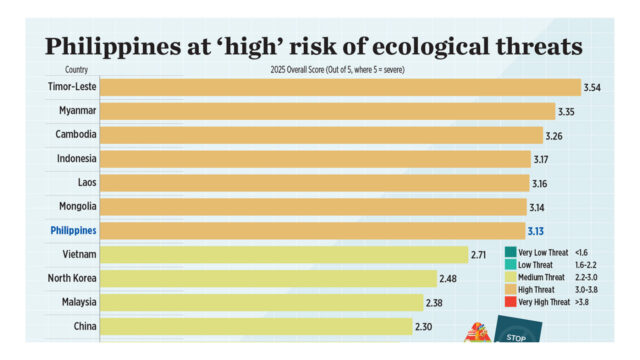
Philippines at ‘high’ risk of ecological threats

The Philippines scored 3.13 out of 5 in the 2025 edition of the Ecological Threat Report (ETR) by think tank Institute for Economics & Peace. This put the country at “high” risk of the impact of natural events, food and water insecurity, and demographic pressure.

Philippines at ‘high’ risk of ecological threats

Balisacan: PHL underlying growth track remains at 6%

ARSENIO M. BALISACAN — PHILSTAR FILE PHOTO

THE growth track for the Philippines remains at 6% over the medium term, the government’s chief economic planner said, noting steady investment, productivity and technology gains, and a healthy labor market.

“Our potential growth remains at least 6% annually,” Secretary Arsenio M. Balisacan, who heads the Department of Economy, Planning, and Development, said in a statement on Thursday.

“Our medium-term targets reflect this capacity. While short-term fluctuations and external headwinds may affect immediate outcomes, the economy’s overall trajectory remains firm,” he added.

Growth is expected to fall short of government targets following the slowdown in public spending in the wake of the infrastructure corruption scandal, as well as a series of typhoons and earthquakes late in the year.

Economic managers have conceded that the economy is unlikely to hit the official 5.5-6.5% target band this year.

However, they said the fallout from the corruption scandal is considered temporary, with a recovery seen in 2026, where 6% growth is deemed within reach.

Mr. Balisacan said the economy remains “strong” despite recent governance challenges and continuing global uncertainties.

“Our sound macroeconomic fundamentals — sustained growth, easing inflation, a healthy labor market, a manageable fiscal deficit and public debt, a broadly stable currency and external position, and a robust banking system — continue to anchor our resilience,” he said.

Mr. Balisacan said that priorities of the economic team, even after a cabinet reshuffle, remain aligned with the Philippine Development Plan 2023‑2028. He said reforms are being undertaken to keep the economy on track.

The government is aiming for 6-7% growth in the 2026-2028 period.

“The government will continue to deploy fiscal, monetary, financial, technological, and social-protection policies, together with key legislative measures, to keep actual growth aligned with this potential,” he said.

“At the same time, we have been laying down the necessary investments to future-proof the economy amid environmental, technological, and geopolitical disruptions,” he said. — Aubrey Rose A. Inosante

EU trade talks unaffected by corruption worries, PHL acted fast — ambassador

PHILIPPINE STAR/MICHAEL VARCAS

By Justine Irish D. Tabile, Reporter

THE European Union (EU) does not expect the infrastructure corruption scandal to affect negotiations with the Philippines for a free trade agreement (FTA), noting that the government seems to be addressing the matter, the delegation of the EU to the Philippines said.

“It is not affecting (negotiations) because we know that the corruption on the flood control-related issues is being tackled,” Massimo Santoro, EU ambassador to the Philippines, said on the sidelines of the Pilipinas Conference on Thursday.

“There is action by the government. There is clear willingness to ensure accountability,” he added. “Of course, it is clear that this is important background for any investor, but it had no specific impact on the current FTA negotiations.”

Mr. Santoro said addressing corruption is embedded in the framework of the FTA but also in the generalized system of preferences.

“It is a general issue of good governance that the two sides share … But it never became a concern (in the negotiations),” he said.

“It was the President himself who identified the issue during his State of the Nation Address. He identified it, and he launched concrete action against it. So we cannot but welcome, of course, any action against corruption,” he added.

The Philippines and the EU are currently negotiating an FTA, with the fourth round taking place last month in Cebu and the next round expected to take place in the first quarter next year in Europe.

“The next round is expected by the beginning of next year. We are now working on a date,” he said, noting that the two sides will continue working between the rounds to prepare.

“In addition to that, we are now also foreseeing that the chief negotiators will also meet before the next formal session … It is important to underline that it’s a continuous negotiation. So there is never a moment where the two sides, I would say, sleep,” he added.

Earlier this week, Trade Secretary Ma. Cristina A. Roque said that the target is to conclude the negotiations as early as next year.

“I have always tried to refrain from mentioning a specific date because I think what is important is to have it done quickly and rapidly and to have a good one in terms of content,” said Mr. Santoro.

“What counts is that it is done well, and it is done fast. I think that if negotiations continue at this good pace and with this kind of cooperation, I really think we can be fast,” he added.

Exporters urged to verify their US tariff-exempt status

PHILIPPINE STAR/EDD GUMBAN

THE Department of Trade and Industry (DTI) said exporters need to consult with the US companies receiving their goods whether their shipments qualify for the latest US tariff exemption on Philippine agricultural goods.

In an advisory on Thursday, the DTI’s Export Marketing Bureau said the US executive order issued on Nov. 14 removes the 19% tariff on Philippine goods like coconut products, banana, pineapple, dried tropical fruit, and coffee.

According to the DTI, the updated tariff rules apply to goods that entered the US beginning 12:01 a.m. (EST) on Nov. 13.

“If duties were already paid on goods that meet the effectivity date and are now exempt under the new executive order, refunds may be processed in accordance with US law and standard US Customs and Border Protection procedures,” it said.

“Exporters are advised to coordinate closely with their US importers or customs brokers to confirm tariff treatment and determine whether recent shipments may qualify for exemption or refund,” it added.

Earlier this week, Trade Secretary Ma. Cristina A. Roque said that about $1 billion worth of Philippine agriculture exports are expected to benefit from the exemption, based on volumes shipped to the US last year.

Following exemptions granted to industrial goods, about 46% of Philippine exports to the US, based on last year’s shipments, are now exempt from the 19% tariff.

The US started imposing a 19% reciprocal tariff on most Philippine goods entering the US market in August. — Justine Irish D. Tabile

BPO workers urge legislators to pass law regulating industry safety, permanent employment, pay levels

PHILSTAR FILE PHOTO

SENATE BILL (SB) NO. 1493, or the proposed BPO Workers’ Welfare and Protection Act, represents the latest effort to ensure that industry employees are protected, a business process outsourcing (BPO) employee association said.

Mylene Cabalona, president of the BPO Industry Employees Network (BIEN), said the industry is beset by limited safeguards, weak labor standards, meager pay, and unsafe work hours.

The Cebu earthquake raised questions about the 1.8 million-worker strong industry’s labor practices, with employees allegedly refused permission to leave their workstations after the quake struck in the evening Cebu time, which coincided with the period during which BPO workers were servicing key Western markets.

“We’ve been pushing this in Congress since 2013. The BPO industry has been largely self-regulating,” Ms. Cabalona said by telephone.

“More lawmakers should sponsor and support this legislation process. BPO workers contribute significantly to the economy and deserve protection and fair pay.”

Filed by Senator Rafael T. Tulfo on Nov. 17, the bill sets an industry minimum wage, automatic regular-employee status after training or probation, enhanced medical and social benefits, and disaster safeguards during typhoons, earthquakes, and fires.

Mr. Tulfo said the bill “aims to uphold and safeguard the rights of many Filipinos, particularly youth seeking immediate employment in BPO firms.”

Entry-level BPO salaries currently range from P20,000 to P35,000, with technical specialists earning P25,000-P40,000.

According to the IT and Business Process Association of the Philippines (IBPAP), the industry generated $38 billion in export revenue in 2024, up from $35.5 billion in 2023, and employed 1.82 million full-time staff, up 7%.

Employment could hit nearly 2 million by 2025, it said.

IBPAP said it is currently reviewing the new Senate bill and consulting stakeholders.

Department of Labor and Employment Secretary Bienvenido E. Laguesma said a technical committee will review the bill.

“Let’s await the process, which will hopefully produce legislation that is mutually beneficial to labor-management relations in the BPO industry,” Mr. Laguesma added.

SB 1493 closely mirrors the House counterpart, House Bill No. 5166, or the Magna Carta for BPO Workers.

Renso Bajala, BIEN secretary-general, noted the risk of delays or dilution of key provisions in committee and in bicameral sessions.

“The biggest challenges will be industry pushback, especially on wages, regularization, and mandatory suspension during disasters,” he told BusinessWorld via Viber.

“Healthy, secure workers make for a more stable and competitive industry. The alignment of Senate and House versions shows that these reforms are timely, achievable, and widely recognized as overdue,” he added. — Erika Mae P. Sinaking