Home Blog Page 6762

Ringgit seen to weather storm from Fed taper

CURRENCY TRADERS are gearing up for an action-packed week as the Federal Reserve moves toward tapering its debt purchases. But the Malaysian ringgit is looking surprisingly calm.

The currency looks set to weather any volatility fueled by a withdrawal of US stimulus as Malaysia’s economy rebounds amid an easing of virus-related curbs. Rising stock inflows and a sizable trade surplus will also provide a buffer.

The ringgit has bounced back from a one-year low as traders bet that a resumption in travel and business activity will haul the economy out of its worst slump since 1998. A policy review on Wednesday will be in focus, with the currency likely to get a boost if Bank Negara Malaysia delivers an upbeat assessment of the growth prospects.

The ringgit has climbed more than 2% in the past three months even as traders ramped up bets for the Fed to tighten policy. It rose 0.2% to 4.1403 per dollar on Friday.

Stock inflows have been a key pillar of support for the currency, with global funds scooping up about $400 million of local equities in October, the biggest monthly purchase since early 2018.

Standard Chartered Plc expects the ringgit to end the year at 4.15 as strong domestic fundamentals counter global risks.

“The improvement in Malaysia’s terms of trade driven by higher energy prices will offset other external headwinds like China’s growth and higher developed-market yield,” said Divya Devesh, head of ASEAN and South Asia FX research at Standard Chartered Bank in Singapore.

The trade surplus has widened to 26.1 billion ringgit ($6.3 billion) in September from the year’s low of 13.75 billion ringgit reached in May. Robust demand for the nation’s electronics and petroleum products has helped to boost the excess.

Malaysia’s economic growth is expected to accelerate to 5.5%-6.5% in 2022 from an estimated 3%-4% this year, Finance Minister Zafrul Abdul Aziz said on Friday. A resumption of activities and increased global demand, coupled with higher commodity prices, will support the expansion, he said.

SUBDUED VOLATILITY
Technicals indicate that the Malaysian currency has room to appreciate. The dollar-ringgit pair fell 1.1% in October, with the 50-day moving average capping its upside, and now looks on track to test support at its September low of 4.13.

A gauge of the pair’s one-week implied volatility is trading at around 6.01 vol versus the year’s high of 7.42, suggesting that traders aren’t bracing for excessive swings in the aftermath of the Fed’s Nov. 3 rate decision.

The ringgit slid over 7% from May through August 2013 after the Fed announced that it was planning to wind down its bond-buying program. — Bloomberg

QCinema presents new Asian Shorts Program

WITH less than a month to go before its 2021 edition, QCinema International Film Festival has announced the movies to be shown under its new Asian Shorts program for its hybrid festival.

Showcasing fresh new voices from Southeast Asia, the Asian Shorts line-up features recent titles that have competed in major festivals abroad. It shines a spotlight on emerging Asian names in the festival circuit, including two Filipino shorts, for their Philippine premieres.

Dear to Me by Monica Vanesa Tedja won a Special Mention award at this year’s Locarno Open Door Shorts. Tackling themes of repression and myth, the film centers on a vacationing young man in a remote Indonesian island who secretly hopes to discover a reincarnated deer as he ponders finding his soulmate.

Sunrise in My Mind is about a young beauty salon employee who gives into her restrained interest with a delivery man who spends his evenings driving through Phnom Penh’s streets by motorbike. Danech San’s second short had its world premiere at Busan and had its European premiere at the 2021 Berlin Critics’ Week.

New Abnormal is a reflection on human life during the COVID-19 pandemic in Thailand and follows different characters from various scenarios who share the same awkward situation. Sorayos Prapapan’s new short is a follow-up to his previous festival favorite, Death of the Sound Man.

Live In Cloud-Cuckoo Land depicts the love story of a woman who works at a wedding dress shop and a local busker. Vietnamese co-directors Vu Minh Nghia and Pham Hoàng Minh Thy show colorful slices of life, including a wedding, a traffic jam, a theft, a miraculous incarnation, and a love story.

New Abnormal and Live In Cloud-Cuckoo Land were selected to compete at the Orizzonti Short Films Competition in the 2021 Venice Film Festival.

Elijah Canlas headlines How to Die Young in Manila where he trails a group of hustlers in the streets of Manila, thinking one of them may be his hook-up for the night. Petersen Vargas’ return to short filmmaking was an official selection in Busan last year.

Winner of a number of awards including the Silver Bear at this year’s Berlinale, Rafael Manuel’s Filipiñana is about Isabel, the new employee in an exclusive golf club who’s looking to subvert the system.

QCinema will be held from Nov. 26 to Dec. 5, with screenings are at Gateway Cineplex 10. Streaming is via KTX.ph.

AllDay shares to benefit from recovery in demand

AllDay Marts, Inc. is anticipated to make a strong market debut as it stands to benefit from the recovery in consumer demand, given the upcoming holidays as well as the national elections, on top of its already well-received initial offer period.

The Villar-led firm conducted its offer period last week, which saw “overwhelming demand” from small investors. The company set its offer price to 60 centavos each, 25% lower than the 80-centavo price ceiling it set.

“The discounted IPO (initial public offering) price could provide potential upside opportunities amid further measures to reopen the economy amid the significant reduction in new COVID-19 (coronavirus disease 2019) cases,” Rizal Commercial Banking Corp. (RCBC) Chief Economist Michael L. Ricafort said in a Viber message on Monday, adding that the progress in the country’s vaccination program is also a factor.

“The price action would also be a function of the country’s recovery story as may be enhanced by the upcoming Christmas season and election spending, both of which could boost consumer spending, which accounts for about 70% of the economy and boost the sales and earnings of retailers as well,” he added.

Mr. Ricafort said retailers could benefit from the resumption of in-person classes, as well as the recovery in the tourism industry.

Pent-up demand from investors not being able to get an allocation from AllDay’s offer period could also affect issue’s price on its listing day.

“Investors who haven’t been allocated enough shares during the offer period may try to buy AllDay shares in the open market instead,” Timson Securities, Inc. Trader Darren Blaine T. Pangan said in a separate Viber message last week.

Mr. Pangan said investors should also monitor if the issue will reflect the benchmark Philippine Stock Exchange index’ downtrend last week.

“We’ll have to observe how traders participate in the stock’s listing day on [Wednesday], given the current market conditions especially after the index dropped over 3% [last] week,” Mr. Pangan said. 

Week on week, the benchmark Philippine Stock Exchange index lost 234.91 points to close at 7,054.70 on Friday, down by 3.22% from its 7,289.61 finish on Oct. 22.

Analysts said investor sentiment was dampened after the government kept Metro Manila under Alert Level 3 instead of easing restrictions to allow for a further reopening of the economy.

AllDay will make its market debut on Nov. 3 under the ticker symbol “ALLDY.” The Villar-led grocery operator offered 6.857 billion shares with an overallotment option of only up to 685.71 million shares for 60 centavos apiece.

However, the offer was said to have received an oversubscription of nearly 1.11 billion common shares, prompting a refund process for some investors who were not given a share allocation.

“The overwhelming demand from the local small investors (LSIs) who participated in [the company’s] initial public offering and subscribed to the company’s common shares resulted in the total demand for the offer shares exceeding the maximum allocation of 685,715,000 common shares with an oversubscription of 1,107,444,000 common shares (or 1.62x),” PNB Capital and Investment Corp. said in a letter to the exchange on Oct. 28.

“Due to the oversubscription, a total of 1,781 investors will be receiving funds for the excess amount subscribed and paid for,” it added.

AllDay conducted the P4.53-billion IPO for debt repayment, capital expenditure, and store network expansion. According to its final prospectus dated Oct. 12, the company aims to retire debt amounting to P3.149 billion, which was said to be incurred to fund the capital expenditures and working capital of AllDay’s existing 33 stores.

“We believe that pursuing this strategy will increase the overall shareholder value of the company as this will decrease our financing cost by as much as P206.39 million per annum,” the company said.

“Any balance of the net proceeds will allow us to partly fund our store network expansion,” it added.

The company aims to expand to 45 stores from its current 33 stores by next year. By the end of 2026, AllDay aims to have a store network with 100 branches.

AllDay’s 33 stores are located across 25 cities and municipalities in the country. The company has an e-commerce platform to reach more consumers, which is also backed by its “dark store concept” servicing as “last-mile fulfillment centers for www.allday.com.ph.” — K.C.G. Valmonte

No Christmas crush? Mall crowds unlikely to hit pre-pandemic level in Q4

PHILIPPINE STAR/ MICHAEL VARCAS

SHOPPING MALLS in the Philippines are unlikely to see foot traffic return to pre-pandemic levels this year, even with the holiday rush and the easing of lockdown restrictions.

“The fourth quarter is perennially a strong period for retail as spending is usually fueled by employees’ holiday bonuses and increased remittances from Filipinos working abroad. We do not see consumer traffic reverting to pre-pandemic level in the next six to 12 months as Filipinos’ propensity to spend is still lukewarm and the quarantine situation in Metro Manila remains volatile,” Colliers Philippines said in a third quarter retail report.

Mobility restrictions have eased in Metro Manila although it remains under Alert Level 3 until Nov. 14, which means malls and restaurants have to operate at limited capacities.

Colliers Philippines Associate Director Joey Roi H. Bondoc expressed optimism the relaxation of lockdowns will spur more Filipinos to go to the malls and spend.

“Revenge shopping and dining should anchor mall operations’ rebound,” he added.

Revenge shopping refers to a trend first seen in countries that have emerged from lockdowns, wherein consumers make up for lost time by spending and going out more.

“The improving inoculation program should improve business and consumer confidence and this should play a crucial role in raising consumer confidence, mall traffic, and retail rents,” Mr. Bondoc said.

According to the Johns Hopkins University Coronavirus Resource Center, the Philippines has fully vaccinated 26.8 million out of its 110 million population as vaccine supply constraints eased.

The number of coronavirus disease 2019 (COVID-19) cases have also continued to decline.

NEW SPACES, HIGH VACANCY
Developers appear to be anticipating a rebound in retail demand starting next year.

Colliers said around 137,000 square meters (sq.m.) of new leasable space is expected to be delivered within the fourth quarter, with the opening of the SM City Grand Central in Caloocan and Ayala Triangle Retail in Makati.

Another 300,900 sq.m. will be completed through 2024, including the Opus Mall, Mitsukoshi Mall, One Ayala Retail, SM Mall of Asia Expansion, Greenhills Center Expansion and the 50,000 sq.m.- expansion of Trinoma Mall.

However, retail vacancy currently remains in double-digits. As of the third quarter, retail vacancy stood at 14.8% in the third quarter, and is expected to continue to rise to 17% next year.

If realized, Colliers said the 17% vacancy projection would be the highest since the 17.3% seen in the fourth quarter of 2002.

“Among the factors that will likely to influence physical mall space absorption beyond 2021 are the growing propensity of Filipinos to shop online as well as rising inflation concerns. The volatile lockdown situation in Metro Manila is also likely to impact retailers’ decision to reopen as well as consumers’ willingness to go out and spend,” Colliers said.

Retail rents have fallen at a slower pace to 5% this year, from 10% in 2020. Colliers said it expects rents to begin to recover next year.

The rising vacancies and drop in rents in malls “should provide an opportunity for retailers to lock in space and haggle for lower lease rates in prime locations,” it added.

At the same time, mall operators should be more cautious of new supply over the next two years, Colliers said.

“Developers should factor in the projected recovery in consumer spending and easing of quarantine restrictions, as well as economic factors such as inflation and OFW remittances… Developers should also assess the viable sizes of new malls,” it said.

Developers also should reconsider their plans and look into building neighborhood malls with less than 50,000 sq.m., Colliers said. — Cathy Rose A. Garcia

Lenders drive higher consumer spending in India with easy credit

SOME OF India’s top lenders and shadow finance companies are helping fuel demand among consumers wanting to splurge on everything from clothes to two-wheelers and homes, offering hopes of a consumption-driven recovery in Asia’s third-largest economy.

Businesses are expecting sales during Diwali — the Hindu festival of lights — will pick up to levels seen before the pandemic struck early last year. That is in part because financiers, sitting on a huge pile of excess cash, are eager to lend with outstanding consumer durable loans already at its highest in more than three years. Borrowers want to take advantage of record low interest rates, an improving labor market as lockdowns ease and a better economic outlook as vaccinations gather pace.

HDFC Bank’s retail loans surged 12.9% in the three months ended September from a year earlier, the lender’s first double-digit growth in such loans since the onslaught of the pandemic. The country’s third-largest private lender, Axis Bank’s retail loans rose by 16%, the fastest pace in five quarters, and India’s top consumer lender Bajaj Finance’s assets increased by a record.

“We expect economic activity to recover further, driven by festive season, pick up in vaccination and the likely increase in government spending,” Srinivasan Vaidyanathan, chief financial officer at HDFC Bank said at a recent earnings call. Spending by the government on better health services, roads and infrastructure is crucial as it lifts growth and incomes, economists say.

Vaidyanathan added that loans to the retail sector were going up. For the country’s largest private lender that’s a shift in strategy after it had pulled back on retail lending last year.

Overall, personal loans offered by banks grew 12.1% in September as compared with 8.4% a year earlier, driven by consumer durables, housing, vehicle loans and borrowings against gold jewelry, according to the Reserve Bank of India.

And it’s not only banks, but also some shadow lenders — a sector hobbled by a damaging default in 2018 — that are keen to jump in by offering loans for as little as 10,000 rupees ($134).

Mumbai-based Mehul Kumar, a 24-year old Youtuber decided to buy a sports bike recently availing a loan of 1.3 million rupees. “Interest rates are low, banks are keen to lend during Diwali and the winter season is great for biking. I got my loan approved in just 24 hours,” he said over the phone.

‘FEAST’ TIMES
Indian lenders have used the pandemic to shore up their capital base, which is now allowing them to increase lending, especially to the household sector. Private-sector banks which have been at the forefront of stepping up consumer loans, raised 536 billion rupees of equity money in the last financial year while their state-run peers raised 120 billion rupees in capital.

“Growth is looking better at this time across a wider set of segments, recoveries are in control,” said Dipak Gupta, joint managing director at Kotak Mahindra Bank Ltd. “All of that gives a comforting feeling to take the foot off the brake and start moving it to the accelerator.”

According to Rajeev Jain, managing director at Bajaj Finance Ltd., there has been a strong revival in growth in recent months, compared to when the second wave was at its peak — a period he described as a “famine.”

“We live in some famine and feast times,” Jain added. In the absence of another wave “we are quite confident about the second half of the year on growth.” — Bloomberg

Locking guests inside Disneyland shows China’s extreme tactics vs COVID-19

REUTERS
Visitors are seen at Shanghai Disney Resort in China May 10, 2020. — REUTERS/ALY SONG/FILE PHOTO

WHILE THOUSANDS of visitors to Shanghai Disneyland on Sunday were queuing for roller coasters and watching fireworks above the fairytale castle, staff quietly sealed the amusement park. People in Hazmat suits streamed in through the gates, preparing to test everyone for coronavirus disease 2019 (COVID-19) before they could leave for the day.

Nearly 34,000 people at Disneyland underwent testing, which ended close to midnight, long after the festivities at the park are usually finished. Ferried home on 220 special buses, all were found Monday to be negative but are still required to isolate at home for two days, and be re-tested for the coronavirus in two weeks.

The shutdown of one of Walt Disney Co.’s most lucrative parks came after a positive case in a woman who traveled to Shanghai from nearby Hangzhou over the weekend. While officials are yet to confirm whether she visited Disneyland, her infection sparked an aggressive contract tracing effort across China, which eventually ensnared the park-goers, their families and Disneyland staff.

To people in parts of the world where COVID is already endemic, the reaction may seem extreme, but it’s emblematic of China’s increasingly hardcore approach to keeping the pathogen out at any cost.

Since containing its initial outbreak in Wuhan last April, China has sought to not just quell the virus but eliminate it. To do that it’s deployed a raft of measures from border curbs and compulsory quarantines, to localized lockdowns and mass testing, aimed at hunting out cases before an outbreak takes root — and quashing them. It was a strategy used successfully in other parts of the Asia-Pacific region, from Singapore and Taiwan to Australia and New Zealand, before the Delta variant made it almost impossible to execute.

China and its territory Hong Kong are now the last real COVID Zero proponents left as other places look to open their borders and live with the virus. But instead of slowly easing toward reopening, too, China is doubling down, even as waves of the more contagious Delta come more frequently and with the current resurgence — totaling some 480 cases — spreading to more than half of the country’s provinces.

As the threat has become more persistent, so has the intensity of China’s curbs, which are becoming as disruptive to people’s lives as they are effective in controlling the virus’s spread.

While snap lockdowns and ad-hoc internal travel restrictions are increasingly being deployed — weighing on spending and consumer demand — some officials are going even further in their efforts to keep out COVID.

A small county in eastern China’s Jiangxi province turned all its traffic lights to red after one case was detected, breaking the province’s 610-day COVID-free track record. The move, which local authorities said was an emergency measure aimed at reducing mobility, was decried on Chinese social media, where dissent is typically censored. It was soon repealed and the lights resumed, local media reported.

In Beijing, the escalating restrictions are having farcical consequences. Some residents who leave the capital have reported not being able to come back because they are recorded as recently being in the city, parts of which are currently classed as high risk because of a small outbreak. Stranded at airports and train stations around China, many have taken to social media to ask for help and to criticize the rules.

Perhaps nowhere is the full force — and increasing absurdity — of China’s devotion to COVID Zero evident than in the small southeastern city of Ruili, on the remote border with Myanmar. People there have been locked down four times in the past seven months alone. The 268,000 residents are largely barred from leaving as the virus keeps creeping over from Myanmar, where it is rampant.

The city’s former deputy mayor made a plea last week for more support from Beijing, saying it can’t control the virus alone and the constant restrictions were killing small businesses. Local media over the weekend reported about a baby who had been tested as many as 74 times for COVID since September last year, with mass testing of entire cities and populations a key part of China’s toolkit.

With a key import conference where President Xi Jinping is set to speak starting this weekend in Shanghai, and the Winter Olympics taking place near Beijing in less than 100 days, China is unlikely to change tactics any time soon — even as the rest of the world opens up. The approach also extends to Xi, who hasn’t left the country since the pandemic began, opting out of attending the Group of 20 nations meeting in person this past weekend in Rome, and climate talks now starting in Scotland.

Zeng Guang, the former chief scientist of epidemiology at China’s Center for Disease Control and Prevention, told local media in August that the country’s devotion to the elimination strategy was partially to do with inadequate vaccination and the need for “updated” COVID shots. So far, the country has fully vaccinated more than 75% of its 1.4 billion people with homegrown inoculations, and is doling out boosters to adults.

The shots, most from Sinovac Biotech Ltd. and the state-backed Sinopharm, use more traditional inactivated vaccine technology, which has proven less effective at stopping transmission and infection than the mRNA inoculations in use in the US and other parts of the West. Chinese company Shanghai Fosun Pharmaceutical Group Co. has the right to sell the Pfizer, Inc.-BioNTech SE vaccine on the mainland, but the US-funded shot is yet to get the regulatory green light.

“As the international situation changes, China will definitely change,” Zeng said. “When the dividend on COVID Zero no longer exists, we won’t do it.” — Bloomberg

SEC warns public vs seven entities’ unlicensed investment schemes

THE Securities and Exchange Commission (SEC) has issued advisories against seven entities to warn the public about their unlicensed investment programs.

Ascend Intelligence Company, PHMALL.APP, and “A” Plus Investment, LLC exhibit Ponzi-like investment schemes, the commission said. Ponzi schemes are programs wherein the “monies from new investors are used in paying ‘fake profits’ to prior investors and is designed mainly to favor its top recruiters and prior risk-takers.”

The three entities are not registered with the SEC as a corporation or as a partnership and also lack the required license to solicit investments from the public.

“The offering and selling of securities in the form of investment contracts using the ‘Ponzi scheme,’ which is fraudulent and unsustainable, is not a registrable security,” the SEC said.

“The commission will not issue a license to sell securities to the public to persons or entities that are engaged in this business or scheme,” it added.

Ascend Intelligence, which also goes by Ascend Intelligent, AI Company, and ascend-intelligence.com, offers investment packages hinged on crypto-currency trading via its “AI Robot,” promising a 100% profit in 40 days, a direct referral bonus of as much as 20%, and a one percent indirect referral bonus.

Meanwhile, PHMall or PHMALL.APP offers six “VIP plans” where investors can allegedly earn from P320 up to P240,000 monthly, depending on the plan they get. Investors may also “earn” 10% from direct order rebates and five percent from direct order rebates, as well as “invitation rewards” from P100 to as much as P200,000, among its other programs.

“A” Plus Investment or A+, A-Plus, A-Plus Mall also offers three “VIP Level” packages, which range from P800 to P35,000. Investors may also earn via referral bonuses or through “invitation rewards.”

Meanwhile, the SEC also warned against a new investment program led by a certain Danea Ruby Cardones Solmayor.

The commission said Ms. Solmayor “lured [her] victims with great [returns] of investment evidenced by written investment contracts.” She owns a Department of Trade and Industry-registered business called Danea Clothing Wholesaling. However, Ms. Solmayor is not registered with the SEC, nor does she have the license to solicit investments from the public.

The regulator also flagged Infinite Profit Asia Ltd. for its investment program, which promises a daily income of as much as eight percent. It is allegedly involved in cryptocurrency trading. It is not registered with the SEC and it also lacks the license needed to collect investments from the public.

On the other hand, unregistered Digicoin Markets International PH offers investment plans ranging from P1,000 to up to P1 million. It promises a daily interest of five, six, or 7% for 30 days, on top of possible earning opportunities via referrals. It is also not licensed to conduct investment solicitations, the SEC said.

“Further, Digicoin Markets or Digicoin Markets International PH is also not a registered Virtual Asset Service Provider (VASP) with the Bangko Sentral ng Pilipinas and does not have a corresponding Certificate of Authority as a Money Service Business as required under Circular No. 1108, Series of 2021, or the Guidelines for Virtual Asset Providers,” the SEC said.

The commission is also warning the public against MCM Royalty Legacy International, Inc.’s investment programs. While it is registered with the SEC, it doesn’t have a license to solicit investments.

MCM Royalty Legacy is said to be led by Mary Chiles Talamayan Mendoza and James Catimbag Sabenecio. Ms. Mendoza has been linked to other SEC-flagged entities such as Yeheey iTraffic System, Inc., Pays Up Online Marketing Business, and Pays-UpGen Marketing Business Unlimited.

The SEC said those involved in the unlicensed investment activities of entities may be prosecuted and held criminally liable and may also be subjected to a monetary fine of up to P5 million or a penalty of up to 21 years of imprisonment under the Securities Regulation Code.

As of October, the commission has issued 100 advisories against investment schemes offered by unregistered firms or entities without a secondary license from the SEC.

Last year, the SEC published over 120 warnings, more than double the 50 advisories issued in 2019. — Keren Concepcion G. Valmonte

Entertainment News (11/02/21)

Don’t Breathe 2

Free Spanish films shown on Vimeo

THIS month, Instituto Cervantes, in collaboration with the Festival de Cine Europeo de Sevilla and the Embassy of Spain in the Philippines, will present the film cycle “New Cinephilias Online,” featuring four recent movies which, due to their language and their themes, innovate, take risks and play with contemporary structures and narratives. The films will be shown through the Instituto Cervantes channel on the Vimeo platform (https://vimeo.com/channels/institutocervantes). They will be freely accessible for 48 hours from their start date and time. The film series will kick off on Nov. 6 and 7 with the thriller Arima (Jaione Camborda, 2017). Four women and a girl who, upon the arrival of two strangers, see how their environment becomes unbalanced and how fear and desire emerge, discovering a tangle of echoes from the past, mysteries and mirror games. The movie will be available on demand through the link https://vimeo.com/607360275, for 48 hours, until Nov. 9 at 3 a.m. The series will continue on Nov. 13 and 14 with the comedy Violeta no coge el ascensor (Mamen Díaz, 2019); Nov. 20 and 21 with the documentary This Film is About Me (Alexis Delgado, 2019); and on Nov. 27 and 27 with the comedy La reina de los lagartos (Burnin’ Percebes, 2019). The films will be in Spanish with English subtitles. Admission is free. For the schedule, film details and further information, log on to Instituto Cervantes’ website (http://manila.cervantes.es), or Instituto Cervantes Facebook page, www.facebook.com/InstitutoCervantesManila.

Don’t Breathe 2 opens on Nov. 17

FROM the minds behind blockbuster thrillers Don’t Breathe and Evil Dead comes what Indiewire describes as “a clever, twisted continuation that breathes new life into the horror sequel,” Columbia Pictures’ Don’t Breathe 2. The sequel opens exclusively in Philippine cinemas on Nov. 17. In 2016’s Don’t Breathe, Norman Nordstrom (Stephen Lang) was underestimated by everyone because of his blindness, but ultimately revealed a will to survive and get what he wants, and a monstrous, evil side of his personality. Now, in Don’t Breathe 2, eight years have passed, and Nordstrom lives with 11-year-old Phoenix. When intruders once again come to his home, Norman will reveal for a second time what’s hidden inside him, in new and unexpected ways. Starring Stephen Lang, Brendan Sexton III, and Madelyn Grace, Don’t Breathe 2 is directed by Rodo Sayagues.

Malignant to open on Nov. 24

WARNER Bros. Philippines has announced that James Wan’s new original horror film Malignant will open in Philippine cinemas starting Nov. 24. Malignant is the latest creation from Conjuring universe architect James Wan, and marks his return to his roots with this new original horror thriller. In the film, Madison is paralyzed by shocking visions of grisly murders, and her torment worsens as she discovers that these waking dreams are in fact terrifying realities. Malignant stars Annabelle Wallis, Maddie Hasson, George Young, Michole Briana White, Jacqueline McKenzie, Jake Abel, and Ingrid Bisu).

Kids’ shows at the Kapamilya Channel

CHILDREN nationwide can learn from animated and Kapamilya kiddie shows as YeY returns to TV on National Children’s Month starting Nov. 6 on Jeepney TV and the Kapamilya Channel. YeY shows will air all week on Jeepney TV’s YeY Weekend and YeY Weekdays blocks. Airing every Saturday is Kongsuni and Friends at 8 a.m., followed by Team YeY at 9 a.m., and kiddie gag show Goin’ Bulilit at 9:30 p.m. Sunday mornings will feature child-friendly blockbusters on KidSine Presents from 8-10 a.m. Kids can watch their favorite animated shows on Jeepney TV from Monday to Friday on its YeY Weekdays block, featuring back-to-back episodes of science-fantasy cartoon series Johnny Test at 8 a.m., followed by the adventures of Max Steel at 9 a.m. Meanwhile, the Kapamilya Channel will show YeY Weekend every Saturday from 6-7:40 a.m., with back-to-back episodes of Max Steel (6 a.m.), and Kapamilya kiddie shows Team YeY (6:45 a.m.), and Goin’ Bulilit (7:10 a.m.). On free TV, kids can also watch YeY shows Peppa Pig and Rob the Robot every Saturday (8 to 9 a.m.), Team YeY and Goin’ Bulilit every Saturday and Sunday (9-10 a.m.) via A2Z’s Kidz Weekend, beginning Nov. 6. For more updates on shows, events, and promos, parents can follow YeY on Facebook (fb.com/yeychannel), Instagram (@yeychannel), TikTok (@yey.channel), and YouTube channel (youtube.com/yeychannel).

TapGO streams 25 James Bond films

THE WORLD’S longest-running film franchise, James Bond, can be viewed in the “James Bond Movie Marathon” on streaming app TapGO. With the 25th James Bond film, No Time to Die, yet to hit Philippine cinemas, viewers can watch previous releases of the franchise, from the 1962 film Dr. No to 2015’s Spectre, on demand. TapGO is the first subscription streaming service in the Philippines that provides access to live premium sports content as well as entertainment programs. Programs such as the UFC, Formula 1, the Tonight Show with Jimmy Fallon, and Chicago PD can be viewed on TapGO. The James Bond film library on TapGO can be viewed for P199 monthly through the TAPGO GOLD subscription package.  To subscribe, visit www.tapgo.tv or download the TapGO app on IOS and Android.

Ed Sheeran releases new album

ED SHEERAN has just released his new album “=” (Equals), written and produced by Mr. Sheeran, Johnny McDaid, and Fred Gibson. The fourth installment in Mr. Sheeran’s symbol album series, the new album finds Mr. Sheeran taking stock of his life and the people in it as he explores the varying degrees of love, loss, resilience, and fatherhood, while also processing his reality and career. Ed Sheeran will embark on the first leg of his + – = ÷ x Tour (pronounced “The Mathematics Tour”) in April 2022. He will perform across the UK, Ireland, Scandinavia, and Central Europe. Shows in other territories will be announced in due course.

Hannah Pangilinan releases EP

SINGER-SONGWRITER Hannah Pangilinan continues her musical journey this year with the release of her new EP, Phases. Embracing a broader explorative path with her musicality, Ms. Pangilinan presents the song “Hinto,” which asks “When was the last time you let yourself rest?,” and the English track “Nothing,” which is characterized by colorful melodies and easy-listening lyrics. The five-track EP includes her previously released singles “Limits,” “’Pag Nandiyan,” and “All the Way,” her collaboration with Rico Blanco. Phases is now available on Spotify, Apple Music, YouTube Music, Amazon Music, and Deezer.

Cheats releases music video of single

CHEATS released the music video for its melancholic new single, “Hakbang,” the first single off of their upcoming third studio album. Directed by filmmaker Quark Henares, the black and white video stars Piolo Pascual as someone dealing with a nervous breakdown in his apartment, while the band members of Cheats are in the background, trying to cope with the challenging times by acting relaxed and normal. The music video ends with the actor joining the Cheats members in a dance sequence choreographed by PJ Rebullida. The music video of “Hakbang” can be seen at www.youtube.com/watch?v=3X4i3BpfRWY.


Stocks to move sideways ahead of data, earnings

BW FILE PHOTO

STOCKS could move sideways this week ahead of the release of economic data and third quarter financial reports of more companies.

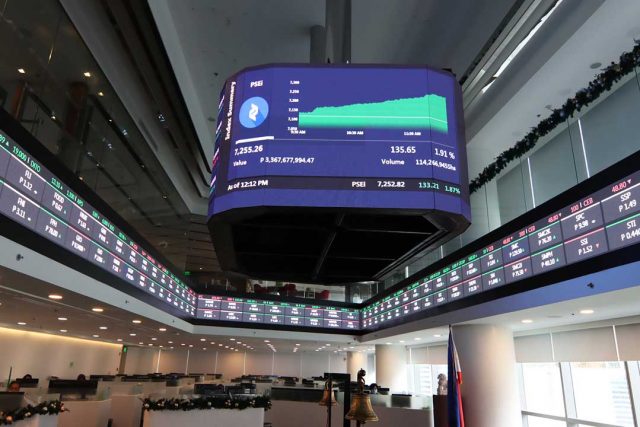
The 30-member Philippine Stock Exchange index dropped by 103.03 points or 1.43% to close at 7,054.70 on Friday, while the broader all shares index lost 34.06 points or 0.77% to end at 4,386.79.

For this week, “investors will continue to digest more earnings… and other macroeconomic data to help with their projections for 2022,” Regina Capital Development Corp. Sales Head Luis A. Limlingan said in a Viber message.

More companies are expected to release their financial reports this week. Economic reports set to come out in the coming days include the Markit Purchasing Managers’ Index, as well as data on employment, inflation and trade.

US data to be released this week may also affect trading at the stock market, Rizal Commercial Banking Corp. Chief Economist Michael L. Ricafort said.

“Most of the upcoming US economic data expected could still show some recovery from previous levels, especially the latest (Federal Reserve) monetary policy-setting meeting on Nov. 3 and the latest US employment/jobs data on Nov. 5,” Mr. Ricafort added.

Markets are also anticipating the government to further reopen the economy in November and December as the number of coronavirus cases decline, in time for the holidays, which is when spending is expected to go up, Mr. Ricafort said.

Daily coronavirus infections in Manila, the capital and nearby cities would probably fall to 500 by mid-November, according to researchers from the University of the Philippines.

Metro Manila is now under Alert Level 3, which allows 50% capacity for outdoor services and 30% capacity for indoor activities.

The Department of Health reported 3,410 coronavirus cases on Sunday, bringing the total to 2.8 million.

The death toll rose to 43,172 after 128 more patients died, while recoveries increased by 5,825 to 2.7 million, it said in a bulletin.

There were 45,233 active cases, 73.6% of which were mild, 4.9% did not show symptoms, 6.8% were severe, 11.83% were moderate, and 2.9% were critical.

Presidential adviser for entrepreneurship Jose Maria “Joey” A. Concepcion III has been urging the government to place the region under Alert Level 2 to boost business recovery.

As of Oct. 31, over 59 million vaccines against the coronavirus have been administered nationwide, according to Presidential Adviser Carlito G. Galvez, Jr. Of the 59 million, 27.29 million are fully vaccinated, while 31.9 million have received their first dose.

Meanwhile, investors will also monitor Villar-owned AllDay Marts’ initial public offering, Timson Securities, Inc. Trader Darren Blaine T. Pangan said.

Mr. Pangan said “6,940 seems to be the next support area to watch, while 7,320 may be considered the closest resistance level for the index” this week. — B.A.D. Añago

Philippines gets five-star rating in remote learning readiness

Philippines gets five-star rating in remote learning readiness

Legislator calls for social services to take priority over debt service 

REUTERS

A LEGISLATOR called for the passage of a bill proposing to repeal a Presidential Decree that automatically allocates funds to service the national debt, saying that the government must prioritize spending on social services.

Bayan Muna Rep. Ferdinand R. Gaite called on Malacañang and Congress to back House Bill 4087, or the Repeal the Automatic Appropriation for Debt Service Bill, which is pending at the committee level.

“The automatic appropriation for debt service at the expense of basic services is unjust. It preempts the people’s prerogative by giving absolute and unquestioned priority to debt servicing and placing so much of the national budget outside normal budget processes. It has caused economic policy to systematically favor narrow private creditor and corporate interests over the needs of the people,” he said in a statement.

Mr. Gaite said the passage of the bill would align government priorities with the constitutional obligation to provide adequate social services.

The bill would amend Presidential Decree (PD) 1177, issued during the Marcos years when the President could govern by decree. PD 1177 effectively puts the government’s creditors first in line for payment via automatic appropriations, placing the debt service bill beyond the budgetary process and Congressional oversight.

The Bureau of the Treasury estimates outstanding public debt at the end of September at P11.9 trillion, up 27.2% year on year and up 2.41% from a month earlier.

The bureau attributed the increase in the national debt to the peso’s depreciation and the net issuance of both domestic and external debt.

Some 70.4% of the debt was borrowed from domestic sources.

Some P541.3 billion is allotted for debt service in the 2022 National Expenditure Program. — Russell Louis C. Ku

Conservation task force orders gov’t agencies to upgrade cooling systems

PHILSTAR

THE Inter-Agency Energy Efficiency and Conservation Committee (IAEECC) said it will require government agencies to install upgraded cooling systems that are in compliance with the prevailing MEPP standard.

“All government entities shall ensure that only energy-efficient inverter type air-conditioning units that are compliant with the Minimum Energy Performance for Products (MEPP) shall be installed or used in their buildings, facilities and air-conditioning retrofit projects,” the committee said in a recent resolution posted on the Department of Energy’s (DoE) website.

MEPP-compliant cooling systems must have a minimum cooling seasonal performance factor (CSPF) of 3.08 for those that consume less than 3.3 kilowatts (kW); and a CSPF of 2.8 for those consuming 3.3 kW to 9.9 kW.

The DoE has said that inverter-type cooling units use up 30% less power compared to conventional air-conditioning units.

The resolution put the trade and science departments in charge of issuing the guidelines on certifying energy-efficient inverter type air-conditioning units, and undertaking research on better cooling technologies, respectively.

“All government entities shall observe… waste management collection, recycling and disposal under Republic Act No. 11285 (Energy Efficiency and Conservation Act) to prevent any negative impacts on the environment brought about by the replacement of non-energy efficient air-conditioning units,” it added.

The IAEECC is chaired by Energy Secretary Alfonso G. Cusi. Its eight members include representatives from the Departments of Finance, Trade and Industry and Science and Technology. — Angelica Y. Yang