Home Blog Page 6702

Credit growth picks up as production loans rise

BANK LENDING rose faster in October, fueled by an increase in production credit on the back of the economy’s gradual reopening and ample liquidity.

Outstanding loans issued by big banks rose by 3.5% year on year to P9.268 trillion in November from P8.956 trillion, based on preliminary data released by the Bangko Sentral ng Pilipinas (BSP) on Monday evening.

This is faster than the 2.7% year-on-year expansion seen in September and marked the third straight month that bank lending grew.

The October growth pace is also the fastest since the 4.7% posted in August 2020.

Inclusive of reverse repurchase agreements, bank lending rose by 3.6%. Meanwhile, outstanding loans by big banks rose by 0.6% month on month.

“The continued recovery in outstanding loans of universal/commercial banks reflects the expansion in business activity amid easing quarantine restrictions, declining COVID-19 cases, and increasing vaccinations,” BSP Governor Benjamin E. Diokno said in a statement.

“In conjunction with the National Government’s fiscal and health interventions, the BSP will keep a patient hand in providing policy support in order to enable a sustainable recovery in domestic demand,” Mr. Diokno said.

Loans for production activities grew 4.9% in October, quicker than the 4.4% seen in September.

Growth was seen in borrowings for real estate activities (7.6%), information and communication (27.7%), financial and insurance activities (11.5%), and manufacturing (5%).

On the other hand, lending to the agriculture, forestry and fishing industries dropped by 6.8%.

Meanwhile, consumer loans dropped by 7.2% in October, easing slightly from the 7.8% contraction seen in September. Declines were seen for motor vehicle loans (16.1%) and salary-based credit (7.2%), while credit card loans expanded by 0.9%.

“Bank lending sustained its expansion in October as the lagged impact from BSP’s rate cuts in 2020 continued to help support bank lending activity,” ING Bank N.V. Manila Senior Economist Nicholas Antonio T. Mapa said in an e-mail.

The central bank last year slashed rates by a total of 200 basis points to support the economy amid the pandemic crisis. Bank lending contracted from December to July but has expanded since August.

Mr. Mapa said the growth in production loans could boost capital formation.

“Loans to consumers remain downbeat, reflecting the still nascent recovery as households are constrained to allocate limited budgets to daily expenses while investments are postponed for the meantime as they rebuild savings,” he said.

M3 GROWTH SLOWS
Meanwhile, liquidity growth eased to 8.2% in October from 8.3% the previous month, based on preliminary BSP data.

Month on month, M3 — the broadest measure of cash in an economy — increased by 0.7%.

Domestic claims increased by 7.5% in October, slower than the 7.7% growth seen in September.

Meanwhile, net claims on the central government rose by 21.5% in October, slower than the 24.4% climb logged the previous month.

Growth in claims on the private sector likewise eased to 2.6% from 3.1% a month earlier.

Net foreign assets in peso terms grew by 8.8% in October from 11.3% in September.

Rizal Commercial Banking Corp. Chief Economist Michael L. Ricafort said in a note that the slower expansion in M3 in October may have been due to base effects following the liquidity released last year amid the crisis.

Mr. Diokno earlier said the BSP’s easing measures released some P2.23 trillion in cash into the financial system, which is equivalent to 12.5% of the country’s 2020 gross domestic product.

“Looking ahead, the BSP will ensure appropriate liquidity conditions in order to preserve ongoing policy support to domestic economic activity, consistent with its price and financial stability objectives,” Mr. Diokno said in a statement. — L.W.T. Noble


Ayala unit aims for dominance in local real estate logistics

AYALALAND Logistics Holdings Corp. (ALLHC) is aiming to be a “dominant player” in the real estate logistics sector, taking note that the sector has become a “favorite” among institutional investors globally.

In a webinar hosted by BPI Trade on Monday, executives of ALLHC said the real estate logistics sector has “strong” growth opportunities.

“In the Philippines, real estate logistics is a fragmented market, it’s been that way, and we think it’s actually exciting for ALLHC because it’s an opportunity for us to consolidate and become the dominant player in real estate logistics as a sector,” ALLHC Chairman Jose Emmanuel H. Jalandoni said.

“If you look at real estate logistics globally, this is actually a favorite sector. It’s attracting a lot of institutional investors because of its high-growth potential, because of strong secular trends on e-commerce, because of data centers,” he added. 

The company said it is capitalizing on “secular drivers.” It is “trying to execute locally” what is happening abroad.

“If you look at other countries, developed countries, real estate logistics is actually very much consolidated,” Mr. Jalandoni said. “Large real estate logistics companies are actually operating in countries like Japan, the US, Australia… these are big companies backed up by institutional investors and the leading players in their respective regions.”

ALLHC is targeting to expand its presence to 10 key areas across the country. It is currently present in Manila, Laguna, Cavite, Pampanga, and Laguindingan in Northern Mindanao.

The company said it also aims to grow its warehouse gross leasable area (GLA) to 500,000 square meters (sq.m.) by 2025 from its current 224,000 sq.m.

Its core business segments include industrial and logistics hubs, warehousing, cold storage, and data centers.

“For the industrial parks, we are the only industry player that presently expands geographically,” ALLHC President and Chief Executive Officer Maria Rowena M. Tomeldan said.

“For the warehouses and for real estate logistics, there are so many small players, but I guess it is our group that is able to consolidate and look at all aspects from dry storage, to cold storage, and now we also have data centers, which is the industrial real estate space or the real estate logistics space globally,” she said.

ALLHC aims to further grow its cold storage business. It also plans to further capitalize on the continuous growth of the e-commerce market, as well as the rising demand for data centers.

The company is looking at offering fulfillment hubs, first through its Tutuban Center.

ALLHC and Ayala Corp.’s newest firm, AC Logistics Holdings Corp., is said to “complement” each other.

“[AC Logistics is] really focused on the supply-chain solution, they are really focused on the management of warehouses and that includes all the other aspects related to logistics, while we are focused on real estate logistics,” Ms. Tomeldan said. — Keren Concepcion G. Valmonte

As more people eat better, Philips predicts double-digit growth in air fryers in SEA

Image via Marco Verch/CC BY 2.0 

WITH THE growing adoption of healthy lifestyles in the Philippines and the rest of Southeast Asia, Philips foresees double-digit growth in air fryer sales, according to Ipek Akinci, Philips Domestic Appliances’ country manager for Singapore, Malaysia, Philippines, and Emerging Markets.   

“With more people staying home and discovering their inner home cook, we are seeing consumers wanting to cook meals using little to no oil, all signs point to the air fryer becoming a mainstay on top of kitchen counters across the world,” Ms. Akinci said. 

An air fryer — a countertop device that circulates heated air with a fan to fry, grill, or bake food — reduces calorie intake since it uses less fat.  

The kitchen appliance has become so common that Merriam-Webster added the term “air fryer” to its dictionary this October, 11 years after the first air fryer was introduced at a German consumer electronics fair in 2010 by Royal Philips.  

“Air fryers can help individuals eat healthy, given that they use little to no oil [with] this equipment,” said Christian Angelo Cruz, a registered nutritionist-dietitian and founder of Vegan Strong Philippines, to BusinessWorld. “Regular frying makes the batter absorb more oil, resulting in an increased consumption of oil and fats, which may lead to cardiovascular-related problems.”  

Any type of food that can be fried can work with air fryers — from potatoes to chickpeas to tofu.  

“Air fryers help decrease the caloric content of food, as compared to regular frying, by 70–80%,” said Mr. Cruz. “There are a number of harmful chemicals that regular oil frying produces that an air fryer can help prevent. One example is the chemical acrylamide, which is produced when you fry starchy food.”  

Acrylamide, known to cause cancer in animals, is used to make the substances necessary for the production of paper, dyes, and plastics. Air fryers reduce the amount of acrylamide in frying potatoes by up to 90%, according to a 2015 study published in the Journal of Food Science

Like any kitchen device, air fryers are only as healthy as the food that is put inside it. According to Cleveland Clinic, air fryers do not remove the saturated fat from bacon, hence opting for healthy fare like lean proteins is still ideal.  

Healthier Product Reformulation in the Philippines, a report from the Food Industry Asia released in November, found that 99% of Filipino consumers have an interest in adopting healthier eating habits. The key areas for diet improvement noted by the respondents were eating more fruits and vegetables (41%), as well as reducing the intake of salt (34 %), sugar (32%), and fat (32%). — Patricia B. Mirasol  

Hanoi-bound downhill mountain bike racers top trials in Danao

PHILCYCLING FB PAGE

NATIONAL team mainstays Lea Denise Belgira and Eleazar Barba, Jr. showed their readiness to compete in next year’s Hanoi Southeast Asian (SEA) Games as they topped their respective categories in the PhilCycling Mountain Bike National Trials for Downhill in Danao City, Cebu yesterday.

Ms. Belgira, out to claim another SEA Games gold medal after topping the 2019 edition in Tagaytay, ruled the women’s elite division in a minute and 29.164 seconds in a race done at the 850-meter, International Cycling Union (ICU)-grade course in Barangay Sandayong Sur.

The Guimaras native bested a field that included Naomi Gardoce and Jade Nicole Balete, who clocked 1:31.187 and 1:58.453 to settle for the silver and bronze medals, respectively, in the meet organized by PhilCycling.

Mr. Barba, a 2019 SEA Games silver medalist, reigned supreme on the men’s side in 1:13.593 ahead of Emmanuel Torregoza Cabalquinto, who clocked in at 1:15.175 for the silver, and 2019 SEA Games golden boy Jerich Farr, who wound up with the bronze in 1:15.671.

The 1-2-3 finishers in the other categories were Gwen Hanah Barba, Samantha Rem Yuson and Alexa Ysabel Barba in Women 16-below; Khim Catalbas, Renselle Abada and Ray Gabriel Arat in Men 16-below; Mark Hector Medenilla, Adrian Nino Villanueva and Wendell Barna in Men Master A; and Frederick Farr, Jonathan Verga and Leopoldo Ocampo in Men Master B.

The PhilCycling, headed by Philippine Olympic Committee (POC) President Abraham Tolentino, also organized an MTB cross-country Olympic event in Danao in June and a road race in Clark in July as part of the national team selection process for the Hanoi Games. — Joey Villar

Arts & Culture (12/01/21)

(left-right) Artists of CCP Dance Workshop Monica Gana, EJ Arisola, John Ababon, Erl Sorilla, _ Jessa Tangalin in Tuloy Ang Pasko Photo by Lester Regu

Ortigas Library welcomes vendors to sale

THE ORTIGAS Foundation Library is inviting vendors of antiques, books, and ephemera to join its Christmas sale on Dec. 11 and 12 at the atrium of the Shoppesville mall, Greenhills Shopping Center, San Juan. For P1,500, vendors get two folding tables set up for the sale. Vendors get to keep all their sales. Set up time is at 7 a.m. For more information, call 0926-729-9029.

CCP to hold live dance performance

AFTER almost two years of not performing live, the dancers return to the Main Theater stage of the Cultural Center of the Philippines (CCP) with A Christmas Celebration, on Dec. 12, 2 and 7 p.m. Held in cooperation with Ballet Philippines Alumni Association, the production will be the finale production for the Professional Dance Support Program (PDSP), a special program initiated by the CCP to support the professional dance in the Philippines. The show features a divertissement of dances including the “Garland Waltz,” “Little Red Riding Hood with The Wolf,” and “Princess Florine and the Bluebird” from Sleeping Beauty. With restaged choreography by Victor Ursabia and Eugene Obille, the ballet also features the Grand Pas De Deux with Princess Aurora and her Prince. The production also includes Tuloy Ang Pasko, the all-original Filipino dance production that was created, filmed, and premiered online in 2020. It tells the story of five old friends who reminisce, over Zoom, about the Christmases of their youth including the Christmas carols. The production features music composed by National Artists Ryan Cayabyab, Levi Celerio, and Felipe de Leon, among others. With musical arrangements by Mr. Cayabyab, Tuloy Ang Pasko features choreography by Erl Sorilla, John Ababon, Lester John Reguindin, Bonifacio Guerrero, AL Abraham, and Ronelson Yadao. Tickets for the show are available at TicketWorld and the CCP Box Office. Prices are: P300 (Balcony), P500 (Orchestra Side), P700 (Orchestra Center). For boxes (three seats per box): P1,000 (Upper Box); P1,800 (Lower Box), and P2,400 (Parterre Box). To ensure a safe theater experience, read the CCP’s new normal health protocol at http://bit.ly/CCPNewNormalProtocol.

SUB ROSA poetry collection released online

SUB ROSA: The Crucifix of a Poet and other Poems is a collection of written works by Maria Linda Hanihara, an award-winning creative writer, editor, lawyer, wife and mother to her special child, Mina Ellen. Launched recently online, the poetry book is the author’s open vault containing a compilation of her thoughts, feelings and experiences about her personal life, and more importantly, her journey with her daughter. First printed in May 2014, Sub Rosa features poems she has written over a span of several years that the poet had kept to herself. The poetry book offers 125 poems, including one that first appeared in Focus magazine in 1976, and subsequently in Literary Apprentice, Inspirations in Ink, and Caracoa III. The second printing of Sub Rosa in June 2017 was dedicated to the poet’s passing after she succumbed to breast cancer in 2016. In between chapters, readers will also find some of the artworks of the poet’s daughter, Mina Ellen, now an accomplished painter. SUB ROSA is available only in Amazon at https://www.amazon.com/Sub-Rosa-Crucifix-Other-Poems-ebook/dp/B09K37YHXW.

Silverlens’ year-end shows

SILVERLEN’S final shows for the year are currently on view. They are “Bukang Liwayway,” a two-person exhibition by Ryan Villamael and Liv Vinluan, and “her demilitarized zone” by Gina Osterloh, which run through Dec. 22. “Dobol Trobol” by Pow Martinez and Jigger Cruz, Silverlens’ Online Viewing Room presentation, is scheduled to open on Dec. 2. These shows are installed onsite and are accessible online on silverlensgalleries.com. In “Bukang Liwayway,”  Vinluan and Villamael reckon with history’s physical properties. Known for their material manipulations and eloquent engagements with maps, photos, and Colonial Period illustrations, the artists re-energize some of their recurrent themes to locate terra firma in the face of loss, instability, and questions about the nature of truth. Osterloh’s solo exhibition, “her demilitarized zone,” reflects on the current human condition and contemplates an alternate way of being where words and images are de-weaponized; implements of brutality, violence, and exclusion metamorphose into a poetry of pleasure and possibility.

Lampara Books launches new imprint

LAMPARA Books recently launched Guiding Light, a new family-oriented and faith-based imprint that aims to promote spiritual formation, values education, emotional growth, and community development through entertaining but transformative books written and designed by some of the world’s most promising and award-winning writers, illustrators, and personalities. For its premiere offering, Guiding Light has recently released its Little Life Lessons series — a collection of activity books that parents and their children can color, play around with, and use as a medium for purpose-driven instruction. Written in both English and Filipino, the series is made for childhood care providers and parents to help their kids learn important values in life. Guiding Light also has Family Bible Illustrated, which has 365 pages of bible stories, meditations, and prayers for the whole family to reflect on together, and The Comic Book Bible. For readers who are looking for a new spin to the familiar narrative, there is Classic Bible Stories, illustrated for pictures-and-words format by young artist Tommaso d’ Incalei. Another title under its banner is The Classic Children’s Bible, which is illustrated and presented to cater to a younger readership. Other titles that are currently available at the Guiding Light website are Rhona Davies’ The Life Of Christ, and Angela M. Burrin’s Welcome To The Mass, an illustrated book that “explains the Mass by linking the liturgy to scenes from the Gospels.” The classic and new titles are available at the Guiding Light official website, https://www.guidinglight.com.ph.

Local firms advised to use AI for cybersecurity

ARTIFICIAL intelligence (AI) can help Philippine organizations be more proactive in responding to cybersecurity threats, global technology company ManageEngine said.

Philippine organizations should leverage technologies like AI to strengthen their cybersecurity coupled with raising employee awareness, said Arun Kumar J, regional sales director for Asia-Pacific at ManageEngine.

AI helps in “continuously monitoring user and entity behavior to identify threats early,” Mr. Kumar told BusinessWorld in a recent e-mail interview.

It can also help in “preventing users from inadvertently providing their credentials to phishing sites posing as legitimate ones,” he noted.

At the same time, AI can detect aberrations in monitored metrics and forecast potential security threats that are difficult to identify using traditional methods and have the potential to negatively impact information technology infrastructure, like low-and-slow DDoS (distributed denial of service) attacks.

With the work-from-home setup, cybercriminals are expected to continue exploiting unprotected or unpatched employees’ home computers to gain access to corporate networks in 2022, internet security company Kaspersky said in an e-mailed statement.

“Social engineering to steal credentials and brute-force attacks on corporate services to gain access to weakly protected servers will continue,” it added.

Mr. Kumar said it is critical that employees be educated on cybersecurity best practices, as the surface area exposed to attackers has become larger due to the hybrid work model.

“Steps like identifying and reporting phishing campaigns, accessing organizational networks only from authorized devices, and using VPNs (virtual private networks) can greatly help organizations ensure security,” he noted. — Arjay L. Balinbin

Eased BDA rules seen to benefit rural lenders

THE CENTRAL BANK’S directive allowing banks to let clients open basic deposit accounts (BDAs) without identification documents will help bring unbanked members of rural communities into the formal financial system.

Rural Bankers Association of the Philippines President Albert T. Concha, Jr. said the move is a welcome development as 88% of their member lenders offer the BDAs.

“This move will definitely de-clog one of the available avenues for rural Filipino households to save,” Mr. Concha said in an e-mail.

“Identification is one of the factors why a lot of Filipinos are unable to open a bank account and this will make it easier for rural banks to cater to our unbanked populace, most of whom live in the areas where it is difficult for them to secure any kind of identification, much more government-issued IDs,” he added.

BDAs do not have a maintaining balance and requires no more than P100 for opening, making it accessible to more individuals.

Memorandum No. M-2021-065 released by the central bank last week said those wanting to open BDAs can present a signed certification that they do not have an ID by next year.

Mr. Concha said most rural banks are familiar with their clients as they usually live in the same community as their employees, reducing the risk of identity theft.

“Rural banks are deeply rooted in the community and pretty much know everyone. Thus, we see this regulatory easing as an opportunity to offer our services to more people,” he said.

The legacy systems still employed by many rural banks is also an advantage, Mr. Concha said.

“The risks of fraud, identity theft, data breaches, failure of technical systems and the like are quite low,” he said.

Mr. Concha noted that the continued promotion of financial literacy in the countryside will help bring more Filipinos into the banked population.

“Encouraging the opening of more branch-lite units in the remote areas would also help,” he said.

Banks that will offer BDAs with relaxed Know-Your-Customer requirement for IDs will be given regulatory relief by the BSP, including waiving fees related to the application of Advanced Electronic Payment and Financial Services for 2022.

They will also be subject to lower annual supervisory fees for 2022 to 2023 as the BSP will reduce their average Assessable Assets depending on the average amount of BDAs maintained in the preceding year.

To guard against risks, basic deposit accounts opened without an ID will be monitored for potential abuse. Suspicious transactions will be reported to the Anti-Money Laundering Council, the BSP said.

A central bank study showed the third most cited reason Filipinos do not have accounts with financial institutions is the lack of documentary requirements. This is next to lack of money (45%) and the view that they do not need an account (27%).

The BSP wants 70% of Filipino adults to be part of the country’s banked population by 2023 from just 29% in 2019. — Luz Wendy T. Noble

Border controls, mask wearing, vaccination to fight Omicron variant 

COMPUTER-GENERATED representation of COVID-19 virions via Felipe Esquivel Reed / CC BY-SA

On Nov. 26, the World Health Organization (WHO) designated the SARS-CoV-2 variant B.1.1.529 a variant of concern, named Omicron. The WHO’s decision was based on currently available evidence showing that Omicron has several mutations that may make it spread more easily. This latest variant was first reported to the WHO from South Africa on Nov. 24. 

All viruses evolve over time. Each time a virus replicates, it sometimes develops small changes called mutations. A virus with one or more new mutations is referred to as a variant of the original virus.  

“When a virus is widely circulating in a population and causing many infections, the likelihood of the virus mutating increases. The more opportunities a virus has to spread, the more it replicates — and the more opportunities it has to undergo changes,” the WHO explains. 

Preliminary evidence suggests there may be an increased risk of coronavirus disease 2019 (COVID-19) reinfection with Omicron, as compared to other variants of concern, but information is limited.  

Researchers in South Africa and around the world are conducting studies to better understand many aspects of the variant and will continue to share the findings of these studies as they become available, according to the WHO. 

Among the things that are being studied are its transmissibility or how fast it spreads from person to person as well as whether or not Omicron causes more severe disease compared to other variants. It is important to note though that all variants can cause severe disease or death. At the moment, the WHO stressed that current vaccines remain effective against severe disease and death. 

“We will see in the next couple of weeks just how bad (or not) Omicron is. In the meantime, we prepare — strengthen our borders, wear our masks, vaccinate as many people as we can. All of these will still work, and efficacy isn’t expected to go all the way down to zero. Layers work,” wrote infectious disease specialist Dr. Edsel Maurice T. Salvaña, director of the Institute of Molecular Biology and Biotechnology of the University of the Philippines National Institutes of Health, and a member of the Department of Health (DoH) Technical Advisory Group, in a Facebook post. 

As the number of COVID-19 cases in the country continues to go down, the government is taking proactive steps to keep the Omicron variant out and preserve the gains of the country’s pandemic response.  

Resolution No. 151, issued on Nov. 28 by the Inter-Agency Task Force for the Management of Emerging Infectious Diseases, directs the Bureau of Quarantine and local government units to identify and locate passengers who arrived within 14 days prior to Nov. 29 from countries classified as “red.”  

Countries currently included in the “red list” are Austria, Belgium, Botswana, Czech Republic, Eswatini, Hungary, Italy, Lesotho, Mozambique, Namibia, the Netherlands, South Africa, Switzerland, and Zimbabwe. Passengers from these countries are required to complete home quarantine for 14 days from date of arrival and undergo RT-PCR if symptoms develop. 

Amid the emergence of the Omicron variant, the WHO stressed that current vaccines remain critical to reducing severe disease and death, including against the dominant circulating variant, Delta.  

Hospital reports submitted to DoH Data Collect from March 1 to Nov. 14 showed that 85% of the admissions due to COVID-19 were individuals who are not fully vaccinated. Moreover, reports gathered by DoH showed that deaths and serious cases of COVID-19 are more likely among unvaccinated patients, with over 93.4% of them dying from the disease. 

The Pharmaceutical and Healthcare Association of the Philippines (PHAP) joins the DoH in urging the general public to live out the spirit of bayanihan and participate in the “Bayanihan Bakunahan: Ligtas. Lakas. Buong Pinas” campaign, a massive vaccination drive that aims to increase vaccine coverage to protect our people from COVID-19. 


Teodoro B. Padilla is the executive director of Pharmaceutical and Healthcare Association of the Philippines (PHAP), which represents the biopharmaceutical medicines and vaccines industry in the country. Its members are at the forefront of research and development efforts for COVID-19 and other diseases that affect Filipinos. 

Virus worries, IPOs to affect market sentiment

PHILIPPINE STAR/KRIZ JOHN ROSALES

INVESTORS are expected to stay on the sidelines this month on concerns over the impact of the new coronavirus disease 2019 (COVID-19) variant on economic activity.

The 30-member Philippine Stocks Exchange index (PSEi) plunged 77.56 points or 1.06% to finish at 7,200.88 on Monday, while the all shares index slid 33.26 points or 0.85% to close at 3,838.13.

Philippine financial markets were closed on Tuesday in observance of Bonifacio Day.

“It will be hard now because it won’t be the same Christmas rally [the] markets were hoping for because of the risk of new COVID-19 variant,” Regina Capital Development Corp. Head of Sales Luis A. Limlingan said in a Viber message.

Omicron, the new COVID-19 variant that was first detected in South Africa, has now spread to more countries, namely: Hong Kong, Britain, Germany, Italy, Belgium, Botswana, Israel, Hong Kong, Netherlands, Denmark, Australia, and Canada.

The World Health Organization said on Monday that the Omicron variant carried a very high risk of infection surges, while border closures by various countries cast a shadow over an economic recovery from the two-year pandemic, Reuters reported.

Asian share markets weakened sharply in late trading on Tuesday, giving up earlier gains as investors worried the Omicron variant will prove more resistant to vaccines and could cause more widespread global economic disruption.

MSCI’s broadest index of Asia-Pacific shares outside Japan was 0.45% lower later on Tuesday after initially being up as much as 0.52%.

“We’ll have to see how December unfolds amid the ongoing spread of the Omicron variant, coupled with inflation fears across the globe. Investors may be looking forward to the upcoming listing dates of a few IPOs (initial public offerings) in the local bourse,” Timson Securities, Inc. Trader Darren Blaine T. Pangan said in a Viber message.

Medilines Distributors, Inc. and Solar Philippines Nueva Ecija Corp. are set to conduct their IPOs this month, while Citicore Energy REIT Corp. and Figaro Coffee Group, Inc. are just awaiting the exchange’s approval for their offerings.

“Immediate support is at 7,200 versus further downside potential or correction, while next important support level is at 7,040-7,120 levels, which help keep intact the underlying upward trend over the past two months,” Rizal Commercial Banking Corp. Chief Economist Michael L. Ricafort said in a Viber message.

Mr. Ricafort added that in case there is a “healthy correction” for the PSEi, a support at the 6,730-6,870 levels will help maintain the upward trend over the past four months.

Meanwhile. Timson Securities’ Mr. Pangan said 7,060 is the PSEi’s significant support level this month.

“Otherwise, he said, we’ll have to see if the index breaks out of the 7,400 level before the year ends,” he said. — M.C. Lucenio with Reuters

PAF advances to Champions League volley semis

PNVF

GAMES TODAY
(Aquamarine Recreational Center Gym, Lipa, Batangas)
10 a.m. – Sabong International Spikers vs. Team Dasma Monarchs
1:30 p.m. – VNS Manileño Spikers vs. Basilan Steel Spikers
4 p.m. – MRT-Negros vs. Global Remit

LIPA CITY — Go For Gold-Air Force (PAF) punched a ticket to the semifinals with a sweep of pool play following a 25-15, 28-26, 25-20 win over Basilan Steel Spikers in the Philippine National Volleyball Federation (PNVF) Champions League men’s tournament at the Aquamarine Recreational Center Gym here.

Living up to expectations as the tournament’s heavy favorites, the national team-heavy Aguilas rose to the occasion and clinched the top seeding in Pool A after also trouncing VNS Manileño Spikers in the opener the other day.

John Vic de Guzman and Mark Alfafara fired 17 and 13 markers, respectively, to anchor the Aguilas, who will face the No. 2 team in Pool B in the crossover semis knockout on Friday.

“We still need to work on our defense, service and reception entering the Final Four. That will set the pace for us moving forward,” said coach Dante Alinsunurin, banking on a core composed of the country’s Southeast Asian Games team in 2019.

Earlier, Team Dasma Monarchs claimed the solo lead in Pool B after smothering MRT-Negros 25-16, 22-25, 25-20, 25-23 behind the troika of Mark Frederick Calado, Madzlan Gampong and Ronniel Rosales.

Calado and Gampong chipped in 13 points each while Rosales added 10 with three blocks as the Monarchs zoomed to a 2-0 card in Pool B entering their last match against Sabong International today.

“We’re happy to be 2-0, but we still have a lot to learn. We can’t relax yet,” said mentor Norman Miguel as his squad aims for the top-seed finish in Pool B after also besting Global Remit the other day.

Negros slid to 1-1 in Pool B heading into a must-win match against Global Remit today while Basilan (0-1) and VNS Manileño (0-1) dispute the last semifinal spot from Pool A.

The PNVF Champions League is backed by Rebisco, Pitmaster Foundation, Inc., Top Speed, 1Pacman Partylist, Philippine Sports Commission and Philippine Olympic Committee as platinum sponsors; F2 Logistics, Asics, PLDT, MVP Sports Foundation and Mikasa as gold sponsors; and BCDA, Philippine Red Cross, Lipa City, Davis Paint and Emerald PVC Pipes, Fittings and Doors as silver sponsors with PNVF godfather, Taguig Rep. Alan Peter S. Cayetano, chairman of the Champions League, giving his full support. John Bryan Ulanday

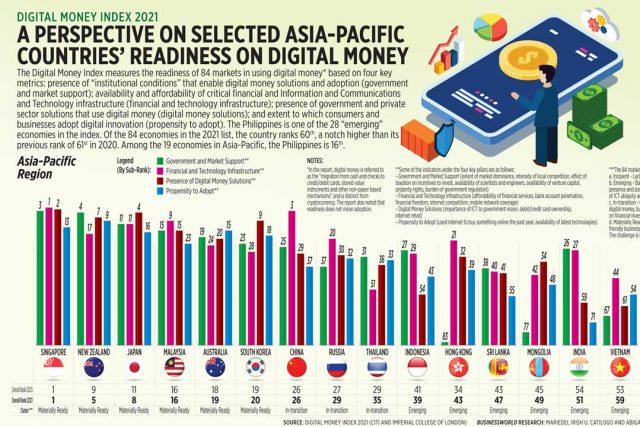
A perspective on selected Asia-Pacific countries’ readiness on digital money

A perspective on selected Asia-Pacific countries’ readiness on digital money

PEZA actively pitching Korean investors as economy reopens

THE PHILIPPINE Economic Zone Authority (PEZA) said it is pinning its hopes on expanding the pool of South Korean investors to add momentum to the reopening of the economy.

PEZA Director General Charito B. Plaza said at a recent virtual forum that the agency is continuing its efforts to attract investors throughout the coronavirus disease 2019 (COVID-19) pandemic.

“We continue our efforts to attract and invite investors. We establish new partnerships as well with various government agencies so that we may be able to urge more local and foreign investors to do business in the Philippines by improving the efficiency factors for investments,” Ms. Plaza said.

According to PEZA, there were 320 registered South Korean locators in the Philippines as of September, representing P53.98 billion worth of investment and generating $1.095 billion in exports. It added that South Korean locators employ 42,675 workers.

Maria Theresa B. Dizon-De Vega, Philippine ambassador to South Korea, urged South Korean companies to take advantage of investment opportunities in advanced industries that may emerge with the finalization of the Philippine-Korea Free Trade Agreement (FTA).

Ms. De Vega said that in 2020, South Korea was the fifth-largest trading partner of the Philippines, seventh-largest export market, and fourth-largest source of imports, with bilateral trade valued at $13.92 billion.

“Korea’s status as a high-technology, innovation-focused economy makes it an attractive development partner for the Philippines in various sectors… the Philippines’ development in these sectors is critical in helping the country fulfill its stated long-term commitments towards inclusive green growth and sustainable development,” Ms. De Vega said.

“We hope that businesses will take advantage of the FTA once it becomes effective by next year so we can increase trade between our two countries. With an FTA in place, the Philippines remains as an ideal investment destination and partner for companies in Korea,” she added. — Revin Mikhael D. Ochave