Home Blog Page 6700

Population collapse and the RH Law mistake

RAWPIXEL.COM-FREEPIK

One of the biggest lies fostered on humanity was the need for it to impose genocide on itself. That was what the myth of “overpopulation” ultimately decreed: that humans are becoming too many for the planet and thus need to be reduced either before (i.e., through contraceptives or abortion, or destroying the institutions of marriage and the family) or after (euthanasia or assisted suicide) they come into existence.

Unfortunately, that Malthusian mindset was completely wrong. The world is not heading towards overpopulation. The world is just simply too big for us. And if a Lancet study (“Fertility, mortality, migration, and population scenarios for 195 countries and territories from 2017 to 2100,” July 2020) holds true, the world’s population may even shrink to alarming levels.

Thus, “the global population was projected to peak in 2064 at 9.73 billion (8.84–10.9) people and decline to 8.79 billion (6.83–11.8) in 2100.” Total fertility rates (TFR) for several countries are expected to fall drastically: “By 2050, 151 countries were forecasted to have a TFR lower than the replacement level (TFR <2·1), and 183 were forecasted to have a TFR lower than replacement by 2100. Twenty-three countries in the reference scenario, including Japan, Thailand, and Spain, were forecasted to have population declines greater than 50% from 2017 to 2100.”

Even more disconcerting is the expected aging global population: “with 2.37 billion (1.91–2.87) individuals older than 65 years and 1.70 billion (1.11–2.81) individuals younger than 20 years, forecasted globally in 2100.”

China, the supposed upcoming superpower, is seen to have its population halved by 48% by the end of this century, with India (expected 1.09 billion by 2100) and Nigeria (791 million) overtaking China’s predicted 732 million. Because of its deranged one child policy and a preference for boys, China, forecast to become the largest economy by 2035, will gratifyingly see it returning to second place again to the US by 2098.

So, “while the world was expecting a baby boom driven by the COVID-19 pandemic as people locked down in their homes for several months, the supposition came crashing down. The reality is much soberer and the pandemic has actually led to a baby bust rather than a boom. Research shows that the US is facing the biggest slump in births in a century, France has recorded its lowest birth rate since World War II and China has received 15% fewer registrations for babies.” (“The World is Heading Towards Population Collapse and it’s a Matter of Concern — and Celebration” by Shweta Sengar, India Times, Jan. 19, 2022)

Pew Research Center, meanwhile, points out that “other advanced countries have also begun to experience declining birth rates. Italy, Japan, France and Belgium are among the nations that have reported sudden drops in births about nine months after the start of the pandemic, compared with the previous year” (https://www.pewresearch.org/fact-tank/2021/05/07/with-a-potential-baby-bust-on-the-horizon-key-facts-about-fertility-in-the-u-s-before-the-pandemic/). Also, as mentioned in this column previously: “Official figures for England and Wales reported a record 50.1% of women being childless by the age of 30.” Finally, this is complemented by the Lancet study: “A sustained TFR lower than the replacement level in many countries, including China and India, would have economic, social, environmental, and geopolitical consequences” (https://www.thelancet.com/article/S0140-6736(20)30677-2/fulltext).

And what is the prime cause for the shrinking birth rates? The Lancet study says this: “access to contraception will hasten declines in fertility and slow population growth.”

Because once you introduce into society the idea that having children and the family are burdens, it becomes very difficult to reverse and the population slide becomes a long continuous downward spiral.

Which brings us to the wisdom (or complete and utter lack of it) of the RH Law. As pointed out by the Supreme Court (Imbong vs Ochoa, GR 204819): “The population of the country kept on galloping at an uncontrollable pace. From a paltry number of just over 27 million Filipinos in 1960, the population of the country reached over 76 million in the year 2000 and over 92 million in 2010. The executive and the legislative, thus, felt that the measures were still not adequate. To rein in the problem, the RH Law was enacted.”

Wisely, the Supreme Court saw through the deception and lies propagated by RH Law’s supporters: “Despite efforts to push the RH Law as a reproductive health law, the Court sees it as principally a population control measure. The corpus of the RH Law is geared towards the reduction of the country’s population.”

Unfortunately, all that did not prevent the Court from making the appallingly inexplicable mistake of ruling in favor of the RH Law. Nevertheless, it did make this quite prescient remark: “At any rate, population control may not be beneficial for the country in the long run. The European and Asian countries, which embarked on such a program generations ago, are now burdened with ageing populations.”

Let’s hope the next Administration will be wise enough to get rid of the RH Law before it causes more damage at taxpayers’ expense.


Jemy Gatdula is a senior fellow of the Philippine Council for Foreign Relations and a Philippine Judicial Academy law lecturer for constitutional philosophy and jurisprudence

https://www.facebook.com/jigatdula/

Twitter@jemygatdula

S.Korea’s president-elect harnessed voter discontent. Now comes the hard part

South Korean President Yoon Suk-yeol. — REUTERS
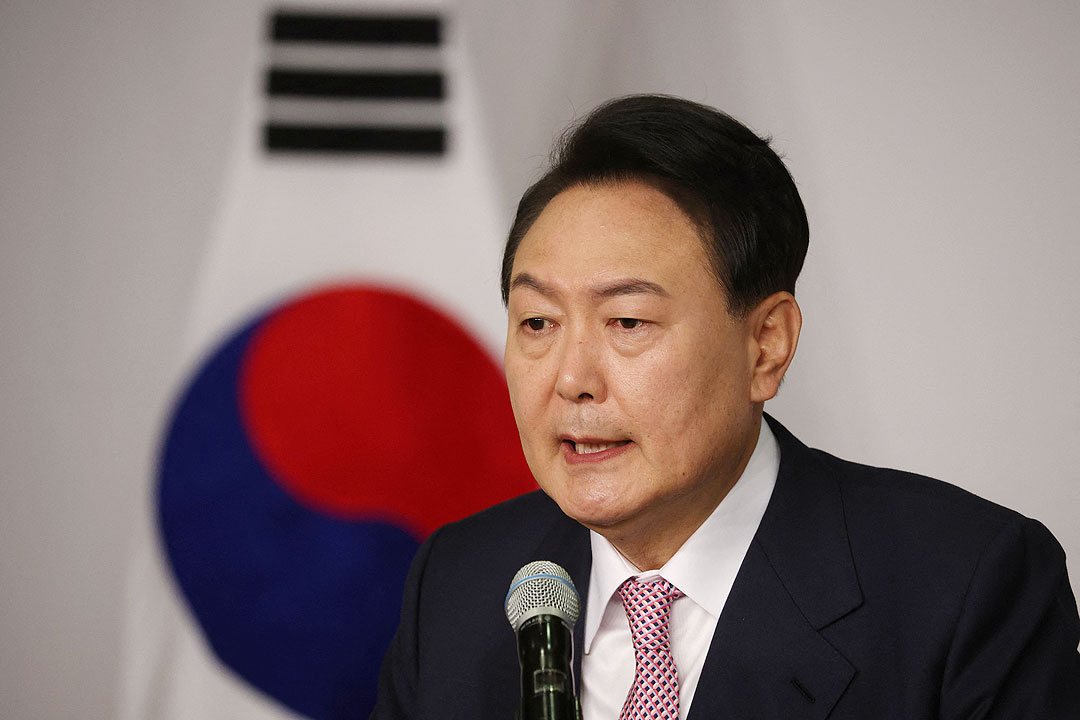
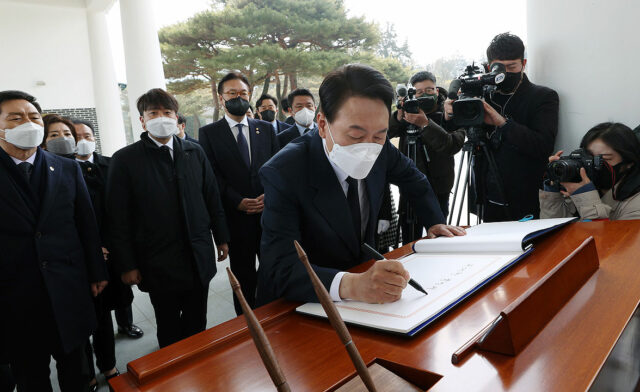
SOUTH KOREA’s president-elect Yoon Suk-yeol speaks during a news conference at the National Assembly in Seoul, South Korea, March 10. — REUTERS

SEOUL — South Korea’s new president-elect harnessed widespread public discontent and disillusionment to win Wednesday’s election but the same volatile forces that brought him to power may complicate his efforts to enact reforms, analysts said.

Conservative People Power Party candidate Yoon Suk-yeol, a former prosecutor-general who had never run for office before, won in the closest election in decades after a bruising campaign marred by scandals and gaffes.

The close result, the fact the rival Democratic Party will still control the one-house National Assembly, and his vow to investigate the outgoing administration means Mr. Yoon will be hard-pressed to move beyond policy failures and political battles, analysts said.

“After a divided electorate has produced a divided government, Seoul may struggle to pursue policies of reform rather than politics of retribution,” said Leif-Eric Easley, a professor at Ewha University in Seoul.

Mr. Yoon, 61, is also expected to take a harder line on North Korea though he says he is open to talks while boosting deterrence and “resetting” ties with China.

At the center of the voter frustration that propelled Mr. Yoon to victory are soaring housing prices and growing inequality.

Polls have shown for months that South Koreans wanted change, as voters who helped center-left incumbent Moon Jae-in win in 2017 grew frustrated with his administration’s failure to curb runaway home prices and narrow economic divides.

South Korea’s economy is forecast to expand 3% this year, the slowest in five years, while one in four young South Koreans are effectively jobless.

A fast-aging society is a growing threat to public finances when small businesses and families are demanding more government subsidies to cope with the impact of the coronavirus pandemic.

Mr. Yoon is also facing calls to get tough on trade unions to help conglomerates add jobs, and reverse plans to gradually ditch nuclear power stations.

Mr. Yoon has promised to rein in property prices, implement a 100-day emergency plan for the pandemic-hit economy, build more than 2.5 million apartments, cut capital gains taxes and deregulate knock-and-rebuild homes.

His success hinges on his ability to find common ground across the political spectrum, as Democrats still hold nearly 60% of 295 seats in the National Assembly.

“Yoon Suk-yeol’s victory … should lead to a shift away from the bigger, and more active state that began under President Moon,” London-based research firm Capital Economics said in a report.

“But the lack of a parliamentary majority means he will struggle to pass large parts of his reform agenda.”

ANGRY YOUNG MEN
On top of perceived policy failures, several corruption and sexual abuse scandals involving top presidential aides and ruling party officials meant Mr. Moon’s Democratic Party struggled to differentiate itself from his conservative predecessor, Park Gun-shy, who was impeached, removed from office, and imprisoned in a corruption scandal, analysts said.

“It feeds into this idea that the liberals are similar to the conservatives, so it doesn’t make much difference who you vote for,” said Ramon Pacheco Pardon, a Korea expert at King’s College, London.

Mr. Yoon helped prosecute Park and in 2019 Mr. Moon appointed him prosecutor-general. He then became a household name when he clashed with the president amid investigations into senior administration figures, including a justice minister who was forced to resign. In an unprecedented move, Mr. Moon approved suspending Mr. Yoon over allegations of abuse of power and other misconduct but a court overturned the suspension.

Mr. Yoon then resigned and was quickly wooed by the conservative opposition seeking to capitalize on the backlash against Mr. Moon’s government.

Mr. Yoon tapped into voter anger over perceived hypocrisy by Mr. Moon’s party, and also courted young men who have spearheaded a backlash against equality measures in a country with stark gender divides.

Complaints that the Democratic Party was encouraging “reverse discrimination” that compounded economic struggles, helped lead to a major drop in support among young men who had helped Mr. Moon win in 2017.

Exit polls showed Mr. Yoon won about 58% of men in their 20s, while his liberal opponent won the same percentage of women in their 20s.

“That resentment helped some people think the government equals injustice,” said Kim Nae-hoon, author of a book on South Korea’s young voters.

“Most people didn’t know what Yoon Suk-yeol was doing exactly, but they vaguely came to like Yoon because they think ‘he is someone hated by those we hate’.” — Reuters

China closed off part of South China Sea to look for a crashed aircraft, says Taiwan intelligence agency

REUTERS

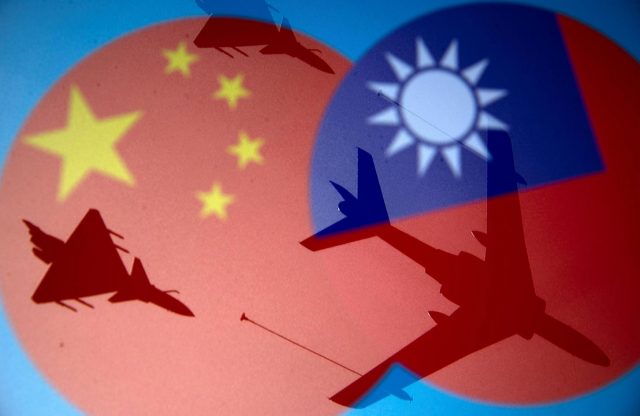
TAIPEI — China closed off a part of the South China Sea close to Vietnam this month in its hunt for a crashed aircraft, Taiwan’s intelligence agency said on Thursday, offering an alternate explanation for an exercise Beijing has called military drills.

On Friday, China said it was carrying out more than a week of exercises in the disputed South China Sea in an area between its southern province of Hainan and Vietnam, warning shipping to stay away.

In a report to parliament, Taiwan’s National Security Bureau said a Chinese aircraft had crashed and China has declared the area off limits while its forces searched for it, and also to conduct drills.

The bureau’s director-general Chen Ming-tong told lawmakers he could not give any further details on the incident as it involves the source of their intelligence.

Taiwan is another claimant to the South China Sea and keeps a close watch on movements there. It controls Itu Aba island deep in the southern part of the waterway, and the Pratas Islands at its northern end.

China has not announced any military aircraft crashes in the area. Its defense ministry did not immediately respond to a request for comment.

Vietnam’s Foreign Ministry has complained to China about the drills.

China’s Foreign Ministry rejected that complaint, saying: “It is reasonable, lawful and irreproachable for China to conduct military exercises on its own doorstep”.

Taiwan’s security bureau added that China was trying to “test the bottom line” of the other claimants and the United States while global attention is on the war in Ukraine.

In 2014, tension between Vietnam and China rose to its highest levels in decades when a Chinese oil rig started drilling in Vietnamese waters. The incident triggered boat rammings by both sides and anti-China riots in Vietnam.

China routinely carries out military exercises in the South China Sea. Malaysia, the Philippines and Brunei all also have competing claims. — Reuters

US man with transplanted genetically modified pig heart dies

A 57-YEAR-OLD man with terminal heart disease who made history as the first person to receive a genetically modified pig’s heart died on Tuesday at the University of Maryland Medical Center (UMMC), the hospital said.

David Bennett received the transplant on Jan. 7.

His condition began deteriorating several days ago, the hospital said in a statement on Wednesday, and he was given “compassionate palliative care” after it became clear that he would not recover.

Mr. Bennett “wasn’t able to overcome what turned out to be the devastating debilitation” caused by the heart failure he experienced before the transplant, Dr. Bartley Griffith, director of the UMCC cardiac transplant program, said in a videotaped statement.

The transplanted heart functioned “beautifully,” Dr. Griffith said.

Mr. Bennett was able to communicate with his family during his final hours, the hospital said.

Bennett first came to UMMC as a patient in October and was placed on a heart-lung bypass machine, but was deemed ineligible for a conventional heart transplant.

After Mr. Bennett received a pig heart that had been modified to prevent rejection with the use of new gene editing tools, his son called the procedure “a miracle.”

For Mr. Bennett, the procedure was his last option.

“Before consenting to receive the transplant, Mr. Bennett was fully informed of the procedure’s risks, and that the procedure was experimental with unknown risks and benefits,” the hospital said.

Researchers have long considered pigs to be a potential source of organs for transplants because they are anatomically similar to humans in many ways. Prior efforts at pig-to-human transplants had failed because of genetic differences that caused organ rejection or viruses that posed an infection risk.

“The demonstration that it was possible — that we were able to take a genetically engineered organ and watch it function flawlessly for nine weeks, is pretty positive in terms of the potential for this therapy,” Dr. Griffith said. — Reuters

Online sales not the smartest time to buy smartphones — iPrice

PCH.VECTOR/FREEPIK

Smartphone prices are higher during online sales like 11.11 and 12.12 than on normal days, according to a study published this March by the iPrice group, a Malaysia-based online shopping meta-search website. 

In each month of 2021 starting August, the cheapest median prices for smartphones in the Philippines occurred on non-sales days rather than sales days. The cheapest of the year cost around P17,200, nearly a week after the 11.11 sale, on November 17. 

Meanwhile, prices were marked up days before sales. October, for example, was the worst time to buy a smartphone, with the median price going up starting Sept. 30 and reaching P22,100 on Oct. 2. It only dropped to P20,500 on the 10.10 sale itself. 

iPrice found that bargain hunters should have gotten a phone on Sept. 25 instead, since the price was 15% lower at about P18,300. 

However, based on the median prices per month, the study determined December to be the best month to buy a smartphone, costing just P18,300 on average. October’s average price was the highest at around P20,600.  

This means 12.12 offered the cheapest smartphone price of any sales day, with a cost of just P17,600. 

SECOND-HIGHEST PRICES
The Philippines has the second-highest smartphone prices out of all the Southeast Asian countries included in the study, iPrice also found. 

Second only to Singapore, which had the highest median price of P23,400, smartphones in the country were found to cost P19,100 on average. Indonesia had the cheapest median price for smartphones at P13,000. 

“Given that the Philippines has one of the lowest wages and the highest smartphone prices in the region, Filipinos need the best deals they can get,” the e-commerce website said in a statement. 

“Thus, iPrice created this study to help Filipino consumers save money when purchasing smartphones,” it added. 

Between July 16 and Dec. 31, 2021, smartphone price data was gathered using iPrice’s database of over 7 billion products and 8 million sellers across SEA. This period was chosen for the increased traffic due to online sales, the aggregator said. — Brontë H. Lacsamana

‘Lost generation’ feared as COVID school closures fuel inequality

UNSPLASH

NEW DELHI/KAMPALA — Standing in front of India’s Taj Mahal, tour guide Raju Usmani fears for his daughter’s future. With coronavirus disease 2019 (COVID-19) decimating his income, he may have to pull her out of school just as she is catching up after nearly two years stuck at home. 

Areeba, 10, is among 1.6 billion children globally — more than 90% of all school students — who have been affected by pandemic school closures, which threaten to widen wealth inequalities both within and between countries. 

“We’re running the risk of a lost generation,” United Nations (UN) education expert Robert Jenkins told the Thomson Reuters Foundation. “It’s a now-or-never moment to turn things around.” 

Without urgent action, many countries could end up without the skilled workers they need for their future development, said Mr. Jenkins, head of education at UN children’s agency UNICEF. 

He is also increasingly concerned about the risk of social instability in countries where a large number of youths are left without skills, jobs or hope. 

Children in low- and middle-income nations have been disproportionately affected as their schools tended to shut for longer and they were less able to access remote learning, UNICEF said ahead of the pandemic’s two-year anniversary on Friday. 

There are no global figures on the numbers who have dropped out. But evidence from Uganda — where schools reopened in January after being shut for a record 22 months — suggests up to 30% of children may not return to class. 

School closures have increased child labor, adolescent pregnancies and early marriages, children’s rights activists say. And many parents impoverished by lockdowns can no longer afford to send their children to school. 

The World Bank says classroom shutdowns could cost children $17 trillion in lifetime earnings — the equivalent of 14% of today’s global gross domestic product (GDP) — as education losses limit their future opportunities. 

CRITICAL MOMENT
Educators say the world is at a crossroads. Reopening classrooms is not enough — schools must assess children and adapt curriculums to help them catch up. 

Evidence from past crises such as the 2005 Pakistan earthquake show learning losses may even grow after children return to school if teaching does not adjust to meet their needs. 

In India, Usmani’s problems are far from over. His earnings have fallen to about $5 a day from $13 pre-pandemic. 

His wife is sick and his children have fallen way behind as they do not have internet access for online learning. 

Areeba, who wants to become a teacher, finally returned to school in January, rejoining the same grade she was in two years ago. She has forgotten sums she used to whizz through. 

Her brother Ayazuddin, 5, is back in kindergarten, struggling to remember his English and Hindi alphabets. 

It is a common problem worldwide, with some teachers saying children have not only forgotten what they have learnt, but how to learn. 

“My children’s future depends on the education they get right now,” said Usmani, 38, who pays about $20 a month for private schooling because he says the state system is poor. 

“I don’t want them to get a half-baked education like I did.” 

Areeba is thrilled to be back in school and rushes home after class to show her father the teachers’ stars in her exercise book. 

“She really missed school,” he said. “Gone are the days when children dreaded going to school. Corona has changed that for sure.”

HOLISTIC APPROACH
Education was in crisis even before the pandemic, with 53% of 10-year-olds in low- and middle-income countries unable to read a simple story, the World Bank says, warning this could now soar to 70%, with potential consequences lasting decades. 

But children have not only missed learning. They have also lost opportunities to develop social skills with friends, play sport and, for some, escape troubled homes beset by abuse. 

Many have struggled with feelings of isolation, and an estimated 5.2 million are grieving the loss of a parent or carer from COVID-19. 

UNICEF’s Mr. Jenkins said schools must take a holistic approach as they welcome children back, addressing their mental, psychosocial and physical wellbeing. 

In many countries, girls have been disproportionately impacted. They often have less access to technology than their brothers, and are more likely to have to help with domestic chores when classrooms shut. 

Parents may also prioritize sending a son back to school over a daughter if money is tight. 

But for hundreds of thousands of girls there is another barrier to resuming lessons — they have become pregnant. 

In 2020, aid agency World Vision estimated 1 million girls across sub-Saharan Africa may drop out because of pregnancies. 

Rwanda and Sierra Leone have received praise for measures to reintegrate young mothers back into schools. But stigma, poverty and lack of childcare could still conspire to keep many out of class. 

FUTURE IMPACT
Educators say governments must do far more to assess the numbers who have left school, and address obstacles preventing their return. 

Many children have quit to earn money. Globally, 9 million risk being pushed into child labor by the end of 2022 because of the pandemic, according to UNICEF. 

In the Ugandan capital, Kampala, Kareem Kato, a top science student with ambitions to become an engineer, was about to start secondary school when the pandemic struck. 

But the lockdown hit his parents’ finances, scuppering his dreams. At 14, he started work as a carpenter to help support his siblings. 

His twin sister, Sumaya, hoped to become a lawyer so she could fight social injustice, but was also forced to drop out and now helps her mother on her market stall. 

“My schoolmates have nicknamed me ‘omuyiribi’ which means hustler,” said Kareem, holding back tears as he stuffed cushions for a couch. “Sometimes I cry when I watch them returning from school happy, and I’m sweating in the workshop.” 

Even before the pandemic, Uganda lacked the skilled workforce it needs, analysts said. 

“We may not see the impacts right now, but we’re going to see it in the future,” said Muhire Francis, an economist at Makerere University Business School. 

“Two years of school closure is really huge. The impact is going to be long-term and massive.” — Annie Banerji and Hedwig Arinaitwe/Thomson Reuters Foundation

Variant that combines Delta and Omicron identified; dogs sniff out virus with high accuracy

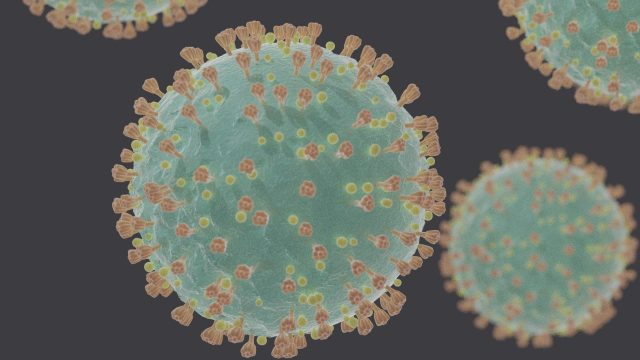
COMPUTER-GENERATED representation of COVID-19 virions via Felipe Esquivel Reed / CC BY-SA

The following is a summary of some recent studies on coronavirus disease 2019 (COVID-19). They include research that warrants further study to corroborate the findings and that has yet to be certified by peer review. 

‘DELTACRON’ WITH GENES OF DELTA AND OMICRON FOUND
Hybrid versions of the coronavirus that combine genes from the Delta and Omicron variants — dubbed “Deltacron” — have been identified in at least 17 patients in the United States and Europe, researchers said. 

Because there have been so few confirmed cases, it is too soon to know whether Deltacron infections will be very transmissible or cause severe disease, said Philippe Colson of IHU Mediterranee Infection in Marseille, France, lead author of a report posted on Tuesday on medRxiv ahead of peer review. 

His team described three patients in France infected with a version of SARS-CoV-2 that combines the spike protein from an Omicron variant with the “body” of a Delta variant. 

Another two unrelated Deltacron infections have been identified in the United States, according to an unpublished report by genetics research company Helix that has been submitted to medRxiv and seen by Reuters. On virus research bulletin boards, other teams have reported an additional 12 Deltacron infections in Europe since January — all with an Omicron spike and a Delta body. 

Genetic recombinations of human coronaviruses have been known to happen when two variants infect the same host cell. 

“During the SARS-CoV-2 pandemic, two or more variants have co-circulated during same periods of time and in same geographical areas… This created opportunities for recombination between these two variants,” said Mr. Colson, adding that his team has designed a PCR test that “can quickly test positive samples for the presence of this… virus.” 

DOGS SNIFF OUT CORONAVIRUS WITH HIGH ACCURACY
New research adds to evidence that trained dogs could help screen crowds to identify people infected with the coronavirus. 

At two community screening centers in Paris, 335 volunteers getting traditional PCR tests also provided sweat samples. Overall, 78 people with symptoms and 31 people without symptoms tested positive by PCR. 

Given the sweat samples to smell, the dogs were 97% accurate at detecting the infected patients, and 100% accurate at detecting infection in the asymptomatic patients, according to a report posted on Tuesday on medRxiv ahead of peer review. They also were 91% accurate at identifying volunteers who were not infected, and 94% accurate at ruling out the infection in people without symptoms. 

“Canine testing is non-invasive and provides immediate and reliable results,” the authors said. “Further studies will be focused on direct sniffing by dogs to evaluate sniffer dogs for mass pre-test in airports, harbors, railways stations, cultural activities or sporting events.” 

Future variants-of-concern likely lurk in today’s patients 

The many coronavirus particles inside an infected person likely include some mutated ones that may turn out to be early examples of important variants, new findings suggest. 

Closely analyzing virus particles obtained from 10 people with infections attributed to the Alpha variant in Spain in April 2021, researchers identified some mutated particles resembling the Omicron variant, which was not formally identified until seven months later. They also found mutations characteristic of a form of Delta and Iota, according to a report published on Tuesday in the Journal of Clinical Investigation

While identifying an individual patient’s dominant variant may be sufficient for diagnostic purposes, the “ultra deep” genetic sequencing used in this study could help scientists track mutations in SARS-CoV-2 particles that might evolve into variants of concern, the researchers said. 

“The virus that replicates in each infected patient is in reality a mixture of slightly different SARS-CoV-2 viruses,” and these different viruses account for varying proportions of the full “ensemble,” said coauthor Celia Perales of Universidad Autonoma de Madrid. Minority variants in one infected individual can become dominant in someone else, either by chance, or due to a selective advantage related to the presence or absence of drugs, vaccines, or other factors, she said. — Nancy Lapid/Reuters

South Korea elects conservative outsider as president in tectonic shift

Republic of Korea president-elect Yoon Suk-yeol. Image via Korean Ministry of Culture, Sports and Tourism/Korean Culture and Information

SEOUL — Conservative South Korean opposition candidate Yoon Suk-yeol rode to victory in a tight presidential election on a wave of discontent over economic policy, scandals and gender wars, reshaping the political future of Asia’s fourth-largest economy. 

His victory in Wednesday’s bitterly fought election marks a stunning turnaround for the main conservative bloc, now known as the People Power Party, which has regrouped since the 2017 snap election after the impeachment and ouster of then President Park Geun-hye. 

Mr. Yoon is a former prosecutor-general involved with Park’s case who fell out with outgoing President Moon Jae-in after being appointed by him, gaining notoriety for his investigations of top presidential aides. 

“The people put me here with hope in my conviction that I have not yielded to any power for fairness and justice for 26 years,” Mr. Yoon said in a speech of his career as a prosecutor. 

Mr. Yoon has pledged to stamp out graft, foster justice, and create a more level economic playing field, while seeking a “reset” with China and a tougher stance towards reclusive North Korea, which has launched a record number of missile tests in recent months. 

He faces the challenge of uniting a country of 52 million riven by gender and generational divisions, growing inequality and surging home prices. 

“Real estate prices, housing policy, jobs, and tax policies will top his domestic agenda,” said Duyeon Kim, a Seoul-based expert with the Center for a New American Security. 

Mr. Yoon will need to restore public trust in Korea’s institutions and is likely to conduct major “housecleaning” by following through on a campaign pledge to investigate Mr. Moon’s administration for corruption, she added. 

Official results showed Mr. Yoon, 61, edged out the ruling center-left Democratic Party’s Lee Jae-myung to replace Moon, whose single five-year term ends in May. 

Mr. Yoon’s lack of elected political experience was seen as both a liability and an asset. 

While his campaign was marked by gaffes and controversy, the race became a referendum on Mr. Moon’s economic policies from jobs to housing to wealth inequality. 

The benchmark KOSPI rose more than 2%, its sharpest daily rise in at least three months, with Mr. Yoon expected to speed deregulation in South Korea’s capital markets. 

The election was one of the closest in recent history and came after an unusually bitter campaign marred by scandals and smears. Both candidates’ disapproval ratings matched their popularity as scandals, mud-slinging and gaffes dominated what was dubbed the “unlikeable election.” 

CONFRONTING CRISIS
Mr. Lee’s loss casts doubt on Mr. Moon’s legacy, including his signature efforts to engage with North Korea, which have largely been stalled since talks fell apart in 2019. 

The new president will likely face an almost immediate crisis with Pyongyang, which appears to be preparing to launch a spy satellite and has suggested it could resume testing of long-range intercontinental ballistic missiles or nuclear weapons for the first time since 2017. 

Mr. Yoon has vowed to forge even closer ties with the United States — South Korea’s only treaty ally — in the face of increased missile activity by North Korea and competition with China, which is the South’s largest trading partner. 

The White House congratulated Mr. Yoon, saying President Joseph R. Biden, Jr., looked forward to working closely with him to bolster the alliance. 

Messrs. Yoon and Biden spoke by telephone on Thursday, the White House later added. 

“We can expect the alliance to run more smoothly and be in sync for the most part on North Korea, China, and regional and global issues,” said Mr. Kim from the Center for a New American Security. 

Japanese Prime Minister Fumio Kishida welcomed Mr. Yoon’s win, and said he hoped to work closely with him to rebuild healthier ties with its neighbor amid tensions over historic and economic disputes dating to Japan’s 1910-1945 occupation of Korea. 

More than 77% of South Korea’s 44 million eligible voters cast ballots to pick their next leader, despite a record surge in new coronavirus disease 2019 (COVID-19) cases this week. 

Mr. Yoon said he would work with opposition parties to heal polarized politics and foster unity. 

“Our competition is over for now,” he said in an acceptance speech, thanking and consoling Mr. Lee and other rivals. “We have to join hands and unite into one for the people and the country.” 

At a separate ceremony with supporters, Mr. Yoon said he would put top priority on “national unity,” adding all people should be treated equally regardless of their regional, political and socioeconomic differences. 

Mr. Lee had conceded defeat and congratulated his opponent. 

“I did my best, but failed to live up to your expectations,” he told a news conference, blaming his “shortcomings”. — Josh Smith and Hyonhee Shin/Reuters

ECB seeks to reconcile soaring inflation with war risks

REUTERS

FRANKFURT — The European Central Bank (ECB) is likely to make as few policy commitments as possible on Thursday as the shock of Russia’s invasion of Ukraine up-ends its expectations for the economy and leaves policymakers grappling with new realities. 

With inflation in the euro zone at a record high even before Moscow began its assault on Feb. 24, policymakers had been expected to announce an end to years of money-printing stimulus, opening the way for an interest rate hike late this year. 

But the war has shattered that consensus and the 25-member ECB Governing Council will go into the meeting divided, raising the chances of a policy surprise — and the risk of an error. 

“No one can seriously expect the ECB to start normalizing monetary policy at such a moment of high uncertainty,” ING economist Carsten Brzeski said. 

The safest route would appear to be for the bank to confirm an earlier decision to continue reducing bond purchases next quarter while leaving all other commitments, including an end-date for the buys and the timing of a rate hike, up in the air. 

“We believe the ECB will aim to buy some time by proceeding with the previously planned gradual tapering in April … while increasing flexibility in the forward guidance to allow more room to act once the immediate fog lifts,” Societe Generale economist Anatoli Annenkov said. 

“As long as we avoid recession, which is our current baseline, we expect the ECB to conclude later this spring that the policy stance will need to tighten faster to stabilize inflation expectations.” 

Inflation across the 19 countries that use the euro could be three times the ECB’s 2% target this year and is likely to remain elevated next year, too. 

A rebound in economic growth and the tightest labor market in decades should also be pushing the ECB to abandon its ultra-easy policy stance and end a nearly decade-long experiment with unconventional stimulus. 

The Federal Reserve is sticking to its plans to raise US interest rates next week, heralding a string of increases to borrowing costs as inflation rises. 

But the conflict in Ukraine, the unprecedented sanctions slapped by Western countries on Russia and soaring commodity prices will all raise uncertainty, dampen growth, and sap households’ purchasing power, adding to the case for caution. 

Some policy hawks are nevertheless likely to push the ECB to curb stimulus and return policy at least to a “neutral” setting, so the bank could signal the end of bond buys in the coming months, a decision that would raise the chances of — but not cement — a 2022 rate hike. 

The bank is also expected to drop any reference to a rate cut in its guidance, and may remove a stipulation that a rate hike would come “shortly” after bond purchases end. 

STRUCTURAL WORRIES
Even if Thursday sees the can kicked down the road, high inflation makes the removal of stimulus almost unavoidable, but the real issue is how a changed world order will impact prices further out, a time horizon more relevant for the ECB. 

High energy prices will lower growth and could be a drag on inflation in the longer term as families have less to spend on other items and firms postpone investments. 

This is why the ECB’s inflation projection for 2024 is unlikely to be wildly different from the 1.8% it predicted three months ago. 

These forecasts have been so unreliable in recent months that policymakers are now openly questioning them, making them less relevant in decision-making. 

War in Ukraine is also likely to set in motion economic forces that could boost prices further out. 

Increased defense spending, as outlined by several euro zone members, and a quicker green transition to wean the bloc off Russian gas are both likely to boost government spending and inflation. 

These may also be backed by joint European Union debt issuance, and the bloc would be likely look to the ECB to keep its cost of borrowing down. 

It is next to impossible to quantify the inflation costs of these long term decisions, however, so ECB projections will not reflect them, even if policymakers are likely to raise them in the debate. — Balazs Koranyi and Francesco Canepa/Reuters

Ukraine prepares potential move of sensitive data to another country — official

PIXABAY

The Ukrainian government is preparing for the potential need to move its data and servers abroad if Russia’s invading forces push deeper into the country, a senior cybersecurity official told Reuters on Wednesday.

Victor Zhora, the deputy chief of Ukraine’s State Service of Special Communications and Information Protection, emphasized his department was planning for a contingency, but that it is being considered at all suggests Ukrainians want to be ready for any Russian threat to seize sensitive government documents.

“We are preparing the ground,” Mr. Zhora said. Plan A was to protect IT infrastructure within Ukraine. Removing it to another country would only be a “Plan B or C.”

The move could only happen after regulatory changes approved by Ukrainian lawmakers, Mr. Zhora said.

Government officials have already been shipping equipment and backups to more secure areas of Ukraine beyond the reach of Russian forces, who invaded on Feb. 24 and are laying siege to several cities.

Last month Mr. Zhora told Politico there were plans to move critical data out of the capital Kyiv should it be threatened, but preparations for potentially moving data abroad go a step further.

Ukraine has received offers to host data from a variety of countries, Mr. Zhora said, declining to identify them. For reasons of proximity “a European location will be preferred,” he said.

“There are a lot options,” he said. “All the proposals are highly welcome and worth considering.”

Mr. Zhora gave few details of how such a move might be executed, but he said past efforts to keep government data out of Russia’s grasp involved either the physical transport of servers and removable storage devices or the digital migration of data from one service or server to another.

PROTOCOL 

Even if lawmakers agreed to lift the restriction on sending Ukrainian data abroad and a protocol for the removal of IT assets were established, it would not necessarily mean that all or even most of the government’s data or network equipment would immediately be sent out of the country, Mr. Zhora said.

Government agencies would have to decide on a case-by-case basis whether to keep their operations running inside the country or evacuate them.

What to do in wartime with piles of data gathered by governments became a topic of international concern following the Taliban’s lightning offensive in Afghanistan last August that took city after city as US and other foreign forces withdrew.

The Taliban conquest of Kabul meant that their forces were in a position to inherit sensitive data — such as payroll information for Afghan government employees and soldiers — which they could potentially mine for leads on how to arrest or eliminate domestic opponents.

Similar concerns are at play in Ukraine. Russia possessing Ukrainian government databases and intelligence files could be helpful if Russia wanted to control Ukraine.

Pavol Jakubec, a historian at Sweden’s University of Gothenburg, said Ukraine was not necessarily planning for a potential government in exile, usually a last resort.

“It may be that they want to forestall potential Russian efforts to block their operations, analogue and digital,” he said.

In 1940 Norway physically sent the bulk of its Foreign Ministry archives to the north of the country and then eventually to Britain as German forces invaded, Mr. Jakubec said.

Beyond trying to protect citizens under occupation, Ukrainian officials would want to deny Russian forces the opportunity to possess documents “which could otherwise be doctored by the enemy and used for propaganda purposes,” Mr. Jakubec said. — Raphael Satter and James Pearson/Reuters 

Seven out of 10 Filipinos had more sex during the pandemic, says study

PHILCARE

FILIPINOS turned to intimacy and enjoyed a better sex life during the pandemic, according to a recent survey.

A 2021 wellness index by health maintenance organization PhilhealthCare, Inc. (PhilCare) found that 69.5% of 1,500 respondents, or 7 out of 10 adult Filipinos, said they had more sex during the coronavirus disease 2019 (COVID-19) pandemic than before.

They also shared being satisfied with their sexual partner, with 84.4% of married respondents and 94.3% of cohabitating respondents admitting to enjoying more sex.

“This interesting finding proves that something positive can really come out of lockdowns. With their protracted time together under one roof, couples can enjoy more opportunities to improve their relationship in terms of physical and emotional intimacy,” said PhilCare president and chief executive officer Joseph Agustin “Jaeger” L. Tanco.

He noted that these findings only prove the importance of promoting sexual health in the workplace, since the quality of conversations surrounding sex can “shape a person’s general view of what sex is and its effects on their physical and mental health.”

A January 2021 study at the Journal of Sexual Medicine found that reduced levels of anxiety and depression were found in sexually active people during lockdown. The study also used logistic models to determine that lack of sexual activity was associated with a significantly higher risk of developing anxiety and depression.

PhilCare added that the workplace can do its part in creating an inclusive culture where Filipino employees can be comfortable to discuss sex-related health concerns.

“Employers have the power to remove the stigma of discussing sex and help prevent societal problems such as sexual assault and harassment, unplanned pregnancies, and the spread of sexually transmitted infections,” said Mr. Tanco.

The organization suggested counseling support for employees who need advice on sexual health concerns and seminars and gender-sensitivity training which could correct misconceptions about sexual health and conduct.

The PhilCare Wellness Index was conducted via a nationwide telephone survey in September 2021, covering Metro Manila and 65 provinces. Most respondents are employees, with 64.5% working for private firms. — Brontë H. Lacsamana

Taiwan wants to be ‘full member’ of US Indo-Pacific Economic Framework

lisanto-unsplash

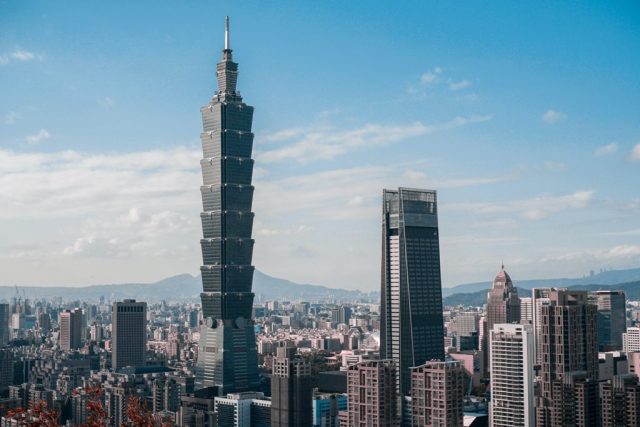
TAIPEI — A senior Taiwanese minister called on Wednesday for the island to be made a “full member” of the United States’ forthcoming Indo-Pacific Economic Framework, saying Taipei was a reliable partner and crucial part of the global supply chain.

Washington vowed last month to commit more diplomatic and security resources to the Indo-Pacific to push back against what it sees as China’s bid to create a regional sphere of influence and become the world’s most influential power.

The 12-page strategy overview reiterated US plans to launch an Indo-Pacific Economic Framework in early 2022, an initiative the administration hopes will at least partially fill a big gap in engagement with the region since 2017 when then-President Donald J. Trump quit a multinational trade framework.

Speaking to an online event organized by the Brookings Institution, a US think-tank, Taiwan’s chief trade negotiator John Deng said democratically governed Taiwan was a dependable and stable partner both politically and economically.

“Taiwan is very willing to support the US Indo-Pacific Economic Framework,” he said.

“I would like to urge the US government, and I hope all the audience participating in the seminar today can help us convey this message to the US government, that Taiwan would like to be a full member of this framework.”

Supply chain cooperation between Taiwan, a major semiconductor producer, and the United States was vital for both, Mr. Deng added.

China, which claims Taiwan as its own territory, has condemned the US Indo-Pacific push, saying Washington is creating “exclusive clubs.”

Any Taiwanese participation in the economic section would likely further strain Sino-US ties with Beijing angered by any shows of support from Washington for the island.

Asked about Mr. Deng’s remarks, a US administration official told Reuters the United States was engaging with Indo-Pacific partners as it was developing the framework, but didn’t currently have “membership” details to announce.

“That being said, the US is committed to deepening our trade and investment relationship with Taiwan,” the official said.

A senior US diplomat said last month his country had “no intention” of engaging with China in its Indo-Pacific Economic Framework.

Mr. Deng said China had been using subsidies and unfair trade practices to boost its economic power in recent years, something Beijing routinely denies.

“China’s political and military ambitions also let the world understand that they pose a threat to the world order,” he added. — Reuters

ADVERTISEMENT
ADVERTISEMENT