Home Blog Page 6670

Biden calls Putin a war criminal

RUSSIAN President Vladimir Putin. — REUTERS

KYIV/LVIV, Ukraine — International outrage over Russia’s invasion of Ukraine grew on Thursday as US and Ukrainian officials said civilians waiting in line for bread and sheltering in a theater had been killed by Russian forces.

US President Joseph R. Biden called Russian leader Vladimir Putin a war criminal in comments the Kremlin said were “unforgivable” as it insisted the war in Ukraine was “going to plan” amid talk of compromise at peace talks.

Moscow has yet to capture any of Ukraine’s biggest cities despite the largest assault on a European state since World War II. More than 3 million Ukrainians have fled and thousands have died as the war enters its fourth week.

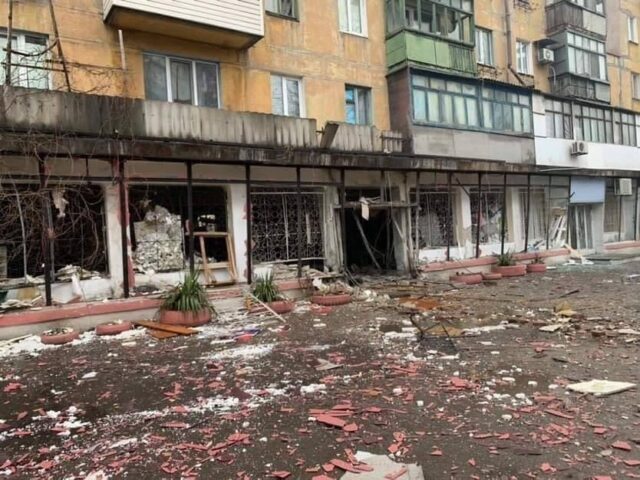
Ukraine’s foreign ministry said Russian forces dropped a powerful bomb on a theatre in the besieged southern port city of Mariupol, leaving many civilians trapped and an unknown number of casualties. Reuters could not independently verify the information.

Maxar Technologies, a private US company, distributed satellite imagery it said was collected on March 14 and showed the word “children” in large Russian script painted on the ground outside the red-roofed building.

The theater had been housing at least 500 civilians, according to Human Rights Watch.

“This raises serious concerns about what the intended target was in a city where civilians have already been under siege for days and telecommunications, power, water, and heating have been almost completely cut off,” Belkis Wille from the rights group said.

Moscow denies targeting civilians and Russia’s defense ministry said its forces had not struck the building, RIA news agency said.

Thirteen buses carrying around 300 refugees from Mariupol have arrived in Russia’s Rostov region, Russia’s Interfax news agency cited the Russian defense ministry as saying on Thursday.

The US Embassy in Kyiv said Russian forces had shot dead 10 people waiting in line for bread in Chernihiv, northeast of Kyiv. Russia denied the attack and said the incident was a hoax.

The United Nations’ top court for disputes between states ordered Russia on Wednesday to immediately halt its military operations in Ukraine, saying it was “profoundly concerned” by Moscow’s use of force.

‘NEUTRAL STATUS’
Ukraine’s armed forces are conducting small-scale counter attacks on several fronts and Russian troops have not been able to gain ground because of a lack of resources, Ukrainian presidential adviser Oleksiy Arestovych said on Wednesday.

There were signs of compromise and progress at ongoing talks between Russia and Ukraine.

The Kremlin said negotiators were discussing a status for Ukraine similar to that of Austria or Sweden, both members of the European Union that are outside the NATO military alliance.

“Neutral status is now being seriously discussed along, of course, with security guarantees,” Russian Foreign Minister Sergei Lavrov said. “There are absolutely specific formulations which in my view are close to agreement.”

Vladimir Medinsky, Russia’s chief negotiator, told state TV: “Ukraine is offering an Austrian or Swedish version of a neutral demilitarized state, but at the same time a state with its own army and navy.”

Austria and Sweden, the biggest of six EU members outside NATO, both have small militaries that cooperate with the alliance.

President Volodymyr Zelensky has said Ukraine could accept international security guarantees that stopped short of its longstanding aim to join NATO. That prospect has been one of Russia’s primary concerns.

“My priorities during the negotiations are absolutely clear: the end of the war, guarantees of security, sovereignty, restoration of territorial integrity, real guarantees for our country, real protection for our country,” Mr. Zelensky said in a video address released early on Thursday.

In a speech on Wednesday to the US Congress by video link, Mr. Zelensky repeated a request for a no-fly zone over Ukraine, something the West won’t introduce.

“In the darkest time for our country, for the whole of Europe, I call on you to do more,” he said.

The United States announced an additional $800 million in security assistance to Ukraine to fight Russia, with the new package including drones, anti-armor and anti-aircraft systems.

“More will be coming as we source additional stocks of equipment that … we are ready to transfer,” Mr. Biden said, later condemning Mr. Putin.

“He is a war criminal,” he told reporters.

NATO defense ministers meeting in Brussels also pledged more arms supplies to help Ukraine.

The U.N. Security Council is due to vote on Friday on a Russian-drafted call for aid access and civilian protection, but diplomats say the measure is set to fail because it does not push for an end to the fighting or withdrawal of troops. — Reuters
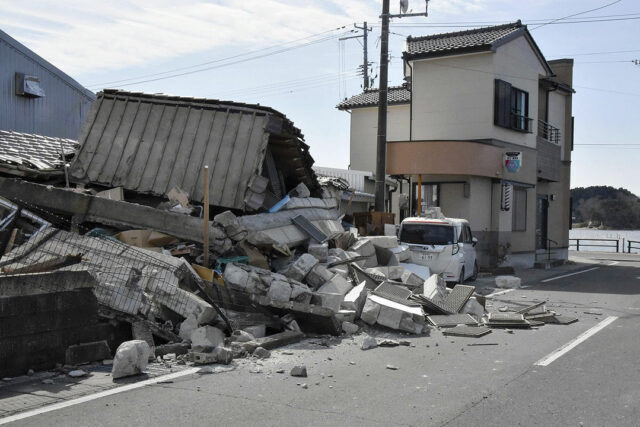
Thousands of Japan homes without power after quake kills four

A DAMAGED BUILDING following a strong earthquake is pictured in Soma, Fukushima prefecture, Japan, in this photo taken by Kyodo on March 17. — REUTERS

TOKYO — Tens of thousands of Japanese households remained without power on Thursday morning after a magnitude 7.4 quake struck shortly before midnight, throwing a swathe of northeastern Japan into darkness, severing key transportation links and killing four.

Companies including Toyota Motor Corp. and chipmaker Renesas Electronics Corp. raced to assess the impact, with any supply chain disruption likely to add pressure to strained global output of smartphones, electronics and automobiles.

The temblor revived memories of Japan’s biggest quake, of magnitude 9.1, which struck on March 11, 2011 in the same area and which includes Fukushima prefecture and a nuclear power plant crippled by a tsunami and meltdown. It left a Shinkansen bullet train service indefinitely suspended, and at least one major highway to the region closed for safety checks.

“This one felt different (to the 2011 quake), it was huge. I had to hang on to something to stay upright,” said Aoi Hoshino, who owns a bar in Fukushima and had customers when the quake struck.

One of her customers shrugged off the initial tremors, but when the biggest one hit, he stood up and shouted, “This is a big one!” she recalled.

The damage was minimal, save a few framed pictures and cups that fell, thanks to rails Ms. Hoshino had added to shelves to stop bottles from falling in the event of an earthquake.

“For a while my hands wouldn’t stop shaking,” she said.

Parts of building facades tumbled into streets in some areas. Television footage showed a steep tiled roof crumpled over a parked, crushed car and workers examining cracked highways.

About 300 km (186 miles) south of Fukushima, areas of the capital Tokyo lost power immediately after the quake, though most regained it within three hours.

But some 5,775 households serviced by Tohoku Electric Power Co, Inc. in the northeast remained without electricity as of noon local time (0300 GMT) on Thursday, though the firm said it expected most will have supply restored later in the day.

Prime Minister Fumio Kishida said four people had died and that the government would be on high alert for the possibility of further strong tremors over the next two to three days.

At least 107 people were reported injured, several seriously, with 4,300 households also still without water by mid-morning. Residents of one Fukushima city formed a long queue to fill up plastic tanks with water for use at home.

Renesas, a major supplier of automotive chips, said it had suspended production at two semiconductor plants and partially stopped output at a third.

Among them is its Naka plant in Ibaraki prefecture just north of Tokyo, which supplies semiconductors to auto companies worldwide that have already had to curb output because of chip shortages resulting from COVID-19-related disruption.

The quake, initially measured at magnitude 7.3 but later revised to 7.4 by the Japan Meteorological Agency, hit at 11:36 p.m. local time (1400 GMT) just off the coast of Fukushima prefecture at a depth of 60 kilometers. The 29 km deep 2011 quake and tsunami off Fukushima — commemorated across the country less than a week ago — left some 18,000 dead.

A tsunami warning was issued but canceled early on Thursday morning. Some areas reported a rise in the sea level but no serious damage was immediately reported.

The 2011 disaster also set off meltdowns at the Fukushima Daiichi nuclear power plant. No abnormalities were reported at any nuclear power plants after the latest quake, though authorities earlier said a fire alarm had been triggered at a turbine building at the crippled plant.

Manufacturers said they were trying to gauge the potential damage to their facilities in the region.

Toyota canceled the day shift at two factories after workers evacuated during their evening shift on Wednesday. The automaker said it will decide on Thursday’s evening shift later.

To cover the area affected by the Shinkansen outage, ANA Holdings, Inc. and Japan Airlines Co, Ltd. added extra flights to northern cities. There were no forecasts of when regular rail service might be restored. — Reuters

Handbags at dawn: Chanel duels South Korean resellers in luxury boom

REUTERS
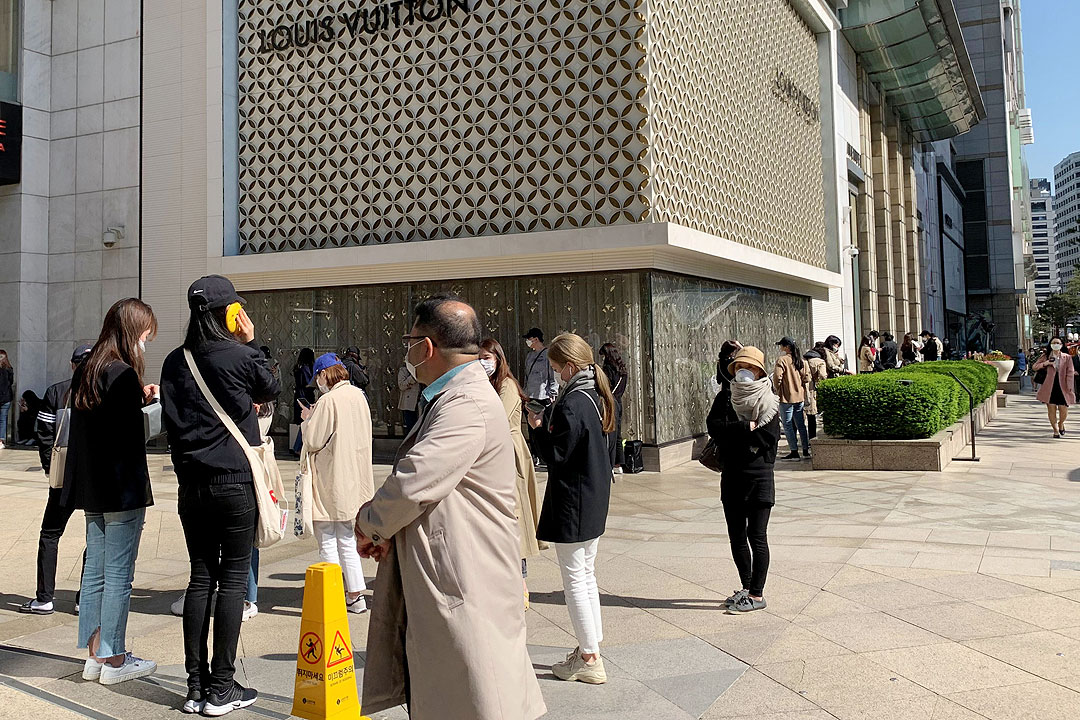
People queue to enter the Chanel boutique at a department store in Seoul, South Korea, May 13, 2020. — REUTERS/MINWOO PARK

SEOUL — As COVID curbs cut travel and duty-free shopping, South Koreans are driving a luxury goods boom at home that has left Chanel barring nearly a third of would-be shoppers to stop bulk buyers snagging $10,000 bags for resale with markups of 20% or more.

The storied French fashion and luxury company told Reuters it has seen traffic to its boutiques in South Korea skid since it began screening for customers it believed might be stocking up purely to flip to others in the resale market.

“We were able to identify them (bulk buyers) after having analyzed their buying patterns. Since this policy was implemented, the traffic in our boutiques has decreased by 30%,” Chanel told Reuters in a statement. It didn’t disclose exactly how it deemed those customers to be potential bulk buyers, and the privately owned business doesn’t disclose sales numbers by country.

Chanel’s strategy, implemented since July last year, came as global demand for luxury goods was picking up after the worst of the coronavirus pandemic. South Korea is the world’s seventh-biggest luxury goods market according to Euromonitor, and the research firm estimates it was one of only two of the top seven markets by revenue — the other being China — to see sales grow last year from 2019 levels.

Supply at brands like Chanel, though, is tightly controlled, preserving exclusivity and boosting appeal with no online shopping option beyond cosmetics, perfumes and some small accessories. Such is the appetite in downtown Seoul that long queues form before dawn outside department stores as shoppers brace for what’s known as an ‘open run’ — a sprint to Chanel’s doors at opening time.

“I arrived … at 5.30 a.m. for an open run and I was notified that there were more than 30 people in front of me,” a shopper told Reuters in front of a Chanel boutique in Seoul. Speaking on condition of anonymity because of privacy concerns, he said by the time he entered the store — nearly 10 hours later — the item he wanted was sold out.

Reflecting such red-hot demand in the resale market, a Chanel medium classic flap bag was sold at 13.5 million won ($11,031) — 20% more than its standard retail price — in January on KREAM, a platform offering everything from sneakers to tech and luxury goods that is an affiliate of tech giant Naver Corp.

KREAM, an acronym for ‘Kicks Rule Everything Around Me’, was launched in 2020. It told Reuters its monthly transactions exceeded 100 billion won in December, and said South Korea’s resale market is worth more than 1 trillion won — nearly $820 million — even at the most conservative estimates.

‘QUEUE MANAGEMENT’
While resale platforms like KREAM offer a range of brands, Chanel, like Swiss watchmaker Rolex, is a particularly sought-after brand because of its status among couples in South Korea as one of the most popular wedding gifts, and frequent price increases of its most iconic handbags.

Chanel increased prices of some handbags, accessories and seasonal ready-to-wear earlier this month in Asia and Europe, including by 5% in South Korea — where prices have just been raised for the fifth time in nine months, according to Chanel Korea.

In tandem with its screening for bulk buyers, Chanel said it has implemented a “queue management system”: Clients are asked to give their contact number and reason for visiting the store so that they can be informed via text messages when they will be able to enter the boutique.

Brand experts and consumers are divided on the impact of the new buying pattern on Chanel.

“Consumers are voluntarily doing free ads for Chanel — camping outside (boutiques), doing open runs, posting their experiences on social media,” said Lee Eun Hee, a professor of consumer science at Inha University.

“I think all those phenomena have helped Chanel draw younger customers and make a big chunk of money off it.”

Still, some consumers say long queues and waiting lists have put them off.

“I just gave up buying a Chanel product long ago,” said a Seoul resident in her 30s, declining to be named due to privacy concerns.

“It’s too difficult to buy one, with some 300 people usually on a waiting list, and by the time it’s my turn, there is no product left. This really puts me off and I don’t want to be at the center of this craziness.”

Not giving up any time soon are the bulk buyer-resellers.

Speaking on condition of anonymity because of the sensitivity of the matter, some resellers told Reuters they’re hiring “line standers” for a fee of up to $125 a day to stand in queues or enter stores on their behalf.

One reseller in his 30s told Reuters he’s been reselling his purchases at usually more than 20% profit — and it can be far more profitable when inventory level is low.

He said he sold a Chanel flap card holder recently on secondhand marketplace app Karrot for nearly 1 million won, 40% above its retail price — five minutes after it went up for sale. — Reuters

BayaniPay reduces remittance costs for Fil-Ams

BAYANIPAY.COM

BayaniPay Inc., a California-based neobank launched March 17, reduces cross-border remittance costs for Filipino-Americans and other migrant professionals sending funds home by doing away with transaction fees.  

Through a partnership, clients of the digital-only bank will also be able to transact at any of the branches of East West Bank (EWB), the largest Asian-American bank in the US. 

“We call it omniservice, where any customer can walk into [our bank] and get the same exact service as anyone else” said Parker Shi, East West Bank executive vice president and chief operating officer. “We are looking at not only doing business in the US, but also serving Filipinos from the Philippines.”  

Mr. Damarillo said serving immigrants is “one of the most underappreciated opportunities there is.”  

“If you land the immigrants, it’s a very interesting opportunity moving forward,” he said at the hybrid launch.  

The neobank reduces 30% of the friction cost of sending funds home by removing the transaction fee for the service, and only earning a margin on its “market-leading” exchange rates. Other remittance firms charge for both. 

Apart from cross-border remittance payments, BayaniPay offers direct digital cash payments and EWB-powered debit cards. An emergency credit line is also in the pipeline.  

“We co-designed this with merchant partners,” added Mr. Damarillo, describing the neobank’s direct pay function that it “copied” from Philippine e-wallets like GCash and PayMaya:  

“You take your Bayani wallet, go to a grocery like Seafood City, present your QR code to the cash register, and do a regular transfer of funds. Merchants don’t have to pay fees to Visa and Mastercard.” 

Seafood City, the largest Filipino-owned supermarket chain in the US, and BDO Unibank are among BayaniPay’s partners.  

Mr. Damarillo, a Filipino-American and Silicon Valley veteran with three successful exits, moved to the US two decades ago to follow his now-wife, as well as to realize the American Dream.   

“My parents put together all their dollars, sent me off to the airport, and wished me good luck,” he said. “[Mine] is not an uncommon story… The US delivered. I’m among the four million Pinoys in the US who have become an important part of the economy.” 

Money sent home by Filipino migrants rose to $2.668 billion in January from $2.603 billion a year earlier, reflecting improving employment prospects abroad despite recent surges in coronavirus disease 2019 (COVID-19) infections.  

The Filipino-American community is the third-largest Asian-American group in the US It accounted for $146 billion or 14.4 percent of the Asian-American market in 2019. — Patricia B. Mirasol

Filipino youth overestimate their ability to spot fake news, according to survey

FREEPIK

Young Filipinos aged 18 to 39 years old are confident in their ability to identify false information online, according to a 2021 survey about fake news in social media. 

Majority (93.27%) of 327 respondents said they encountered it daily on social media platforms, and nearly 86% shared that they are confident they are able to determine which of the information is fake.  

“The Philippines is not just the social media capital of the world, but it is also patient zero when it comes to fake news and false information,” said Georgeline B. Jaca, the De La Salle University political science lecturer who conducted the survey, at a Mar. 11 webinar organized by Participate, a non-partisan political participation coalition. 

“Being labeled as such implies the magnitude of issues and consequent effects in the upcoming 2022 national elections,” she added. 

The survey, conducted from November to December 2021, found that Filipino youth are now more aware of the flow of information and communication online, which is relatively “less guarded, more direct, and more sensationalized.” 

To determine which news is fake, respondents said the telltale signs would be questionable or missing sources; poor editing, grammar, and layout; information that is too good to be true; or a heavily opinionated tone. 

With 89 million active social media users in the Philippines as of January 2021, fighting misinformation and disinformation online is a shared and urgent responsibility of the private and public sectors, added Ms. Jaca. 

Even the Filipino youth who said they are confident in their fact-checking ability may have “unclear political internal efficacy,” which is a measure of an individual’s evaluation of his or her own competence to participate in politics. 

“In another study by the Ateneo School of Governance, they found out that the confidence level of people does not really match their actual ability,” she said. “Surveyed youth had standard clues and signs in identifying fake news, but what if eventually the way false information is peddled becomes more sophisticated?” 

GREATEST THREATS
Retired election commissioner Ma. Rowena Amelia V. Guanzon said vote buying and false information in social media are the two greatest threats to the upcoming elections. 

“We should be taking this seriously and informing everyone to do the right thing,” she explained at the webinar. 

One way this can be done is to review the Commission on Elections’ Resolution No. 10730, to clarify what is considered “acts of election campaigning or partisan political activity” as defined in section 1 clause 4, according to Ms. Jaca. 

She recommended that this be reviewed since blogs are not classified as campaign material despite their being a large source of fake news based on Filipinos’ experience. If blogs are placed under Comelec regulation, it could help address the issue. 

Legal measures against the peddling of fake news and false information should also be considered but only as a last resort, she added. — Brontë H. Lacsamana

Russia sanctions pierce luxury jet world’s ultra-private bubble

Rob Hodgkins/CC BY-SA 2.0/Wikimedia Commons

The gleaming, late-model European jet for sale was a rarity in the hot market for second-hand corporate aircraft. 

It was only after aviation lawyer Amanda Applegate’s client did some additional digging that they discovered the aircraft, while not registered in Russia, was in fact Russian-owned. 

For that buyer, it was a deal-breaker, said Ms. Applegate, a partner at US-based Soar Aviation Law, as the West imposes sweeping sanctions in the aftermath of Russia’s invasion of neighboring Ukraine. 

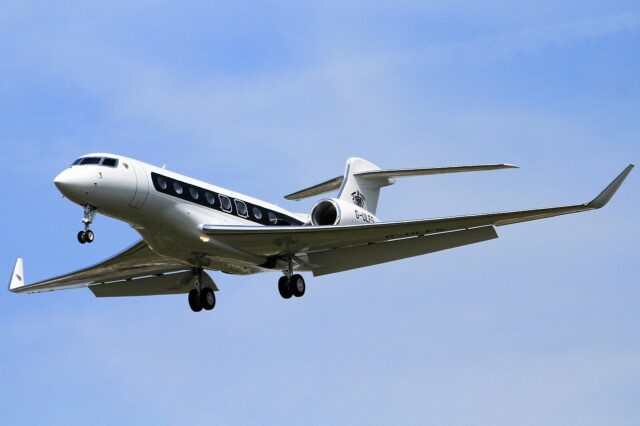
The private jet world is on high alert to avoid doing business with Russia at a time when a Twitter account run by a Florida teenager, @RUOligarchJets, has focused popular attention on the fugitive luxury fleets of the ultra-rich. 

“When I look at compliance, it’s like a taco, wrapped in a burrito, wrapped in a chalupa,” said an executive at a business jet manufacturer, who spoke on condition of anonymity. 

According to European data research and consulting company WINGX, there are only about 100 business jets on the Russia Register. Yet about 400 corporate aircraft flew frequently from the country last year, raising questions over the true extent of Russian control of the fleet. 

“We think that a good proportion of the 400 are owned by Russia-based individuals or entities,” said WINGX managing director Richard Koe. 

Worried planemakers are handing out questionnaires and doing extra vetting to make sure parts shipped to repair centers outside Russia aren’t inadvertently sustaining jets covered by sanctions, the manufacturing executive said. 

That’s far from easy in the ultra-private world of corporate aviation. 

Most Russian-owned business jets are registered outside the country and ownership is camouflaged behind layers of shell companies and trusts. 

Some 5% of European business jets are registered in Russia, according to Jefferies analysts. But those actually owned by Russians could be up to triple that amount, analysts say. 

VETTING EXPORTS
One of the world’s largest maintenance firms, Germany’s Lufthansa Technik, has set up a task force and created an export approval process to avoid violating sanctions that ban technical support as well as shipments of parts to Russia. 

“This means more complexity for our global supply chain processes,” a spokesperson said. 

Planemakers must be sure that a part shipped to a maintenance center won’t later end up on an aircraft owned by a sanctioned person or entity. 

That’s not such a problem when orders come in for parts for a specific aircraft, identified by its serial number. But in some cases the order could come from a maintenance center without mentioning a specific jet. 

“I expect that the (manufacturers) and other suppliers will start to ask more questions so that they can vet the end-users for parts exports to certain countries,” said aviation lawyer Jonathan Epstein, partner at US-based Holland & Knight. 

Canada’s Bombardier and General Dynamics Corp’s Gulfstream are among the biggest suppliers of jets with Russian owners, according to analysts and brokers. 

Bombardier, which has cut ties in Russia, said it is strengthening company procedures. 

It has suspended the accounts of some customers even though they are not directly covered by sanctions, and won’t provide parts or technical support to anyone located anywhere if they use the aircraft in Russia, the Canadian planemaker said in a customer bulletin seen by Reuters. 

Gulfstream did not respond to a request for comment. 

It is equally a headache for buyers. Like Ms. Applegate’s client, many are avoiding all Russian-owned planes, not just those belonging to sanctioned owners. 

William Quinn, president of US consulting firm Aviation Management Systems, said he expects to see more deals for European business jets come under scrutiny. 

He recently represented a lender on a deal for a year-old Pilatus jet registered in Guernsey. That deal, too, fell through when the client discovered it was Russian-owned, Quinn said. 

One broker has advised clients “to run, don’t walk” from deals with any Russian for fear that more names will end up on blacklists, or that deals would worry lenders. The Kremlin has warned against anti-Russian feelings in the West. 

“There is real concern the ‘list’ isn’t yet refined and will continue to grow,” said the broker on condition of anonymity. “Much more risk of getting caught up in it than simply going in another direction.” — Allison Lampert/Reuters

UK plans action to stop the rich and big firms abusing its courts

UNSPLASH

LONDON — Britain said on Thursday it was planning action to prevent the rich and powerful from abusing its court system to silence journalists and campaigners as part of measures to target Russian oligarchs and other corrupt elites. 

The proposals would seek to stop wealthy individuals or large businesses using “Strategic Lawsuits Against Public Participation” (SLAPPs) — a threat of lengthy and expensive legal action using libel or privacy laws to intimidate critics and prevent the publication of certain stories or books. 

The move comes after Britain pushed through a new law earlier this month to crack down on “dirty money” flowing through London, part of measures designed to target those close to Russian President Vladimir Putin after Russia’s invasion of Ukraine. 

“The ability of a free press to hold the powerful to account is fundamental to our democracy and as a former journalist I am determined we must never allow criticism to be silenced,” Prime Minister Boris Johnson said. 

“For the oligarchs and super-rich who can afford these sky-high costs the threat of legal action has become a new kind of lawfare. We must put a stop to its chilling effect.” 

Measures being considered include changing libel laws to strengthen its public interest defense, capping the legal costs claimants could recover or requiring them to prove “actual malice.” 

The government said it would assess the evidence to see how widespread the problem was before deciding what exact action it would take, and would run a consultation until May 19. 

The announcement to tackle the issue was welcomed by Britain’s National Union of Journalists, and the Society of Editors, which represents senior figures working in national and local press, radio, and television. 

“Deployed by powerful individuals and companies in an effort to silence and intimidate critics and deter legitimate public interest journalism, SLAPPs not only have a chilling effect on the public’s right to know but they pose a grave threat to media freedom,” said the Society’s Executive Director Dawn Alford. — Michael Holden/Reuters

Meta rolls out parental supervision tools on Instagram

SOUVIK BANERJE-UNSPLASH

Facebook owner Meta Platforms Inc. will allow parents to track how much time their children are spending on Instagram and will soon roll out parental supervision features on Quest virtual reality headsets, the company said on Wednesday. 

The new parental controls are part of Meta’s promise to protect children using its social media apps, after a whistleblower leaked internal documents that showed the company was aware that Instagram caused body image problems for some teenage girls. 

The uproar resulting from the leaked documents led to Adam Mosseri, head of Instagram, testifying before Congress in December, where he was grilled about children’s safety online. 

The Instagram supervision tools will be available in the United States beginning Wednesday and will roll out globally over the coming months, Meta said. 

Parents will be able to view what accounts their children follow and can set time limits for how long their kids spend on the app. 

In May, Meta will launch a dashboard that includes supervision tools for its Quest headsets and will automatically block teens from downloading age-inappropriate apps on Quest. 

Parental supervision on both Instagram and Quest will require consent from teens, Meta said in a blog post

The company added it plans to eventually allow parents to oversee their kids’ activities across all of Meta’s services from one central place. — Sheila Dang/Reuters

Ukraine’s Zelenskyy asks US Congress to ‘protect our sky’ against Russia

Ukrainian President Volodymyr Zelenskiy — REUTERS

WASHINGTON — Ukrainian President Volodymyr Zelenskyy urged American lawmakers to do more to protect his country from Russia’s invasion in an address to the US Congress on Wednesday and pleaded with President Joseph R. Biden, Jr., to be the world’s “leader of peace.”  

“Russia has turned the Ukrainian sky into a source of death for thousands of people,” Mr. Zelenskyy said in a virtual address before showing graphic video of death and destruction in his country that ended with an appeal to “close the sky over Ukraine.” 

Mr. Zelenskyy continued his push for the imposition of a no-fly zone over Ukraine and asked for aircraft and defensive systems to respond to the invasion launched by Russian last month that has unleashed a wave of refugees. He also called for more economic sanctions against Russia. 

Ukraine is facing terror that Europe had not experienced since World War Two and the nation’s destiny is being decided, Zelenskyy said through an interpreter. 

“Is this a lot to ask for — to create a no-fly zone over Ukraine to save people? Is this too much?” Mr. Zelenskyy asked in remarks from Kyiv, a capital city attacked every day that he said “doesn’t give up.” 

Mr. Zelenskyy closed with a direct plea in English to Mr. Biden: “I wish you to be the leader of the world. Being the leader of the world means to be the leader of peace.” 

He received standing ovations before and after his remarks. 

Mr. Zelenskyy invoked American history, asking the lawmakers to remember the 1941 Japanese bombing of Hawaii’s Pearl Harbor, the 2001 al Qaeda attacks on the United States and civil rights leader Martin Luther King Jr.’s 1963 “I have a dream” speech in Washington. 

“I have a dream. These words are known to each of you today. I can say: I have a need. I need to protect our sky,” Mr. Zelenskyy said. 

Democratic and Republican lawmakers said after the speech that they were ready to do more for Ukraine quickly by clamping down on Russia, providing more military aid including aircraft and tightening global human rights law. But they again rejected a no-fly zone, saying there was too great a risk of wider war with nuclear-armed Russia. 

Mr. Biden and NATO also have opposed establishing a no-fly zone. The White House has not supported a proposal to help transfer Russian-made MiG warplanes into Ukraine, although that idea has some support in Congress — especially among opposition Republicans. 

Mr. Zelenskyy said Ukraine is grateful to the United States for its overwhelming support and to Mr. Biden “for his personal involvement, for his sincere commitment to the defense of Ukraine and democracy all over the world.” 

“In the darkest time for our country — for the whole Europe — I call on you to do more,” Mr. Zelenskyy added. 

The video presented during his remarks showed buildings exploding into fire, dead and wounded people as well as babies cradled by soldiers and police officers. 

Russia calls its actions in Ukraine a “special operation.” 

BILLIONS IN AID
Mr. Biden on Tuesday signed into law $13.6 billion in emergency aid to Ukraine to help it obtain more weaponry and for humanitarian assistance. He previously announced a ban on Russian energy imports and called for a suspension of a trading status that lowers tariffs on Russian exports. The House is expected to vote to suspend that status as soon as this week. 

The Senate on Tuesday passed a resolution condemning Russian President Vladimir Putin as a war criminal. 

Mr. Zelenskyy, who sought to shore up support for his country in speeches to foreign audiences, on Tuesday made a plea to Canada’s parliament for a no-fly zone and more Western sanctions on Russia. He made similar appeals to the British and European parliaments this month. 

US House of Representatives Speaker Nancy Pelosi introduced him with Ukrainian words meaning “glory to Ukraine.” At the conclusion of his remarks, Mr. Zelenskyy waved and put his hand on his chest in thanks for the reception. 

Support for Ukraine is a rare instance in which Republicans and Mr. Biden’s fellow Democrats have aligned in the sharply divided Congress. 

“The carnage is not coming from Russian airplanes and the Russian air force, it’s coming from the ground and from missiles,” said Representative Hakeem Jeffries, chairman of the House Democratic caucus, making reference to the proposed no-fly zone. 

Republican Representative Liz Cheney said the United States has done a great deal and should do more quickly, noting that Biden can do more on his own. 

“The United States has got to lead. Our own freedom and security depends upon it. And there can be no equivocation between our support for Ukraine versus Russia,” Ms. Cheney told reporters. — Richard Cowan and Patricia Zengerle/Reuters

Primeworld Land Holdings, Inc. tops off District Tower H in Cebu

From L-R: Helen Zafra (Marketing and Sales Director VISMIN), Mykee Tan (EXECOM) and Nichole Tan (EXECOM), Ar. Alex Tan (President, Hamm-asia), Johnny Uy (Chairman), Sherwin Uy (Executive Vice-President), Benjie Picardo (Guest), Nelba Pangilinan (Consultant), Ar. Fritz Correa (Sr. Architect, Hamm-asia), Ar. Arnel Gabriel Wong (Hamm-asia, General Manager)

Manila-based developer Primeworld Land Holdings, Inc. (PLHI) topped off its second tower in Primeworld District, Tower H in Mactan Island, Cebu, in a ceremony held on March 13.

Primeworld District is a residential development that is home for those who dream to have a permanent holiday. Young families can find their starting point here at an affordable price. For local and foreign investors, securing a property is a practical idea as their condos and villas are perfect for vacation rentals.

Primeworld District Tower P and Tower H, as of March 12, 2022

Located in Brgy. Agus Basak, Lapulapu City, Cebu, Primeworld District is an eight-tower (Tower H has 10-storeys with 328 units) resort-themed residential condominium complex with private villas in a 4.6-hectare land. Unit cuts include 22 sq. m. one-bedroom units, 51 sq. m. two-bedroom units, and 132 sq. m. villas with own swimming pools.

With just a quick drive away from nearby establishments, malls, hospitals, and the airport, Primeworld District’s accessibility is unmatched by any other development on the island.

With multiple swimming pools, jacuzzi, leisure and lap pool, grand lobby with alfresco dining, function halls and open event spaces, promising outdoor environment, gyms, and commercial areas, residents will enjoy top-of-the-line amenities that offer a resort-style living experience.

Primeworld District is also designed to offer hotelier assistance to everyone, making the vertical community a safe space for foreigners who wish to retire in Cebu. It holds the promise of a laid-back-island lifestyle within a quickly emerging urban hub all year round.

Due to the health restrictions and challenges brought by the COVID-19 pandemic, the Primeworld District Tower H development team admitted that they struggled with communication and skeletal workforce implementation as the company is based in Manila. The team also had to prepare contingency sales plans as people are not yet keen on investing following Typhoon Odette.

“We are very happy to top off the second tower in the midst of the pandemic. We thank our General Contractor, Hamm Asia, who prepared and ensured that there will be no damages from Typhoon Odette. It’s a tremendous milestone for PLHI,” Sherwin Uy, PLHI executive vice-president, said.

Helen Zafra, PLHI sales & marketing director for VisMin, expressed, “We share this momentous day with our partner sellers who have come a long way to make this happen.”

Today, prospects of real estate industry look promising in Cebu as this first-class highly urbanized city remains to be at the forefront of tourist destinations in the Philippines, offering homebuyers the best of both worlds.

PLHI believes that every Filipino deserves a good home by developing quality houses in safe communities where Filipinos can thrive and live a good life as well.

Established in 2010 as a pocket housing developer, PLHI has evolved into a full-grown housing development firm with market presence across key cities in the Philippines.

PLHI has ongoing developments in the Province of Quirino, Bulacan, Polomolok, and Butuan and is eyeing future projects in Nueva Vizcaya and Isabela in North Luzon; Pampanga, Tarlac, Quezon City, and Caloocan City in Mega Manila; and Davao in Mindanao.

The company plans to mark its name in the industry with more projects in store for areas of tourism hotspots nationwide and to continue on delivering its promise of providing homes to more families in major cities and beyond.


Spotlight is BusinessWorld’s sponsored section that allows advertisers to amplify their brand and connect with BusinessWorld’s audience by enabling them to publish their stories directly on the BusinessWorld Web site. For more information, send an email to online@bworldonline.com.

Join us on Viber to get more updates from BusinessWorld: https://bit.ly/3hv6bLA.

WHO says global rise in COVID cases is ‘tip of the iceberg’

REUTERS

Figures showing a global rise in coronavirus disease 2019 (COVID-19) cases could herald a much bigger problem as some countries also report a drop in testing rates, the World Health Organization (WHO) said on Tuesday, warning nations to remain vigilant against the virus.

After more than a month of decline, COVID cases started to increase around the world last week, the WHO said, with lockdowns in Asia and China’s Jilin province battling to contain an outbreak.

A combination of factors was causing the increases, including the highly transmissible Omicron variant and its cousin the BA.2 sub-variant, and the lifting of public health and social measures, the WHO said.

“These increase are occurring despite reductions in testing in some countries, which means the cases we’re seeing are just the tip of the iceberg,” WHO’s head Tedros Adhanom Ghebreyesus told reporters.

Low vaccination rates in some countries, driven partly by a “huge amount of misinformation” also explained the rise, WHO officials said.

New infections jumped by 8% globally compared to the previous week, with 11 million new cases and just over 43,000 new deaths reported from March 7–13. It is the first rise since the end of January.

The biggest jump was in the WHO’s Western Pacific region, which includes South Korea and China, where cases rose by 25% and deaths by 27%.

Africa also saw a 12% rise in new cases and 14% rise in deaths, and Europe a 2% rise in cases but no jump in deaths. Other regions reported declining cases, including the eastern Mediterranean region, although this area saw a 38% rise in deaths linked to a previous spike in infections.

A number of experts have raised concerns that Europe faces another coronavirus wave, with cases rising since the beginning of March in Austria, Germany, Switzerland, the Netherlands, and the United Kingdom.

The WHO’s Maria Van Kerkhove said at the briefing that BA.2 appears to be the most transmissible variant so far.

However, there are no signs that it causes more severe disease, and no evidence that any other new variants are driving the rise in cases.

The picture in Europe is also not universal. Denmark, for example, saw a brief peak in cases in the first half of February, driven by BA.2, which quickly subsided.

But experts have begun to warn that the United States could soon see a similar wave to that seen in Europe, potentially driven by BA.2, the lifting of restrictions, and potential waning immunity from vaccines given several months ago.

“I agree with the easing of restrictions, because you can’t think of it as an emergency after two years,” said Antonella Viola, professor of immunology at Italy’s University of Padua.

“We just have to avoid thinking that COVID is no longer there. And therefore maintain the strictly necessary measures, which are essentially the continuous monitoring and tracking of cases, and the maintenance of the obligation to wear a mask in closed or very crowded places.” — Jennifer Rigby and Manas Mishra/Reuters

Empty pharmacies, dwindling medical supplies a reality in Ukrainian port city 

Courtesy of Doctors Without Borders (Médecins Sans Frontières or MSF)

The southeastern port city of Mariupol has borne the brunt of what Russia calls a “special operation” in Ukraine. Volunteers of the humanitarian organization Doctors Without Borders (Médecins Sans Frontières or MSF) cope with the reality of empty pharmacies, dwindling medical supplies, and a lack of running water for patients in need.  

“In a dramatically changed landscape, the work I was doing with Doctors Without Borders earlier is no longer possible, wrote an MSF staff member in Ukraine who sent a first-hand account to the organization on March 17 under the pseudonym Aleksandr Burmin. Many of my colleagues find themselves in the same situation. But even in the most trying circumstances, they have been working hard to provide emergency medical assistance.

Hospitals are reporting a rising number of injured individuals as a result of the conflict, said another MSF staffer using the pseudonym Lishchynska. 

“These people need urgent care. At the same time, hospitals are reporting that they are running out of supplies to treat these severe injuries,” he told BusinessWorld in a March 11 e-mail, adding that surgical instruments and trauma kits are needed. “It is crucial that more supplies — and the right supplies — are rushed to hospitals where they are needed as quickly as possible.”   

Romanian non-governmental organization Zibedine donated medicines, the first batch of which was delivered March 13. More are expected to arrive in the coming days.  

A hospital complex with a maternity ward was attacked a few days ago, according to Lishchynska.  

“While we cannot confirm that this was a targeted attack, we know from our staff that houses and hospitals have been damaged during the fighting over the past days…” he said. “Depriving people of much-needed health care is a violation of the laws of war. It is imperative that civilians and civilian infrastructure including health facilities be spared from attacks, and people’s right to seek health care and safety guaranteed.”  

Mariupol, which had a population of around 450,000 before the conflict, has been lacking food, water, and electricity since at least March 5, another on-the-ground staffer confirmed. 

“We saw people going to ground springs to get some water,” said MSF staffer Olexander (also a pseudonym) in a phone conversation with his coordinator, the audio files of which were shared with BusinessWorld. “In one place, we saw a truck with water from UNICEF [the United Nations’ children’s agency]. But it was only in one place and a huge, huge queue of people trying to get [that ration of water].”  

A majority of pharmacies and groceries, added Olexander, has already been emptied by residents who have nowhere to buy food and medicines.  

“There’s no fuel in the city anywhere. We have gas in our flat, but in some parts of the city, the gas has already been cut off. In the left bank, which is severely impacted, there is no gas as well,” he said. — Patricia B. Mirasol

ADVERTISEMENT
ADVERTISEMENT