Home Blog Page 6642

Brace yourself. Brazil is about to rock markets

NATANAELGINTING-FREEPIK

YOU MIGHT THINK the most important factors driving commodity markets right now are the speed at which the US Federal Reserve unwinds stimulus; the state of China’s real estate industry; or geopolitical jostling within OPEC. Don’t rule out the significance of Brazilian welfare payments.

Brazil’s currency, the real, has been trading around record lows in recent months, thanks largely to the President Jair Bolsonaro’s efforts to tear up a fiscal straightjacket and introduce an anti-poverty program ahead of elections in 2022. Laws that will allow the passage of the measures — a reboot of the Bolsa Familia cash welfare payment introduced by his predecessor Luiz Inacio Lula da Silva that Bolsonaro wants to raise to around 400 reais ($71) a month — have already cleared the lower house of congress and are now working their way through the Senate.

Politically, it’s a remarkable reversal. One of Bolsonaro’s central policies on coming to power in 2018 was a reform of the state pension system to plug budget deficits and regain the investment-grade credit rating Brazil lost in 2016. Winning back that investor confidence was the driving force behind the constitutional public spending cap that Bolsonaro himself is now abandoning to push forward with his own welfare program. Battered by the highest number of COVID-19 deaths after the US, Brazil’s commitment to fiscal restraint has become so threadbare that the career decisions of its more orthodox economy minister, Paulo Guedes, have become a market-moving indicator.

The broader global impact may be in commodity markets, though. Along with signs of easing in America’s supply chain crisis and Chinese energy prices returning to something approaching normal levels, the weakness of the real may yet help to ease the inflationary pressures coursing through the world economy.

That’s because Brazil has an outsize role in a wide array of the world’s essential foodstuffs and minerals. When the currency falls, production costs for Brazilian producers fall as well, making their goods more competitive and adding to supply.

Take soybeans, the country’s largest export, where US futures prices hit a nine-year high in May. Land typically accounts for about a quarter of costs for Brazilian soybean farmers, but — unlike fertilizers and pesticides, global commodities whose prices tend to move in tandem with the dollar — it doesn’t really rise in price when the real weakens. The same goes for spending on labor, tax, and other domestic expenses.

As a result, production in the current crop season is projected to hit a record of more than 5 billion bushels. Corn, whose futures prices also spiked back in May, is also forecast to see record output.

It’s a similar situation in meat. Brazil is the biggest exporter of chicken and beef and the third-biggest of pork, and all three are forecast to see rising production over the coming year, according to the US Department of Agriculture. Exports will total 2.66 million metric tons in the 2022 marketing year, the USDA reported this month, driving Brazil’s share of the global trade from around 18% in 2017 to 22% now. That may be just the start of it: cattle take several years to reach maturity, and the growth rate of Brazil’s herd is faster than that of its exports. Four out of five cows added to the global herd since 2017 have been in Brazil. That suggests further export expansion in the years ahead.

In chicken, the effects have been muted by the way that currency depreciation, pandemic, and inflation have hit living standards. Domestic chicken consumption has surged in recent years to replace beef calories that Brazilians can no longer afford. Even so, output will climb to 4.2 million tons next year.

Only iron ore among Brazil’s major commodity exports has fallen behind. Analysts expect output by state-controlled Vale SA will grow by about 20 million metric tons next year, but company forecasts may come in short of that when they’re presented later this month, Bloomberg News reported. Leading producer Australia will account for a larger share of output growth next year, and a faster pace, too.

The biggest commodity bet over the real, however, is likely to be in coffee. Traditionally, Brazil has been such a dominant producer of the arabica beans from which high-quality brews are made that speculators would use them as a way of placing bets on the real, and vice versa. When the currency weakens, output goes up and arabica prices go down.

That appears to have broken down in recent years. At a time when the real is trading close to record lows, coffee is at its highest levels in a decade. Investors don’t expect this to be an anomaly, either: With reports of poor crop performance from the coffee belt, traders’ net long position in arabica futures is only just below record levels, suggesting they expect prices to rise further.

That’s a bold bet. Brazil’s fiscal turmoil and slumping currency is already roiling and upending markets in soybeans, beef and chicken. Don’t be surprised if it repeats the trick in coffee.

BLOOMBERG OPINION

Japan to bar foreign visitors as Omicron worries grow globally

TOKYO/SYDNEY — Japan, the world’s third-biggest economy, will close its borders to all foreigners, while Australia’s plans to reopen to skilled migrants were also in doubt as nations scrambled on Monday to rein in the spread of the Omicron variant of the coronavirus.

Markets regained some composure as investors await more details of the variant following a freefall last week after news of its emergence ignited fears that fresh curbs could upend a nascent economic revival from a two-year pandemic.

Potentially more contagious than prior variants, Omicron, first identified in South Africa, has been found in Australia, Belgium, Botswana, Britain, Canada, Denmark, France, Germany, Hong Kong, Israel, Italy, the Netherlands and South Africa.

It could take “days to several weeks” to understand the level of severity of the variant, says the World Health Organization (WHO), which has dubbed it a “variant of concern.”

Japan will close its borders to all foreigners from Tuesday, Prime Minister Fumio Kishida said.

“We are (taking measures) with a strong sense of crisis,” he had told reporters earlier, although no Omicron infections have yet been found in Japan.

Australia is to review plans to reopen from Dec. 1 to skilled migrants and students, Prime Minister Scott Morrison said on Monday, adding it was a “bit too early” to reinstate two-week hotel quarantine for foreign travelers.

“So we just take this one step at a time, get the best information, make calm, sensible decisions,” Mr. Morrison told broadcaster Nine News.

A national security panel was set to meet later in the day to assess border easing due from Wednesday, he added, while leaders of states and territories were set to meet.

Mr. Morrison called for calm as the severity, transmissibility and vaccine resistance of Omicron had not been determined, echoing remarks by the WHO.

Symptoms of Omicron are so far mild and could be treated at home, a South African doctor, one of the first to suspect a different variant, has said.

TRAVEL CURBS
Countries from Indonesia to Saudi Arabia have imposed travel curbs for visitors from southern Africa.

Singapore has deferred the start of vaccinated travel lanes with Middle Eastern countries, such as Qatar, Saudi Arabia and the United Arab Emirates, in view of their role as “transport nodes” for affected countries, its health ministry said.

The wealthy southeast Asian city-state and neighboring Malaysia reopened their land border, one of the world’s busiest, allowing vaccinated travelers to cross after a shutdown that lasted nearly two years.

Britain said it would call an urgent meeting of G7 (Group of Seven) health ministers on Monday.

In the most far-reaching effort against the variant, Israel is to ban the entry of foreigners and re-introduce counter-terrorism phone-tracking technology, it has said.

South Africa has denounced the measures as unfair and potentially harmful to the economy, saying it was being punished for its scientific ability to identify variants early.

“The prohibition of travel is not informed by science, nor will it be effective in preventing the spread of this variant,” President Cyril Ramaphosa said on Sunday.

“The only thing (it) will do is to further damage the economies of the affected countries and undermine their ability to respond.”

President Joseph R. Biden will give an update on the variant and the US response on Monday, the White House said in a statement.

It will take about two weeks to get definitive information about the transmissibility and other features of Omicron, Dr. Anthony Fauci, the top US infectious diseases official, has told Mr. Biden, it added.

Mr. Fauci believes existing vaccines “are likely to provide a degree of protection against severe cases of COVID,” the White House said. — Reuters

Nuclear talks resume as West asks if Iran is serious or stalling

VIENNA — World powers and Iran were set to gather in Vienna on Monday to try to salvage their 2015 nuclear deal, but with Tehran sticking to its tough stance and Western powers increasingly frustrated, hopes of a breakthrough appear slim.

Diplomats say time is running low to resurrect the pact, which then-US President Donald Trump abandoned in 2018, angering Iran and dismaying the other powers involved — Britain, China, France, Germany and Russia.

Six rounds of indirect talks were held between April and June. The new round begins after a hiatus triggered by the election of a new Iranian president, Ebrahim Raisi, a hardline cleric.

Tehran’s new negotiating team has set out demands that US and European diplomats consider unrealistic, Western diplomats say.

They include insisting that all US and European Union sanctions imposed since 2017, including those unrelated to Iran’s nuclear program, be dropped.

In parallel, Tehran’s conflicts with the UN atomic watchdog, which monitors the nuclear program, have festered.

Iran has pressed ahead with its uranium enrichment program and the IAEA says its inspectors have been treated roughly and refused access to reinstall monitoring cameras at a site it deems essential to reviving the deal.

“If Iran thinks it can use this time to build more leverage and then come back and say they want something better, it simply won’t work. We and our partners won’t go for it,” US envoy Robert Malley told BBC Sounds on Saturday.

He warned that Washington would be ready to ramp up pressure on Tehran if talks collapse.

Iranian officials have insisted in the run-up to Monday that their focus is purely the lifting of sanctions rather than nuclear issues. Highlighting that, its 40-strong delegation mostly includes economic officials.

“To ensure any forthcoming agreement is ironclad, the West needs to pay a price for having failed to uphold its part of the bargain. As in any business, a deal is a deal, and breaking it has consequences,” Iran’s top nuclear negotiator, Ali Bagheri Kani said in defiant column in the Financial Times on Sunday.

“The principle of ‘mutual compliance’ cannot form a proper base for negotiations since it was the US government which unilaterally left the deal.”

Diplomats have said Washington has suggested negotiating an open-ended interim accord with Tehran as long as a permanent deal is not achieved.

Failure to strike a deal could also prompt reaction from Israel which has said military options would be on the table.

“The talks can’t last forever. There is the obvious need to speed up the process,” Moscow’s envoy Mikhail Ulyanov said on Twitter. — Reuters

NE Patriots ride Mac Jones’ career day to win over Titans

NEW England Patriots quarterback Mac Jones (10) throws a pass against the Tennessee Titans in the second quarter at Gillette Stadium. — REUTERS

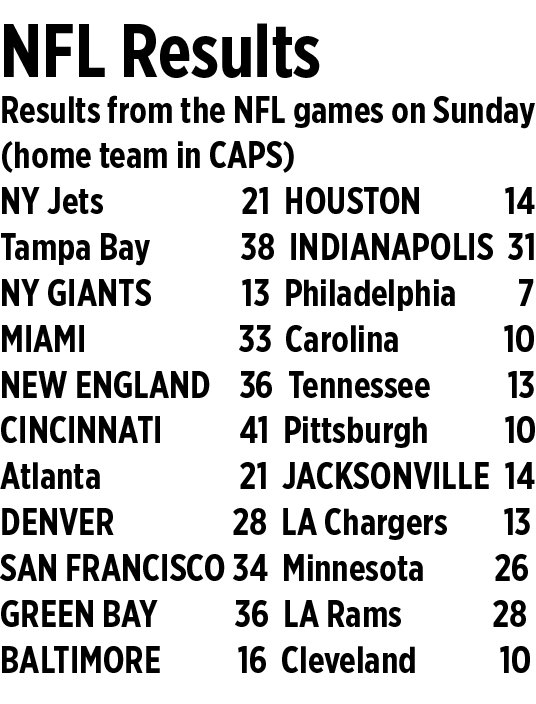
MAC Jones passed for a career-high 310 yards and two touchdowns (TD) as the host New England Patriots (NE) defeated the Tennessee Titans (36-13) for their sixth straight win on Sunday in Foxborough, MA.

The rookie quarterback completed 23 of 32 passes and eclipsed his previous high of 307 yards in New England’s 54-13 rout of the New York Jets on Oct. 24. Kendrick Bourne made a pair of TD catches on Sunday while Jakobi Meyers had a team-high 98 receiving yards for the Patriots (8-4).

The Patriots’ league-leading winning streak is their longest since they opened the 2019 season with eight straight victories.

Dontrell Hilliard rushed for a career-best 131 yards and a touchdown on 12 carries for Tennessee (8-4). The fourth-year rusher was elevated from the practice squad by the injury-depleted Titans ahead of last week’s loss to Houston.

D’Onta Foreman also rushed for 109 yards on 19 carries. Ryan Tannehill passed for 93 yards on 11-of-21 passing with one touchdown and an interception for Tennessee.

It was the Titans’ second straight loss following a six-game winning streak. Tennessee held the No. 1 seed in the conference coming into the day. New England entered as the third seed behind the Baltimore Ravens (7-3), who host Cleveland on Sunday night.

New England led 16-13 at half time. Nick Folk’s fourth of five field goals had the Patriots on top 19-13 early in the third.

Late in the quarter, Jones connected with Bourne for a 41-yard score down the sideline that was set up by a timely block from Meyers.

Folk added a 52-yarder in the fourth quarter before Damien Harris rushed for a 14-yard touchdown with 4:38 remaining to put the game away.

The Patriots scored on their first possession of the game, with Jones hitting Bourne on a 4-yard fade in the corner of the end zone to make it 7-0 with 7:37 left in the first quarter.

Nick Westbrook-Ikhine dove low into the end zone on a 1-yard pass from Tannehill with 14:29 to play in the second quarter, but Randy Bullock missed the extra point.

Three straight Folk field goals put the Patriots up 16-6 before Hilliard broke loose for a 68-yard touchdown run with 37 seconds left before half time. — Reuters

James scores 33 points to lead Lakers past Pistons

DETROIT Pistons center Isaiah Stewart (28) is defended by Los Angeles Lakers forward LeBron James (6) and guard Avery Bradley (20) in the first half at Staples Center. — REUTERS

LEBRON James recorded 33 points and nine assists to help the Los Angeles Lakers notch a 110-106 victory over the visiting Detroit Pistons on Sunday night.

Russell Westbrook had 25 points and nine assists and Anthony Davis contributed 24 points and 10 rebounds as the Lakers won for just the third time in the past eight games.

Jerami Grant scored 32 points but couldn’t prevent Detroit from losing its sixth consecutive game.

Frank Jackson added 17 points, Cade Cunningham registered 15 points and 11 rebounds, Trey Lyles scored 13 points and Hamidou Diallo tallied 10 for the Pistons.

The contest was a rematch of the game in Detroit seven days earlier when James and Detroit’s Isaiah Stewart were involved in a wild fracas that saw James suspended for one game and Stewart for two contests. There were no incidents this time.

Last week in Detroit, the episode began when James struck Stewart in the face with his left fist as the two battled for positioning at the free-throw line. An enraged Stewart attempted to get at James multiple times despite blood flowing out of a huge gash on his face.

Stewart had five points and six rebounds in 27 minutes on Sunday night.

Talen Horton-Tucker added 12 points for the Lakers, who made 50% of their field-goal attempts, including 9 of 32 from 3-point range.

Detroit shot 42.7% from the field and was 13 of 33 from behind the arc.

The Pistons recovered from a 19-point deficit to trail 108-102 on Grant’s basket with 1:21 remaining.

Grant made two free throws to cut the deficit to four with 16.7 seconds left. He later scored on a dunk with 2.1 seconds to play to pull Detroit within 109-106 before Horton-Tucker split two free throws with 0.9 seconds left to put the game away.

Earlier, Grant’s dunk tied the score at 56 with 9:12 left in the third quarter before the Lakers made seven straight shots during a 16-0 burst.

James scored seven points during the run, which was completed by Davis’ dunk with 5:24 left in the period.

Horton-Tucker drained a 3-pointer to increase the advantage to 77-58 with 3:43 remaining but Detroit narrowed its deficit to 83-70 entering the final stanza.

The Pistons made a spirited run and pulled within 99-93 on Jackson’s basket with 4:38 left.

James (15), Westbrook (14) and Davis (13) combined for 42 first-half points as the Lakers led 51-48 at the break. — Reuters

Messi in assist mode as Paris St.-Germain routs 10-man St.-Étienne, 2-0

SAINT-ÉTIENNE, France — Lionel Messi set up all three goals as Paris Saint-Germain (PSG) stretched their Ligue 1 lead to 12 points with a 3-1 comeback win at 10-man Saint-Étienne on Sunday, while Neymar was taken off on a stretcher with a possible ankle injury.

PSG made the most of Timothée Kolodziejczak’s red card on the stroke of half time. Messi fed Marquinhos for two headed goals and Angel Di Maria struck to seal a clinical turnaround after Les Verts had opened the scoring through Denis Bouanga.

The result put the capital side on 40 points from 15 games, with Stade Rennais leapfrogging Nice into second after goals by Gaetan Laborde and Jeremy Doku earned them a 2-0 win at Lorient, their sixth victory in their last seven league games.

St.-Étienne, who mounted a decent challenge despite being a man down as snow fell on the Geoffroy Guichard stadium, is now bottom of the standings with 12 points.

The game marked Sergio Ramos’s debut for PSG, almost five months after joining from Real Madrid as a free agent, and the Spaniard started in central defense alongside Marquinhos. — Reuters

League leader Chelsea held 1-1 by Manchester United

MANCHESTER United put their worries to one side to frustrate Premier League leader Chelsea with a 1-1 draw at Stamford Bridge on Sunday as Jadon Sancho scored a breakaway goal that was canceled out by a Jorginho penalty.

Chelsea, under pressure after Manchester City and Liverpool both won earlier over the weekend, were dominant against a United side playing their first Premier League match under caretaker manager Michael Carrick after Ole Gunnar Solskjær’s sacking last weekend.

But the Blues were punished for failing to turn possession into goals five minutes after the restart when United cleared a Chelsea free kick and Jorginho — on his own near the halfway line — miscontrolled the high ball, allowing Sancho to race past him and beat the helpless Edouard Mendy.

Chelsea was rocked by the goal against the run of play but Jorginho repaid his debt to the Stamford Bridge faithful in the 69th minute when he coolly converted a penalty after Aaron Wan-Bissaka had fouled Thiago Silva.

The hosts brought on Romelu Lukaku, returning from injury as a substitute for the last 10 minutes, but they failed to find a way through United’s defense.

Fred had United’s best late chance to snatch a winner after a Mendy error but he wasted his shot. Then Antonio Rudiger, who had hit the crossbar in the first half, missed with a volley in almost the last kick of the game.

“We were the better team, we were the team who invested in this game to win,” Chelsea coach Thomas Tuchel told BBC Radio.

“We tried to win it from the first to the last minute. We had full control in all moments except one. We dealt with it. We came back… There is nothing to worry (about).”

United goalkeeper David de Gea, who pulled off a string of saves to keep his side in the game, sounded like a relieved man after Chelsea racked up 24 shots to United’s three.

“On the pitch, in the goal, I was feeling danger for nearly the whole game,” De Gea told Sky Sports. “We defended well, they missed big chances and the one they give us… we score. It is not enough to draw but at the moment it is a big point.”

The result leaves Chelsea top of the table, a point ahead of Manchester City and two clears of Liverpool. United sit in eighth place, 12 points behind Chelsea.

Carrick dropped Cristiano Ronaldo to the bench as he sought to frustrate Chelsea with a defense-focused approach but he brought on the Portuguese star in the second half.

The former United midfielder looks likely to step aside soon after the club announced German coach Ralf Rangnick will take over as interim manager until the end of the season. — Reuters

Chan’s par putt clinches win in first Asian Tour event of 2021

TAIWAN’S Chan Shih-chang rolled in a four-foot par putt on the final hole to win the $1-million Blue Canyon Phuket Championship on Sunday as the Asian Tour returned to action for the first time in almost two years.

Chan pipped playing partner Sadom Kaewkanjana for the $180,000 first prize as he finished on 18-under for the tournament, one shot clear of the Thai golfer.

Sadom had looked set to take the tournament into a playoff but had his first dropped shot of the day when he missed a six-foot par putt on the last hole, dropping him into a share for second with South Korea’s Kim Joo-hyung.

Chan had started the day tied for the lead with Sihwan Kim from the United States and the American appeared to be cruising to the title despite starting his final round with a bogey.

Kim reached the 10th four-under for the day after a run of three successive birdies from the eighth and, at one point, he held a three-shot lead. That all changed on the back nine.

A bogey at the par-4 13th reduced Kim’s lead to a single stroke and by the time he had holed out at the 15th, the 33-year-old was in a three-way tie with Sadom and Chan, who had pulled level on 17-under after both birdied the par-5.

Sadom and Chan then birdied the 16th to leave Kim adrift for the first time and a bogey at the par-3 17th meant he eventually finished in a four-way tie for fourth.

That turned the tournament into a final hole shootout and, after both Chan and Sadom missed the green with their approach shots, the Taiwanese golfer claimed the title when he rolled in his par putt following Sadom’s miss.

The event was the first on the Asian Tour since the Malaysian Open in March 2020 due to the ongoing pandemic.

It comes a month after the organization announced it would be launching 10 new events in 2022 in partnership with LIV Golf Investments, a company backed by Saudi Arabia’s Public Investment Fund, worth a total of $200 million. — Reuters

Champion Spain out of Davis Cup after loss to Russia; Serbia through

CHAMPION Spain was knocked out of the Davis Cup as favorites Russian Tennis Federation booked their spot in the quarterfinals with a thrilling victory in Madrid.

Spanish duo Marcel Granollers and Feliciano Lopez needed to win their doubles decider to send Spain through at Serbia’s expense, but Aslan Karatsev and Andrey Rublev came from a set down seal a 4-6, 6-2, 6-4 victory and top spot for Russia in Group A.

Sweden and Novak Djokovic’s Serbia took the two best runners-up spots and a place in the last eight by virtue of their better match win-loss records among the second placed sides throughout the group stages.

Spain needed to win the tie against Russia to progress to the last eight, with the 40-year-old Lopez defying his years to storm back from a set down and get the better of world number five Rublev, getting the defending champions off to the perfect start in Madrid.

Rublev had just picked up his 50th win of the year the previous day, with his power hitting seeing him take the first set, before Lopez turned things around to win the match 2-6, 6-3, 6-4.

US Open champion Daniil Medvedev settled any Russian nerves in the second singles rubber against Pablo Carreno Busta after making a blistering start to the first set, racing into a 4-0 lead in under 11 minutes, before taking it 6-2.

The world number two made hard work of the second, eventually coming through in a tie-break to win the match and take the tie to a doubles decider, with Russia dramatically edging a tight tussle to end Spain’s hopes of retaining their title.

“We were very close but it was not enough,” said Lopez.

“It is what it is and I don’t want to give excuses. We showed everyone that we are ready to compete in any conditions, even with so many issues that we went through. It’s so disappointing.”

Germany secured top spot in Group F and a quarterfinal against Britain after battling to a 2-1 success over Austria, with Kevin Krawietz and Tim Puetz sealing their progress with a straight-sets victory in the final doubles decider.

Colombia’s 2-1 victory over the United States in Turin mattered little as they finished second behind Italy in Group E, unable to grab one of the best runners-up spots, as 32-times champions the US slipped out with a whimper.

Croatia, Kazakhstan and Britain progressed to the quarterfinals earlier on Sunday after the trio topped their respective groups, while 28-times champion Australia was knocked out.

Britain got off to a poor start against the Czech Republic as they looked to secure top spot in Group C.

Dan Evans lost his singles rubber against Tomas Machac, before British number one Cameron Norrie managed to level and doubles pair Joe Salisbury and Neal Skupski won in straight sets to take the tie 2-1 and secure top spot ahead of France.

The first quarterfinal gets under way on Monday, as Italy hosts Croatia in Turin, before Britain faces Germany in Innsbruck, Austria the following day. — Reuters

Peso strengthens as oil prices drop

BW FILE PHOTO

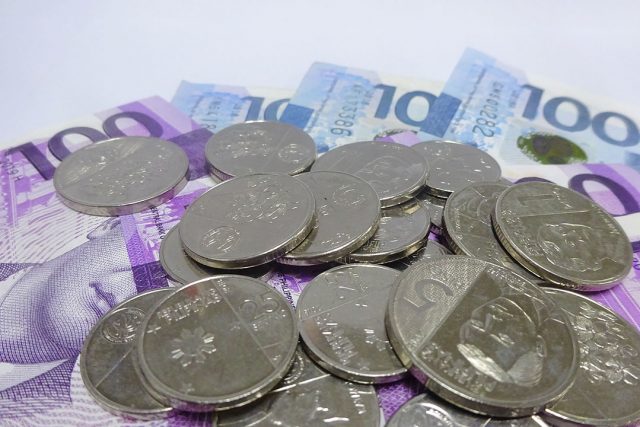
THE PESO rebounded versus the greenback on Monday as oil prices declined due to concerns over the Omicron coronavirus variant.

The local unit closed at P50.39 per dollar on Monday, gaining four centavos from its P50.43 finish on Friday, data from the Bankers Association of the Philippines showed.

The peso opened Monday’s session at P50.50 per dollar, which was also its worst showing for the day. Meanwhile, its intraday best was at P50.33 against the greenback.

Dollars exchanged dropped to $819.3 million on Monday from $1.15 billion on Friday.

A trader said the peso gained versus the dollar due to the sudden decline in oil prices amid fears over the impact of the Omicron variant on global economic activity.

Bloomberg reported Friday that oil prices dropped by more than 11% on Friday as the market feared the possibility of the return of lockdowns could hurt global demand for oil. On Monday, oil prices recouped some of their losses.

Meanwhile, Rizal Commercial Banking Corp. Chief Economist Michael L. Ricafort said sentiment was also affected by the government’s national vaccination drive.

The Philippines aims to vaccinate nine million from Nov. 30 to Dec. 1 to put the country closer to its goal of vaccinating 70 million Filipinos by yearend. It has fully vaccinated 40.58% of its population, based on data from the Johns Hopkins University.

Financial markets are closed on Tuesday in observance of Bonifacio Day.

For Wednesday, Mr. Ricafort gave a forecast range of P50.30 to P50.50, while the trader expects the peso to move within P50.30 to P50.55 per dollar. — L.W.T. Noble with Bloomberg

PHL shares decline as investors dump risky assets

REUTERS

STOCKS went down on Monday as investors veer away from risky assets due to concerns over the new coronavirus disease 2019 (COVID-19) variant called Omicron.

The 30-member Philippine Stocks Exchange index (PSEi) declined 77.56 points or 1.06% to finish at 7,200.88 on Monday, while the all shares index fell 33.26 points or 0.85% to close at 3,838.13.

“Philippine shares plunged to end the month of November as the new COVID-19 variant found in South Africa triggered a global shift away from risk assets,” Regina Capital Development Corp. Head of Sales Luis A. Limlingan said.

Financial markets are closed on Tuesday, Nov. 30, in observance of Andres Bonifacio Day.

The new COVID-19 variant has pushed various governments to impose stricter border controls as it spread to more countries, Reuters reported.

Initially detected in South Africa last week, the Omicron variant — which the World Health Organization described as more transmittable than other variants — has cases found in Hong Kong, Britain, Germany, Italy, Belgium, Botswana, Israel, Hong Kong, Netherlands, Denmark, and Australia.

Asian markets were trying to regain some composure on Monday as the spread of the Omicron variant in developed nations threatened to derail economic recoveries and the tightening plans of some central banks, Reuters reported separately.

MSCI’s broadest index of Asia-Pacific shares outside Japan was down 0.2%, but with few markets yet open.

“The PSEi was also lower after the target vaccination versus COVID-19 from Nov. 29 to Dec. 1 was reduced to 9 million,” Rizal Commercial Banking Corp. Chief Economist Michael L. Ricafort said in a Viber message on Monday.

The government is holding a three-day nationwide vaccine drive to push the country closer to its target to inoculate 70% of the population or nearly 54 million by yearend. A second leg will happen on Dec. 15 to 17.

Majority of sectoral indices closed in the red on Monday except services, which gained 10 points or 0.50% to finish at 1,986.48.

Meanwhile, industrials slid 181.67 points or 1.71% to 10,439.75; holding firms decreased 107.43 points or 1.52% to 6,932.84; financials dipped 16.65 points or 1.04% to 1,569.85; property lost 27.18 points or 0.81% to 3,297.13; mining and oil slipped 44.76 points or 0.47% to 9,440.56.

Value turnover increased to P28.02 billion with 2 billion issues switching hands on Monday from the P9.97 billion with 1.04 billion shares traded on Friday.

Decliners outnumbered advancers, 150 versus 57, while 45 names closed unchanged.

Foreigners turned buyers anew, logging P651.50 million in net purchases versus the P545.03 million in net sales seen on Friday.

“In the remaining days of the week, we’ll have to see if 7,060 holds, otherwise, 7,454.50 seems to be the closest resistance level,” Timson Securities, Inc. Trader Darren Blaine T. Pangan said in a Viber message. — M.C. Lucenio with Reuters

Singapore, Malaysia reopen land border amid worries over the Omicron variant

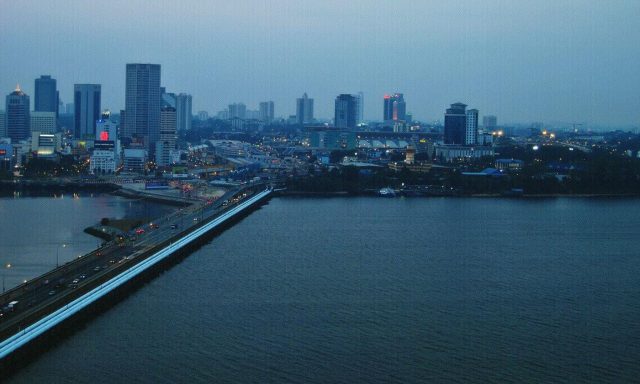
Image via Schristia/CC BY 2.0/Wikimedia Commons

SINGAPORE — Singapore and Malaysia reopened one of the world’s busiest land borders on Monday, allowing vaccinated travelers to cross after nearly two years of being shut due to the coronavirus disease 2019 (COVID-19) pandemic.  

Although travelers welcomed the chance to reunite with family and friends, there were concerns the border might be closed again due to the new Omicron coronavirus variant.  

As many as 300,000 Malaysians commuted daily to Singapore before the pandemic. The sudden closing of the border in March 2020 left tens of thousands stranded on both sides, separated from families and fearing for their jobs.  

At the Queen Street bus terminal in Singapore, a few dozen people waiting to board the first buses to Malaysia expressed caution.  

“The borders may close soon because of the new variant,” said Eugene Ho, a 31-year-old banker leaving Singapore for the first time in nearly two years. “I am actually very worried about getting stuck.”  

Travelers must test negative for COVID-19 before departure, and also take an on-arrival test.  

Malaysia’s health minister Khairy Jamaluddin said on Monday one traveler had tested positive to a rapid antigen test, noting some COVID-19 cases were inevitable.  

“What’s important is our diagnostic capabilities and requirements, and the risk assessment steps to be taken when something like this happens,” he said.  

Malaysian Prime Minister Ismail Sabri Yaakob was welcomed by Singaporean Prime Minister Lee Hsien Loong at one of the land border crossings on Monday, his first official visit as premier to Singapore.  

Both countries were aiming to include general travelers in this reopening plan from mid-December onwards, Mr. Lee said during a joint news conference.  

Under the latest arrangement, up to 1,440 travelers from either side can cross the land border per day without quarantine, if they hold citizenship, permanent residency or long-term visas in the destination country.  

Siva Kumar, a 41-year-old engineer in the semiconductor industry based in Singapore, said he had been inundated with calls from his two teenage sons waiting eagerly for his return to Malaysia.  

“All morning they keep calling, ‘Where are you now? Have you taken the bus yet?,’” Mr. Kumar said. “[I want to] hug them, kiss them. I’ve really missed them.”  

The first flights operating under an air travel lane for vaccinated passengers between the two countries also arrived in both countries on Monday.  

Singapore has vaccinated 85% of its entire population, while about 80% of Malaysia’s population has been inoculated.  

With an aging population of 5.5 million, Singapore relies heavily on Malaysians living in the southern state of Johor to staff businesses ranging from restaurants to semiconductor manufacturing.  

Singapore reported 747 locally acquired COVID-19 cases on Sunday, its lowest tally since mid-September. Malaysia reported 4,239 cases on Sunday, the smallest number since early November. — Joe Brock and Chen Lin/Reuters