Home Blog Page 6639

RTL can modernize the country’s rice industry and lock in rice security

JCOMP-FREEPIK

Presidential candidate Ferdinand Marcos, Jr. had recently articulated his support for reversing the rice tariffication law (RTL). He decried the so-called many “unintended consequences” of RTL for the country’s rice farmers. He said his government would usher back the old policy of using rice imports as a last resort to protect rice farmers. He wants the National Food Authority (NFA) to resume its role not just as a rice importer but also a regulator of rice prices.

The RTL or Republic Act 11203, enacted nearly two years ago, liberalized rice imports, ending the nearly half a century of the NFA’s monopoly of rice imports. It lowered import tariffs on rice from 50% to the country’s ASEAN rate of 35% and made the NFA, powerful food price regulator, into a mere trader and keeper of the country’s emergency rice stocks.

Those who have opposed RTL, like the Federation of Free Farmers (FFF), continue to push for reversing the law. FFF have argued that the net gain of RTL to all Filipinos, while positive, comes at the expense of rice farmers and favors rice importers and wholesalers/retailers. Not even consumers, on whose behalf the RTL was enacted to reduce rice price inflation, have registered significant gains, garnering only nearly a quarter of a billion pesos yearly. The number pales in comparison with the losses of rice farmers which FFF estimated at about P40.34 billion. Even rice millers lost. The biggest gains went to importers and traders, who siphoned off about P57 billion yearly.

Studies on the impact of RTL, which make use of economic models of the country — like Balié, J. and Valera, G., 20201; Perez, N. Pradesha, A. 20192; Cororaton, C., and K. Yu., 20193; and Briones, R. 20184 – had found that the net gain to Filipinos is positive. Rice farmers lose from rice tariffication, but this is more than offset by the gains of rice consumers, who include rice farmers. Balié, J. and Valera, G., 2020 estimated that 89% of Filipinos are net buyers of rice.

The other group of studies is comprised of ex-post assessments on the economic impact of RTL on various stakeholders. PhilRice (2019)5 estimated that around 1.6 million or 55% of rice farming households are smallholders, growing rice on smaller than a hectare field. This implies that although over half of the country’s farmers might have lost from lower farm prices during harvest because of the reform, they nonetheless gain as rice consumers in the rest of the year as consumers.

Adriano, K. et al. (2020)6 focused on the impact of RTL on inflation rate, which peaked at more than 6% in the third quarter of 2018 due largely to the delayed and limited rice imports. In just two quarters of RTL implementation in 2019, the inflation rate significantly dropped to its lowest level at less than 2%, as rice constitutes almost 10 percentage points in the computation of the consumer price index.

Do rice farmers have to lose for the rest of society to gain from RTL? No, not all rice farmers lose, only those farm households who are net sellers of rice since RTL lowered the protection accorded to rice farmers. The majority of rice farm households gained since they are more rice consumers in most times of a year as PhilRice has noted.

There are two things we can do to cushion the losses of rice farmers due to RTL, but those exclude reversing RTL. Restoring rice trade protection will come at the expense of rice consumers, majority of whom are poor. According to Adriano et al. (2020), the highest retail price of regular milled rice in 2018 averaged around P45 per kilogram. Immediately after the RTL passage, the price went down to an average of P37 from September to December 2019. That is a significant help to the majority of the voting population of the country and their families.

One way to cushion farmers’ losses, which is done by RTL, is to use the tariff revenues from rice imports to invest in raising the productivity of rice farmers. RTL created the Rice Competitiveness Enhancement Fund or RCEF. While several analysts had criticized how RCEF had been designed, having the fund is already a good start at ensuring rice farmers can increase productivity.

Higher rice productivity can undo the current disadvantage of rice farmers with production costs remaining high, even as return to rice farming had gone down because of RTL. FFF National Chairman Raul Montemayor, citing a survey they made of rice production costs in several places of the country, decried the net income squeeze RTL had induced. But with higher yields, rice farmers can regain partly the loss they suffer from reduced trade protection.

Production costs can go down. RCEF can be more effective in raising productivity if rice farms are clustered or larger because of scale economies. About half of the fund is devoted to mechanization, the incremental productivity of which is higher with larger farms.

Per hectare production costs are high because of rice farm fragmentation, thanks to the comprehensive agrarian reform program (CARP). CARP has forced rice farmers to become small holders, and thus their leverage for reducing production costs has been greatly reduced. The government may consider promoting the clustering of rice farms into cooperative farming as a condition for them getting RCEF assistance. Perhaps, we can also consider getting rid of the ceiling farm size of five hectares under CARP in order to reduce production costs.

The second way is to modernize rice milling and domestic trading. Jandoc and Roumasset (2019)7 had observed that the larger share of the higher price that consumers pay for rice goes to traders and millers, not to rice farmers. If the government reverses the RTL, the higher protection would only sustain the low productivity in rice milling and trading. The two authors estimated that about three-fourths of the price did not go to rice farmers, but to rice traders and millers.

If we use part of RCEF to modernize rice milling, that could significantly increase the farmgate price of palay (unmilled rice). The losses of rice millers that the FFF had noted could reflect that rice mills with relatively low milling conversion rates had to exit the business because of RTL. That can be undone with investments in more efficient rice mills.

In RTL, we have the opportunity of modernizing our rice industry. With rice trade liberalization, consumers are already benefiting from lower rice prices, and we don’t have to spend taxpayer money to sustain the operation of the NFA. We need, however, to raise productivity of rice farming and milling efficiency to cushion if not to completely offset the losses of rice farmers and millers. RCEF investments, farm clustering, getting rid of land market restrictions under CARP, and investments in modern rice mills can make the good vision of RTL happen.


1 See Balié, J., Valera, G. 2020. Domestic and international impact of the rice trade policy reform in the Philippines. Food Policy 92. www.elsevier.com/locate/foodpol.

2 See Perez, N. Pradesha, A. 2019. Philippine rice trade liberalization: Impacts on agriculture and the economy, and alternative policy actions. NEDA-IFPRI Policy Studies June 2019. Washington, DC: International Food Policy Research Institute (IFPRI).

3 See Cororaton, C., & K. Yu. 2019. Assessing the Poverty and Distributional Impact of Alternative Rice Policies in the Philippines. DLSU Business & Economics Review 28(2): 1.

4 Briones, R. 2018. Scenarios for the Philippine Agri-Food System with and without Tariffication: Application of a CGE model with Endogenous Area Allocation. Discussion Paper Series No. 2018-51. Quezon City: PIDS.

5 PhilRice. (2019). Rice Tariffication Law (Republic Act 11203). FAQs Rice Competitiveness Enhancement Fund (RCEF), Series no. 2. Retrieved from https://www.philrice.gov.ph/wp-content/uploads/2019/09/RCEF_FAQ02-RiceTariff.pdf.

6 Adriano, F., Adriano, L., Adriano, K. 2020. Philippine Rice Tariffication Law — A year and a half later: Challenges and Opportunities. ADB paper, unpublished.

7 Jandoc, K. and Roummaset, J. 2018. Rice Tariffication and its Role in Reducing Rice Prices. Unpublished paper.


Ramon L. Clarete is a professor at the University of the Philippines School of Economics.

How well has the economy bounced back in 2021?

The year 2020 will be remembered as the year that broke our 21-year streak of steady economic expansion.

COVID-19 triggered a five-quarter GDP contraction that caused the economy to shrink by 9.6% in 2020 and by 4.2% in the first quarter of 2021. Along with the contraction came a spike in our national debt to 60.4% of GDP (first quarter 2021) and a bloated budget deficit of 7.5% of GDP. COVID caused unemployment and poverty rates to balloon to 10.3% and 16.2%, respectively. Nearly 30% of all MSMEs went on indefinite hiatus or have closed permanently. Bar none, 2020 will go down on history as one of our most horrible years since becoming a self-governing republic.

Thanks to the availability of the vaccine, the long trek towards economic recovery began in the second quarter of 2021. Although the economy will only attain full recovery by the third quarter of 2022 (when output matches pre-pandemic levels), the year 2021 will be remembered as a year of healing.

As 2021 comes to a close, let us assess the extent by which the economy bounced back.

Between January to September, gross domestic product clocked-in a growth rate of 4.9%. The fourth quarter is rather encouraging given the benign rates of COVID infections and the extent by which the economy has opened up. That said, experts expect a 7% expansion in the fourth quarter. This should put the whole year growth rate well within the upper rung of government’s projections of 5.5%.

Inflation has been a festering problem principally due to the shortage of pork resulting from the Asian Swine Flu. Between January to October, inflation averaged 4.5% which negated economic growth in as far as buying power is concerned. The BSP (Bangko Sentral ng Pilipinas) forecasts yearend inflation to be at 4.3%, a figure seconded by the IMF.

The national debt burden remains high. It stood at 54.4% of GDP as of the end of 2020 and ballooned to 63.1% as of the third quarter of this year. We do not expect debt levels to decrease below the 60% threshold until 2023. Naturally, the high intake of debt caused gross international reserves to reach $107.9 billion as of the end of October. The BSP is awash with cash with M3 liquidity ratio at a comfortable 8.2%.

Massive spending by government worsened the budget deficit, from 7.5% of GDP as of the end of 2020 to 9.3% of GDP as of last September. It does not look like it will ease substantially by year end. Suffice it to say that the next administration will be left with the burden to balance the budget.

As for our foreign exchange earners, merchandise exports are seen to rebound by 14% in 2021 after posting an 8.6% contraction in 2020. The IT-BPM sector is seen to expand by 10% this year, following a 1.3% contraction last year. OFW remittances have remained resilient and will increase by 5.6% this year after shrinking by 1% last year. Our intake of foreign direct investments in 2020 was at $6.4 billion. This amount was surpassed as early as August this year. We are hopeful that FDI intake will surpass the 2019 intake of $8.7 billion.

The banking system is stable and strong. Non-performing loans stand at 4.4% while the capital adequacy ratio is at 17%, well above the 10% requirement of the BSP. Loans provided by banks increased by 2.7% this year.

So, what is the prognosis for 2022?

Assuming the attainment of herd immunity and the absence of lockdowns, we see the economy expanding by 7% to 9%. Inflation will ease to 3%, assuming the Department of Agriculture acts decisively on the pork shortage issue. Merchandise exports will grow by 6%, but will be outpaced by imports which will grow by 10%. Service exports, driven by the IT-BPM industry, will expand by 7%. Foreign direct investments are seen to reach $7.5 billion, but can potentially balloon to over $10 billion if the next president enjoys high confidence. The budget deficit will be a festering problem and so will high debt levels. But, like I said, this will be for the next administration to fix.

Although the prospects for 2022 seems sound, it is still contingent on the absence of another COVID surge and peaceful elections.

All this considered that the next administration will be inheriting a fundamentally weaker economy than Mr. Duterte did in 2016.

It will be incumbent on the next administration to future-proof the economy and this will require radical reforms. New laws will have to be enacted and/or existing laws will have to be amended to make the country a more competitive investment destination; increase manufacturing competitiveness; improve agriculture conditions and land use; improve education to better capacitate the workforce; curtail corruption by digitizing government functions; break down oligopolies; and widen capital markets, among many others.

The good news is we know exactly what to do fully maximize the potentials of the economy — but I will save that discussion for another day. Suffice it to say that 2021 was a good year in that we were able recover most of the ground lost in 2020. For that, we are grateful. I wish you all a Happy New Year!


Andrew J. Masigan is an economist

andrew_rs6@yahoo.com

Facebook@AndrewJ. Masigan

Twitter @aj_masigan

The five biggest US PR blunders of 2021

PIKISUPERSTAR-FREEPIK

It’s been a year of big challenges for many companies, with an ongoing pandemic, labor shortages, supply-chain bottlenecks and record inflation. As if all this weren’t enough, some corporations added to their own afflictions with self-made crises caused by dreadful public-relations judgment.

Back, by popular demand, here are my picks for the five worst corporate PR decisions of the year:

1: PELOTON’S AND JUST LIKE THAT… IMBROGLIO.
After a year off my list, this repeat offender returns thanks to a dizzying succession of stupid and savvy PR decisions. First, a company representative said Peloton didn’t know Mr. Big would die after riding its bike when it gave permission for one of its instructors to appear in the sequel series to Sex and the City.

That was its first fatal mistake (pun intended). Its stock dropped 11.3%, to a 19-month low. Moral of the story: Insist on knowing storylines before agreeing to product placement or guest appearances.

Next came some smart moves: The company argued that the fictional Mr. Big’s lifestyle was to blame for his heart disease, and exercise likely prolonged his life. While it’s unfortunate that a lack of foresight left Peloton in the position of needing to make this self-serving argument in the first place, it was also accurate. Peloton quickly threw together an ad with actor Chris Noth (who played Mr. Big) along with the Peloton instructor, claiming “he’s alive.” Critics applauded. Its stock rose over 7%.

Then came the latest twist: Noth has been accused of sexual assault by two women (allegations he denies). Peloton pulled the ad. Next moral of the story: Conduct thorough background investigations on any potential staffers or partners before working with them. If this ad hadn’t been pulled together in such a rush, it’s possible the company could have sussed out these potential problems — though investigations are never, of course, foolproof.

Another shrewd decision: Peloton promptly pulled the ad. The company deserves plaudits for responding — by both releasing and recalling the ad — in the “golden hour” of crisis response. Just as someone having a heart attack is more likely to survive if they get to the hospital within an hour, organizations have to respond speedily to crises in order to survive with their reputations intact.

But the even savvier approach is to avoid creating them in the first place.

2: MORGAN STANLEY CHIEF EXECUTIVE JAMES GORMAN’S TO EMPLOYEES IN JUNE, SAYING “WE’LL HAVE A DIFFERENT KIND OF CONVERSATION” IF THEY WEREN’T BACK IN THE OFFICE BY LABOR DAY.
Gorman did say that the policy wouldn’t be “dictatorial” and that staffers could do some work from home. And to his credit, he now acknowledges he was wrong about the pandemic. “I thought we would have been out of it past Labor Day, and we’re not,” he said earlier this month.

The first lesson (which should have been obvious even in June) is that the coronavirus isn’t predictable. But that’s not the only thing Gorman was wrong about. Amid the Great Resignation, as workers quit their jobs en masse and search for better work-life balance, burnishing a reputation as an inflexible, insensitive employer is a surefire means of scaring talent away.

3: BETTER.COM CHIEF EXECUTIVE VISHAL GARG’S FIRING 900 STAFFERS ALL AT ONCE.
Lesson: Word of how companies treat their staffers gets around quickly. After communicating this decision so tactlessly, Better.com is unlikely to be able to successfully recruit top talent when it needs to hire again. (The company now says Garg is “taking time off.”)

4: TESLA AND SPACEX CHIEF EXECUTIVE ELON MUSK IN A DISPUTE OVER TAXES.
This leader — who, as I’ve said, didn’t have an ego in need of stroking when he was designated Time’s “Person of the Year” earlier this month — clearly feels emboldened by all the attention. But cultivating a reputation as a troll rather than as a trustworthy leader stands to backfire on Musk in the future when lawmakers take up inevitable big questions about legislating driverless vehicles and space travel.

5: THE AFTER THE NOMINEES WERE OFFICIALLY ANNOUNCED.
Although the National Academy of Recording Arts and Sciences is a nonprofit organization, I’m sneaking this snafu onto my list because its members are big players in the industry. After the academy received questions about Chorney’s exclusion, it claimed the indie singer and songwriter wasn’t added to the list until her nomination was cleared under an audit performed by Deloitte.

A few lessons to other organizations: Get your facts straight before making announcements and anticipate eminently foreseeable controversies like this one before creating them. It’s also extraordinary that executives still need to be reminded to include members of underrepresented groups like independent artists in everything they do. (In 2012, Chorney was accused of “gaming the system” by promoting herself to people who voted for nominees, even though she didn’t break any rules. But how else is an independent artist supposed to gain recognition?)

After years of writing these lists, one thing is clear: Companies are great at creating their own public-relations problems. In fact, when I created a new online public-relations graduate program at Hofstra University last year, I included a mandatory concentration in reputation and crisis management because I’ve come to believe the most important skill PR executives can learn is how to protect their organizations from self-inflicted harm. Here’s hoping some of these lessons sink in before next year’s column.

BLOOMBERG OPINION

DeMar DeRozan wins it at buzzer again for Bulls

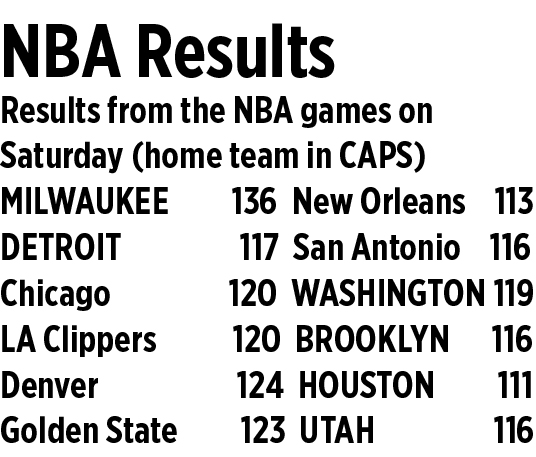
DEMAR DeRozan knocked down a game-winning, buzzer-beating 3-pointer for the second time in as many nights to cap the Chicago Bulls’ come-from-behind, 120-119 defeat of the host Washington Wizards on Saturday.

Coby White triggered a sideline inbounds pass to DeRozan with 3.3 seconds remaining. After getting the defender to leave his feet with a pump fake in the corner, DeRozan fired a double-clutching 3-pointer that went in.

DeRozan capped the Bulls’ win Friday at Indiana with a running 3-pointer at the buzzer. He is the first player in NBA history to hit game-winning buzzer-beaters in back-to-back days.

DeRozan was one of four Bulls to score at least 20 points, going for 28. Nikola Vučević recorded a double-double with 22 points and 12 rebounds, White shot four-of-eight from 3-point range en route to 20 points and Zach LaVine led all scorers with 35 points.

LaVine scored 15 of his points in the first quarter and hit four-of-five from 3-point range in the period to help keep the Bulls close. He finished seven-of-12 from deep, pacing Chicago to a blistering 17-of-34 from beyond the arc.

The Bulls’ 3-point shooting countered a 72-30 advantage in points in the paint for the Wizards.

Washington surged ahead in the opening period and led for most of the way, extending its lead to as many as 13 points. Kyle Kuzma led the Wizards with a season-high 29 points, the last of which came on a 3-pointer with four seconds remaining.

Kuzma’s basket gave Washington a 119-117 lead after DeRozan had made a pair of free throws with 49.2 seconds left to give Chicago a lead. Kuzma missed on the subsequent possession but grabbed the last of his game-high-matching 12 rebounds.

Saturday was Kuzma’s third straight game scoring at least 20 points, the first time he has done that since December 2018.

Bradley Beal added 27 points and dished a career-high 17 assists in the loss. Daniel Gafford went 9-of-10 from the floor for 19 points, and Kentavious Caldwell-Pope notched 13 points. — Reuters

Man City marches on as Spurs, Hammers keep up in chase for fourth

MANCHESTER CITY’S Rodri (16) scores their second goal. — REUTERS

MANCHESTER City moved 11 points clear at the top of the Premier League after a last-gasp goal from Rodri gave them a 2-1 victory at fourth-placed Arsenal on Saturday in a controversy packed game at the Emirates stadium.

The battle for the top four places looks set to be a close one with Tottenham Hotspur also leaving it very late for a 1-0 win at Watford and West Ham United enjoying a 3-2 victory at Crystal Palace.

City’s title rivals Chelsea and Liverpool meet on Sunday with both sides knowing defeat would leave them with huge ground to make up on Pep Guardiola’s side, who are targeting back-to-back titles.

No team has failed to win the Premier League after beginning January with a lead as big as City’s.

The defending champions are on 53 points from 21 games, Chelsea are second on 42 points from 20 matches and Liverpool are third on 41 from 19.

Arsenal will feel hard-done by after a good performance despite playing the last half hour with 10 men following the sending-off of defender Gabriel.

The Gunners, whose manager Mikel Arteta missed the game after testing positive for coronavirus disease 2019 (COVID-19), took the lead when Bukayo Saka finished a sweeping move by driving home Kieran Tierney’s pass.

City leveled from the spot through Riyad Mahrez early in the second half when Granit Xhaka was adjudged, after a video assistant referee (VAR) review to have fouled Bernardo Silva in the box before Arsenal had Gabriel sent off for his second yellow card two minutes later.

Rodri then struck from close range deep into stoppage time, as City extended their winning streak to 11 games.

Arsenal was upset that their appeal for a first half penalty when Ederson challenged Martin Odegaard was not reviewed by VAR.

“We have VAR in place so why not check yourself as a referee? That did not happen so it is disappointing,” said Arsenal assistant manager Albert Stuivenberg.

Davinson Sanchez struck at the death to earn Spurs three points at struggling Watford after they had found chances hard to create.

Defender Sanchez to break the deadlock in the sixth minute of stoppage time, flicking in a header from a whipped delivery by Son Heung-min.

It was cruel on Watford who have now lost six consecutive league games and sit one place and two points above the bottom three, having played two more games than 18th-placed Burnley.

West Ham led 3-0 at the break against Palace, a scoreline which didn’t reflect the home side’s level of performance but although Patrick Vieira’s side got two late goals, the Hammers move within a point of fourth-placed Arsenal.

West Ham took the lead in the 22nd minute with Michail Antonio sliding in to poke home a wonderful cross from Said Benrahma.

Three minutes later, Manuel Lanzini scored with a clever finish, flicking the ball to his left foot and volleying home after good work from Declan Rice.

Lanzini made it three just before the break, drilling home a penalty after a VAR review found that Luka Milivojevic had handled in the box.

Palace got a goal back in the 83rd minute when Odsonne Edouard stretched to turn in a fine cross from substitute Michael Olise who then scored himself in the 90th minute with a freekick.

West Ham are on 34 points, one more than Spurs and three ahead of Manchester United although both those teams have two games in hand. — Reuters

Thailand secures sixth Southeast Asian crown after Indonesia draw

THAILAND secured a record sixth Southeast Asian title after a 2-2 draw with Indonesia in Saturday’s second leg of the Suzuki Cup final earned the War Elephants an emphatic 6-2 aggregate win.

Egy Mualana’s late equalizer earned Indonesia a 2-2 draw on Saturday but that was not enough to stop Thailand’s charge towards their first title in the competition since 2016.

Leading 4-0 after the first leg, Mano Polking’s side were given an early scare when Ricky Kambuaya scored Indonesia’s opener seven minutes into the second leg at Singapore National Stadium.

The goal gave the Indonesians, who have never won the title and were appearing in a sixth final, a glimmer of hope as Siwarak Tedsungnoen allowed the low shot from the edge of the area to squirm out of his hands and spin over the line.

But two goals in two second-half minutes snuffed out any chance of a comeback for coach Shin Tae-yong and his team, with Adisak Kraisorn leveling before Sarach Yooyen put the Thais in front.

Adisak’s equalizer came nine minutes after his half time introduction when he scored on the rebound following Bordin Phala’s initial shot, while two minutes later Sarach’s low drive was directed past Nadeo Argawinata.

With 10 minutes remaining Egy pulled Indonesia level with a shot across Siwarak that found the bottom corner, but it was not enough to spark a late and unlikely revival.

Thailand reclaimed the trophy for the first time since beating Indonesia in the 2016 final. They also triumphed in 1996, 2000, 2002 and 2014.

The competition, which had been postponed due to the coronavirus disease 2019 (COVID-19) pandemic, was being played as a centralized competition in a biosecure bubble in Singapore. — Reuters

Jets’ young secondary faces tough test vs Tom Brady, Buccaneers

THE Tampa Bay Buccaneers were a wild-card team last postseason, never enjoying home-field advantage until they won Super Bowl LV at their home digs. This year, they already know their path to a repeat will be a bit easier.

The Buccaneers locked up the NFC South with their most recent win, and with two weeks to go, all that’s left is for them to jockey for the conference’s No. 1 overall playoff seed. That begins Sunday when they visit the rebuilding New York Jets.

“Having been through the playoffs last year, playing three road games leading up to the Super Bowl, kind of gives all of us confidence that we’re going to get things figured out,” tight end Cameron Brate said.

Tampa Bay (11-4) put its division away Sunday with its handy 32-6 win at the Carolina Panthers, a nice rebound from its 9-0 loss to the New Orleans Saints the week before. Tom Brady threw for 232 yards and a touchdown, Antonio Brown hauled in 10 catches for 101 yards and second-year running back Ke’Shawn Vaughn had a breakout game with 70 yards and a score on seven carries.

Now Brady gets to face a struggling team he’s historically picked on during his New England Patriots days. Brady is 29-7 all-time against the Jets (4-11), marking the second-most wins he has earned against a single opponent. The Buccaneers are 12 1/2-point favorites.

How New York’s inexperienced secondary handles the future Hall of Famer will go a long way in determining Sunday’s outcome. The Jets’ pass defense ranks 28th in the NFL at 250 yards per game. Every cornerback who has started at least one game for the Jets this season — including 2021 draft picks Michael Carter II, Jason Pinnock and Brandin Echols — is 22 to 24 years old.

“I think I was in the womb when (Brady) was in college or something like that,” Pinnock said. “But this is Tom Brady. It’s a tremendous opportunity. I’m a young guy, (going) against a wise old GOAT. Looking forward to it.”

The good news for the Jets is that second-year pro Bryce Hall may be available after being removed from the reserve/ coronavirus disease 2019  (COVID-19) list Saturday.

The Jets also have their head coach back. Robert Saleh wasn’t on the sidelines for last week’s 26-21 victory over the Jacksonville Jaguars while the first-year coach battled COVID-19. But Saleh and six players, most notably starting defensive linemen John Franklin-Myers and Folorunso Fatukasi, returned Wednesday from stints in COVID protocol.

On the flip side, the Buccaneers announced Saturday that coach Bruce Arians, who tested positive for COVID-19 earlier in the week, would be back Sunday. They also removed starting cornerbacks Jamel Dean and Sean Murphy-Bunting from the reserve/COVID list, raising the possibility that either or both could return.

Harold Goodwin, Tampa Bay’s assistant head coach and run game coordinator, ran the team in Arians’ absence.

“We’ve always said ‘next man up,’ so when one man goes down, another guy’s got to rise to the occasion,” Goodwin said. “And for a player, as a competitor, you want to do well. And so far, so good — knock on wood — we’ve had those guys step in and do a nice job.”

The Bucs’ absences extend past the coronavirus. Linebacker Shaq Barrett landed on the injury report with a knee injury suffered in Sunday’s game. Barrett, fellow linebacker Jason Pierre-Paul (shoulder), safety Antoine Winfield, Jr. (foot) and defensive back Richard Sherman (Achilles) did not practice Wednesday. Brown (ankle) was limited.

For the Jets, receiver Jamison Crowder (calf) did not participate in practice. Defensive lineman Sheldon Rankins (knee) also sat out, but Saleh said it was a scheduled day off to rest his knee. — Reuters

Spain, Argentina secure easy wins at ATP Cup; Serbia downs Norway

SYDNEY — Spain and Argentina both won their ATP Cup ties with some ease as men’s professional tennis returned for the 2022 season in the lucrative team tournament at Sydney’s Olympic Park on Saturday.

Spain’s Roberto Bautista Agut and Pablo Carreno Busta made light of the absence of Rafa Nadal with contrasting victories over Chileans Cristian Garin and Alejandro Tabilo.

Carreno Busta was forced to come from 0-3 down in both sets, and again from 1-3 in the decisive tie break, before overcoming tricky lefthander Tabilo (6-4), (7-6) (4) in the first match of the year on Ken Rosewall Arena.

Bautista Agut then steamrollered world number 17 Garin (6-0), (6-3) to give the Spaniards an unassailable lead in the Group A tie before Alejandro Davidovich Fokina and Pedro Martinez made it a 3-0 sweep with a tough 7-6(3), (4-6), (10-7) win over Marcelo Tomas Barrios Vera and Alejandro Tabilo.

“It was very early on the first day of the year to play tennis,” said Bautista Agut, the world number 19.

“Today was a good start for me, I played a very solid game, I felt had a good rhythm, a good speed on the ball, I’m really happy.”

Federico Delbonis earlier made light work of Aleksandre Metreveli with a 6-1, 6-2 win at the Sydney Super Dome to give Argentina a 1-0 lead in their Group D tie against Georgia.

Diego Schwartzman then trounced Nikoloz Basilashvili by the same score before Maximo Gonzalez and Andres Molteni beat Zura Tkemaladze and Saba Purtseladze, again 6-1, 6-2, in the doubles to complete the 3-0 win.

In the evening session, Greece fell to a 2-1 loss to Poland as world number four Stefanos Tsitsipas pulled out of his singles match with Hubert Hurkacz due to a niggling right elbow issue.

Kamil Majchrzak gave Poland the lead with a comfortable 6-1, 6-4 win over Michail Pervolarakis before world number nine Hurkacz swept aside Tsitsipas’ replacement, Aristotelis Thanos, 6-1, 6-2.

“I was expecting to play Stefanos and I was preparing tactics with my coach and Marcin (Matkowski), so it was difficult when I found out,” said Hurkacz.

“I’d never played (Thanos) before, or seen him play. He had a big serve and fortunately,  I was returning quite well and put pressure on him.”

Tsitsipas, however, returned for the doubles rubber, partnering Pervolarakis to claim a hard-fought (6-4, 5-7, 10-8) win over Hurkacz and Jan Zielinski.

In the other Group A encounter, Filip Krajinovic and Nikola Cacic helped Serbia, who are without world number one Novak Djokovic, earn a 2-1 victory over Norway after downing Casper Ruud and Viktor Durasovic (7-6 (3), 6-3) in the doubles decider.

The two teams had shared the singles rubbers, with Krajinovic overcoming Durasovic (6-2, 7-5) in the opening match before world number eight Ruud saw off a spirited challenge from Dusan Lajovic (6-3, 7-5) to level things up.

“It was a high-quality match from the beginning until the end,” said Ruud. “Near the end I got a bit nervous… I haven’t been playing matches for four or five weeks now, so it is a bit difficult to get that rhythm going.”

The third edition of the $10-million tournament has 16 teams divided into four groups playing at two venues at Sydney’s Olympic Park.

The absence of Djokovic, Nadal and Roger Federer for various reasons has robbed the event of some sparkle, but 14 of the world’s top 20 players are in action as they prepare for the start of the Australian Open on Jan. 17.

Daniil Medvedev, second in the world rankings behind Djokovic, will represent champions Russia in their opening Group B tie against France on Sunday. — Reuters

Best in the East

The Bulls had five players out due to the National Basketball Association’s health protocols yesterday, but they weren’t looking for any excuses on the road, and on the second night of a back-to-back set. Admittedly, missing vital cogs isn’t new to them (as, to be fair, with the rest of the league); the new normal has franchises leaning on hardship signings on 10-day contracts, with G-League mainstays and previously mothballed veterans getting significant on-court burn in the face of the continued shortage of warm bodies.

It bears noting that the Bulls have more than been able to make the most out of their situation. And it isn’t as if they’re just getting by. Forget that they had three games postponed in December; since the middle of the month, they haven’t been on the wrong end of final scores. They’ve made short work of the Lakers, Rockets, Hawks (twice), and Pacers (also twice), and if they’ve been affected by their tighter rotation, they haven’t shown it. Quite the opposite, in fact; they’ve been uniformly solid in the crunch, with yesterday’s second straight last-second win underscoring their poise under pressure.

Certainly, the Bulls relied on a concerted effort to steal a win at the Capital One Arena. To argue that the Wizards gave the game away would be to ignore the absence of seven rotation regulars under quarantine. That said, they did lead for most of the outing, and looked well on their way to starting 2022 with a bang in front of 19,043 fans. Instead, DeMar DeRozan spoiled the party, just as he did at the Gainbridge Fieldhouse in becoming the only player in NBA history to inflict buzzer-beating backbreakers on otherwise-hostile hosts.

After a frenzied offseason that saw the Bulls claiming solid contributors, a high seed in the playoffs appeared to be a sound objective. Instead, they find themselves on top of the Eastern Conference, in the process keeping such notable contenders as the Nets and Bucks at bay. Whether they are able to maintain the pace remains to be seen. In any case, it’s clear that they will not beat themselves. Complete or not, they’ll leave nothing in the tank as they forge ahead. Which is to say they’ll never stop trying to prove true to their name and its championship legacy.


Anthony L. Cuaycong has been writing Courtside since BusinessWorld introduced a Sports section in 1994. He is a consultant on strategic planning, operations and Human Resources management, corporate communications, and business development.

Vietnam minister asks China to reopen gates at border

REUTERS

HANOI — Vietnam’s trade ministry asked China’s Guangxi authorities to take urgent measures to ease congestion at border crossings after China stepped up its border controls with neighbors to follow zero COVID-19 policies, state media reported.

Pictures and video footage from state-run Vietnam News Agency (VNA) showed thousands of trucks were held up at the border following reports that imported coronavirus disease 2019 (COVID-19) cases had been detected in Guangxi province.

“Anti-virus prevention measures that Guangxi is applying under the ‘zero COVID’ policies, including closing border gates or stopping fruit imports, are over necessary,” VNA reported, citing a trade ministry statement.

“This disruption has caused negative impact on bilateral trade and great losses to businesses and people on both sides.”

Guangxi trade officials in response said they would increase the duration of customs clearance and pass along other proposals to higher authorities, according to the report.

China is Vietnam’s largest trading partner, and the biggest market for its fruit and vegetables.

Trade turnover of agriculture products between the two countries in the first 11 months of 2021 rose 19.5% against the same period last year to $11.3 billion, official data showed. — Reuters

New York shatters daily COVID record with 85,476 new cases

REUTERS

NEW YORK state shattered its record for new coronavirus disease 2019 (COVID-19) infections, reporting 85,476 cases on Saturday as the Omicron variant continues its lightning spread.

That number compares with a daily average of just below 6,700 new cases on Dec. 1, according to data from Johns Hopkins University and Bloomberg. The tally on Saturday was almost 9,000 higher than the day before.

New York City had by far the state’s highest rates of infection, with a seven-day average of 419 cases per 100,000 people.

Hospitalizations also continued to surge on Saturday, up 532 patients to 8,451. The percentage of positive tests declined slightly, to 22.24%. Another 88 people died. — Bloomberg

France reduces COVID-19 isolation period for fully vaccinated people to seven days

REUTERS

PARIS — French Health Minister Olivier Veran said on Sunday the isolation period for fully vaccinated people who test positive for coronavirus disease 2019 (COVID-19) would be cut to seven days from 10 days.

French authorities followed other countries such as the United States, which this week cut the isolation period to prevent disruptions in industries for lack of staff.

“This isolation could be lifted after five days in case of a negative test. Those who are not vaccinated will have to self-isolate for 10 days, with a possibility to come out of isolation after seven days under the same terms,” Mr. Veran told newspaper le Journal du Dimanche published on Sunday.

He also said the new COVID-19 Omicron variant was too contagious to be stopped unless a “strict lockdown” was re-imposed.

In his New Year’s Eve address, French President Emmanuel Macron said the next few weeks would be difficult but he stopped short of imposing new restrictive measures to contain the virus.

“We will remain vigilant throughout January,” Mr. Veran said, adding the current Omicron-fueled spread could be the last one.

France became the sixth country in the world to report more than 10 million COVID-19 infections since the outbreak of the pandemic, according to official data published on Saturday.

French health authorities reported 219,126 new confirmed cases in a 24-hour period, the fourth day in a row that the country has recorded more than 200,000 cases. — Reuters