Home Blog Page 6606

Entertainment News (04/01/22)


FDCP calls for producers for Cannes networking

THE FILM Development Council of the Philippines (FDCP) is searching for producers to participate in the Marché Du Film – Cannes Producers Network which will be held at the Cannes Film Festival in France from May 19 to 23. The FDCPs will be selecting five Spotlight Producers and five Featured Producers with projects in development to represent the country in the event. The Spotlight Producers will participate and present their projects in the networking platform consisting of 500 producers from around the world. Filipino producers with a project in development can use this opportunity to build their peer network and get international co-production projects off the ground. Interested applicants must prepare a short introductory video showcasing themselves and their project along with other requirements. To access the application form, visit https://bit.ly/FDCP-CPN2022. The deadline to send the requirements to projectlab@fdcp.ph is April 6. Applicants must also be registered at the FDCP National Registry (https://nationalregistry.fdcp.ph/).

Season 2 of He’s into Her starts April 20

THE LOVE story of Deib and Max (Donny Pangilinan and Belle Mariano) at the fictional Benison International School will continue on April 20 on iWantTFC (for Premium users outside the Philippines). Produced by ABS-CBN Entertainment, Star Cinema, and iWantTFC, viewers can access all the episodes of season 2 of He’s into Her by subscribing to iWantTFC Premium for $12.99 (USA) and C$9.99 (Canada) a month. New eligible users can enjoy streaming free for 30 days. iWantTFC users can watching advanced episodes on the iWantTFC app (iOs and Android) and website (iwanttfc.com) beginning April 22, with a new episode dropping every Wednesday for iWantTFC Premium users outside the Philippines.

Super Radyo DZBB airs new noontime program

GMA NETWORK’s flagship AM radio station Super Radyo DZBB 594 launches a new noontime drama program titled SumasaPuso, hosted by Toni Aquino. The show focuses on how every piece of music has a story. SumasaPuso airs Monday to Friday at 12:30 p.m. on Super Radyo DZBB 594 kHz. Audio livestream is also available on DZBB’s official website www.gmanetwork.com/radio/streaming/dzbb.

Collab version of ‘roses & and sunflowers’ out

AFTER racking up 6.3 million streams on Spotify, Timmy Albert’s 2019 single, “roses & sunflowers,” gets an alternate version with a collaboration Angelina Cruz titled “roses & sunflowers (Together)” which is available to stream on Spotify.

Gloc-9 releases album’s title track

TO mark Gloc-9’s 25th year in the industry, he is slated to release a new album, which will be called Pilak, under Universal Records. The rapper has released the album’s title track on all streaming platforms. For his new album, the rapper delivers new poetic songs with musical arrangement, mixing, and mastering by Thyro Alfaro and cover artwork by CLMRarts.

K-Pop group Oh My Girl drops new album

SEVEN-member Korean pop group Oh My Girl returns with their new full-length album and lead track “Real Love.” The 10-track release follows the Dear OHMYGIRL EP which was released in May 2021, and their 2019 album, The Fifth Season. The group’s sophomore album centers on perfumes and lingering fragrances as narrative motifs in telling stories of young romance and infatuation. It also explores an eclectic range of music styles spanning pop, EDM, R&B, Latin, and hip-hop influences. Real Love is available on all digital music platforms worldwide via Sony Music Entertainment Korea.

Tate McRae releases new single

SINGER-DANCER Tate McRae releases her new track for “chaotic” via RCA Records and Sony Music. It is available on all digital music platforms worldwide. The emotionally charged ballad continues to showcase more of Tate’s personal lyrics and reunites her with Grammy Award winning songwriter/producer Greg Kurstin. The song will be featured on Tate’s debut album which is due out early Spring. The Calgary native has had over 3.2 billion music streams, over 700 million video views, a #1 Top 40 hit and multiple #1 dance hits. She was listed on Forbes 30 Under 30 List for 2021 as the youngest musician on the list as well as Apple’s Up Next Artist for 2021.    

Netflix’s The Sound of Magic to premiere in May

NETFLIX has confirmed the worldwide release of The Sound of Magic on May 6. The story features Yoon Ah-yi — a girl who has lost her dreams in the face of reality — and Na Il-deung — a boy pressured to fulfill his dreams. The story takes off as the two encounter the magician Rieul. Directed by Kim Sung-oun, the series stars Ji Chang Wook, Choi Sungeun, and Hwang In Youp.

Spotify introduces new Blend features

Blend playlist cover with K-Pop boy band BTS

Spotify is expanding Blend, a feature which allows users to create shared playlists, with two new features: Blend will now allow users to merge musical tastes starting with 20 artists, and users can create a Blend playlist with up to 10 other people. Previously, users could Blend with one friend or family member at a time. Launched in August 2021, Spotify Blend combines the best of the platform’s personalization capabilities and collaborative playlist functionality into a single shared playlist, making it easier for users to connect, discover, and bond over the music they love. Available for Free and Premium users, music lovers can create personalized playlists. Listeners can now connect more deeply with their favorite artists by creating a Blend playlist with a growing list of top artists, including BTS, AB6IX, Charli XCX, Kacey Musgraves, Lauv, Megan Thee Stallion, Mimi Webb, Tai Verdes, Xamã, Camilo, Diplo, Angèle, Badshah, Kim Loaiza, CRO, Benjamin Ingrosso and Bennett Coast. Users will also receive a share card showing their listening preferences in relation to the artist’s, and the songs that bring them and their idol together. This may be shared directly to Instagram, Facebook, Snapchat, or Twitter.

Six key trends impacting global supply chains in 2022

KPMG recently released an article regarding key trends impacting global supply chains in 2022.

As the effects of COVID-19 continue to impact the global supply chain, how should businesses seek to build resilience into their supply chains moving forward? Below are some of the major disruptions affecting supply chains and strategies that are being rapidly deployed by leading organizations to help build resilience and agility.

1.  Logistics disruption

The ongoing global logistics disruptions stemming from the COVID-19 pandemic continue to impact businesses and consumers as the flow of consumer goods into key markets such as North America and Europe, South East Asia and India is restricted by the continued shutdowns of major global ports and airports, largely in China, South Korea, and the US.

Assuming that these disruptions recede and access to sea and airfreight reverts back to pre-pandemic levels, it will likely take some time before things return to normal.  In the interim, we expect to see higher prices (as excessive freight costs are passed onto the consumer), and longer waits for retail shelves to be replenished (especially imported products). Consumers should reset expectations, as items requiring repairs and maintenance could also be delayed in lengthy service queues.

Government and industry leaders are seeking to define strategies that build resilience and boost our domestic capabilities, thereby becoming less reliant on regional and global supply chains. Companies should look to re-design alternative supply chain flows, inventory storage capabilities closer to their customers, and determine how to best enhance last mile deliveries and returned goods.

2. Production delays

Production delays during COVID-19 have become headline news. Manufacturers are competing for limited supply of key commodities and logistical capacity, leading to consumers experiencing empty shelves and long purchase lead times. However, it’s not all doom and gloom. The pandemic has intensified the focus on supply chain evaluation and evolution. Industry is evaluating and investing in their long-term supply chain strategies, paving the way for a new post-pandemic normal.

The days of buffering inconsistent supply with excessive inventory at the lowest purchase cost are quickly becoming a relic of the past. Manufacturers are evaluating risk first as a key decision point in their supply chain development.

 3. Over reliance on a limited number of third parties.

Despite the inherent risk associated with focusing on “one major trading partner,” many businesses have strong relationships with one major supplier, one large customer (or export market) and/or one major supply chain partner. As we emerge from the COVID-19 slowdown, many businesses recognize the need to better equip their supply chains by identifying alternative trading partnerships.

Businesses can build greater agility and resilience into their supply chains by working with providers who provide new capabilities as a service. New technologies (trading systems, planning and analytics capabilities, etc.) and additional logistics requirements, provided as variable cost solutions rather than long-term fixed overheads, thereby providing more flexibility and better cost control. The outcomes can create a more diversified and strengthened supply chain with greater potential for risk and cost mitigation in the future.

4. Doubling down on the technology investment

The initial investments made in the previous 18 months by many companies were aimed at automating key nodes within the supply chain (such as intelligent automation used to enable efficient, effective and safe operations) including stores, warehouses, manufacturing facilities and even corporate office buildings. In 2022, we expect to see an accelerated level of investment as businesses seek to enhance critical supply chain planning capabilities by adopting more advanced digital enablers, such as cognitive planning and AI-driven predictive analytics as well as adding greater integrity and visibility into secure supply chains by using advanced track and trace and blockchain technologies.

One can observe that many supply chain managers are currently troubled by a lack of visibility throughout their extended supply chains, as there are so many nodes and participants within the extended chain. Leading organizations are using advanced technologies to significantly improve visibility and thereby become far more responsive to major disruption and variability within their domestic, regional and global supply chains.

5. Commodity pricing

Today, supply chain and procurement professionals are expected to have much more knowledge of categories rather than just being negotiators. A deeper understanding of commodities helps in leveraging the necessary levers and understanding the right price of purchase.

Spend transparency remains poor. While the category price is available, the detailed break up of price in terms of the material component, wastage, conversion, labor, premium added are not defined.

To overcome this, teams are focusing on digital transformation and technology — seamless flow of information across value chain and insights delivers faster decision making. Organizations are leveraging spend analytics tools and software packages to increase visibility of where, how and when they spend. Consolidation of spend enables improved buying leverage and negotiating power to help drive value or push for improvements. Often spend consolidation acts as a precursor to vendor consolidation and ESG segmentation and helps in reducing the variation in quality and pricing for the same type of product/service across geographies.

6. Workforce and labor

The COVID-19 period has been riddled with uncertainties and labor market shortages have further complicated post-COVID-19 recovery scenario for many industries. The shortages are for both white and blue collared workers alike in terms of both skills and numbers. Apart from the labor constraints due to the improvement in post-COVID-19 demand, there are several other non-COVID-19 related factors in play that organizations should look into to mitigate the staffing related issues.

The onset of new technology has fundamentally changed the way supply chains operate globally. The consumers are becoming more demanding, and this is leading the supply chains to change and evolve at a faster rate. Modern operations are focused on technology and innovations, and as a result, supply chains are becoming more complex. With this, the boundary between blue collared and white collared workers are diminishing. Technology cannot operate in silos and it needs workers that are equipped with the right skills and capabilities. Hence, supply chain and manufacturing operations need a blend of both physical and technological skills to sustain and grow at present and in the future.

WHAT’S NEXT?
With these aforementioned supply chain issues dominating board-level discussions for some time now, many organizations have experienced a resulting loss of focus on their existing transformation mandates.

There are several considerations to assist companies as they face these challenges:

• Operations should be flexible and resilient enough to adapt and adjust in real-time to changes in trade flows, new regulations, the impact of COVID-19, climate change, trade tensions and other geopolitical movements.

• Technology should be effectively utilized to help reduce operating costs, provide visibility, and diversify the way customer needs are met.

• Capability to adapt to digital operations and drive actionable improvements from data is important.

• Fleet management and supply chain networks should be responsive to increasing customer requirements.

• Collaboration and supplier partnerships, and ongoing risk monitoring are all needed to de-risk the supply chain.

To address the rigidity, companies should focus on building a network of trusted vendors (customers, supply chain partners, and suppliers) to help manage disruptions and support business continuity. Cultivating a resilient supply chain means that the organization can be better at anticipating, reacting and planning against the unexpected by enabling cross-functional integration and collaboration with its ecosystem of vendors.

***

The opinion expressed herein does not necessarily reflect the views of these institutions and BusinessWorld.


Michael Arcatomy H. Guarin is the 2022 president of the Financial Executives Institute of the Philippines (FINEX), vice-chairman of FINEX Research & Development Foundation, and the head of the Deal Advisory  Group of R.G. Manabat & Co. (KPMG in the Philippines)

ACEN invests $140M in international subsidiary

AC ENERGY Corp. (ACEN) subscribed to about 1.402 million redeemable preferred shares of its subsidiary ACEN Renewables International Pte. Ltd. (ACEN International) for $100 apiece for additional direct investment.

In a disclosure to the exchange on Thursday, ACEN said it would shell out a $140.2 million as the subscription price to the shares of its Singapore-based unit. The listed energy platform is the controlling shareholder of ACEN International through AC Energy International, Inc.

The subscription payment will be used by ACEN International for its projects in various renewable energy and development companies in Indonesia, Vietnam, India, and Australia wherein it holds interests.

On March 15, ACEN through ACEN International took full control of its Australia joint venture company UPC-AC Renewables Australia after buying the 52% stake of its partner UPC Renewables Asia-Pacific Holdings Pte. Ltd. and Anton Rohner.

The acquisition was valued at $243.4 million, which will be paid in two tranches. It is expected to be completed by the first quarter of next year.

UPC-AC Renewables Australia is building a 520-megawatts (MW) solar farm in New England, Australia and has a development pipeline of more than 8,000 MW spanning New South Wales, Tasmania, Victoria, and South Australia.

ACEN is targeting to become the biggest listed energy platform in Southeast Asia as it aims to put up 5,000 MW of renewable energy capacity by 2025.

At home, the company is building around 484 MW of wind and solar capacity. Across the region, it has around 3,800 MW of attributable net capacity, of which, renewables account for a share of 87% or 3,300 MW.

At the stock exchange, ACEN shares on Thursday went up by 20 centavos or 2.34% to close at P8.73 apiece. — Marielle C. Lucenio

Pinay booters drop Malditas moniker for ‘Filipinas’

THE FIFA world ranked no. 54 Filipinas — PHILIPPINE FOOTBALL FEDERATION

The FIFA world no. 54 sets up training camp in Australia

THE Philippine women’s football team, now officially going by the moniker “Filipinas,” has set up a training camp in Australia to bolster its preparations for next month’s Southeast Asian Games (SEAG).

The International Federation of Association Football (FIFA) Women’s World Cup-bound Filipinas, who reached an all-time high of 54th in the latest FIFA world rankings last week, are also scheduled to play Fiji in a pair of international friendlies on April 7 and 11 while encamped in Sydney, where coach Alen Stajcic is based.

The Pinay booters’ Australia camp will run until early May before they embark on the hunt for a breakthrough gold in the SEA Games in Vietnam.

“It is crucial that the team gets as much time as possible to prepare,” said team manager Jefferson Cheng. “We hope that the work put in on this camp will bring great results in the upcoming tournaments.”

Aside from the SEAG, the Filipinas are set to see action in two other major meets this year — the AFF Women’s Championship at home in July and the Asian Games in China in September.

Meanwhile, the Philippine Football Federation announced that the women’s squad will exclusively use “Filipinas” to identify itself moving forward. In the process, it is dropping the old “Malditas” moniker, which it felt had a “negative connotation” in large parts of the world.

“It (Filipinas) is simple and nationalistic. Our athletes are Filipinas. They are strong-willed, determined, passionate and driven by the goal to represent not just themselves but the country,” said Mr. Cheng. — Olmin Leyba

Worker refuses promotion to supervisory post

Johnny is a loyal, hardworking and consistent high performer. He has been with us for the past five years. When we offered to promote him to a supervisory post, he declined as he admitted to lacking the confidence to manage people and their complex issues. We told him he can be in a leadership program simultaneously with his promotion. Just the same, he refuses to accept the proposal. What can we do to recognize his efforts? What if we charge him with insubordination? — Over the Rainbow.

There’s more to this issue than meets the eye. You must take many things into consideration, including the possibility of sending the wrong signal to other like-minded employees.

Assuming you have a robust salary structure that is regularly updated to ensure its competitiveness within the industry, a promotion from within policy, and everything in between, you must consider what he wants in the first place. Dig deeper into the root causes of Johnny’s refusal. You must understand where the refusal is coming from by asking a lot of probing questions.

Then, map out his answers against what you can offer. Do not force the issue here; you can come to an agreement by exploring a good number of options.

Whatever happens, don’t hire outside supervisors unless extremely necessary. This creates more problems than you can prepare for. Supervisors who are pirated from another company may bring in new ideas but they may not jell with the company’s culture. Sometimes, current employees may also not like the idea of being supervised by outsiders.

Another important issue is how Johnny’s salary will look like in the years to come. I’m assuming that your organization gives out annual merit pay increases to deserving employees. I’m referring to Johnny’s salary moving into red circle territory, which means his pay exceeds the upper bounds of a person in his position should get under your salary structure.

TWO-TRACK SYSTEM
Dig the well before everyone gets thirsty. This means a lot of preparation in order to arrive at a holistic solution. If you don’t have much time, you may focus on revising your promotion from within policy to ensure that you offer a two-track system that offers both line and staff opportunities to qualified people.

Let me explain. A line supervisor requires an incumbent to manage workers and see to it that they perform according to standards and meet department goals. A line supervisor does a lot of administrative work like creating schedules, inspecting the work output for quality, managing internal issues, and ensuring teamwork, among others.

On the other hand, a staff position has nothing to do with the direct management of workers. People who hold these jobs are treated as internal experts or consultants who specialize in certain special advisory functions like public relations, government relations, legal, marketing research, accounting, training, or business development.

A staff supervisor need not manage a group of workers except one or two executive assistants to manage paperwork, depending on the size of the organization and the complexity of the business.

Therefore, any worker who refuses to be promoted out of a reluctance to manage people and solve their issues may be offered the staff supervisory track. However, this needs a lot of preparation as well. The sooner that you identify a candidate for either line or staff tracks, you must put them in a long-term Management Development Program (MDP).

An MDP will help you develop leaders and give them the confidence to perform their jobs long before a need arises to promote them.

OTHER OPTIONS
As to your second question, promoting someone from within need not result in disciplining them for insubordination if they refuse. Confidence levels vary, and if the worker admits to lacking the qualities to become a line or staff supervisor, then you must believe him.

It is better that way, rather than forcing the issue, which management may regret later on.

If Johnny insists that he cannot be promoted, then explain that you can’t continue to give him an annual merit increase because you wish to avoid creating a red circle situation in which a person becomes overpaid for his job description.

Whatever happens, don’t browbeat him. Explain all the possible consequences if he continues to reject the promotion. Then document everything. Documentation will guide other managers in dealing with him in the future. Just the same, allow him to join the MDP when the time comes. Continue to encourage Johnny. Nothing is permanent in this world. There’s always a chance he may change his mind in due time.

In the meantime, look for another person that you can promote as the next supervisor.


Have a chat with Rey Elbo via Facebook, LinkedIn or Twitter or send your workplace questions to elbonomics@gmail.com or via https://reyelbo.consulting

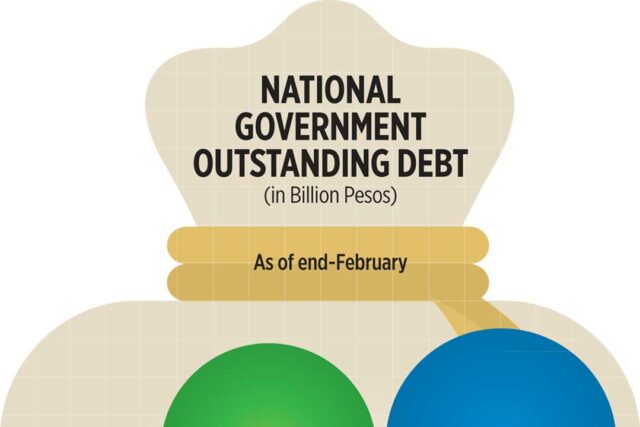
National government outstanding debt

THE NATIONAL Government’s outstanding debt hit a record P12.09 trillion as of end-February, as domestic and offshore borrowings increased, the Bureau of the Treasury (BTr) said on Thursday. Read the full story.

National government outstanding debt

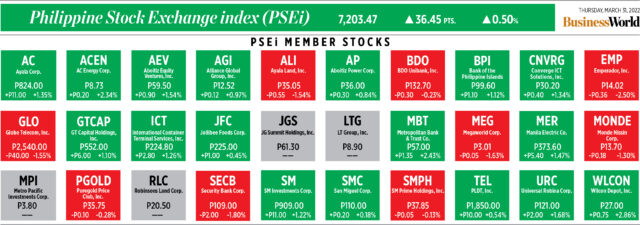
How PSEi member stocks performed — March 31, 2022

Here’s a quick glance at how PSEi stocks fared on Thursday, March 31, 2022.


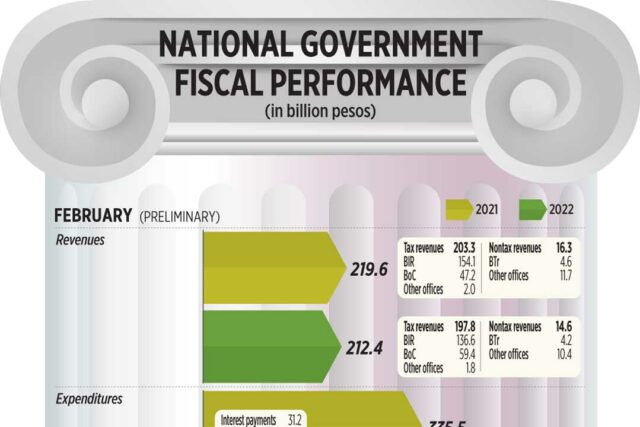
National government fiscal performance

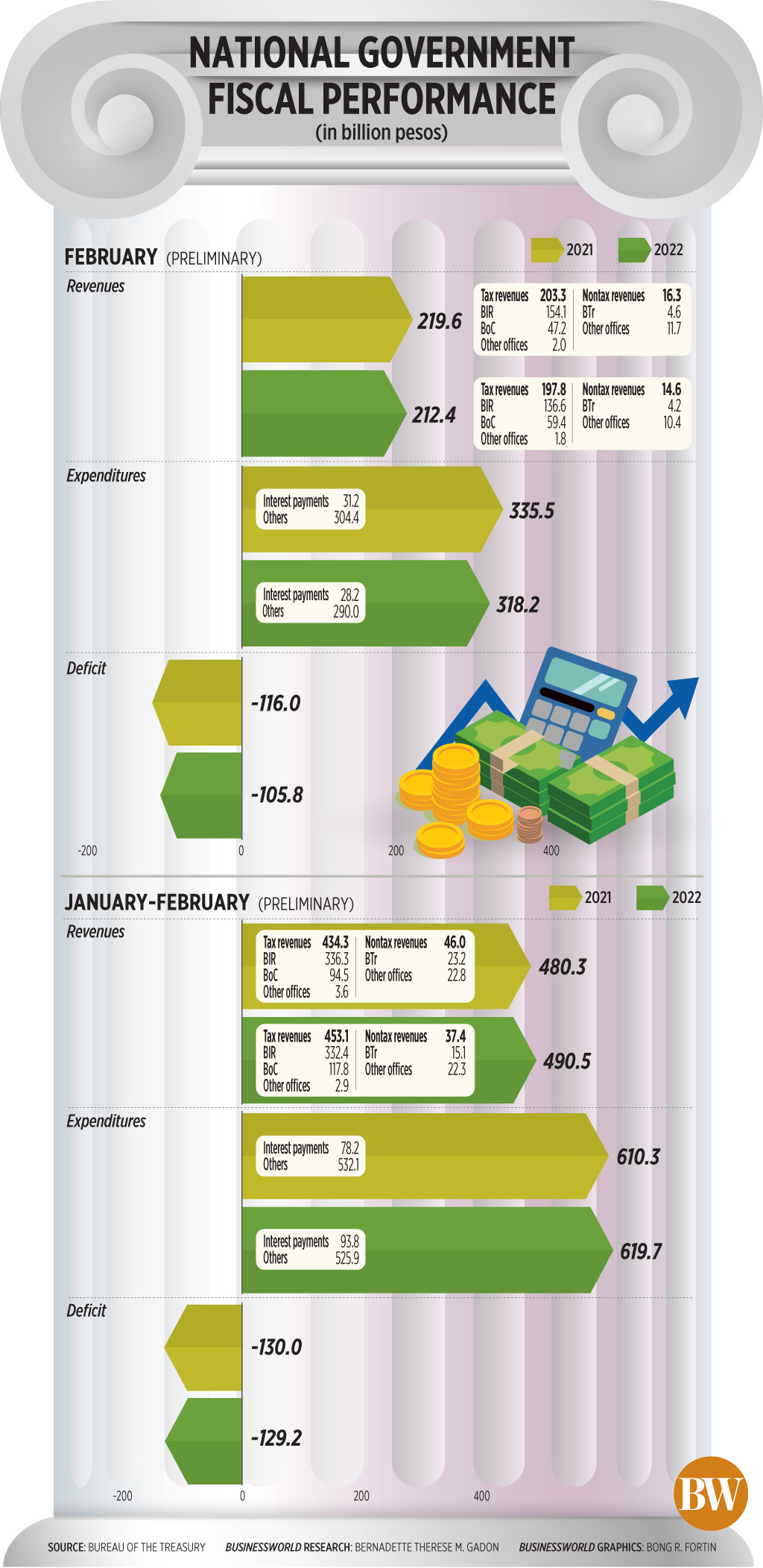
THE NATIONAL Government’s budget deficit narrowed to P105.8 billion in February, as spending and revenue collections slumped, the Bureau of the Treasury (BTr) reported. Read the full story.

National government fiscal performance

Peso climbs vs dollar as oil prices decline

BW FILE PHOTO

THE PESO strengthened versus the greenback on Thursday for the seventh straight day amid a possible release of oil reserves, which could temper supply concerns amid the Russia-Ukraine war.

The local unit closed at P51.74 per dollar on Thursday, appreciating by 27 centavos from its P52.01 finish on Wednesday, based on Bankers Association of the Philippines data.

This was the peso’s strongest finish in nearly a month or since March 3, when it closed at P51.50 against the dollar, Rizal Commercial Banking Corp. Chief Economist Michael L. Ricafort said in a Viber message.

The peso opened Thursday’s session at P51.98 versus the dollar. Its weakest showing was at P51.995, while its intraday best was at P51.74 against the greenback.

Dollars exchanged dropped to $1.047 billion on Thursday from $1.119 billion on Wednesday.

The peso appreciated amid the decline in international crude oil prices as the United States is considering to release some of its strategic oil reserves, a trader said in a Viber message.

The Biden administration is considering releasing up to 180 million barrels of oil over several months from the Strategic Petroleum Reserve (SPR), four US sources said on Wednesday, as the White House tries to lower fuel prices, Reuters reported.

The latest amount of US oil release being considered, which is equivalent to about two days of global demand, would mark the third time the United States has tapped its strategic reserves in the past six months, and would be the largest release in the near 50-year history of the SPR.

The International Energy Agency member countries are also set to meet on Friday at 1200 GMT to decide on a collective oil release, a spokesperson for New Zealand energy minister said in an e-mail, aimed at calming global crude prices that scaled 14-year highs this month amid the Russia-Ukraine conflict.

Oil prices fell sharply on Thursday. Brent crude futures for May dropped 3.6% or $4.11 to $109.34 per barrel by 0637 GMT on Thursday. Meanwhile, the US West Texas Intermediate futures for May delivery sank by $5.33 or 4.9% to $102.49 a barrel after touching a low of $100.85.

The market is awaiting a statement from US President Joseph R. Biden regarding policies to lower gasoline prices amid the ongoing war between Russia and Ukraine.

Mr. Ricafort added that there was optimism in the market following the release of data showing faster lending growth.

Central bank data released on Thursday showed outstanding loans by big banks increased by 8.8% in February, quicker than the 8.4% seen in January. Both lending for production activities and consumers increased by 9.7% and 0.9%, respectively.

For Friday, Mr. Ricafort gave a forecast range of P51.65 to P51.90, while the trader expects the local unit to move within P51.75 to P52 a dollar. — LWTN with Reuters

PSEi extends climb on plan to release oil reserves

SHARES continued to climb on Thursday as the United States and other countries are set to discuss a possible release of oil reserves to help bring down global fuel prices that have been climbing due to the Russia-Ukraine war.

The benchmark Philippine Stock Exchange index (PSEi) inched up by 36.45 points or 0.50% to close at 7,203.47 on Thursday, while the broader all shares went up by 17.08 points or 0.45% to 3,811.83.

“The PSEi was on a volatile ride but today’s gains underscore market focus on the oil price drop, as Washington plans to release massive oil from its strategic reserves plus Ukraine-Russia ceasefire talks restarting this week,” First Metro Investment Corp. Head of Research Cristina S. Ulang said in a Viber message.

“Investors bought into the Philippine market to end the first quarter of 2022 while keeping a watchful eye on developments in Ukraine and the waning signs of progress for peace talks with Russia,” Regina Capital Development Corp. Head of Sales Luis A. Limlingan said in a Viber message.

The Biden administration is considering releasing up to 180 million barrels of oil over several months from the Strategic Petroleum Reserve, four US sources said on Wednesday, as the White House tries to lower fuel prices, Reuters reported.

The International Energy Agency member countries are also set to meet on Friday at 1200 GMT to decide on a collective oil release, a spokesperson for New Zealand- energy minister said in an email, aimed at calming global crude prices that scaled 14-year high this month amid the Russia-Ukraine conflict.

Oil prices have surged since Russia invaded Ukraine in late February and the United States and allies responded with hefty sanctions on Russia — the No.2 exporter of crude.

Russia is among the top three oil producers and accounts for about 14% of the world’s total supply.

Majority of the sectoral indices ended in the green except for property, which fell by 21.79 points or 0.65% to 3,315.15.

Meanwhile, holding firms climbed by 70.25 points or 1.02% to 6,905.12; financials rose by 13.19 points or 0.78% to 1,694.89; industrials gained 66.19 points or 0.68% to 9,800.04; services went up by 12.93 points or 0.66% to 1,953.33; and mining and oil increased by 46.95 points or 0.37% to 12,440.47.

The MidCap index added 9.65 points or 0.81% to close at 1,202.84, while the Dividend Yield index rose by 16.08 points or 0.95% to 1,709.83.

Value turnover increased to P7.81 billion with 1.49 million shares changing hands from P6.87 billion or 719.59 million issues seen on Wednesday.

Advancers beat decliners, 110 versus 83, while 49 names closed unchanged.

Foreigners turned buyers with P221.50 million in net purchases on Thursday from P48.90 million in net sales seen the previous trading day. — L.M.J.C. Jocson with Reuters

Elon Musk’s SpaceX preparing to enter Philippine market — DTI

REUTERS

SPACE EXPLORATION Technologies Corp. (SpaceX) is preparing to enter the Philippine market, and is currently undertaking preparatory activities like site selection, the Department of Trade and Industry (DTI) said.

Trade Secretary Ramon M. Lopez said via Viber on Thursday that he hopes SpaceX, a satellite company controlled by billionaire Elon Musk that can beam broadband even to remote locations, can start doing business here “as soon as possible.” He said the company’s timeline for setting up shop falls within the remaining three months of President Rodrigo R. Duterte’s administration.  

“(SpaceX is) still finalizing investment figures. But, (it is) selecting sites already for their gateways, (looking) both at major cities and suburbs,” Mr. Lopez said.  

Mr. Lopez said the DTI will assist SpaceX in registering for incentives with the Board of Investments (BoI). Its activities qualify under the Strategic Investment Priority Plan governing the granting of incentives. It also qualifies for expedited processing of permits under the Ease of Doing Business law.

According to the DTI, the Philippines is poised to be the first country in Southeast Asia to avail of SpaceX’s technology, which will bring high-speed satellite broadband connectivity to areas where connectivity has been difficult or impossible.

Mr. Lopez said the DTI met with SpaceX senior executives Rebecca Hunter and Ryan Goodnight, National Telecommunications Commission Deputy Commissioner Edgardo V. Cabarios, and DFNN, Inc. Executive Chairman Ramon C. Garcia, Jr. on March 30 to discuss the project.  

SpaceX hopes to service the Philippines via a low Earth orbit (LEO) satellite network, known as Starlink.

Its network consisted of over 1,600 satellites as of mid-2021, and hopes to add thousands more mass-produced small satellites in LEO, which communicate with designated ground transceivers, the DTI said.

In a separate statement, the DTI said SpaceX is currently establishing a company in the Philippines that will serve as its wholly-owned subsidiary.

“(The company) is targeting to deploy three gateways in the first phase of the launch,” the DTI said.

 Mr. Lopez said that the launch of SpaceX will raise broadband speeds, improve connectivity, and add capacity for telecommunications services and bring down rates.

According to the DTI, SpaceX is bullish on the Philippines’ growing consumer base and improved investment climate.

“The signing of the amended Public Service Act (PSA), which allows up to 100% foreign ownership of public services, was a critical factor in (SpaceX’s) decision to invest, as all its technologies are proprietary,” the DTI said.

The BoI and SpaceX discussed the latter’s entry into the Philippine market during an investment mission in November.

“This was followed by a series of online meetings with the company…, an update session in February 2022, and another in early March to discuss further its business plans in the Philippines in line with the amendment of the PSA. At present, their application is being processed and the locations of their gateways are being visited,” the DTI said. — Revin Mikhael D. Ochave

PHL aircraft maintenance market seen growing as travel industry recovers

DORNIER TECHNOLOGY

By Arjay L. Balinbin, Senior Reporter

DEMAND for aircraft maintenance in the Philippines is “growing strongly” as the airline industry sees a recovery in travel, according to Dornier Technology, an aircraft maintenance, repair and overhaul (MRO) company.

“We see the recovery in the commercial airline industry as a very positive development because, as airlines put their aircraft back into operation, it increases demand for both base maintenance (heavy maintenance) as well as line maintenance,” Nikos Gitsis, newly appointed chief executive officer of Dornier Technology, told BusinessWorld in an e-mail interview.

“We see demand for line maintenance growing strongly at Manila airport and other popular destinations such as Kalibo, Caticlan (Boracay), Bohol, and Davao,” he added.

Dornier Technology’s operations in the Philippines are headquartered at Clark International Airport.

Mr. Gitsis said the domestic travel market is posting a solid recovery, particularly on the Boracay route, which the company expects to return to pre-pandemic levels by the end of the year.

“We are now also starting to see the Philippines outbound international market recover. We believe the recovery in the international market will start slowly but will very likely gain momentum as the current opening up and improved environment takes hold, especially for the Philippines’ destinations that are popular with international tourists.”

He said the MRO industry’s main challenges in the Philippines involve “Airport space and costs,” which he described as “major hurdle.”

“Government and airport operators should encourage investment in the aviation MRO sector because MRO businesses create highly technical, well-paying jobs,” he added.

Mr. Gitsis said that while manpower remains a challenge, “Filipinos in particular are well-trained and exposed to the industry internationally, and we are encouraging those expatriates or OFWs in Asia and the Middle East to come home again and help build up the industry here.”

He said the company has been targeting Filipinos with years of service overseas in aerospace maintenance jobs.

MRO base maintenance requires substantial investment in tooling, facilities, and expertise to meet the requirements of customers and regulators.

“Scalability comes in large blocks, and financing is also a challenge in an industry that awards work on a year-by-year basis. There are few long-term contracts with operators. For an independent MRO such as ours, however, after many years reaching this point, the basis of our ongoing success is continual feedback on customer requirements, and methodically moving to provide those,” Mr. Gitsis said.

Dornier Technology is certified by the civil aviation regulators of the Philippines, South Korea and Indonesia. The certification allows it to maintain aircraft registered in these countries.

The company aims to be certified by more countries, including those in the Association of Southeast Asian Nations, or markets within four hours’ flight time from the Philippines. 

It hopes to be certified by regulators in Taiwan, China, Australia and Pacific-island nations such as Papua New Guinea. 

“The Philippines is ideally positioned as a center for aircraft maintenance in the Asia-Pacific region, because (it) has a pool of skilled and qualified aircraft technicians and engineers. The Philippines is also cost competitive,” Mr. Gitsis said.

“Because the commercial aviation sector has suffered through this pandemic, we are highlighting to our price-sensitive customers the capabilities of the Philippines along with the lower man hour costs that we have here,” he added.

“The Philippines, including Clark airport, are centrally located, making us an ideal location for customers from around Asia-Pacific to bring their aircraft for airframe heavy checks.”

ADVERTISEMENT
ADVERTISEMENT