Home Blog Page 6600

A ‘physical’ MIAS 2022 to happen from April 7-10

The Manila International Auto Show in 2019 — PHOTO BY KAP MACEDA AGUILA

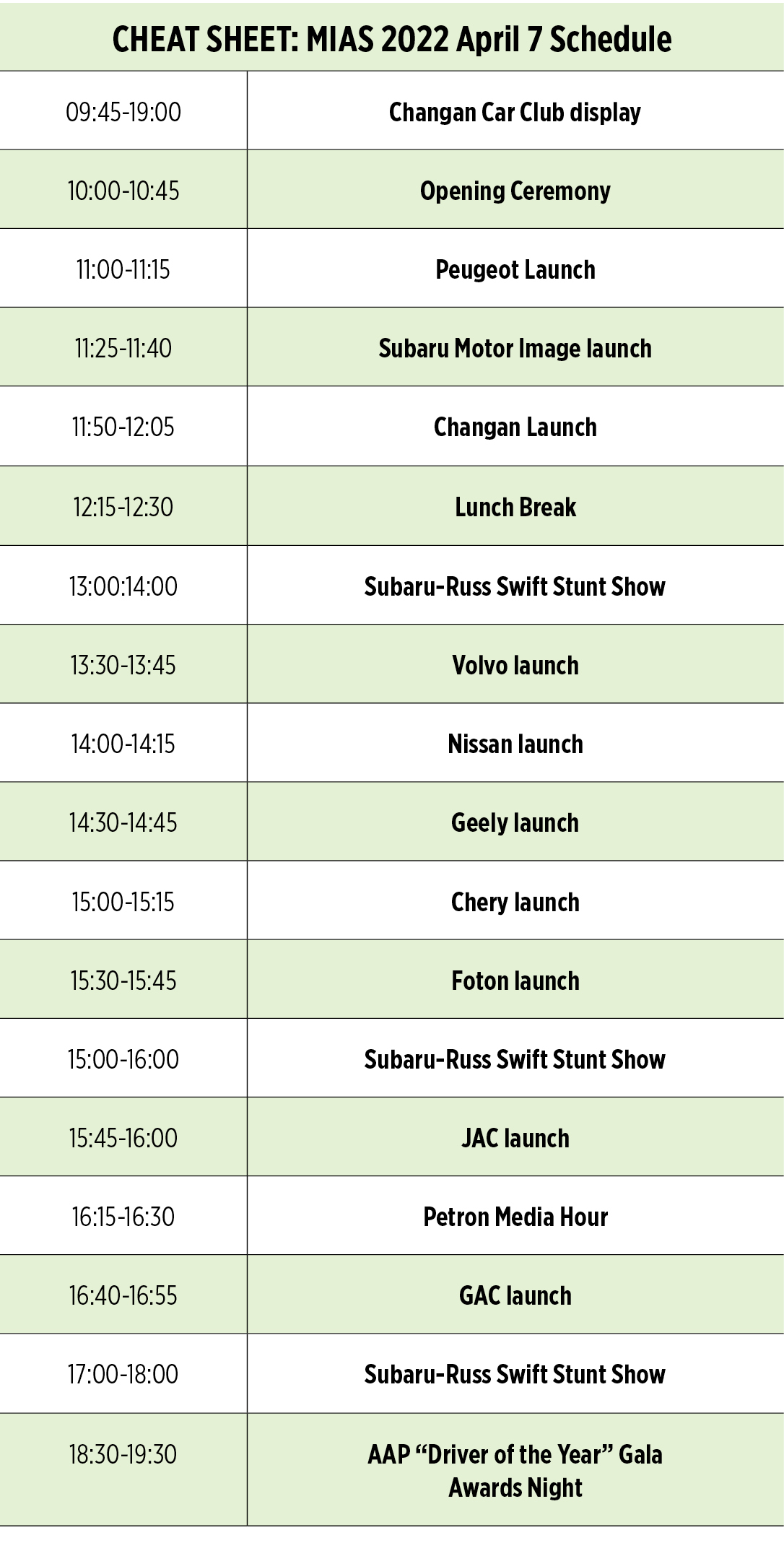
THE COUNTRY’S preeminent motor show will mark its first physical staging since the COVID-19 pandemic hit. The Manila International Auto Show (MIAS) will return for a 17th run — opening the doors of its usual haunt, the World Trade Center Metro Manila — from April 7 to 10.

Known as the biggest and most anticipated auto show in the country, “MIAS has conquered both on-ground and online execution through the past years to deliver the brands’ promise undeterred by different situations,” co-organizer Worldbex Services International said in a release.

Before the pandemic hit, the last physical staging of MIAS collected some 200 companies across a 33,000-sq.m. total exhibition space. The spectacle featured 400 cars, trucks, and motorcycle displays — attracting an excess of 140,000 visitors. After the pandemic struck, MIAS Wired saw the auto show take its attractions and features online via an interactive platform where automotive brands reached more people to showcase their products. MIAS Wired was participated in by 20 exhibitors and garnered more than 100,000 online booth visits during its five-day staging.

“With the restrictions finally easing up and the economic comeback looking unstoppable, the most anticipated rally of the biggest auto show in the country will stage its event back on-ground this 2022. This year’s installment is promised to be a bigger and bolder presentation for its crowd and its stakeholders. In this regard, we gladly inform everyone that preparations are already in place to ensure that the 17th edition of MIAS will be safe and fruitful,” continued Worldbex.

BSP sets internal audit rules for trust corporations

BW FILE PHOTO

THE CENTRAL BANK is allowing trust corporations that are part of a bigger group to perform an internal audit, either by itself or through a central unit of its parent.

Circular No. 1141 signed by Bangko Sentral ng Pilipinas (BSP) Governor Benjamin E. Diokno said the internal audit function of trust corporations shall assess and complement other control initiatives like risk management and compliance.

“In any case, the audit shall ascertain whether the institution’s trust and other fiduciary business and investment management activities have been administered in accordance with laws, Bangko Sentral rules and regulations, and sound trust or fiduciary principles,” the circular said.

The BSP said that a permanent audit function should be established, either under the trust corporation itself or its parent bank or non-bank financial institution.

The circular allows the board of directors of a trust corporation to conduct internal audit that can supplement or replace an annual audit cycle.   

“The audit may be conducted in intervals commensurate with the assessed levels of risk in trust and investment management operations,” the circular said.

The BSP said the head of the group internal audit of a trust corporation must define audit strategies, methodology, scope, and quality assurance measures. These should be set in consultation and coordination with the board of directors or audit committee of the trust corporation.

The central bank also gave trust corporations leeway to outsource internal audit activities, provided these will not be given to a trust corporation’s own external audit firm.

The BSP has been undertaking various reforms in the trust industry. Last year, trust corporations were allowed to sell unit investment trust funds (UITFs) through individual and institutional agents to level the playing field with banks that have broad distribution networks.

Latest central bank data showed there are 37 BSP-supervised financial institutions with trust authorities, including banks, trust corporations, and other non-bank financial intermediaries.

The assets under management of the trust industry reached nearly P5 trillion as of end-September 2021, based on BSP data. — L.W.T. Noble

Ukraine sunflower oil crisis hits food from chips to cookies

RUSSIA’S invasion of Ukraine has disrupted the supply of almost half of the world’s sunflower oil exports, forcing companies to turn to less desirable alternatives such as palm oil in products ranging from potato chips to cookies. 

Thousands of items, also including ready meals and even wrapping paper, use sunflower oil. Prices are surging and the ingredient will only become more scarce from the summer as Ukrainian farmers may struggle to grow and export the crop.

“Sunflower oil prices have gone up 1,000%, but it is less about the price as the oils are often only a small constituent part of the products,” said Richard Walker, the managing director of grocery chain Iceland Foods. “The real challenge is getting your hands on it.”

Just as the food industry was getting a handle on dealing with Covid-related shortages, Russia’s invasion of Ukraine has exacerbated the situation with the war driving up prices of basic ingredients such as wheat. US President Joe Biden has warned that the world will experience food shortages and countries should prepare for alternative sources. 

Walker said 450 products Iceland Foods sell are affected and while many can use alternatives, such as rapeseed oil, the grocer will have no choice but to “regrettably” use palm oil in about 30 to 40 products. This is a reversal of a high-profile pledge the grocer made in 2018 to remove all palm oil from its own-brand lines over concerns about its links to forest destruction.

“I just don’t know how long this will go on for,” Iceland’s Walker said, adding that it would only use sustainably grown palm oil.  “The only alternative to using palm oil under the current circumstances would simply be to clear out our freezers and shelves of a wide range of staples.”

Wm Morrison Supermarkets said it too will have to use sustainable palm oil in some products when they are unable to switch to alternatives such as rapeseed oil.

Russia’s invasion has caused a humanitarian disaster in Ukraine and disrupted trade in foods across the world, sending wheat and corn prices to the highest in a decade. Ukraine is a key supplier of grains to countries in the Middle East. Meat prices are also under pressure as the cost of the feed used for cattle and pigs rises.

Ukrainian farmers are pressing ahead with spring planting, but will face challenges as they grapple with shortages of workers, fuel and fertilizers. Russia has blocked Ukraine’s ports, cutting off the traditional export route. Ukrainian President Volodymyr Zelenskiy said on Thursday that Russian troops are targeting agriculture, placing land mines in farms and destroying machinery.

“Where sunflower oil exists as an ingredient in products, retailers will be substituting it with other safe oils, such as rapeseed oil,” said Andrea Martinez-Inchausti, Deputy Director of Food at the British Retail Consortium. For food like potato chips which use sunflower oil as a key ingredient, retailers will add information on substitute oil onto existing labels, she said.

For pre-packaged sandwiches, sellers are having to put up signs explaining some ingredients may have changed because the packages were printed in advance, according to the British Sandwich & Food to Go Association. Philippines-based Monde Nissin said it’s substituting UK-sourced rapeseed oil for sunflower oil in its meat alternatives.

Companies using sunflower oil for frying have been replacing it with palm oil, soybean oil and rapeseed oil, industry group Fediol said. Andrew Crook, president of the UK’s National Federation of Fish Friers, said his own shop in Euxton in northwest England has seen prices for 20-liter sunflower oil drums rise to 40 pounds from 30 pounds in the past two weeks. They typically go through eight or nine a week and might have to switch to palm oil at some point, though he values sunflower for its “nice, clean taste.”

That raises concerns that higher food prices and the need to search for supplies further afield will water down Europe’s food standards and push companies to opt for ingredients that may be more harmful to the environment. Palm oil and soy have come under increasing scrutiny in recent years over their role in deforestation, prompting plans for EU import curbs

Rapeseed oil is seeing the highest increase in demand, according to Hemeline Macret, head of oilseed market analysis at Strategie Grains. “It’s used for food already and palm oil is not very popular because of its bad image.” Soybean oil isn’t used in many food recipes because it’s often made from genetically modified soy, she said.

The war is exacerbating an already strained supply chain, with transportation snarls and harvest setbacks pushing food prices to record highs. Soaring costs for basic foods in import-dependent Middle Eastern and North African countries are putting people’s resilience at a “breaking point,” according to the United Nations’ World Food Programme.

“If this war doesn’t stop soon, supply disruptions could last from now to 2023,” Hemeline Macret said. — Bloomberg

Gin Kings-Bolts matchups were incredibly close, says Tim Cone

By Olmin Leyba

ENJOYING a whopping 3-0 upperhand against Meralco head-to-head in the PBA Governors’ Cup finals doesn’t in any way give Barangay Ginebra a false sense of security heading into their latest titular duel.

“It’s the opposite. You start thinking of the odds, you start thinking, oh-oh, this gotta change some time,” Ginebra coach Tim Cone said in the recent Power and Play program on Radyo Singko.

“Do we have a secret formula against them? We certainly don’t. I wish we did.”

He pointed out that their prior faceoffs with Meralco were actually down-to-the-wire situations. In 2016, Justin Brownlee knocked down a booming trey at the buzzer to clinch it in Game 6, 91-88. The following year, before 54,000 fans, the Gin Kings beat the Bolts in Game 7, 101-96, and two years later, Ginebra won in five against their injury-hit rivals.

The rivals met again in the 2020 Philippine Cup semifinals in the Clark bubble and Mr. Cone’s troops needed a last-second triple from Scottie Thompson to prevail in the do-or-die Game 5, 83-80.

“Every series has been incredibly tight and could have gone either way. I worry about it, you know, one shot here or there could have gone in their favor this time,” said Mr. Cone.

The multi-titled mentor said Meralco import Tony Bishop and tall guards led by Chris Newsome present matchup issues for his crew.

“(Mr.) Bishop is tough to handle because he can do so many things, he can beat you in so many ways. He’s not incredibly strong in any one thing but he’s really good at many, many things. He can shoot from the perimeter, he can get to the basket, he’s a great rebounder, he’s a long defender, he can post up,” said Mr. Cone.

Mr. Newsome, he noted, has always been “difficult to guard” with his size and power; so do his backcourt peers like Bong Quinto and Allein Maliksi.

“They have a big guard lineup. There’s a lot of issues but the biggest thing is they play really, really well together,” Mr. Cone observed.

The Gin Kings and the Bolts kick off their fourth championship confrontation on Wednesday at the Smart Araneta Coliseum.

Tom Cruise’s Top Gun sequel to screen at Cannes Film Fest

Tom Cruise in Top Gun: Maverick (2022) — PARAMOUNT PICTURES

LONDON —  Tom Cruise will screen his hotly anticipated Top Gun sequel at the Cannes Film Festival in May, where an event will also look back on his Hollywood career, organizers said on Friday.

Thirty-six years since Cruise’s cocky pilot Maverick soared into the sky, Top Gun: Maverick, which sees the actor reprise the role that launched his career as a global action star, will begin its global cinema roll-out from May 25 after several pandemic-related delays.

Mr. Cruise, 59, was last at the Cannes festival, an annual glitzy industry event on the French Riviera, for his 1992 movie Far and Away.

“Exactly 30 years later, on May 18, 2022, the Festival de Cannes will pay him an exceptional tribute for his lifetime achievements,” organizers said in a statement.

“On that special day, Tom Cruise will have an on-stage conversation with journalist Didier Allouch in the afternoon and will walk up the steps of the Palais des Festivals for the evening screening of Top Gun: Maverick.”

This year’s Cannes Film Festival, its 75th edition, will run from May 17-28. — Reuters

Peso may weaken vs dollar ahead of CPI, trade data

BW FILE PHOTO

THE PESO may weaken this week due to elevated inflation expectations and a likely wider trade deficit.

The local unit ended trading at P51.67 per dollar on Friday, gaining seven centavos from its P51.74 close on Thursday, based on data from the Bankers Association of the Philippines.

It also strengthened by 46 centavos from its P52.13 finish a week earlier.

The peso opened at P51.79 per dollar on Friday. Its weakest showing was at P51.81, while its intraday best was at P51.55 versus the greenback.

Dollars exchanged increased to $1.33 billion on Friday from $1.047 billion on Thursday.

The peso appreciated on market optimism following improved manufacturing data, Rizal Commercial Banking Corp. Chief Economist Michael L. Ricafort said.

The Philippine purchasing managers’ index reached a reading of 53.2 in March, based on a report by S&P Global Ratings on Friday. This is its highest since the 54.2 reading in November 2018. A reading above 50 shows expansion while below means a contraction in activity.

S&P said manufacturing activity in the Philippines expanded for the second straight month as businesses continued to reopen amid more relaxed restrictions, allowing output to grow further. New orders also piled up amid higher client demand, it added.

Meanwhile, UnionBank of the Philippines, Inc. Chief Economist Ruben Carlo O. Asuncion said the market factored progress in discussions between Russia and Ukraine, which caused a decline in global oil prices during the week.

Bloomberg reported that oil prices posted their biggest weekly decline by Friday.

During the week, representatives of Ukraine and Russia met in Turkey for their peace talks. Market participants were also soothed as US President Joseph R. Biden floated their plan to release 1 million barrels of oil a day for six months from their strategic reserves to ease supply concerns amid the war.

The West Texas Intermediate dropped by over $14 on Friday from a week earlier, which was the most since 2011.

For the coming week, Mr. Asuncion said the market will look at trade data set to come out this week as a wider deficit could cause the peso to weaken.

February trade data will be released on April 8. The country’s trade gap widened to $4.696 billion in January from the $2.878-billion deficit a year earlier.

Meanwhile, Mr. Ricafort said the market will also factor in the inflation outturn for March. This will be reported by the Philippine Statistics Authority on April 5.

A BusinessWorld poll of 18 analysts yielded a median estimate of 4% for last month’s consumer price index (CPI), nearer the upper end of the central bank’s 3.3% to 4.1% projection. If realized, this would be faster than the 3% CPI in February and matches the upper end of the 2-4% target of the Bangko Sentral ng Pilipinas

Analysts said the massive hike in oil prices likely caused quicker increases in food and transport costs.

For this week, Mr. Ricafort gave a forecast range of P51.40 to P51.90 against the dollar, while Mr. Asuncion expects the local unit to move within P51.50 to P52. — L.W.T. Noble with Bloomberg

Koso to step down as Isuzu PHL head by Q2

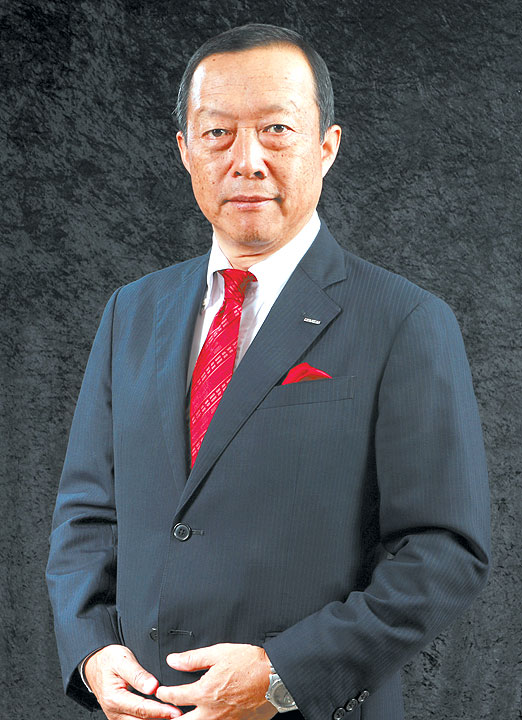
Isuzu Philippines Corp. President Hajime Koso — PHOTO FROM IPC

ISUZU PHILIPPINES Corp. (IPC) recently announced that its longest-serving president, Hajime Koso, will step down at the start of April. Mr. Koso will be succeeded by Noboru Murakami, a senior executive from Isuzu Motors Limited, Japan (IML).

IPC reported, “Under Koso’s leadership, the company has seen numerous company milestones like its 300,000 (units in sales), the introduction of a new parts hub in Metro Manila that eased the delivery of parts to different dealerships nationwide, (the) launch of the Isuzu Mobile Medic service, a strong dealer expansion program and (the) new Isuzu Outlet Standardization, to name a few.”

The firm also noted that Mr. Koso helped steer the company throughout the most challenging of times amid the onslaught of the COVID-19 pandemic — all the while keeping IPC the leading truck firm in the country and overseeing the release of new models.

The outgoing executive is seen to leave a “strong legacy” in IPC, even he has laid out a “more sustainable path” for the company in the future. This new direction will then be passed on to Mr. Murakami, who is expected to drive the company to a more sustainable and eco-friendlier route in the years ahead.

Mr. Murakami was assigned to handle different markets under IML, and brings with him years of experience and expertise in the truck industry. IPC expressed confidence that this expertise will help solidify the company’s leadership position in the Philippine truck market.

Egg empires are coming as bird flu, cage-free rules drive up farm costs

IT’S BECOMING too expensive for some farmers to produce eggs as costs soar due to everything from bird flu to cage-free mandates — and that’s paving the way for giant companies to get even bigger.

Deadly avian influenza is spreading across the US and is hitting commercial egg farms, forcing farmers to kill millions of hens. Feeding the birds is also pricey, with grain costs around decade-highs, partly due to supply chain chaos caused by Russia’s invasion of Ukraine. Meanwhile, ​​​​​the US egg industry is making a historic shift toward producing mostly cage-free eggs, a move that’s better for chickens but bad for small farmers who can’t afford to make the costly transition.

Ironically, the higher costs could be a positive for Cal-Maine Foods, Inc., the biggest US producer, which has 20% of the market. It’s been on an acquisition spree in recent years, and all signs point to more consolidation in the fractured egg market. The company said last week that it’s putting $82 million into expanding its cage-free operations, bringing the egg giant’s total investment in cage-free to about $625 million.

The signs are not so great, on the other hand, for a small farmer like Eli Berkowitz.

Berkowitz has been in the egg business for more than six decades, but he’ll have to close shop within four years rather than pay $1.8 million to convert his farm in Foster, Rhode Island, of 45,000 hens to a cage-free operation, thanks to a recent state law that require the transition by 2026.

“Small guys like me, we’re going to get squeezed out,” said Berkowitz, who laments that he won’t be able to pass the business down to his son.

The trend toward consolidation highlights a tension: Consumers are demanding farmers raise animals using more humane production methods. Yet as costs rise, it’s big, industrial producers who are able to step in to supply that demand, and the emergence of giant egg farms brings its own issues. Over in the chicken, beef and pork world, ‘Big Meat’ is coming increasingly under scrutiny, with the Biden administration taking companies like Tyson Foods, Inc. to task on antitrust issues, including criminal probes for price-fixing. 

The behemoths of animal agriculture are also being blamed for inflation, with democrats criticizing meat companies for exploiting their domination of processing capacity to gain record profits amid recent supply-chain disruptions. Four companies control 85% of beef processing and 54% of the poultry market.

Now, egg consolidation is set to speed up, especially with the transition to cage-free going at full tilt. Most hens live in the confines of what are called battery cages, where they have 67 square inches of room, about the size of a sheet of paper. In cage-free production, hens are held in indoor spaces where they can turn around and stretch their wings, as well as perch, scratch, nest and take dust baths.  The number of operations has shot up about 40% in the last year, comprising roughly 34% of the total flock. That’s up from about 12% just five years ago, said Karyn Rispoli, egg market reporter at Urner Barry.

In January, a law went into effect in California — which consumes about 12% of the eggs in the US — that prohibits eggs from caged hens being sold in the state. Eight other states are following suit.

There’s a switch “to a much more commercialized industry of egg companies that are either publicly traded, or they have broad management pools,” said John Brunnquell, chief executive officer of Egg Innovations, one of the biggest US producers of free-range eggs. “Middle class producers that had three to five million chickens, a lot of those will be casualties.”

Private equity firms have begun to step in to help capitalize some farms, but without that, small-scale growers like Berkowitz would have to go into debt to make the switch. Then, it would take at least a year and a half to convert the facilities, including a remodel and installation of new equipment. Without any place to house his flock, Berkowitz would have to sell off each bird during that time — and lose half of his revenue stream in the process.

“I don’t know how many banks would be willing to lend me over a million dollars,” he said. “I’ll never be able to pay it back.”

Meanwhile, Cal-Maine’s pouring hundreds of millions into becoming the leading cage-free producer.  Max Bowman, chief financial officer, said the industry as a whole needs 60% of the flock to be cage-free by 2025 in order to meet the growing demand, which will cost over $6 billion. That’ll be a tough task, especially as the pandemic has put further pressure on labor and logistics costs, he said.

But the march toward cage-free eggs — and consolidation — will continue. Josh Balk, vice-president of Farm Animal Protection at the Humane Society, said that the cage-free is what more and more consumers will want.

“It certainly costs money to shift to cage-free,” Balk said. “What is more economically painful is to produce a product that no one wants. And that’s what eggs produced from caged chickens will be in the coming years.” — Bloomberg


Stocks to move sideways ahead of inflation data

BW FILE PHOTO

SHARES may move sideways this week as the war between Russia and Ukraine continues to dampen investor sentiment and ahead of the release of March inflation data.

The benchmark Philippine Stock Exchange index (PSEi) fell by 50.59 points or 0.70% to close at 7,152.88 on Friday, while the broader all shares dropped by 23.24 points or 0.61% to 3,788.59.

Week on week, the PSEi gained 28.04 points from its finish of 7,124.84 on March 25.

China Bank Securities Corp. Research Director Rastine Mackie D. Mercado said the market may see a pullback following two weeks of slow ascent amid continued volatility due to the Russia-Ukraine crisis and ahead of the release of March inflation report.

“The index is likely to continue pulling back in the early part of [this] week as investors continue to take profit following gains made since March 21. A pullback to the 7,000 to 7,050 level is ideal as this solidifies the strength of the 7,000 support,” Mr. Mercado said in an e-mail.

“We may also see volatility inching higher as geopolitical developments remain fluid and as investors await March inflation data. An uptick after the pullback should be viewed as an opportunity for redeployment,” he added.

“Russia’s continued invasion and war with Ukraine [sent] oil, energy and other global commodity prices higher recently. That could still lead to higher inflation, petitions for transport fare hike, possible wage hike, risk of second-round inflation effects that could lead to tighter monetary policy and higher borrowing and financing costs for some listed companies,” Rizal Commercial Banking Corp. Chief Economist Michael L. Ricafort said in a text message.

Ukraine’s troops have retaken more than 30 towns and villages around Kyiv, Ukrainian officials said on Saturday, claiming complete control of the capital region for the first time since Russia launched its invasion, Reuters reported.

After five weeks of fighting, Russia has pulled back forces that had threatened Kyiv from the north to regroup for battles in eastern Ukraine.

Meanwhile, the Philippine Statistics Authority will release March inflation data on Tuesday.

Analysts said headline inflation likely accelerated last month as the surge in global oil prices amid the Russia-Ukraine war caused faster increases in food and transport costs.

A BusinessWorld poll of 18 analysts yielded a median estimate of 4% for last month’s inflation, nearer the upper end of the central bank’s 3.3% to 4.1% projection.

If realized, this would be faster than the 3% in February and would match the upper end of the 2-4% target of the Bangko Sentral ng Pilipinas. Still, it would be slower than the 4.5% seen a year earlier.

For the coming week, Mr. Ricafort placed the PSEi’s immediate support at the 6,600 to 6,700 levels and resistance at the 7,200 level.

Meanwhile, China Bank Securities’ Mr. Mercado said in case the index climbs this week and breaks out of its 7,200 resistance, it could rally to the 7,500 level. — Luisa Maria Jacinta C. Jocson with Reuters

UAAP welcomes return of fans at the Mall of Asia Arena

UAAP teams can’t wait to enjoy the true school spirit once again after playing in a deafening silence for a week as the league welcomes the return of its roaring fans starting this week at the Mall of Asia Arena.

The league’s 84th season started last Saturday behind closed doors under a bubble setting due to the pandemic but tomorrow, gates will be open anew for fans albeit under a limited capacity for now.

It’s a breath of fresh air and a fitting return of the passionate Philippine crowd to “where they belong” according to Ateneo mentor Tab Baldwin.

“What I’m excited about is for the people of the Philippines to be back where they belong supporting their teams,” said Baldwin as the Blue Eagles get to shoot for their 31st straight win against NU (National University) at 7 p.m. tomorrow with an in-game crowd at last.

“It’s great for the fans. The UAAP (University Athletic Association of the Philippines) has done the right thing getting the fans, cheering squads and drum choirs back. They’re part of the atmosphere. They’re all part of what makes UAAP a great competition,” he added.

For the UAAP, the decision to allow fans anew under Metro Manila’s Alert Level 1 came after a thorough discussion with the Commission of Higher Education (CHEd) and the Pasay City local government unit (LGU) with strict protocols in place.

“The UAAP is a competition best experienced with students and alumni supporting their respective schools,” said UAAP president Nonong Calanog, assuring the health and safety of student-athletes.

Only fully vaccinated individuals will be allowed with fans required to present proof of vaccination upon entry. Wearing of masks and social distancing will also be implemented while eating and drinking will be in designated areas only.

Aside from the Ateneo-NU duel, fans will also enjoy the matches between Santo Tomas and La Salle at 10 a.m., UP and Adamson at 1 p.m., as well as UE and FEU at 4 p.m. — John Bryan Ulanday

Converge rises ahead of Elon Musk’s SpaceX entry

By Ana Olivia A. Tirona, Researcher

INVESTORS stock up on Converge ICT Solutions, Inc. shares last week on the back of better revenue performance and the anticipated entry of Elon Musk’s Space Exploration Technologies Corp. (SpaceX) in the Philippine market.

Philippine Stock Exchange data showed Converge was the most actively traded stock in terms of value turnover last week. A total of 66.97 million Converge shares worth P1.97 billion were traded from March 28 to April 1.

The fiber internet provider closed at P30.00 apiece on Friday, up week on week by 5.3% from its March 25 finish but down by 3.7% from the first trading day of the year.

Regina Capital Development Corp. Equity Analyst Arielle Anne D. Santos said the stock’s movement last week was driven by Department of Trade and Industry’s (DTI) announcement on the preparations for Starlink, a unit of SpaceX by entrepreneur Elon Musk.

“A classic sell-on-news scenario wherein traders jumped in early in the week, then cashed in profits upon the release of DTI’s statement that it’s making preparations to facilitate the entry of Elon Musk’s SpaceX Leo here at home,” she said in an e-mail interview.

In February, Converge struck an agreement to lease fiber lines and other ground support to SpaceX’s Starlink project, which aims to launch a low Earth orbit (LEO) satellite network in the country.

On Thursday, the Trade department said SpaceX was establishing its wholly owned subsidiary in the Philippines.

The DTI said the Philippines would be the first country in Southeast Asia to acquire SpaceX’s technology that aims to deliver high-speed satellite connectivity even in far-flung areas.

Starlink’s network is comprised of more than 1,600 satellites as of mid-2021, and hopes to add thousands more mass-produced small satellites in LEO, which communicate with designated ground transceivers, the Trade department said.

The satellite company SpaceX is currently in the midst of scouting gateway sites in major cities and finalizing investment figures.

Meanwhile, Mercantile Securities Corp. Analyst Jeff Radley C. See said the buying pressure pushed activity for Converge.

“Coming from an oversold territory at P21.50, the stock bounced up hitting a high of P30.00,” he said in a Viber message.

“The company continues to produce good earnings which resulted in a 69.2% [year-on-year] revenue growth for FY2021. We think that the company will continue the growth this year and remain on track to reach approximately 55% of households by 2023,” he added.

Converge’s net earnings jumped more than twofold to P7.16 billion last year from P3.39 billion in 2020.

Revenues rose by 69.2% year on year to P26.48 billion last year. Revenue from its residential business went up by 83.2% to P23.13 billion, which was pushed by “significant subscriber growth.” Likewise, its enterprise revenue increased by more than a tenth to P3.35 billion.

Subscriber growth showed 163,000 new gross additions and about 115,000 net subscriber additions, bringing the number of total residential subscribers to 1.7 million.

Ms. Santos expects Converge’s bottom line to post a double-digit growth this year amid sustained demand for its residential business and rebound in enterprise businesses.

“April is usually a slow month for equities,” Ms. Santos said, expecting Converge to trade sideways in the medium term.

She placed its support at P27.60 and resistance at P31.40.

Mr. See pegs the stock to move down this week with support levels to range P28.50-P27.00 and resistance levels at P30.50-P33.00.

Will Smith resigns from film academy, says he’s ‘heartbroken’

Will Smith in a scene from the film King Richard. — IMDB.COM

ACTOR Will Smith has resigned from Hollywood’s Academy of Motion Picture Arts and Sciences, saying on Friday that his slapping of presenter Chris Rock on stage at this year’s Oscars ceremony was “shocking, painful and inexcusable.”

“I betrayed the trust of the Academy. I deprived other nominees and winners of their opportunity to celebrate and be celebrated for their extraordinary work. I am heartbroken,” Mr. Smith said in a statement.

“So, I am resigning from membership in the Academy of Motion Picture Arts and Sciences, and will accept any further consequences the Board deems appropriate,” he said.

At the Oscars ceremony last week, Mr. Smith strode up to the stage after Mr. Rock made a joke about the appearance of Smith’s wife, then smacked Mr. Rock across the face.

Less than an hour later, Mr. Smith gave a tearful speech on stage as he accepted the best actor award for his role in King Richard.

Mr. Rock’s joke about Mr. Smith’s wife, Jada Pinkett Smith, made a reference to the 1997 film G.I. Jane in which actress Demi Moore shaved her head. It was unclear whether Mr. Rock was aware that Jada Pinkett Smith has a condition that causes hair loss.

David Rubin, president of the film academy, said on Friday that the group accepted Mr. Smith’s resignation but would continue with disciplinary proceedings that could lead to additional sanctions.

The matter is due to be discussed at the group’s next board meeting on April 18.

In his statement, Mr. Smith added: “Change takes time and I am committed to doing the work to ensure that I never again allow violence to overtake reason.” —  Reuters

ADVERTISEMENT
ADVERTISEMENT