Further driven to boost Philippine capital markets
By Adrian Paul B. Conoza, Special Features Assistant Editor
Investment houses, while appearing to be rarely mentioned compared to commercial or universal banks and other financial institutions, play significant roles in the Philippine economy. As institutions that work primarily for corporations and the government, the country’s investment houses have grown into essential developers and drivers of the Philippine capital market, and they have also been playing a part in shaping the direction of the Philippine economy.
These values are what the Investment House Association of the Philippines (IHAP) continues to uphold for over four decades. IHAP President Robert M. Lehmann recognized that the association, through its member institutions, provides a major impetus to the Philippine economy by suggesting reforms and improvements in the financial markets and by forming innovative financial packages — all with the aim of efficiently harnessing capital into productive endeavors and investments.
“These endeavors and investments in return result in improving the lives of our countrymen, creating jobs, generating taxes for our government, and creating wealth for our people,” Mr. Lehmann told BusinessWorld in an e-mail. “Ultimately, our hope is that these endeavors and investments… result in the formation of more capital that would fuel a continuous cycle of economic growth.”
Mr. Lehmann, who is also the president and chief executive officer of Amalgamated Investment Bancorporation, noted that the numbers speak for how the IHAP has been fulfilling its mission “to catalyze and nurture reforms in the Philippine financial markets for our stakeholders.”
“Over a 10-year period the total outstanding bonds have grown from P277.53 billion in 2012 to P1.38 trillion in 2022. Volumes have grown almost fivefold. In terms of the number of issuers, there are 53 companies with bonds listed in the Philippine Dealing Exchange Corp., up from just 17 companies in 2012,” the IHAP president shared.
Growth was also shown in the number of listed companies, Mr. Lehmann added. From 230 in December 2012, the number increased to 281 in February this year. IHAP members, in particular, have underwritten a total of P394.52 billion in initial public offerings (IPOs) over the past 10 years.
Mr. Lehmann also shared that the total market capitalization in the Philippine Stock Exchange (PSE) stands at P18.251 trillion as of February 2022, compared to only P9.314 trillion 10 years ago. Average daily trading volumes in stocks in 2021 stand at 26.46 billion with an average amount of P12.35 billion, versus 2.68 billion with an average amount of P4.42 billion in 2011.
Moreover, Mr. Lehmann noted as well that in spite of the massive economic impacts of the coronavirus disease 2019 (COVID-19) pandemic, many IHAP members experienced a “pretty good” 2021 as they were found to be fulfilling the projection of capital markets leading the country’s economic recovery.
To recall, Finance Secretary Carlos G. Dominguez III said in a statement last year that “the reforms being initiated and pushed by the Duterte administration to further deepen the Philippines’ capital markets will let the economy emerge stronger and more resilient in the aftermath of the prolonged COVID-19 pandemic.”
Noting that boost in Philippine capital markets, Mr. Lehmann cited a record number of 11 IPOs, totaling P127.377 billion, that were listed in the PSE and underwritten by IHAP member institutions between March 2020 and end-2021. These IPOs included five real estate investment trusts (REITs) totaling P61.024 billion. In addition, member institutions of IHAP underwrote approximately P182 billion in bonds and preferred shares in 2021.
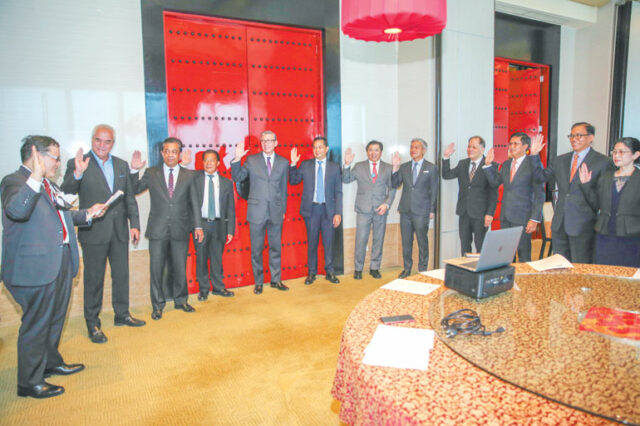
With a newly-inducted board of directors and officers for this year, including Mr. Lehmann, IHAP aims to further drive the growth of capital markets — in time with further eased restrictions and a more reopened economy in the “new normal.”
“The vision has always been to work for the continued growth of the capital markets with the goal of making the Philippines a major global capital market center,” the IHAP president stressed.
Achieving this vision, he continued, will entail active participation in the Capital Market Development Council; as well as close cooperation with the Securities and Exchange Commission (SEC), Bangko Sentral ng Pilipinas, Department of Finance, PSE, and legislators in pushing for reforms; improving current practices and procedures; and ensuring strict adherence to rules, regulations, and laws pertinent to the capital markets.
“[W]e shall work with the SEC to try and find ways to further streamline present procedures and processes in registration without sacrificing safeguards and controls. We shall work on reforms on how to make the capital markets more accessible and inclusive,” Mr. Lehmann said.
Sustaining capital market growth, the IHAP president added, also means pursuing inclusivity and sustainability by making the capital markets accessible to as many enterprises and investors as possible.
By upskilling employees of IHAP member institutions through informative and value formation seminars and workshops, the association also envisions that investment house professionals “would not only be the best and the brightest but also the most honest, fair and upright.”
IHAP also looks forward to guiding its members in quickly adapting to the challenges investment houses are facing. These challenges, Mr. Lehmann notes, include a faster shift to digital transactions, climate change, shifts in geopolitics that have major global implications, shortages in food and vital resources, possible new pandemics, and major disruptive technological breakthroughs.
“IHAP will assist its members by initiating and encouraging regular exchange of ideas and information to keep all our members abreast of the changes happening in the world and maintain a spirit of cooperation and coordination among our members,” Mr. Lehmann said.
With the elections coming near, while other organizations have expressed hopes for the next administration specific to their concerns, the IHAP president shares his hopes for the electorate.
“For the coming elections, we are hoping that… the Filipino voter would seriously study the platforms and background of all the candidates and come out with an intelligent choice on the right candidate that would truly fulfill his promises and work solely for the greater good of the Philippines,” Mr. Lehmann said.