Home Blog Page 6587

PhilGuarantee’s MSME portfolio reaches P2.95 billion

PHILIPPINE Guarantee Corp. (PhilGuarantee) has extended nearly P3 billion in financial assistance to micro, small and medium enterprises (MSMEs) through credit guarantees since 2020, the Department of Finance (DoF) said.

PhilGuarantee President and Chief Executive Officer Alberto E. Pascual said the performance of the agency’s credit guarantee portfolio for MSMEs saw an improvement since its MSME Credit Guarantee Program (MCGP) started in December 2020 with an initial fund of P207 million.

The MCGP aims to increase credit available to MSMEs affected by the coronavirus disease 2019 (COVID-19) pandemic by providing starting capital.

As of March 10, P2.95 billion has been disbursed under the program, benefitting 20,310 entrepreneurs, Mr. Pascual said.

Broken down, the wholesale and retail sector benefitted the most from the MCGP, accounting for P1.95 billion of disbursed funds, followed by manufacturing (P230.54 million), transport, storage, and communication (P172.84 million), community, social, and other establishments (P140.68 million), agriculture and forestry (P130.36 million) and hotels and tourism (P114.53 million).

MSMEs benefitted by MCGP surged by 589%, or nearly seven times from the original coverage of 2,948 MSMEs in December 2020.

Mr. Pascual said more than 75% or 15,308 of all enterprises serviced by the program are in the wholesale and retail industry, while the rest are from manufacturing, transport, agriculture, and hotels and restaurants, among others.

There are currently 48 banks with approved PhilGuarantee facilities; 18 are currently active, while 28 banks have fulfilled their guarantee agreements.

“The growth in the MSME credit guarantee portfolio, with the support of 18 banks in the country, represented more than 13 times or 1,325 per cent since December 2020, and this was impacted further by PhilGuarantee in the implementation of its key assistance role,” Mr. Pascual said.

“The approval of the credit guarantee facilities enabled the availability and accessibility of credit from banks that would have otherwise been reluctant to lend to MSMEs owing to the uncertainties that prevailed with the onset of the COVID-19 pandemic,” he added.

“The sizable increase in this state-run corporation’s financing assistance to MSMEs at the height of the COVID-19 outbreak underlines this administration’s commitment to rescue small entrepreneurs hardest hit by the global downturn and ensure their swift and strong recovery from the prolonged pandemic.” Finance Secretary Carlos G. Dominguez III, who also chairs the PhilGuarantee Governing Board, said.

He added that the swift recovery of MSMEs is crucial for the economy’s recovery as they make up 99% of all businesses and account for 36% of output. — T.J. Tomas


Office building to rise at Greenhills Center

AN ARTIST’S rendition of the GH Tower in Greenhills Center, San Juan City. — COURTESY OF ORTIGAS LAND CORP.

By Luisa Maria Jacinta C. Jocson

ORTIGAS LAND Corp. is developing an office building within the Greenhills Center in San Juan City, as the company bets on a rebound in office space demand after the pandemic.

GH Tower is part of the redevelopment of Greenhills Center as a “prime back-to-office location.” It will have a gross leasable area of 41,506 square meters covering 21 floors, with 15 dedicated for office space.

“We envisioned it to be a hybrid building to attract both traditional, multinational, and business process outsourcing (BPO) companies. It is a new office location within our Greenhills estate. We are hoping this kind of set-up will indeed attract multinational corporations,” Ortigas Land Head of Office Business Unit Trina R. Chan said in a virtual briefing last week.

She noted Ortigas Land had been receiving many inquiries about office spaces within the Greenhills Center.

“That made us think about it and consider it in our masterplan. Greenhills, being at the center of a lot of businesses, could attract traditional accounts. The floor plan of GH Tower is flexible enough,” Ms. Chan said.

The project is on track to be completed in May 2023.

GH Tower will have sustainable and eco-efficient features, including a rainwater collection system, 100% double-glazed glass ratio to allow in natural light, and energy-efficient LED lights, among others. The sixth floor will have a hotel-like lobby that provides a direct connection to the Greenhills Mall, as well as green and open spaces.

“We were even thinking the sixth floor could be a co-working space, but we will have to wait and see if this will be a location if they would be interested in setting up their businesses. We will see and observe if there will be a good demand for the Greenhills location,” Ms. Chan said.

CBRE Philippines Country Head Jie Espinosa said in a virtual briefing that there are many “encouraging signs” of recovery in the local office sector.

“The information technology and business process management (IT-BPM) industry continue to exhibit healthy growth, not just in Metro Manila but the province as well… This quarter compared to the same period last year, the increase we’re getting is so much higher. A lot of this is pent-up demand that were supposed to come in last year, but stalled because of the Omicron variant,” Mr. Espinosa said.

“We think we will see a more impactful number in terms of demand and transactions in the market,” he added.

Ortigas Land partnered with real estate brokers CBRE Philippines and JLL Philippines for the project.

Saso shares 17th place in LPGA season first major

FIL-JAPANESE Yuka Saso finished joint 17th in the Ladies Professional Golf Association’s (LPGA) first major of the season while Dottie Ardina fumbled in her title bid in the Epson Tour on Sunday.

Ms. Saso closed out with an even 72 to tally five-under 283 in the Chevron Championship in Rancho Mirage, California.

The 20-year-old Ms. Saso missed a Top 10 finish by three shots but netted $57,388 (around P2.95 million) for her final standing.

Ms. Saso started her round at the Mission Hills Country Club with a birdie on No. 2 but dropped a shot on Nos. 4 and 6 to reach the turn at one-over. She bounced back with a birdie-bogey-birdie stint at the back to match par.

American Jennifer Kupcho captured the title with a winning 14-under 274 after a final-round 74. Kupcho scored a two-stroke triumph against Jessica Korda (276 after a closing 69) to bank $750,000.

Ardina didn’t get the perfect ending she sought over at the Casino del Sol Classic in Tucson, Arizona.

Down by only one and running second after three rounds, Ardina faltered in the windup and limped with a four-under 76 to plummet in the final standings.

The former amateur standout ended up tied for 17th with her 10-under 278 aggregate in the tournament ruled by Amanda Lee, who beat Lucy Li in the third playoff hole.

Ardina earned $2,717 (P139,000).

Compatriot Clariss Guce placed three spots ahead of Ardina with her closing 69 and 11-under 277. Guce won $3,146 (P161,000). — Olmin Leyba

Morbius opens to No. 1 with decent $39 Million

LOS ANGELES — Morbius, the latest comic book adventure from Sony’s Universe of Marvel Characters, opened in first place at the North American box office, though ticket sales were considerably softer than recent superhero blockbusters.

Dinged by comically terrible reviews, Morbius sunk its teeth into $39.1 million from 4,268 North American theaters in its first weekend of release. That initial tally is at once a sign that audiences truly love comic book movies (in pandemic times, a non-superhero film with a 17% on Rotten Tomatoes wouldn’t stand a chance at the box office) and an indication that not every superhuman character will be greeted equally on the big screen. (Sony’s 2018 antihero origin story Venom was similarly panned but still managed to score at the domestic box office with $80 million to start and $213 million in total).

Morbius took in $44.9 million at the international box office, boosting its global total to $84 million. Like many Hollywood movies, it’s unclear if Morbius will land a release date in China.

Sony spent $75 million to produce the vampire-infused Morbius, which is less than studios typically shell out for superhero blockbusters. Marketing and other promotional costs added many millions more to expenses. Since Morbius the Living Vampire is not nearly as well-known as Spider-Man, Batman or even Venom — who was introduced to general audiences in Tobey Maguire’s Spider-Man 3 and later played by Tom Hardy in the standalone movies — film industry analysts were not expecting Morbius to break box office records.

Still, Sony has a lot riding on Morbius, which stars Jared Leto as Michael Morbius, a renowned biochemist who becomes a lethal vampire after attempting to cure himself of a rare blood disease. The studio majorly scored with Spider-Man: No Way Home ($1.88 billion at the worldwide box office) and successfully spun Venom into cinematic gold (the first movie earned $856 million globally and the 2021 sequel Let There Be Carnage earned $501 million at the worldwide box office). But Sony has grander plans to fashion a viable rival to Disney’s Marvel Cinematic Universe, and a so-so turnout for Morbius signals that in order to get audiences to go to theaters, these movies actually have to be watchable. After Morbius, Sony’s Universe of Marvel Characters is chugging along with standalone stories on Kraven the Hunter, starring Aaron Taylor-Johnson, and Madame Web, featuring Dakota Johnson.

Daniel Espinosa directed Morbius, with a cast that includes Adria Arjona, Matt Smith, Jared Harris and Michael Keaton, reprising his role from previous Spider-Man films.

Given the muted reception from critics and moviegoers (it landed a C+ CinemaScore), box office experts do not expect Morbius will have a fruitful life on the big screen. It’ll face steep competition from younger male ticket buyers as Sonic the Hedgehog 2 (April 8) and Fantastic Beasts: The Secrets of Dumbledore (April 15) open in theaters.

“This is a weak opening by Marvel’s exceptional standard for launching a new superhero series,” said David A. Gross, who runs the movie consulting firm Franchise Entertainment Research. He added, “Marvel movies are generally very well reviewed; here reviews are uncharacteristically poor.” — Reuters

Medilines delivers cancer diagnosis package to Davao City hospital

MEDILINES Distributors, Inc. said on Monday that it recently provided state-of-the-art cancer diagnostic equipment to Southern Philippines Medical Center (SPMC), which is for the hospital’s new Cancer Diagnostic Institute Building.

Davao City-based SPMC is said to be the largest tertiary hospital under the Department of Health. Medilines described it as “fast becoming a world-class facility and the leading provider of health care and training in Mindanao.”

The listed trader and distributor of medical devices said the new facility is now equipped with three advanced cancer diagnostic equipment — the SPECT/CT (single photon emission computed tomography/computed tomography), PET/CT (positron emission tomography/computed tomography), and the medical cyclotron.

The facility offers the first complete cancer diagnosis package in Mindanao, it said, adding that molecular imaging modalities complete the imaging needs of the nuclear medicine section of the cancer institute.

“These advanced modalities essentially equip the facility with the most useful diagnostic and/or treatment information for many diseases. Nuclear medicine offers the potential to identify disease in its earliest stage, often before symptoms occur or abnormalities can be detected with other diagnostic tests. It enables the physicians to find, characterize and follow the development of the disease over time,” Medilines said.

It said nuclear medicine modalities requires radio pharmaceutical or tracer “to image patients.”

“SPMC does not have dependencies on the supply of radio pharmaceuticals since the facility already has the capability to produce these in-house,” it said.

Medilines said SPMC now has the tools to support its patients at any point in their condition, including “from detection and comprehension of each patient’s situation to effective and personalized treatment, therapy, monitoring, and even to restaging and follow-ups for those in remission.”

The P529-million cancer diagnostic institute was completed in March 2022, Medilines said, adding it provided service and support since the start of construction in October 2019.

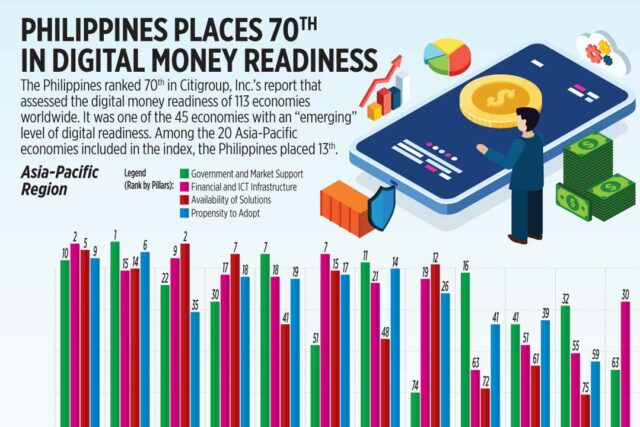
Philippines places 70th in digital money readiness

Philippines places 70<sup>th</sup> in digital money readiness

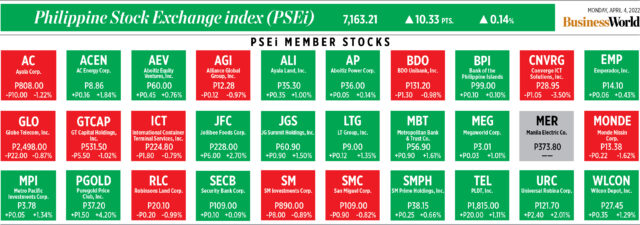
How PSEi member stocks performed — April 4, 2022

Here’s a quick glance at how PSEi stocks fared on Monday, April 4, 2022.


Shares rebound as net inflow of hot money rises

SHARES advanced on Monday ahead of the release of the March inflation report and as hot money net inflows grew in February.

The benchmark Philippine Stock Exchange index (PSEi) climbed by 10.33 points or 0.14% to close at 7,163.21 on Monday, while the broader all shares grew by 8.95 points or 0.23% to 3,797.54.

“Philippine shares were slowly bought up as investors speculated on the latest inflation print that will be released tomorrow, while other recent economic data painted a better picture of the economy,” Regina Capital Development Corp. Head of Sales Luis A. Limlingan said in a Viber message.

Foreign portfolio investments, also called hot money because of the ease by which these funds enter and exit the economy, yielded a $274-million net inflow in February, up from the $14.6 million recorded the previous month and a turnaround from the $40.4-million net outflow seen in the same month in 2021, central bank data released on Friday showed.

Meanwhile, analysts said headline inflation likely accelerated in March as the surge in global oil prices amid the Russia-Ukraine war caused faster increases in food and transport costs.

A BusinessWorld poll of 18 analysts yielded a median estimate of 4% for last month’s inflation, nearer the upper end of the central bank’s 3.3% to 4.1% projection.

If realized, this would be faster than the 3% in February and would match the upper end of the 2-4% target of the BSP. Still, it would be slower than the 4.5% seen a year earlier.

The Philippine Statistics Authority will release March inflation data on Tuesday.

“Helping in Monday’s climb is the anticipated decline in fuel prices, which in turn tempers inflation expectations,” Philstocks Financial, Inc. Senior Research Analyst Japhet Louis O. Tantiangco said in a Viber message.

Fuel companies said pump prices will be rolled back on Tuesday, with Cleanfuel, Petro Gazz, Pilipinas Shell, and Seaoil announcing a decrease of P2.30 per liter for gasoline and P1.85 per liter for diesel.

Most sectoral indices ended in the green except for holding firms, which retreated by 18.47 points or 0.27% to 6,810.15.

Meanwhile, mining and oil soared by 177.62 points or 1.43% to end at 12,557.48; industrials added 80.87 points or 0.83% to 9,824.33; property went up by 24.13 points or 0.72% to 3,333.58; services improved by 2.33 points or 0.12% to 1,941.40; and financials inched up by a point or 0.05% to end at 1,684.76.

Value turnover went down to P3.87 billion with 1.33 billion shares changing hands from the P5.40 billion with 15.20 billion issues seen on Friday.

Advancers outnumbered decliners, 96 versus 83, while 56 names were unchanged.

Foreigners turned net buyers with P202.58 million versus the P683.69 million in net selling seen on Friday. — R.C.S. Agustin

Peso strengthens, tracks stock index gains

BW FILE PHOTO

THE PESO appreciated versus the greenback on Monday to track gains in the stock market and with players already pricing in faster inflation.

The local unit closed at P51.38 per dollar on Monday, gaining 29 centavos from its P51.67 finish on Friday, based on data from the Bankers Association of the Philippines.

The peso opened the session at P51.60 versus the dollar, which was also its weakest showing for the day. Meanwhile, its intraday best was at P51.31 against the greenback.

Dollars exchanged declined to $1.208 billion on Monday from $1.33 billion on Friday.

The peso appreciated on Monday as it tracked gains in the stock market, Rizal Commercial Banking Corp. Chief Economist Michael L. Ricafort said in a Viber message.

The benchmark Philippine Stock Exchange index rose by 10.33 points or by 0.14% to close at 7,163.21 on Monday, while the broader all shares index also increased by 8.95 points or 0.24% to 3,797.54.

Mr. Ricafort said market sentiment improved as global oil prices have declined from the highs seen at the beginning of the Russia-Ukraine war.

Oil rose above $105 a barrel on Monday as concern about tight supply arising from the war in Ukraine and the lack of an Iranian nuclear deal persisted despite countries releasing oil from strategic reserves, Reuters reported.

Last week oil prices slid by 13%, their biggest weekly fall in two years, after US President Joseph R. Biden announced the largest-ever US oil reserves release.

Meanwhile, a trader in an e-mail said the peso appreciated as the market has already factored in faster inflation and anticipate more hawkish signals from the central bank.

A BusinessWorld poll of 18 analysts yielded a median estimate of 4% for March inflation, nearer the upper end of the central bank’s 3.3% to 4.1% projection.

If realized, this would match the upper end of the 2-4% target of the Bangko Sentral ng Pilipinas (BSP) and would be faster than the 3% in February.

The Philippine Statistics Authority will report March inflation data on Tuesday.

BSP Governor Benjamin E. Diokno last week signaled the key policy rate could reach up to 2.75% by next year.

The central bank has kept its key rate untouched for the 11th straight meeting last month despite warning that its inflation target might be breached this year due to surging global oil prices brought by the Russia’s invasion of Ukraine.

For Tuesday, Mr. Ricafort gave a forecast range of P51.25 to P51.50, while the trader expects the local unit to move within P51.30 to P51.50 per dollar. — L.W.T. Noble with Reuters

SIPP draft lists ‘green’ projects, R&D as eligible for incentives

FREEPIK

A DRAFT of the Strategic Investment Priority Plan (SIPP) retains all the priority industries listed in the 2020 plan while creating two other tiers for “green” industries and research and development (R&D) activities, among others.

The draft, which was released to the media by House Ways and Means Committee Chairman and Albay Rep. Jose Ma. Clemente S. Salceda, remains unsigned but appears to be set for implementation via executive order (EO). The draft itself that Mr. Salceda released appears to be set to go out initially as a memorandum order to be issued by the Office of the President (OP), over the signature of Executive Secretary Salvador C. Medialdea.

The latest version of SIPP will be a companion document to the Corporate Recovery and Tax Incentives for Enterprises (CREATE) Law and seeks to identify the industries to which the government hopes to attract investment by offering tax incentives.

According to the draft, Tier I consists of industries included in the 2020 version of the SIPP. The 2020 SIPP was carried over as a transitional list pending the release of a new SIPP that conforms to the provisions of CREATE, which took effect in April 2021.

Tier II was defined as activities “that are supportive of a competitive and resilient economy and will fill in gaps in the Philippines’ industrial value chains, which are critical in promoting green ecosystems, ensuring a dependable health system, achieving robust self-reliance in defense systems, and transforming industrial and agricultural sectors to being modern, competitive, and resilient,” according to the draft.

Tier III will include activities which are “supportive of the acceleration of the transformation of the economy primarily through the application of research and development (R&D) and attracting technology investments.” The tie also proposes to incentivize equipment and parts manufacturing and services related to new technologies, as well as the commercialization of R&D.

A draft foreword to the SIPP that was to go out in the name of Trade Secretary Ramon M. Lopez listed the Tier I projects as follows: various manufacturing activities including agro-processing projects; strategic services; healthcare and disaster risk reduction management services; mass housing; infrastructure and logistics projects including public-private partnerships entered into with local governments; innovation drivers, innovative business models, environment or climate-change-related projects; and energy.

Tier I also incentivizes export activities and other projects granted incentives by special laws.

According to a draft message that was to go out in the name of President Rodrigo R. Duterte that was attached to the draft SIPP, the President expressed hope that the plan will allow the Philippines to “attract more investments that will help propel economic recovery beyond the pre-pandemic levels while promoting sustainable inclusive growth, which will put us back on track towards upper-middle income country status in the long term.”

CREATE is the second package of the Comprehensive Tax Reform Program. It reduces the corporate income tax rate to 20% from 30%, and makes fiscal incentives more time-bound and performance-based.

According to Mr. Lopez of the Department of Trade and Industry, the Palace is due to receive a draft EO this week to implement the SIPP.

“The details of the executive order have been finalized also by the technical working group, and the draft EO on SIPP will be transmitted to OP this week,” Mr. Lopez said in a Viber message. — Jaspearl Emerald G. Tan

Chamber wants next gov’t to focus on agriculture

PHILIPPINE STAR/ MICHAEL VARCAS

THE NEXT government needs to grant priority status of agriculture and education, according to the Federation of Filipino-Chinese Chambers of Commerce and Industry, Inc. (FFCCCII).

FFCCCII President Henry Lim Bon Liong said agriculture and education form the basis of the rise to power of the US and China.

“I think all candidates should prioritize (agriculture and education),” Mr. Lim Bon Liong said in a television interview on Monday.

He expressed hope for continuity with the approach taken by the Duterte administration, especially its decision to seek friendly relations with China and other neighbors.

“We support whoever will be the duly elected president. But, as far as the different candidates are concerned, the federation is looking at a candidate that will continue the legacy of President Duterte in dealing with our neighbors,” Mr. Lim Bon Liong said.

He expressed the hope that the two candidates leading the surveys, former Senator Ferdinand R. Marcos, Jr. and Vice-President Maria Leonor G. Robredo take a similar approach to China relations.  

“Both Mr. Marcos and Ms. Robredo are acceptable to us. But, of course, hopefully both of them will have the same stand of trying to get as (many) possible concessions from our giant neighbor, China,” Mr. Lim Bon Liong said.  

Mr. Lim Bon Liong said that the country is expected to be “back to normal” soon if drastic quarantine restrictions do not return.

“Right now, with Alert Level 1, a lot of people are going back to work. We are fully open and we are back to business. Those that we have temporarily laid off, we are getting them back already. We hope that the government will not go back to Alert Level 2 or 3,” Mr. Lim Bon Liong said, referring to the quarantine settings with more restrictive caps on mobility and capacity of business establishments.

“As long as we are under Alert Level 1 or we can go to Alert Level 0 that would be even be better. I think we will be back to normal pretty soon,” he added. — Revin Mikhael D. Ochave

Gov’t seeking to revive Korean visitor market

PHILSTAR

THE Department of Tourism (DoT) said it is targeting a recovery in arrivals from South Korea in order to drive the tourism industry’s recovery.

In a statement on Monday, the DoT said it met with the South Korean travel industry and regulators between March 28 and April 1 in a bid to increase visitor traffic from there.

The Philippine delegation included representatives from Philippine Airlines and Cebu Pacific Air, Inc., which met their counterparts from Asiana Airlines, Inc. and South Korean low-cost carriers Air Seoul, T’way, Jin Air, Jeju Air, and Fly Gangwon. The delegation also met with the South Korean Ministries of Foreign Affairs and Trade, Industry and Energy.

“The Philippines is more than ready to welcome our Korean tourists. Our entry requirements are one of the safest and most relaxed in Asia. It is understandable that some may still be reluctant to travel amid the pandemic but let me reassure you that the Philippine government and tourism industry have instituted measures to keep everyone safe,” Tourism Secretary Bernadette Romulo-Puyat said during a meeting with the South Korean travel industry on March 30.  

Ms. Puyat said that 97% of the Philippines’ tourism workers and other stakeholders are vaccinated.

“With the majority of the country’s tourism workers being fully vaccinated, we have begun rolling out our booster shots for added protection. We hope that these efforts will help entice visitors to return, especially now that we have developed many new tourism circuits catering to the interests of tourists in this new era of travel,” Ms. Puyat said.

According to the DoT, visitor arrivals from South Korea amounted to 1.98 million in 2019, making it the Philippines’ leading source of tourists.

Since the borders reopened on Feb. 10, the Philippines has tallied 5,551 visitors from South Korea.

“Other than its natural beauty, the lure of the Philippines to South Korean tourists can be partly attributed to the proximity of the Philippines, which takes only three and a half hours by air. The emergence of low-cost carriers, resulting in frequent flights and reasonable travel costs, and good quality of service have also attracted Korean tourists to the Philippines,” the DoT said.

In a television interview, Ms. Puyat said that the Philippines has logged 176,857 visitor arrivals since it reopened its borders on Feb. 10 with eased quarantine requirements for vaccinated travelers.

She said the top source of visitors since the reopening are the US, Canada, and the UK.

“The requirement to enter the Philippines is to be fully vaccinated and have either a negative reverse transcription-polymerase chain reaction (RT-PCR) test 48 hours before going here or negative lab-based antigen test 24 hours before departure,” Ms. Puyat said. — Revin Mikhael D. Ochave