Home Blog Page 6569

The 5 don’ts of employee problem-solving

I’m the human resource (HR) manager of a business process outsourcing firm. Our newly-appointed American chief executive officer (CEO) is puzzled why our typical worker does not volunteer to solve a problem even if it’s adversely affecting their work. I told our CEO that we need to be patient, as workers may be waiting to figure out the new CEO’s management style. What’s your take on this? — White Flower.

He who waits to do something good will never accomplish anything. Management is not a waiting game. You should be the first to know that in HR, being the in-house specialist in people management. If you’re a regular follower of this column, you’ll find that the common thread in much of my advice is to be proactive with the workers.

That’s why I’m not a big fan of exit interviews, which are too little, too late. They are reactive and reveal few hints about what’s wrong with management. That’s assuming that resigning employees are willing to share their frustrations. Most of the time, they don’t want to rock the boat in order not to delay the release of their terminal pay, employment certificate, clearance and recommendation letter for their next employer.

You can do a lot to encourage people to problem-solve. Start by coming up with a corporate-wide program to establish a formal framework, in which the workers must identify their everyday operational issues and make recommendations to management about their proposed solution.

FIVE DON’TS
However, the real issue is that workers will have many solutions in mind. The trouble is that they’re not sure whether management is receptive to their ideas if the work environment is not conducive. Sometimes, when prompted to propose solutions, they bring up measures that are too expensive for the organization to accept and apply.

I’ve talked to many workers whose main recommendation is hiring additional manpower as work piles up, or buy expensive software to improve productivity. These are typically rejected by management even if the money is there.

In many cases, however, organizations don’t have enough funds for those solutions. So, what can we do? As I’ve said earlier, management must create a work environment where problem-solving and decision-making are delegated to the workers to a certain extent. You may have heard of the employee suggestion program, kaizen teams, quality circles, labor-management cooperation or a combination of any two or three of those.

Whatever name you may want to call it, start something by empowering people with an improvement program outlined in a simple policy, a suggestion form to be used, the role of line executives, the approval process, and the reward system. You can start from there and innovate as you go along. In general, management must be cautious of the following:

One, don’t be trigger-happy in rejecting employee ideas. Emphasize in the policy that management will only accept low-cost solutions. It’s up to you to define the meaning of “low-cost.” Don’t take it literally. A budget of say, $200 or even $500 may be acceptable if it solves a recurring $1,500 problem. It’s your call.

This is the true essence of kaizen (continuous improvement). It includes maximizing current resources to solve certain issues. Give examples of the type of preferred solutions that are welcome and likely to be approved. I have a list of these examples that I could share with you.

Two, don’t monopolize the discussion when convening the group to solve a problem. Don’t be a victim of “groupthink.” This is a principle in psychology that when a boss, a senior team member or a bully voices an opinion, it tends to disrupt critical thinking in other people. If you’re tempted to say something, recast it as a question, or else ask “why” lots of times to challenge the logic of various proposals.

Whatever you do, establish a low-key position. Let the workers shine on their own. If you start announcing your preferred solution, chances are, it will be misinterpreted as something that you would want done.

Three, don’t interrupt team members as they lay out their ideas. If you don’t agree with a proposal, let the group decide for themselves as long as they follow the established guidelines. The same principle applies even if you agree with something. This is the logic behind co-ownership.

It would be easy for everyone to support an idea if they’re allowed to weigh in on the pros and cons without active management intervention. Such group participation also helps to convey the message that management trusts the system and the people who are working behind it.

Four, don’t allow the discussion to erupt into disagreement. In many cases, this is inevitable, but practical solution is always available. If there’s a conflict between team members, try to placate everyone by acknowledging that the opposing parties’ positions are both valid. Then review the rules if they contain a path to resolving the conflict.

Another approach is to solicit ideas from a passive member who might see things differently. As a last resort, allow all team members to conduct a secret ballot to arrive at a final decision.

Last, don’t forget to show your appreciation to the team and to individuals. Kind words are easy to utter and work well in any situation. Don’t sound insincere or phony. Depending on the nature or importance of the issue at hand, you can say something like — “That’s an excellent idea. Let’s explore it with the help of the team.”

Ensure that other group members hear your words of praise. By doing so, you’ll be encouraging everyone to develop more ideas with the help of the team. Management must seize every opportunity to promote teamwork in situations where the workers are allowed to manage their own processes.


Have a chat with Rey Elbo via Facebook, LinkedIn or Twitter or send your workplace questions to elbonomics@gmail.com or via https://reyelbo.consulting


Meralco calls for more ILP participants

PHILSTAR FILE PHOTO

MANILA Electric Co. (Meralco) has reached out to its eligible customers to take part in its interruptible load program (ILP) in which participants, when needed, “de-load” from the electricity grid and use their own generators.

“Currently, there are 122 companies with a total committed de-loading capacity of close to 560 megawatts (MW) in the Meralco franchise area that are enrolled under this program,” Meralco Vice-President and Head of Utility Economics Lawrence S. Fernandez said in a Viber message.

The program is implemented by the Department of Energy (DoE) along with distribution utilities in response to thinning power reserves, especially during the summer months.

On March 31, Meralco conducted a webinar in coordination with the DoE urging eligible customers to sign up for the ILP.

“This is one of the measures we have in place to ensure there will be continuous and reliable electricity service, particularly during the dry months and the upcoming National and Local Elections,” Mr. Fernandez said.

In the instance when the National Grid Corporation of the Philippines (NGCP) declares insufficient power supply scenarios, Meralco asks the ILP participants to temporarily de-load from the grid and switch on their generators.

In preparation for the elections in May, NGCP will be mobilizing 24/7 operations of its overall command center from May 8 to 10 to oversee power transmission operations and facilities.

NGCP’s dedicated team, the power task force elections (PTFE), has already carried out preparatory activities by coordinating with Commission on Elections and other government agencies for the deployment of their respective contingency plans.

“Our Integrated Disaster Action Plan (IDAP) prescribes these and other measures to ensure the readiness of all power transmission facilities to be affected by emergencies during important national events. With its security and contingency preparations set, NGCP can ensure reliable power transmission services before, during, and after the election date,” the company said in a statement.

This year, the DoE forecast a total peak demand of 12,387-MW for the Luzon grid by the last week of May, 747-MW higher than the previous year’s peak load of 11,640-MW that occurred on May 28.

Meralco’s controlling stakeholder, Beacon Electric Asset Holdings, Inc., is partly owned by PLDT, Inc. Hastings Holdings, Inc., a unit of PLDT Beneficial Trust Fund subsidiary MediaQuest Holdings, Inc., has an interest in BusinessWorld through the Philippine Star Group, which it controls.

Meralco shares at the local bourse advanced by P5.60 or 1.53% to close at P372.60 apiece. — Ram Christian S. Agustin

Creamline goes for Petro Gazz’s jugular to avert finals collapse

PVL

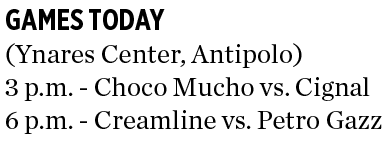
CREAMLINE seeks to bury the ghost of the past as it goes for Petro Gazz’s jugular and avert a repeat of its finals collapse last season in the Premier Volleyball League (PVL) Open Conference, which moves to the Ynares Center in Antipolo City.

Powered by the clutch efforts of Jia De Guzman, Alyssa Valdez and Tots Carlos, the Cool Smashers turned back the Angels, 25-16, 23-25, 25-12, 32-30, in the series opener on Wednesday at the MOA Arena and could wrap it all up with another triumph in their 6 p.m. duel.

A decider, if necessary, is on Sunday at the same venue.

The power-spiking Mses. Valdez and Carlos uncorked 26 points apiece while Ms. De Guzman had 39 excellent sets to go with four hits including a couple of blocks and 15 excellent digs and should be the focal points of Creamline’s attack again as they shoot for their first crown as pros and fourth overall in the league.

Ms. Morado though stressed the job isn’t complete yet, knowing they also led 1-0 in their series with the Chery Tiggo Crossovers in Bacarra, Ilocos Norte a season back.

But as fate would have it, the Cool Smashers dropped the last two games including the winner-take-all match where they led two sets to none only to lose the last three frames and the crown.

“You can’t win a championship in one game, there’s one more to go,” said Ms. De Guzman, a former Finals MVP who is a strong candidate to win the league’s best setter award.

For the Angels, they would play minus Grethcel Soltones, who have a swollen right knee and awaiting the result of her MRI on Thursday.

Myla Pablo, who had cramps in Game One, and Nicole Tiamzon, who has sore legs, were given the green light to see action.

“Ms. Gretch (Soltones) won’t. Myla and Nicole are sore but yes they will play,” said Petro Gazz coach Jerry Yee.

Meanwhile, Choco Mucho likewise goes for the kill in its best-of-three face off with Cignal for third place at 3 p.m.

The Flying Titans took Game One, 25-17, 25-21, 21-25, 25-22. — Joey Villar

The Northman aims to tell Viking tale with accuracy and action

Alexander Skarsgård in The Northman — IMDB.COM

LONDON — Filmmaker Robert Eggers says his new star-studded revenge epic The Northman is both a big popcorn movie and a truthful portrayal of Viking culture and mythology.

Set in 895, the film stars Alexander Skarsgard as Viking prince Amleth, who flees his home in the North Atlantic after his uncle (Claes Bang) brutally kills his father, King Aurvandil (Ethan Hawke).

Years later, Amleth, disguised as a slave, travels to Iceland where his uncle and mother, Queen Gudrun (Nicole Kidman) now live, to avenge his father’s murder and to rescue his mother. Along the way he meets a mysterious woman, Olga (Anya Taylor-Joy), with whom he forms the first real human connection since his childhood.

“There really hasn’t been an accurate Viking movie ever before, and I was working with the greatest historians and archaeologists in the field and, one thing is for sure, this is the most accurate Viking movie that’s ever been made,” Mr. Eggers told Reuters at the film’s London premiere.

The Northman is produced by Mr. Skarsgard, who had spent several years developing a Viking epic before meeting Mr. Eggers.

“It’s been a dream of mine since I was a little kid growing up in Sweden, surrounded by runestones,” he said.

Mr. Skarsgard, 45, went through a physical transformation to play the burly Viking, working with his Tarzan trainer Magnus Lygdback.

“When Amleth transforms from his human state to his spirit animal, he becomes a hybrid of a bear and a wolf, so it was important to bulk up a bit and get a bit bigger,” he said.

The movie’s violent, large-scale action scenes were a first for Mr. Eggers, who has previously directed two feature films, The Lighthouse and The Witch. It involved meticulous planning and organization to keep his hundreds of extras, stunt performers and animals on track.

“He loves authenticity, he loves very long takes, scenes with no cuts. It’s quite challenging shooting big, big action set pieces with just one camera, one shot. So we had to rehearse them many, many times and work on that choreography and the relationship between the characters and the camera,” said Mr. Skarsgard of the experience.

The Northman, which also features Icelandic singer Bjork in her first big screen appearance in 17 years, is being released in cinemas around the world this month. —  Reuters

Polymer bills to be circulated starting April 18

THE trial circulation of P1,000 polymer bills will start this month, with the central bank assuring the notes have security features to prevent counterfeiting.

Bangko Sentral ng Pilipinas (BSP) Governor Benjamin E. Diokno said the notes will be circulated starting April 18.

“People can have it through over-the-counter transactions. In six months’ time, you will see it through the ATM (automated teller machines),” he said in a virtual briefing on Thursday.

Mr. Diokno said ATMs will be configured to include the P1,000 polymer bills as they will be circulated alongside the current notes.

“It (trial circulation) could be six months or less. We expect that there will be competition among banks. So we don’t expect this to be done 100% in six months or one year,” he said.

The P1,000 polymer bills were presented to President Rodrigo R. Duterte on Wednesday evening. The trial circulation involves 10 million pieces of notes.

Sarah Severina Curtis, deputy director of the BSP’s Banknotes and Securities Production Management Department, said the design of the polymer bills has security features as given P1,000 bills are the highest denomination, making them a target of counterfeiters.

The front design of the bill is a Philippine eagle, setting it apart from existing P1,000 notes that feature World War II heroes Jose Abad Santos, Vicente Lim, and Josefa Llanes Escoda.

Also, on the front side of the bill is a sampaguita, while the Tubbataha Reefs Natural Park, South Sea Pearl, and T’nalak weave are on the reverse side.

The central bank pushed to test polymer bills to see if the benefits of using the material seen by other central banks will also be seen in Philippine conditions.

Polymer bills last at least 2.5 times longer than paper banknotes, given their resistance to water, oil, dirt, and general wear and tear.

“Their extended lifespan makes polymer banknotes more cost-effective in the long run. They can also be recycled into other useful forms, such as compost bins, building components, furniture and other household products,” the BSP said. — LWTN

How PSEi member stocks performed — April 7, 2022

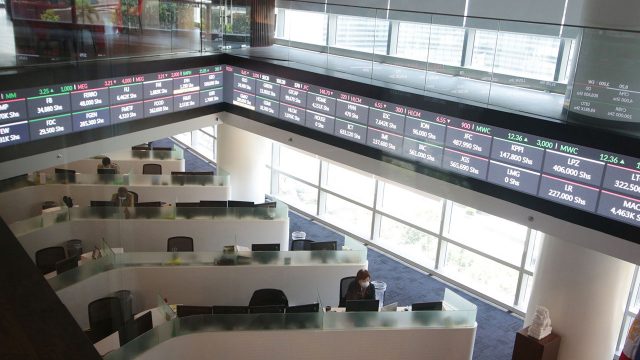
Here’s a quick glance at how PSEi stocks fared on Thursday, April 7, 2022.


Philippine manufacturing rebounds to 5-month high in February

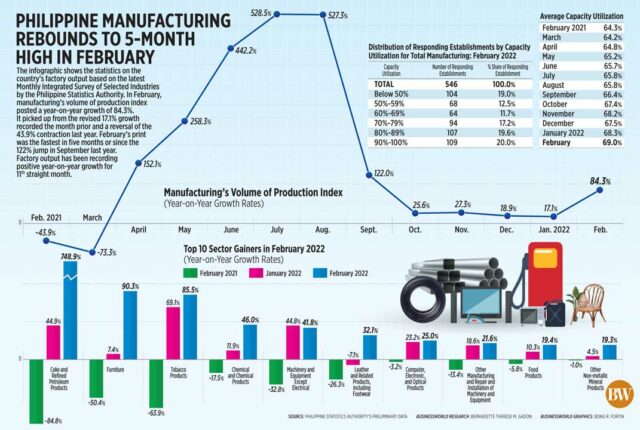
MANUFACTURING rose to its highest level in five months in February, thanks to favorable base effect and increased economic activity amid looser mobility curbs. Read the full story.

Philippine manufacturing rebounds to 5-month high in February

Philippine labor force situation (Feb. 2022)

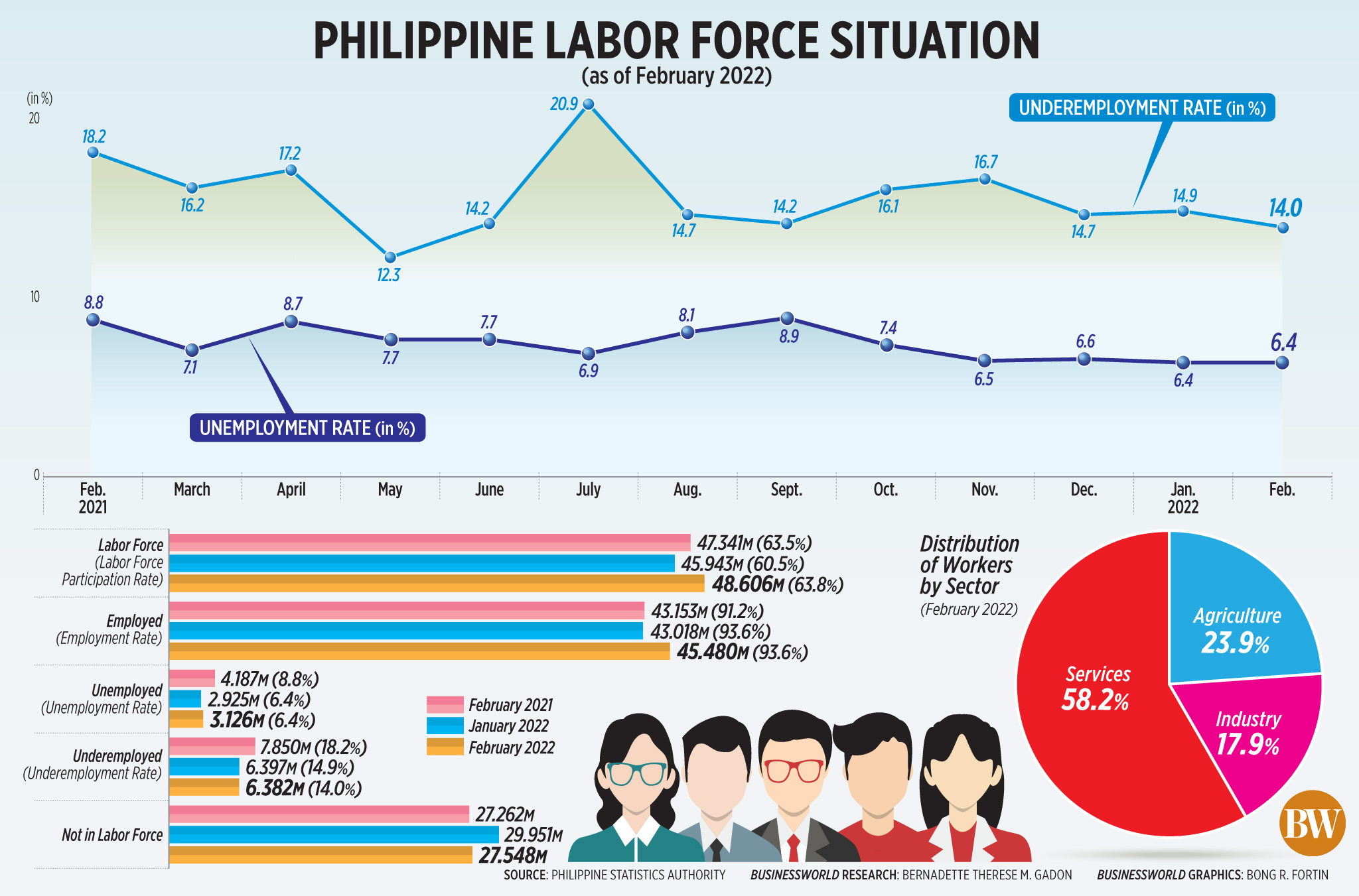
THE PHILIPPINES’ unemployment rate steadied on a monthly basis in February, but the number of jobless Filipinos increased to 3.126 million despite the gradual reopening of the economy, the Philippine Statistics Authority (PSA) reported on Thursday. Read the full story.

Philippine labor force situation (Feb. 2022)

Peso sideways after Fed minutes

BW FILE PHOTO

THE PESO closed sideways versus the greenback due to the hawkish tone of minutes of the US Federal Reserve’s latest meeting.

The local unit closed at P51.42 per dollar on Thursday, inching up by a centavo from its P51.43 finish on Wednesday, based on Bankers Association of the Philippines data.

The peso opened Thursday’s session at P51.37 versus the dollar. Its weakest showing was at P51.43, while its intraday best was at P51.33 against the greenback.

Dollars exchanged dropped to $885.5 million on Thursday from $1.263 billion on Wednesday.

The peso slightly appreciated following the release of minutes of the Fed’s March meeting, Rizal Commercial Banking Corp. Chief Economist Michael L. Ricafort said in a Viber message.

The minutes released on Wednesday showed the Fed was initially looking to increase rates by 50 basis points (bps), but reduced this to 25 bps as it took into account the war in Ukraine, Reuters reported.

It also showed officials generally agreed to cut up to $95 billion monthly from the central bank’s asset holdings to fight surging inflation.

Meanwhile, a trader in a Viber message said the peso gained after the decline in fuel prices.

The Brent and West Texas Intermediate benchmarks dropped to their lowest closing levels since mid-March at $101.07 and $96.23 a barrel, respectively.

For Friday, Mr. Ricafort gave a forecast range of P51.30 to P51.45 per dollar, while the trader expects the local unit to move within P51.25 to P51.45. — LWTN with Reuters

PSE index falls to 6,900 level on Fed minutes

BW FILE PHOTO

SHARES continued to decline on Thursday as the majority of Wall Street indices fell due to the US Federal Reserve’s hawkish tone in the minutes of its latest meeting where it raised rates from near zero.

The benchmark Philippine Stock Exchange index (PSEi) plunged by 183.23 points or 2.57% to close at 6,926.03 on Thursday, while the broader all shares shed 79.26 points or 2.09% to 3,701.23.

“Philippine shares fell with investors continuing to digest the Federal Reserve’s plans to tighten monetary policy… On top of this, the minutes indicated that participants judged it appropriate to move towards a neutral policy position ‘expeditiously,’” Regina Capital Development Corp. Head of Sales Luis A. Limlingan said in a Viber message.

COL Financial Group First Vice-President April Lynn C. Lee-Tan said the PSEi’s decline was due to weak performance of US market overnight.

“Also, the higher-than-expected inflation and rising 10-year bond rate. Investors [are] locking in gains for the meantime,” Ms. Tan added.

Wall Street’s main indexes fell on Wednesday, with steep declines in tech and other growth stocks, after minutes from the Federal Reserve’s March meeting sharpened investors’ focus on the US central bank’s plans to fight inflation, Reuters reported.

The Dow Jones Industrial Average fell 144.67 points or 0.42% to 34,496.51; the S&P 500 lost 43.97 points or 0.97% to 4,481.15; and the Nasdaq Composite dropped 315.35 points or 2.22% to 13,888.82.

Minutes of the Fed’s March 15 to 16 meeting showed policy makers rallying around plans to cut the central bank’s massive balance sheet as soon as next month.

Fed officials “generally” agreed to cut up to $95 billion a month from the central bank’s asset holdings as another tool in the fight against surging inflation, even as the war in Ukraine tempered the first US interest rate increase.

Policy makers were convinced to not only raise the target policy rate by a quarter of a percentage point from its near-zero level but also to “expeditiously” push it to a “neutral posture” of around 2.4%.

All sectoral indices ended in the red on Thursday. Property went down by 98.26 points or 2.97% to 3,207.11; financials dropped by 48.59 points or 2.86% to 1,644.87; industrials lost 239.09 points or 2.44% to end at 9,556.07; mining and oil gave up 284.06 points or 2.26% to 12,257.61; services retreated by 43.61 points or 2.26% to 1,886.08; and holding firms decreased by 148.66 points or 2.21% to 6,566.87.

The MidCap index fell by 23.3 points or 1.93% to 1,181.73, while the Dividend Yield lost 36.99 points or 2.17% to close at 1,669.40.

Value turnover increased to P6.41 billion with 920.28 million shares changing hands from the P4.98 billion with 11.53 billion issues seen on Wednesday.

Decliners overwhelmed advancers, 139 versus 33, while 52 names were unchanged.

Net foreign selling grew to P953.3 million on Thursday from the P464.96 million seen the previous trading day. — Luisa Maria Jacinta C. Jocson with Reuters

VP candidate Sotto says Palace about to break ‘endo’ promise 

SENATE.GOV.PH

By Alyssa Nicole O. Tan

SENATE President Vicente C. Sotto III, who is running for vice-president (VP) , said the Palace is on the verge of breaking its promise to end the practice of labor contractualization, and expressed his disappointment about the President’s decision to veto a 2019 bill, which he said had arrived at a balance of interests between workers and employers.

“For whatever reason, the fact is, (the 2019 bill) was vetoed,” told BusinessWorld in a Viber message on Thursday. “Employees waited for it. Employers were against it… We worked on the bill that was equitable for all stakeholders. It’s sad that the executive felt that way.”

The administration’s term is about to end without addressing contractualization, which is known as “endo.” Endo denies workers a path to permanent employment by engaging them in contracts that do not bring them past the six-month probation period. Employers are obliged to grant their workers regular status after they complete six months’ probation.

Re-electionist Senator Emmanuel Joel J. Villanueva has promised to refile the Security of Tenure (SoT) bill if he is returned to office after the May polls.

On Thursday, the President’s acting spokesman, Jose Ruperto Martin M. Andanar said in a statement that the SoT bill that had been vetoed “unduly broadens the scope and definition of prohibited labor-only contracting, effectively proscribing forms of contractualization that are not particularly unfavorable to employees involved.”

“The President hopes that Congress would rectify the vetoed provisions as he remains committed to eradicating all forms of abusive employment practices and protecting the workers’ right to security of tenure,” Mr. Andanar added.

Under the bill, workers will be classified as either regular or probationary employees. Project and seasonal workers will be considered regular employees. The services of any worker cannot be terminated without cause.

In July 2019, the President said in his veto message that the SoT bill contains a “sweeping expansion of the definition of labor-only contracting, (which) destroys the delicate balance and will place capital and management at an impossibly difficult predicament with adverse consequences to the Filipino workers in the long term.”

Fitch Solutions bullish on PHL power industry decarbonization 

PHILSTAR FILE PHOTO

FITCH SOLUTIONS Country Risk and Industry Research said policies adopted by the Department of Energy (DoE) are poised to accelerate the decarbonization of the power industry by raising investor interest in renewable energy (RE).

The positive outlook for the renewables sector was driven by changes to the regulatory environment such as the DoE’s Renewable Portfolio Standard (RPS) and the Green Energy Option Program (GEOP).

Fitch Solutions also noted a significant expansion of more than 10 times in the renewables project pipeline compared to the level recorded in March 2021. Pending projects include those participating in the DoE tender for 2 gigawatts of renewable energy for the Luzon, the Visayas, and Mindanao.

Under RPS, power distribution utilities, as well as electric cooperatives and retail electricity suppliers, are required to source portion of their energy supply from RE.

Meanwhile, the GEOP gives electricity consumers the option to tap RE for their energy needs.

In a virtual interview, DoE Director of the Renewable Energy Management Bureau Mylene C. Capongcol said that the department has also started examining how to mitigate risk for geothermal energy investors.

“Geothermal actually is 24/7 and can compete with other conventional (sources) like coal. Right now, the cost of developing geothermal is very expensive and the success rate is very low, so recognizing the value of that, we will be coming out soon with a risk mitigation policy for geothermal energy development,” she said.

Strong opposition to the use of coal as a fuel for power generation has led Fitch Solutions to revise downwards its forecast for coal-fired power generation in the Philippines.

Even with the moratorium on coal-fired power projects issued by the DoE in December 2020, coal remains the leading fuel for the industry, with coal-fired plants accounting for 61% of the power mix by 2031. — Ram Christian S. Agustin