Home Blog Page 6539

No major damage from magnitude 6.2 earthquake in Davao Oriental  

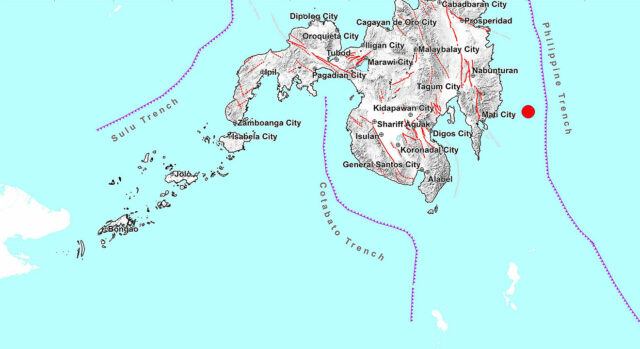
A MAGNITUDE 6.2 earthquake struck Davao Oriental province in Mindanao, the Philippine southern mainland, at mid-morning Tuesday, the Philippine Institute of Volcanology and Seismology (Phivolcs) reported.   

The tectonic tremor was located offshore, about 57 kilometers east of Manay town.                   

Intensity 4 which is generally felt indoors with vibration similar to a passing heavy truck, according to Phivolcs10-level intensity scale was reported in parts of Davao Oriental as well as in Hinatuan and Bislig City in neighboring Surigao del Sur.  

Phivolcs said no damage was expected from the earthquake but warned of aftershocks. At least 12 aftershocks were recorded by the agency as of 12 noon, ranging in magnitude from 2.9 to 4.4.  

There were no immediate reports of significant damage from local governments.   

The National Grid Corporation of the Philippines said power transmission services were not affected.   

The Mindanao Grid remains intact as there are no reports of power interruption and damaged transmission facilities in Davao Oriental and nearby areas where the earthquake was felt,it said. MSJ

SC junks former OMB chair’s petition to dismiss graft charges 

PHILSTAR FILE PHOTO

THE SUPREME Court (SC) has dismissed the petition of former Optical Media Board (OMB) chairperson Ronald N. Ricketts to dismiss the graft charges against him for failing to file charges against sellers of pirated DVD and VCD goods during a raid in 2010.  

In a resolution dated Nov. 18 last year and made public on Apr. 19, the High Court affirmed the resolutions of the Sandiganbayan in 2012 and 2017 denying his motion for a demurrer to evidence for lack of merit.  

A demurrer of evidence asserts that the evidence presented by the opposing party is insufficient.  

Mr. Ricketts argued that the anti-graft court committed grave abuse of discretion in denying his motion as there is insufficient evidence to sustain his indictment. 

In 2010, a team of OMB agents seized 127 boxes and two sacks of pirated DVDs and VCDs along Quiapo, Manila. Three Chinese nationals were arrested and the confiscated materials were brought to the OMB office.   

The former OMB chief allegedly told his personnel to load 121 of the 127 boxes of pirated products to a truck marked “Sky High Marketing,” and no charges were filed by the agency against any person after.  

The Office of the Ombudsman filed a complaint before the Sandiganbayan against Mr. Ricketts and his co-accused for supposedly giving “unwarranted benefit, advantage or preference” to Sky High Marketing Corporation. It added that Mr. Ricketts caused damage and prejudice to the government by not filing the appropriate charges against the offenders. 

“The orderly procedure prescribed by the Revised Rules of Court is for the accused to present his evidence, after which the trial court, on its own assessment of the evidence submitted, will then properly render its judgment of acquittal or conviction,” the High Court said in its ruling. John Victor D. Ordoñez

Melbourne City dominates United City, 3-0, in AFC Champions League

UNITED City FC stumbled to its second consecutive loss in the 2022 Asian Football Confederation (AFC) Champions League, bowing to Australia’s Melbourne City FC, 3-0, on Monday night in Pathum Thani, Thailand.

The reigning Philippine titlist gave up 21 shots and nine corners to the A-League kingpins, who dominated possession at 64.8% and found the back of the net through brace-scorer Marco Tilio and Stefan Colakovski.

The loss, which came three days after a 1-0 opening defeat to Korea’s Jeonnam Dragons, left United City at the bottom of Group G.

Melbourne, with four points on one win and one draw, took the lead on goal difference against BG Pathum United, which beat Jeonnam in the other game 2-0.

Colakovski fired a right-footed shot from the right side of the box in the 34th minute to put Melbourne on the board against listless United.

Twenty-year-old forward Tilio doubled the Australians’ lead 14 minutes after restart with his low effort from eight yards then got his second goal off a Raphael Rodrigues assist in the 75th to put the game beyond reach. — Olmin Leyba

Liverpool has to be ‘angry’ and ‘greedy’ against Man Utd, says Klopp

LIVERPOOL manager Jürgen Klopp has told his players to view their Premier League game against Manchester United later on Tuesday as the most important three points of their lives as they continue their push for an unprecedented quadruple.

Liverpool, who has already won the League Cup and are in the FA Cup final and the Champions League semifinals, trail league leaders Manchester City by a point with seven games left.

While fifth-placed United are on course for a fifth straight season without a trophy, Klopp told reporters on Monday that they can still cause Liverpool “massive problems” at Anfield.

“We have to be angry in a good way and all these kind of things,” he said. “Greedy, really, like you are if you have won nothing, like you would be with nil points and it is the most important three points in your life.

“That’s actually the attitude we need for this game because the quality is too high and they are too good for not being in that mood.”

Ralf Rangnick has failed to inspire a turnaround in United’s fortunes since taking over on an interim basis last year and Klopp said there was no quick fix for the club’s issues.

“We had a similar situation when I started here,” he added. “We were not flying from the first day. Let me say it like this, and you might have thought after six or seven weeks: ‘Is it really much better than before?’”

“When you are in that situation, you just accept that you need all the steps. You cannot just put on a magic sprinkle and go from there.” — Reuters

76ers roll over short-handed Raptors for 2-0 series lead

JOEL Embiid had 31 points and 11 rebounds to lift the host Philadelphia 76ers past the Toronto Raptors 112-97 to take a 2-0 lead in their Eastern Conference opening round playoff series on Monday.

Tyrese Maxey added 23 points, nine rebounds and eight assists, Tobias Harris contributed 20 points and 10 rebounds and James Harden chipped in with 14 points as the Sixers defended their home court with a pair of wins. Danny Green also had 11.

It was the 100th career playoff win for head coach Doc Rivers.

Game 3 will be played Wednesday in Toronto.

OG Anunoby led the Raptors with 26 points, Fred VanVleet added 20 and Pascal Siakam had 20 points and 10 rebounds. Chris Boucher also scored 17.

The Raptors played without Scottie Barnes, who suffered an ankle injury in Game 1 when Embiid landed on him.

Toronto’s Gary Trent, Jr. played 10 minutes and didn’t return due to a non-COVID illness. He was scoreless on 0-for-3 shooting.

The Sixers went ahead 59-46 when Harden drove to the basket and scored with 5:09 left in the second quarter.

Precious Achiuwa responded with a jumper on Toronto’s ensuing possession.

Philadelphia then surged to a 67-52 lead heading into the locker room thanks in large part to Embiid’s 19 points. All 19 came in the first quarter.

VanVleet paced the Raptors with 17, though he shot 6 of 18 overall.

The Sixers came out aggressive on both ends of the court to begin the third and opened a 19-point advantage after dunks by Embiid and Harris.

Philadelphia held a 95-71 lead at the end of the third.

Toronto’s frustration became evident when Siakam was whistled for a technical foul with 10:19 remaining in the fourth.

The Raptors responded and soon closed within 97-84 after Anunoby hit a trey with 7:31 to go.

Following an empty Sixers possession, Toronto came back with a tough layup by Khem Birch.

Maxey halted the 20-2 run with a 3-pointer and a 100-86 lead.

The Sixers cruised to the win from there. — Reuters

Barca’s shock loss to Cadiz puts Real on verge of LaLiga title

BARCELONA — Barcelona’s faint hopes of catching LaLiga leaders Real Madrid suffered a huge blow as they slipped to a shock 1-0 home defeat by relegation-threatened Cadiz on Monday.

Real’s last-gasp victory at Sevilla on Sunday extended their advantage over Barça in second to 15 points, but Xavi Hernandez’s in-form side were expected to close the gap by beating Cadiz at the Camp Nou.

The hosts never really got going, however, in front of a disgruntled crowd and Cadiz had the better first-half openings with Lucas Perez missing a glorious opportunity to break the deadlock.

Cadiz kept coming after the interval and Perez scored in the 48th minute before the visitors wasted further big chances to extend their advantage — Alex Fernandez slotting wide when it looked easier to score.

Barça piled on the pressure but lacked that killer pass as they slipped to a first defeat in 16 LaLiga matches stretching back to December. They remained on 60 points from 31 games, 15 behind Real who have one hand on the trophy.

“We had the chances, more than enough to take the three points, but we have to rise from this and think about the next games,” Xavi said.

“We have to change our form as soon as possible. We have got back into the Champions League places but we have to keep going.

“It’s a very bad week for us and we need to change the dynamic as soon as possible.”

Aside from their shock Europa League exit at home to Eintracht Frankfurt last week, Barça has enjoyed a revival under Xavi in recent months to climb back into the title race.

Not only had they gone 16 matches unbeaten in the league, they had won their previous seven LaLiga games in a row, scoring 22 goals in the process.

Other than Ousmane Dembele’s shot, they did not look like scoring in the opening period, with Cadiz, looking for their first-ever win in the Nou Camp, much the better side.

The decisive strike came at the third attempt after Marc-Andre ter Stegen made a fine double save, with Perez picking the perfect moment to score his first league goal of the season.

Ter Stegen saved Barça on several occasions before substitute Pierre-Emerick Aubameyang almost snatched a point for Barcelona who have now lost two home games in a row for the first time since 2003. — Reuters

Celtics vs Nets

The most-anticipated matchup of the first round of the National Basketball Association Playoffs lived up to billing. Owing to unique circumstances, the Celtics found themselves pitted against the highly regarded Nets. And given the personalities on tap, the hype was far more than that normally accompanying a set-to involving second and seventh conference seeds. The 19,156-strong crowd at the TD Garden were certainly pumped, and, in the end, rewarded by a thrilling victory off a last-second layup at the buzzer by resident top dog and surefire All-league selection Jayson Tatum.

Needless to say, fans were buoyed — or, to be more precise, riled up — by the presence of former hero turned heel Kyrie Irving. The Celtics faithful predictably booed him at every turn, even hurling invectives his way. And for a couple of instances, he felt compelled to react accordingly. As he noted, “The same energy they have for me, I’m gonna have… for them. It’s not every fan, [but] there’s only but so much you can take as a competitor.”

For the most part, though, Irving seemed to secure motivation from all the negative reactions. He was close to unstoppable from the get-go, and certainly a handful for the Celtics, even for newly minted Defensive Player of the Year Marcus Smart. That said, he displayed less-than-stellar decision making in the end, leading to a rushed 30-foot attempt from All-Star teammate Kevin Durant and setting up Tatum’s buzzer beater.

The Celtics rightly celebrated, but the Nets have reason to hold their heads high. The latter came close to winning the series opener even though Durant uncharacteristically struggled from the field. That’s not likely to happen again. Meanwhile, Irving figures to stay fueled by the desire to put the Celtics in his rear-view mirror. “This is a guy that made the game-winning shot in the Finals, played in the Olympics, [became] All-Star Game MVP. I don’t know [if] there’s any atmosphere that’s really gonna rattle him,” argued head coach Steve Nash.

In short, all and sundry better be prepared for a long series. Game Two tomorrow looks to be close anew, as will just about every match thereafter. And whether the Celtics or the Nets ultimately prevail depends on, in Nash’s words, “a split second here and there.”


Anthony L. Cuaycong has been writing Courtside since BusinessWorld introduced a Sports section in 1994. He is a consultant on strategic planning, operations and Human Resources management, corporate communications, and business development.

Effecting a Civil-Maritime Regime in the Philippine Archipelago

BW FILE PHOTO

The late 2010s were marked by Southeast Asian states’ efforts to build and develop their nascent coast guards and other maritime law enforcement agencies (MLEAs). These countries see the need to protect and manage their maritime jurisdiction as well as defend their offshore claims and secure their maritime interests and resources. For these littoral states, the coast guard is seen as the primary agency for effecting a civil-maritime regime in their respective territorial and contiguous waters, and Exclusive Economic Zones (EEZs).

NAVY OR COAST GUARD?
In the last century, Southeast Asian countries have protected their maritime domain by building and deploying their modern navies. Navies represent a strong expression of raw state power and control over the sea aimed at conveying to other states that the disputed territory is a matter of national security and a clear signal that a state is willing to use force against other states. The navy’s task is primarily naval warfighting and deterrence against maritime aggression for national defense. Naval vessels play a significant role in a state’s projection of its maritime power. They are designed and built for high technology warfare and high intensity maritime operations.

The coast guard is different from the navy since it is responsible for law enforcement and safety and security in waters under national jurisdiction. Coast guard activities primarily involve a wide range of routine and peacetime maritime security regimes such as safety of seafarers, and the protections of vessels, ports, the marine environment, and offshore installations, and the provision of humanitarian and disaster assistance.

It is a civilian agency optimized for low-intensity maritime operations, tasked primarily with constabulary operations based on a principle of reasonable use of force that requires skills and training in the effective enforcement of civil regulatory frameworks at sea. It is seen as the civilian face of state power in maritime areas whose operation is conducted under a domestic civilian jurisdiction, subject to domestic laws and regulation, and designed for effecting a civil-maritime security governance in Southeast Asia.

EFFECTING A CIVIL MARITIME-SECURITY REGIME
Southeast Asian states have recently relied on their newly established coast guards rather than on their long-established navies to manage their maritime domains and, in certain cases, assert their sovereign rights over disputed waters against other states. This is only natural since Southeast Asia is the site of the world’s two largest archipelagic states, Indonesia and the Philippines. The subregion is crisscrossed by several important bodies of water such as the South China Sea and the Malacca Straits.

The littoral states have long recognized the need to establish civil-maritime security governance to manage the dramatic increase in maritime related activities and to address non-traditional security challenges at sea.

The emergence of a vibrant and integrated regional economy, the increase in trade, and the consequent boom in shipping demand have led to a surge in maritime commerce and trade. An externality to this development is the proliferation of non-traditional security challenges in the waters of Southeast Asia, such as illegal fishing that leads to marine environmental destruction, piracy, terrorism, trade in illicit drugs, pollution incidents, and human trafficking.

As one of the two Southeast Asian archipelagic states, the Philippines has designated the Philippine Coast Guard (PCG) as the lead agency in instituting a civil maritime-security regime over its 7,000 islands, which constitute over a tenth of the global coastline. This civilian agency has diverse tasks ranging from ensuring maritime safety, security, and law and good order to deploying its white hulls in efforts to protect and safeguard the Philippines’ claim in the South China Sea. It is an armed and uniformed civilian service tasked primarily with enforcing national laws, ensuring maritime safety and security, and protecting the marine environment — all missions that are similar to a typical coast guard.

The PCG, given its vast powers and unique characteristics, can transition seamlessly across defense-support and policing activities while keeping its universal treatment as a humanitarian service agency.

During President Gloria Macapagal Arroyo’s term, the PCG played an important role in assisting her administration in realizing the vision of a “Strong Republic” linked by the Philippine Nautical Highway System, in providing assistance to victims of several maritime accidents, and managing the country’s worst oil spill disaster off Guimaras Island in July 2006. At the end of her nine-year term, the Philippine Congress passed the PCG Law of 2009 which clearly and legally stipulated that this agency would remain under the Department of Transportation and Communication’s permanent supervision.

In the 2020s, the PCG is the Philippine government’s primary enforcer of the country’s maritime rights and interests in the country’s EEZ, a role that the Philippine Navy (PN) traditionally held until the Scarborough stand-off of 2012. The Philippine government and its security partners, such as Australia and Japan, have invested in the development of the PCG’s capabilities in recent years.

Still plagued with challenges such as lack of technology, limited manpower, the absence of shore infrastructure to support its operations at sea, and its lingering inter-service dynamics with the PN, the PCG nevertheless assumes an essential role in enforcing and strengthening the country’s civil maritime security.


Dr. Renato De Castro is a Trustee and Convenor of the National Security and East Asian Affairs Program of the Stratbase ADR Institute.

Strategic plan for creative industries

FREEPIK

(Part 4)

One very obvious lesson we can learn from the countries in which the creative industry sector has reached a certain level of success is the very important role of the Government in supporting the various stakeholders of the industry. That is why I would like to report in this article what the leaders of the Creative Economy Council of the Philippines (CECP) expect of the next administration so that their industry can take full advantage of the favorable global trends that we have been enumerating in the previous articles of this series. It would be logical that the champions for the local creative in the next administration should be legislators, cabinet officials, and local government officials who have themselves been involved in the industry as film or TV actors and actresses, media personalities, musicians, and entertainers in general. This article is first and foremost addressed to them.

The ideas contained in this article have been extracted mostly from a position paper prepared by the CECP at the height of the pandemic. There is a portion of the strategy paper devoted to how the sector will be able to recover from the adverse impact of the pandemic. A larger part of the strategic recommendation is a long-term Creative Economy Roadmap up to 2030. Since I have covered the short-term stop-gap measures in a previous part of this series, I will focus on the long-term plan envisioned by the CECP, especially on what they expect at least the next three administrations to do to proactively help the sector to flourish and to attain the vision of becoming the top creative economy in the ASEAN region in much the same way that South Korea is the top creative economy in Northeast Asia.

Using Strategic Planning nomenclature, the stated Vision 2030 is: By 2030, the Philippines will be the Number One Creative Economy in the ASEAN in terms of size and value of our creative industries, as well as the competitiveness and attractiveness of our creative talents and content in the international markets. To attain this Vision 2030, the major objectives are as follows:

1. Rebuild the creative industries to generate jobs, grow its contribution to gross domestic product (GDP), and stimulate inclusive development across the country.

2. Accelerate the growth of creative exports, especially creative services outsourcing.

3. Develop, promote, and protect Filipino intellectual property in content and innovation for long-term sustainable value.

4. Build a renewed sense of pride and cultural soft power through Filipino creativity that is recognized and valued across the world.

To attain these objectives, six strategic areas will be pursued, as follows:

1. Creative policy: Establish a Creative Economy Agency that will set growth targets for the Philippine Creative Economy and will implement the policies to accelerate growth.

2. Creative industries: Identify priority creative industries that have the highest potential to generate jobs and revenues from domestic and foreign markets.

3. Creative zones: Develop special economic creative zones where prioritized creative industries collocate to achieve economies of scale and gain market viability.

4. Creative cities. Encourage LGUs, especially outside Metro Manila, to embrace their own creative economy development agenda. Incentivize cities that gain UNESCO Creative Cities recognition. Some of my own candidates for these “creative cities” are Balanga, Bataan; Baguio; Cebu; Vigan, Ilocos Sur; Puerto Princesa, Palawan; Iloilo City; Dumaguete City; Zamboanga City; Naga City; and Lipa City. I am sure there will be more. I suggest that those who will be elected LGU officials of these cities (and others) make use of part of what they will receive from the National Government under the Mandanas-Garcia ruling to fund some of the facilities (in partnership with the private business sector) that will be needed to realize this objective.

5. Creative tourism. Grow tourism through creative festivals, events, and visits to creative communities. The more than 60 million Filipinos who were domestic tourists before the pandemic are expected to indulge in “revenge travel” after the pandemic. They should be the first to be targeted by the creative cities even before the foreign tourists who can be expected to come back in big numbers only in 2024.

6. Creative education. Strengthen our pipeline of world class Filipino creatives, while becoming an ASEAN Center of Excellence for Creative Education. The courses envisioned here should be patterned after the offerings of the College of St. Benilde system, an innovative offshoot of my alma mater, De La Salle University, that knew how to package academic programs that were more skills-oriented rather than college diploma-focused. The programs offered, more along the line of tech-voc education, are arts management, dance, music production, production design, theater arts, architecture, fashion design and merchandising, industrial design, interior design, animation, film, multimedia arts, culinary arts, photography, hospitality management, travel and tourism management, and real estate management.

As a guide to the next administration and future ones, the following goals and key result areas (KRAs) are being proposed:

1. Creative policy: Grow the creative economy from 6.52% of GDP to 15% by 2030; grow creative jobs from less than one million to 5 million full time jobs by 2030; be the Number One in ASEAN Creative Exports, focusing on our competitive advantage of creative services exports rather than goods exports.

2. Creative industries: Accelerate digital creative services exports/outsourcing, especially animation, game development, software and digital marketing; target $15 billion to $20 billion by 2030; reinvigorate creative goods exports with improved design and technology. Target $5 billion to $10 billion of creative goods by 2030.

3. Creative zones: Have 10 Creative Special Economic Zones across the country with the Clark Creative Zone as a lighthouse model.

4. Creative cities: Have five or more UNESCO Creative Cities that stimulate sustainable economic growth across the country through LGU policies that are focused on encouraging the establishment of creative enterprises in their localities. Baguio and Cebu can be pioneer models.

5. Creative tourism: 10 million foreign tourists attending Philippine-based creative festivals and events; generate at least $1 billion in creative tourism revenues ($100 per tourist for arts, crafts and experience).

6. Creative education: Provide world class creative education needed for 5 million creative jobs; become the ASEAN leader in creative education, with foreign students at 10% to 15% of the total creative students.

To achieve these goals, the Government, in close partnership with business and the academe, must implement the following policies and projects:

1. Establish a Creative Economy Technical Working Group (TWG) under the leadership of the Department of Trade and Industry (DTI). This TWG will federate and orchestrate the efforts of various agencies (the National Commission for Culture and the Arts, the Science and Technology, Tourism, and Education departments, the National Economic and Development Authority, etc.) to work together towards common goals; DTI leadership should monitor closely industry development, job creation, and economic impact; the TWG will set the foundation for a Creative Economy Agency to be patterned after Indonesia’s BEKRAF (Badan Ekonomi Kreatif).

2. Develop official creative economy statistics through consistent measurement and mapping: officially define creative industries to be included in the creative economy; measure jobs and revenues in each sector of the industry; provide creative economy statistical data for all key cities, using the tools of big data analysis; track the growth of the creative economy by industry and by geographical region year on year.

3. Develop an acceleration plan for creative services exports and outsourcing: clearly define priority international markets and sectors; define the resources needed to grow Philippine market share in these global markets; attract FDI into Philippine creative industries to accelerate growth; fund trade missions and investor road shows for identified priority industries; Project Benchmark: the IBPAP Industry Association plan developed by McKinsey.

4. Reinvigorate creative goods exports through design and technology interventions: develop programs for design workshops, manufacturing technology, and digital marketing innovation to help creative goods exporters improve their competitiveness in international markets.

5. The Intramuros Maestranza Creative Quarter for Design: Project concept approval by the Intramuros Board and Tourism department for priority execution in 2023; Project Benchmark: Thailand Design Center.

6. The Clark Creative Zone: creative process outsourcing (animation, digital games, software development, and digital marketing services, concept development and planning in progress with BCDA) for priority execution in 2023; Project Benchmark: the Dubai Media City.

7. National Government Incentives for accredited UNESCO Creative Cities: Fund to help creative city-specific projects (e.g. the Baguio International Creative Festival, the Baguio Creative Hub for Crafts and Folk Art); encourage LGUs to submit applications for 2023.

8. Develop an International Creative Festival designed to attract international participants: After the pandemic crisis, develop a high-profile Creative Festival that will help revive Philippine foreign tourism, although domestic tourism is expected to bounce back much earlier (the Panagbenga Festival in Baguio was already revived this March); Project Benchmark: the Montreux Jazz Festival and the Edinburgh Theater Festival.

9. Creative Talent Development Strategy: Identify talent gaps/needs for priority industries through a study to be completed in 2022; propose comprehensive programs for K-12, university, and tech-voc programs that close these gaps in partnership with the Department of Education, the Commission on Higher Education (CHED) and the Technical Education and Skills Development Authority (TESDA); Project Benchmark: the UK Design Industries Talent Gap Analysis

10. ASEAN Creative Education: Work with private and public universities to create courses and programs that will attract international students from the ASEAN region; launch pilot online programs by 2023.

These strategic directions were formulated pre-pandemic and will require some significant updating. I call upon the stakeholders of the Creative Economy of the Philippines to send me their reactions, updated information, and other policy recommendations that can be compiled by the CECP so that the new administration that will be in place on July 1 can hit the ground running in working towards the vision of making the Philippines the Number One Creative Economy in the ASEAN. There is no doubt that we have the human talent. What we need is the political will of the Government to give its full support to the private sector to make things happen.


Bernardo M. Villegas has a Ph.D. in Economics from Harvard, is professor emeritus at the University of Asia and the Pacific, and a visiting professor at the IESE Business School in Barcelona, Spain. He was a member of the 1986 Constitutional Commission.

bernardo.villegas@uap.asia

Safe spaces in the digital world

PCH.VECTOR-FREEPIK

Global research by Plan International published on Oct. 16, 2020 revealed an alarming rate of 68% of girls and young women experiencing online harassment, while 79% received threats of sexual violence on social media. The same research defined online harassment and violence to include “threats of sexual violence, sexual harassment, threats of physical violence, anti-LGBTIQ+ comments, racist comments, body-shaming, purposeful embarrassment, stalking, and abusive and insulting language.”

This kind of violence and abuse should not be overlooked, especially not when there are laws that seek to punish this very kind of behavior.

For instance, a person who threatens a woman with rape on social media may be prosecuted under the Cybercrime Prevention Act for using the information and communications technology, such as the internet, to commit a crime punishable under the Revised Penal Code, specifically Grave Threats (Rep. Act No. 10175 [2012], Sec. 6). The crime of Grave Threats, which punishes a person who threatens another with the infliction of a wrong amounting to a crime (Rev. Penal Code, Art. 282), is punishable with a higher penalty if it is committed with the use of the internet.

Another example that has become all too common these days is that of posting comments that contain misogynistic remarks against a woman. The Safe Spaces Act, enacted in 2019, specifically addresses this.

The said law punishes gender-based online sexual harassment, which includes acts that use information and communications technology in terrorizing and intimidating victims through physical, psychological, and emotional threats; unwanted sexual misogynistic, transphobic, homophobic, and sexist remarks and comments online whether publicly or through direct and private messages; invasion of victim’s privacy through cyberstalking and incessant messaging; uploading and sharing without the consent of the victim, any form of media that contains photos, voice, or video with sexual content; any unauthorized recording and sharing of any of the victim’s photos, videos, or any information online; impersonating identities of victims online or posting lies about victims to hark their reputation or filing false abuse reports to online platforms to silence victims (Rep. Act No. 11313 [2019], Sec. 12).

As a further deterrent against online sexual harassment, the offense is qualified, and thus merits a higher penalty, if the offended party is a minor, senior citizen, or a person with disability (PWD), among others (Rep. Act No. 11313 [2019], Sec. 15). A video gone viral, therefore, of a person hurling expletives against a woman already a senior citizen is punishable with a heavier penalty.

Even the act of posting lies about a fake lewd video or photo of a woman with the end in mind of harming the victim’s reputation falls squarely under the definition of gender-based online sexual harassment.

It must be noted that the Safe Spaces Act protect men, women, and members of the LGBTQI+ alike, in the same way that it punishes offenders regardless of their gender or sexual orientation. In fact, the law seeks to establish equality, security, and safety of both men and women in digital spaces, among others (Rep. Act No. 11313 [2019], Sec. 2). Thus, any locker room talk does not have a place in the digital world.

Indeed, the lack of face-to-face interactions over the internet has made it easier for people to be vile in their criticism against others, so much so that it translates to verbal violence. Legislative innovation, however, is catching up with technological evolution, as it should. The legal world is adapting towards the shift to the online world. In this regard, social media users should remember that they can be held accountable for their acts and statements made virtually. It is high time that everyone should be reminded of the adage: “Think before you click!”

This article is for informational and educational purposes only. It is not offered and does not constitute legal advice or legal opinion.


Patricia Therese C. Mirador Litigation and Dispute Resolution Department (LDRD) of the Angara Abello Concepcion Regala & Cruz Law Offices or ACCRALAW.

(632) 8830-8000

pcmirador@accralaw.com

Russia begins ‘Battle of Donbas,’ Ukraine says

Army soldier figurines are displayed in front of the Ukrainian and Russian flag colors background in this illustration taken, Feb. 13, 2022. — REUTERS/DADO RUVIC/ILLUSTRATION

LVIV/KYIV — Russian forces have launched their anticipated offensive in eastern Ukraine, attempting to push through defenses along almost the entire front line early on Tuesday in what Ukrainian officials described as the second phase of the war.

Ukrainian President Volodymyr Zelensky said Russia had begun the “Battle of Donbas” in the east and a “very large part of the entire Russian army is now focused on this offensive”.

“No matter how many Russian troops they send there, we will fight. We will defend ourselves,” he said in a video address on Monday.

Zelensky’s chief of staff, Andriy Yermak, assured Ukrainians their forces could hold off the offensive in “the second phase of the war”.

“Believe in our army, it is very strong,” he said.

There was no immediate comment from Russia’s defense ministry on the latest fighting. The governor of the Russian province of Belgorod said Ukrainian forces had struck a border village wounding one resident.

Ukrainian media reported a series of explosions, some powerful, along the front line in the Donetsk region, with shelling taking place in Marinka, Slavyansk and Kramatorsk.

Blasts were also heard in Kharkiv in the northeast, Mykolaiv in the south and Zaporizhzhia in the southeast while air raid sirens were also going off in main centers near the front line, officials and media said.

Reuters was not immediately able to verify the reports.

Ukraine’s top security official, Oleksiy Danilov, said Russian forces attempted to break through Ukrainian defenses “along almost the entire front line of Donetsk, Luhansk and Kharkiv regions”.

Driven back by Ukrainian forces in the north, Russia has refocused its ground offensive in the two eastern provinces known as the Donbas, while launching long-distance strikes at other targets including the capital, Kyiv.

Donbas has been the focal point of Russia’s campaign to destabilize Ukraine, starting in 2014 when the Kremlin used proxies to set up two separatist “people’s republics” in the ex-Soviet state. It is also home to much of Ukraine’s industrial wealth, including coal and steel.

Ukraine’s general staff said Russian forces aimed to establish full control over the Donetsk, Luhansk and Kherson regions, while intensifying missile strikes in west Ukraine.

BIDEN TO HOST CALL WITH ALLIES
Western countries and Ukraine accuse Russian President Vladimir Putin of unprovoked aggression, and the White House said US President Joseph R. Biden would hold a call with allies on Tuesday to discuss the crisis, including on how to coordinate on holding Russia accountable.

French President Emmanuel Macron said his dialogue with Mr. Putin had stalled after mass killings were discovered in Ukraine.

The United Nations said on Monday the war’s civilian death toll had surpassed 2,000, reaching 2,072 as of midnight on April 17 from the beginning of the invasion on Feb. 24.

About 4 million Ukrainians have fled the country.

Russia denies targeting civilians in what it calls a special operation to demilitarize Ukraine and eradicate dangerous nationalists. It rejects what Ukraine says is evidence of atrocities, saying Ukraine has staged them to undermine peace talks.

‘HELL ON EARTH’
Russia has been trying to take full control of the southeastern port city of Mariupol, which has been besieged for weeks and which would be a big strategic prize, linking territory held by pro-Russian separatists in the east with the Crimea region that Moscow annexed in 2014 and freeing up the besieging troops.

Video footage showed block after residential block in charred ruins. Shell-shocked residents in the Primorskyi district cooked on open fires outside their damaged homes.

“To be honest, we are not well,” one resident named Olga told Reuters. “I have mental problems after air strikes, that’s for sure. I’m really scared. When I hear a plane I just run.”

The city council said at least 1,000 civilians were still hiding in shelters beneath the vast Azovstal steel plant, which contain myriad buildings, blast furnaces and rail tracks.

Major Serhiy Volyna, commander of Ukraine’s 36th marine brigade which is still fighting in Mariupol, appealed for help in a letter to Pope Francis.

“This is what hell looks like on earth … It’s time (for) help not just by prayers. Save our lives from satanic hands,” he said in the letter, according to excerpts that Ukraine’s Vatican ambassador posted on Twitter. — Reuters

Court overturns mask mandate on public transport

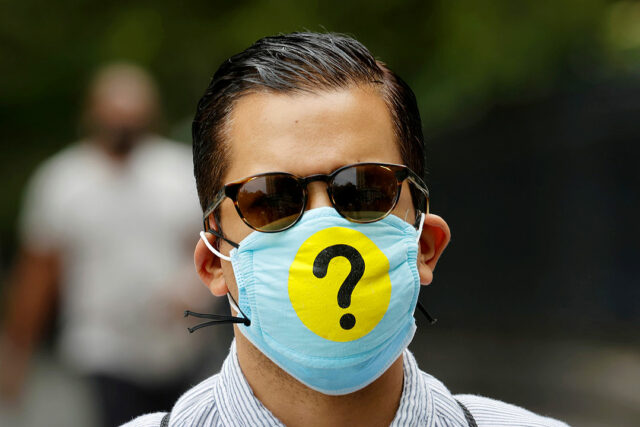
A MAN wears a protective face mask in lower Manhattan during the outbreak of the coronavirus disease (COVID-19) in New York, US, May 22, 2020. — REUTERS/MIKE SEGAR

WASHINGTON/CHICAGO — The Biden administration will no longer enforce a US mask mandate on public transportation, after a federal judge in Florida on Monday ruled that the 14-month-old directive was unlawful, overturning a key White House effort to reduce the spread of COVID-19.

Soon after the announcement, all major carriers including American Airlines, United Airlines and Delta Air Lines, as well as national train line Amtrak relaxed the restrictions effective immediately. 

Last week, US health officials had extended the mandate to May 3 requiring travelers to wear masks on airplanes, trains, and in taxis, ride-share vehicles or transit hubs, saying they needed time to assess the impact of a recent rise in COVID-19 cases caused by the airborne coronavirus.

Industry groups and Republican lawmakers balked and wanted the administration to end the 14-month-old mask mandate permanently.

The ruling by US District Judge Kathryn Kimball Mizelle, an appointee of President Donald Trump, came in a lawsuit filed last year in Tampa, Florida, by a group called the Health Freedom Defense Fund. It follows a string of rulings against Biden administration directives to fight the infectious disease that has killed nearly one million Americans, including vaccine or test mandates for employers.

Judge Mizelle said the US Centers for Disease Control and Prevention (CDC) had exceeded its authority with the mandate, had not sought public comment and did not adequately explain its decisions.

A US administration official said while the agencies were assessing potential next steps, the court’s decision meant CDC’s public transportation masking order was no longer in effect. The administration could still opt to appeal the order or seek an emergency delay in the order’s enforcement.

“Therefore, TSA will not enforce its Security Directives and Emergency Amendment requiring mask use on public transportation and transportation hubs at this time,” the official said in a statement.

“CDC recommends that people continue to wear masks in indoor public transportation settings.”

The Transportation Security Administration (TSA) said it will rescind the new Security Directives that were scheduled to take effect on Tuesday.

The ruling comes as COVID-19 infections rise again in the United States, with 36,251 new infections reported on average each day, and 460 daily deaths, based on a seven-day average – the highest number of reported total COVID-19 deaths in the world.

The White House called the ruling “disappointing.”

The CDC first issued a public health order requiring masks in interstate transportation in Feb. 2021. The TSA issued a security directive to enforce the CDC order.

The CDC and Federal Aviation Administration (FAA) declined to comment.

United Airlines, American, Delta, Southwest Airlines, JetBlue and Alaska Airlines said masks are now optional on their planes.

“We are relieved to see the US mask mandate lift to facilitate global travel as COVID-19 has transitioned to an ordinary seasonal virus,” Delta said. The World Health Organization warned against comparing the virus to an endemic illness like the flu earlier this year, noting it is evolving too quickly.

The move could impact travel demand, which has roared back after a blip caused by the Omicron coronavirus variant. US passenger traffic has been averaging about 89% of the pre-pandemic levels since mid-February, according to TSA data.

With the COVID-19 case count rising again, lifting the mandate could make some passengers wary, while prompting others to fly again.

Only 36% of Americans think it’s time for people to stop using masks and quarantines so that life can get back to normal after COVID-19, according to a Reuters/Ipsos poll conducted between Jan. 31 and Feb. 7. However, while a mere 16% of Democrats hold this view, a whopping 60% of Republicans do, according to the poll.

Delta Chief Executive Officer Ed Bastian last week acknowledged the risk, but said the airline still expected its flights to be full.

“It’s a question of individual accountability, personal accountability, making your own decisions rather than the government making decisions for people as to how to stay well,” Mr. Bastian told Reuters in an interview.

On Monday, Delta asked its employees to show “understanding and patience” as the unexpected nature of the announcement could result in “inconsistent” enforcement.

Since Jan. 2021, there have been a record 7,060 unruly passenger incidents reported, 70% involving masking rules, according to the FAA. Thousands of passengers have been put on “no-fly” lists for refusing to comply with masking requirements.

Alaska said some passengers will remain banned, even after the mask policy is rescinded. — Reuters

ADVERTISEMENT
ADVERTISEMENT