Home Blog Page 6538

Seizing new growth opportunities for ASEAN

FREEPIK

AS ASEAN economies continue their path to safely reopening and getting back to business, they must also manage growing economic challenges and identify how best to seize new opportunities for a resilient, inclusive, and sustainable recovery.

The first challenge is the Russian invasion of Ukraine which has caused tremendous suffering and sent shockwaves across the global economy.

ASEAN’s direct exposure to Russia and Ukraine through trade and investment appears limited. But with the price of oil surging to its highest levels since 2008, inflation is heating up. ASEAN’s net oil importers face substantial challenges with rising import bills. Food security and fragile supply chains are at greater risk too.

The second challenge is increasing interest rates in the United States which are complicating the inflation battle amid heightened uncertainties. Widening interest rate differentials between ASEAN economies and the US and a shift in investor confidence could trigger a sudden reversal in capital flows, currency depreciation, and financial instability.

To sustain momentum for recovery, the region must stay vigilant and prepare for collective action to avert regional financial instability. In particular, authorities must carefully manage the combined effects of higher oil prices, US interest rate hikes, and the phasing out of fiscal stimulus.

Against this backdrop, ASEAN policymakers face three important policy priorities: Strengthening regional cooperation to ensure a strong recovery; enhancing domestic resource mobilization; and scaling up investment for green and inclusive growth.

Regional cooperation can pave the path to a sustained and resilient recovery.

Strong regional trade and investment gave ASEAN a buffer during the global slowdown in trade and economic activity. The Regional Comprehensive Economic Partnership agreement, which became effective early this year, is expected to expand this buffer. ADB will remain a reliable partner for regional economies in this area by providing trade finance, technical assistance, and knowledge solutions.

Deepening our local-currency bond and capital markets is also critical. ADB is supporting this through the ASEAN+3 Asian Bond Markets Initiative (ABMI). The ABMI aims to nurture local currency bond markets as an alternative source of funding to foreign-currency denominated bank loans to alleviate the currency and maturity mismatches in the region’s financing for investment and reduce the risk of financial vulnerability. We also support the development and issuance of green, social, and sustainability bonds to help governments invest in environmental sustainability, climate change mitigation and adaptation, and resilience.

ASEAN’s efforts to strengthen food and energy security through regional cooperation, bolster regional health security, and strengthen disease surveillance mechanisms are crucial to mitigate risks and maintain sustainability.

A second priority is efficient domestic resource mobilization. This is important to restore fiscal sustainability to maintain post-pandemic recovery and finance efforts to achieve the Sustainable Development Goals.

ASEAN has room for improvement here due to its comparatively low tax revenue mobilization. Several ASEAN members have strengthened their tax administration systems through digital solutions. We are working with economies to simplify processes for taxpayers that can enhance voluntary compliance and improve tax policy formulation.

We know that international tax cooperation is key to combatting tax avoidance and evasion. To promote this through knowledge sharing and coordination on tax policy and administration, we launched the Asia Pacific Tax Hub.

The third priority is scaling up investment in quality, climate-resilient infrastructure.

The countries in Asia and the Pacific are vulnerable to some of the most destructive effects of climate change, and these are expected to worsen. At the same time, our region is the source of more than 50% of annual global greenhouse gas emissions. We need to recognize that the battle against climate change will be won or lost in Asia and the Pacific.

ADB’s ambition is to deliver $100 billion in cumulative climate financing from 2019 to 2030, including $34 billion for adaptation projects, to help the region’s response to the climate challenge.

The ASEAN Catalytic Green Financing (ACGF) Facility, which is owned by all ASEAN members and managed with ADB, is supporting development and financing of green infrastructure projects. It has mobilized $2 billion in public and private resources with support from nine partners, including cofinancing from the European Union, Italy, the United Kingdom, and the Green Climate Fund under the Green Recovery Platform launched at COP26.

ACGF helps reduce risks in green investment and attract private capital by providing loans to cover high initial capital costs and grants to support governments as they identify and prepare commercially viable green infrastructure projects.

The Energy Transition Mechanism, or ETM, is another innovative program launched by Indonesia, the Philippines, and ADB last year. ETM seeks to catalyze private capital and accelerate the transition from coal to clean energy in ASEAN. It aims to retire coal-fired power plants early; to scale up clean, renewable energy solutions; and to ensure that the transition is just and affordable.

ETM will provide low-cost financing by combining concessional public finance, private sector investment, and resources from philanthropies. This innovative mechanism has the potential to become the largest carbon reduction model in the world.

As ASEAN’s recovery from the COVID-19 pandemic moves into high gear, regional cooperation initiatives will remain critical to managing growing challenges and seizing new opportunities to build a stronger future.


Masatsugu Asakawa is President of the Asian Development Bank.

Violations of the Revised Corporation Code which are specifically punished

RAWPIXEL-FREEPIK

Section 159 of the Revised Corporation Code (RCC) expressly penalizes “the unauthorized use of a corporate name” with a fine ranging from P10,000 to P200,000. The rather simplistic formula used under Section 159 raises many “due process” issues when seeking to hold a person criminally liable.

The first point is that Section 159 does not really define what constitutes the crime of “unauthorized use of a corporate name,” thus: Does it mean the use by a corporation, its officers, and representatives, of a corporate name that has not been authorized by the Securities and Exchange Commission (SEC) in business transactions even when such a name is not registered with any other person or entity? Does it mean the use by a third party of the registered name of a corporation without the knowledge or authority of the registrant corporation? Can a corporation that uses without authority a corporate name be punished, or is the offense imposable on the corporate officers who are acting on behalf of the corporation?

The language of the last paragraph of Section 17 regulating corporate names would be indicative of the proper answers to the foregoing queries, thus: “If the corporation fails to comply with the [SEC’s] order [relating to the use of corporate name], the [SEC] may hold the corporation and its responsible directors or officers in contempt and/or hold them administratively, civilly and/or criminally liable under this Code and other applicable laws and/or revoke the registration of the corporation.”

The crime of “unauthorized use of a corporate name” under Section 159 of the RCC would cover only the particular situations under Section 17 where the corporation, its directors or officers, have refused to comply with the SEC’s order against the use of a corporate name (i) that is distinguishable from that already reserved or registered for the use of another corporation; (ii) that is already protected by law; or (iii) when its use is contrary to existing law, rules and regulations. Since “unauthorized use” is the essence of the crime, then a criminal offense arises under the terms of Section 159 only when there has been a previous order from the SEC regarding the use of a corporate name that has been unheeded by the corporation and its responsible officers.

RESERVATION ON THE SEC’S CONTEMPT POWER AND POWER TO IMPOSE ADMINISTRATIVE SANCTIONS
The last paragraph of Section 17 provides that “If the corporation fails to comply with the [SEC’s] order, the [SEC] may hold the corporation and its responsible directors or officers in contempt and/or hold them administratively, civilly and/or criminally liable under this Code and other applicable laws and/or revoke the registration of the corporation.” Reference directly to the corporation under Section 17 constitutes sufficient statutory authority to hold the corporation itself criminally punishable under Section 159 of the RCC.

On the other hand, the overarching language in the last paragraph of Section 17 may also be construed to imply the policy that when Congress intends all three sanctions — contempt, administrative sanction, and criminal penalties — to be imposed on the same offense, it goes out of its way, as it does in Section 17 (and also the last paragraph of Section 170), to so expressly provide. Therefore, in all other instances in the RCC when a criminal penalty is imposed for a specific violation of its provision, the SEC should have no power to separately impose contempt sanctions and/or administrative sanctions.

If that were not the legislative intent, then the last paragraph of Section 17 is certainly a surplusage that creates more legal doubt rather than doing any of the good intended from its crafting. Another indication of the faulty crafting of the last paragraph of Section 17 is how it provides for the penalty to “revoke the registration of the corporation” as being separate and distinct from the same administrative sanction provided under Section 158 of the RCC.

VIOLATION OF DISQUALIFICATION PROVISION
Under Section 160 of the RCC, when “despite the knowledge of the existence of a ground for disqualification as provided in Section 26 of this Code, a director, trustee or officer willfully holds office, or willfully conceals such disqualification, such director, trustee or officer shall be”:

(a) Punished with a fine ranging from P10,000 to P200,000, at the discretion of the court;

BUT: When injurious or detrimental to the public, the fine shall range from P20,000 to P400,000; and,

(b) Permanently disqualified from being a director, trustee or officer of any corporation.

The criminal offenses defined under Section 160 of willfully holding office despite disqualification or willfully concealing such a disqualification, are both circumscribed by the term “as provided in Section 26 of this Code.” It means that only the disqualifications provided for under Section 26 and those imposed by the SEC and the PCC can give rise to the defined crime under the said section. We posit therefore that the additional disqualifications provided for under the articles or bylaws of the corporation cannot become the basis for a criminal prosecution under Section 160 of the RCC.

WHEN INJURIOUS OR DETRIMENTAL TO THE PUBLIC
The corporate offense defined under Section 160 of the RCC pertains to ensuring that those who serve the fiduciary role of director, trustee, or officer are persons of high moral character, with no criminal or administrative record. Consequently, the interest sought to be protected under Section 160 pertains to intra-corporate relationships and to the supervisory role of the SEC over corporations registered under the RCC.

When Section 160 of the RCC provides for a higher imposable penalty “when injurious or detrimental to the public,” it must mean that the corporation is one whose business is vested with public interest, since it is in such situations where the corporate reins, if placed in the hands of disqualified directors, trustees, or officers, could adversely affect the public. In corporations not vested with public interest, it would be difficult to find that the consequences of the non-compliance with Section 160 have gone beyond the intra-corporate realm and have become public in character.

VIOLATION OF THE OBLIGATION TO REMOVE DISQUALIFIED DIRECTORS OR TRUSTEES
Although the last paragraph of Section 27 of the RCC clearly implies an obligation on the part of the Board of Directors to remove a disqualified director, Section 160 cannot be the basis for imposing criminal liability on the breach of such obligation since its provisions are directed solely at the disqualified director.

In addition, a criminal prosecution under Article 170 of the RCC would also be unavailing against the members of the Board for violation of their obligation to remove a disqualified member since the last paragraph of Section 27 provides that the only power of the SEC is to impose on the Board of Directors an administrative sanction: “The removal of a disqualified director or trustee shall be without prejudice to other sanctions that the [SEC] may impose on the Board of Directors who, with knowledge of the disqualification, failed to remove such director or trustee.”

VIOLATION OF DUTY TO MAINTAIN RECORDS, TO ALLOW THEIR INSPECTIONS OR REPRODUCTION
Section 161 of the RCC provides that the unjustified failure or refusal by the corporation, or by those responsible for keeping and maintaining corporate records, to comply with “Sections 45, 73, 92, 128, 177 and other pertinent rules and provisions of this Code on inspection and reproduction of records,” shall be punished with a fine ranging from P10,000 to P200,000, at the discretion of the court, taking into consideration the seriousness of the violation and its implication; but that when injurious or detrimental to the public, the fine shall range from P20,000 to P400,000.

The punitive applications under Section 161 have been discussed under each of the five instances which identify a “duty to maintain records,” namely:

• Section 45: Adoption of the Bylaws

• Section 73: Books and Corporate Records Subject to Inspection

• Section 92: List of Members and Proxies

• Section 128: Minutes Book for OPCs

• Section 177: Reportorial of Corporations

RESERVATION AS TO SEC’S EXERCISE OF CONTEMPT POWER
The last paragraph of Section 161 of the RCC provides that “The penalties imposed under this section shall be without prejudice to the [SEC’s] exercise of its contempt powers under Section 157 hereof.” Such express reservation under Section 161 of the power of the SEC to exercise its contempt power in addition to the criminal penalty imposed for the offenses defined leads to the following issues:

Firstly, the last paragraph of Section 161 may be held to imply that in all other criminal offenses defined specifically in the RCC, where such reservation is not found, the SEC would not have the power to cite the offenders in contempt. If this was not the legislative intent, and that SEC’s power to cite in contempt under Section 157 stands enforceable on its own accord, separate and distinct from the imposition of criminal penalties, then what was the point of making such express reservation under the last paragraph of Section 161?

Secondly, the last paragraph of Section 161 may be held to imply that since only the SEC’s power to cite in contempt is reserved as an additional sanction for the criminal penalty imposable, then the legislative intent is to the effect that the SEC has no power to impose separately any of the administrative sanctions for any of the violations covered under Section 161 vis-à-vis Sections 45, 73, 92, 128 and 177 of the RCC. If that were not the legislative intent, then why does Section 161 not make the same reservation for the imposition of administrative sanctions by the SEC?

Thirdly, the last paragraph of Section 161 may be construed to imply a legislative intent that in sections of the RCC that specifically impose criminal penalties and where the power to impose administrative sanctions is not reserved as being separate from the criminal penalty (as is done in Section 170), that the SEC is without power to impose administrative sanctions under Section 158 of the RCC.

If it were the legislative intent that the imposition by SEC of the administrative sanctions under Section 158 of the RCC is independent and separate from the imposition of any other administrative/civil sanctions, then such statement should have found itself located within Section 158 itself — and yet Section 158 of the RCC is completely silent on such a policy.

WHEN INJURIOUS OR DETRIMENTAL TO THE PUBLIC
Section 161 of the RCC provides that “When the violation of this provision is injurious or detrimental to the public, the penalty is a fine ranging from …P20,000… to …P400,000…”

Except in the case of OPCs under Section 128 on the keeping of the Minutes Book which is intended for the protection of the creditors, the various duties to maintain corporate records and allow inspection and/or reproduction go into protecting the common law rights of shareholder or members, as well as promoting the regulatory supervision of the SEC over corporations organized under the RCC. Consequently, non-compliance or violation of the various duties to maintain corporate records for which Section 161 imposes criminal penalties would be injurious or detrimental to the public only when they involve corporations whose business enterprise affects the public, and whose stakeholders have a right to be made aware of the various key information in the business operations that would affect their legitimate interests.

For corporations whose business is not vested with public interest, it would be difficult to sustain the imposition of the higher penalty imposed under Section 161 of the RCC based on the allegation that the violation was injurious or detrimental to the public.

This article reflects the personal opinion of the author and does not reflect the official stand of the Management Association of the Philippines or MAP.


Attorney Cesar L. Villanueva is Co-Chair for Governance of the MAP ESG Committee, the Chair of the Institute of Corporate Directors, the first Chair of the Governance Commission for GOCCs, a former Dean of the Ateneo Law School, and a Founding Partner of Villanueva Gabionza & Dy Law Offices.

map@map.org.ph

cvillanueva@vgslaw.com

http://map.org.ph

Energy prices and renewables-gas lobby

There are some eyebrow-raising developments in the global and domestic energy situation captured by these recent reports in BusinessWorld:

1.) “Transition to renewables seen accelerating in response to high price of imported fuel” (March 29)

2.) “Fitch Solutions bullish on PHL power industry decarbonization” (April 7)

3.) “Think tank says hidden costs erode appeal of cheap coal power” (April 10)

4.) “ACEN to refinance unit’s loan, reinvest in renewables” (April 12)

5.) “Power rates up in April as generation charge rises” (April 12)

6.) “Battery storage seen as critical for RE adoption” (April 13).

I say “eyebrow-raising” because the expected rise in fuel and electricity prices due to the Ukraine war and stiff economic sanctions against Russia are used to further demonize fossil fuels and coal power in particular and invite blackout economics to come back in the Philippines and other countries.

For instance, report Nos. 1, 2, and 6 are about decarbonization and high imported fuel (oil, coal) — but prices of lithium, cobalt, manganese, nickel, zinc, other metals to produce solar PV, batteries for e-cars and battery energy storage system (BESS) are also high. And the price of indigenous Malampaya gas will also rise.

Report No. 3 quotes Redentor Constantino,  Executive Director of the Institute for Climate and Sustainable Cities, as saying “A quick look at actual coal generation costs of major distribution utilities shows that these costs range from over P4 per kilowatt-hour to approaching P9 pesos per kWh. Not only are these costs much higher than expected but they are also volatile as they reflect ‘Pasaload’ of fuel costs to the consumer.” But Mr. Constantino is silent on the “Pasablackout” of intermittent power to the consumers when the wind does not blow and the sun is covered by thick clouds, when it rains, or it is absent at night.

Report No. 4 is about Ayala Energy’s (ACEN) 244 MW Calaca, Batangas coal plant which will be decommissioned by 2025 — 15 years ahead of end of the end of its technical life — following the Energy Transition Mechanism (ETM) of the Asian Development Bank (ADB). Ayala Energy and ADB want to further thin out already thin reserves of stable, dispatchable coal power and risk blackout economics. See this column’s piece, “ADB’s kill coal plan, government corporations, and power transmission” (Sept. 13, 2021).

And report No. 5 is expected — Meralco has to raise our electricity bill by P0.536/kwh because the cost of various components has increased: generation increased by P0.399/kwh, transmission + subsidies + system loss + taxes have increased by P0.138/kwh.

A populist and renewables lobby NGO, People for Power (P4P), led by Gerry Arances, staged a rally and issued a press release, Consumers protest Meralco greed amid new power rate hike (April 13) arguing that “coal, gas, other fossil fuels for our power supply is an electricity affordability disaster.”

Two items are wrong in the Arances “analysis”:

1.) the idea of “Meralco greed” which is disproven by the numbers in the preceding paragraph. All increases in the April electricity bill came from generation, transmission, subsidies, and taxes. There is no increase in Meralco’s distribution cost, which has been stable for nearly seven years now since July 2015.

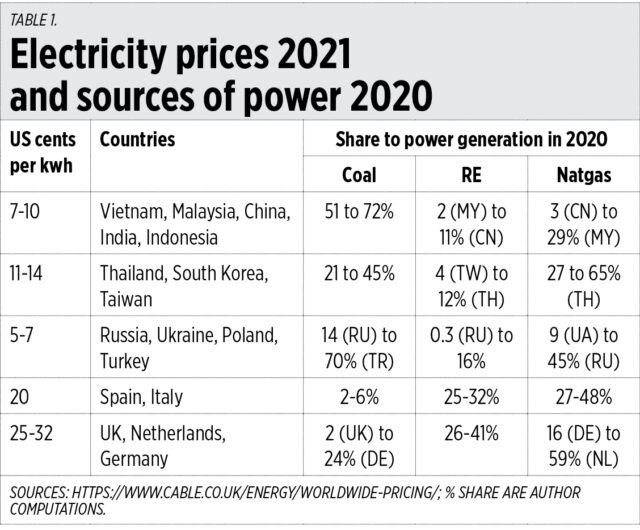
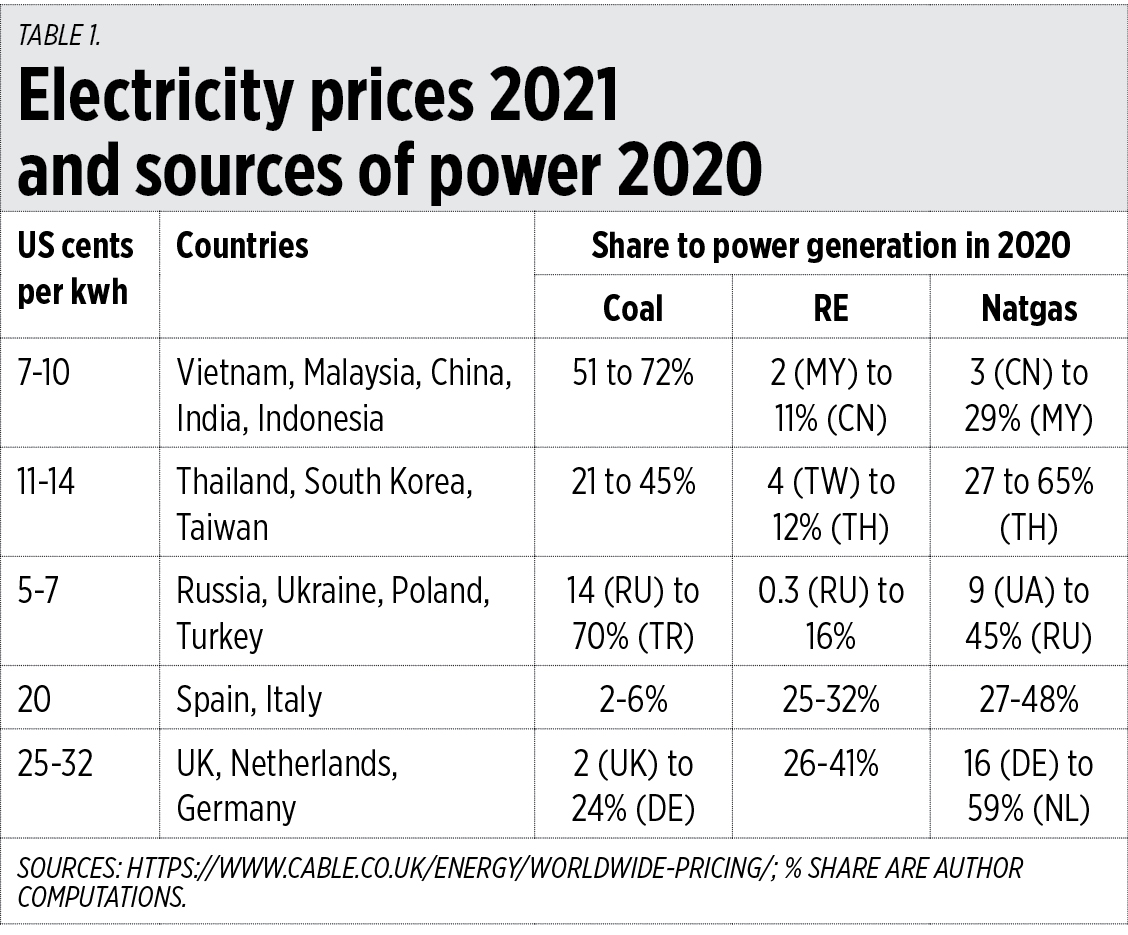
And, 2.) “coal, fossil fuels electricity affordability disaster,” which is far out. It should be “solar-wind electricity affordability disaster” as countries that have big share of coal to total power generation like our neighbors Vietnam, Malaysia, and Indonesia have very low power prices while Europeans with a big solar-wind share to total generation like Spain, the Netherlands, Italy, the UK, and Germany have prices that are two to three times more expensive than the mentioned ASEAN countries (see Table 1). See also this column’s recent piece, “The effects of Biden and sanctions on energy and commodity prices” (March 28).

In another paper, “Profiting from outages,” Pedro Maniego cherry-picked two out of 365 days in 2021 when there was a price spike because several big coal plants extended their maintenance shutdowns, so he blames the other coal plants that continued running as profiting.

Because of this, he invites government to issue another intervention: “The regulators should investigate whether any of these dominant players who own or operate the coal plants with extended and frequent outages, benefited from the higher WESM (Wholesale Electricity Spot Market) rates.”

So, “who is profiting from the power outages” and by extension, who is profiting from thin reserves? I think the answer to both questions are the sellers of gensets, candles, and fire insurance. When there are frequent thin reserves, frequent yellow-red alerts and rotating blackouts, the rich buy gensets and the poor buy candles. More candles often lead to more fires, so there is need to buy fire insurance for one’s office and other properties.

Notice that Mr. Maniego’s paper calls for the harassment of coal plants, but not of gas plants that also experience occasional extended shutdowns and derating, or solar-wind plants that produce zero or little power when the wind does not blow and the sun is covered by thick clouds or absent at night.

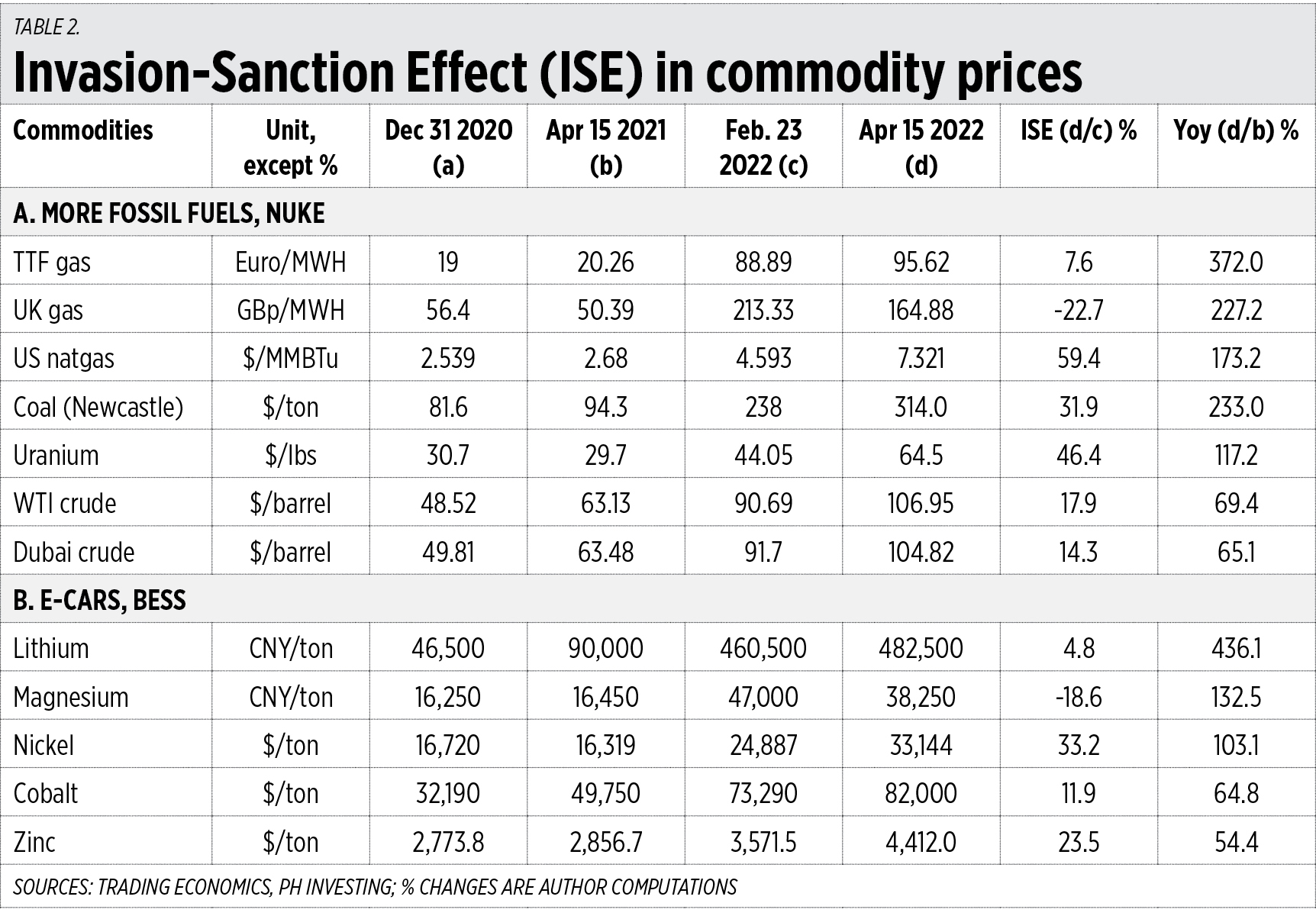
And going back to the complaint of Messrs. Constantino, Arances, and Maniego that coal plants create expensive electricity — coal fuel used to be cheap, below $100/ton, but the continuing global war and underinvestment in coal mining and power plants led to tighter supply. Notice the increase in price from April 2021 to pre-invasion Feb. 23, 2022.

The gas plants in Batangas using Malampaya gas will raise their prices too because Malampaya gas prices are indexed or based on Dubai crude prices. This will start in next month’s billing as Malampaya gas prices are adjusted quarterly.

The big gas plants that are being built to use imported LNG will also charge higher prices when they start operating because LNG supply is tight, as shown in US natgas and TTF/EU gas prices.

And as mentioned above, the prices of commodities that are used to manufacture solar PV, e-car batteries, and BESS are also rising. In fact, the year-on-year (yoy) percent increase in lithium prices is six times larger than WTI and Dubai crude, four times larger than the uranium nuke price, and twice that of coal and UK gas prices (see Table 2).

The main reason why “net-zero” and decarbonize-obsessed Europe endured expensive oil-gas-coal (to avoid blackouts) even before the invasion of Ukraine is because their beloved wind-solar energy produced little power due to the less-windy, often cloudy years, 2021 and 2022.

It seems the Ukraine war will be prolonged and the sanctions against Russia and its ally trade partners will last even longer. We should expand, not shrink, our power sources. The war against coal should stop, let more coal, gas, oil, nuclear, hydro, even intermittent wind-solar plants with BESS be built. And let them compete in prices and supply stability.

I and many power consumers have “vested interests” in the energy debate: I want stable electricity, no blackouts even for a minute, no unnecessary damage to my home appliances, lights, and gadgets due to power fluctuations. I want there to be no need to buy gensets or candles. A price hike for a few days is ok as long as stable, competitive prices return for the rest of the year with no blackouts.

And please, do not ask the government for more intervention, investigation, and harassment in the competitive power generation sector. Let stiff competition be the main regulator among many private gencos. The government should instead focus its regulation and investigation on the monopoly transmission sector.


Bienvenido S. Oplas, Jr. is the president of Minimal Government Thinkers.

minimalgovernment@gmail.com

The campaign season and the security sector

FREEPIK

Members of the security sector, as citizens, have the right to choose the candidate they desire. But as members of the force, they are expected to be silent as to which candidate they support or not during elections. This is because it is the security sector – the police and military — who are tasked to ensure that elections are credible, honest, orderly, and peaceful. If members of the security sector are actively partisan during the campaign season, the credibility of their agency will be compromised, and consequently the integrity of the elections will be questioned.

Per my observation, a significant number of our police and military are very much involved in the campaign — not just in declaring their chosen candidates, but also in criticizing, sometimes using foul and colorful language to malign other candidates. A case in point — a presidential candidate is accused of having a connection with the underground movement, the New People’s Army. This issue is not new — it surfaced a couple of years back, alleging that the official was a member of the NPA, and a picture of her alleged wedding with an NPA cadre was even peddled on social media. The allegation was fabricated. No evidence has ever been produced to support this claim. It was fake news.

This campaign season, the same piece of fake news has re-surfaced. Another issue, an alleged sex video, is even appended, this time targeting the daughter of the same candidate. Both cases are cybercrimes, the latter also a violation of the Safe Spaces Act. What is disturbing is that among those who peddle and share this fake news are active members of the police and military. Instead of investigating, some members of the police trumpet the information like gospel truth. This is disturbing since the police is the primary instrument of the state to enforce the law, its core competency is to investigate and file cases against law breakers. It is the agency that gives a premium on evidence in ascertaining the “truth.” If some members of the police are peddlers of fake news, some of which are clearly cybercrimes, and if the institution does nothing and thus remains complicit, then the agency’s professionalism must be questioned.

Another issue that dominates the discursive space this campaign season is the issue of human rights, the Achilles heel of the security sector. Coming out of the martial law experience where the military and police were used by the dictator to stay in power, to silence the opposition, and to subvert democratic processes, the security sector’s ethics, norms, and competence suffered gravely, not to mention the negative public image that resulted. The post-1986 EDSA era saw both agencies painstakingly going through rigorous reform processes to remove the vestiges of martial law, promote good governance and professionalism, and instill human rights principles in the norms and core imperatives of the organizations. The reform process is still incomplete, but both agencies have made significant progress. One therefore would expect the military and police to be at the forefront of human rights and good governance discourse, given the scrupulous process that these institutions went through over the years.

It is thus surprising that several members of the military and police favor the candidate with an unconvincing platform on human rights, not to mention being himself embroiled with the issue of human rights violation of his late father during the martial law period. The father committed the abuses, and the son has not shown any remorse nor asked for an apology for the infractions that his father and his family have committed. Far worse is the attempt of the candidate’s camp to re-write history, to gloss over the abuses and corruption, and to portray the martial law period as a “golden era,” even though its human rights violations and corruption are documented and affirmed by court rulings. The candidate is even promising a return of the “new society” that his father promoted, using the same songs and symbolism of the time. A critical observer understands that these moves are a clear affront and insult to the hard work that the military and police institutions have done to reform their respective institutions.

Logic says we choose the candidate that reflects our values, the leader whom we can emulate, and who can be the role model of our children. If the chosen leader of several members of the police and military has dubious background, doubtful values, and if his standards are not aligned with the principles of good governance, we need to ask, “why him?”

If this candidate wins, how will it impact the reform process, especially in mainstreaming human rights and good governance values in the security sector? How can the candidate be a role model if his own track record in promoting the rule of law is itself unimpressive?

Our foreign security allies are strong advocates of human rights — how will they regard the presidency of the candidate who talks about the martial law period as a golden era, despite court rulings recognizing the massive corruption and human rights abuses of the period?

The same candidate, together with his mother, has a contempt judgement issued by a US Court in 1995 in connection with the human rights class suit filed against his father. If he wins the elections, how will the US, our major security partner under the Mutual Defense Treaty, regard his Presidency, especially if the candidate can’t even set foot on US soil due to his human rights court case? How will the members of the European Union, our major trading and security allies who are also staunch advocates of human rights, consider his administration?

I sincerely hope that our security sector will always stand by the principles of their respective institutions — honor, integrity, patriotism. I hope their members will always be on the side of good governance and human rights; and choose leaders who, together with them, will be true defenders of the state and the Filipino people. And I hope that on election day, our military and police will truly ensure the integrity and honesty of the process.


Jennifer Santiago Oreta, PhD is a faculty member of the Department of Political Science of the Ateneo de Manila University, and Coordinator of the Ateneo Initiative for Southeast Asian Studies.

joreta@ateneo.edu

Ukraine’s Zelensky says Russian shelling is ‘deliberate terror’

Ukrainian President Volodymyr Zelensky — UKRAINIAN PRESIDENTIAL PRESS SERVICE/HANDOUT VIA REUTERS

LVIV/KYIV -— Ukrainian authorities condemned Russian artillery attacks on cities in the northeast and the continuing siege of the southern port city of Mariupol, of which Moscow said it had taken almost full control, following almost two months of bloody fighting.

After failing to overcome Ukrainian resistance in the north, the Russian military has refocused its ground offensive on Donbas, while launching long-distance strikes at targets elsewhere, including the capital, Kyiv.

Eighteen people have been killed and more than 100 wounded in shelling in the past four days in the northeastern city of Kharkiv, Ukraine’s President Volodymyr Zelensky said.

“This is nothing but deliberate terror: mortars, artillery against ordinary residential quarters, against ordinary civilians,” he said late on Sunday.

Russia denies targeting civilians and has rejected what Ukraine says is evidence of atrocities as staged to undermine peace talks. It calls its action a special military operation to demilitarize Ukraine and eradicate what it calls dangerous nationalists.

The West and Kyiv accuse Russian President Vladimir Putin of unprovoked aggression.

Ukrainian Prime Minister Denys Shmyhal said troops in the pulverized port of Mariupol were still fighting on Sunday, despite a Russian demand to surrender by dawn.

“The city still has not fallen,” he told ABC’s This Week program, adding that Ukrainian soldiers continued to control some parts of the southeastern city.

On Saturday, Russia said it had control of urban areas, with some Ukrainian fighters remaining in the Azovstal steelworks overlooking the Sea of Azov.

Capturing Mariupol, the main port in the Donbas region, would be a strategic prize for Russia, linking territory held by pro-Russian separatists in the east with the Crimea region Moscow annexed in 2014.

Serhiy Gaidai, the governor of the neighboring region of Luhansk, which has seen heavy fighting, repeated a plea for people to evacuate.

“The next week will be difficult,” he said in a post on his Facebook page. “It may be the last time we have a chance to save you.”

On the streets of Mariupol, small groups of bodies were lined up under colourful blankets, surrounded by shredded trees and scorched buildings.

Residents, some pushing bicycles, picked their way around destroyed tanks and civilian vehicles while Russian soldiers checked the documents of motorists.

Among them was Irina, who was evacuating with a niece wounded in the shelling.

“I have a daughter in DNR,” she said, referring to the self-proclaimed Donetsk People’s Republic. “Maybe we will try to move there for the time being.

“I hope they will rebuild (Mariupol). The most important thing is utility systems. Summer will pass fast and in winter it will be hard.”

‘EASTER OF WAR’
About four million Ukrainians have fled the country, cities have been shattered and thousands have died since the start of the invasion on Feb. 24.

The economic damage is significant. Mr.  Shmyhal said Ukraine’s budget deficit was about $5 billion a month and urged Western governments for more financial aid.

On Twitter, Mr. Zelensky said he had discussed ensuring Ukraine’s financial stability and preparations for post-war reconstruction with International Monetary Fund Managing Director Kristalina Georgieva, quoting her as having said support was essential to lay the foundations for rebuilding.

Ukraine pressed on with efforts to swiftly join the European Union (EU), as officials completed a questionnaire that is a starting point for the EU to decide on its membership.

On Easter Sunday, Pope Francis implicitly criticized Russia, pleading for an end to the bloodshed and lamenting the “Easter of war” in a speech in St Peter’s Square after Mass.

“May there be peace for war-torn Ukraine, so sorely tried by the violence and destruction of the cruel and senseless war into which it was dragged,” he said.  Reuters

Crypto fund founder warns industry on North Korean cyber attacks

A broken ethernet cable is seen in front of binary code and words “cyber security” in this illustration taken on March 8, 2022. — REUTERS

ALL PROMINENT cryptocurrency organizations are probably being targeted by North Korean hackers and should strengthen their cybersecurity, according to the founder of a crypto fund.

North Korea is likely to devote more resources to such attacks given the success it’s had so far, said Arthur Cheong, who set up DeFiance Capital in Singapore in 2020 and was himself a recent victim of a cybercrime. He advised crypto firms to take extra care in hiring remote teams, have dedicated computers for crypto transactions and revoke unnecessary token approvals.

“It is critical that this industry is highly aware that we are being targeted by a state-sponsored cybercrime organization that is extremely resourceful and sophisticated,” Mr. Cheong said on Twitter.

North Korea appears to have stepped up its crypto-related cyber-attacks in recent months. Last week, the US Treasury Department tied the North Korean hacking group Lazarus to the theft of more than $600 million in cryptocurrency from a software bridge used for the popular Axie Infinity play-to-earn game. Cybercrimes have provided a lifeline for the struggling North Korean economy, which has been hobbled by sanctions to punish it for nuclear and missile tests, and has grown smaller since Kim Jong Un took power about a decade ago. — Bloomberg

COVID-shaming pits neighbor against neighbor as tensions increase in locked-down Shanghai

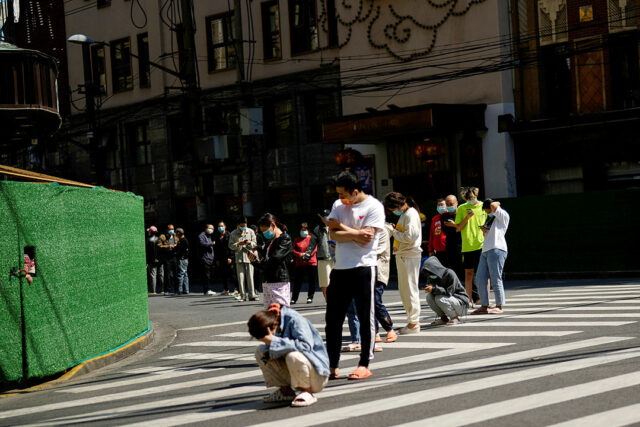
RESIDENTS line up for nucleic acid tests during a lockdown in Shanghai, China, April 17. — REUTERS

SHANGHAI — The tensions of lockdown have exposed divisions among Shanghai residents, pitting young against old, locals against outsiders, and above all, COVID-negative against COVID-positive people.

Shanghai’s 25 million people, most of whom live in apartment blocks, have forged new communal bonds during the city’s coronavirus outbreak, through barter and group buying and setting up food-sharing stations.

But with no end in sight to a lockdown that for some has lasted four weeks, frustrations are also mounting behind the shuttered gates of the city’s tower blocks, often playing out within WeChat message groups.

In one, conflict erupted when a woman who had been taken to centralized quarantine — where she tested negative — accused her neighbor of reporting her to authorities.

It is not unusual for test results to be shared and positive cases announced in building WeChat groups, as authorities try to get to grips with China’s largest outbreak since the virus was first identified in Wuhan in late 2019.

One US citizen was told she would be sent to a quarantine center after results from a mixed test, including hers, came back positive last week, sparking panic. Three others whose samples were in the batch were taken to quarantine, but her own at-home tests continued to be negative.

“In the group chats, they were saying things like, ‘oh are the positive people still here, are the positive people still here?’,” she said, declining to give her name.

Older residents, more vulnerable to coronavirus disease 2019 (COVID-19), have also been more likely to call for the immediate expulsion of positive cases from their compound.

“Because of the media’s exaggeration about the disease, and since old people have weaker immune systems, they are more afraid of the virus than young people,” said one resident who had seen this happen.

Another foreign resident, who only wanted to be identified as Alexy, was suspected by neighbors of being COVID-positive when his test result failed to upload to his health app.

His building’s management tried to block his family’s food deliveries unless they shared home test results with the rest of the residents — a demand that several Shanghai residents have said is widespread and violates privacy.

“They have no guidelines and CDC (Center for Disease Control) services are overwhelmed,” he said. “They felt invested with the most important mission of their life, being able to play doctor, policeman and judge at the same time.”

LOCKED-OUT
Some people were refused entry into their homes and ordered to stay in hotels after release from central quarantine, violating state guidelines.

Another foreign resident who tested positive said she was confined in her apartment rather than sent to central quarantine, much to the chagrin of her neighbors, who asked her to leave, tried to exclude her from group grocery orders and even demanded she make a formal apology.

One neighbor called her “foreign trash” while another spread lies about her mental health, and the residential committee was no help, she said.

“I saw screenshots of them telling the residents to continue calling to get me out,” she said, adding that she would move out as soon as she could. — Reuters

South Korea lifts most COVID precautions as new cases dip to two-month low

A MAN walks along a nearly empty street in Seoul, South Korea, July 12, 2022. — REUTERS

SEOUL  — South Korea lifted almost all of its COVID-19 precautions on Monday in a major step towards a return to normal life as the Omicron variant recedes and daily infections retreated to a more than two-month low of fewer than 50,000.

A midnight curfew on restaurants and other businesses was scrapped, along with a cap of 10 people allowed to gather. From next week, people will be allowed to eat snacks in cinemas and other indoor public facilities such as stadiums.

People are still required to wear masks, however, with the government planning to review whether to lift a rule for masks outdoors in two weeks.

The relaxation of the rules come as the number of coronavirus cases in South Korea fell to 47,743 on Monday, the lowest since Feb. 9, after hovering at more than 620,000 a day in mid-March.

Some rules, however, remain including mandatory quarantine for unvaccinated inbound travellers and negative PCR tests for the fully vaccinated.

South Korea has largely managed to limit deaths and critical cases through widespread vaccination, and it has scaled back the aggressive tracing and containment efforts that made it a mitigation success story from most of the first two years of the pandemic.

Nearly 87% of the 52 million population are fully vaccinated, with 64% having also had a booster, according to Korea Disease Control and Prevention Agency data.

In line with the easing of the rules, companies are gradually returning to their offices.

Most staff at giant steelmaker POSCO have returned to their offices this month, becoming one of the first major firms to bring people back.

LG Electronics said it had reduced the proportion of employees working from home to 30% from 50% from Monday, while scrapping a limit on the number of people allowed in meetings.

Samsung Electronics said it had yet to implement its back-to-office plan and the public sector is also awaiting new government guidelines.

The Bank of Korea, which has 30% of its head office staff working from home, is considering easing its guidelines, officials said.

The government had recommended workplaces with 300 or more employees adopt flexible working hours and have 10% of staff work from home. — Reuters

Sri Lanka’s reluctance to tap IMF helped push it into an economic abyss

SRI LANKAN military officer lowers the national flag at the flag square in Colombo, Sri Lanka, March 23, 2021. — REUTERS

COLOMBO — Sri Lanka’s worst economic crisis has triggered an unprecedented wave of spontaneous protests as the island nation of 22 million people struggles with prolonged power cuts and a shortage of essentials, including fuel and medicines. 

President Gotabaya Rajapaksa’s government has come under growing pressure for its mishandling of the economy, and the country has suspended foreign debt payments in an effort to preserve its paltry foreign exchange reserves. 

On Monday, Sri Lanka will begin talks with the International Monetary Fund (IMF) for a loan program, even as it seeks help from other countries, including neighboring India, and China. 

HOW DID IT GET TO THIS?
Economic mismanagement by successive governments weakened Sri Lanka’s public finances, leaving its national expenditure in excess of its income, and the production of tradable goods and services at an inadequate level. 

The situation was exacerbated by deep tax cuts enacted by the Rajapaksa government soon after it took office in 2019, which came just months before the coronavirus disease 2019 (COVID-19) crisis. 

The pandemic wiped out parts of its economy — mainly the lucrative tourism industry — while an inflexible foreign exchange rate sapped remittances from its foreign workers. 

Rating agencies, concerned about government finances and its inability to repay large foreign debt, downgraded Sri Lanka’s credit ratings from 2020 onwards, eventually locking the country out of international financial markets. 

But to keep its economy afloat, the government still leaned heavily on its foreign exchange reserves, eroding them by more than 70% in two years. 

By March, Sri Lanka’s reserves stood at only $1.93 billion, insufficient to even cover a month of imports, and leading to spiraling shortages of everything from diesel to some food items. 

J.P. Morgan analysts estimate the country’s gross debt servicing would amount to $7 billion this year, with the current account deficit coming in around $3 billion. 

WHAT DID THE GOV’T DO?
Faced with a rapidly deteriorating economic environment, the Rajapaksa government chose to wait, instead of moving quickly and seeking help from the IMF and other sources. 

For months, opposition leaders and experts urged the government to act, but it held its ground, hoping for tourism to bounce back and remittances to recover. 

Newly appointed Finance Minister Ali Sabry told Reuters in an interview earlier this month that key officials within the government and Sri Lanka’s central bank did not understand the gravity of the problem and were reluctant to have the IMF step in. Mr. Sabry, along with a new central bank governor, was brought in as part of a new team to tackle the situation. 

But, aware of the brewing crisis, the government did seek help from countries, including India and China. Last December, the then finance minister traveled to New Delhi to arrange $1.9 billion in credit lines and swaps from India. 

A month later, President Rajapaksa asked China to restructure repayments on around $3.5 billion of debt owed to Beijing, which in late 2021 also provided Sri Lanka with a $1.5 billion yuan-denominated swap. 

WHAT HAPPENS NEXT?
Finance Minister Sabry will start talks with the IMF for a loan package of up to $3 billion over three years. 

An IMF program, which typically mandates fiscal discipline from borrowers, is also expected to help Sri Lanka draw assistance of another $1 billion from other multilateral agencies such as the World Bank and the Asian Development Bank. 

In all, the country needs around $3 billion in bridge financing over the next six months to help restore supplies of essential items including fuel and medicine. 

India is open to providing Sri Lanka with another $2 billion to reduce the country’s dependence on China, sources have told Reuters. 

Sri Lanka has also sought a further $500 million credit line from India for fuel. 

With China, too, the government is in discussions for a $1.5 billion credit line and a syndicated loan of up to $1 billion. Besides the swap last year, Beijing also extended a $1.3 billion syndicated loan to Sri Lanka at the start of the pandemic. — Reuters

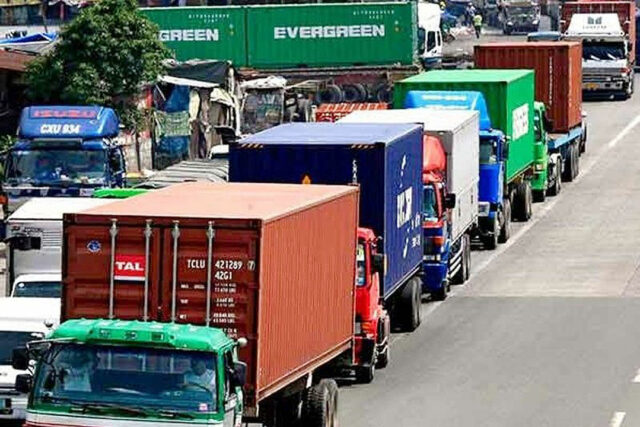
Trucking group deploys smart device to monitor road behavior of drivers

PHILSTAR FILE PHOTO

A camera-equipped smart device that monitors driving behavior will be installed in about 1,300 trucks belonging to the Inland Haulers and Truckers Association (INHTA). The camera will initially be placed in five trucks operated by Quicktrans Cargo Moving Inc. by the end of April.

As part of DRIVER PH (Drivers Roadworthiness Improvement Verification Education and Readiness for the Philippine Logistics Industry), data on speed, location, and temperature gathered by the smart device will be analyzed through machine learning and used to flag possible traffic rule violations.  

“One important aspect of the project is its mobile and web-based application, which helps educate drivers through video tutorials and digitalized lessons,” said Felizardo C. Reyes, Jr., DRIVER PH project manager and computer science and information technology program chair of the Technological Institute of the Philippines (TIP), which developed the device. “We want to professionalize them.”  

“Our drivers will know how to drive the right way. They will also learn about their rights on the road,” said Teddy S. Gervacio, Quicktrans chief executive officer, in the vernacular during a recent event organized by the Department of Science and Technology. “Truckers are movers of the economy.” 

He added that DRIVER PH will address the shortage of drivers with the skills needed to steer large vehicles.  

The Lobien Realty Group, in 2020, said that the Philippine logistics and trucking market is projected to become a P1 trillion market by 2023. It is forecasted to grow 8.2 to 8.8% between 2018 and 2024.   

DRIVER PH, a one-year project, was funded by the DoST Collaborative Research and Development to Leverage Philippine Economy (CRADLE) program.  

The Metro Manila Development Authority tallied an average of 178 total road crashes per day in 2020. In 2019, 15.33% of the total road accidents were truck-related.   

The Department of Justice and the Department of Health have noted that driver awareness and attitude can minimize traffic altercations and protect road users. —Patricia B. Mirasol

Ukraine completes questionnaire for EU membership — official

REUTERS

Ukraine has completed a questionnaire which will form a starting point for the European Union to decide on membership for Kyiv, Ihor Zhovkva, deputy head of President Volodymyr Zelenskyy’s office, said. 

European Commission (EU) President Ursula von der Leyen handed the questionnaire to Mr. Zelenskyy during her visit to Kyiv on April 8th, pledging a speedier start to Ukraine’s bid to become a member of the EU following Russia’s invasion of the country. 

“Today, I can say that the document has been completed by the Ukrainian side,” Mr. Zhovkva told the Ukrainian public broadcaster Sunday evening. 

The European Commission will need to issue a recommendation on Ukraine’s compliance with the necessary membership criteria, he added. 

“We expect the recommendation … to be positive, and then the ball will be on the side of the EU member states.” 

Mr. Zhovkva added that Ukraine expects to acquire the status of a candidate country for EU accession in June during a scheduled meeting of the European Council meeting. 

The European Council is to meet June 23–24, according to the Council’s schedule on its website. 

“Next, we will need to start accession talks. And once we hold those talks, we can already talk about Ukraine’s full membership in the EU,” Mr. Zhovkva said. — Reuters

Global Citizen seeks up to $1B for six sustainable ‘Impact’ funds

PHILSTAR FILE PHOTO

LONDON — Global Citizen, an international non-profit aiming to help end poverty, said on Monday it plans to launch six funds of up to $1 billion each focused on generating environmental and social impact in the developing world. 

The Global Citizen Impact Funds aim to help plug a large gap in funding for poorer countries struggling to meet the United Nations 2030 Sustainable Development Goals, which include providing access to clean water and fighting climate change. 

The world’s poorest countries need close to $400 billion annually in external finance to meet those goals, but currently get only a fraction of that, Global Citizen’s Chief Policy Officer Mick Sheldrick told Reuters. 

To help drive faster change, Global Citizen said its funds, created with partner NPX, would bring together philanthropists and investors using a financing model that it believes would prove scaleable quickly. 

It hopes to start raising donor money over the next six to nine months and is targeting at least $25 million for each fund, although most of the NGOs chosen to receive funding could scale quickly and absorb up to $1 billion in donor money. 

Under the model, investors, primarily funds with impact mandates, would give money to the NGO to help it expand its services, with the aim of hitting certain targets. If successful, and after the results have been independently verified by a third-party, the Global Citizen fund in question would release donor money to the NGO, to repay the investors. 

Through the process, the investors would receive a return on their capital of around 5–6%, the NGO would get an incentivization payment, while the donors would have the assurance that they would fund only initiatives that worked. 

“We really think it has the potential to be a groundbreaking outcomes-fund vehicle that could transform philanthropy,” Mr. Sheldrick said. “Our hope would be that it could, over time, lead to an upsurge in the amount of philanthropic capital that is available for SDG-related programs.” 

The NGOs selected include One Acre Fund, which supports smallholder farmers in Africa around climate action, including through planting and protecting more trees. 

Its target would be to support the survival of 44 million trees planted over four years, leading to 7.4 million tonnes of carbon being sequestered. If successful, the plan could scale to more than 1 billion trees over the next decade. 

The other funds will focus on detecting and treating malaria; improving literacy and numeracy for children in crisis settings; providing access to clean water; lifting marginalized women out of poverty; and improving food security. — Reuters