Notice: Function _load_textdomain_just_in_time was called incorrectly. Translation loading for the Newsmag domain was triggered too early. This is usually an indicator for some code in the plugin or theme running too early. Translations should be loaded at the init action or later. Please see Debugging in WordPress for more information. (This message was added in version 6.7.0.) in /data/bwonline/walaakomaisip/wp-includes/functions.php on line 6131
BusinessWorld Online | BusinessWorld: The leading and most trusted source of business news and analysis in the Philippines | Page 6490                                   
Home Blog Page 6490

ABAP sees good performance of Paalam-less national team in Hanoi

THE Association of Boxing Alliances (ABAP) in the Philippines is optimistic it will perform well in the Hanoi Southeast Asian (SEA) Games set on May 12 to 23 in spite of the absence of Tokyo Olympics silver medalist Carlo Paalam.

The country will be without Paalam and will field in a 10-strong squad headed by Olympian silver medal winner Nesthy Petecio and bronze medalist Eumir Felix D. Marcial instead.

Claiming Paalam’s flyweight spot was Rogen Ladon, who came through with a performance to remember in stunning Asian champion and Asian Games titlist Amit Panghal of India and seizing the mint in the Thailand Open held early this month in Phuket.

“Carlo (Paalam) is still catching up in his conditioning while Rogen has been doing well since the start of the year and he also struck gold in Thailand,” said ABAP secretary-general Marcus Manalo.

Olympian Irish Magno, meanwhile, will spearhead the women’s squad as she competes in the 51-kilogram class.

The other members of the team are Ian Clark Bautista (57kg), James Palicte (63kg) and Marjon Pianar (69kg) in the men’s division and Josie Gabuco (48kg), Riza Pasuit (57kg) and Hergie Bacyadan (75kg) in the women’s.

The Filipinos are eyeing to match, if not surpass, their seven-gold, three-silver and two-bronze haul in the 2019 SEA Games in Manila.

Mr. Manalo though refused from making a fearless forecast.

“I think we put up a solid lineup with boxers who have very good chances to finish at the top of the podium,” said Mr. Manalo. “We use a process-oriented approach so we don’t really set numeric goals like the number of medals or gold to win.”

“But the team will be ready,” he added.

Cryptocurrency goes mainstream

THE year 2021 has been touted by experts, analysts, and enthusiasts as the year cryptocurrency went mainstream. Why? Because the blockchain-powered digital asset drew about $30 billion from venture capitalists in 2021, more than in all previous years, according to a Bloomberg report.

Even the US Senate Republican Policy Committee recently headlined in its website “Cryptocurrency goes mainstream,” citing that “cryptocurrency has the potential to reduce transaction costs and speeds and to increase privacy”; and that “In March, President Biden issued an executive order directing federal agencies to report regulatory and policy recommendations associated with developing digital assets.”

I had previously written that blockchain and its applications such as in cryptocurrency and non-fungible tokens (NFTs) had a breakout year in 2021; that it already went past its hype. But in the Philippines, blockchain and its applications are still in its early stages, with its ecosystems and infrastructure still being integrated to bring more value to different markets.

What bodes well with blockchain’s adoption is the huge adoption of NFT in the country. I have mentioned before that the Philippines ranked first in NFT adoption out of twenty countries surveyed by Finder in 2021, with 32% of those surveyed owning an NFT which runs on a blockchain network. This was primarily due to the popularity of Axie Infinity, a play-to-earn gaming platform from a Vietnamese startup, among user communities in the Philippines.

But aside from NFTs, blockchain use is moving to mainstream, with the entry of new applications. One such is PayMaya’s roll out of its very own cryptocurrency feature integrated in its app. This new feature allows for crypto to be embraced by more Filipinos, equipping anyone the capacity to invest and trade in digital currencies such as Bitcoin and Ethereum for as low as one peso.

This new feature in the PayMaya app opens new doors for Filipinos who are interested in diving head on into cryptocurrency but did not have the means to access or capability to do so before. This creates a great opportunity for Filipinos, especially our tech-savvy young market. According to PayMaya, anyone with an upgraded PayMaya account can already trade for as low as a peso. No more need for dollar conversions as all transactions can be converted to affordable units, ready and within the grasp of any PayMaya user. No need to use multiple apps as customers can cash in from their PayMaya wallet and buy and sell crypto using the same app.

Going into crypto is a bold move from PayMaya and worth closely watching. It looks like PayMaya is going beyond payments and it is making a big bet on the younger crypto market. It’s foray into crypto is the real deal as it is backed by a Virtual Asset Services Provider (VASP) license from the BSP, ensuring customers it adheres to regulatory standards. It also worked with Coinbase, one of the biggest names in crypto for its platform.

Before this came along, you need to have an e-wallet or bank account as fund source and a crypto account using another app or platform. You then need to top up from one platform to another. PayMaya still offers this service as a cash in wallet for other crypto apps. But with it’s crypto feature, the company is betting on customer convenience. Everything can be done with a few swipes, a seamless process as PayMaya’s e-wallet features give users the funding platform for their transactions without transferring applications and platforms.

What’s most commendable is how PayMaya has customer education in mind. PayMaya’s crypto currency feature in the app which includes a learning guide is a first for an e-wallet in the Philippines. It is very helpful especially for customers who are just starting their crypto journey.

Indeed, cryptocurrency has gone mainstream. It’s already within the reach of every Filipino.


Reynaldo C. Lugtu, Jr. is the founder and CEO of Hungry Workhorse, a digital and culture transformation consulting firm. He is the chairman of the Information and Communication Technology Committee of the Financial Executives Institute of the Philippines (FINEX). He is a fellow at the US-based Institute for Digital Transformation. He teaches strategic management in the MBA Program of De La Salle University. The author may be e-mailed at rey.lugtu@hungryworkhorse.com

What workers can do when a manager breaks a promise

I’ve been in my organization for more than five years without receiving a pay increase, even though I have been receiving an additional workload. My boss is keeping my hopes alive by promising me many things, including a promotion. How long should I wait? — Rainbow Connection.

Per my experience with dynamic companies, the average number of years between promotions is three years, in addition to getting annual pay increases in line with inflation. Sometimes, I hear people being promoted after two years for consistent high performance and the possession of a unique skill that is difficult to find outside the organization.

I am also aware of ordinary workers being paid merit increases to retain them as a means of keeping up in the wars.

Your case would depend on how you’re enjoying your job despite the heavy workload. The trouble is that even if you’re given a promotion or pay increase, it doesn’t mean indefinite happiness. Sooner or later, you’ll be given more tasks in exchange for a higher salary. You must make a decision on what’s important to you.

Choose what you prefer among the following: Is it high salary with neck-deep workload? Average pay with average workload? Or average pay with reduced workload? Some other factors may be relevant to your choice, like interesting jobs. In most cases, it’s hard to arrive at a good balance between the right amount of pay and an appropriate level of tasks assigned to you. Even if your boss decides to pay you the “right” salary, the boss is likely to gradually increase your tasks to the point that you end up feeling burned out.

For many people, burnout can manifest itself in mistakes, reduced quality of output, or worse — accidents due to ignoring health and safety protocols. It’s important to manage the situation by focusing on the things that you can control.

CONTROLLABLE POINTS
First and foremost, you must take a good look in the mirror. How is your work performance? Is it acceptable to management? These two questions are tricky if you don’t understand the boss’s expectations. To manage this issue, consider the following:

One, agree with your boss on which tasks should be prioritized. Do this as soon as you can. One caveat though. Don’t exaggerate as this could be misinterpreted as a complaint. Instead, make your point as subtly as possible. Whatever you do, play the numbers game by citing facts, such as the likelihood of higher profits resulting from completing project ABC compared to project XYZ.

Two, propose to make your job easier. Many management policies are designed to control both the work process and result. Unfortunately, these same policies can constrict and limit efficient ways for doing the job. One example is the requirement to submit an hourly progress report rather than a daily report.

While technology can help solve the issue, many organizations can’t afford it. Therefore, the best thing to do is to eliminate unnecessary tasks rather than automate them.

Three, exceed expectations. If you can convince your boss of your superior track record, it should be easy to negotiate pay suitable for your career track and your organization’s situation. I’m talking about your image in that organization. Objectively, the question you should answer is this: How would your current boss recommend you to a new employer?

Four, make yourself indispensable to the organization. We often hear our bosses telling people that no one is indispensable. That’s because they’re always prepared to replace anyone in an instant or assign it to someone else within the organization in an emergency. This is the essence of dynamic succession planning.

Therefore, be the worker that your boss can’t afford to lose. Acquire as many skills as necessary to perform your job and that of other people.

Last, maintain proactive communication with your boss. Always be certain you understand the job’s expectations and standards. If there are problems with the boss’s instructions, ask questions right away, or offer solutions. This is imperative to avoid wasting time. By doing this, you will significantly improve your relationship with your boss.

CONTINUING EDUCATION
With the evolving workplace, it’s important to keep improving your skills. Train constantly via free online courses offered by Coursera or similar institutions. You know your own training needs best, but make sure to align them with the demands of your organization and other industries.

Of course, reading is a must, especially books related to your industry. Beyond those varied training-related issues you have to deal with, there are other ways to improve yourself.

Whatever the case, think of any arguments that may come up to counter your requests for a salary increase or reduced workload, and be prepared to address such questions.


Have a chat with Rey Elbo via Facebook, LinkedIn or Twitter or send your workplace questions to elbonomics@gmail.com or via https://reyelbo.consulting


First Gen signs up Puresteel for renewable power

STEEL products maker Puresteel Manufacturing Corp. has tapped First Gen Corp.’s unit for the supply of electricity from clean and renewable sources, the listed company said on Thursday.

In a media release, Lopez-led First Gen said its subsidiary First Gen Energy Solutions, Inc. (FGES) and Cebu-based Puresteel had firmed up their contract for 600 kilowatts (kW) of renewable energy (RE).

The contract, which took effect on March 26, brings to 2.1 megawatts (MW) the total energy drawn by the Chioson group of companies from the First Gen group. The new power supply will be used to run Puresteel’s facilities in Mandaue, Cebu.

“Our main reason for switching to RE is to have a cleaner way to produce and manufacture steel. We want to reduce our carbon footprint by using green, renewable energy,” said Bernard B. Chioson, Chioson Development Corp. (CDC) chief operating officer and concurrent chief executive officer of Puresteel.

The electricity supply will be sourced from geothermal power plants in Leyte under Energy Development Corp. (EDC), another First Gen subsidiary.

The Chioson group of companies aim to achieve carbon neutrality by 2025.

“When we started our green energy journey in 2021, we decided to get First Gen as a partner because we share the same sustainability values with First Gen. We are confident that First Gen can help Puresteel achieve its goal of carbon neutrality by the year 2025,” Mr. Chioson said.

CDC makes and markets steel products such as steel bars, nails, steel mattings, plates and wires. Puresteel handles c-purlins, corrugated sheets, square tubes, rigid steel conduit pipes, and rectangular tubes.

Last year, the Chioson group through CDC reached an agreement with FGES for an initial 1,500 kW of renewable energy from EDC’s geothermal power plants in Leyte and Bicol. The power supply is for CDC and its Cebu property arm FLB Industries, Inc.

Carlos Lorenzo L. Vega, First Gen vice-president, said: “We offered to partner with the Chioson Group after finding out about its carbon neutrality goal.”

He said the move was another opportunity for the Lopez group to practice its new mission, “Forging collaborative pathways for a decarbonized and regenerative future.”

“By offering competitive power rates, we can help the Chioson Group pursue its sustainability goal, while at the same time improving its competitiveness in the market,” Mr. Vega added.

EDC is First Gen’s main renewables arm. FGES is a licensed retail energy supplier of First Gen.

First Gen’s power plant portfolio includes other renewable energy sources such as hydro, wind and solar. It owns and operates facilities that run on natural gas. It ended last year with an installed energy capacity of 3,495 MW. — VVS

What To See This Week (04/29/22)

The Bad Guys

The Bad Guys 

ADAPTED from a graphic novel series by Australian author Aaron Blabey, The Bad Guys follows a gang of animal outlaws — Mr. Wolf, Mr. Snake, Mr. Piranha, Mr. Shark and Ms. Tarantula — who are finally caught after years of successful heists. To avoid a prison sentence, the animal outlaws must pull off becoming model citizens. Directed by Pierre Perifel, the animated film features the voices of Sam Rockwell, Marc Maron, Anthony Ramos, Craig Robinson, Awkwafina, Lilly Singh, Richard Ayoade, Zazie Beetz, and Alex Borstein. Collider’s Ross Bonaime writes, “First-time director Pierre Perifel, who has worked in animation on such projects as 2006’s Curious George, Monsters vs. Aliens, The Illusionist, and the Kung Fu Panda series, directs The Bad Guys more like an action film than an animated film. Every frame of The Bad Guys is full of life and excitement, a beautiful film that wears its cinematic loves on its sleeve.” Review aggregate site Rotten Tomatoes’ Tomatometer gives it a score of 87% and the audience score is 93%.

MTRCB Rating: PG

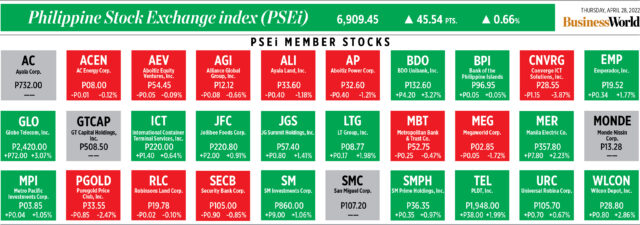
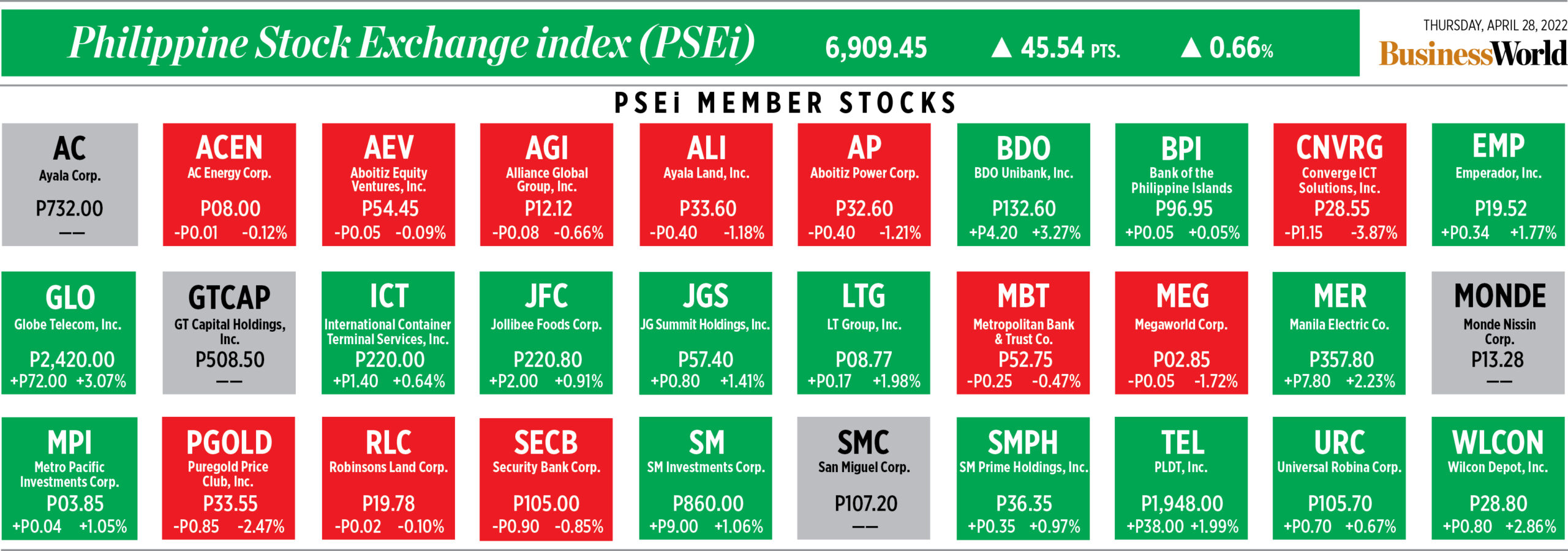
How PSEi member stocks performed — April 28, 2022

Here’s a quick glance at how PSEi stocks fared on Thursday, April 28, 2022.


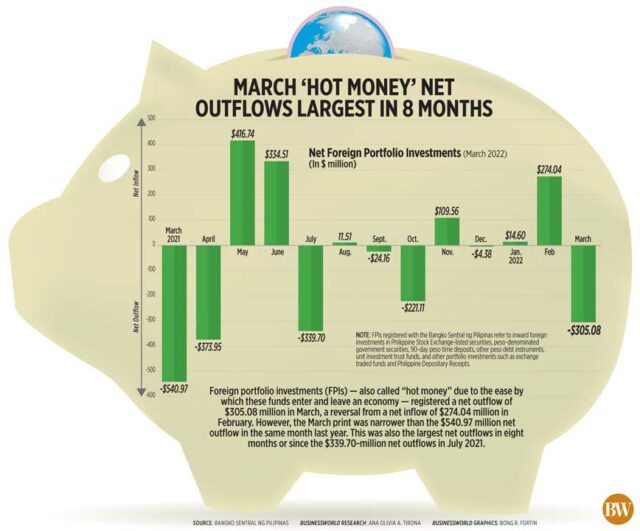
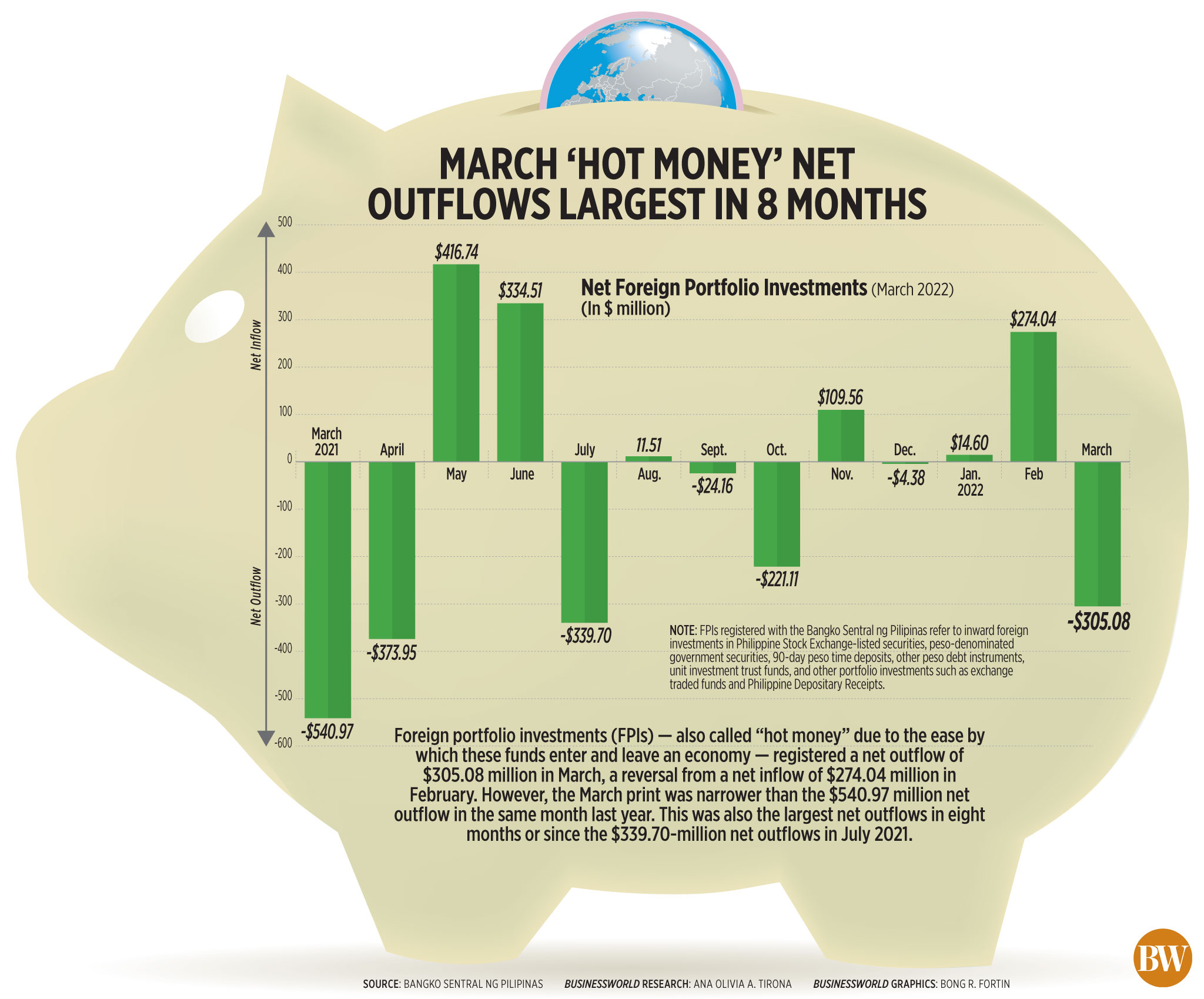
March ‘hot money’ net outflows largest in 8 months

MORE SHORT-TERM foreign investments left the Philippines than what entered in March, reflecting heightened uncertainty from the Russia-Ukraine war and monetary policy tightening in the United States. Read the full story.

March ‘hot money’ net outflows largest in 8 months

Regional share in gross domestic product

THE NATIONAL Capital Region’s (NCR) economy bounced back last year from a double-digit contraction in 2020, but remained below the national growth rate due to strict lockdowns meant to contain the coronavirus. Read the full story.

Regional share in gross domestic product

PSEi rebounds on bargain hunting, income results

STOCKS rebounded on Thursday on bargain hunting and the release of more local and US corporate financial reports.

The bellwether Philippine Stock Exchange index (PSEi) gained by 45.54 points or 0.66% to close at 6,909.45 on Thursday, while the broader all shares index went up by 17.15 points or 0.46% to 3,677.48.

“The market ended in green territory amid investors hunting for bargains following the bourse’s weak performance yesterday. Market participants may also be assessing the corporate earnings reports that have continued to be released over the past few days,” Timson Securities, Inc. Trader Darren Blaine T. Pangan said in a Viber message.

“Bargain hunting emerged anew and that’s due to corporate earnings resilience in some sectors,” First Metro Investment Corp. Head of Research Cristina S. Ulang said in a Viber message.

“Philippine shares rose to recover some previous losses, as concerns over inflation and global economic growth stirred up further volatility across risk assets… Investors digested a slew of mixed corporate earnings from the likes of Microsoft and Alphabet,” Regina Capital Development Corp. Head of Sales Luis A. Limlingan said in a Viber message.

Mr. Limlingan said investors are waiting for other technology firms’ earnings, namely from Apple, Amazon, and Twitter, among others.

A mixed bag of earnings from some of Wall Street’s biggest companies may muddy the outlook for investors hoping to “buy the dip” amid a vicious stock market sell-off, Reuters reported.

With a massive week of corporate results under way, Google parent Alphabet, Inc. reported first-quarter revenue below expectations on Tuesday, while software giant Microsoft Corp. forecast double-digit revenue growth for its next fiscal year.

At home, listed companies have begun announcing their results for full-year 2021 and the first quarter of 2022.

All sectoral indices ended in the green on Thursday. Mining and oil surged by 145.83 points or 1.26% to 11,636.26; financials rose by 16.88 points or 1.03% to 1,644; holding firms climbed by 45.14 points or 0.70% to 6,453.45; services went up by 13.18 points or 0.68% to 1,929.70; industrials added 52.48 points or 0.56% to end at 9,395.95; and property increased by 1.49 points or 0.04% to 3,172.35.

The MidCap index advanced by 6.79 points or 0.60% to 1,130.57 and the Dividend Yield index gained 15.06 points or 0.93% to 1,631.49.

Advancers outnumbered decliners, 92 versus 83, while 58 names ended unchanged.

Value turnover decreased to P5.73 billion with 8.5 billion shares changing hands on Thursday from the P8.78 billion with 816.50 million issues seen the previous day.

Foreigners turned sellers anew with P772.5 million in net sales on Thursday versus the P1.67 billion in net purchases recorded on Wednesday.

For Friday, the last trading day of the week, Timson Securities’ Mr. Pangan placed immediate support at the 6,800 area and resistance at 7,510. — L.M.J.C. Jocson with Reuters

Peso falls on virus fears, March ‘hot money’ net outflow

BW FILE PHOTO

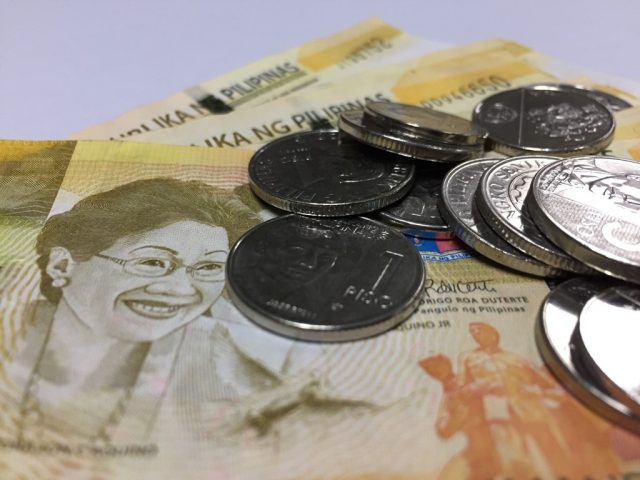
THE PESO weakened versus the greenback on Thursday following news of the detection of a case of the new sub-variant of the coronavirus disease 2019 in the country and data showing a net “hot money” outflow last month.

The local unit closed at P52.27 per dollar on Thursday, weaker by 15 centavos from its P52.12 finish on Wednesday, based on data from the Bankers Association of the Philippines.

The peso opened Thursday’s session at P52.15 against the dollar. Its weakest showing was at P52.36, while its intraday best was at P51.96 versus the greenback.

Dollars exchanged declined to $1.597 billion on Thursday from $1.654 billion on Wednesday.

The peso depreciated on news of the detection of the first case of the Omicron sub-variant (BA.2.12) in the country, Rizal Commercial Banking Corp. Chief Economist Michael L. Ricafort said in a Viber message.

The virus was detected in a female who arrived from Finland earlier this month, the Department of Health said late Wednesday. The patient, who is fully vaccinated and was asymptomatic, went to Baguio City to conduct seminars.

The US Center for Disease Control earlier attributed rising infections in the world’s largest economy to the sub-variant.

The net hot money outflow recorded last month also caused risk-off sentiment, Mr. Ricafort added.

Foreign portfolio investments posted a net outflow of $305.08 million in March, the central bank reported on Thursday. This is smaller by 43.6% than the $540.97-million net outflow a year earlier but a reversal of the $274.04-million net inflow seen in February.

Last month’s net outflow is also the biggest in eight months or since the $339.7 million seen in July 2021. Analysts attributed the net outflow to worries amid the war in Russia as well as uncertainties ahead of the national elections on May 9.

Meanwhile, a trader in a Viber message said the peso “depreciated from bargain hunting after the currency briefly reached below the P52 level intraday.”

For Friday, both Mr. Ricafort and the trader gave a forecast range of P52.15 to P52.35 per dollar. — Luz Wendy T. Noble

NLEX Corp. to build P5.5-billion Candaba swamp third viaduct

NLEX

By Arjay L. Balinbin, Senior Reporter

NLEX Corp., a unit of Metro Pacific Tollways Corp. (MPTC), hopes to start the construction of a P5.5-billion third Candaba Viaduct later this year, its President and General Manager said.

The Candaba Viaduct is a causeway allowing motorists to traverse the section of the swamp between Pulilan, Bulacan and Apalit, Pampanga.

“What we are busy with today, apart from the NLEX Connector project, is we are bidding out the Candaba Viaduct, (which) we call the third viaduct,” NLEX Corp.’s J. Luigi L. Bautista told BusinessWorld in a chance interview.

“Today, you have the northbound viaduct and the southbound viaduct, right? What we will do is we will construct a third viaduct in the middle,” he added.

He said two contractors were vying for the project. “We are in the process of selecting the contractor.” 

Construction is expected to take two years, “if not in the last part of the third quarter, maybe early fourth quarter of this year,” Mr. Bautista noted.

The viaduct is a bottleneck for vehicles traveling north and south along NLEX, where the available lanes narrow from the normal width on dry land.

The company is also planning to start this year the construction of a two-kilometer expressway section between the Mindanao Avenue toll plaza and Quirino Highway in Novaliches, Quezon City.

It is currently awaiting approval from the Toll Regulatory Board for the implementation of the first section of the proposed P92-billion NLEX-CAVITEX Port Expressway Link project.

The 15-kilometer (km) NLEX-CAVITEX Port Expressway Link project was originally a joint unsolicited proposal with the Manila-Cavite Expressway (CAVITEX) submitted to the Department of Public Works and Highways in 2019 to extend the North Luzon Expressway (NLEX).

MPTC’s capital expenditure budget for the year has been set at P32 billion. It recently opened the Cebu-Cordova Link Expressway project in Cebu.

MPTC expects the completion of NLEX Connector Phase 1, Cavite-Laguna Expressway – Cavite Segment, NLEX Segment 8.2 Section 1A, NLEX Connector Phase 2, and CAVITEX C5 Link projects this year.

MPTC is the tollway unit of Metro Pacific Investments Corp., one of three key Philippine units of Hong Kong-based First Pacific Co. Ltd., the others being Philex Mining Corp. and PLDT, Inc.

Hastings Holdings, Inc., a unit of PLDT Beneficial Trust Fund subsidiary MediaQuest Holdings, Inc., has a majority stake in BusinessWorld through the Philippine Star Group, which it controls.

Grab seeks more ride-share slots as mobility rules ease

GRAB Philippines, the dominant ride-sharing company, said it is asking the government to allow it to hire more drivers amid increasing demand due to reduced mobility restrictions.

“We anticipated this situation, and are working with the LTFRB (Land Transportation Franchising and Regulatory Board) to onboard more TNVS (technology- and app-based transport network vehicle service) drivers on the platform,” Grab Philippines said in a statement.

“Last April 12, we received the welcome news that the LTFRB will open a batch of almost 8,000 TNVS slots on April 18 through the TNVS online portal,” it added.

The company expects additional TNVS drivers to be on the road in two to three months. But the additional TNVS slots “are not enough to meet the increasing demand for GrabCar,” it noted.

“Grab continues to work with the LTFRB to add more TNVS slots to better serve the needs of the riding public.”

Grab Philippines has said that as of February 2020, it had around 33,000 active drivers daily.

The number significantly decreased during the pandemic, it said.

“We understand that life is going back to normal, and more Filipinos are going out and taking GrabCar for their everyday commute. Despite Grab Philippines’ efforts to support driver-partners on the platform, the prolonged suspension of ride-hailing during the height of the lockdowns forced thousands of GrabCar driver-partners to give up their cars, or look for alternative income opportunities elsewhere,” it also said.

“This situation has created a serious imbalance in GrabCar’s supply and demand conditions, resulting in fewer GrabCar driver-partners on the road having to serve an ever-increasing number of passengers.”

In March, drivers of ride-hailing services, including Grab, urged the LTFRB to act on their petition to increase base fares by P15 as pump prices continued to rise.

Rates vary depending on the vehicle type. The flag down rate is as much as P40 for sedans and as much as P50 for premium Asian and sport utility vehicles. For hatchback or sub-compact cars, the flag down rate is as much as P30. — Arjay L. Balinbin

ADVERTISEMENT
ADVERTISEMENT