Home Blog Page 6484

Workers march on Labor Day to back Leni’s presidency
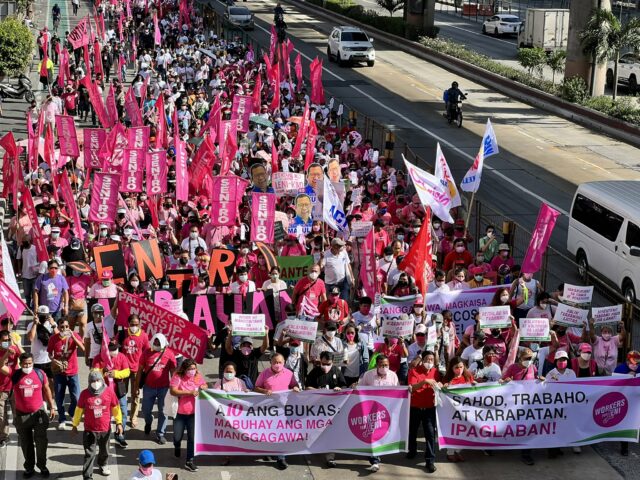
Renato Reyes, Bagong Alyansa Makabayan

By Kyle Aristophere T. Atienza, Reporter

MEMBERS of Kilusang Mayo Uno (KMU), one of the largest and oldest militant labor groups in the Philippines, marched on major streets in the capital region on Sunday to protest President Rodrigo R. Duterte’s failed promise to end short-term employment contracts.

This was the first time KMU held a pink-themed march on Labor Day, which has been traditionally commemorated with large protests in front of the Philippine presidential palace.

KMU and other labor groups later gathered at an indoor arena near the capital Manila to express their support for the presidential run of Vice- President Maria Leonor “Leni”G. Robredo.

“Duterte promised to end contractualization but nothing happened,” said Jan Robert R. Go, an assistant political science professor at the University of the Philippines (UP), adding that politicians have exploited labor reform promises.

“This is something we should look out for,” he said in a Facebook Messenger chat. “Politicians are still trapped within the donor-centered campaign. They need to ensure they balance their support for labor with their support for large industries and big corporations.”

KMU earlier lauded Ms. Robredo’s commitment to review minimum wages nationwide and end labor contractualization.

“Labor leaders and groups, especially the progressive ones, tend to support or work with candidates who are sympathetic to their cause,” said Arjan P. Aguirre, a political science instructor at the Ateneo De Manila University.

“They know how to spot a candidate who is merely campaigning, and a candidate who is willing to work with them.”

Mr. Go said some politicians have been giving generic promises such as higher wages and livelihood for all without saying how they plan to do these.

“Experience is important in dealing with labor,” he said. “How can a person detached from the realities of the working class consider their welfare?”

Maria Ela L. Atienza, who also teaches political science at UP, said the next government should include concerns about short-term employment, labor rights and welfare, and pandemic recovery in the government’s agenda for workers.

She added that among presidential candidates, only Ms. Robredo and labor leader Leodegario “Ka Leody” de Guzman have laid out clear programs for the labor sector, which has been severely affected by the coronavirus pandemic.

Ms. Robredo has vowed to pursue a P192-billion plan to strengthen local industries, generate jobs for Filipinos, and support businesses if elected on May 9.

Her job recovery plan involves strengthening local industries, ending discrimination at work, supporting small businesses and providing safety nets for those who lose their jobs.

Ms. Atienza said Mr. de Guzman, who has a rich experience in labor organizing, and Ms. Robredo are the only candidates who “have a better grasp of workers’ issues and needs.”

She cited Ms. Robredo’s immersion with various sectors before becoming an elected official and poverty alleviation program during her vice-presidency, which allowed her to work with more sectors, including workers.

The pandemic wiped out 1.7 million wage and salary jobs in the 12 months to Jan. 2021, according to a report by the Asian Development Bank (ADB).

“The pandemic could create long-lasting effects on employment,” ADB said, noting that there would be more jobseekers, including people who lost their jobs, school dropouts and new labor market entrants. “This temporary large shock to the economy might produce a persistently lower employment rate even after the economy has started to grow again.”

Sonny A. Africa, executive director of think tank Ibon Foundation, said Mr. Duterte had “given the least wage hikes” among presidents after the ouster of the late dictator Ferdinand E. Marcos.

“Without a large wage hike in his twilight weeks, his administration will be the only one in the post-Marcos era which will see the value of the real wage decline — for instance, by nearly 10% in the case of Metro Manila,” he said in a Messenger chat.

Mr. Africa noted that Senator and boxing champ Emmanuel “Manny” D. Pacquiao, another presidential candidate, had consulted with labor groups to improve his labor agenda. “But he’s still developing the ideological framework to put this in a coherent platform.”

The analysts said the late dictator’s son Ferdinand “Bongbong”R. Marcos, Jr. might not inspire confidence in the pandemic-hit sector.

“If he wins, he’s unlikely to consider labor rights, welfare and issues as important,” Ms. Atienza said. “Labor will not be a priority.”

Mr. Marcos’s spokesman, Victor D. Rodriguez, did not immediately reply to a text message seeking comment.

“Marcos, Jr.’s lack of experience and familiarity toward labor might spell trouble to the kind of response and attention that his likely presidency would give to the labor sector,” Mr. Aguirre said.

“In fact, his current labor agenda that promises security of tenure lacks depth and details,” he said. “These promises seem to embody the same messaging and framing that has been used in the past.”

Anthony Lawrence A. Borja, a member of De La Salle University’s Department of Political Science and Development Studies, said the former senator’s lack of on-the-ground experience “would make him less sensitive to the everyday struggles of workers.”

“However, his ties to labor unions might compensate for this if he is capable of listening and responding to the representatives of these unions,” he said.

The Trade Union Congress of the Philippines is backing the candidacy of Mr. Marcos.

Mr. Africa said that Mr. Marcos’ political career is “remarkably devoid of any concern for labor.”

“Only Robredo and de Guzman have taken real efforts to consult organized constituencies for labor and social reforms,” he said. “This is reflected in their platforms which are the only ones that give more than token mention and lip service.”


Hontiveros pushes for speedy review of minimum wage hike petitions 

A cyclist passes by at street level as workers install a drainage system in Marikina in this June 2021 photo. — PHILSTAR/ MICHAEL VARCAS 

A SENATOR on Sunday, the observance of Labor Day, pushed for the speedy review of petitions to raise regional minimum wage rates amid the rising cost of living in the past three years due mainly to fuel price surges and disruptions in food supply movement.   

The Department of Labor and Employment (DoLE) had announced in March that it will consider the petitions filed yet nothing has changed since then, said Senator Ana Theresia RisaN. Hontiveros-Baraquel, who is running for reelection on May 9. 

Currently, the minimum wage in the capital region is P537 per day, already the highest among 17 regions in the country.   

Whats taking so long? Any delay in issuing the decision on minimum wage can cause hunger or loss of hope for workers seeking to rise above their numerous dues,she said in a mix of English and Filipino in a statement.  

The take-home pay of minimum wage earners has long been overtaken by the rising cost of food, transportation, public utilities, among other basic essentials, she added.  

The Trade Union Congress of the Philippines (TUCP), the countrys largest group of labor federations, had filed wage hike petitions in the National Capital Region and several other regions.   

They noted that in Metro Manila, the current monthly minimum wage of P13,962 is far belowthe P16,625.00 a month poverty threshold for a family of five.  

Citing a study from the Ateneo Policy Center, the group said that daily food requirement amounts to P734 for a family of four.  

Ms. Hontiveros also called out the labor department for its inability to enforce minimum wage mandates efficiently, citing the 2018 Labor Force survey which showed that one of four employed workers received less than the minimum wage.  

DOLE should report on the process of enforcing the implementation of past minimum wages,she said.  

Meanwhile, Senator Sherwin T. Gatchalian, who is also seeking reelection, vowed to pursue measures that will institutionalize tax cuts for work-from-home employees, additional benefits to construction workers, and condoning penalties for unpaid Social Security System (SSS) contributions of household employers.  

These will help alleviate the financial concerns of workers, he said, especially for daily wage earners.   

Mr. Gatchalian cited three bills currently pending in the Senate committee which he aims to refile and push for if he wins another term.  

These are: Senate Bill (SB) 1706 or the Tax Incentives for Individuals on a Work-from-home or Telecommuting Program, which he co-authored, proposes a reduction of P25 from the taxable income for every hour of work of telecommuting employees; SB 741 or the Construction Workers Insurance Act; and SB 744 or the Domestic Workers Act that includes a provision on the condonation of penalties for unpaid SSS contributions of household employers.   

“The fundamental precept of social justice is that ‘those who have less in life must have more in law,Mr. Gatchalian said.  

If we can extend the benefits of workers, we can raise their standard of living,he added. Alyssa Nicole O. Tan 

Debate fiasco adds to Comelec credibility issues — analysts 

COMELEC officials discuss issues on the third round of debates during a press conference on April 22, 2022 at the Comelec office in Intramuros, Manila. — PHILSTAR/ RUSSELL PALMA

THE CONTROVERSY over the cancellation of the supposed final round of official debates for the country’s top two positions for the upcoming May 9 national elections has again put internal issues of the Commission on Elections (Comelec) in the spotlight, adding to public doubt in the agency, political analysts said at the weekend.  

“It seems like something suspicious could have happened, considering the amount that would have been spent on the high-budgeted debates,” Gerard V. Eusebio, a political science lecturer from the De La Salle University, said in a Facebook Messenger chat.   

Comelec announced last week that the third round of official debates would be modified into a pre-taped panel interview format after the failure of their private contractor, Impact Hub Manila, to fulfill P14 million in financial obligations to the venue, Sofitel Philippine Plaza Manila.  

“The Comelec should always maintain its purity at all costs and not allow its credibility to be eroded in any way,Mr. Eusebio said.   

Election Commissioner Rey E. Bulay, who is leading the probe on the incident, said in a statement on Friday that he recommends to temporarily relieve Comelec Spokesperson James B. Jimenez and Comelec Education and Information Director Frances A. Arabe from their media relations roles, as they were the point-persons for the Impact Hub Manila partnership.  

Ms. Arabe told reporters in a Viber message last Friday that her actions concerning the debates were legitimate, but will abide by Mr. Bulay’s directive when issued.  

Mr. Jimenez has yet to issue a statement on the issue.  

“Considering the controversies even before this, I think Comelec’s position remains troubled,” Hansley A. Juliano, a former political science professor studying at Nagoya Universitys Graduate School of International Development in Japan, said in a Facebook Messenger chat.   

One of the recent issues raised against the election body were delays in the resolution of disqualification cases against presidential candidate Ferdinand BongbongR. Marcos, Jr.  

Comelec has also been criticized for printing a significant number of ballots without the presence of accredited observers. There was also a confirmed hacking incident involving a worker of Smartmatic, the technology service provider for this years automated elections.   

“At the same time, I am indeed getting the impression that the breakdown of the (debate) issue is technically an internal logistical concern at heart (involving perhaps mistakes or bad actions by a few people) but because it involves a very public event like this, it’s inevitable it blew up,Mr. Juliano said.  

Only six of 10 presidential candidates and four of nine vice-presidential candidates accepted Comelec’s invitation to the modified forum, Election Commissioner George Erwin M. Garcia told reporters in a Viber message last week.  

Vice President Maria Leonor “Leni” G. Robredo, Manila Mayor Francisco “Isko” M. Domagoso, and Senator Panfilo “Ping” M. Lacson declined the invitation due to prior commitments, Mr. Garcia noted.  

Mr. Marcos, who skipped the first two Comelec-sponsored debates on March 19 and April 3, also declined the interview format.   

“The only real impact of an election debate/forum is if the frontrunners are there,” Mr. Juliano said. John Victor D. Ordoñez 

Davao Region’s insurance sector remains among top service industries; SLGFI readies bigger work force 

BW FILE PHOTO

FINANCIAL and insurance activities in Davao Region grew 6.1% in 2021 and was the second biggest services sector, the Philippine Statistics Authority (PSA) regional office reported.  

Services as a whole accounted for 58.7% of the regions economic output, which grew by 5.9% in 2021 with a value of P882 billion from about P833.2 billion in 2020. 

Insurance sector growth is expected to continue this year, driven by a still considerable untapped client base, according to Sun Life Grepa Financial, Inc. (SLGFI) or (Sun Life Grepa) Executive Vice President Roy Padiernas.     

Growth will come from the potential market,he said in an interview in Davao City last week.   

In the first quarter this year alone, he said, the leading insurance firms total annualized premium collection has increased by 41.8%.  

This tells us that we are already up for a good start, especially in this part. Davao Region is actually our number one region (in growth),he said.   

To tap the potential market, the company is beefing up its local sales force with a target of at least 250 agents from the current 160.   

One important dimension of the economic story, which has not been highlighted much, is the consumption patternand the performance of the insurance industry with growing public consciousness of (including it) in the basket of priorities,said Assistant Secretary Romeo M. Montenegro, deputy executive director of the Mindanao Development Authority.  

OTHER INDUSTRIES
Meanwhile, PSA-Davao Region Director Ruben D. Abaro Jr. said of the overall 5.9% economic growth, 3.3 percentage points came from services, 2.5 percentage points from industry, and 0.1 was contributed by the agriculture, forestry, and fishing sectors.  

Agriculture, forestry, and fishing contributed the least to the total economy of Region 11 with 16.1% share,he said during the local PSAs press conference on Thursday.  

Gilberto A. Altura, assistant regional director of the National Economic and Development Authority, said the low output in the agriculture sector was due mainly to a reduction in poultry production as well as the impact of the African Swine Fever in the hog sector.   

Also, the effect of Typhoon Odette (in mid-December) that reduced the output of agriculture sector,he added.   

Mr. Abaro said industries in the region with the fastest growth were mining and quarrying with 21.9%; human health and social work activities with 14.6 %; construction with 12.5%; and accommodation and service activities with 10.8 %.  

Davao Region is composed of the independent city of Davao and the five provinces of Davao del Norte, Davao del Sur, Davao Oriential, Davao Occidental, and de Oro. Maya M. Padillo and Marifi S. Jara 

Roads projects worth P187.7M completed in Aklan, Zamboanga Sibugay provinces 

THE NEWLY-built tourism center in Bulusan includes a view deck overlooking the Bulusan Lake. — DPWH

ROADS that improve access between farms and markets as well as to nature tourism sites have been completed in the provinces of Aklan and Zamboanga Sibugay, the Department of Public Works and Highways (DPWH) reported on Sunday.  

In Aklan, located on the western side of central Philippines, one of two completed projects was a 4.5-kilometer access road to Capiz, which will support the provinces coconut processing and native sleeping mat industries. It cost P53 million.   

Another 3.4-kilometer concrete road in Libacao, worth P79 million, eases delivery of various products using native materials such as abaca. It also serves as an access route to the tourist attraction called Manila Viewpoint.   

The completion of these road projects has provided great relief since local producers need not walk hours to neighboring towns or provinces to deliver their native goods to nearby markets,said DPWH Secretary Roger G. Mercado in a statement.   

A P23.4-million road going to the Mangayaw Falls in Libacao has also been completed.   

In Zamboanga Sibugay, a province on the southwestern side of the countrys south, three completed projects will improve connectivity between towns as well as in the transport of crops, especially during the rainy season, DPWH said.   

With a total cost of P32.3 million, these were: 1.02-km La Dicha-Danlugan Diversion Road; 0.931-km Guilawa-Palalian-Barangay Poblacion Malangas Bypass Road; and 0.953-km Kulasi-An-Balungisan Bypass Road in Payao.  

MT. BULUSAN TOURISM
Meanwhile, the department also announced the completion of a new 1,002-square meter tourism center in Bulusan, Sorsogon  

The town is most known for its mountain and lake with the same name.   

Multipurpose facilities were built near Bulusan Lake consisting of a food bar or dining area with comfort rooms and ramps, waiting shed, souvenir shop, ticket booth and queue sheds, and the main feature of upper view deck overlooking the lake,said DPWH-Bicol Regional Director Virgilio C. Eduarte.  

The facility and supporting road network, built at a cost of P60 million, has been turned over to the Bulusan local government. MSJ 

NBA fines Suns $25,000 over injury-reporting of Devin Booker

THE Phoenix Suns were fined $25,000 by the National Basketball Association (NBA) on Saturday after violating the league’s injury-reporting guidelines over Devin Booker’s status ahead of Game 6 against New Orleans on Thursday. The league ruled that Phoenix did not reveal Booker’s playing status “in an accurate and timely manner” before he returned to action in the Suns’ first-round series-clinching win over the Pelicans. Booker, who missed the series’ previous three games after suffering a Grade 1 hamstring strain in Game 2, had been upgraded to questionable earlier in the day on Thursday. After testing the leg during pregame warm-ups, the All-Star guard started and played 32 minutes, scoring 13 points in the 115-109 Phoenix victory. The 25-year-old Booker averaged 26.8 points, 5.0 rebounds and 4.8 assists in the regular season in making his third straight All-Star Game appearance. The Suns begin their second-round series at home on Monday in Game 1 against the Dallas Mavericks. — Reuters

Taylor triumphs over Serrano

NEW YORK — Katie Taylor retained her undisputed lightweight world championship on Saturday, with a split-decision victory over Amanda Serrano on a historic night in Madison Square Garden in front of a raucous sellout crowd. The Irishwoman, who stretched her unbeaten professional record to 21-0, and Serrano were the first women to headline a fight at the world’s most famous arena and put on a show-stopping performance equal to the occasion. Competing under the watchful eye of pioneering Hall of Famer Christy Martin in the biggest fight in the history of women’s boxing, the meeting between the two best pound-for-pound boxers ushered in a new era for the sport. Promoter Matchroom Boxing said the fight attracted more media applications than Briton Anthony Joshua’s heavyweight fights at Wembley against Wladimir Klitschko and against Oleksandr Usyk at Tottenham Hotspur Stadium. With the Empire State Building lit up in the colors of the Irish and Puerto Rican flags, Taylor secured the seven-figure purse and seemed ready for more. “Let’s do it again, Amanda!” she declared. — Reuters

Sailing action returns to Punta Fuego

THE Punta Fuego Regatta, one of the country’s longest-running yachting tournaments, returned after a two-year pandemic hiatus and a postponement from its original schedule in January. The 19th edition of the Regatta was won by Subic Sailing Club-based Selma Star, a 37-foot Beneteau yacht of veteran sailor Jun Avecilla which ruled the IRC Class. Finishing as runner up was Belatrix, an Ice 52 sailboat helmed by Jun Villanueva and Sean Mitchell. Both yachts won top honors at the BPI Busuanga Cup 2022 held in February. Meanwhile, Hurricane Hunter of Albert Altura and international-award winning Karakoa of Ray Ordoveza settled for third and fourth places, respectively. Wild Honey led by James Villareal, Plus Ultra of Pablo Lobregat, and Isabelle of Tere Marcial copped the top three awards in the Cruising Class. Rounding up the winning circle was Twin Popsies jointly helmed by Dylan Tantuico and Gordon Luk, and Vincent Ruais’ MYG2 which shone in the Ocean Multihull category. “The successful return of the Regatta despite the many challenges is a clear sign of the return to normalcy of sailing events due to the improving health situation in the country,” said Club Punta Fuego general manager Edgar Krohn, in a press release. The regatta is spearheaded by the Philippine Inter-Island Sailing Foundation, co-presented by Landco Pacific, and hosted by Club Punta Fuego.

Rivers loses franchise workhorse

Not a few quarters saw fit to second-guess Sixers head coach Doc Rivers’ decision to leave top dog Joel Embiid on the floor in the dying minutes of Game Six of their first-round series. After all, the pundits noted, the red, white, and blue were already up by 21 when the fourth canto began, and the Raptors could go no closer than 18 the rest of the way. And given the Most Valuable Player candidate’s injury history, prudence dictated that his minutes be managed well. Instead, he burned rubber for all but the last three minutes and 58 seconds of the payoff period, and only because he was on the wrong end of an elbow that, it was subsequently learned, gave him a concussion and facial fracture.

Hindsight makes for 20/20 vision, to be sure, and Rivers could not have known Embiid would be the victim of a freak play. Predictably, it’s what he pointed out to scribes that greeted him after practice yesterday. “Everyone was in there, and the other team had all their guys in, too,” he said. And he’s right. Then again, the Raptors’ situation — what with the deficit necessitating full force (aside from no small measure of good fortune) to overcome — was markedly different from their own. Taken in this context, his defense was that he had already planned to take the Sixers’ leading scorer and rebounder out prior to the fateful play came off as more of an excuse.

It bears noting that Rivers traditionally tightens his rotations in the playoffs. Embiid normed close to 34 minutes in 68 regular-season games, in contrast to the 39-per-match average against the Raptors. It’s also reflective of the bench tactician’s desire to avoid a Game Seven after the Sixers claimed the first three contests; he counted on his best charges to close the deal, perhaps with his previous postseason failures at the back of his mind. In any case, what’s done is done, and he has no choice but to prepare for the conference semifinals without his franchise workhorse.

Needless to say, the burden is on Rivers to steer the Sixers to success without Embiid on tap — which may well be a tall order against the resilient Heat. With no one on the roster close to approximating the lost talent level at the slot, he’s bent on using a platoon to tide them over. How that will work out remains to be seen. “We just have to be very smart in how we plan our bigs,” he argued. And, given their leader’s indefinite period of convalescence, how “smart” figures to determine how much — and, yes, how long — they will stay competitive.


Anthony L. Cuaycong has been writing Courtside since BusinessWorld introduced a Sports section in 1994. He is a consultant on strategic planning, operations and Human Resources management, corporate communications, and business development.

Who is most competent to grow our economy?

PRESIDENTIAL ASPIRANT Vice-President Leni Robredo greets her supporters during a sortie at Brgy. Calipahan, Talavera, Nueva Ecija, March 22. — PHILIPPINE STAR/MICHAEL VARCAS

“The economy, stupid.” This was a campaign slogan of Bill Clinton in the US’s 1992 presidential election. It was a most fitting message at a time when the US was suffering from recession. Hammering home to voters the message it’s “the economy, stupid” made Clinton win the election.

Thirty years after, “the economy, stupid” as a catchphrase resonates in the Philippines and elsewhere. The pandemic, aggravated by how authorities bungled the pandemic response, led to the worst recession that the Philippines has suffered since independence.

An internal, unpublished survey done in December 2021 showed that the main fears of the voters were: 1) “getting sick,” 2) “not having a job and salary,” and 3) “not being able to afford basic needs.” Here, health or containing the pandemic was a primary concern, and it was inextricably tied to economic well-being.

But as infection rates, severe cases, and deaths have declined significantly since the pandemic’s peak in January this year, the people’s attitude and behavior have changed. One can observe pandemic fatigue and even complacency.

A more recent survey (April 2022), likewise unpublicized, showed that the chief concern of voters is the revival of the economy. Similarly, the survey pointed out that voters want “a clear tangible plan for reviving the economy.”

The question thus is who among the candidates for President is most capable, most competent to address an economic recovery? Since the race has boiled down to a “two-way race” between Bongbong Marcos and Leni Robredo, let’s focus on these two candidates.

Based on background, record, and articulation of economic platform, Robredo has the clear advantage.

Robredo is an alumna of the University of the Philippines School of Economics (UPSE). UPSE is the premiere school of economics in the Philippines. Although Robredo is not a practicing economist (for she specialized in lawyering for the poor and the oppressed), the schooling and training she received from the leading economics professors and the firm support she has gotten from economists — in the academe, think tanks, civil society, and business — demonstrate the credibility and confidence she enjoys managing the Philippine economy.

More importantly, Robredo has articulated a well-thought-out economic plan. She grasps well the link between fighting COVID-19 and growing the economy. Her many initiatives to stop the spread of COVID-19 do facilitate economic revival and job protection or creation.

She likewise has a good grasp of the issues of fiscal policy. She is committed to increasing spending on health, education, climate change, technological innovation, and infrastructure. And she will do this by creating fiscal space by reducing waste, inefficiency, and corruption in government spending and, at the same time, increasing the tax effort through reforms in tax policy and tax administration.

Under a Robredo administration, we can expect policy continuity with respect to the reforms that have led to Philippine economic transformation (but which were disrupted by the pandemic) in the last decade.

On the other hand, Marcos Jr. spells trouble for the Philippine economy.

His grasp of economics ever since has been poor. In a column titled “Yes, I tutored Bongbong in Economics” (Inquirer, Nov. 6, 2021), Solita Collas-Monsod wrote that at Oxford, Marcos Jr. applied for the bachelor’s degree in Philosophy, Politics and Economics. “Well, he passed Philosophy, but failed in Politics and Economics.”

So, Professor Monsod was assigned by the UPSE Dean Jose Encarnacion to tutor Marcos Jr. in economics. The young Marcos had an attitude problem; he didn’t even bother to show up for the first tutoring session.

One can argue that Marcos Jr. can appoint qualified economic managers to his Cabinet. But a serious problem arises. Whoever will be Marcos’s economic managers, they must follow the leader. But Marcos Jr.’s answer to the complex economic problems we have is “Unity,” which is empty-headed.

Marcos Jr. also promises subsidies left and right. But where will he get the resources considering the budget constraint? His populism is of the worst type, because he is opposed to taxation, which is necessary to have the space for increased spending. For instance, he opposed the sin tax law, a reform that has provided substantial financing for universal healthcare. (Robredo supported the sin tax reforms.)

The truth is, even the technocrats under the Duterte administration fear a Marcos presidency will reverse the economic reforms. Do ask them, and they will give their honest answers.

Incidentally, Secretary Sonny Dominguez recently said that the “Department of Finance’s successes on Duterte watch” are a result of the “good work” of predecessors, a result of “policy continuity.”

But the “good work” is threatened. The title of an article from Focus Economics (Economic Forecasts from the World’s Leading Economists) goes: “Philippines: Marcos Jr. vs. Robredo: Economists prefer Robredo despite Marcos Jr.’s poll lead” (April 26). The article said, “the election is already having a macroeconomic impact” and uncertainty prevails. “Moreover, investor perceptions of Marcos appear weak, raising market jitters.” Further, said article posited that “the most salient aspect of Marcos Jr.’s economic platform is its lack of clarity.”

We have been subject to a lot of misinformation. There’s the myth of Marcos and Marcos Jr. There’s the lie about the competency of Robredo — her being lugaw and lutang. I hope this piece has given the information that Robredo is the best candidate (and that Marcos is the poor candidate) to tackle “the economy, stupid.”

If Keynes were alive, he would have informed voters: “When my information changes, I alter my conclusions.”


Filomeno S. Sta. Ana III coordinates the Action for Economic Reforms.

www.aer.ph

PPPs — Partnerships towards a Progressive Philippines

A RESIDENT of Brgy. Old Balara undergo swab testing in their community at Sitio Liwanag. — PHILIPPINE STAR/MICHAEL VARCAS

(Part 1)

It has often been observed that our best qualities as a people emerge during times of national catastrophe — typhoons, flooding, volcanic eruptions, earthquakes, tsunamis. This spirit is expressed in a word that does not directly translate to English: “bayanihan.” Defined as the enduring value of the Filipino “to help fellow countrymen in times of need without expecting anything in return,” this comes from the word “bayani” (hero). Bayanihan is an invitation for heroes from all walks of life to work together.

The once-in-a-generation COVID-19 pandemic is perhaps the mother of all catastrophes in terms of duration, global reach, and the suddenness and severity of its impact on peoples’ lives and the economy — truly an existential threat to individuals and institutions. It is fortunate that our national response, both public and private, has been proportionate to the disaster, showcasing the best of public-private partnerships (PPPs).

In April 2020, responding to a call from the government for a partnership to manage COVID, the private sector created Task Force T3 (Test, Trace, Treat). Starting initially with a small group composed of Ayala, AC Health, McKinsey, MPIC Hospitals, the Philippine Disaster Resilience Foundation (PDRF), Unilab, and Zuellig Pharma working with the Inter-Agency Task Force for the Management of Emerging Infectious Diseases (IATF), Department of Health, the Asian Development Bank, Presidential Adviser for Entrepreneurship Joey Concepcion’s Go Negosyo, and the Foundation for Economic Freedom, under the baton of Bill Luz and Fred Ayala, T3 quickly expanded to cover the entire business community in a consortium working with government across many different fronts of the COVID response.

At the outset, the work focused on expanding the RT-PCR testing capacity nationwide, from 4,500 tests per day in the third week of April 2020 to 30,000 by the end of May (and eventually to over 100,000 tests daily). A second job of increasing PPE (personal protective equipment) inventory was also given to the task force. Eventually, T3 worked on over a dozen projects, all the way to the national vaccination rollout with Secretaries Charlie Galvez and Vince Dizon.

COVID-19 showed, in a tremendously tangible way, the power of bayanihan in successfully meeting a massive challenge. I share the belief that this same spirit of partnership can likewise propel us to solve our most burning, persistent problems, and truly create a Progressive Philippines.

KEY THEMES AND LESSONS OF T3
Partnerships work. Both sides of the partnership complemented each other’s strengths and covered for each other’s limitations. For instance, the agility of the private sector made immediate response measures possible as the government realigned its budgets and mobilized its machinery. Meanwhile the public sector’s size, reach, and resources made massive impact at scale possible, supplementing what the private sector had started. Building on these, key themes begin to surface on what truly made T3, as a cooperation model, successful:

Speed is of the essence. As noted, the private sector’s agility was crucial during the early stages of the crisis, while the more bureaucratic and massive ship of the State undertook the required legislation and organizational effort. We saw this quite clearly across all the partnership initiatives, from the earliest relief undertaking (Project Ugnayan) and in expanding testing capacity, building quarantine facilities, building up PPE supply, data management, communications, and vaccine deployment, among others.

Private sector investments in technology, supply chains, and human capital made the difference. The resource base, capabilities, and access of the private sector taken together across industries, and, most especially, globally, appears to be at an advantage versus most governments. This was most evident in vaccine logistics and administration, data management and analytics, communications, and the development and application of internationally recognized best practice protocols and the latest scientific findings on the virus.

Taskforces over traditional reporting lines. A multifaceted catastrophe such as COVID-19, cannot just rely on official “boxes and lines” on who is responsible for what. In this case, this is not just a “public health crisis” that would normally fall under the Department of Health, which has historically been limited in its resources, but also a “socioeconomic crisis,” as severely affected livelihoods, ultimately translates to lives impacted. We have heard many stories of Filipinos who were risking infection by continuing to make ends meet outside of quarantine: say in many ways, “Hindi nga ako mamamatay sa sakit, mamamatay naman ako sa gutom” (Yes, I won’t die of disease, but then I’ll die of hunger).

Initially, the IATF used what was once considered as the strictest quarantines to control contagion, driven by understandably cautious health professionals. However, through well-organized, targeted consultations involving the government economic managers; and the severely impacted, but committed private sector groups across industries (healthcare, retail, transportation, construction, education, etc.); while drawing on the experience and expertise of other countries secured from global knowledge banks (the Asian Development Bank, McKinsey, and Boston Consulting Group), the strategies and policies were refined that allowed us to eventually “dance with the virus” and minimize the adverse impact on our people. Proposed measures now had to go through this multistakeholder group during their regular cadences before implementation. Thus, after a severe 9.6% contraction of the GDP in 2020, we have bounced back and are enroute to full recovery.

Public sector scale augments private sector speed. While the private sector can contribute early and quickly, especially technological resources not available to government, the reality is that for adversities of this magnitude, only the public sector has the massive financial resources, and legislative and executive powers needed to address them systematically. This is especially relevant as the private sector itself was severely impacted commercially and needed fiscal support from the government.

This was highly evident in the government’s large-scale, and wisely diverse vaccine procurement — which built upon the initial vaccine procurement effort of the private sector for their stakeholders — the “ayuda programs,” and the actual vaccination at the local government level, after private experts helped develop data-based strategies. All told, counting public spending, lending, fiscal stimulus, and the government’s COVID-19 response amounted to P3 trillion or 15.6% of GDP from March 2020 to April 2022, according to the Department of Finance.

Inclusive Capitalism emerges as an idea whose time has come. As these partnership efforts materialized alongside government, a heightened sense of social responsibility and a greater appreciation of stakeholder impact appeared to manifest within private institutions. These have certainly long been present within the Philippine private sector and have been building up for many years through coalitions and alliances, such as the Philippine Business Groups (FINEX, MAP, MBC, PCCI, PBEd, PBSP, etc.), and the Philippine Disaster Resilience Foundation, among others.

Amidst COVID-19, further strengthening its alignment to a stakeholder-centric model of doing business became a compelling proposition to the private sector. As a tangible expression of this, in November 2020, more than 20 business associations launched the Covenant for Shared Prosperity, inspired by a similar movement of the Business Roundtable in the United States.

PPPs AS A PLATFORM FOR NATIONAL DEVELOPMENT PRIORITIES
The pandemic was certainly an existential crisis. It’s almost impossible to consider anything else that may be as severe, immediate, and all-encompassing in its impact on the nation and its people. Yet there are disaster-proportion adversities already upon us that are perhaps not so apparent, since they do not come in a big blow, but creep up on us slowly — the proverbial thief in the night, or the lobster in the boiling pot. I can point to subpar education and healthcare quality, outdated infrastructure, poor child nutrition, lethargic FDI, poor ease of doing business metrics, and many others, as fundamental and persistent challenges that the country continues to suffer from.

There may be opportunities for harnessing more PPP to address these, based on more long-term commercial contracting commitments, rather than pure altruism for one-shot short-term undertakings during an existential crisis.

Fortunately, we have in place one of the more advanced PPP legal, regulatory, and governance frameworks that has yielded globally cited examples of successful partnerships benefiting the public. Since the passage of the Build-Operate-Transfer Law, we have seen multiple examples of success in the expansion of our power, water, expressway, and airport infrastructure.

T3 only cemented the value of this engagement model with the private sector, given its tremendous contributions to the fight against COVID and in bringing much-needed attention to our healthcare space.

Looking forward, we can build on these PPP successes in physical infrastructure and, in light of the COVID crisis, the social sector to address some of these fundamental problems that we face.

(To be continued. Part 2 covers possible PPP interventions in health services and education and suggests revisions in government mindset and policies for a more enabling PPP environment.)

I am grateful for the valuable input from Fred Ayala, Paolo Borromeo, Bill Luz, and Paolo Monteiro. Mistakes are all mine, the author.


Romeo Bernardo served as finance undersecretary during the President Cory Aquino and President Fidel Ramos administrations. He currently sits on the boards of the Foundation for Economic Freedom, the Management Association of the Phil. and the FINEX Foundation.

romeo.lopez.bernardo@gmail.com

Who is more prepared for the presidency?

As the election season reaches its last mile, the race for the presidency has become a two-horse race. On one hand, we have Ferdinand Marcos, Jr. who operates with the advantage of money, machinery, and might of political dynasties. On the other hand, we have Vice-President Leni Robredo whose campaign is propelled by an army of hard-working, dedicated volunteers.

On the shoulders of the next president are serious problems that will require immediate attention. The economy has lost momentum following the pandemic. Foreign debts are at their maximum tolerable levels while poverty and unemployment have spiked anew. In terms of national security, China’s creeping invasion continues to advance, emboldened by President Rodrigo Duterte’s passive (or permissive) policy towards China’s encroachment. Exacerbating matters are national emergencies such as the state of education in the country.

Who between Marcos and Robredo is in a better position to solve these problems? I would have wanted to make a point-by-point comparison between the two but Marcos offers no platform or leadership plan except to say that we must all unite. Robredo, on the other hand, offers a comprehensive agenda.

Without basis for comparison, let me focus on Robredo’s intentions in as far as the economy, China, and education are concerned.

ON THE ECONOMY
Robredo offers a sensible plan on how to move the economy forward amid crippling debt and loss of competitiveness. At the heart of it all is job generation. In one masterplan called “Hanapbuhay para sa lahat” (Livelihood for all), Robredo ventures to solve the nation’s biggest problems — poverty, unemployment, and income inequality. The creation of jobs also translates to wealth generation for individuals and the country. This will help solve such threats as the rising national debt, a gaping budget deficit, and the lack of funds for social services. Indeed, job generation cuts through most of our problems. I reckon the plan to be well considered.

Foreign direct investment (FDIs) is the silver bullet that can address our immediate problems and accelerate development. That said, fundamental to Robredo’s plan is to restore trust in government. Restoring trust means leveling the playing field, quashing corruption, and reverting to rule-based governance. Robredo promises to clamp-down on influence peddling, syndicates, and red tape since these are the tumors that make the Philippines unideal for doing business and uncompetitive in attracting investors. With confidence restored, FDIs will pour in, jobs will be created, and lives will improve.

The second aspect of her plan is to awaken Philippine industries. I was delighted to see the inclusion of maritime industries or “the blue economy” in the plan. Blue industries include ship building, ports and shipyards management, logistics services, seafarer crewing, maritime financing, aquaculture, and offshore energy exploration. I’m glad Robredo recognizes the potential of the blue economy — no other president has.

The re-activation of manufacturing industries is another component of Robredo’s economic agenda. There is simply no way out of it — we must industrialize if the country is to grow in wealth. We must recalibrate the economy from being 73% consumption-driven and only 27% production-driven. High growth can only be sustained by a production-based economy. It cannot be done on the back of consumption without stressing debt levels.

Robredo aspires to climb the technology value chain in the IT-KPO (Information Technology-Knowledge process outsourcing) space. She commits to positioning the country as a center of excellence in artificial intelligence, cloud services, genetic medicine, and the like. She also aims to make the Philippines the center of climate industries. This includes manufacturing of electric vehicles and parts, adoption of climate-resilient agriculture, and use of renewable energies.

As for the development of MSMEs (Micro, small and medium enterprises), Robredo plans to give small businesses a shot in the arm by giving them first priority in government procurement.

ON POLICY TOWARDS CHINA
Robredo will pursue an inclusive and independent foreign policy that favors no specific nation except our own. This is loud and clear.

As for China, Robredo expressed willingness to cooperate in the realms of trade and investments. When it comes to the West Philippine Sea, however, China must first recognize Philippine sovereign ownership over the disputed territories before deals like joint exploration of resources can be pursued. Fundamental to all is China’s recognition of the arbitration ruling of the International Tribunal for the Law of the Seas.

Robredo categorically opposes China’s territorial grab and militarization of the West Philippine Sea. To that, she plans to further strengthen relations with our oldest ally, the United States, to help protect our sovereign rights.

And make no mistake, she will do everything in her power to enforce the decision on the West Philippine Sea in favor of the Philippines.

ON EDUCATION
Declaring an educational crisis is one of the first acts Robredo will do as President, she said. This will open the door for immediate high-impact reforms and the expeditious release to budgets. Access and quality of education is the challenge that must be addressed.

To this, she commits to appropriate 6% of GDP (from 3% today) towards education to give the Department of Education the ammunition needed to address the struggling sector. Among the priority areas are the overhaul of curriculums to put emphasis on STEM learning (Science, Technology, Engineering and Mathematics); better alignment of curriculums with job opportunities; increasing the salaries of public-school teachers; and improving teacher training programs to re-skill and up-skill.

More teachers will be hired to decrease student-to-teacher ratios. In addition, administrative work will be relaxed for teachers so they can dedicate more time to remedial classes and one-on-one tutoring.

Collaboration between the public and private sectors will be pursued to build more classrooms, dormitories, transportation facilities, and nutritional programs for students. Robredo will also establish Regional Excellence Centers to focus on research and development and to foster closer collaboration between the academe and industry.

In a column last month, I already came out as a supporter of Robredo. My decision stems from her well-considered leadership plan, a solid track record, and a character marked by honesty and humility. As the undecideds contemplate who to vote for, may we look beyond personal biases and choose according to who is truly better prepared for the presidency.


Andrew J. Masigan is an economist

andrew_rs6@yahoo.com

Facebook@AndrewJ. Masigan

Twitter @aj_masigan