Home Blog Page 6428

Zoonotic spillover is the apocalypse you’ll be hearing about a lot

WIRESTOCK-FREEPIK

THE TERM “zoonotic spillover” might sound either reassuringly geeky or deceptively innocuous — like a sticky mess involving a melted ice cream cone between the monkey cage and the aquarium. It refers, in reality, to one of the greatest dangers to humanity. As such, it is neither more nor less menacing than climate change, but a direct consequence of it.

The word “zoonosis” comes from the Greek for “animal disease.” It applies to pathogens that can jump both between critters and from them to us. HIV, the virus that causes AIDS, hopped to humans from chimps, for example. MERS, a respiratory virus, spread to us from dromedary camels. Ebola probably came from apes, monkeys, or bats, or all of them. In similar ways, we’ve imported hundreds of other ills from the wild kingdom — not least, SARS-CoV-2 (COVID-19), which we also picked up from bats.

What does this have to do with climate change? A lot. The more animals mingle — with other fauna or us — the more opportunities the pathogens they’re hosting have to travel, mutate, and spread. And global warming causes exactly such mingling.

As average temperatures rise, they change habitats. Wet areas become arid; cool or lush zones turn into deserts, and so forth. As a result, animals migrate out of their familiar surroundings and come in contact with many other species, most of which they’ve never encountered.

A team working with Colin Carlson, a biologist at Georgetown University in Washington DC, has now used some very fancy math to model the contacts and cross-species virus transmission we can expect. They’ve published the results in the journal Nature.

It makes for frightening reading. Both the mingling and the transmission are already well underway but will accelerate dramatically in our lifetime. Even in the most conservative warming scenario, for example, we can expect another 15,000 viruses to hop among 3,000 species of mammals in the coming decades. The main melting pots won’t be the regions near the polar north or south, as might be expected, but the higher elevations of Asia and Africa.

Mammals play a starring role in this horror movie mainly because they’re genetically close enough to us for their bugs to wreak havoc in our bodies. Bats present a particular threat because they can fly and are thus able to migrate farther and faster. Brazilian free-tailed bats, for example, have spread throughout the southeastern US in recent years.

Global warming also abets pathogens in many other ways. For example, it causes a thaw of the permafrost. That frozen ground in northern latitudes is a vast arsenal of ancient viruses, bacteria, and other nasties. The frost has kept them away from wildlife so long, animals and people no longer have any immunity to them. But now they’re coming out of their icy vaults. There have been outbreaks of anthrax in Siberia recently, after spores wafted out of ancient reindeer carcasses previously sealed in the ice. We can expect much more of this sort of thing.

Can we do anything about all these threats? Only up to a point. We should certainly clamp down on deforestation — especially in the Amazon rainforest — which also forces species into involuntary contact with one another and us. And we should regulate and monitor wildlife markets, farms, and other places where species jostle up against one another.

Above all, we should prepare for future epidemics and pandemics now. For decades before COVID-19 arrived, various Cassandras told us to have a plan and make it global, but we largely ignored them.

But the most urgent and important effort to which we must recommit is the struggle against climate change itself. In the Paris Agreement of 2015, we collectively declared the ambition to keep global warming to a long-term increase of 1.5 degrees over temperatures in the 19th century. No chance. According to new projections by meteorologists, we’re likely to breach that threshold by 2026. From here on, every additional uptick on the thermometer also raises our risk of disease.

BLOOMBERG OPINION
Growth, electricity, vaccination, and the new administration

This article will cover four different topics so we go straight to them.

GDP GROWTH IN FIRST QUARTER 2022
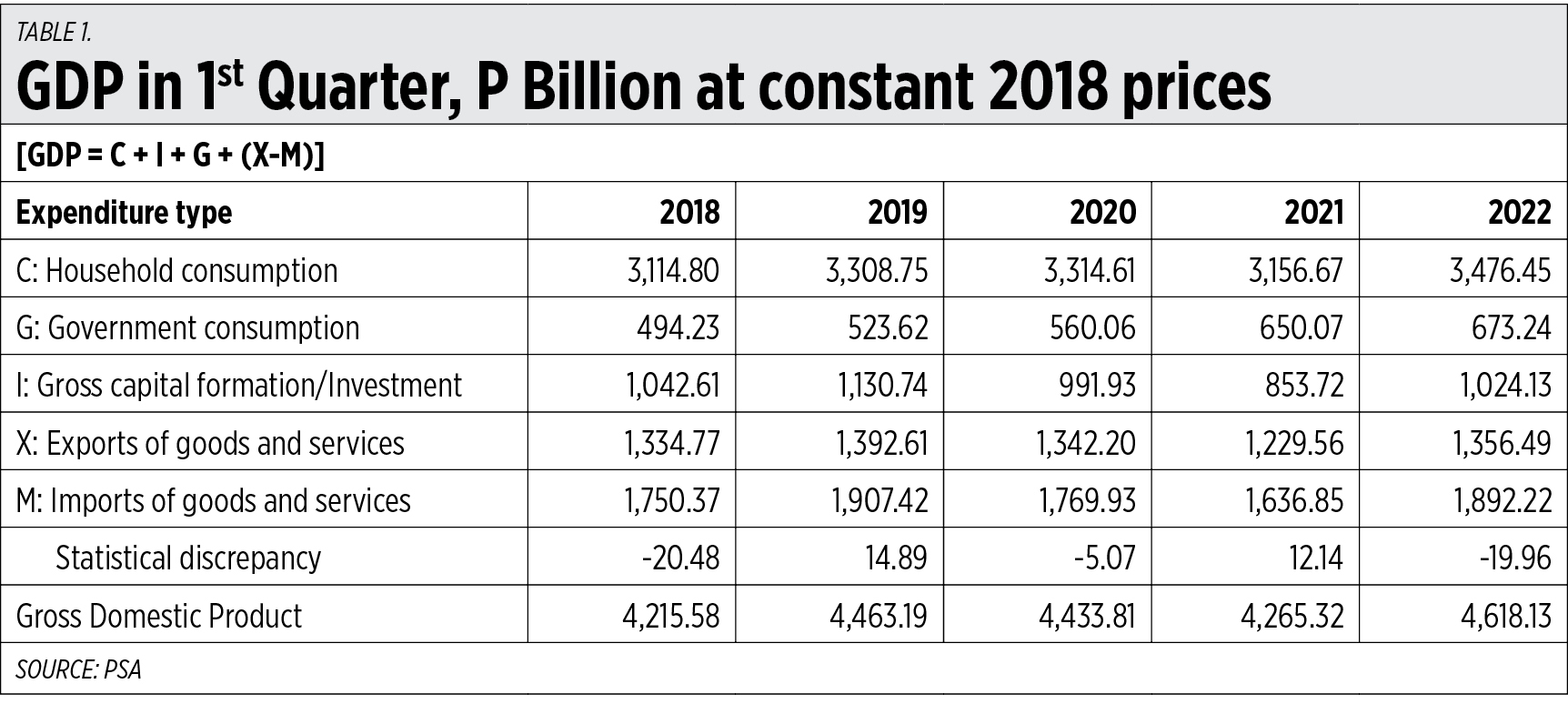
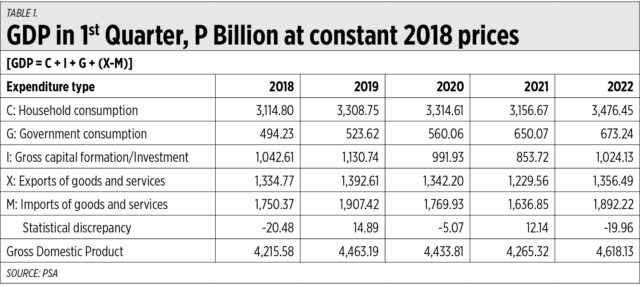
Last week the Philippine Statistics Authority (PSA) released the country’s economic performance in the first quarter (Q1) of the year. Growth was 8.3% compared to the level a year ago — nice. But in terms of pesos worth of goods and services produced, there was little to celebrate actually if we compare Q1 2022 vs Q1 2019 or three years ago.

One, the P4.62 trillion output in Q1 2022 was only P160 billion higher than the P4.46 trillion output three years ago while there was an increase of 4.5 million more Filipinos over the same period. So the per capita income has continued to decline.

Two, the increase was due to more government consumption and spending — a difference of P150 billion — plus household consumption which increased by P168 billion, mainly due to higher spending by politicians and sponsors in this year’s presidential election than in the mid-term election of 2019.

Three, capital formation decreased by P106 billion and is practically comparable to the 2018 level four years ago. Meaning the investment environment remains poor and unattractive (see Table 1).

GROWTH AND ELECTRICITY GENERATION
One of the major man-made “growth killers” in the Cory Aquino administration (1986-1992) was the killing of the 620-MW Bataan Nuclear Power Plant (BNPP) with no alternative set up to replace it. Many big potential investors saw that major blackouts would happen, so they did not come in. And frequent blackouts did happen in 1990-1991. The other man-made “growth killer” was the series of bloody but unsuccessful coup d’état attempts by Gringo Honasan and Johnny Ponce Enrile from 1987-1989.

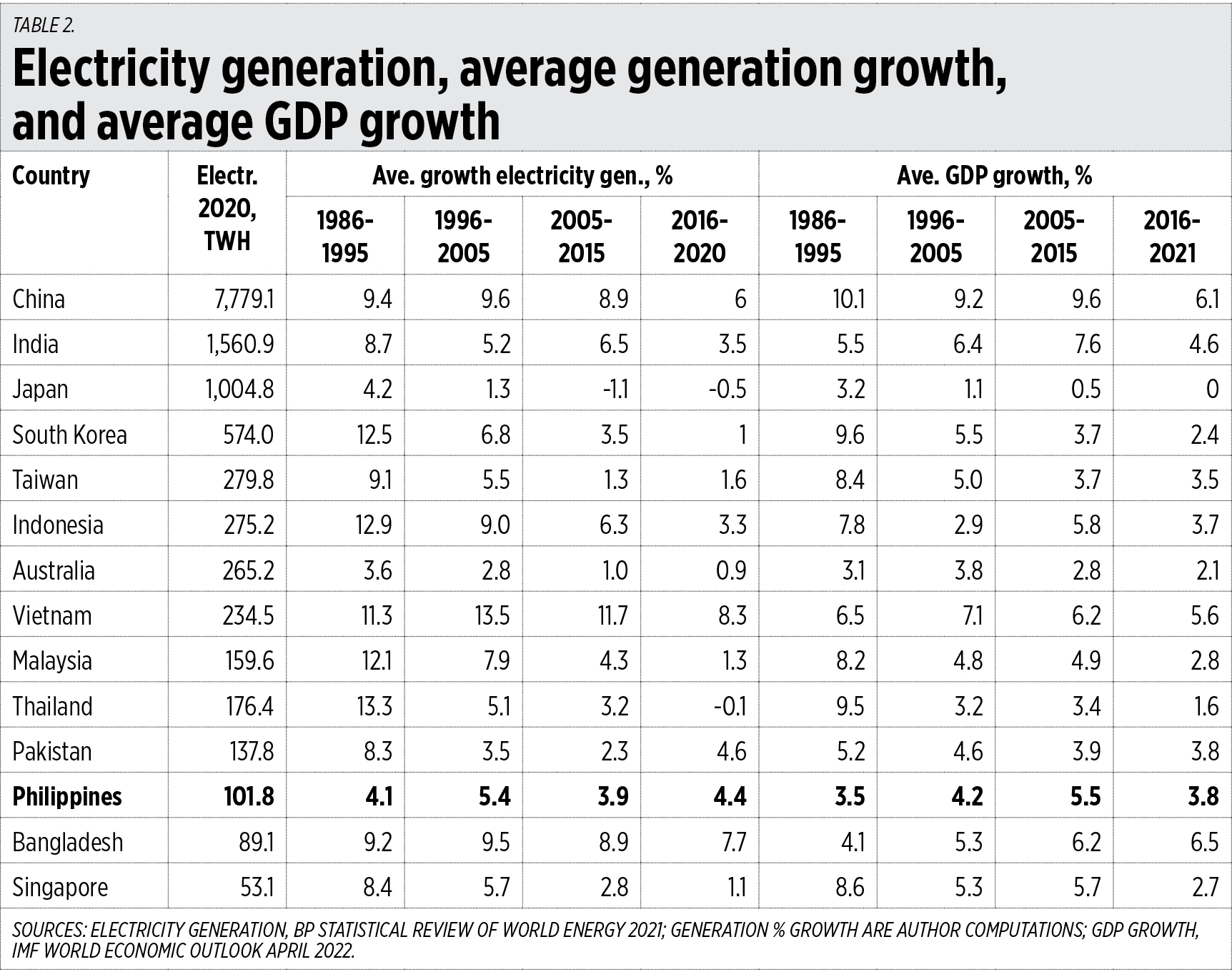
I compared the annual growth in power generation (in terawatt-hours, TWH) and annual GDP growth of many Asian countries plus Australia from 1986 to 2020, and until 2021 for GDP growth. I averaged them by decade and the result is consistent — high or fast power generation led to high GDP growth, and slowing power generation led to slowing GDP growth, for the past 35 years.

The Philippines has the third lowest power generation growth next to Japan and Australia (which have high base already), and is comparable to Pakistan. Consequently, we have low decadal GDP growth similar to Pakistan, while Japan and Australia have much lower GDP growth.

TRANSMISSION CONGESTION BY NGCP
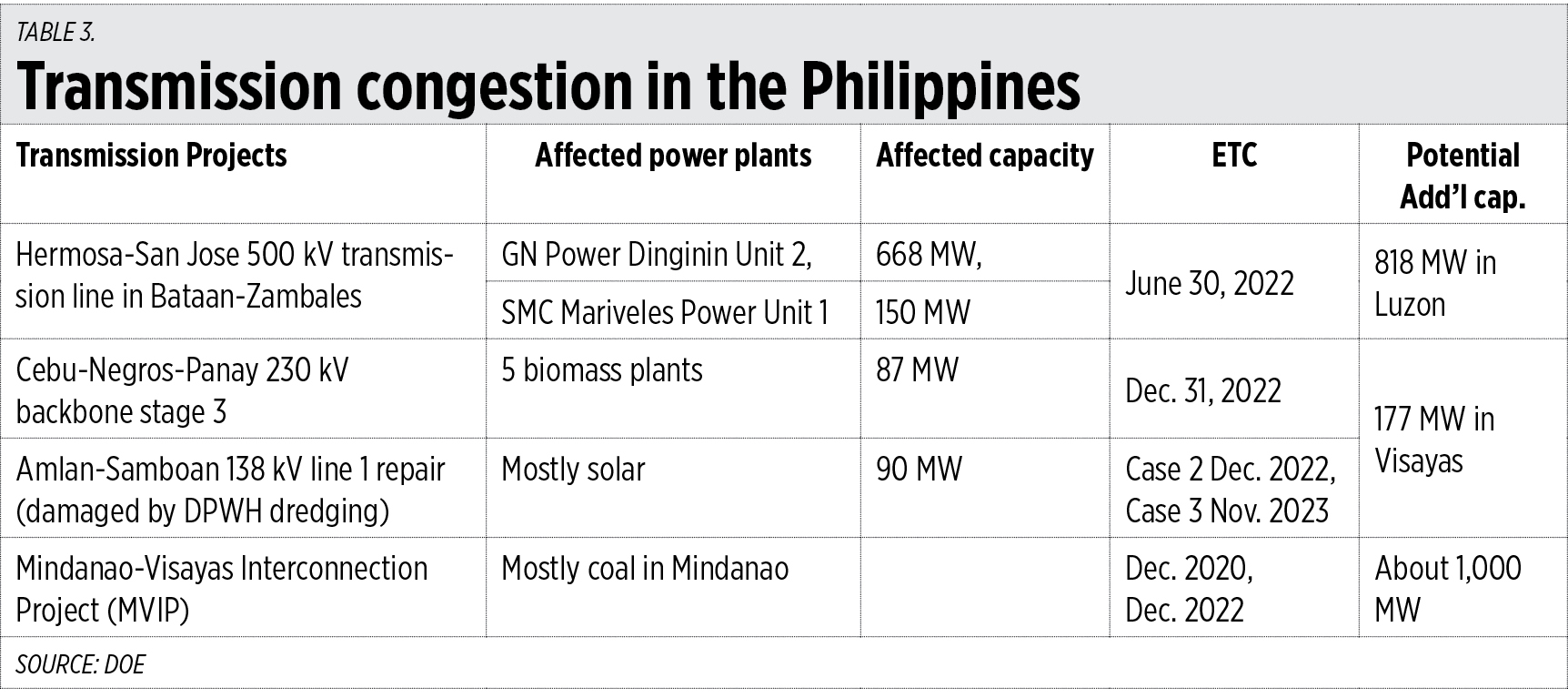
Aside from the low increase in power generation due to various bureaucracies, some of the power plants that were successfully built experience transmission problems. As the power system operator, the National Grid Corporation of the Philippines (NGCP) is occasionally remiss in its mandate of ensuring sufficient transmission lines between actual and potential power plants to distribution utilities, corporations, and cooperatives.

Previously in this column, I cited the Philippine Independent Power Producers Association, Inc. (PIPPA) estimates of “1,000+ MW of stranded capacity in Bataan and Quezon due to transmission line limitations; another 1,000+ MW of power surplus in Mindanao that cannot be exported to the Visayas and Luzon” (see https://bit.ly/Oplas050322).

Table 3 tackles some details, the affected power plants, and expected time of completion (ETC) of transmission projects.

If the power plants are already there but there are no working transmission lines up yet, and construction and commissioning are delayed, then no new power can be dispatched. And this contributes to business uncertainty. Why build a new power plant when the NGCP may not be able to complete the new transmission project or expand the capacity of an existing congested transmission line to connect it to?

This uncertainty caused by the NGCP will hit the brakes on potential high growth. Big investors will factor in the cost of buying big gensets and their maintenance, since the threat of red-yellow alerts and potential blackouts will remain over their heads.

MANDATORY VAX BROUGHT BEFORE THE SC
The Inter-Agency Task Force (IATF) Resolution 148-B issued in November 2021, plus related government orders, on mandatory vaccination of on-site workers are coercive. They require on-site workers who are unvaccinated to take RT-PCR tests regularly at their own expense. The resolution also barred unvaccinated individuals from boarding and riding public transportation with very few exceptions.

With many reports of displaced workers and vaccine injuries, several groups went to the Supreme Court on May 12 and asked the Court to stop the enforcement of all government issuances and policies that impose mandatory vaccination against COVID-19 which the groups say violate Constitutional provisions on due process, equal protection of the law, security and privacy, religious freedom, and freedom of movement and travel.

The petitioners were led by Nick Perlas and lawyers of the group COVID Call to Humanity, doctors and scientists of the Concerned Doctors and Citizens of the Philippines, Legal Lightworkers for Life and Liberty, and Juan Dakila Movement, plus COVID vaccine-injured employee, religious leaders, government and private sector employees, and public-school teachers.

The respondents named in the petition were the IATF, Health Secretary Francisco Duque III, Executive Secretary Salvador Medialdea, Interior and Local Government Secretary Eduardo Año, Transport Secretary Arthur Tugade, Education Secretary Leonor Briones, and Makati City Mayor Abby Binay.

Mandatory orders mean zero choice. It means full government authoritarianism, and that individual freedom and individual choice is disrespected. The mandatory lockdowns and many business closures in 2020-2021 largely contributed to a GDP contraction in 2020 of 9.6%, the worst in Asia, then anemic recovery in 2021 of 5.6% which put the GDP level only at the level of 2018.

The new administration of Bongbong Marcos-Sara Duterte should learn the lessons of the past few years: heavy coercion and authoritarianism is a growth-killer. Insufficient power and repeated threats of blackouts is a growth-dampener. Economic freedom and individual liberty remain the single biggest growth-creator and enhancer.


Bienvenido S. Oplas, Jr. is the president of Minimal Government Thinkers.

minimalgovernment@gmail.com

Obtaining Corporate Registration through fraud

SCOTT GRAHAM-UNSPLASH

Section 164 of the Revised Corporation Code (RCC) provides that “those responsible for the formation of a corporation through fraud, or who assisted directly or indirectly therein,” shall be penalized with a fine ranging from P200,000 to P2 million; but that, when injurious or detrimental to the public, the fine shall range from P400,000 to P5 million. It should be noted that Section 164 does not limit itself to the incorporators who signed the articles of incorporation.

For the ground discussed hereunder, we posit that no successful prosecution can be obtained under the language of Section 164 of the RCC.

1.) What constitutes “fraud” in the formation of a corporation?

The offense covered under Section 164 of the RCC, i.e., that of obtaining registration of a corporation through fraud, actually cast a very wide net in violation of the due process clause, since usually when “fraud” is used to define a crime, the requisites of what constitutes fraudulent acts are usually defined or enumerated. In addition, criminal fraud, when properly defined, requires the element of “injury” or “damage” to amount to a criminal offense.

The term “responsible for the formation of a corporation through fraud,” could cover a wide range of corporate malpractices from the use of dummies in areas covered by nationalization law, mis-declaration or mis-evaluation of the consideration paid for the subscription of the capital stock, to false certification of the amounts actually paid-in.

The term could cover any person responsible for the formation of a corporation, or who assisted directly or indirectly therein, including promoters, passive investors, and bank officers who certified to the subscription contributions, the lawyers who handled the formation of the corporation, the appraisers who undertook the valuation of the property contributions, and even the officers of the Securities and Exchange Commission (SEC) who approved such registration where fraud was involved.

Without defining the requisites of what would constitute “formation of a corporation through fraud,” it would be difficult to convict an accused under Section 164, since the quantum of evidence required in a criminal case is guilt beyond a reasonable doubt. Also, the lack of a proper definition under Section 164 of what acts constitute the criminal offense would be in violation of the rudiments of due process in criminal proceedings.

2.) Title II on the Incorporation and Organization of Private Corporations

The requirements and procedures for the formation of a corporation are detailed under Title II (Incorporation and Organization of Private Corporations) of the RCC, and it can be expected that the offense of “fraud in the formation of a corporation” under Section 164 of the RCC, must impinge upon any of the requirements and procedures provided therein.

Except for the unauthorized use of a corporate name which is expressly penalized under Sections 17 in relation to Section 159, no section under Title II of the RCC imposes a criminal penalty for failure to comply with its provision. In fact, when there are lapses in complying with the requirements for the formation of the corporation, Section 16 provides that the proper action of the SEC is to “disapprove” the articles of incorporation and grant the incorporators, directors, trustees, or officers reasonable time to modify the objectionable portions of the articles of incorporation. On the other hand, the corporation has been duly registered with the SEC but there have been serious flaws in the manner of its formation, Section 19, in laying down the doctrine of de facto corporation, provides that the proper remedy would be for the SEC to work through the Solicitor General to seek a dissolution of the corporation through quo warranto proceedings.

Nothing in the structure of Title II of the RCC can support imposition of the criminal offense referred to in Section 164 as “formation of a corporation through fraud.”

3.) Chilling effect on the whole machinery to promote the use of the corporate vehicle.

Since the broad language of Section 164 of the RCC could ensnare the commercial world in a wide-ranging criminal net, it actually induces a “chilling effect” on the various players and institutions in the commercial world that seek to promote the corporate medium as the medium by which to attract investments in our economy. In that sense, the introduction of Section 164 into the RCC is actually against the principle of promoting the ease of doing business in our country through the corporate medium.

4.) SEC’s Restatement of Section 164 Offense

SEC Memorandum Circular No. 16-2020, entitled “Guidelines on Authentication of Articles of Incorporation in Applications for Registration of New Domestic Corporations,” restates Section 164 of the RCC by providing, under Section 6 thereof, as follows:

SECTION 6. Obtaining Corporate Registration through Fraud or Misrepresentation. — The registration of a corporation, which has procured its Certificate of Registration through fraud or misrepresentation, shall be revoked.

Furthermore, those responsible for the formation of a corporation through fraud, or who assisted directly or indirectly therein, shall be punished with a fine ranging from P200,000 to P2,000,000. When the violation is injurious or detrimental to the public, the penalty shall be a fine ranging from P400,000 to P5,000,000.

It cannot be said that the SEC is defining an administrative offense by the foregoing provisions since the fines imposed are beyond the amounts authorized under Section 158 of the RCC, and that both the language and amounts tract the language of Section 164 (Obtaining Corporate Registration Through Fraud; Penalties) of the Code.

Consequently, SEC Memorandum Circular No. 16-2020 fails to define an offense that can be the subject of an administrative sanction, nor can it complete the inadequacies of the language of Section 164 of the RCC to comply with rudiments of criminal due process.

FRAUDULENT CONDUCT OF BUSINESS
Section 165 of the RCC provides the legal basis to hold a corporation criminally liable as the respondent in a criminal case. On the other hand, Section 165 provides no legal basis to hold criminally liable the directors, trustees, officers and/or employees who are guilty of conducting the company’s business through fraud. In other words, the criminal liability of the acting officers and employees would be based on the laws that punish the fraudulent acts done in the management of the affairs of the corporation. It would then be Section 171, in relation to Section 165 by which to hold the culprit directors, trustees, officers and/or employees liable for conducting the corporation’s business through fraud.

This article reflects the personal opinion of the author and does not reflect the official stand of the Management Association of the Philippines or MAP.


Attorney Cesar L. Villanueva is co-chair for Governance of the MAP ESG Committee, the chair of the Institute of Corporate Directors, the first chair of the Governance Commission for GOCCs, a former dean of the Ateneo Law School, and a founding partner of Villanueva Gabionza & Dy Law Offices.

map@map.org.ph

cvillanueva@vgslaw.com

http://map.org.ph

Shanghai targets return to normal life starting June 1

A VIEW of the city skyline in Shanghai, China, Feb. 24, 2022. — REUTERS

SHANGHAI/BEIJING — Shanghai set out plans on Monday for the return of more normal life from June 1 and the end of a painful coronavirus disease 2019 (COVID-19) lockdown that has lasted more than six weeks and contributed to a sharp slowdown in China’s economic activity.

In the clearest timetable yet, Deputy Mayor Zong Ming said Shanghai’s reopening would be carried out in stages, with movement curbs largely to remain in place until May 21 to prevent a rebound in infections, before a gradual easing.

“From June 1, to mid- and late June, as long as risks of a rebound in infections are controlled, we will fully implement epidemic prevention and control, normalize management, and fully restore normal production and life in the city,” she said.

The full lockdown of Shanghai and COVID curbs on hundreds of millions of consumers and workers in dozens of other cities have hurt retail sales, industrial production and employment, adding to fears the economy could shrink in the second quarter.

The severe restrictions, increasingly out of step with the rest of the world, which have been lifting COVID rules even as infections spread, are also sending shockwaves through global supply chains and international trade.

Data on Monday showed China’s industrial output fell 2.9% in April from a year earlier, down sharply from a 5.0% increase in March, while retail sales shrank 11.1% year-on-year, after falling 3.5% the month before. Both were well below expectations.

Economic activity has probably been improving somewhat in May, analysts say, and the government and central bank are expected to deploy more stimulus measures to speed things up.

But the strength of the rebound is uncertain due to China’s uncompromising “zero COVID” policy of eradicating all outbreaks at all costs.

“China’s economy could see a more meaningful recovery in the second half, barring a Shanghai-like lockdown in another major city,” said Tommy Wu, lead China economist at Oxford Economics.

“The risks to the outlook are tilted to the downside, as the effectiveness of policy stimulus will largely depend on the scale of future COVID outbreaks and lockdowns.”

Beijing, which has been finding dozens of new cases almost every day since April 22, offers a strong indication of how difficult it is to tackle the highly transmissible Omicron variant.

The capital has not enforced a city-wide lockdown but has been tightening curbs to the point road traffic levels in Beijing slid last week to levels comparable to Shanghai’s, according to GPS data tracked by Chinese internet giant Baidu.

On Sunday, Beijing extended guidance to work from home in four districts. It had already banned dine-in services at restaurants and curtailed public transport, among other measures.

In Shanghai, the deputy mayor said the city would begin to re-open supermarkets, convenience stores and pharmacies from Monday, but that many movement restrictions had to remain in place until at least May 21. It is not clear how many businesses have reopened.

From Monday, China’s railway operator will gradually increase the number of trains arriving and departing from the city, Zong said. Airlines will also increase domestic flights.

From May 22, bus and rail transit will also gradually resume operations, but people will have to show a negative COVID test not older than 48 hours to take public transport. — Reuters

Sweden, Finland NATO membership seen to increase Baltic security

BERLIN — Sweden and Finland joining NATO would increase the security of the Baltic region, Estonian Foreign Minister Eva-Maria Liimets said.

“When we see that in our neighborhood also other democratic countries belong to NATO, it would mean that we could have broader joint exercises and also … more defense cooperation,” Ms. Liimets told Reuters in Berlin where she joined a meeting with other NATO counterparts on Saturday.

Ms. Liimets said she hoped Sweden, Finland and Turkey would overcome differences on the Nordic states joining the alliance, adding that the Berlin meeting atmosphere was very supportive.

“We have seen some differences, but we have also seen a willingness of those countries to overcome the differences,” she said.

Estonia appreciates NATO enforcing its presence in the Baltic region but would like the allies to move from enhancing their presence to enhancing their defense.

“It would mean that we would have more robust presence of land forces, but also air and maritime defense,” she added. — Reuters

Sri Lanka stumbles toward its first default on foreign debt

Sri Lankan bank notes in a container at a vegetable stall in Colombo. — BUDDHIKA WEERASINGHE/BLOOMBERG

SRI LANKA is sliding inexorably into default as the grace period on two unpaid foreign bonds nears an end, the latest blow to a country rattled by economic pain and social unrest.

The island nation could be formally declared in default if it fails to make an interest payment to bondholders before Wednesday, when the 30-day grace period for missed coupons on dollar bonds ends. That would mark its first default.

Sri Lanka’s government announced in mid-April it would stop paying back its foreign debt to preserve cash for food and fuel imports as it struggled with a dollar crunch that’s led officials to implement capital controls and import curbs. A few days later, it failed to service a $78-million coupon on its dollar bonds due in 2023 and 2028, leading S&P Global Ratings to declare a selective default.

“Without an agreement, there will be a formal default,” said Carlos de Sousa, a money manager at Vontobel Asset Management in Zurich. “Legally that matters. But for markets, Sri Lanka is already de facto in default, so the price effect of such an event is probably not going to be significant.”

Sri Lankan dollar notes due in 2029 were down 1.2% to 38.7 cents on the dollar Monday, after touching an all-time low of 37 cents on the dollar last week, indicative pricing data compiled by Bloomberg showed. The extra yield investors demand to hold the notes over US Treasuries is at 37 percentage points, according to JPMorgan Chase & Co. That’s far above the 1,000-basis point threshold to be considered distressed.

While a default is widely expected by investors, it has important implications. Many of Sri Lanka’s bonds have so-called cross-default clauses, which drag all the outstanding dollar debt into default if there’s a missed payment in a single bond. On the debt due in 2023 and 2028, the clause is triggered if any payment that exceeds $25 million is not met.

“At this point most bondholders who are unwilling or unable to hold distressed credits should already have cleared out,” said Patrick Curran, a senior economist at Tellimer.

Sri Lanka has been rattled by power cuts, food shortages, and a currency in free fall, which fueled protests and pushed Prime Minister Mahinda Rajapaksa to resign. His brother, President Gotabaya Rajapaksa, last week appointed a long-time opponent to run the government in a bid to bring a modicum of stability to the country amid bailout talks with the International Monetary Fund.

As of Monday morning, the country hadn’t yet named a finance minister. The central bank governor has threatened to quit if political stability doesn’t return soon. The monetary authority is due to review policy May 19.

“The prime minister quitting was something that was really needed,” said Dean Tyler, the London-based head of global markets at BancTrust, who sees the recovery value of the notes between 35 and 45 cents per dollar. “Hopefully, it will start to clear the air and clear the streets.” — Bloomberg

North Korean leader Kim orders military to stabilize distribution of coronavirus drugs

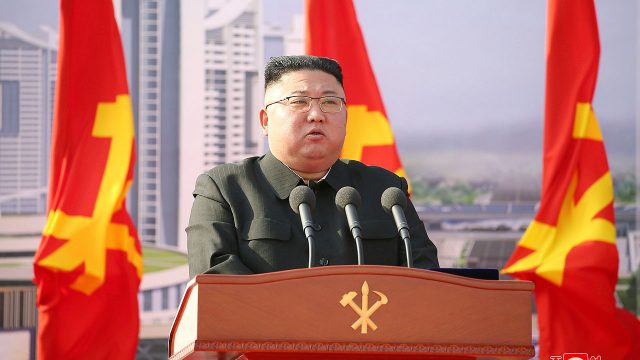
KCNA VIA REUTERS

SEOUL — Leader Kim Jong Un has ordered North Korea’s military to stabilize distribution of COVID-19 medicines in the capital, Pyongyang, in the battle on the country’s first confirmed outbreak of the disease, state media said.

Last week brought the North’s first acknowledgment of an “explosive” outbreak, with experts warning it could wreak devastation in a country with limited medical supplies and no vaccine programme.

Drugs procured by the state were not reaching people in a timely and accurate way, Mr. Kim told an emergency politburo meeting on Sunday, before visiting pharmacies near the capital’s Taedong River, state news agency KCNA said.

Mr. Kim ordered immediate deployment of the “powerful forces” of the army’s medical corps to “stabilize the supply of medicines in Pyongyang City,” it added.

Although authorities had ordered distribution of national reserves of medicine, pharmacies were not well-equipped to perform their functions smoothly, Mr. Kim added, the agency said.

Among their shortcomings were a lack of adequate drug storage other than showcases, while salespeople were not equipped with the proper sanitary clothing and hygiene in their surroundings fell short of standards, the leader said.

He criticized the “irresponsible” work attitude, organization and execution by the cabinet and the public health sector, it added.

Neighboring South Korea will spare no effort to help the North fight its outbreak, President Yoon Suk-yeol told parliament on Monday, saying it was ready to provide COVID-19 vaccines and other medical support if Pyongyang agrees.

Seoul’s unification ministry, reponsible for relations between the neighbors, said it would soon propose a plan of support to the North.

North Korea’s tally of the fever-stricken stood at 1,213,550, with 50 deaths by Sunday, after KCNA reported 392,920 more cases of fever, and eight more deaths. It did not say how many suspected infections had tested positive for COVID-19.

The North has blamed a large number of the deaths on people who were “careless in taking drugs” because of a lack of knowledge about the Omicron variant of coronavirus and its correct treatment. — Reuters

Wrestling goes to action; Bodybuilders sent back home

HANOI — With Noel Norada and Jason Baucas showing the way, the national wrestling team goes into action Tuesday at the Gia Lam District Sporting Hall, determined to stamp its class in the 31st Vietnam Southeast Asian Games here despite lack of training due to the pandemic.

Mr. Norada, 38, and Mr. Baucas, 24, are bidding to keep the titles they won in 2019 back home when the national team came up with a 2-10-1 gold-silver-bronze production, second overall to Vietnam.

Mr. Norada will defend his crown in the 63kg class of the Greco-Roman event while Mr. Baucas will compete in the heavier 77kg division, the 72kg class where he won in the Philippines having been scrapped by the hosts.

Other Pinoy bets competing in the Greco-Roman class of the three-day competition are Jason Balabal, Margarito Angana at Jefferson Manatad.

Seeking medals in the women’s freestyle class are Noemi Tener, Minalyn Foy-os, Grace Loberanes and Jiah Pingot while Alvin Lobreguito, Jhonny Morte, Joseph Angana and Elvis Julius will fight in the men’s side.

BODYBUILDING TEAM SENT BACK HOME
It could have been prevented.

Philippine Olympic Committee President Abraham Tolentino was lamenting on the recent brouhaha concerning the national bodybuilding team that was sent back home packing for failing to comply with the Hanoi Southeast Asian Games doping requirements.

“I did everything up to the last minute,” said Mr. Tolentino. “But they invoke some rules which could have been remedied if some officials are really ‘working officials’.”

“Anyways, it’s a lesson learned,” he added.

Composed of eight men and a woman, the squad was not allowed to compete because it did not submit the necessary doping tests that should have been done three weeks before the start of their event.

It was mentioned in the games’ handbook that all participating athletes must submit doping and clearance certificates for them to be able to join.

Apparently, the Filipino bodybuilders have not.

In a story from Agence France-Presse, a news wire agency, the team was sad to learn that they could not participate and shoot for medals in the biennial meet.

They vowed to make a big return though in next year’s SEA Games edition in Phnom Penh, Cambodia.

Lois Kaye Go, Rianne Mikhaela Malixi save day for Pinoy golfers

VINH PHUC — Determined to make up for their failure to win medals in individual play, Lois Kaye Go and Rianne Mikhaela Malixi rallied in the closing holes Monday to power the Philippines, the defending champion, to a 2-0 win over Indonesia and into the semifinals of the women’s golf team event in the 31st Southeast Asian Games here.

Ms. Malixi, the 15-year-old prodigy backed by ICTSI, trailed Holly Hallim Victoria by one hole through most of the match until she caught fire, knocking in three straight birdies to post a 2 and 1 victory at the Heron Lake course.

Ms. Go, 23, a member of the team that won the gold in 2019, also pulled off a come-from-behind 1-up win over Ida Ayu Indira Melati Putri after trailing by as many as two holes.

She began holding the lead in the first four holes until Ms. Putri won 14, 16 and 17 to take a two-hole lead. Ms. Go took the 18th hole to reduce the deficit to one. After both played halved the hole from first to sixth, Ms. Go turned the game around by winning 7 and 9 to prevail 1-up.

The Filipinas take on top seed Thailand, which took a bye, on Tuesday.

While the women’s team advanced, the men’s bowed out after suffering a 3-0 defeat at the hands of Indonesia.

Jet Hernandez led early after taking the second hole, but lost grip of the match and trailed by as many as two holes until he drew level on 12.

But Randy Arbenata won 13, 14 and 17 to complete a 3 and 1 victory.

Gab Manotoc was beaten 3 and 2 by Naraajie Emerald, who led all the way after winning the third hole, while Jed Dy lost to Amadeus Christian 3 and 2.

The other women’s semifinal match pits Malaysia against Singapore.

The Malaysians routed Vietnam 2-0, with Mirabel Ting Ern Hui trouncing Minh Doan Xuan Khue 5 and 3, and Jeneath Wong humbling Thuy Le Thi Thanh 4 and 3.

Singapore ousted Myanmar 2-0. Aloysa Mabutas Margiela Atienza, whose parents are Filipino migrants, whipped Waing Waing 4 and 2, while Hailey Loh Suanne edged Phu Pwint Yati Khine 1-up.

Rondina-Pons tandem clinches second win in beach volleyball

THE Philippine women’s team secured its second win in the 31st SEA Games beach volleyball after overwhelming Malaysia on Monday at the Tuan Chau Beach, Quang Ninh.

Sisi Rondina and Bernadeth Pons made short work of Farwizah Aina Ahmad Nizar and Maegan Beh Jia Yin, 21-11, 21-9, while Jovelyn Gonzaga and Dij Rodriguez handily beat Foo Sin Xi and Sin Sing Yee, 21-14, 21-9.

Up next for the Philippines is 2019 silver medalist Indonesia, composed of Dhita Juliana and Putu Utami, and Martha Rahawarin and Nur Atika Sari, at 3:45 p.m. (Manila time) on Tuesday.

After bowing to defending champion Thailand on Sunday, Indonesia bounced back by beating Singapore, 2-0, to even its record to 1-1 and tie host Vietnam.

Like the Filipinas, bronze medalists in the 2019 edition, the Thais are also perfect in two contests after defeating the Vietnamese, 2-0.

The women’s competition is a single-round robin, where the Philippines needs to finish at least in the top two to make it to the gold medal match. If they finish in third or fourth after the single-round robin, the Filipinas will play in the bronze medal match.

In the men’s division, the Philippines will play Cambodia at 10:45 a.m. (Manila time) on Tuesday.

The men’s competition is pool play, where the Philippines needs to finish in top two in Pool A to advance to the semifinals.

Inter race to final day with victory at Cagliari

CAGLIARI, Italy — A double from Argentine striker Lautaro Martinez earned Inter Milan a 3-1 win at Cagliari on Sunday, a victory that ensured the Serie A title race will go to the final weekend for the first time since 2008.

With leaders AC Milan having beaten Atalanta 2-0 at the San Siro earlier on Sunday, Inter had to win in Sardinia to keep the title race alive, edging in front in the 25th minute through Matteo Darmian.

Martinez added a second six minutes after the break for Inter and they appeared on course for a comfortable ninth win in 10 matches in all competitions, before Charalampos Lykogiannis arrowed in a strike out of nowhere to get Cagliari back in it.

Inter suffered some nervy moments before Martinez’s quality shone through at the last, as his classy finish six minutes from time finally ended Cagliari’s hopes of a comeback.

The victory ensured Inter remained two points behind Milan going into the final round. The champions must beat Sampdoria at home on Sunday, and hope Milan lose at Sassuolo, if they are to defend the Scudetto.

“It wasn’t easy after Milan’s win, but the team played really well against an opponent who is problematic on their own ground,” coach Simone Inzaghi told DAZN.

“I congratulate my team, because this was by no means to be taken for granted, especially after playing 120 minutes on Wednesday (in the Coppa Italia final).

“Naturally, we are behind, so we need a victory and for them (Milan) to lose. It’s happened before, I won with Lazio when we were two points behind and Juventus lost to Perugia (in 2000), so it can happen again.”

Inter thought they had settled their nerves in the must-win contest when Milan Skriniar bundled the ball into the net early on, only for VAR to rule the Slovakian defender had used his hand to score.

The visitors did not have to wait much longer for one to count, however, as Ivan Perisic crossed for Darmian to head home his second league goal of the season.

Martinez almost added another on the cusp of halftime, before hammering home the second – his 20th league goal of the campaign. The Argentine became the sixth player in Inter’s history to score 20 goals in a single Serie A term before turning 25.

In cruise control, Inter stood off Lykogiannis and his strike was unstoppable, giving the home fans hope.

But it was Martinez who had the final say, lofting his second of the match into the net.

Cagliari’s fate will also be sealed on the final day of the season. They remain in the bottom three, two points behind Salernitana in 17th. The Sardinians must beat already-relegated Venezia on the final day to have any hope of survival.

Genoa, who have spent the last 15 seasons in Serie A, were relegated on Sunday after their 3-0 loss at Napoli. — Reuters

Celtics clobber Bucks to reach Eastern Conference finals

GRANT Williams exploded for a career-high 27 points and led a defensive charge on Milwaukee star Giannis Antetokounmpo as the host Boston Celtics advanced to the NBA’s final four with a 109-81 romp over the defending-champion Bucks in Game 7 of their Eastern Conference semifinal series on Sunday afternoon.

Jayson Tatum chipped in with 23 points and Jaylen Brown 19 for the second-seeded Celtics, who will advance to face the top-seeded Miami Heat in the Eastern Finals. Game 1 is scheduled for Tuesday in Miami.

The Celtics will be making their fourth trip to the Eastern Finals in the last six seasons. They have not advanced to an NBA Finals since 2010, having lost four consecutive times when one step away, twice to the Heat and twice to the Cleveland Cavaliers.

After losing twice at home earlier in the series and falling behind 10-3 in the best-of-seven finale, the Celtics dominated the final 44 minutes, especially from long range.

Williams, a third-year pro who had never scored more than 21 points in his NBA career and never made more than six 3-pointers, stunned the Bucks with 7-for-18 accuracy from beyond the arc, accounting for all but six of his points.

“I told him to ‘Let it fly. They’re disrespecting you more tonight than earlier in the series,’” Celtics coach Ime Udoka said of his message to Williams. “That was the plan for him and other guys.”

Tatum added five 3-pointers and Payton Pritchard four as the Celtics shot 22-for-55 on 3-point tries, outscoring the Bucks by a whopping 66-12 from beyond the arc.

With Jrue Holiday and Pat Connaughton combining for 0-for-11, Milwaukee went just 4-for-33 from deep.

After a last-second foul on Antetokounmpo on a Marcus Smart 3-point heave from beyond half court had helped the Celtics build a 48-43 halftime lead, the hosts gradually pulled away throughout the second half.

Williams, Tatum and Brown all hit 3-pointers in an early burst in the third period that opened a 59-47 lead, and Milwaukee was never closer than 10 after that.

“They were the better team in a seven-game series,” Bucks coach Mike Budenholzer said of Boston.

Pritchard finished with 14 points and Smart 11 for the Celtics, who stayed alive with a 108-95 win at Milwaukee in Game 6 on Friday.

Smart completed a double-double with a game-high 10 assists, while Al Horford was the Celtics’ top rebounder with 10 to go with six points and six assists.

Antetokounmpo, who had averaged 35.3 points on 46.8-percent shooting in the first six games of the series, was harassed into 10-for-26 shooting and limited to a team-high 25 points.

“I felt like we started grinding him down,” Udoka said of the two-time league MVP. “He missed some of the easier shots around the basket. That’s what we talked about. It’s not just one guy (guarding him). We stuck with that.”

He also found time for a game-high 20 rebounds and team-high nine assists.

Holiday finished with 21 points and Bobby Portis 10 for the Bucks, while Brook Lopez logged a double-double with 15 points and 10 rebounds.

The Bucks played the series without three-time All-Star Khris Middleton, who sprained the MCL in his left knee during Game 2 of the first-round series against the Chicago Bulls.

“Every team goes through something. Nobody feels sorry for us,” Budenholzer said. “It’s the age-old equation: You’ve got to have good players; you’ve got to be a little lucky; and you’ve got to be healthy. You need all of these things to be successful in the playoffs. I’ve heard it a million times. We weren’t as healthy as we could have been, but nobody cares.” — Reuters

ADVERTISEMENT
ADVERTISEMENT