THE final playdate of the UAAP Season 88 men’s basketball proved to be more than just a rumble for the final ticket.
In a surprising turn, Janrey Pasaol stole the thunder from league leaders in the nick of time to claim the Most Valuable Player (MVP) honor as a consolation prize to Far Eastern University’s (FEU) exit at the end of the two-round eliminations.
Mr. Pasaol finished with 81.5 statistical points to snatch the award from De La Salle University’s (DLSU) Mike Phillips and National University’s (NU) Jake Figueroa behind a solid performance in the FEU Tamaraws’ 81-79 win against the University of Santo Tomas Growling Tigers to finish at fifth place with a 7-7 slate.
The brother of PBA player and UAAP great Alvin delivered a double-double of 13 points and 11 assists laced by six rebounds and five steals, proving enough to propel him to No. 1 in the statistical race from No. 3. entering the final game.
Mr. Pasaol, who’s set to be crowned as the first Tamaraw MVP since Terrence Romeo in 2013, was the league’s best floor general with a league-best 7.5 assists on top of 15.43 points, 4.14 rebounds and 2.14 steals.
Before FEU’s last assignment against semis-bound Santo Tomas, Mr. Pasaol was sitting at third with 79.154 points behind Mr. Phillips (79.231) and Santo Tomas foreign-student athlete (FSA) Collins Akowe (82.231), who however is ineligible for MVP award due to the new UAAP ruling.
Mr. Phillips and Mr. Akowe went on to finish with only 80.429 and 79.286 points, respectively.
Mr. Figueroa, as the captain of league-leading NU, led majority of the second round but settled for three points, two rebounds, two assists, one steal, and one block in the Bulldogs’ 80-71 loss to the Growling Tigers to miss out with 77.286 points.
The three joined Mr. Pasaol to the Mythical Five, now rebranded as the Elite Team, including Santo Tomas’ Nic Cabañero who finished seventh in the race with 66.643 points.
University of the East’s (UE) Precious Momowei (74.214) and FEU’s Mo Konateh (74.786) were ahead of Mr. Cabañero but only one FSA could make it to the Top Five.
New UAAP ruling has a separate MVP award for locals and Best FSA award for foreign players but since there was no top FSA in the statistical race with Mr. Akowe settling for third behind locals Messrs. Pasaol and Phillips, no such plum will be awarded this season.
High school sensation Mr. Akowe will have the Rookie of the Year instead after winning the MVP and Best FSA awards in his final two junior seasons with the NU Bullpups before committing for the Growling Tigers in the collegiate ranks.
In women’s division, NU’s Karl Ann Pingol (93.571) ended the back-to-back MVP reign of Ateneo’s Kacey dela Rosa (91.429) as Santo Tomas’ Kent Pastrana (88.643), NU’s Kristine Cayabyab (73.571) and Angel Surada (71.714) completed the Elite Team.
UE’s Goodluck Okebata clinched the MVP plum in the U16 division with 96.214 points. Joining him in the Elite Team were Santo Tomas’ Rowie Cabañero (95.643), FEU’s Dwyne Enriquez (89.286), NU’s Moussa Diakite (85.143) and FEU’s Prince Cariño (84.769). — John Bryan Ulanday
Games on Tuesday (Alonte Sports Arena, Biñan, Laguna) 4 p.m. – Negros vs Dasma 6 p.m. – Quezon vs Biñan
UNBEATEN Dasma Monarchs and Biñan Tatak Gel Arellano University Lady Chiefs scored contrasting wins to move on the verge of arranging a finals duel in the 2025 Maharlika Pilipinas Volleyball Association (MPVA) on Wednesday night at the Alonte Sports Arena in Laguna.
Dasma hardly broke a sweat against the fourth-ranked Negros ICC Blue Hawks, 25-15, 25-15, 25-16, while the third-seeded Lady Chiefs banked on homecourt to stun reigning champion and No. 2 seed Quezon Tangerines, 17-25, 25-21, 15-25, 26-24, 15-13, for 1-0 leads in the best-of-three semifinals.
Another win by both squads in Game 2 on Tuesday at the same venue would seal the finale, also under a race-to-two format for the coveted crown of the regional volleyball league founded also by Maharlika Pilipinas Basketball Association Chairman Manny Pacquiao.
Natasha Kaye Bombita fired 11 points to lead a balanced attack anew as Dasma needed only 80 minutes to extend its perfect campaign to 15 games after sweeping the two-round eliminations.
Vange Alinsug and Celine Marsh added nine and eight points, respectively, as eight more players barged into the scoreboard for the Monarchs, represented by three-time UAAP and four-peat SSL champion National University (NU) Lady Bulldogs.
NU, under the watch of new mentor Regine Diego, is looking to add the MPVA to its treasure and it’s definitely in prime position to do it via sweep behind the coverage of super rookie Sam Cantada, Alexa Nichole Mata and Minierva Maaya with seven points each.
In the other pairing, Biñan clawed back from a 1-2 deficit via slimmest of margins in the final two sets to finally beat Quezon in the rematch of last year’s finalists of the MPVA backed by Mikasa, Asics, Spurway Enterprises, Gerflor, Smart Communications and XIV Apparel.
Laika Tudlasan stamped her class anew with 17 points as the Lady Chiefs avenged their 0-2 finals loss to the Tangerines last season.
She drew solid support from Crisanta Servidad and Keisha Alexa Abitria with 13 and 11 points, respectively, as Biñan’s edge at home played a huge factor.
Zam Nolasco, Clydel Catarig, Camila Amor Bartolome and Shekaina Lleses had 16, 15, 14 and 12 points, respectively, but the Tangerines still fell short to lose steam at a title retention bid.
Gelah Lopez, with 10 points, was the lone silver lining for Negros looking to force a sudden death Game 3 in the MPVA organized by the Volleyball Masters of the Philippines. — John Bryan Ulanday
Game on Friday (Calvo Field House, Guam) 7 p.m. (5 p.m. Manila Time) – Guam vs Philippines
THE ROAD to the 2027 FIBA World Cup — and long-term, the 2028 Olympics — starts in this Guam stop.
And so this is foremost on the minds of Gilas Pilipinas as it takes on Guam on Friday at the Calvo Field House in the Asian side of the World Cup Qualifiers.
The 7 p.m. game (5 p.m. in Manila) touches off a two-way swing that brings the two protagonists to the Blue Eagle Gym, the Nationals’ new home venue, on Monday for the return leg.
“Our number 1 goal is to get to the Olympics. If we don’t win this window, then we don’t make the World Cup. If we don’t make the World Cup, we can’t make the Olympics,” Gilas coach Tim Cone said in emphasizing the value of the twin opening matches in Group A.
The Top 3 teams in the bracket will advance to the second round of the qualifiers and with reigning three-time FIBA Asia Cup titlist and world No. 6 Australia and 25th ranked powerhouse New Zealand around, the No. 37 Philippines and No. 81 Guam are expected to battle it out for the third slot.
Gilas faces the Boomers and the Tall Blacks in succeeding windows next year.
“These two games (against Guam) are the most important games we play. And Guam knows that they’re the most important. They’re looking at New Zealand and Australia, and saying: we can’t beat them, but maybe we can beat the Philippines,” said Mr. Cone.
“Home court means something and that’s why this Friday game is really crucial to us. We’ve got to come with our best foot forward. We can’t take anything for granted with them being at home in front of their home crowd,” he added.
Mr. Cone added two new faces in big man Quentin Millora-Brown and guard RJ Abarrientos to Gilas’ regular crew of Justin Brownlee, Dwight Ramos, June Mar Fajardo, Scottie Thompson, AJ Edu, Carl Tamayo, Chris Newsome, Kevin Quiambao, Japeth Aguilar and CJay Perez for this mission.
“We had a really good camp. I was really impressed by the way the guys came,” he said.
“We took a little different approach this time. We really pushed much harder than we normally have done in the previous windows. We kind of wanted to play with a more aggressive style,” he added.
Expected to lead Guam are Fil-Guamanian Jericho Cruz, post-up specialist Tai Wesley, 6-foot-10 Jonathan Galloway and shooter Takumi Simon. — Olmin Leyba
THE Federal Land, Inc. (FLI) on Wednesday said that it seeks to encourage a more active lifestyle and bring new opportunities to Marikina City through its first football field aligned with the standards of the Fédération Internationale de Football Association (FIFA).
“We believe that football brings people in, so it increases foot traffic, and in turn supports nearby businesses, and it creates an active environment,” FLI Senior Project Development Manager Caryl S. Rodolfo told BusinessWorld in an interview.
“We want the community to stay active, play together, and enjoy sport,” she added.
The football turf, which is currently working towards obtaining FIFA certification, measures 106 meters by 76 meters, with a playing area of 100 by 68 meters.
A FIFA quality mark is awarded to football fields that have undergone field and laboratory testing by FIFA-accredited institutes.
Ms. Rodolfo noted that the football field plays a vital role in the Marikina Town Center initiative that promotes the city as an emerging hub for business, employment, and leisure.
“Our vision really is for Marikina Town Center to be a hub for families and residents, and we believe that the football field is a step towards that vision,” she said.
“We want Marikina Town Center to be a place where people can not just eat and shop but also to play and connect with other people,” she added.
According to City Mayor Marjorie Ann Ang-Teodoro, the world-class pitch will help drive economic growth in the city.
“This is an opportunity for economic growth, especially here in Marikina. Facilities like this are something new here in Marikina,” she told BusinessWorld at the sidelines of the launch.
“We know that other athletes or people from other towns will go here and visit Marikina; they will rediscover what Marikina is,” she added.
Apart from the football field, the town center features commerce and leisure spaces that could boost local businesses within the area.
“We have 17 hectares of this prime location in Marikina,” FLI President Jose Mari H. Banzon said at the launch. “We’re still going to do much, much more.”
“What we’re doing is that we’re trying to develop it to be a complete community. That’s why we’re building this football field to complement the residential development,” he added.
The Blue Wave Mall, which is under the FLI, is also set to finish its renovation in 2026. The new features of the mall include sports and lifestyle facilities, such as basketball, badminton, and pickleball courts.
“We take advantage of the opportunity to renovate it by developing a sports center,” Mr. Banzon said. “Our vision for our Marikina development is to be the center for wellness and recreation.”
The latest meeting between the Lakers and Clippers functioned both as spectacle and as affirmation of the pecking order. The final score in favor of the purple and gold comes off as a whipping on surface, punctuated by scoring bursts from marquee names. At the same time, clarity lies beyond the numbers: Roles, rhythms and resolve have clearly coalesced for the winners and unravelled for the vanquished.
From the jump, the Lakers moved with purpose. Luka Doncic erupted for 24 of his 43 points in a first half that disabused the Clippers of any notion of competitiveness. LeBron James — still getting back to shape after a prolonged absence to start the season — moved with an air of authority and assurance, his 25, six, and six underscoring his willingness to cede the limelight (yes, even to undrafted Austin Reaves) and pick his spots. And when the battlesmoke cleared, with victory came validation.
For the Lakers, what mattered wasn’t just who scored; it was when and how. Notwithstanding their pronounced preference for isolation sets when pressed, they operated in sync. If nothing else, the outcome of the set-to against their crosstown rivals proved their capacity to threaten for the hardware when healthy. Meanwhile, the Clippers looked lost on the court and unable to get any reprieve off it.
In the aftermath, beleaguered Kawhi Leonard stressed the need for the Clippers to acquire “more talent” and “better talent.” And while he may not have been wrong, his colorful injury history effectively deprived him of any moral ascendancy to make the call. A supposed leader making public demands after an embarrassing loss rarely offers solace. Far more often, it leads to diminished confidence in the status quo.
Against this sobering truth, the Lakers stand tall. Their net rating is barely in the black, but there can be no denying that they find ways to prevail. Their brand of dominance may not reflect ebullience, but it is no less effective. It whispers in timing, unifies in purpose, and defines itself in unmistakable efficiency. But will it be enough against more pronounced opposition? Only time will tell.
Anthony L. Cuaycong has been writing Courtside since BusinessWorld introduced a Sports section in 1994. He is a consultant on strategic planning, operations and human resources management, corporate communications, and business development.
A “Make America Great Again” hat is seen on display on the trading floor at The New York Stock Exchange. — REUTERS
WASHINGTON — The Trump administration last week ordered US diplomats abroad to lobby against pro-migration policies and raise concerns over what it says are migrant populations committing violent crimes, according to a State Department cable seen by Reuters.
The cable, sent on Friday to dozens of US embassies across Europe, Canada and Australia, argues that crime and human rights abuses linked to mass migration and “individuals of a migration background” were a significant concern in Europe and the West. It says these incidents threaten public safety and social cohesion around the world.
It instructs US missions to report to Washington on such crimes and abuses and to provide analysis of how the host country reacts, while pushing the governments to reform migration policies and limit any programs that enable mass migration.
“We encourage your government to ensure that policies protect your citizens from the negative social impacts of mass migration, including displacement, sexual assault, and the breakdown of law and order,” reads one of more than a dozen talking points the State Department provided to US diplomats in the cable, which was first reported by the New York Times.
Anti-immigration was a major part of Donald J. Trump’s presidential campaign. After taking office, he launched an aggressive enforcement campaign, surging troops to the southern border and pledging to deport millions of immigrants who were in the US illegally.
The Republican president has repeatedly blamed migrants in the US illegally for fueling violent crime, although studies show immigrants are not more likely to commit crimes.
The administration has also worked to internationalize its restrictive approach. In September, top officials urged other nations to join a global campaign to roll back asylum protections, a major shift that would seek to reshape the post-World War II framework around humanitarian migration.
Late last month, Mr. Trump slashed the limit on refugee admissions for fiscal 2026 to a record low 7,500 from the 100,000 who entered under then-President Joseph R. Biden in fiscal 2024. Mr. Trump said his administration would focus on bringing in white South Africans of Afrikaner ethnicity.
A State Department spokesperson, asked for comment on the cable, said mass migration was a human rights issue and that it regularly led to a rise in violent crimes. The spokesperson did not provide any data to support the assertion.
The cable, which quotes Mr. Trump as saying that “a nation without borders is not a nation,” also asks governments to resist practices that “disproportionately favor migrant populations at the expense of local communities, including displacement, legal consequences for criticizing mass migration.” — Reuters
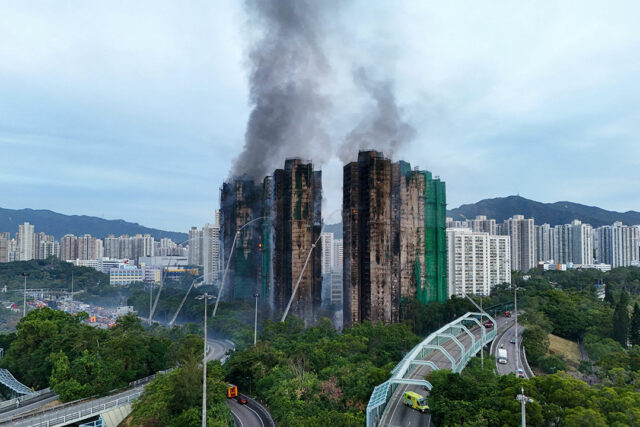
A DRONE view shows flames and thick smoke rising from the Wang Fuk Court housing estate during a major fire in Tai Po, Hong Kong, China, Nov. 27. — REUTERS/TYRONE SIU
HONG KONG — A huge fire still burning in a Hong Kong apartment complex that has killed at least 44 people and left nearly 300 missing may have been caused by a “grossly negligent” construction firm using unsafe materials, police said on Thursday.
Almost a full day after the fire began, firefighters were struggling to reach residents potentially trapped on the upper floors of the Wang Fuk Court housing complex due to intense heat and thick smoke from the fire that erupted on Wednesday afternoon.
Police said in addition to the buildings being covered with protective mesh sheets and plastic that may not meet fire standards, they discovered some windows on one unaffected building were sealed with a foam material, installed by a construction company carrying out year-long maintenance work.
“We have reason to believe that the company’s responsible parties were grossly negligent, which led to this accident and caused the fire to spread uncontrollably, resulting in major casualties,” said Eileen Chung, a Hong Kong police superintendent.
Three men from the construction company, two directors and one engineering consultant, had been arrested on suspicion of manslaughter over the fire, she added.
Police officers searched the housing estate’s building maintenance company on Thursday morning, seizing documents that mention of Wang Fuk Court, local media reported. The company did not immediately respond to a request for comment.
The tightly packed complex in the northern Tai Po district has 2,000 apartments in eight blocks that are home to more than 4,600 people in a city struggling with chronic shortages of affordable housing.
By Thursday morning, authorities said they had brought the fire in four of seven blocks under control, with operations continuing in three blocks. Video from the scene some 22 hours after the blaze started showed flames still leaping from at least two of the 32-story towers sheathed in green construction mesh and bamboo scaffolding.
The bamboo scaffolding is a mainstay of traditional Chinese architecture but has been subject to a phaseout in Hong Kong since March for safety reasons.
A firefighter was among the 44 killed, with 45 people in hospital in critical condition, Hong Kong police told a press conference before dawn on Thursday.
“The priority is to extinguish the fire and rescue the residents who are trapped,” Hong Kong leader John Lee told reporters. “The second is to support the injured. The third is to support and recover. Then, we’ll launch a thorough investigation.”
Some 279 people were uncontactable, and 900 were in eight shelters, he added.
The death toll is now the highest in a Hong Kong fire since 1948, when 176 people were killed in a warehouse blaze.
SEARCHING FOR RELATIVES The latest fire has prompted comparisons to the Grenfell Tower inferno that killed 72 people in London in 2017. That fire was blamed on firms fitting the exterior with flammable cladding, as well as failings by the government and the construction industry.
“Our hearts go out to all those affected by the horrific fire in Hong Kong,” the Grenfell United survivors’ group said on social media. “To the families, friends and communities, we stand with you. You are not alone.”
Harry Cheung, 66, who has lived at Block Two in one of the complexes for more than 40 years, said he heard a loud noise about 2:45 p.m. (0645 GMT) and saw fire erupt in a nearby block.
“I immediately went back to pack up my things,” he said.
“I don’t even know how I feel right now. I’m just thinking about where I’m going to sleep tonight.”
A woman surnamed Ng, 52, was distraught as she looked for her daughter outside a shelter.
“She and her father are still not out yet. They didn’t have water to save our building,” she sobbed, carrying her daughter’s graduation photo.
Another long-time resident, a woman surnamed Chu, said she still had not been able to contact her friends who live in the next block. After staying over at a friend’s place on Wednesday night, the 70-year-old came back to see her home still burning.
“We don’t know what to do,” she said.
An online app showed missing persons reports submitted through a linked Google document that detailed residents of individual towers and rooms.
It includes descriptions like “mother-in-law in her 70s, missing” or “one boy and one girl” or “Rooftop: 33-year-old male.”
One description simply says “27th floor, room 1: He is dead.” Reuters could not independently verify the information on the app.
CHINA’S XI URGES ‘ALL-OUT’ EFFORT AGAINST FIRE Many residents took to social media to criticize what they saw as negligence and cost cutting as a cause of the fire. One video showed several construction workers smoking on the bamboo scaffolding surrounding one of the complex’s blocks during the renovation process.
From the mainland, China’s President Xi Jinping urged an “all-out effort” to extinguish the fire and to minimize casualties and losses, China’s state broadcaster CCTV said.
Hong Kong’s Transport Department said that a number of roads would remain closed in the area on Thursday morning and 39 bus routes have been diverted, while nearby schools have been closed.
Hong Kong’s government started phasing out bamboo scaffolding in March, citing worker safety after 22 deaths involving bamboo scaffolders between 2019 and 2024. It announced that 50% of public construction works would be required to use metal frames instead.
Hong Kong’s sky-high property prices have long been a trigger for social discontent in the city, and the fire tragedy could further stoke resentment towards authorities ahead of a city-wide legislative election in early December.
Wang Fuk Court is one of many high-rise housing complexes in Hong Kong, one of the most densely populated areas in the world. Tai Po, located near the border with mainland China, is an established suburban district with some 300,000 residents.
Occupied since 1983, the complex is under the government’s subsidized home ownership scheme, according to property agency websites. According to online posts, it has been undergoing renovations for a year at a cost of HK$330 million ($42.43 million), with each unit paying between HK$160,000 and HK$180,000. ($1 = 7.7779 Hong Kong dollars). — Reuters
SYDNEY — Australia will overhaul its environment laws in long-awaited reforms after the Greens party agreed to back the center-left Labor government’s legislation on the final day of parliament for the year, Prime Minister Anthony Albanese said on Thursday.
The reforms will establish an independent National Environment Protection Agency to strengthen compliance and enforcement, impose higher penalties for major breaches of the law, and remove exemptions from the legislation for “high-risk land clearing and regional forest agreements.”
The Greens said Labor’s plan to allow coal and gas projects to use fast-tracked approvals based on “national interest” would also be dropped.
“This is a landmark day for the environment in this country. It is also a good day for business in this country by providing more certainty, reducing delays and making sure that we get better outcomes and improved productivity,” Mr. Albanese told reporters.
After pledging to set up an independent environmental protection agency in its 2022 election manifesto, Labor has battled criticism from all sides in its efforts to overhaul environmental law in a way that would better protect nature but also speed up the approvals process for projects in sectors such as critical minerals, renewable energy and housing.
The bill drew criticism from Australia’s conservative opposition, the fossil fuel industry, and farmers, while mining groups expressed concern about increasing regulation.
Liberal Party leader Sussan Ley accused the Greens of being “at war with gas.”
Lobby group Australian Energy Producers said the bill would hamper new gas supply to tight domestic markets and was “simply not in the national interest.”
Labor, which lacks a Senate majority, had been negotiating separately with the conservative Liberal-National coalition and the Greens to secure support for the legislation.
The Greens said while the bill remained “woefully short” of what was needed to address the climate crisis, their negotiations had improved the legislation.
“Greens pressure made this bill better than the weak laws we have now, and infinitely better than if the government had done a deal with the climate deniers in the Coalition,” said Greens Senator Larissa Waters.
She said the party had secured stronger safeguards for native forests, closed loopholes on land-clearing, and prevented Labor from fast-tracking coal and gas projects.
The Clean Energy Council, which represents the renewable energy industry, welcomed the reforms, which will speed up approvals for renewable energy projects that have struggled with complex procedures at both state and federal level.
In early August, Australia’s Productivity Commission called for the simplification of renewable energy projects to hit its target of 82% renewable energy in the grid by 2030. ($1 = 1.5344 Australian dollars).— Reuters
A EUROPEAN UNION’S flag flutters outside the European Commission headquarters in Brussels, Belgium, Oct. 15, 2020. — REUTERS
BELGIAN SECURITIES depository Euroclear warned that a European Union (EU) plan to back a €140-billion loan for Ukraine with frozen Russian assets could be viewed as “confiscation” and increase borrowing costs for member states, the Financial Times (FT) reported on Thursday.
Euroclear said the proposal risks damaging Europe’s investment climate and raising sovereign bond spreads, according to a letter seen by the FT.
Reuters could not immediately verify the report. Euroclear did not immediately respond to a Reuters request for comment.
The depository holds about €185 billion ($215 billion) of Russian assets immobilized in Belgium, while an estimated additional €25 billion of Russian state assets are frozen in EU banks in various countries, mainly in France and Luxembourg.
European Commission President Ursula von der Leyen told the parliament on Wednesday that the commission is ready to present a legal text on the loan plan supporting Ukraine’s efforts.
Euroclear Chief Executive Officer Valerie Urbain said the plan could lead to retaliation and potential legal challenges and urged that Euroclear should be covered for such action, the FT report added.
Belgium raised similar concerns, saying that it wants other EU countries to guarantee it would not be left alone to cover the expense and financial fallout which may stem from this scheme.
Although EU leaders failed to agree on the loan at their October summit, officials close to the talks between the commission and Belgium are confident that all concerns can be addressed. ($1 = 0.8618 euros). — Reuters
POCO has been known for finding the sweet spot between specs, features, and pricing. The new POCO Pad M1 tries to walk the line between the two use cases of a full-sized tablet: content consumption and content creation. It’s a balancing act that a manufacturer like POCO has been known to execute well with its phones. But does it succeed with its newest tablet?
At first glance, the hardware gives the impression of a more premium device with its all-metal build. Whether you hold it in vertical or landscape orientation, handling the unit is a cinch because of its finely rounded edges. Putting it in a case is optional.
When it comes to the case design, POCO went for the minimalist route with just the brand’s big yet still understated typeface logo the back. The only other prominent feature at the back is the rear camera lens and LED light which are mounted on a slightly raised platform. The quad stereo speakers are optimally mounted for landscape use. With support for Dolby Atmos, the speakers deliver the goods when it comes to sound quality. It can get pretty loud with minimal distortion at near max volume. There’s still a dedicated headphone jack near the charging port for those who want to use a wired headset.
With its 16:10 screen ratio, it’s definitely a multi-media centric tablet. At 12.1 inches, it’s suited for watching marathon movie and TV show sessions as well. Browsing, reading ebooks, comics, and graphic novels is a satisfying experience on the 2.5K resolution IPS LCD panel with a max brightness of 600 nits. Packed with a 12,000 mAh battery, the tablet lasts long enough for more than half a day of mixed usage. Ultrafast charging would’ve been ideal for a tablet this size but with 33W charging, expect around 3 hours to charge from zero to full.
The Snapdragon 7s Gen 4 chipset plus the 8GB ram keeps everything, well, snappy with ample storage space with 256GB onboard with the option to add up to 2TB expandable memory. When used for gaming, Pad M1 users can expect to crank everything up to medium settings for most graphics-heavy games.
As a stand-in for a laptop, the tablet works best with an add-on keyboard. You can adequately perform most tasks such as writing emails, content creation for social media, editing online documents, and even mobile-based graphics and video editing. Main connectivity is only via Wi-Fi6 so you have to keep that in mind when taking the tablet out for internet-heavy tasks.
At 610g, the tablet is easy to toss and lug around. Even without a case, the matte finish of the rear metal panel makes gripping it with one or two hands easier. The rear is resistant as well to smudges. Another must-have accessory should be the POCO Smart Pen which can be purchased separately. We didn’t have a unit during the review period but on paper, it’s an ideal drawing and sketching companion with 4,096-level pressure sensitivity and 240hz touch sampling rate.
On the software side, the tablet runs Xiaomi HyperOS v2.0. There’s practically no bloatware with only essential apps installed. Apart from standard Google apps, Gemini is also pre-installed to provide basic AI-features.
The POCO Pad M1 is now available at POCO’s official Shopee store for P12,999 (launch price) until Dec. 9 with a free keyboard/case bundle. SRP is P15,999. — Ed G. Geronia Jr.
Over 2,000 NMSMEs attended the TindaNow Mindanao Summit 2025 — a day of digital financial literacy, learning about GCash for Business, and the new GCash Pera Outlet Plus — equipping local entrepreneurs for success in the digital economy.
In collaboration with the Local Government of Tagum City, Department of Trade and Industry (DTI), Technical Education and Skills Development Authority (TESDA), and Tagum City Council of Women Foundation, Inc. (TCCWFI), the Philippines’ leading finance superapp and largest cashless ecosystem GCash, gathered over 2,000 nano, micro, small, and medium enterprises (NMSMEs) at the TindaNow Mindanao Summit 2025 to introduce digital innovations that help strengthen and grow their businesses — from smarter operations enabled by GCash for Business (G4B), to expanded earning opportunities through the upgraded GCash Pera Outlet Plus, and accessible lending support via Fuse Financing, Inc., the lending arm of GCash.
The day-long summit placed a strong focus on equipping NMSMEs with tools that can help them grow their businesses more confidently in an increasingly digital marketplace. It also introduced the new GCash Pera Outlet Plus, which transforms neighborhood retailers into local cash-in and cash-out hubs, enabling small business owners to earn additional income by facilitating load purchases and bill payment services for their communities.
This was complemented by access to formal lending through Fuse Financing, Inc. guided by the principle that lending should be a tool, not a burden. By offering transparent and structured credit, Fuse allows small business owners to invest in inventory, expand operations, or enhance services under fair terms. Ultimately, MSME owners can grow their businesses more sustainably while avoiding predatory lending.
This initiative comes at a time when many MSMEs continue to face challenges in accessing financial services and digital tools that can help them grow. In DTI 2023 figures, data show MSMEs accounted for 99.63% of all registered businesses in the Philippines. In Mindanao alone, MSMEs generated 986,186 jobs, representing 76.45% of total regional employment. Yet, as of end‑March 2025, loans to MSMEs were only 4.63% of banks’ total loan book versus the 10% mandate (8% for micro/small, 2% for medium). Solutions like GCash Pera Outlet Plus and formal lending through Fuse Financing, Inc. provide practical, accessible tools to help MSMEs manage finances, expand operations, and grow sustainably.
From left to right: DTI Division Chief Erick Cezar Elipian; GCash CXM Governance Training Head JJ Pacheco; GCash Account Manager Inbound Sales for Mindanao Angela Pupos; GCash Head of Sustainability CJ Alegre; TCCWFI President Alma Lim Uy; GCash Vice-President and Head of Public Sector Cleo Celeste Santos, Fuse Financing, Inc., the lending arm of GCash; GCash Head of B2B lending Kevin Yu; Mindanao Regional Sales Head Abran Tinagan; Mindanao Channel Distribution Manager Mikee Esguerra; and TESDA Senior Specialist Lythelle Ramos
The summit was attended by key officials led TCCWFI President Alma Lim Uy, City Councilor Arthur Ong, City Councilor Vreni Gem Caasi, DTI Division Chief Erick Cezar Elipian, together with GCash Vice-President and Head of Public Sector Cleo Celeste Santos, GCash Head of Sustainability CJ Alegre, Fuse Financing, Inc., the lending arm of GCash, Head of B2B lending Kevin Yu, and CXM Governance Training Head JJ Pacheco.
“This summit with GCash is more than just an event; it is a commitment to ensure that every community in Tagum that no matter how small the enterprise is, becomes part of our growing digital and economic landscape,” Mayor Rey Uy said in his message delivered by Councilor Uloy Ong, the Committee Chairperson for Tourism, Sisterhood Ties, and International Relations.
“As we embrace digitalization in partnership with GCash, we are opening doors to new opportunities: wider markets, faster transactions, safer payments, and more efficient business operations. Digital tools empower even the smallest enterprises to compete and to shine,” he added.
TCCWFI President Alma Uy stressed the importance of digitalization to thrive and scale sustainably, especially for NMSMEs.
TCCWFI President Alma Uy stressed that digital transformation is vital to empower the entrepreneurs to sustain business and strengthen business resilience to adapt in modern times. “This initiative reinforces our advocacy for digital and financial inclusion, empowering entrepreneurs to embrace digital payment systems, online business tools, and financial innovation, especially since Gcash has tools tailored to NMSME,” Ms. Uy said.
DTI Undersecretary Blesila Lantayona said in her message delivered by Davao del Norte Division Chief Erick Cezar Elipian that this summit is an opportunity for NMSMEs to expand their horizons, embrace digital transformation, and explore new pathways for growth and competitiveness in an increasingly dynamic and globalized economy.
She added that the initiative of GCash is aligned with the DTI MSME Development Plan 2023-2028, which emphasizes digital adoption, technological innovation, and business resilience to strengthen entrepreneurial capacity.
Transforming community stores to upgraded financial hubs
A pivotal moment of the summit was the introduction of the new GCash Pera Outlet Plus Dagdag Kabuhayan Program. This upgraded initiative offers small store owners a clear pathway to generate significant supplementary income by establishing their shops as essential community financial hubs.
During her speech, Ms. Santos highlighted that this initiative is part of the work of GCash in supporting community enterprises and extending financial progress to underserved sectors.
“We aim to give every community entrepreneur the tools and confidence to grow through practical financial education and safe, accessible digital solutions,” Ms. Santos said.
GCash for Business (G4B) also introduced digital solutions like SoundPay and Pocket Pay that streamline payment collection, boost operational efficiency, and help businesses formalize and scale.
Attendees had the chance to learn more about the new GCash Pera Outlet Plus and engage in financial literacy sessions.
Highlighting the importance of digital adoption, the summit featured financial literacy lessons on money management, online safety, and using digital finance to build long-term resilience for small businesses.
“At GCash, we are dedicated to supporting every Filipino, ensuring they have the tools to start, grow, and expand their businesses through digitalization. Our financial literacy program is specially designed for small businesses, equipping them with the knowledge they need to thrive. We make it simple, accessible, and seamless for them to implement these insights through our innovative digital products,” Mr. Alegre noted.
Meanwhile, Mr. Yu led a session on responsible capital access, outlining loan options that help entrepreneurs restock, expand, and reach new markets. He emphasized how accessible credit can bridge long-standing gaps for NMSMEs that often face financing barriers and are traditionally sidelined by other formal institutions.
Through the strategic convergence of financial literacy education, accessible platforms like the new GCash Pera Outlet Plus and GCash for Business, and responsible lending from Fuse, GCash is fundamentally equipping entrepreneurs with the knowledge and tools required to adapt, thrive, and sustain their operations.
Spotlight is BusinessWorld’s sponsored section that allows advertisers to amplify their brand and connect with BusinessWorld’s audience by publishing their stories on the BusinessWorld Web site. For more information, send an email to online@bworldonline.com.
Join us on Viber at https://bit.ly/3hv6bLA to get more updates and subscribe to BusinessWorld’s titles and get exclusive content through www.bworld-x.com.
Use your bike when running errands, such as bringing your dogs to the groomer’s. — Photo from Pexels
The Philippines faces more severe typhoon events, rising sea levels, and warmer temperatures each year. These natural hazards are further intensified by climate change, or the long-term shift in weather patterns.
The United Nations has noted that for the past 200 years, human activities have been virtually the major drivers of climate change, leading to global warming, or the rise of Earth’s average temperature, causing a range of more extreme weather conditions.
In this year’s 18th Global Warming and Climate Change Consciousness Week (CCC Week), the Climate Change Commission (CCC) encourages the public to rethink everyday habits that emphasize how responsible climate action can also begin at home.
Bike or hike short distances
Science dictates that with more vehicles plying the streets, it leads to more burning of fuel, which releases carbon dioxide (CO₂) that accumulates in the atmosphere and traps heat. It only follows that one of the best ways to reduce carbon footprint is to use private vehicles only when absolutely necessary.
Besides opting for public transport, finding optimal carpool buddies and work-from-home arrangements, biking routes or hiking short distances can significantly lessen pollution and even improve health.
Choosing plant-based meals and support local farmers
These glass containers are packed with plant-based foods for the week ahead. — Photo from Pexels
According to aUN guide on plant-based food, switching to this kind of diet reduces an individual’s annual carbon footprint by up to 2.1 tons with a vegan diet, or up to 1.5 tons for vegetarians.
Filipinos are at least starting to entertain the idea of this shift.In 2025, Tokyo-based research company GMO Research published a study which found that 85% Filipinos prefer food establishments to serve more plant-based options.
While it’s understandably challenging to change a regular diet overnight, easing into it by choosing at least one meal a week to plant-based foods can be a great way to get started. In addition, opting to incorporate a plant-based diet or more vegetables in meals can also help local farmers and producers.
Energy efficiency at home
Upgrade home, cut costs. Switching to LED bulbs is a simple step toward better energy efficiency. — Photo from Pexels
The nation’s power grid still relies heavily on fossil fuels, coal, oil, or gas. By choosing to reduce one’s usage of electronic devices at home, households can collectively reduce further pressure on the grid, which can lead to less carbon emission and, of course, lower electricity bills every month.
Some practical solutions include using LED lighting, turning off and unplugging unused appliances (including standby modes), and switching to renewable energy. Solar-powered small appliances such as electric fans, flashlights, and lighting are now available on the market even for the budget-conscious buyer.
Reuse, upcycle, ukay-ukay
Sustainable style is always in season. Give these pieces a second life. — Photo by Precious Altura | Kapasigan Thrift Store, Pasig City
In Filipino culture, the act of hand-me-downs is an age-old tradition practiced from our elders down to the youngest of the family — sometimes even beyond. For many, this simple act is a meek manifestation of a circular economy in the household, or circular fashion.
The practice of ukay-ukay (derived from root: halukay or to dig up) is an entire industry altogether for secondhand clothing.In a published story by the World Bank, they cited it takes 3,781 liters of water to make a pair of jeans, from the production of cotton to the delivery of the final product to the store — emitting around 33.4 kilograms of carbon equivalent.
Reusing clothes, or upcycling it to produce newer pieces without discarding them entirely, showcases Filipino ingenuity while threading creativity through time.
Managing food waste
This is the staggering reality of fresh produce being discarded. Think before you toss! — Photo by John W. Vizcaino/Corbis via Getty Images
For context, food waste goes to the landfill and as it decomposes, it produces a huge amount of methane, a potent greenhouse gas.
To avoid this, plan your meals accordingly, consume responsibly, and practice proper food storage. Doing so reduces potential harm to the environment while also causing less harm to the wallet.
Composting is another way to manage food waste responsibly, which can be done in your home or community.
The CCC Week
The call for more collective action towards climate change will be strengthened in this year’s Climate Change Consciousness Week. Whether you follow these simple everyday habits or go beyond, your everyday actions will always count towards a greater cause and impact.
The week-long celebration kicked off on Wednesday, Nov. 19, with the Net Zero Challenge (NZC), a multi-stakeholder partnership between business sector, civil society organizations (CSOs), local government units, youth organizations, and many others. More than 400 tree seedlings of varying species, including 100 banaba, 100 acacia, and 200 langka trees, were planted at the Caliraya-Lumot Watershed in Paete, Laguna for this activity.
This marks the 4th iteration of the NZC, a pioneer program of the Commission designed to strengthen community engagement and stakeholder participation in implementing nature-based solutions to address the impacts of climate change.
The CCC encourages all partner agencies and local communities to get involved in climate action and to be champions in helping build a more sustainable future.
Spotlight is BusinessWorld’s sponsored section that allows advertisers to amplify their brand and connect with BusinessWorld’s audience by publishing their stories on the BusinessWorld Web site. For more information, send an email to online@bworldonline.com.
Join us on Viber at https://bit.ly/3hv6bLA to get more updates and subscribe to BusinessWorld’s titles and get exclusive content through www.bworld-x.com.