Home Blog Page 6359

U.S. states, other nations back Mexico’s lawsuit against gun makers

STOCK PHOTO | Image by Carlos Andrés Ruiz Palacio from Pixabay

BOSTON – Thirteen U.S. states and two Latin America and Caribbean nations on Monday threw their support behind a lawsuit from Mexico that accuses several major U.S. gun makers of facilitating the trafficking of weapons to drug cartels, leading to thousands of deaths.

The states and the countries of Antigua and Barbuda and Belize filed separate briefs urging a federal judge in Boston to not dismiss Mexico’s $10 billion lawsuit against companies including Smith & Wesson and Sturm, Ruger & Co.

The companies have argued Mexico has failed to establish its harms were attributable to them and that a U.S. law, the Protection of Lawful Commerce in Arms Act, protected gun makers from lawsuits over their products’ misuse.

Mexico’s lawyers in a filing on Monday countered that the law only precludes lawsuits over injuries that occur in the United States and would not shield the companies from allegations over the trafficking of guns to Mexican criminals.

Democratic attorneys general from 13 states including Massachusetts, California and New York along with the District of Columbia agreed, saying even if that law applied extraterritorially, the statute would not bar Mexico’s claims.

Representatives for the companies did not respond to requests for comment. Other defendants include Beretta USA, Barrett Firearms Manufacturing, Colt’s Manufacturing Co and Glock Inc.

In a lawsuit filed in August, Mexico claimed the companies undermined its strict gun laws by designing, marketing and distributing military-style assault weapons in ways they knew would arm drug cartels, fueling murders, extortions and kidnappings.

Mexico’s lawsuit said over 500,000 guns are trafficked annually from the United States into Mexico, of which more than 68% are made by the manufacturers it sued.

Lawyers for Antigua and Barbuda and Belize argued countries in their region had likewise faced violent gun crimes and that U.S. gun manufacturers “must not be permitted to hold hostage the law-abiding citizens of an entire region of the world.” – Reuters

Forecast for the Year of the Water Tiger 2022

Chinese New Year is often a much-awaited occasion for its festive celebrations and sumptuous meals and delicacies like tikoy and hopia. Yet, for many who still embrace ancient Chinese beliefs, this is once again the time to seek guidance from the Chinese zodiac on how they will move forward in the year ahead.

According to the lunar calendar, 2022 is the Year of the Water Tiger. The Tiger is mostly characterized as ferocious, daring, enthusiastic, powerful, independent, and dynamic. Marites Allen, well-known in the country as “The Queen of Feng Shui,” added in a livestreamed forecast: “When life knocks it down, the tiger gets up again. The tiger is aggressive; it’s impatient, it waits for no one.”

While noting its strength, leadership, and purposefulness, however, Ms. Allen said that the Tiger also shows vulnerability, sensitivity, and overestimation. “When the tiger is hot-headed, it’s difficult to control it. The Year of the Water Tiger is coupled with aggression, tension, rebellion… So, we need to make sure that our reactions to everything are controlled,” she was quoted as saying.

What lies for each Chinese zodiac sign this Year of the Water Tiger? Astrology website KarmaWeather finds that animals with Yang polarity (Rat, Tiger, Dragon, Horse, Monkey, Dog) will get a boost from Tiger’s energy, while those with Yin polarity (Ox, Rabbit, Snake, Goat, Rooster, Pig) will have to be more arduous and not be easily discouraged in initial pitfalls.

For Rats, this year is expected by KarmaWeather to be slightly hectic for them, but they should manage to overcome obstacles without too much difficulty. In addition, Ms. Allen advises people born under this sign to practice self-restraint and serious effort at improving their game for the first half of the year.

Oxen are predicted to be placed under the seal of protection amid facing a period of struggles and intense efforts. “Stay calm, be honest to yourself, and try as much as possible, not to disclose personal information to people you don’t really know,” Ms. Allen tells them.

Tigers are said to anticipate a mixed period of decisions that can be as much the source of resplendent success as of sharp failures. For Ms. Allen, steadfastness and commitment, as well as lowered expectations, will help things get better for them.

Rabbits, similarly, are advised to reduce expectations about life and to be more circumspect in their social relationships to limit or prevent disappointments. They should brace themselves for possible negativities brought by hostile energies that could lead to heartache and misunderstanding, Ms. Allen added.

For Dragons, the year is expected to be challenging in the professional level, eventful regarding finances, and structuring in the emotional field. They are advised to be wary of mental and physical stress while staying positive and optimistic.

While Ms. Allen predicts luck for them in love, travel, wealth, and career, Snakes are warned of a complex and tumultuous period since Tiger years are generally not fulfilling for them. The experience and teachings gained, nonetheless, are said to be greatly beneficial for them. They are told to be wary of health risks.

Dynamic is how KarmaWeather predicts the year for Horses, who are predicted to overcome for good the obstacles they inherited in the previous lunar year. A focused mind is considered by Ms. Allen to be their key to win this year.

With last year’s bad energies predicted to leave by 2022, Goats, or Sheep, are predicted to experience recovery and optimism, as well as interesting opportunities in terms of consolidation of achievements. Planning this year ahead is advised.

A complex, exhausting, yet stimulating year is said to await Monkeys. While they can expect a period of troubles and uncertainties, they are told not to resign to the whims of fate. Their business luck is found to be very high, but they are advised to figure out if one thing works out for them or carefully look into situations before making decisions.

For Roosters, a “lively year, focused on a dynamic of exalted renewal” is expected, which calls them to update their priorities and consider taking radical decisions. They can’t work in isolation this year, Ms. Allen advises, and they must balance trusting their abilities and carrying their team along.

Dogs can expect a “beautiful year rich in surprises and twists and turns of all kinds,” yet they are advised to assimilate the difference between a need that can wait and an emergency that requires immediate action. They are encouraged to use their talents and abilities the catch the “good tidings” set for them.

Pigs or Boars are predicted to have a stimulating year, with many interesting perspectives in terms of personal evolution. They are, however, advised to have a fair understanding of their emotions and to study the offers that really suit them. They are also told to beware of getting cheated or swindled, as well as prepare for instances that will demoralize and test their character. — Adrian Paul B. Conoza


A significant celebration of traditions

Chinese New Year, also known as the Spring Festival or Lunar New Year, is a significant and widely celebrated occasion for billions of people. Traditions, beliefs, and festivities fill the celebration of this time, honored in history dating back over a thousand years.

Tracing its long roots, the origin of Chinese New Year can be explained by folklore involving a monstrous beast Nian.

According to a story on the website of Confucius Institute for Scotland in the Univesity of Edinburgh, the myth goes with Nian preying on the people and livestock on the last day of the lunar year. Then one year, an old man appeared and vowed to drive the beast away. When the monster once again arrived in the village, the sound of firecrackers suddenly rose with bright flares, trembling Nian. The old man then stepped forward dressed in red, which made the beast frenzy. Terrified further, the monster rushed away.

A day after, the old man, eventually realized as a celestial being who came to help the villagers, told them the weapons to drive the monster away are “items that are red in color,” “bright lights” and “firecrackers.”

Since then, the Chinese held the tradition of setting up red lanterns, lighting up firecrackers, kept the lights on, and stayed up late. This tradition, as we surely have seen, remains observed today.

The celebration of Chinese New Year spans around two weeks. Following the lunar calendar, the Chinese New Year falls on a different day each year. It typically starts with the first new moon, which occurs between the end of January and spans the first 15 days of the first month of the lunar calendar, until the full moon. This 2022, the Chinese New Year falls on Feb. 1, welcoming the Year of the Water Tiger.

But before Chinese New Year Eve, the festive atmosphere is already surrounding.

Aside from shopping to prepare for the occasion, the days prior are also for house cleaning and decorating. Houses are adorned with traditional paintings and paper designs with red color. An exhaustive cleaning also takes place in the house, with hopes to sweep away ill fortunes and make way for good luck to come in. Sweeping and cleaning would not be allowed on the first day of Chinese New Year to not sweep away the good luck.

By the eve of Chinese New Year, connecting with one’s family highlights the celebration, making the day one of the most important times for them.

Chinese people kept their New Year tradition of honoring their ancestors by visiting their graves the day before the Chinese New Year. They also offer sacrifices to their ancestors before the reunion dinner and place an added glass on the dinner table on New Year’s eve.

For the family reunion dinner on the eve of Chinese New Year, everyone, no matter where they are, are expected to go to their homes. This significant time gathers families around the table to enjoy their dinner and time together.

Feast during the Chinese New Year also holds various eating customs. The dishes are significant for the symbols they represent. Certain foods believed to bring good luck for the coming year are served during the season, especially on Chinese New Year Eve. And aside from the foods themselves, their way of preparing, serving, and eating also bear significance. 

Some common foods and their meanings for this celebration are fish for an increase in prosperity, dumplings and spring rolls for wealth, and niangao for a higher income or promotion.

People also exchange gifts during the Chinese New Year. The most common is a red envelope with money inside, which is often given to children and retired seniors.

When midnight strikes, indicating the entrance of the new year, firecrackers and fireworks set off. While evidently a display of celebration, this festive activity is also recognized as a way to frighten the evil away.

Also part of the Chinese New Year celebration is the Lantern Festival, which happens on the 15th day of the first Chinese lunar month. The well-known lion and dragon dances are among the daytime activities at this festival. At night, lanterns can be seen all over — streets, malls, parks, and in the hands of children. A display of firecrackers and fireworks once again takes place, marking the end of this festival and the New Year season.

Traditions of celebrating Chinese New Year may vary between places and even families. And living at a time of the pandemic, the celebration may not look exactly like it was before. In the Philippines, for instance, some used to celebrate Chinese New Year in Binondo, Manila to enjoy the dragon dances and fireworks. But public activities in connection with Chinese New Year festivities are canceled in Manila from Jan. 31 to Feb. 1.

Yet, even with the diverse cultures and the different presentime, the spirit within Chinese New Year can remain the same and alive through the wishes of happiness for loved ones. — Chelsey Keith P. Ignacio

Attracting good energy this new year

Feng shui has been a part of Filipino-Chinese culture even before the time of the Spaniards. As an ancient art — one that literally means ‘the way of wind and water’ — feng shui is one of the ways the ancients tried to make sense of the chaos of the universe, as the traditional practice aims to understand the energy forces of the environment.

The practice stems from the Taoist belief that within everything is chi, a life energy governed by the opposing yet complementary forces of yin and yang. According to Taoist belief, by balancing yin and yang within themselves and their surroundings, people can improve the flow of chi in their lives and keep negative chi away.

Feng shui is the art of arranging buildings, objects, furniture, and space in an environment in such a way to achieve harmony and balance with yin and yang.

According to National Geographic, though little is known about the origins of feng shui, the ancient Chinese may have been designing their homes and towns using feng shui principles for over four thousand years. Some early examples of feng shui can be found in the placement of ancient Chinese grave sites — areas where bringing positive chi was very important.

The tradition continues to remain strong today, as people all over the world use feng shui rules to decorate their homes. The goal is to create and maintain this vital balance between yin and yang energies, and assist the flow of chi throughout the home or office.

All about chi

In feng shui, one strives to achieve sheng chi, or an environment where positive energy or auspicious energy flows. Sheng means upward moving energy, and it is believed to generate a feeling of well-being and health, that same feeling of positive energy as one would have communing with nature through a stroll in the forest, a waterfall, a mountainside or a beach.

Among the many ways to achieve sheng chi and replicate that sense of well-being is getting rid of clutter inside and outside your home or office. This is because si chi, a passive and stagnant energy, is exuded by having a messy and disorganized environment. Si chi is a decaying form of energy, one which slowly eats away its surroundings. Things like dust, rubbish, debris, clutter, cobwebs, stagnant water, and other forms of grime have si chi, and one should keep them away from one’s home and place of business to mitigate their deteriorating nature.

Sha chi, meanwhile, is called the ‘killing energy’ with how it suppresses positive energy and destroys any growth. It can manifest in natural land formations, manmade buildings, objects, or places such as a street, cemetery, or bridge. Feng Shui dictates that straightforward energy flow, narrow and fast, carries a lot of sha chi, which carries positive energy away and replaces it with negative energy.

This means that a house or business, situated right at the end of a straight street, is continuously exposed to a clot of negative energy. Sha chi, like ball lightning, is attracted to it directly. Sha chi also manifests in sharp and jagged corners, such as the peaks of a mountain range, a rocky cliff, a corner of a tall building or an acute angle of the roof.

This is why feng shui encourages that access roads to houses and buildings be made to be slightly winding, and paths be made circular and not with right angles. Thus, negative energy is converted into positive.

Looking forward to 2022

The first of February marks the Year of the Thundering Water Tiger. Recognizing the hardships of recent years, Patrick Lim Fernandez of Yin and Yang Shop of Harmony, told The Philippine Star that welcoming the Chinese New Year with a festive mood, a clear frame of mind and an abundance of distinct, delicious and auspicious dishes could promote the harmony and rebirth that Filipinos need.

The Tiger, he said, brings a lot of yang energy, which is the type of chi that symbolizes strength and aggression. This represents the world’s energy as it remobilizes and awakens from the “slumber” that the pandemic has forced upon it, while also sparking activity in aspects of life such as business, careers, relationships, health, and prosperity.

“As the Year of the Ox comes to a close, we look forward to this coming Year of the Thundering Water Tiger 2022. As the world continues to cope with and manage this global pandemic, there is a light on the horizon. This is because the past three years were the winter years in the 12-year cycle of the Chinese zodiac. The years of the pig, rat and ox (2019 to 2021) belong to the most frigid of seasons,” Mr. Fernandez said.

“It is no wonder that the world had been in a mode of hibernation as is customary during wintertime. The coming year of the Tiger signifies the beginning of spring which will last for the next three years. As the world gets ready to re-emerge from a period of docility and lethargy, the tiger symbolizes a form of rebirth and reinvigoration,” he added. — Bjorn Biel M. Beltran

Bank lending up for 5th straight month

BW FILE PHOTO

By Luz Wendy T. Noble, Reporter

BANK LENDING marked its fifth straight month of expansion in December, as credit activity improved amid the further reopening of the economy.

Outstanding loans issued by universal and commercial banks increased by 4.6% year on year in December to P9.6 trillion, according to preliminary data released by the Bangko Sentral ng Pilipinas (BSP) on Monday.

Lending growth picked up from the 4% seen in November, and the fastest since the 4.7% in August 2020. 

“Credit activity continued to improve due to a more favorable economic outlook from businesses and households amid the sustained rollout of COVID-19 (coronavirus disease 2019) vaccines and the easing of community restrictions during the month,” BSP Governor Benjamin E. Diokno said in a statement.

Metro Manila and most parts of the country were under a more relaxed Alert Level 2 in December, as the number of COVID-19 cases dwindled and the pace of vaccination improved.

Inclusive of reverse repurchase agreements, bank lending also rose by 4.6%. It went up by 0.4% month on month.

“Bank lending supported both consumption and capital formation, helping power the robust fourth-quarter gross domestic product (GDP) growth performance,” ING Bank N.V. Manila Senior Economist Nicholas Antonio T. Mapa said in an e-mail.

Household consumption, which makes up about 70% of the economy, increased by 7.5% year on year in the last three months of 2021. The investment component or capital formation climbed by 12.6%.

The economy accelerated by 7.7% year on year in the fourth quarter, bringing full-year gross domestic product (GDP) growth to 5.6%.

“Follow-through stimulus from the BSP’s 2020 rate cuts fed through to lending while the gradual reopening of the economy also spurred demand for credit,” Mr. Mapa said.

Despite the low interest rates, bank lending declined on an annual basis from December 2020 to July 2021 as borrowers and banks became risk averse during the pandemic.

In December, production loans increased by 5.8% year on year, faster than the 5.4% in the previous month. This was backed by the rise in lending for real estate activities (9.1%), information and communication (27.3%), manufacturing (9.4%), financial and insurance activities (9.9%), and transportation and storage (9.1%).

Consumer borrowings dropped by 5.7% in December, although less steep than the 7.1% contraction in November. Only credit card borrowings (4.7%) registered growth, while motor vehicle loans (-17.2%), and salary-based loans (-8.8%) continued to decline.

The Monetary Board will have its first policy review on Feb. 17.

Mr. Mapa said a possible rise in interest rates could affect lending growth.

“2022 could see bank lending’s recovery capped with global interest rates on the rise. An improving domestic economy coupled with a likely Fed rate hike cycle could mean interest rates will be on the uptrend this year,” he said.   

SLOWER M3 GROWTH
Meanwhile, domestic liquidity grew by 7.7% year on year to P14.747 trillion, the BSP said in a separate statement. This was slower growth than the 8.3% seen in November.

M3 — which is the broadest measure of money supply in an economy — picked up by 0.2% month on month in December.

Domestic claims rose by 8% in December, easing from the 8.1% rise in the prior month.

Net claims on the central government increased by 21.7%, easing from a 24% growth in November.

Meanwhile, growth in claims on the private sector quickened to 3.6% from 3% in the previous month.

Net foreign assets increased by 6.5% in December, slowing from the 8.8% expansion a month earlier.

“Looking ahead, the BSP will continue to monitor liquidity conditions closely in preserving adequate support to the domestic economic recovery, consistent with the BSP’s price and financial stability objectives,” Mr. Diokno said.

Rizal Commercial Banking Corp. Chief Economist Michael L. Ricafort said M3 may continue to expand due to the excessive liquidity in the financial system.

The BSP has infused about P2.3 trillion in liquidity to the financial system amid the crisis. This is equivalent to about 12.5% of GDP.

DPWH wants 18 projects exempted from Comelec’s public works prohibition

Workers are seen mixing cement at a construction site in Quezon City, May 19, 2020. — PHILIPPINE STAR/ MICHAEL VARCAS

EXEMPTIONS are being sought for 18 infrastructure projects from the Commission on Elections’ (Comelec) public works ban during the election season, a National Economic and Development Authority (NEDA) official said.

“The DPWH (Department of Public Works and Highways) has shared to us the list of requested projects. It’s 18,” NEDA Undersecretary Roderick M. Planta said at a briefing on Monday, without identifying the projects.

The Comelec earlier said the public works ban for the May national elections will run from March 25 to May 8, 2022. Aimed at preventing politicians from using public resources for their election campaigns, the ban covers disbursement and spending as well as construction activity.

Pantheon Senior Asia Economist Miguel Chanco has said that these spending restrictions could slow down Philippine economic expansion this year.

NEDA, through the Cabinet-level Investment Coordination Committee (ICC), approved 30 infrastructure and development projects last year, including five new projects.

The five new projects include the Laguna Lakeshore Road Network Project, Davao City Expressway, Seismic Risk Reduction and Resilience Project, Panglao-Tagbilaran Bridge, and the Philippine Multisectoral Nutrition Project.

Mr. Planta in an e-mail said the 25 ongoing projects were valued at P1.02 trillion, while the five new projects are worth P290 billion.

He also said that the country’s infrastructure flagship projects have remained unchanged since May last year. The 112 projects in the list cost P4.687 trillion.

PANDEMIC SCORE
Meanwhile, the government gave itself higher scores in its pandemic-response scorecard in December.

NEDA Undersecretary Rosemarie G. Edillon said coronavirus disease 2019 (COVID-19) infection management improved to 2.74 out of 3, higher than the 2.53 score in November. The vaccine rollout score increased to 2.2 from 2.02.

NEDA last year launched the government’s pandemic scorecard, which measures the country’s infection management, vaccine rollout, and socioeconomic recovery.

But NEDA was not able to release its socioeconomic recovery score due to the unavailability of international flight activities data, an indicator for economic recovery.

The Philippines ranked last or 53rd in the most recent Bloomberg COVID-19 resilience ranking released on Jan. 27 due to problems with deploying vaccines to remote areas.

At the same briefing, Socioeconomic Planning Secretary Karl Kendrick T. Chua said the proposal to remove the alert level system for lockdown restrictions “merits some serious thinking.”

“For the time being, since we are not yet fully out of the pandemic, this is something that I think we should presently retain,” he said.

In the meantime, he said the government would consider the idea as it looks into treating COVID-19 as endemic in the future.

Presidential Adviser for Entrepreneurship Jose Ma. A. Concepcion III has proposed that the Philippines shift away from the alert level system by March or April this year.

Metro Manila and seven other areas will be moved back to a more relaxed Alert Level 2 starting on Feb. 1, which would allow bigger indoor capacity for business activities. — Jenina P. Ibañez

COVID-19 insurance claims breach P8 billion

PHILIPPINE STAR/ MICHAEL VARCAS

PANDEMIC-RELATED insurance claims payouts reached P8.23 billion in the first nine months of 2021, higher than the 2020 figure, a survey from the Insurance Commission (IC) showed.

An IC survey of 126 life and nonlife insurers, health maintenance organizations (HMOs), and mutual benefits associations showed claims paid increased during the Delta-driven surge in coronavirus disease 2019 (COVID-19) cases from August to September.

“The figures we obtained reflect that the claims paid increased drastically from February to April 2021, dipped slightly during the months of May, June and July, and then spiked in August to September of the same year,” Insurance Commissioner Dennis B. Funa said in a statement.

To compare, the commission reported P1.98 billion in total payouts in the same nine-month period in 2020, but surveyed 111 organizations.

In the third quarter of 2021 alone, total claims payouts reached P3.88 billion, nearly half of which went to death benefits.

More than 30% of the value of claims payouts represented in-patient benefits, while just under 16% went to out-patient claims.

The total number of claims in July to September period reached 260,053. The bulk or 217,675 claims went to out-patient benefits.

“Also worth mentioning is the fact that unlike in the survey for the first semester of 2021, there are no claims paid for travel and business interruption benefits during the third quarter of 2021,” Mr. Funa said.

In total, claims paid from the start of pandemic-related lockdowns in 2020 to Sept. 2021 reached P12.12 billion.

The P8.23 billion paid in the first nine months of 2021 represented 68% of this total.

“The claims paid during the first three quarters of 2021 is already more than double of the total claims paid for the year 2020,” Mr. Funa said.

Nearly half or P5.6 billion in COVID-19 claims throughout the pandemic was paid by HMOs, followed by the life insurance sector at P5.46 billion in payments.

Despite pandemic-related risks, Mr. Funa said that the insurance organizations have remained financially resilient. “Based on unaudited quarterly statistics, we noted that as of the second quarter of 2021, the insurance industry’s assets grew by 10.43% compared to the same period in 2020,” he said.

Gross premiums collected by insurance firms and mutual benefit associations rose by 28.71% year on year to P278.66 billion in the third quarter, IC reported previously. The life insurance sector alone collected P230.61 billion in net premiums, up by 33% from a year earlier. — Jenina P. Ibañez

AVID sales jump 14% in 2021

BW FILE PHOTO

SALES of imported vehicles in the Philippines jumped by 14% in 2021, as the reopening of the economy boosted demand for light and commercial vehicles.

In a report released on Monday, the Association of Vehicle Importers and Distributors, Inc. (AVID) said its members sold 58,916 units in 2021, higher the 51,851 units sold in the same period in 2020.

The 14% year-on-year increase was within AVID’s target of up to 20% growth in sales.

AVID said sales of light commercial vehicles, which accounted for 73% of the total, rose by 23% year on year to 42,871 units. Ford Group Philippines, Inc. led the segment with 18,324 units, followed by Suzuki Philippines with 11,314 units and Geely (Sojitz G Auto Philippines) with 6,104 units.

Commercial vehicle sales surged by 212% to 953 units from 305 units sold in 2020.

“Hyundai Trucks and Buses, (Hyundai Asia Resources, Inc.) takes the lead with 206% growth, or from 305 units sold in 2020 to 936 units sold in 2021,” AVID said.  Passenger car sales dropped by 9% to 15,092 units, which AVID attributed to pandemic-related quarantine measures. 

Suzuki Philippines led the segment with 8,079 units sold, followed by Hyundai Asia Resources with 4,639 units and Ford Group Philippines with 1,681 units.

In December alone, total vehicle sales fell by 8% to 5,259 units year on year due to a 28% drop in passenger car sales and a 59% decline in commercial vehicle sales. Light commercial vehicle sales inched up by 1% during the month.

“Despite the year-on-year drop of 28%, the (passenger car) segment’s month-on-month performance gradually improved by 3% with Suzuki at the lead with 8,079 units sold followed by Hyundai with 4,639 units sold,” AVID said. 

AVID President Ma. Fe Perez-Agudo said the group is looking forward to better sales this year, as the economy further reopens.

“With unwavering confidence in the market and in the quality of our product and service offerings, AVID members are determined to build on these gains and look forward to an even better normal in 2022,” Ms. Perez-Agudo said.

“You cannot downplay the importance of mobility in the reopening of the economy, gradual though it may be,” she added. 

Metro Manila will be under a looser Alert Level 2 starting Feb. 1, as the number of new coronavirus disease 2019 (COVID-19) cases appear to be on a declining trend. — R.M.D.Ochave

STAR names sales and marketing director

THE MANAGEMENT of The Philippine STAR announced the promotion of Jay R. Sarmiento as sales and marketing director of the Philstar Media Group effective Feb. 1.

The Group includes The Philippine STAR, Pilipino Star Ngayon, and BusinessWorld, where Ms. Sarmiento is also the sales and marketing head.

Ms. Sarmiento is a veteran of the newspaper industry with over 30 years of combined experience in market research, corporate communications, events management, marketing and sales which has earned her a deep understanding of the Philstar Media Group’s needs.

She also represents The STAR in the United Print Media Group (UPMG), the premier association of major publication companies in the country, where she sits as the incumbent vice-president. She is also active in various industry associations such as the Ad Standards Council, Philippine Association of National Advertisers, Philippine Marketing Association, and the Advertising Foundation of the Philippines.

Ms. Sarmiento joined The STAR’s research team in 1990 after earning a BS degree in Statistics at the University of the Philippines. She later headed the department before being appointed corporate communications manager in 1998.

In 2016, The STAR President and Chief Executive Officer Miguel G. Belmonte tapped Ms. Sarmiento to join BusinessWorld in tandem with The STAR Executive Vice-President Lucien C. Dy Tioco to help revitalize the business paper’s sales and marketing efforts following its acquisition by The STAR. Among the projects she spearheaded include the successful BusinessWorld economic forums.

As director for sales and marketing, Ms. Sarmiento helps lead the group in providing value to business partners who leverage on The STAR’s wide reach as a highly trusted and respected news brand.

PSE suspends DITO CME shares trading over deferred offering

By Keren Concepcion G. Valmonte, Reporter

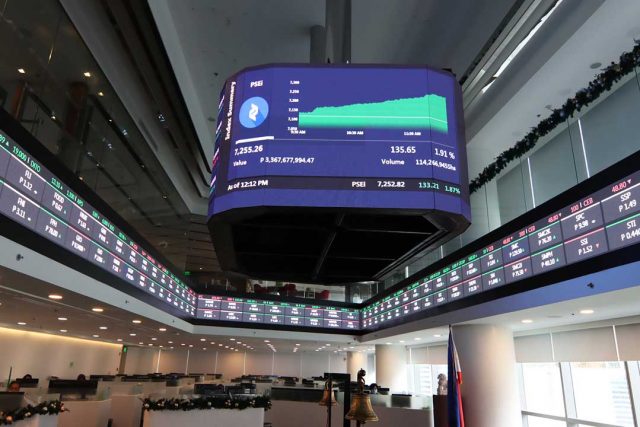
THE Philippine Stock Exchange (PSE) has imposed a trading halt on the shares of DITO CME Holdings Corp. beginning on Monday at 9 a.m., following the company’s announcement to postpone its P8-billion stock rights offering (SRO).

“The exchange has required DITO to submit a full and comprehensive disclosure on the foregoing matter within the day,” the PSE said in a disclosure notice on Monday.

However, the PSE said that it has yet to approve of the deferment of the company’s rights offer.

“Please note that this should not be construed as an approval by the exchange of the deferment of the offering,” the PSE said.

“The company, its underwriter, and other advisers are responsible for strict compliance with the rules of the exchange,” it added.

DITO CME told the exchange over the weekend that it plans to defer its SRO because “current market conditions are less than ideal to pursue the offering.”

“In lieu of this capital-raising exercise, we are studying several alternative financing proposals recently made available to us, which we see to be more value-enhancing to our shareholders,” DITO CME President Ernesto R. Alberto said in a separate statement on Sunday evening.

China Bank Capital Corp., the sole underwriter of the company’s SRO, said it “respects” the company’s decision to postpone the offering despite seeing positive support.

“While we saw good support from existing shareholders, we respect DITO CME’s decision to defer the SRO in the light of current market conditions and other perceived risks. When conditions improve, we are confident that DITO CME may return to the market,” China Bank Capital President Ryan L. Tapia said.

Proceeds from the offer were supposed to be used for the company’s telecommunications services across the country.

However, DITO CME said “arrangements are being made” to fund the expansion. It said there are already lenders, which the company did not name, that have committed to help the company with the financing of its DITO Telecommunity expansion.

“We have been able to secure commitments on more than $4 billion in long-term debt under a project finance arrangement with various foreign lenders. We are currently working on the binding agreements of these loans,” DITO CME Chief Finance Officer Joseph John L. Ong said.

“These commitments are more than enough to finance the rollout plans of DITO Telecommunity for the last three years of our five-year capital expenditure plans,” he added.

Meanwhile, DITO CME Chairman Dennis A. Uy said the company is “more bullish this year” as it pursues its expansion plans.

“In fact, we are very confident of DITO Telecommunity passing its third annual technical audit in July which commits to 70% population coverage and a minimum average speed of 55 Mbps,” Mr. Uy said.

He also thanked DITO CME shareholders who subscribed to the SRO and assured that “all subscriptions paid will be returned at the most expedient due process.”

Meanwhile, COL Financial Group, Inc. President and Chief Executive Officer Conrado F. Bate said the public should wait for the PSE’s decision on the issue.

“We trust that our regulators will handle this development with the protection of those investors in mind, especially since there is a large number of minority shareholders that participated in the offering,” Mr. Bate said in a press briefing on Monday.

“For now, we should wait for the decision of the regulators on this issue, but we hope that DITO and the PSE can resolve the suspension matter as soon as possible for the benefit of the shareholders impacted,” he added.

Japhet Louis O. Tantiangco, senior research and engagement supervisor at Philstocks Financial, Inc., said sentiment from the developments would affect only DITO CME.

“By the end of the day, confidence towards a company who is aiming to raise capital in the market would depend on the company’s fundamentals,” Mr. Tantiangco said in a Viber message.

“If the company who is raising capital is able to deliver robust financial performance and prospects, and if its offer is at an attractive price, then we may still see strong appetite towards the offer,” he added.

PHL cloud market to hit $2.8B by 2025 — GlobalData

MORE Philippine enterprises intend to migrate workloads to the cloud, propelling the country’s cloud market to $2.8 billion by 2025 from $1.8 billion in 2020, making it an ideal destination for global hyperscalers, data analytics and consulting company GlobalData said.

Global hyperscalers, or the massive international companies that dominate the cloud service sector, may be needed to open facilities in the country because “local hosting” is a “key requirement” to address the “strong demand” for cloud services, the company said in its recent study.

“Over half of the enterprises revealed their plan to migrate more workloads to the cloud,” GlobalData said, citing its 2021 study. “Over 20% of these customers foresee having all of their corporate data migrated by the end of [2021].”

It noted that hybrid operations such as remote working, advancements in vertical applications such as e-learning, e-government, e-health, and wider adoption of analytics and artificial intelligence are driving strong cloud demand in the Philippines.

At the same time, continuous network expansion, such as 5G (fifth-generation network) and fiber domestically and internationally, is seen enabling cloud services in the country.

“This will drive the cloud market in the Philippines to grow solidly to $2.8 billion in 2025,” GlobalData said. In February last year, the data and analytics company said the “enterprise spending on cloud services would grow from $1.8 billion in 2020 to $2.6 billion in 2024.”

“In-country hosting is a crucial requirement for most enterprises. Over two thirds of enterprises indicated that local facilities are an important/very important criterion when considering new cloud services,” it noted.

“There are many reasons for this, such as the requirement for low-latency and higher performance when applications are hosted locally, cybersecurity, business continuity, and data sovereignty.”

On why global hyperscale providers are favored, GlobalData said it is “due to their wide range of services, speed to release new features, and overall technical prowess.”

PLDT GROUP’S DATA CENTER
Last year, the PLDT group announced that it would start building the first hyperscaler data center in the country in 2022. It targets to complete the project in 2024.

The group’s budget for the new data center would be approximately about P5 billion.

In an e-mailed statement on Jan. 29, the PLDT group said that it has been “augmenting its capabilities to strengthen the country’s global connectivity infrastructure and be the next preferred geographic destination of hyperscalers in the Asia-Pacific region.”

“Likewise, it has been leading various industry initiatives including the launch of commercial mobile 5G last year, which now has over 6,000 sites,” it added.

PLDT Home announced on Monday that it achieved the highest speed score of 77.24 among major internet service providers in the country at the Ookla Speedtest Awards for the last two quarters of 2021.

“The latest result showed a big jump from PLDT’s Speed Score of 27.28 in the second half of the previous year,” it said in a statement.

Converge ICT Solutions, Inc. came in second with a speed score of 53.17, followed by Sky Cable Corp. (39.92) and Globe Telecom, Inc. (25.66).

PLDT said its fiber footprint expanded by 73% from end 2020 to 743,700 kilometers in 2021, with homes passed at nearly 14 million.

Hastings Holdings, Inc., a unit of PLDT Beneficial Trust Fund subsidiary MediaQuest Holdings, Inc., has a majority stake in BusinessWorld through the Philippine Star Group, which it controls. — Arjay L. Balinbin

COL Financial sets PSEi target at 8,400 in 2022

BW FILE PHOTO

COL Financial Group, Inc. is expecting the bellwether Philippine Stock Exchange index (PSEi) to reach a high of 8,400 this year on the back of the country’s recovery story.

“We remain bullish. We feel that the reopening of the Philippine economy will drive economic growth faster and drive profits higher,” COL Financial Group First Vice-President April Lynn C. Lee-Tan said in a briefing on Monday.

“Our PSEi target for this year is 8,400,” she added. “But that said, buy on dips. We feel that volatility will remain, as you know there are a lot of concerns.”

COL Financial Group Chief Technical Analyst Juanis G. Barredo noted that under the PSEi’s weekly performance, the index is in a “wave 1” of a rally. He placed the index’ current resistance at 7,475 and its next resistance at 7,800 to 8,250.

Major support for the PSEi, meanwhile, was set to 6,950 and 6,600. The easing of restrictions is among the catalysts for the local stock market.

Ms. Lee-Tan noted that a lot of individuals remain cautious when investing in the local stock market, considering the uncertainty of the coronavirus disease 2019 (COVID-19) pandemic, the upcoming national elections, global inflation, and higher interest rates.

However, she added that “there’s no point in being bearish because the cautious views are already priced in.”

Government initiatives such as allocating for higher spending this year by 11.5% to P5.02 trillion and the passage of more “pro-FDI (foreign direct investments) legislation” are also seen to be positive developments for the market.

Meanwhile, for stock picks, Ms. Lee-Tan said they prefer larger capitalized stocks as these “usually lead recoveries” and the “safer” value stocks. Stocks that benefit from reopening plays would be preferred.

Investors are also told to avoid expensive stocks, which are seen to be more “vulnerable” to rising interest rates.

“For the cheaper stocks, we are conscious about valuations at this point,” Ms. Lee-Tan said. “On the large-cap issues, we prefer them over the small-cap issues because usually during a market recovery, they are the first ones to go up.” — Keren Concepcion G. Valmonte