Home Blog Page 6345

In shadow of Ukraine war: US and China set to clash at Asian security meeting

US AND CHINESE national flags are at the Great Hall of the People in Beijing, July 10, 2014. — REUTERS/JASON LEE/FILE PHOTO

SINGAPORE — The United States and China are expected to use Asia’s top security meeting this week to trade blows over everything from Taiwan’s sovereignty to the war in Ukraine, although both sides have indicated a willingness to discuss managing differences.

The Shangri-La Dialogue, which attracts top-level military officials, diplomats and weapons makers from around the globe, will take place June 10-12 in Singapore, the first time the event has been held since 2019 after it was postponed twice because of COVID-19.

On the sidelines of the summit, US Defense Secretary Lloyd Austin and Chinese Minister of National Defense General Wei Fenghe are expected to hold their first face-to-face meeting since President Joseph R. Biden took office.

“We expect, from our perspective, the substance of that meeting to be focused on managing competition in regional and global issues,” a senior US official said.

Chinese media have also said Beijing will use the meeting to discuss cooperation with the United States.

Mr. Austin and Mr. Wei are likely to then use speeches over the weekend to re-affirm their commitment to the Asia-Pacific region, while delivering some pointed remarks in the direction of the other.

Relations between China and the United States have been tense in recent months, with the world’s two largest economies clashing over everything from Chinese belligerence towards Taiwan, its military activity in the South China Sea and Beijing’s attempts to expand influence in the Pacific region.

Although the summit is focused on Asian security issues, Russia’s invasion of Ukraine will remain central to discussions. The conflict, which has killed tens of thousands of people, uprooted millions and reduced cities to rubble, entered its 100th day last week.

Ukraine will send a delegation to the meeting but the Russians will not be attending, according to a source familiar with the list of attendees.

“American participants will use the occasion to criticize China’s strategic partnership with Russia,” said Li Mingjiang, associate professor at the S. Rajaratnam School of International Studies in Singapore.

“We’ll see some inferences of the China-Russia partnership as a coalition of autocracies … China will defend their relationship with Russia, their position and policy in response to Ukraine.”

‘COME OUT SWINGING’
With US military and political capital soaked up by the war in Ukraine, Mr. Austin will be under pressure to convince China’s rivals in Asia that they can rely on Washington.

“They say that China is this huge threat and they’re even saying it’s an acute threat. Yet it seems a major part of the attention and resources are basically going to Europe,” said Elbridge Colby, a former senior Pentagon official. “It’s not about words, it’s about walking the walk.”

Bilateral talks between the United States and China, and much of the conference, will likely focus on Taiwan.

China, which claims democratic Taiwan as its own territory, has increased military activity near the island over the past two years, responding to what it calls “collusion” between Taipei and Washington.

“The US is going to come out swinging on Taiwan specifically but also China’s growing assertiveness throughout the Indo-Pacific,” said Derek Grossman, a senior defense analyst at the RAND Corporation, a think tank.

This month, Mr. Biden said the United States would get involved militarily should China attack Taiwan, although the administration has since clarified that US policy on the issue has not changed and Washington does not support Taiwan’s independence.

Washington has had a long-standing policy of strategic ambiguity on whether it would defend Taiwan militarily.

The Pacific islands have also emerged as a key front in Washington’s strategic competition with China.

Mr. Biden’s special envoy is due to visit the Marshall Islands next week amid growing US worries about China’s efforts to expand its influence in the region. Last week, a virtual meeting of 10 Pacific foreign ministers hosted by Chinese Foreign Minister Wang Yi in Fiji agreed to defer consideration of a Chinese proposal for a sweeping trade and security pact.

Also looming over the Shangri-La Dialogue is the increasing military threat posed by North Korea, which has carried out at least 18 rounds of weapons tests this year, underscoring its evolving nuclear and missile arsenals.

Officials from South Korea, the United States and Japan said on Wednesday that North Korea’s recent missile tests were “serious, unlawful” provocations.

Japanese Prime Minister Fumio Kishida will open the conference on Friday with a keynote speech in which he is expected to call for peaceful resolutions to disputes in the Asia-Pacific region. — Reuters


OECD slashes growth outlook to 3%, but sees limited stagflation risk

REUTERS

PARIS — The war in Ukraine has made the growth outlook far bleaker even though the global economy should avoid a bout of 1970s-style stagflation, the OECD said on Wednesday, slashing its growth forecasts and jacking up its inflation estimates.

The world economy is set to grow 3% this year, much less than the 4.5% expected when the Organization for Economic Cooperation and Development (OECD) last updated its forecasts in December.

Growth will then slow further next year, easing to 2.8%, down from a previous forecast of 3.2%, the Paris-based policy forum said in its latest Economic Outlook.

“Russia’s war is indeed posing a heavy price on the global economy,” OECD Secretary General Mathias Cormann told a news conference.

“Global growth will be substantially lower with higher and more persistent inflation,” he said, adding the OECD was not forecasting recession although there were numerous downside risks to the outlook.

Meanwhile, any quick relief from soaring costs is unlikely, with inflation expected to peak at 8.5% this year in OECD countries before slipping to 6.0% in 2023. Previously the OECD had expected inflation to peak at 5% before gradually receding to 3% in 2023.

Despite the lower growth and higher inflation outlook, the OECD saw a limited risk of “stagflation” like that seen in the mid-1970s, when the oil price shock triggered runaway inflation and surging unemployment.

In particular, developed economies are much more driven by services and less energy-intensive than in the 1970s and central banks have a freer hand to fight inflation, independent of governments more concerned about unemployment.

“To mitigate the cost of inflation, the burden will need to be split between profits and wages, that is about employers and employees negotiating to share this cost in a fair way and avoid a wage price spiral,” OECD chief economist Laurence Boone said.

DOWNGRADED OUTLOOK
The OECD said it saw a strong case for steady removal of monetary policy stimulus in high-inflation economies, such as the United States and eastern Europe.

As the pandemic-related fiscal boost expires, the US economy was seen growing 2.5% this year before slowing to 1.2% in 2023, down from previous forecasts of 3.7% and 2.4% growth, respectively.

China’s economy, which has been hit by a fresh wave of COVID-19 lockdowns, is seen growing 4.4% this year and 4.9% next, down from 5.1% previously expected in both years.

More exposed to Russian energy imports and the fallout from the war in Ukraine, the euro zone economy was seen growing 2.6% this year and 1.6% in 2023, down from forecasts of 4.3% and 2.5% respectively. — Reuters

Russia attacking Ukraine food targets to scare world, says regional governor

REUTERS

MYKOLAIV, Ukraine — Russia is attacking food and agriculture targets in Ukraine in order to scare the world into agreeing a deal to reopen the Black Sea on Moscow’s terms, the head of the region where a major agricultural storage facility was struck on Sunday said.

Vitaliy Kim, governor of the Mykolaiv region, where Russian shelling destroyed the warehouses of one of Ukraine’s largest agricultural commodities terminals over the weekend, said Moscow wanted to make global food shortages “look like a catastrophe”.

“They want to do this because they are trying to trade about opening the Black Sea” in the hope of a deal that might allow Ukrainian and Russian grain to use the waterway, possibly in exchange for an easing of sanctions, Mr. Kim told Reuters in an interview on Wednesday.

“That is why they shoot more. Why they shoot the agricultural enterprises and even fields — just for their own movie that fields are on fire,” said Mr. Kim, who was speaking outside his former office, which was destroyed by a Russian missile in March, killing at least 35 people.

Since Russia’s Feb. 24 invasion of Ukraine, Kyiv has repeatedly accused Russia of targeted attacks on infrastructure and agriculture in an effort to provoke a global food crisis and pressure the West.

Moscow, which calls the war a special military operation and denies hitting civilian targets, blames Western sanctions on Russia and sea mines set by Ukraine for the drop in food exports and rising global prices.

Ukraine’s southern military command, in a statement on Wednesday, accused Russia of “attacking farmland and infrastructure sites where fires of considerable scale have broken out”.

A large producer of tomato pulp was also destroyed in Mykolaiv earlier in the conflict, Mr. Kim’s spokesman said.

Mr. Kim was speaking as Turkish efforts to ease a global food crisis by negotiating safe passage for grain stuck in ports in the Black Sea were being met by some resistance.

Ukraine said Russia was imposing unreasonable conditions and the Kremlin said free shipment depended on an end to sanctions.

The Turkish plan, Mr. Kim said, was a good idea, “but it all depends on the cost… what Ukraine should pay for opening the Black Sea,” he said.

Russian Foreign Minister Sergei Lavrov said on Wednesday the onus was on Ukraine to solve the issues with grain shipments by de-mining the approaches to its ports. He accused the West of exaggerating the global importance of Ukrainian exports.

Ukraine, the world’s fourth largest grains exporter, operates dozens of export terminals along the Black Sea, where cities are regularly shelled by Russia. A Russian blockade is preventing Ukraine from using the sea for exports.

Ukrainian conglomerate Group DF identified the target of Sunday’s Mykolaiv attack as its Nika-Tera port facility in Mykolaiv, saying the attack rendered the port facilities entirely unusable.

Mr. Kim’s spokesman said the shelling hit a warehouse where sunflower meal was stored. — Reuters

Sri Lanka hit by power cuts after key union goes on strike

A MAN waits in line to buy a domestic gas tank in Colombo, Sri Lanka, June 1. — REUTERS/DINUKA LIYANAWATTE

COLOMBO — Swathes of Sri Lanka were hit by electricity cuts on Thursday after a power sector union went on strike opposing new government regulations, compounding hardships as the country tackles a crippling economic crisis.

About 900 out of around 1,100 engineers of the state-run Ceylon Electricity Board (CEB), Sri Lanka’s main power company, went on strike at midnight, stalling operations at eight hydropower plants that generate around 1,000 MW of electricity.

Sri Lanka’s 22 million people are already suffering the country’s most serious financial turmoil in seven decades, with severe shortages of fuel, medicines and other essentials amid record inflation and a devaluation of its currency.

In a bid to stop the CEB Engineers’ Union from striking, Sri Lanka’s President Gotabaya Rajapaksa issued a gazette notification late on Wednesday declaring electricity supply as an essential service.

The legal directive makes it mandatory for engineers to report to work.

“President Rajapaksa called the union president late last night and made an appeal not to let the entire grid collapse. So we are working to ensure hospitals and other essential services have power,” the union’s joint secretary Eranga Kudahewa told Reuters.

“But the strike will continue,” he said.

The union is opposed to government plans to amend legislation governing the country’s power sector, which include removing restrictions on competitive bidding for renewable power projects.

But the government, pushing renewable energy as a potential solution for the country’s power woes, has underlined the need for the amendments to allow for quicker approval and implementation of projects.

Janaka Ratnayake, chairman of the power regulator Public Utilities Commission of Sri Lanka, said regions supplied by hydropower had seen power outages, including parts of the commercial capital Colombo.

“We are working to restore services and will talk with the unions to reduce public inconvenience,” Mr. Ratnayake told Reuters.

Sri Lanka was crippled by long power cuts earlier this year after it was unable to import fuel needed to generate electricity, though the situation has improved as monsoon rains have bolstered hydropower generation. — Reuters

More than 1,000 monkeypox cases reported to WHO

AN ELECTRON MICROSCOPIC image shows mature, oval-shaped monkeypox virus particles as well as crescents and spherical particles of immature virions, obtained from a clinical human skin sample associated with the 2003 prairie dog outbreak in this undated image obtained by Reuters on May 18, 2022. — CYNTHIA S. GOLDSMITH, RUSSELL REGNERY/CDC/HANDOUT VIA REUTERS

LONDON — There have been more than 1,000 monkeypox cases reported to the World Health Organization (WHO) in the current outbreak outside the countries in Africa where it more commonly spreads.

WHO Director-General Tedros Adhanom Ghebreyesus said the risk of monkeypox becoming established in these non-endemic countries was real but preventable at this point.

Twenty-nine countries have reported cases in the current outbreak, which began in May. None have reported deaths.

At a media briefing in Geneva, Mr. Tedros also said there had been more than 1,400 suspected cases of monkeypox this year in Africa and 66 deaths.

“It’s an unfortunate reflection of the world we live in that the international community is only now paying attention to monkeypox because it has appeared in high-income countries,” he said.

He said the outbreak was showing signs of community transmission in some countries. WHO recommends people with monkeypox isolate at home.

Rosamund Lewis, WHO technical lead on monkeypox, said that “interpersonal close contact” was the main way monkeypox spreads, although she added that the risk of aerosol transmission was not yet fully known. Health workers caring for monkeypox patients should wear a mask, she said.

Cases are still predominantly among men who have sex with men, the WHO added, although cases in women have been reported.

The U.N. agency is working with organizations including UN AIDS and community groups to raise awareness and stop transmission.

Post-exposure vaccination, including for health workers or close contacts, including sexual partners — ideally within four days of exposure — may be considered for some countries, WHO added. The vaccines being used are designed against smallpox, a related, more dangerous virus that the world eradicated in 1980, but also work to protect against monkeypox, studies have shown.

WHO senior official Sylvie Briand said the agency is assessing the potency of vaccines stockpiled against smallpox and contacting manufacturers and countries who have previously pledged vaccines. — Reuters

Media access and the right to know

CAMILO JIMENEZ-UNSPLASH

The accreditation of bloggers that Marcos Junior’s choice for Press Secretary (she will also head the Presidential Communication Operations Office or PCOO) is planning is not new. It was also considered by her predecessor, but abandoned because of problems over which bloggers would join the Malacañang Press Corps in covering the President.

There are thousands of bloggers who report and comment on public events and issues, but only a few can be so accredited. The PCOO will of course choose only those it approves of. Like the incoming PCOO head herself, avid Marcos Junior partisans who very likely even helped him campaign will be its preference.

The exclusion of others who do not meet that “qualification” will make the accreditation of the chosen bloggers, if it does happen, one more means through which the incoming regime can control the manner and extent to which its policies and actions are reported. And that seems to be the exact intention.

In a similar vein is the planned “review” of print, broadcast, and online media representation in the coverage of the Office of the President. Exactly what that review will consist of has not been revealed, but that it is even being planned suggests that only those journalists from “friendly” media organizations could be permitted to cover Malacañang.

If implemented, both would be consistent with some journalists’ and media organizations’ experience with Marcos Junior and his Spokesperson during the campaign and after. The former did not participate in the debates and panel discussions in which other candidates were present, and instead granted only one-on-one interviews with selected broadcasting and social media anchors. For his part, the latter ignored journalists from media organizations who were asking the hard questions that neither he nor his boss could answer with some credibility.

The apparent policy is to permit only selected journalists and media organizations access to Mr. Marcos. It was also in evidence after the elections. On May 26, for example, only NET25, Sonshine (sic) Media Network International (SMNI) and GMA 7 were invited to the first Marcos Junior press conference after his proclamation as President-elect.

Both NET25 and SMNI TV had endorsed the Marcos Junior-Sara Duterte team, and were even spreading disinformation and personal attacks against Vice-President Leni Robredo, her family, and her supporters before, during, and after the May 9 elections.

The apparent discrimination in favor of the three networks was explained away as a prior commitment to grant them the interviews they had supposedly requested during the campaign period. But online news site Rappler revealed that other media organizations had been misled by an advisory that said that the so-called “BBM Media Center” where the press conference was held would be closed on that date.

More than putting the independent media at a disadvantage, however, limiting media access to information is in violation of both press freedom and the citizen’s right to know. In supposedly democratic societies like the Philippines, that right is premised on the people’s need to monitor via the media what the officials to whom they have delegated their sovereign powers are doing and to hold them accountable.

The same right has already been compromised by the disinformation many bloggers and the usual mercenaries in print and broadcast media have been spreading so successfully as to make even worse the information crisis that is so prejudicial to the making of an informed citizenry.

But in addition to these infirmities is the media network PCOO runs. Its antecedents go back to the Marcos Senior dictatorship, which created the government media and communication system that succeeding administrations have inherited. The system provided information about government, but also limited the capacity of the privately owned media organizations that were then allowed to function to monitor regime policies and activities.

The system was guided by the regime and its allies in academia’s interpretation of “development communication,” of which the idea that development requires media collaboration with government was the most prominent. In practice this meant censorship, monitoring, and even imprisoning critical journalists, and disseminating through the now defunct Ministry of Information and the agencies it controlled only the “good news” about the regime. It called it “public information,” but what the system was actually doing was developing and enhancing a positive regime image.

Some journalists dismiss public information as just another name for public relations. But it does have the function of providing the citizenry with information it has a right to know. After 1986 there were attempts to reform the government media system. But the politicians who saw it as indispensable to their need for favorable publicity that can mean more votes come election time made doing so almost impossible.

Through Executive Order No. 4, the Benigno Aquino III administration reorganized the Office of the Press Secretary and created the PCOO in 2010. EO 4 declared the need for a public information system that would inform the public what the Executive Branch is doing. But the same EO emphasized the dissemination of Presidential “achievements,” which, during both the Aquino III and Duterte administrations, led to the exclusion of “bad news” from the information the system was providing. And yet, reporting relevant issues and events — the good news as well as the bad — can enhance public understanding of the problems the country has to contend with and what policies are needed to address them.

One of the essentials of an authentic public information system is therefore its openness to a diversity of viewpoints. This is unthinkable to the managers of the government information system as it has been handed down from the Marcos dictatorship to its successors. But opening it to diverse views by making the media under its control forums for debate and discourse on public issues is the only way the system can be of real service to citizens who need information that is as complete and as accurate as possible so they can make intelligent decisions on the things that concern them.

That it can be done has been demonstrated in other jurisdictions. Frequently mentioned in academic circles is the example of the British Broadcasting Corp. (BBC), a public media organization that provides information not only on government but on everything newsworthy.

Ending their dependency on whatever administration is in power is what government-owned radio and TV need to make their programming as relevant and open. Since the Marcos Senior dictatorship they have essentially served as the public relations arm of current administrations rather than providing reliable information. As a scan of their performance during the last election campaign will show, this has resulted in unprofessional reporting biased in favor of administration candidates and against their opponents.

The autonomy of the government media system, to start with, can be achieved by it getting a source of funding independent of any administration. The BBC is primarily funded by an annual television license fee paid by every household and organization that records and/or receives television broadcasts. Creating a similar funding source will require legislation, the details of which the legal geniuses of the incoming administration can forge in accordance with Philippine law. Once such funding is assured, the reorientation, reorganization, and professionalization of government radio and TV should follow.

Unfortunately, if the plans of the next PCOO head are indicative of anything, it is that recognizing the independence and respecting the diversity of all the media in furtherance of the people’s right to know is not what the incoming administration has in mind, but the exact opposite.


Luis V. Teodoro is on Facebook and Twitter (@luisteodoro).

www.luisteodoro.com

The US should be paying more attention to the Pacific

FREEPIK

CHINA suffered a rare diplomatic setback last week when 10 Pacific Island nations deflected its offer of a sweeping trade and security deal. However, the rebuff won’t end China’s efforts to exert influence over these tiny and far-flung countries. The US needs to respond with equal resolve — or risk losing ground in a strategically vital region.

Though lightly populated, the Pacific Islands are critical to the security interests of the US and its allies. In particular, Micronesia, the Marshall Islands, and Palau — which are bound by so-called Compacts of Free Association that offer the US exclusive military access to their territory — serve as a “power-projection superhighway” linking US forces in Hawaii to forward positions in the theater. Western planners assume China’s ultimate aim is to counter the US by gaining a military foothold itself in countries such as the Solomon Islands or Kiribati, from where it could extend the reach of its navy and threaten lines of communication to Australia and New Zealand.

Given the stakes, US engagement with the region has been mystifyingly inconsistent. Past pledges to deepen economic and security ties — dating back 30 years — have fizzled out after initial fanfare. Efforts by the previous US and Australian governments to improve relations were undercut by their skepticism about climate change — an existential issue for low-lying island nations. US President Joe Biden’s administration sent a terrible signal by letting talks to renew economic assistance to the three Compact nations languish until very recently. The US only ranked fifth in direct aid to the region between 2009 and 2019, behind Australia, New Zealand, China, and Japan.

By contrast, China has provided not just aid but extensive trade opportunities: According to one estimate, it absorbed more than half the timber, seafood, and minerals exported from the region in 2019. Chinese companies have built lavish infrastructure projects throughout the islands. Chinese diplomats are more visible than their American counterparts, while top Chinese leaders have cultivated Pacific elites assiduously. In a sign of how China can exploit such ties to make strategic inroads, the country recently reached a security deal signed with the Solomon Islands that could open the door to Chinese naval visits.

To head off further Chinese expansion, the US will need to demonstrate that it understands the region’s long-term priorities and can meet them better than China can. The first step must be to swiftly conclude negotiations over assistance to the Marshall Islands, Micronesia, and Palau. In addition to education grants and eligibility for certain federal programs, the US may face demands for more extensive compensation for survivors of US nuclear tests, as well as greater environmental remediation. It’s a price worth paying. Leaving aside America’s moral obligations, these are small investments to make given the islands’ military value.

Just as importantly, the US needs to work with partners such as Australia and Japan to develop a comprehensive strategy for the region as a whole. They should pool resources to develop flagship infrastructure projects, improve digital connectivity, offer trade incentives, and provide development opportunities for Pacific Islanders. They should intensify efforts to address what local leaders say are their main security threats, from illegal fishing to climate change.

The US, in particular, should expand its diplomatic presence and engage more consistently with regional groupings such as the Pacific Islands Forum. Congress should move forward with proposals that would mandate just such a strategy, then fund it appropriately.

A dose of realism would also help. Pacific nations aren’t naive about Chinese ambitions, and most have little interest in being lectured or becoming pawns in a new Cold War. While drawing the line at a Chinese military presence, the US should accept that these countries will continue to pursue Chinese investment and trade. Building on shared interests, not coercion, is the best way for the US to both promote the welfare of the Pacific Islands and keep a watchful eye on China.

BLOOMBERG OPINION

Replying to SSS: Demonopolize social security

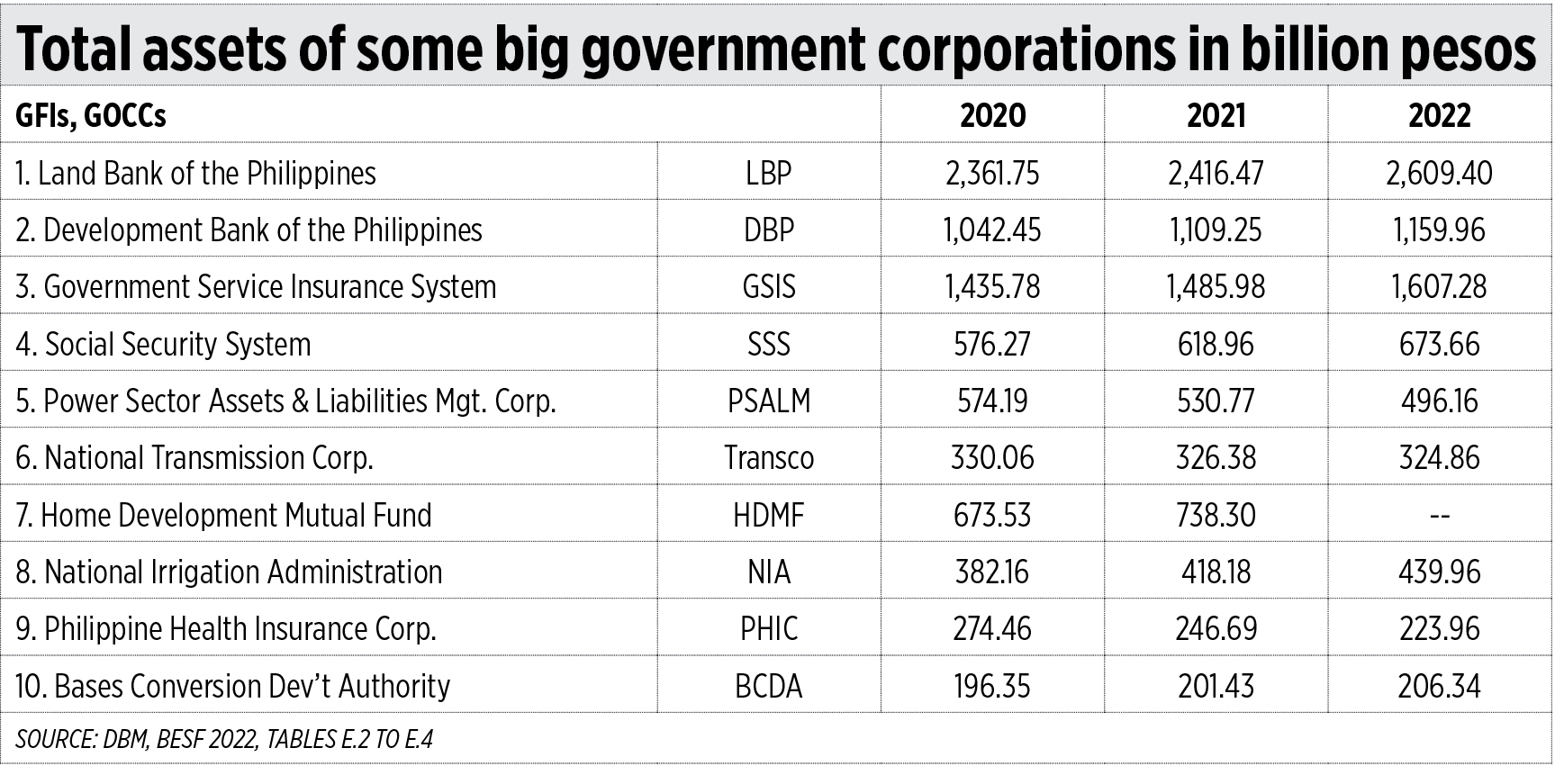
IN a Letter to the Editor yesterday, “SSS clarifies: Not a subsidy for operations,” Mr. Fernando F. Nicolas of the Social Security System (SSS) said that “the P51 billion given to SSS in 2020 was not a subsidy for the agency’s operation (but) wage subsidies to over three million workers nationwide under the Small Business Wage Subsidy (SBWS) program.”

I checked again Tables B.9 and B.11 of the Department of Budget and Management’s Budget of Expenditures and Sources of Financing (BESF) 2022 and the term used is “Budgetary support to government corporations.”

So the SSS is correct, it is “support” to member-workers and not a “subsidy” for its regular operations. My apologies to SSS for mixing them along with PhilHealth, the National Food Authority, the National Irrigation Administration, the National Electrification Administration, Bases Conversion and Development Authority, and other government corporations that just rely on taxpayers’ subsidy yearly to make them “viable.”

Now that we discuss SSS, a state-owned pension monopoly for private sector personnel, we can extend the discussion to another state-owned pension monopoly, that for government sector personnel, the Government Service Insurance System (GSIS). And why they need to be demonopolized and the pension system be made competitive. Three quick reasons.

One, people mobility needs pension mobility. The SSS was created in 1957, and the GSIS was created in 1937, periods when it was generally assumed that people would work, retire, and die in the Philippines. No longer the case now, many Filipinos work a few years here, then work abroad, and go back and forth, even migrate and retire abroad. Same for foreigners who opt to work and retire here. Their pension contributions should be credited wherever they work and retire later. Private pension and insurance firms with a global network would be in a better position to offer this kind of service.

Two, government-owned and -controlled corporations (GOCCs) and government financial institutions (GFIs) like the SSS are political institutions subject to political pressure by any administration in power. Expansion of benefits, even if revenues are not there, extension of funding even to non-contributing members and sectors, are yearly political pressures they must endure and are likely to give in to.

Three, the government needs more privatization money to service and retire huge public debt without any major tax hike. SSS, GSIS, other GFIs and GOCCs are good candidates for privatization in the long-term. SSS and GSIS combined have P2.28 trillion in assets as of 2022.

Government regulations are expanding, not shrinking. When government regulates players and owns some players at the same time, there is a conflict of interest, and favoritism towards government-owned players is inevitable. That is why demonopolization and privatization of those government enterprises should be the appropriate fiscal policy over the medium to long-term.


Read: SSS clarifies: Not a subsidy for operations, Public finance and UPSE’s PDE batch 33

5 ways to captivate your space with chinoiserie’s exotic allure

Bold patterns, intricate designs, and striking colors—chinoiserie is one of the most eccentric and maximalist interiors that offer vibrance and elegance to your home. The decorative features of chinoiserie depict a fusion of ancient Japanese and Chinese art and design cultures. Capture the authentic charm and refinement of chinoiserie with these tips from Wilcon Depot:

Wallpaper is the key

Well-furnished walls play a vital role in achieving a chinoiserie-style interior. You can often notice daring and vivid wallpapers on walls to create a lively, maximalist vibe. It encompasses different styles of vintage patterns, classic greenery, and fairytale-like elements. Decorate your walls with exquisite wallpapers from Heim. They offer a wide range of designs that best suit your home’s palette.

Yes, to birds and foliage

Another must for chinoiserie interiors are birds and foliage. Whether it be as a centerpiece, wall decor, or even furniture, these elements are essential in bringing out the chinoiserie aesthetic. Adorn your home with state-of-the-art pieces from Heim that offers a wide range of lovely embellishments to complete your space.

Opt for classic, traditional furniture

Chinoiserie is a mixture of old and new elements; and that includes the furniture. Play with your taste in design by using the unique texture of classic-themed furniture. You can choose from quality chairs, tables, and cabinets from Heim and Nobizzi. Natuzzi offers elegant, top-of-the-line sofas perfect for your comfort needs.

Glam up through colors

If there’s one thing you’re more than welcome to do, it’s layering different colors using different home items. With the right color palette, you can style your home into a stylish and whimsical space that offers a bright and modish ambiance. It’s a type of design that never goes out of style, perfect for your home’s lasting allure.

A nod to vintage flooring beauty

Unlike its walls, chinoiserie deals with more subtle flooring options. This interior design often uses wooden flooring to highlight the upper part of the room. Modernize your interior with wooden-finish tiles from Arte Ceramiche, Saigress, and Basel. These tiles are made from top-grade porcelain that is known for its durability, low maintenance material, and resistance to scratches, stains, liquids, fading, and many more.

Design your space with authentic and exotic beauty with these products you can find exclusive from Wilcon Depot.


Spotlight is BusinessWorld’s sponsored section that allows advertisers to amplify their brand and connect with BusinessWorld’s audience by enabling them to publish their stories directly on the BusinessWorld Web site. For more information, send an email to online@bworldonline.com.

Join us on Viber to get more updates from BusinessWorld: https://bit.ly/3hv6bLA.

TUMI and Razer™ team-up debuts limited-edition esports-inspired bags

This spring, international travel and lifestyle brand, TUMI, has teamed up with Razer, the leading global lifestyle brand for gamers. Together, they have reimagined TUMI bestsellers as limited-edition gear for gamers. The collaboration leverages TUMI innovation and design excellence and Razer’s iconic aesthetic and branding, which is one of the most recognized in the global gaming and esports communities.

Deepening TUMI’s footing in the esports industry, four highly anticipated, co-branded styles dropped June 3. Each piece is co-branded with Razer’s triple-headed snake logo and signature green accents, blended with TUMI DNA. 

The take-everywhere Laptop Cover 15″ securely carries a gamer’s most prized possession while the Bozeman Sling is the ultimate grab-and-go bag for stashing cords, portable gaming gear and more. Equipped with a padded laptop pocket, the Finch Backpack is designed to carry heavy-duty gear. Gamers can also slip the Add-A-Bag sleeve over the handle of the International Expandable 4 Wheeled Carry-On Luggage for a complete travel kit. Instantly recognizable as TUMI, the case features the beloved 19 Degree contours. Its shell and lining are both made with recycled materials, spotlighting both TUMI and Razer’s commitment to sustainability. Plus, it has a USB-C port to keep global citizens powered on their journeys.

Only 1,337 units of each style from this limited collection will be released around the world. “1337” or “LEET” short for “elite,” was specifically chosen as gamers and esports athletes use this to signal the most skilled gamers.

The two brands not only collaborated on the collection, but also on a forward-thinking, futuristic campaign concept that brings the capsule to life. The motion-packed video is set in the metaverse and pays tribute to the determination of gamers to carry their team to victory with the slogan, “Carry Hard”.

“We have fully embraced our esports category with the Razer partnership. We are looking to deliver new and exciting products that are truly in line with the attitude and passion of their gaming community,” said TUMI Creative Director, Victor Sanz. “Their lifestyle is something that runs parallel to how we generate our products and how we are truly focused on all aspects of our customer’s lives, looking to ensure that only the best is in their hands for them to achieve their goals.”

“We are thrilled to partner with TUMI to bring this exclusive collection to our gaming community,” says Addie Tan, Associate Director of Business Development at Razer. “We know that our fans lead active lifestyles and sometimes have to carry their valuable battle stations with them while they are on the go. So, we wanted to arm them with high quality travel gear, offering them a balance of versatility and functionality so that they can keep winning, even on the go.”

The TUMI | Razer limited-edition capsule will be available at TUMI store in Powerplant Mall and www.TUMI.ph

Retail prices of the collection: 

  • TUMI | Razer International Expandable 4 Wheeled Carry-On Luggage at Php 73,990
  • TUMI | Razer Finch Backpack – For 15” Laptop at Php 55,990
  • TUMI | Razer Bozeman Sling Bag at Php 34,990
  • TUMI | Razer Laptop Sleeve – For 15” Laptop at Php 17,990


Spotlight is BusinessWorld’s sponsored section that allows advertisers to amplify their brand and connect with BusinessWorld’s audience by enabling them to publish their stories directly on the BusinessWorld Web site. For more information, send an email to online@bworldonline.com.

Join us on Viber to get more updates from BusinessWorld: https://bit.ly/3hv6bLA.

Independence Day weekend at Las Casas Quezon City  

Independence Day, for all Filipinos, should be a day to celebrate! And we know that the offers and festivities in store this June 12 at Las Casas, Quezon City are sure to instill Filipino sense of pride.

Back by popular demand, Las Casas QC’s Independence Day Fiesta Street Party will showcase the finest of Filipino cuisine, talents, and more. Celebrate with a Pinoy street food feast or delight in a Filipino-themed buffet dinner. Enjoy entertainment by local artists and performers as you dine amidst the awe-inspiring architecture and artistry that surrounds the plaza.

Celebrate with local craft cocktails made from local liquors, local craft beers, delicacies and so much more. They have also recently relaunched a new menu showcasing classic and modern Filipino dishes and a brand-new Spanish tapas menu that is sure to delight.

For dining reservations and more information about Las Casas Quezon City, call +63917 136 6796 or +63933 822 4522 or visit www.lascasasqc.com.


Spotlight is BusinessWorld’s sponsored section that allows advertisers to amplify their brand and connect with BusinessWorld’s audience by enabling them to publish their stories directly on the BusinessWorld Web site. For more information, send an email to online@bworldonline.com.

Join us on Viber to get more updates from BusinessWorld: https://bit.ly/3hv6bLA.

Phoenix Adarna takes flight with Cebu Pacific

A mobile game–themed flight from budget carrier Cebu Pacific and Tencent Games, a China-based game publisher, features Phoenix Adarna, a PUBG Mobile character inspired by the mythical bird of the same name from Philippine literature.   

Flight 5J 573, a Manila-to-Cebu flight that departs on June 15, will be assisted and crewed by personnel wearing costumes inspired by Phoenix Adarna and other PUBG Mobile characters. 

“Tencent Games and PUBG Mobile have always wanted to partner with an airline company especially since aircrafts are recurring elements within our game,” said Noel Bernard N. Dalmacio, senior business development manager of Tencent Games Philippines, in an e-mail to BusinessWorld.

“We hope that, through this partnership, our game can be a platform to promote Filipino culture and tourism to our young audience,” he said. “We definitely foresee more collaborations with Cebu Pacific in the future — perhaps even taking the partnership higher in terms of offerings and unique experiences we’ll provide to both our markets.” 

The themed flight — a first in Philippine aviation, according to Mr. Dalmacio — includes trivia games and limited-edition PUBG Mobile x Cebu Pacific merchandise.  

PUBG Mobile is a freemium game that has over 5 million registered users, with around 500,000 daily active users in the Philippines. It has more than 500 million downloads worldwide.  

The details of the mobile game-themed flight are subject to change without prior notice. — Patricia B. Mirasol