Home Blog Page 6301

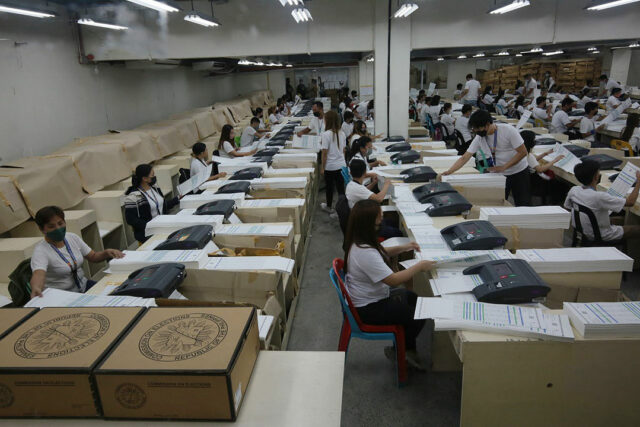
Comelec deletes ballot face database at printing office 

PHILIPPINE STAR/ MICHAEL VARCAS

THE COMMISSION on Elections (Comelec) on Wednesday deleted the ballot face information used for the May 9 elections from its database at the National Printing Office (NPO).  

“From here, we need to pull out of the National Printing Office (NPO) because Comelec’s job here has finished,” Comelec Director for Education and Information James B. Jimenez said in the live-streamed event.   

Comelec invited representatives of political parties, citizens’ arm groups, members of the media, and other stakeholders to observe the event.  

Mr. Jimenez said the deletion of ballot face information, with a backup copy kept by the Comelec, would allow the NPO’s computers to service other projects.  

A total of 67.4 million ballots were printed for this year’s national and local elections, with the NPO producing 1.1 million ballots daily.  

Ballot printing finished on April 2, earlier than Comelec’s initial target date of April 25.  

Comelec started printing in January but only allowed observers in March, citing risks of coronavirus transmission, which raised questions on transparency.    

The election body then granted the request of lawyer Romulo B. Macalintal to examine randomly selected ballots in the presence of observers to ensure the security of the printing process. John Victor D. Ordoñez 

SEC-Davao issues warning vs non-profit groups reportedly soliciting investments

THE SECURITIES and Exchange Commissions (SEC) Davao office issued a warning on Wednesday against foundations and other non-profit groups that were reportedly soliciting investments with guaranteed return through some form of assistance.  

It has reached our attention that some non-profit groups in Davao City have been brandishing their registration certificates and collecting money from the people with a promise of future benefits,the SEC extension office said in a press statement.  

It did not name the suspected groups but said the reports came from the local governments of Davao City and nearby towns and cities.   

The scheme involves inviting people to registerwith the organization for a certain amount and a future assistancewill be delivered.   

Non-stock, non-profit corporations, including foundations, are not allowed to solicit investments from the publicany form of investment solicitation without a secondary license from the Commission is illegal,it said.   

The SEC-Davao said it is already coordinating with local governments and other authorities for appropriate actionsagainst the scheme.   

It stressed that those who act as salesmen, brokers, dealers or agents of entities engaged in unauthorized investment schemescould face a penalty of up to P5 million or 21 years in prison, or both. 

P10M worth of smuggled cigarettes seized in Bataan

BUREAU OF CUSTOMS

SMUGGLED cigarettes worth P10 million were seized in Orion, Bataan on June 6, the Bureau of Customs (BoC) reported on Wednesday.  

The BoC said its Port of Limay office led the raid at a store and resort in the town based on reports of the sale of the contraband.    

The enforcement team, which included members of the police and Philippine Coast Guard, found 487 master cases of cigarettes at the site.   

BoC said the suspects, particularly the owner/s of the store and resort, will be investigated and referred to the agencys Action Team Against Smugglers “for case build-up and possible prosecutionfor violation of the Customs Modernization and Tariff Act (CMTA). Tobias Jared Tomas

Homebound

PCG

MEMBERS of the Philippine Coast Guard, police, and military assist residents of Juban town in Sorsogon on June 8 as they prepare to go home after evacuating Sunday following Mt. Bulusan’s eruption. There were 121 families composed of 418 individuals who evacuated due to ashfall, based on data from the Social Welfare department. Alert level 1 was still up for the volcano, which means a low level unrest.

A 70s Cabinet

PRESIDENT Ferdinand E. Marcos, Sr. and First Lady Imelda R. Marcos with his cabinet members. — PHOTO FROM I SHOT THE PRESIDENT BY HONESTO VITUG / PRESIDENTIAL MUSEUM AND LIBRARY PH (2010-2016)

In the 1970s, then President Ferdinand Marcos moved to create what was then perceived as a technocratic government, perhaps envisioning a “New Society” government run by “technical” experts more than politicians. He thus appointed to his Cabinet many specialists recognized in their respective fields, including known economic and management experts.

It is thus unsurprising that his son and namesake, president-elect Ferdinand Marcos, Jr., appears to now have the same tactic in mind. Perhaps in an attempt to help renew local and foreign investor confidence in the Philippines in this pandemic era, the president-elect will be joined in his incoming administration by technical experts, many of whom have public sector experience.

Senate President Pro Tempore Ralph G. Recto even referred to Mr. Marcos Jr.’s incoming economic team as “premium investment grade” as it consisted of highly regarded professionals who have “the vision to chart our progress and the virtues of hard work and honesty to grow our economy” in the post-COVID era.

“There is no better crew to oversee the drafting of [the] guide out of the economic doldrums inflicted by the pandemic than this A-team,” he added, referring to Benjamin Diokno (Finance), Arsenio Balisacan (the National Economic and Development Authority or NEDA), Alfredo Pascual (Trade and Industry), Mina Pangandaman (Budget) and Felipe Medalla (Bangko Sentral governor). Add to this list Bienvenido Laguesma (Labor).

All these professionals have served in the bureaucracy previously, in various capacities. Moreover, there is very little doubt as to their expertise in their respective fields as well as their professionalism. They all have impeccable and unquestionable academic and professional credentials and have remained untainted by political or personal scandals.

Incidentally, there are several ties that bind some of the appointees: their connection to the University of the Philippines (UP) School of Economics in Diliman, and their links to the Estrada Administration (1998-2001). In this line, perhaps if he had lived long enough, former Health Secretary Dr. Alberto “Quasi” del Gallego Romualdez, Jr. may have been reappointed to the Department of Health as well. Quasi was Health Secretary in 1998-2001.

But then, having been born in 1940, Quasi would have been 82 by now. And this brings me to my concern regarding the present economic team: it is a 70s Cabinet — incoming senior officials aged 70 and above. While I personally consider technical experts in their 70s just as competent and capable as those younger than them, stressful government work can take its physical toll on a person.

And, while one cannot discount these seniors’ intellectual prowess, wisdom, and experience, their physical well-being is just as important a factor to their capacity to do work. I am uncertain whether all of them will manage to finish their respective terms in 2028. Now, more than ever, there should be consistency and continuity in policy, management, and leadership.

Benjamin Estoista Diokno of Taal, Batangas was born in March 1948 and is now 74 years old. He was supposed to end his public service in 2023 as he finishes his term as governor of the Bangko Sentral ng Pilipinas (BSP). But, rejoining the Cabinet gave him a new lease on public life. Assuming he gets to complete his service as Secretary of Finance until the end of the Marcos II Administration in 2028, he will be 80 by the time he steps down from public service.

Prior to becoming Bangko Sentral governor, he was Budget Secretary during the Duterte and Estrada administrations, and Budget undersecretary during the Aquino I Administration. He started in government in 1986, more than 36 years ago. He is also a Professor Emeritus of the School of Economics of the University of the Philippines-Diliman. Mr. Diokno has been around long enough that his experience and institutional memory are not something to disregard. However, is he physically up to the challenge of staying in office until 2028? Is he actually looking at staying on beyond 2025?

Turning 74 years old this July is Alfredo Espinosa Pascual, who was also born in 1948. He is an international development banker and finance expert, and served as the 20th President of the University of the Philippines System from 2011 to 2017. He took up Chemistry at UP, and had taught at its College of Science for a while. He later worked for Procter & Gamble, Bancom Development Corp., Philippine Pacific Capital Corp., and First Metro Investment Corp. In 1989, he moved to the Asian Development Bank (ADB), where he stayed until his appointment as UP president in 2011.

Mr. Pascual’s experience in the private sector as well as ADB will serve him well at the Department of Trade and Industry starting on July 1. His stints at UP and the International Rice Research Institute (IRRI), and his involvement with FINEX and the Management Association of the Philippines, will be a major factor in forging future public-private partnerships.

Just a couple of years younger than Messrs. Diokno and Pascual is Felipe M. Medalla, who was born in 1950 and is now 72 years old. He was Socioeconomic Planning Secretary under President Estrada, and currently an incumbent member of the Monetary Board of the Bangko Sentral ng Pilipinas. He will assume the BSP governorship from Mr. Diokno, his contemporary at the University of the Philippines School of Economics, where Mr. Medalla used to be Dean.

Incoming Labor Secretary Bienvenido E. Laguesma was born in 1950 and is turning 70 this October. Laguesma finished his law degree in Ateneo de Manila University in 1975. He started working at the Ministry of Labor and Employment in the 1970s during the Marcos I Administration. He was Labor Undersecretary from 1990 to 1996, and then Labor Secretary from 1998 to 2001 during the Estrada Administration. He was also the commissioner of the Social Security System during the Aquino II Administration.

Lowering the average age of the economic team considerably is BSP Assistant Governor Amenah “Mina” Pangandaman, who is incoming Budget Secretary. Pangandaman holds a degree in Economics from the Far Eastern University, and a diploma and master’s degree in Development Economics from the University of the Philippines. She is also finishing her Executive Master of Public Administration from the London School of Economics. She was Budget undersecretary during the Duterte Administration. She also served as chief-of-staff to the late Senate President Edgardo Angara, who was Agriculture Secretary during the Estrada Administration.

But, the youngest among the seniors is Arsenio Molina Balisacan, who was born in Solsona, Ilocos Norte in November 1957. He will turn 65 this year, and will be 72 by the time the Marcos II Administration ends. Prior to his impending reappointment to NEDA by President Marcos Jr., he was the first head of the Philippine Competition Commission.

Mr. Balisacan is no stranger to government, having been Socioeconomic Planning Secretary during the Aquino II Administration, and Agriculture Undersecretary for Policy and Planning during the Estrada and Arroyo administrations. He is also a former professor and dean of School of Economics of the University of the Philippines Diliman.

Being the youngest senior in the economic team, I reckon Mr. Balisacan can stay in the Cabinet the longest among all of them. He is a marathon runner, after all. And this drives my point. The work the government faces now is not for sprinters but for long-distance runners. There is much to be done until 2028. And in this regard, I believe that age does matter.


Marvin Tort is a former managing editor of BusinessWorld, and a former chairman of the Philippine Press Council

matort@yahoo.com

Wordle, BeReal and even Facebook: Apps get less addictive

NILS HUENERFUERST E-UNSPLASH

How did Facebook become a business worth $1 trillion at one point last year? Not just by fulfilling its mission of “connecting people,” but by keeping them hooked on the site, sometimes for hours on end.

Facebook parent Meta Platforms, Inc., Alphabet, Inc.’s YouTube, and Twitter, Inc. have spent years perfecting the art of building habit-forming products, whether through the social affirmation of “likes,” the allure of a never-ending newsfeed, or the way YouTube hits your dopamine receptors each time it recommends a new video.

Guillaume Chaslot, an engineer who left Google in 2013 after helping to design YouTube’s recommendation algorithm, remembers being told to program it to encourage larger amounts of time spent by people on the site. “When you optimize for time spent, then you optimize for addiction,” he says. “At the time, I did not even realize that.”

But now, several years into a broad backlash against Big Tech platforms over their safety, more consumer internet services seem to be disregarding the pressure to be “sticky,” in Silicon Valley parlance, or to reward attention-seeking behavior. It’s a promising trend.

Some of these services are actually taking off with consumers.

BeReal is a social app developed in France where all users are told to post a photo of themselves and their surroundings at one randomly appointed time each day. Instead of perfectly angled selfies on the beach, you get double chins, laptop keyboards, and crowds of bus commuters — in other words, the mundane moments of everyday lives. As of May 2022, BeReal had been downloaded more than 10 million times and is growing steadily among teens and college students in the US, UK and France, according to app analytics firm data.ai.

There are no beautifying filters, and BeReal discourages staged photos. “It isn’t showing fake lives like some Instagram influencers present,” says Alice, a 15-year-old in London who started using BeReal in April after a friend recommended it.     

Perhaps more importantly, BeReal isn’t as addictive as Instagram. You only really need to look at the app once a day, when a flood of new photos gets added. I’ve been using BeReal for several months and find it hard to ignore the app’s two-minute alerts for everyone to post a photo, but I’m not hooked on BeReal in the same way I’m compelled to look at Twitter multiple times throughout the day.   

The once-a-day routine is also what has driven tens of millions of people to play Wordle, the hit puzzle game now owned by New York Times Co. that updates itself daily, and which encourages players to share yellow-and-green grid emojis of their results.

Instead of building a constant itch to be checked 24/7, both BeReal and Wordle create anticipation. Instead of showcasing content, the apps encourage a unique, fleeting daily practice that connects users with others.

Both web services could be fads, of course. Remember the apps Dispo, YikYak, and Peach? If not, that’s because social media and internet platforms are a fickle business, filled with flameouts that couldn’t attain long-term appeal with consumers.

But Wordle and BeReal’s current success also comes alongside a broader cultural change: a hardening awareness among consumers, and among teens and 20-somethings in particular, of the psychological risks of spending a lot of time on social media. That knowledge has compelled Gen Z to pioneer finsta accounts on Instagram to post more private and authentic photos for their close friends, or to start trends like #filterdrop.

Ironically, the biggest company ditching the dopamine model may be Facebook itself.

If you find that hard to believe, consider that the metaverse, which Meta Chief Executive Officer Mark Zuckerberg is pivoting his entire company toward, doesn’t seem to have much addictive potential. For one, entering virtual reality is cumbersome. After strapping a headset like the Oculus Quest 2 to your face, you wait several minutes while a game like Beat Saber loads on the headset which, speaking from my own experience of regularly using a Quest 2, becomes noticeably heavy and uncomfortable after about an hour.    

VR headsets are destined to get lighter and more comfortable. But they will still require far more intention than glancing at a phone and casually thumbing a screen. Various studies have shown the average American checks their phone between 50 and 100 times each day. That probably won’t be the case with the metaverse, even when VR devices become sleeker.

That is also because visiting VR requires setting time aside to immerse yourself in a virtual space with the same kind of intent you would have to sit down and watch TV in the evening. It’s a different story with so-called augmented reality, where information is overlaid onto your view of the real world, and which seems more likely to become addictive with its much more seamless transition between real and digital spaces.

“Using the metaverse takes time — being able to log on, and just the amount of focus you have to spend,” Wagner James Au, author of The Making of Second Life, told me in February. “It takes a lot of time and attention.” You can’t, for instance, watch a movie and simultaneously check into the metaverse in the same way you might check your Facebook newsfeed during dull moments of dialogue.

It’s true that 20 years ago the internet’s early skeptics argued that getting online was too complicated to plug into our daily lives. But I still don’t buy Facebook’s vision that people will spend large chunks of their day working, socializing, and playing in the metaverse, because the transition from an all-encompassing virtual reality to our physical reality is clunky.

The metaverse being built by Facebook has serious problems that need ironing out. There have been incidents of harassment, creepy behavior, and a worrying number of children visitors. And Facebook whistleblower Frances Haugen has warned that the metaverse will be habit-forming in the future. But I expect it to be about as addictive as computer games, which have been shown to have narrower incidents of addiction disorder, potentially affecting 0.3% to 1% of the population of the US, UK, Canada, and Germany, according to one 2016 study.

In fact, not only are people not finding themselves lured back to the metaverse over and over as they have with Facebook, metaverse evangelists aren’t, either. “Very few of them actually use the metaverse with the degree of frequency that they say we’re all going to be using it,” Au noted.

The moral paradox of Facebook is that its addictive quality has led to both widespread harm and astonishing financial success. Meta earned $39.4 billion in profit last year, on sales of $117 billion. Its founder is currently the world’s 15th richest person. But its future money-making potential with the metaverse is an open question when putting on a VR headset doesn’t hit the same dopamine reward pathways in our brains as glancing at a smartphone dozens of time each day.

How will Meta attain the same level of ad revenue from the metaverse if people aren’t visiting it anywhere near as frequently as Facebook or Instagram? That question may be fueling broader skepticism about the metaverse’s future business potential: Meta’s shares have sunk 43% since the start of the year, a sharper decline than Alphabet (down 22%) and Amazon, Inc. (down 23%) in the latest tech market rout.

The metaverse will continue to cost Zuckerberg’s company billions of dollars, but when it comes to creating digital junkies out of us all, Meta and other new apps like BeReal seem to be going in a healthier direction.

BLOOMBERG OPINION

SSS clarifies: Not a subsidy for operations

WE WANT to thank you for your support in helping the Social Security System (SSS) further raise the awareness of our members and the general public through the publication of stories about SSS.

However, we would like to clarify one of the statements in the column article by Bienvenido S. Oplas, Jr. entitled, “Public finance and UPSE’s PDE batch 33,” published in BusinessWorld today, June 7, 2022 (https://bit.ly/Oplas060722).

Mr. Oplas discussed the “three elephants in the room” in public finance in the article. One of which is the endless subsidies to government corporations and financial institutions. He cited SSS as an example after the national government gave SSS P51 billion in 2020.

We want to inform him that the P51 billion given to SSS in 2020 was not a subsidy for the agency’s operation. The amount was intended and paid for the wage subsidies to over three million workers nationwide under the Small Business Wage Subsidy (SBWS) program.

SSS only served as the primary conduit for releasing the wage subsidies to workers of small businesses.

The SBWS is a joint program by SSS, the Department of Finance (DoF), and the Bureau of Internal Revenue (BIR) that provided wage subsidies to workers affected by COVID-19. It extended financial assistance to small and medium business enterprises affected by the pandemic and the nationwide enhanced community quarantine from March 2020 onwards, which affected the employment of those working in the private sector.

Workers of small businesses who lost their income while their respective areas were under enhanced community quarantine (ECQ) received a wage subsidy in two tranches ranging from P5,000 to P8,000, based on their respective areas of residence.

We want to emphasize that SSS is not receiving any subsidy from the national government for its operation. SSS remains financially viable in providing benefits to its stakeholders and is not on the verge of bankruptcy.

In this regard, may we kindly request to rectify the statement to avoid misconceptions from our members and employers that the national government is subsidizing SSS.

Thank you for the opportunity to clarify this matter.


Sincerely yours,
Fernando F. Nicolas
Vice-President, NCR North Division Concurrent Acting Head,
Public Affairs and Special Events Division


Read: Replying to SSS: Demonopolize social security

More uncertainty?

COMMISSION ON ELECTIONS (Comelec) Chairman Saidamen Balt Pangarungan cast his vote during local absentee voting (LAV) held inside the Comelec office in Intramuros, Manila, April 27. — PHILIPPINE STAR/KRIZ JOHN ROSALES

It is clear that the bypassing of the confirmations of interim Commission on Elections (Comelec) Chairman Saidamen Balt Pangarungan and Comelec Commissioner George Garcia by the Commission on Appointments (CA) were politically motivated.

This was the response of former Senate President and Minority Floor Leader Franklin M. Drilon, when asked about the probable reasons for the bypassing of the confirmation of the two competent gentlemen from Comelec. We interacted with them during their short tenure at Comelec and we noted their forthrightness and approachability. A third commissioner, Aimee Torrefranca-Neri was also bypassed.

It is, however, perfectly clear and understandable that political appointments like Comelec chairman and Commissioners become…. well, political. It is important that the President of the Republic will have, at the very least, some access or influence, and with politics at its worst, control over his/her appointees in an independent Constitutional agency that manages and administers elections.

The bypassing of the confirmation of Pangarungan and Garcia was achieved simply by the House contingent of the CA not showing up. Their absence prevented the achievement of a quorum. There was therefore no basis for conducting further business.

One ally of Ferdinand Marcos, Jr. however said that it was only right to bypass the confirmation of the three remaining unconfirmed commissioners to give the incoming president “leeway” to get people of his choice and confidence. On the surface, one can say, there is nothing wrong with that, for as long as the power to appoint is used judiciously. Stakeholders have a fair idea of what Comelec needs to do to gain the trust of the people. Civil society groups know what expertise the poll body needs for it to address shortcomings that compromise transparency and being a truly rule-based agency.

The bypassing of the confirmation of Pangarungan and Garcia, further stresses the point that Marcos Jr., although an ally of Rodrigo Duterte and Sara Duterte, will make decisions to achieve his own objectives.

What are Marcos Jr.’s primordial objectives? He said it himself in a campaign interview: “to protect himself” and, most likely, his family, his family’s resources, his father’s legacy. And appointing his own people at the Comelec is ultimately in support of that objective.

Marcos Jr.’s oathtaking at the National Museum is also part of the fulfillment of that objective of promoting, protecting, and defending the legacy of Marcos Sr., whatever that may be in his and his millions of supporters’ eyes. It must be noted that the National Museum was the old Congress. Marcos Sr. started his political career as congressman of the second district of Ilocos Norte from 1949 to 1959 in that same building — which he locked up on Sept. 23, 1972 when he declared Martial Law. Marcos Sr. launched his presidential ambitions from the Senate after being elected Senator in 1959. By 1961, he wanted to be President and had attempted to wrest the Liberal Party nomination for President from then Vice-President Diosdado Macapagal. Marcos Jr. is merely retracing the footsteps of his father.

The formation of Marcos Jr.’s Cabinet, particularly with respect to the economic team, could also be said to follow the same path as Marcos Sr. Marcos Sr. appointed technocrat-academicians-corporate executives like Cesar Virata, Jr., Placido Mapa, Gerry Sicat, Jaime Laya, Vicente Paterno, Rafael Salas, and Alejandro Melchor, to name a few.

Marcos Jr. has recently announced the appointment of a number of Cabinet members who will form the economic team. All members of the economic team have spent time at the University of the Philippines (UP) School of Economics: former National Economic and Development Authority (NEDA) Director-General and Planning Secretary Felipe Medalla; Dr. Arsenio Balisacan, also a former NEDA Director-General and Planning Secretary; Benjamin Diokno, soon to vacate his position as Bangko Sentral ng Pilipinas Governor; and Alfredo Pascual, former President of the University of the Philippines, Secretary of the Department of Trade and Industry.

The scuttlebutt is that Marcos Jr. and his inner circle were in a bit of a panic mode to publicly announce his team of economic managers in light of the negative impact his then-forthcoming victory was having on the international financial market. JP Morgan had quickly downgraded the credit rating of the Philippines. There was a feeling of foreboding and general unease with what appeared to be a clear victory for a candidate who still had to reveal his plans. After all, it is not easy to erase the memories of Martial Law, despite the organized and well-funded efforts at historical revisionism and falsification. In addition, candidate Marcos Jr. snubbed all the Comelec-organized and sanctioned presidential debates, obviously in order to avoid embarrassing questions about Martial Law, his academic credentials, work record as an elected public official, and details of his program of “Unity.” In short, there was a black hole that remained unfilled and that was creating damaging uncertainty.

What made naming his economic team more urgent was that a congressional proclamation of his victory was imminent and to be proclaimed without names and faces of the economic team would further aggravate the uncertainty.

Speaking of uncertainty during this period, one reflects on veteran journalist Vergel Santos’ comment on “incoming press secretary Trixie Angeles’ announcement that she will accredit bloggers to cover Ferdinand Marcos Jr.’s presidency. The idea is dangerous. It tends to legitimize the false impression that bloggers are journalists, and as such, part of the institution that the democratic constitution assigns as the people’s watchdog on government — the press.”

Santos is emphatic, “Blogging is not journalism, not even in the loosest sense. It’s a cheap, individualistic, free-wheeling operation. One need not train for it, and anyone can go into it. It’s not unlike going on a soapbox and shooting one’s mouth off. Journalism, on the other hand, is both a profession and a trade, governed by both ethical and moral standards and rules of practice. Journalists are trained in certain disciplines and skills, and their works go through layer upon layer of specialist vetting — for truthfulness, not to mention technicalities of craft and law — before being put out there for all the public to see.”

Santos further emphasizes his point with a metaphor: “For a graphic distinction: Journalism is a piloted train; blogging is a runaway one.”

Santos ends with both a piece of advice and a warning: “Legit journalists must rethink their journalism. The new landscape does not favor them.”

More uncertainty?


Philip Ella Juico’s areas of interest include the protection and promotion of democracy, free markets, sustainable development, social responsibility and sports as a tool for social development. He obtained his doctorate in business at De La Salle University. Dr. Juico served as secretary of Agrarian Reform during the Corazon C. Aquino administration.

Consuming passion

RAWPIXEL.COM

THE MOST AMAZING phenomena in the previously waged campaigns (they seem such a long time ago) were the pink rallies: a joyous combination of a Woodstock rock concert, street party, town fiesta, religious revival, creative initiative, comic relief, and peace march. They became a numbers contest, this one bigger than the previous, with drone shots of tightly packed bodies computed per square meter of available space as of a certain time (without counting joiners and leavers throughout).

The rallies epitomized the volunteer spirit of attendance in big numbers, with free food, medic support, toilet facilities, and bottled water provided by various anonymous donors and, yes, no cash incentives in envelopes handed out: “hindi kami bayad.” And best of all, the rallyists cleaned up after themselves.

It seemed like the road to victory. And maybe it was.

Should that be the end of a stirring demonstration of volunteerism and generosity of spirit that had brought out the best of our bayanihan culture and its passion to do good? This celebration of kinship, unity for the nation, and cheering for a cause cannot be wasted.

While the daily announcements of appointments to the cabinet garner instant media attention, and, yes, much genuine support, there is little fanfare attending anyone relegated to the private sector — Sir, you’re already part of it.

The bayanihan spirit so recently rediscovered can be rechanneled.

The GDP which economists track quarterly for growth to gauge the health of the economy and the country is made up of 65% consumption. The other two components in “C+I+G” are Investments and Government spending (Build, Build, Build). Consumption is driven by the private sector and occasionally boosted by individuals working in the public sector, with unexplained purchasing power for expensive watches and cars — I was surprised to see a Porsche parked in my garage.

An individual with an explainable source of income for which proper taxes are paid also contributes to the rise in GDP through the passion to consume (buy, buy, buy). This is sometimes called “retail therapy.” Economists in their dry language refer to it as a “propensity to consume.” This is defined as “the proportion of total income or of an increase in income that consumers tend to spend on goods and services rather than save.” Thus does the propensity to consume eat into the propensity to save.

For the post-pandemic economy (referring to COVID, and not any political outcome) there is a more relaxed protocol after the lockdown regimes.

When people are allowed out of the house to, yes, get back to the office, the propensity to consume rises. Those with still enough purchasing power (and restored representation expenses) can treat clients in dining out. (Please remove your mask when eating.)

Maybe, with the new set of bureaucrats driving regulation and the public sector, there is a new round of law firms and powerbrokers to get acquainted with. The changing of the guard at the political level spills over to the private sector. Mergers and acquisitions are just a higher form of consumption, if only for the meetings with the consumption of alcohol and roasted duck these will generate.

Other more normal consumer behaviors follow, like buying clothes to adjust to the WFH waistlines. While some continue to hang on to their pajamas and leisure wear so useful for virtual meetings, more offices and clients are moving to Face-to-Face (FTF) meetings where lower wear needs to be employed.

Domestic travel too will rise, when one no longer needs to deal with checkpoints and pre-registration of local visits. Even foreign travel gets into the GDP with the purchase of airline tickets and maxing out of credit cards.

Consumption is also bumped up by inflation, as in the case of fuel where the same number of liters cost more than a month before. (Sometimes, they are adjusted downwards too.) Inflation affects other necessities like food, utilities, and transportation.

So, can the consuming passion of the rallies be leveraged into the propensity to consume to boost GDP? Will the bayanihan fervor translate into the desire to make the country succeed even with another leader?

Is there really a choice between changing the country for the better… or changing to a better country? Some have already made that decision. Hopefully for most, it’s the first option they decide on. Anyway, it is more fun in the Philippines, with more surprises… some of them pleasant.


Tony Samson is chairman and CEO of TOUCH xda

ar.samson@yahoo.com

Hong Kong is still most expensive city for expats

HONG KONG is the world’s most expensive city to live in as an expat for the second year in a row, according to a new study. New York and Geneva took second and third place in the rankings.

Higher prices and a stronger currency over the past year kept the Asian city at the top of the tree, according to ECA International, which carried out its research in March this year. London and Tokyo round out the top five.

Soaring rental costs were part of the reason London and New York took their positions in the top five, with rent in those cities rising 20% and 12% respectively.

Elsewhere in the Cost of Living report, Singapore stayed in 13th place despite significant rises in rent, petrol prices and utilities. Those were offset by the Singapore dollar weakening against other regional currencies during the latter part of the survey period, ECA said. Japanese cities all fell down the ranks as the yen weakened, while Chinese cities rose — with Shanghai and Guangzhou taking 8th and 9th positions respectively — on a stronger yuan.

Here are some more of the survey’s findings:

Petrol prices climbed on average 37% compared to a year earlier across all cities, while Beirut recorded a 1,128% increase.

Turkey’s Ankara is the cheapest city in the world for expats, after falling five spots to 207th place

War in Ukraine saw cooking oil prices rise an average of 25% last year across cities in the ranking.

Tehran’s fuel prices were cheapest, with a liter of petrol costing just $0.09.

A cup of coffee at $5.21, a liter of petrol at $3.04 and a kilo of tomatoes at $11.51 were just a few of the prices that took Hong Kong to the top of the list.

“Although Hong Kong has been impacted by rising global inflation less than other regional and global locations in the past year, it nonetheless remains the most expensive location in the world,” a press release quoted ECA International’s  Regional Director for Asia, Lee Quane, as saying.

“It has been the strength of the Hong Kong dollar, which is pegged to the US dollar, in the past year which has enabled it to maintain its position as the most expensive location worldwide as other currencies have weakened.”

ECA International analyzes the cost of consumer goods and services in more than 490 locations worldwide, while accommodation data is also factored in, comparing rental costs in areas typically inhabited by expatriate staff in over 410 locations worldwide. The latest report ranks 207 cities in 120 countries. — Bloomberg


HERE are the world’s top 20 most expensive places for expats (with the March 2021 ranking in parentheses):

Hong Kong (2021 ranking: 1)
New York, US (4)
Geneva, Switzerland (3)
London, UK (5)
Tokyo, Japan (2)
Tel Aviv, Israel (7)
Zurich, Switzerland (6)
Shanghai, China (9)
Guangzhou, China (10)
Seoul, South Korea (8)
San Francisco, US (15)
Shenzhen, China (12)
Singapore (13)
Beijing, China (16)
Jerusalem, Israel (18)
Bern, Switzerland (17)
Yokohama, Japan (11)
Copenhagen, Denmark (14)
Oslo, Norway (19)
Taipei, Taiwan (21)

S.Korea, US, Japan lambast N.Korea missile tests, urge return to talks

KCNA VIA REUTERS

SEOUL — North Korea’s recent missile tests were “serious, unlawful” provocations, senior officials from South Korea, the United States and Japan said on Wednesday, urging Pyongyang to return to dialogue and accept offers of coronavirus disease 2019 (COVID-19) aid.

South Korea Vice Foreign Minister Cho Hyun-dong, US Deputy Secretary of State Wendy Sherman and Japanese Vice Foreign Minister Takeo Mori made the comments as they gathered in Seoul, three days after North Korea conducted the latest in a series of missile tests.

The three-way meeting of the countries’ No. 2 diplomats, the first such gathering since November and the first since South Korea’s President Yoon Suk-yeol took office in May, highlighted the urgency and gravity of North Korea’s intensifying weapons tests.

Mori’s visit also marked such trip by the Japanese vice foreign minister since late 2017 amid strained bilateral ties over issues including Japan’s occupation of the Korean peninsula and war-time labor.

Seoul and Washington officials have said North Korea is ready for what would be its first nuclear test since 2017, which Sherman has said would trigger a strong and clear response.

The trio urged Pyongyang to abide by international sanctions and immediately cease actions that “escalate tensions or destabilize the region,” a joint statement said.

They also pledged to ramp up trilateral security cooperation to curb the North’s threats, with Sherman reaffirming the US defense commitments, including extended deterrence.

“They stressed that a path to serious and sustained dialogue remains open and urged the DPRK to return to negotiations, while also expressing their hope that the DPRK will respond positively to international offers of assistance to fight against COVID-19,” the statement said, referring to North Korea by its the initials of its official name, the Democratic People’s Republic of Korea.

North Korea has carried out at least 18 rounds of weapons tests this year, underscoring its evolving nuclear and missile arsenals.

In its latest test, North Korea fired eight short-range ballistic missiles, likely its largest single launch, a day after South Korea and the United States ended joint military drills involving an American aircraft carrier.

The allies launched eight surface-to-surface missiles on Monday in their own show of force responding to the North’s test.

South Korea’s President Yoon Suk-yeol, who took office in May, and US President Joseph R. Biden vowed at their recent summit to deploy more US strategic military assets as part of efforts to bolster the extended deterrence.

North Korea has been grappling with its first confirmed coronavirus outbreak since last month. It has reported more than 4.2 million patients with fever symptoms among its 25 million population, but never confirmed how many tested positive for the virus, lacking in test kits and medical supplies.

Seoul and Washington said they had respectively offered COVID aid but Pyongyang did not respond, even as the World Health Organization warned of a worsening COVID-19 situation there.

“The United States remains prepared to meet the DPRK without preconditions and we iterate again, we have no possible intent toward the DPRK,” Sherman told a joint news conference. — Reuters

Novavax COVID shot, aimed at vaccine skeptics, overwhelmingly backed by FDA panel

REUTERS

ADVISERS to the U.S. Food and Drug Administration on Tuesday voted overwhelmingly to recommend that the agency authorize Novavax Inc’s COVID-19 vaccine for use in adults, which the drugmaker hopes can become the shot of choice among some American vaccine skeptics.

The panel of outside vaccine experts voted 21-0 with one abstention in favor of the vaccine for those 18 and older after discussing whether the shot’s benefits outweigh risks, including rare occurrences of heart inflammation that may be associated with the vaccine.

If the FDA follows the recommendation and authorizes the shot, it will be the fourth COVID vaccine available for use in adults in the United States. The FDA has approved previous COVID shots within days of panel votes, with distribution quickly following.

The timeline for Novavax is not clear.

Novavax Chief Commercial Officer John Trizzino said the agency is still reviewing documents detailing its manufacturing processes submitted last week.

“We hopefully expect to have product in the U.S. in our warehouse by the end of June,” he said in an interview, adding that the company plans to ship millions of doses made by its partner, the Serum Institute of India, soon after authorization.

Novavax’s shot, which is already available in over 40 countries, is a more traditional type of vaccine employing technology that has been used for decades to combat diseases like influenza.

Maryland-based Novavax is hoping to gain a foothold within the roughly 27 million U.S. adults who are yet to be vaccinated, particularly those who do not want to receive a vaccine like the Pfizer PFE.N/BioNTech or Moderna Inc shots based on groundbreaking messenger RNA (mRNA) technology.

“We do have a problem with vaccine uptake that is very serious in the United States,” FDA official Peter Marks told the panel.

“Anything we can do to get people more comfortable to be able to accept these potentially life-saving medical products is something that we feel we are compelled to do,” he added.

However, that demand has not materialized in Europe, where Novavax also said it could drive up vaccination among the hesitant.

Around 12.6 million doses of the vaccine have been distributed in the European Union, but only around 220,000 doses of the two-shot inoculation have been administered there since it was launched in December.

A Department of Health and Human Services (HHS) spokesperson noted that supply is likely to be limited in the near term.

Before shots can be administered, the FDA must authorize the vaccine and the Centers for Disease Control and Prevention (CDC) needs to green light its use.

HHS said in a statement on Monday that it is coordinating with Novavax “to receive a limited quantity of vaccine and will make that vaccine available to the American public” once those steps are complete. A CDC panel may consider the Novavax shots late next week.

Novavax filed for U.S. authorization in late January, almost a year behind its original plan, following development and manufacturing problems. — Reuters