Home Blog Page 6295

Converge’s new appointee to deliver ‘pervasive Gigabit access to all’

CONVERGE ICT Solutions, Inc. announced on Tuesday the appointment of digital transformation expert Paulo Martin G. Santos — a former vice-president for enterprise communication, collaboration, and security in a bank — as its chief network transformation officer.

”I’m eager to bring my years of experience in network infrastructure management to Converge, as it aims to bring world-class connectivity to unserved and underserved Filipinos. With a robust network, we will transform our network operations to deliver pervasive Gigabit access to all Filipinos,” Mr. Santos said in an e-mailed statement.

At UnionBank of the Philippines, Mr. Santos developed partnerships with Huawei Technologies Co., Ltd. and Globe Telecom, Inc. to implement the first fifth-generation (5G)-enabled “bank on wheels,” a mobile concept branch of the bank.

He transformed the bank’s network infrastructure to a “cloud-ready software defined network,” Converge said.

Mr. Santos also founded WiFi Nation PH, a startup offering wireless connectivity solutions, the company added. It was acquired by Smart Communications, Inc.

It added that as head of digital transformation strategy at PLDT, Inc.’s strategy office, Mr. Santos was responsible for building the strategic road map for digitizing corporate operations and customer experience across the PLDT group of companies.

Converge Chief Executive Officer and Co-Founder Dennis Anthony H. Uy said: “We’re building a strong team in pursuit of our vision to become a world-class organization. We’re glad to have onboard a young, tech-savvy executive to transform our network operations.” — Arjay L. Balinbin

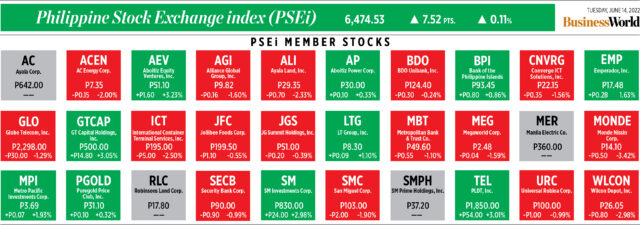
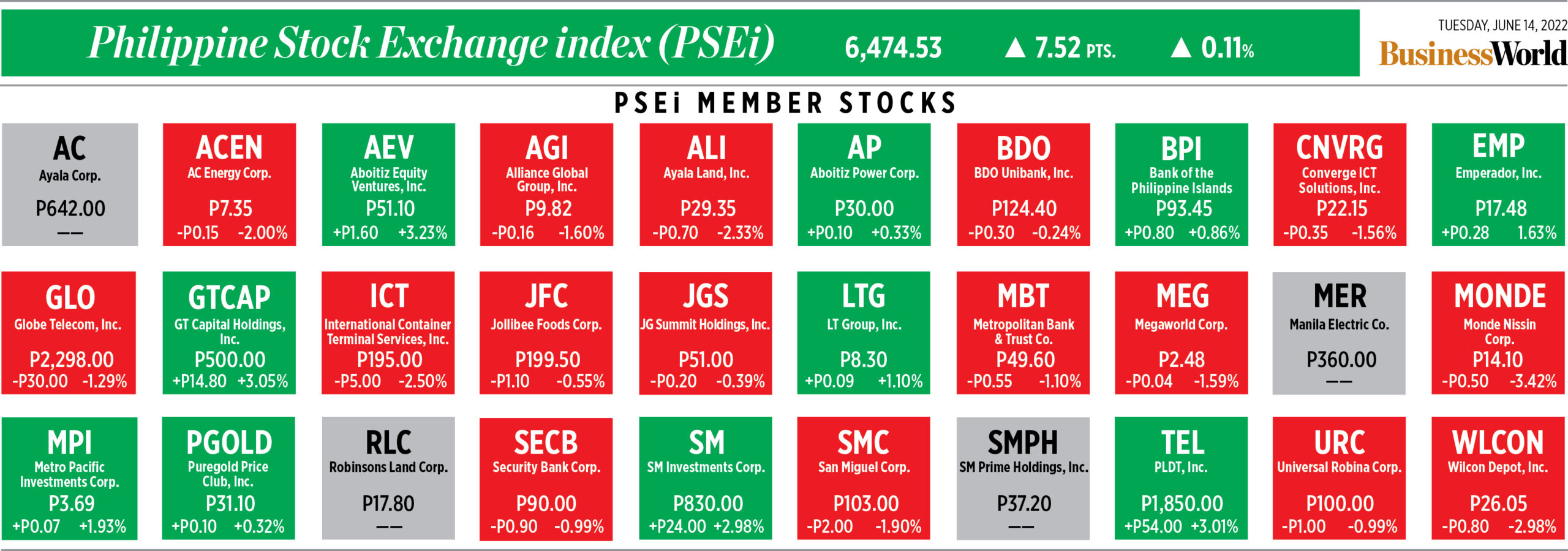
How PSEi member stocks performed — June 14, 2022

Here’s a quick glance at how PSEi stocks fared on Tuesday, June 14, 2022.


Peso rebounds vs dollar on positive sentiment

BW FILE PHOTO
THE PESO gained against the dollar after three straight days of closing lower. — BW FILE PHOTO

THE PESO rebounded against the dollar on Tuesday, correcting after three straight days of decline on positive market sentiment as the benchmark stock index rallied.

The local unit closed at P53.25 versus the greenback on Tuesday, gaining five centavos from its P53.30 finish on Monday, data from the Bankers Association of the Philippines showed.

The peso opened Tuesday’s session at P53.28 against the dollar. Its weakest showing was at P53.40, while its intraday best was at P53.13 versus the greenback.

Dollars exchanged rose to $1.16 billion on Tuesday from $685.2 million on Monday.

The peso’s rebound was a healthy correction after weakening for three straight trading days and was partly due to gains seen in the local stock market that defied recent declines in US markets, Rizal Commercial Banking Corp. Chief Economist Michael L. Ricafort said.

The benchmark Philippine Stock Exchange index slightly went up by 7.52 points or 0.11% to close at 6,474.53 on Tuesday. Meanwhile, the broader all shares index declined by 3.88 points or 0.11% to 3,471.05.

For Wednesday, Mr. Ricafort expects the peso to range between P53.10 and P53.30 versus the greenback. — KBT

PSE index rises on last-minute bargain hunting

BW FILE PHOTO

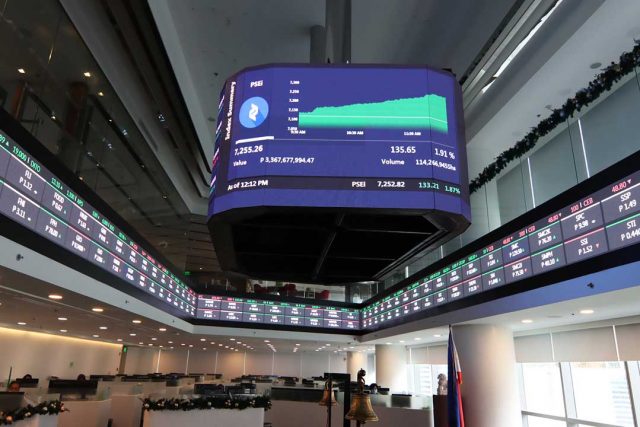
SHARES improved on Tuesday on last-minute bargain hunting despite concerns over the policy paths of the Bangko Sentral ng Pilipinas (BSP) and US central bank due to rising inflation here and abroad.

The benchmark Philippine Stock Exchange index (PSEi) went up by 7.52 points or 0.11% to close at 6,474.53 on Tuesday, while the broader all shares index lost 3.88 points or 0.11% to 3,471.05.

“Last-minute bargain hunting sent the local market higher this Tuesday. For the most part of the day however, the bourse was in the negative territory amid the pessimistic spillovers from Wall Street caused by worries that the Federal Reserve will take aggressive measures in their policy meeting this week in light of the US’ latest inflation print,” Philstocks Financial, Inc. Senior Research Analyst Japhet Louis O. Tantiangco  said in a Viber message.

Regina Capital Development Corp. Head of Sales Luis A. Limlingan added that investors are bracing themselves for the possibility of a larger-than-expected interest rate hike from the Fed.

The US consumer price index increased by a faster-than-expected 8.6% last month, the largest year-on-year increase since December 1981, according to US Labor department data released on Friday, showing inflation has yet to peak.

This caused renewed bets of aggressive action from the Fed at its June 14-15 meeting that could dampen growth prospects for the world’s largest economy.

The US central bank kicked off its tightening cycle with a 25-basis-point (bp) increase in March followed by a 50-bp hike last month as inflation continued to reach multi-year highs.

Meanwhile, First Metro Investment Corp. Head of Research Cristina S. Ulang said the market was affected by the “dovish” messaging from the BSP about a planned reserve requirement ratio (RRR) cut by yearend, which she said assumes “inflation normalization.”

BSP Governor Benjamin E. Diokno chief on Monday signaled they would reduce banks’ RRR by October or November as part of its efforts to manage inflation and as the central bank continues to unwind the accommodations it made for lenders at the height of the pandemic in 2020.

The majority of the sectoral indices ended in the red, except for holding firms, which gained by 97.35 points or 1.64% to 6,025.78, and mining and oil, which rose by 80.94 points or 0.70% to 11,624.43.

Meanwhile, property declined by 29.32 points or 0.96% to 3,015.59; industrials fell by 78.86 points or 0.87% to 8,974.70; services went down by 13.24 points or 0.75% to 1,740.52; and financials gave up by 2.30 points or 0.14% to end at 1,559.68.

Decliners overwhelmed advancers, 118 versus 62, while 44 names ended unchanged.

Value turnover grew to P5.60 billion with 827.41 million shares changing hands from the P5.38 billion with 761.72 million issues seen on Monday.

Net foreign selling ballooned to P1.25 billion from the P624.30 million recorded on the previous trading day. — L.M.J.C. Jocson

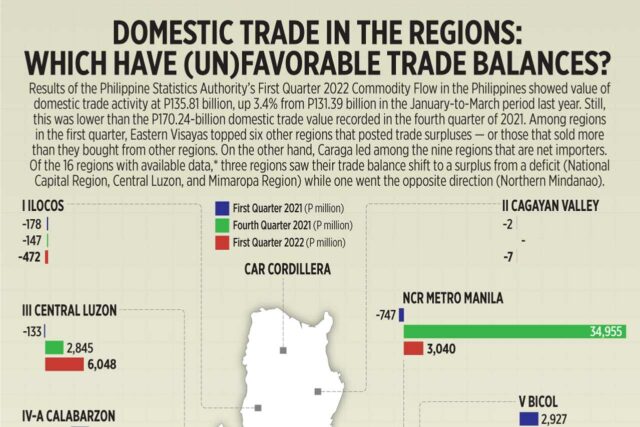
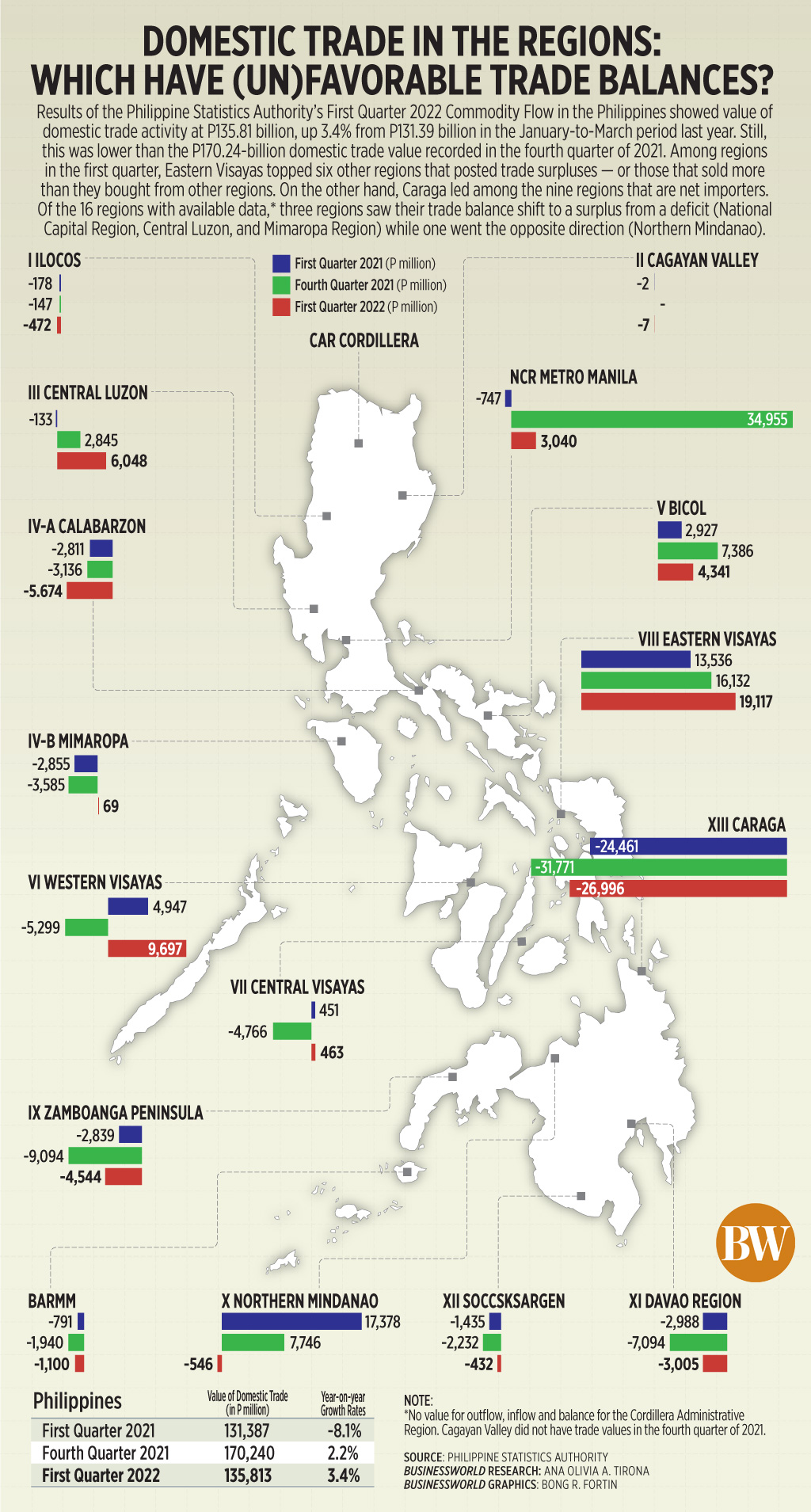
Domestic trade in the regions: Which have (un)favorable trade balances?

TRADE in domestic goods declined by 35.6% in the first quarter to P135.812 billion, the Philippine Statistics Authority (PSA) said on Monday, with trade hindered by mobility restrictions and the disruptions imposed by the Russia-Ukraine war. Read the full story.

Domestic trade in the regions: Which have (un)favorable trade balances?

DoLE nominee Laguesma doubts feasibility of nat’l minimum wage

PHILSTAR FILE PHOTO

BIENVENIDO E. LAGUESMA, who has been nominated to head the next government’s Labor department, said on Tuesday that a national minimum wage may not be possible because many small companies are still struggling to recover from the pandemic.

Labor groups have been pushing for a national minimum wage amid complaints that the recent regional wage increases force workers to survive on what they called poverty wages.

“We have heard this before from the ranks of the laborers,” Mr. Laguesma said in Filipino during an interview with ABS-CBN TeleRadyo on Tuesday. “On the part of the business, especially the small companies, the small- and medium-sized enterprises, this is a heavy ask, especially since we are still suffering from the effects of the pandemic and other calamities that have hit the country.” 

He added that regional wage boards should focus on improving the productivity of businesses to generate more jobs.

“In recent years, the regional boards have been too focused on raising wages but have not addressed increasing productivity,” Mr. Laguesma noted. “It is important to induce or encourage countryside development.”

The World Bank’s World Development Indicators ranked the Philippine labor force’s productivity at 12th among 18 economies in East Asia and the Pacific.

Last week, the Department of Labor and Employment (DoLE) announced that the Zamboanga Peninsula regional wage board had ordered a P35 minimum wage increase for nonagricultural workers and a P20 hike for agricultural workers.

If approved by the National Wages and Productivity Commission, the minimum wage for nonagricultural workers will rise to P351 from P316.

Eastern Visayas will also see a wage increase of P50 across all industries which will be given in two tranches of P25. This will bring daily pay to P375.

DoLE has said new minimum wages will be implemented in 14 regions this month after regional boards approved wage hikes of between P30 and P110.

The new minimum wage in Metro Manila increased by P33 on June 4 to P570 for nonagricultural workers and P533 for agricultural workers.

Central Luzon will have a P40 increase to P414-460.

The new minimum wage in Calabarzon is P390-P470 for nonagricultural workers; P350-P429 for agricultural workers; and P350 for retail and service establishments with not more than 10 workers.

The Trade Union Congress of the Philippines (TUCP) said the recent pay hikes are insufficient to make up for the recent rise in fuel prices, and do nothing to bring workers out of poverty.

“Because of extraordinary inflation, the series of wage increase orders issued by the wage boards failed to restore the purchasing power of wages and (they) didn’t uplift workers’ purchasing power above the poverty threshold,” TUCP President Raymond C. Mendoza said. — John Victor D. Ordoñez

BPOs unlikely to take up gov’t dare to forego incentives

THE Information Technology and Business Process Association of the Philippines (IBPAP) said its members are not likely to sacrifice their tax incentives, which the government has warned they must surrender if they flout tax rules and allow employees to continue working from home.

“I highly doubt that investors in our industry and in other industries for that matter will forego tax incentives… It is a very important factor for continued investment in the country,” IBPAP President Jack Madrid said in a television interview on Tuesday.

The business process outsourcing (BPO) industry typically performs its work in economic zones and enjoy tax incentives. One of the conditions for availing of such incentives is to perform most of the work within the economic zones.

“I think any investor especially in our very large and important industry consider an array of factors before investing in our country. I would say fiscal incentives and tax incentives are critical to continue growing our industry,” he added.

The Finance department said in a recent statement that tax incentives are “not that important” to foreign investors doing business in the Philippines, after BPO company Concentrix decided to continue with its hybrid work arrangements, in the process giving up its tax perks.

“This goes to show that tax perks are not that important to investors doing business in the Philippines. This validates the Department of Finance’s (DoF) policy thrust to avoid the grant of unnecessary tax incentives as this is apparently not the main consideration for them to do business in the country, especially for the BPO firms that have been enjoying the exemptions and incentives for a long time,” Finance Assistant Secretary Juvy C. Danofrata said.  

According to Mr. Madrid, the decision of Concentrix stemmed from the company’s decision to heed its employees’ wishes, after the government ordered economic zone locators to resume on-site work.

“In the case of Concentrix, which is a very active member of the association, this is I believe, a very temporary measure, a painful decision for them to make, given that viable commercial activity and profitability need both fiscal and non-fiscal incentives,” Mr. Madrid said.

“… I think knowing the investment appetite of many of our members, including Concentrix, I believe that fiscal incentives will continue to play an important role to grow investment and to retain investors,” he added.  

Mr. Madrid said the association is contented with the 70% on-site and 30% work-from-home (WFH) arrangement allowed by the Philippine Economic Zone Authority (PEZA) for registered business enterprises (RBEs) that have applied for letters of authority (LoAs) and cannot immediately return to on-site work.

He added that IBPAP is in dialogue with the current and incoming administrations on the importance of flexibility in the workplace.

“We don’t know what that final number (ratio) will be, but we are quite comfortable with the current 70-30 ratio that the PEZA has allowed us to those who have applied for LOAs,” Mr. Madrid said.

“It is extremely challenging, after adopting WFH for almost two years, to suddenly fully return to on-site work. We see (these challenges) beyond our industry. I think we all have seen the benefits of a hybrid work set-up that we are all still trying to figure out what that optimal balance is,” he added.  

WFH was resorted to as a temporary measure during the pandemic, with the Fiscal Incentives Review Board (FIRB) authorizing ecozone locators to adopt alternative working arrangements for safety reasons. This authorization was withdrawn as the coronavirus case count declined.

In April, PEZA announced that it allowed RBEs to maintain a 70-30 on-site work ratio while still enjoying tax incentives. This arrangement is valid until Sept. 12, or the end of the declared national state of calamity, as long as RBEs apply for LoAs.

The Corporate Recovery and Tax Incentives for Enterprises (CREATE) law allows companies registered with investment promotion agencies like PEZA to avail of perks such as an option to pay a 5% special corporate income tax in place of other taxes, an income tax holiday, and enhanced deductions. 

However, these companies need to comply with Section 309 of the Tax Code, which requires that business be conducted “within the geographical boundaries of the zone or freeport” in which the project or activity is registered. — Revin Mikhael D. Ochave

Public transport system on brink of ‘collapse’ due to high fuel prices

PHILIPPINE STAR/ MIGUEL DE GUZMAN

THE SUPPLY of public transport is deteriorating as operators see their margins eroded by high fuel prices, an advocacy group said, making it a matter of urgency for the government to prepare measures that will encourage “active transport,” including the construction of bicycle lanes and walking corridors.

In a statement, the Move As One transport coalition said that with the “rising transport demand outpacing collapsing supply,” policymakers and the incoming economic team must decisively expand the number of public utility vehicles (PUVs), while heavily investing in infrastructure that would encourage more people to walk or cycle.

“The transport sector is in a deadly spiral: Oil prices are skyrocketing. Drivers are losing their jobs as they cannot afford to ply their routes,” the group said. “Public transport supply is collapsing. More commuters are experiencing long lines, waiting times, and crowded commutes in enclosed spaces, and are at-risk for COVID-19.”

Transport was the second biggest driver of overall inflation in May, according to the Philippine Statistics Authority (PSA). The 14.6% inflation in transport costs recorded in May outstripped the overall inflation rate of 5.4%.

“Economic managers should prioritize walking, cycling, and road-based public transport,” the group said. “This is the most important policy shift economic managers should take. It is the founding principle of the fight against transport inflation and the fastest, most effective, and the only sustainable way to do so.”

The coalition said walking, cycling, and road-based public transport are the “predominant ways people travel to get to work.”

Citing a Social Weather Stations (SWS) survey conducted in 2020, the group said 44% of workers walked to work, compared to only 3% who use private cars and 24% who use motorcycles. 

The group said 14% of workers used tricycles, 8% jeepneys, 3% buses, 0.2% trains and 0.1% airplanes.  Only 0.4% used ride sharing platforms, it added.

Move As One said that from 2010 to 2021, the National Government budgeted 1% or P40 billion to improve walking, cycling, and road-based public transport, compared to P2.8 trillion for road construction, widening, and maintenance, benefitting mainly private motor vehicles.

“If the national budget is the real measure of the government’s priorities, then the National Government has given only 1% of its attention to the majority of Filipinos who depend on and demand better public transport,” it said. 

“Safe pathways, accessible walkways, protected bike lanes, and bus rapid transits are much easier, cheaper, and faster to build than these big ticket infrastructure projects, and will have a much greater and more immediate impact on commuters’ lives and transport prices,” it added.

The investment gap for such modes of transport was estimated at P150 billion over the next budget cycle, it said. “This is a much smaller, but more effective use of our taxpayer money than the P2.8-trillion road construction budget in the past decade, and the P2-trillion transport infrastructure pipeline in the next decade.”

Move As One also urged economic managers to encourage local governments to apply for the P10.6-billion support fund that would allow them to install more protected bike lanes, pedestrian infrastructure, open spaces, and public parks. 

Under a program which expires on June 30, villages, municipalities, cities, and provinces can get up to P5 million, P10 million, P20 million, and P30 million, respectively.

Move As One also asked the Department of Transportation to immediately implement and spend the P2-billion active transport budget for protected bike lanes, wider and safer pedestrian walkways, and at-grade crosswalks for persons with disabilities. “As of today, this budget has not been used.”

The number of trips not served by public transport was estimated at around 2.8 million a day in Metro Manila before the pandemic, the coalition said. 

The number of bus and jeepney trips declined 14% between 2012 and 2019 on Metro Manila’s major roads as private car and motorcycle trips surged 46%, worsening road congestion, Move As One said, citing government data. 

“Despite the steady growth in our urban populations, there has been hardly any increase in the supply of public transportation in Philippine cities over the past decade,” it said. “The oil crisis has only worsened this shortage of public utility vehicles — and the suffering of countless commuters competing for scarce public utility vehicles.”

Move As One also urged the government to implement an enhanced service contracting program and accelerate the release of payments to workers who have been contracted by the government. 

The government must increase the capacity of PUVs, in part by allowing them to use special lanes and setting aside hours for their operations, it added.

“The government can implement these PUV-only lanes today because the Department of Transportation has a special provision under the 2022 budget which requires 50% of road space to be allocated for walking, cycling, and public transport.” — Kyle Aristophere T. Atienza


IPEF expected to boost supply chain, green energy industries

THE Department of Trade and Industry (DTI) said the US-backed Indo-Pacific Economic Framework (IPEF) is expected to boost trade and investment, particularly in the supply chain and green energy industries.

Trade Undersecretary Ceferino S. Rodolfo said during an informal ministerial meeting on the Trade Pillar of the IPEF in Paris on June 11 that the framework will be a “vehicle to spur investment from the private sector.”

“We see the IPEF as a framework providing incentives to our stakeholders, tied up with the reforms that we are already undertaking domestically, through having a mechanism to link the Trade Pillar with pillars on supply chain resiliency and green energy transition,” Mr. Rodolfo said.

Mr. Rodolfo said he is hoping that other Association of Southeast Asian Nations (ASEAN) member states will be invited to the IPEF.

“To realize the vision of shared interests in post-pandemic economic recovery and supply chain resiliency, the Philippines, along with other framework partners, underscored the need to secure partners’ commitment in guaranteeing the free flow of critical goods such as food, fuel, and medicine,” the DTI said.

Launched on May 23, the IPEF seeks to boost the economic engagement of the US in the Indo-Pacific region. It aims to initiate objectives related to trade facilitation, standards for digital economy and technology, supply chain resiliency, decarbonization and clean energy, infrastructure, worker standards, and other areas of shared interest.  

IPEF members are the US, Philippines, Australia, Brunei Darussalam, Fiji, India, Indonesia, Japan, South Korea, Malaysia, New Zealand, Singapore, Thailand, and Vietnam.

At the Paris session, US Trade Representative Katherine Tai said future IPEF negotiations will center on pillars such as trade, supply chains, clean energy, decarbonization, infrastructure; and tax and anti-corruption measures.  

“In 2021, the Philippines’ total trade with current framework partners amounted to $106.89 billion, which is 53.71% of its total trade with the world. Among the framework partners, top trading partners of the Philippines are Japan, the US, South Korea, Singapore, and Thailand,” the DTI said. — Revin Mikhael D. Ochave

New fish feed to address rising input costs — DA

PHILSTAR FILE PHOTO

THE GOVERNMENT is developing a sustainable and low-cost feed for milkfish and tilapia to address rising aquaculture production costs.

The new feed uses by-products from corn and poultry abattoirs and copra meal to replace fish meal.

“The ongoing crises, COVID-19 pandemic and Russia-Ukraine conflict, have had a ripple effect on the whole seafood value chain. It’s not just food and fuel, it also affects feed for livestock and aquaculture since the majority of our feedstuff is sourced from outside the country,” Agriculture Secretary William D. Dar said in a statement.

“What we need are sustainable technologies and interventions that can provide our fishing communities locally available ingredients providing (the added) benefit of cost savings and reduced imports,” he added.

The project is a collaboration between the Department of Agriculture’s (DA) National Fisheries Research and Development Institute (NFRDI) and the Southeast Asian Fisheries Development Center’s (SEAFDEC) Aquaculture Division.

The feed formula was developed by the Aquaculture Division’s Head of Technology Verification and Extension, Roger Edward P. Mamauag.

During the field tests, SEAFDEC reported that the milkfish and tilapia given the alternative feed were comparable with fish given commercial feed in terms of growth performance and other biological parameters. 

“One of the major problems that we wanted to address through this project is to lower the cost of feed, which comprises 50 to 70% of the production cost. By making the feed cost-effective and sustainable it will increase profits and encourage more fish farmers to venture in aquaculture,” NFRDI Director Lilian C. Garcia said.

The new feed costs P27 per kilogram (kg) for milkfish and P24 per kg for tilapia. Commercial feed typically costs P33-35 per kg for milkfish and P32-34 per kg for tilapia.

The DA said the expensive component of commercial fish feed is fish meal. It is also resource intensive as obtaining it requires harvesting fish from the ocean just to have raw material.

“While plant-based protein sources like soybean meal and wheat gluten can provide lower-cost alternatives, the ongoing Ukraine crisis has made prices of imported feedstuff volatile and therefore unsustainable,” the department said.

Mr. Dar said that the project will help address the ecological impact of supplying the aquaculture industry.

“With this verified technology, we can now transfer this to the private sector particularly, feed milling processors… making the technology more accessible to fish growers and farmers,” he added. — Luisa Maria Jacinta C. Jocson

Lanao power co-op to settle P12.9-billion arrears with PSALM

THE National Electrification Administration (NEA) said the Lanao del Sur Electric Cooperative, Inc. (Lasureco) has committed to settle its outstanding balance of P12.9 billion with the Power Sector Assets and Liabilities Management Corp. (PSALM).

In a statement on Tuesday, the NEA confirmed that Lasureco met with PSALM on June 8 along with other local government officials to discuss its payments in arrears.

NEA said Lasureco will submit a letter of commitment to PSALM that will outline its payment plans.

NEA Administrator Emmanuel P. Juaneza said that he will ask the NEA Board of Administrators about possible financial assistance that may be extended to Lasureco.

Lanao del Sur Governor Mamintal Alonto Adiong, Jr. also asked PSALM to defer Lasureco’s power supply disconnection.

“Governor Adiong also committed to discussing with the municipal mayors of the province how they can help Lasureco pay its obligation to PSALM and asked PSALM for three months to carry this out,” the NEA said.

“Lanao del Sur shall call for another meeting with PSALM, Lasureco, NEA, and Department of Energy, among others, to come up with a resolution for the matter arising from the recently concluded meeting on the concerns of Lasureco and other stakeholders,” it added.

The NEA said in a separate statement on Tuesday that Maguindanao Electric Cooperative, Inc. (Magelco) has committed to restructure its arrears with the National Grid Corp. of the Philippines (NGCP).

The NEA confirmed that Sultan Kudarat Governor Suharto T. Mangudadatu will improve Magelco’s services as a prerequisite to the restructuring, adding that the financial program needs to be further developed.

Magelco had over P3.8 billion worth of unsettled payables at the end of April. The cooperative has settled only P45.5 million of the P147.2-million power bill for the December 2021 to April 2022 period.

As of June 10, the NEA said that the NGCP has officially deferred the disconnection after receiving the proposal submitted by Magelco. — Revin Mikhael D. Ochave 

Clean energy companies tout community-centric business models

WEGEN-ENERGY.COM

CLEAN ENERGY companies said their business models depend on community engagement, the importance of which they cited in making the transition to green sources of power more inclusive.

Charlie Ayco, president of WeGen Laudato Si’, Inc., cited community participation in his presentation on the company’s business model, “The Power of Sharing,” delivered during the Asia Clean Energy Forum 2022 on Tuesday.

“You can replicate the model… as long as you engage the local electric cooperative or the distribution utility because they own the distribution system, and then the participation of the community is very, very important because they are the ones maintaining and collecting the payments,” he said.

Knowledge of the technology, operations and maintenance are also crucial components, he added.

The model was applied to a community on Pamilacan island in Bohol, taking the form of a donation. Mr. Ayco said power used to be available only for eight hours a day, during night time.

“It is a 39-kilowatt power (kwp) solar photovoltaic (PV) system, and we included a 154-kilowatt hour battery storage,” he said.

“The solar PV system provided the daytime electricity needs of the island while the diesel generator powered the island during the night. As a result, the island got 24/7 electricity starting 2017,” he added.

“For our company, the Pamilacan power energy system is a perfect case of (making) sustainable energy available anytime and anywhere.”

John Mark Napao, president of Solar Hope, Inc., said his company’s strategy starts with community engagement or mapping, followed by capacity building or training, and then installation of solar home systems.

Solar Hope has been working since 2017 with communities in Malitam, Batangas; Paluan, Occidental Mindoro; and Antipolo, Tanay, Rodriguez, and Morong, Rizal.

He said Solar Hope is soliciting pledges for 829 homes, and has secured pledges for 446.

The group hopes to light 1,275 homes to “help families cope with the pandemic, distance learning, and enjoy the benefits of having access to energy.” — Arjay L. Balinbin

ADVERTISEMENT
ADVERTISEMENT