Home Blog Page 6266

FIFA, World Athletics review transgender rules

SEBASTIAN Coe, president of World Athletics — MOHAN, DOHA STADIUM PLUS QATAR

MANCHESTER, England — World soccer’s governing body International Federation of Association Football (FIFA) and World Athletics said on Monday that they are reviewing their transgender eligibility policies after swimming passed new rules that restrict transgender participation in women’s events.

On Sunday, swimming’s world governing body International Swimming Federation (FINA) voted to restrict the participation of transgender athletes in elite women’s competitions and create a working group to establish an “open” category for them in some events as part of its new policy. The new policy states that male-to-female transgender swimmers (transgender women) are eligible to compete in women’s competitions only if “they can establish to FINA’s comfortable satisfaction that they have not experienced any part of male puberty beyond Tanner Stage 2 (of puberty) or before age 12, whichever is later.”

A spokesperson for FIFA told Reuters it was in a consultation process over a new policy.

“FIFA is currently reviewing its gender eligibility regulations in consultation with expert stakeholders,” said the spokesperson.

“Due to the ongoing nature of the process, FIFA is not in a position to comment on specifics of proposed amendments to the existing regulations,” the spokesperson added.

Sebastian Coe, president of World Athletics, told the BBC that the organization’s council would discuss their regulations at the end of the year.

Coe praised FINA for taking the decision, which has been criticized by trans rights advocates.

“We see an international federation asserting its primacy in setting rules, regulations and policies that are in the best interest of its sport,” he told the BBC.

“This is as it should be. We have always believed that biology trumps gender and we will continue to review our regulations in line with this. We will follow the science.

“We continue to study, research and contribute to the growing body of evidence that testosterone is a key determinant in performance, and have scheduled a discussion on our regulations with our council at the end of the year,” he added.

FIFA said it was taking guidance from medical, legal, scientific, performance and human rights experts and also the position of the International Olympic Committee (IOC).

“Should FIFA be asked to verify the eligibility of a player before the new regulations will be in place, any such case will be dealt with on a case-by-case basis, taking into account FIFA’s clear commitment to respect human rights,” the spokesperson said.

Last year, the IOC issued a “framework” on the issue, leaving eligibility decisions up to individual sports bodies, but adding that “until evidence determines otherwise, athletes should not be deemed to have an unfair or disproportionate competitive advantage due to their sex variations, physical appearance and/or transgender status.”

World Athletics’ current rules cap testosterone levels at five nanomoles per liter for transgender athletes and for competitors with differences in sex development (DSD) in some women’s running events.

Coe said it was important to protect the integrity of women’s sport.

“When push comes to shove, if it’s a judgement between inclusion and fairness, we will always fall down on the side of fairness — that for me is non-negotiable.

“We can’t have a generation of young girls thinking there is not a future for them in the sport. So we have a responsibility… maintaining the primacy and the integrity of female competition is absolutely vital,” he added.

Last week, the International Cycling Union (UCI) tightened its rules on transgender participation by increasing the transition period on low testosterone to two years and reducing the maximum permitted testosterone level. — Reuters


No. 1 pick odds lean heavily toward Auburn’s Jabari Smith

THE 2021-22 National Basketball Association (NBA) season came to a close with the Golden State Warriors defeating the Boston Celtics in the NBA Finals.

With the season over, the offseason kicks off this week with the 2022 NBA Draft. Major sportsbooks, including BetMGM and DraftKings, are projecting where tomorrow’s stars might be selected.

The NBA draft is Thursday night at the Barclays Center in Brooklyn.

The draft lottery draw led to the Orlando Magic having the first overall pick, where Auburn’s versatile second-generation star Jabari Smith is expected to be the selection.

The Oklahoma City Thunder, followed by the Houston Rockets and the Sacramento Kings, are up next in the first round.

As of now, which prospects align with those teams is unclear.

Inarguably, the favorite as the top draft pick, as well as the leader of what will be a very talented pool, is Jabari Smith, Jr. The Auburn University product is following in the footsteps of his father, who played in the NBA, as well as Spanish and Mexican leagues.

The forward spent one year at Auburn and averaged 16.9 points, 7.4 rebounds, 2.0 assists, 1.1 steals and 1.0 blocks in 34 college games, shooting 42% on 3-pointers.

Smith is projected to be a lock for being one of the top three picks.

Duke’s Paolo Banchero and Chet Holmgren of Gonzaga are also viewed as sure top picks.

Included in the wave of international talent available are France’s Ousmane Diengo, projected for the first round, and Serbian Nikola Jović.

A big unknown: Where Canadian Shaedon Sharpe winds up.

The explosive shooting guard signed with the Kentucky Wildcats in September of 2021, but did not play last season.

THE 2 SPOT
BetMGM and DraftKings have Smith, Jr. as the first overall pick and recent movement provides him with an even bigger lead over the field.

Smith, who is also getting most of the action, started at -105 when lines opened, but was -165 as of June 20.

Holmgren is the hedge. A high school teammate of the Magic first-round pick last season, Jalen Suggs, the 7-footer is now getting strong odds to be the first pick. He opened at +145, but recently moved to +115.

Even so, Holmgren already made it clear that his preference would be to slide to the Thunder at No. 2.

Banchero is heading in the opposite direction on BetMGM. He opened at +350 to be the first pick and is now at +1500.

Smith controls 27.1% of the action, while Holmgren currently has 24.5%. Banchero is receiving 16.5% of all the bets.

A similar ranking is found at DraftKings. Smith’s current odds to be the top pick are -175. Holmgren is in second place with current odds of +150.

Banchero rounds out the top three, getting +950 odds to be the first pick.

Smith is getting most of the action on DraftKings.

He has 38% of the handle, as well as 28% of the bets. Holmgren follows with 34% and 24%, respectively. Banchero is getting 23% and 21%. — Reuters

Warriors celebrate NBA title with fourth parade in eight years

THE dynastic Golden State Warriors toasted their fourth National Basketball Association (NBA) championship in eight years with a title parade through San Francisco on Monday afternoon.

The last time the Warriors lifted the Larry O’Brien Championship Trophy, in 2018, Kevin Durant was part of the all-star crew. Durant has since moved on, but the Warriors’ core of Stephen Curry, Klay Thompson, Draymond Green and Andre Iguodala all celebrated their upcoming fourth rings.

Also joining them for this party was forward Andrew Wiggins, who became a vital starter after being traded to Golden State in 2020, and guard Jordan Poole, who had a breakout season in his third NBA campaign.

Poole made 51 regular-season starts while Thompson worked his way back from his lengthy injury absence, then averaged 17.0 points and 3.8 assists per game in the playoffs on his first trip to the championship.

“It’s crazy, when you work as hard as you can and then finally get rewarded, it feels how it’s supposed to feel,” said Poole, wearing an alternate “Oakland” jersey and light-hearted glasses.

Curry told reporters that his fourth title “hits different for sure.”

“Just knowing what the last three years have meant, what it’s been like from injuries to changing of the guard in the rosters, Wiggs coming through, our young guys carrying the belief that we could get back to this stage and win, even if it didn’t make sense to anybody when we said it, all that stuff matters,” Curry said. “And now we got four championships. Me, Dray, Klay, and Andre, we finally got that bad boy. It’s special.”

The Warriors closed out the Boston Celtics in the NBA Finals in six games after beating the Denver Nuggets, Memphis Grizzlies and Dallas Mavericks to advance through the Western Conference. — Reuters

Mobile Legends Asia Cup

THE Philippines remains as the Kings of Southeast Asia (SEA) after winning the Mobile Legends: Bang Bang Southeast Asia Cup 2022. RSG PH scored a victorious 4:0 sweep against the ‘King of Kings’ RRQ Hoshi. Eman “Emann” Llanda Sangco was awarded the most valuable player (MVP). The newly crowned SEA kings are the third Filipino team to take home the SEA title alongside Aether Main (Bren Esports) in 2018 and Smart Omega (formerly known as Execration) in 2021.

LA Lakers

There are a variety of reasons the Lakers continue to dominate discussions in hoops circles. Fresh off a season in which a top-shelf ranking turned into a disappointing absence from the playoffs, the purple and gold believe their 2022-23 campaign will be much, much better. Wishful thinking? Perhaps. If nothing else, their poor record since the formation of an updated Big Three showed the inability of resident stars LeBron James and Anthony Davis to incorporate the singular talents of former Most Valuable Player awardee Russell Westbrook. And because the latter owns a virtually untradable contract, correcting the mistake in the wake of declining numbers seems like a stab in the dark.

Don’t tell that to James and Davis, though. No doubt, it’s because they believe an adequate supporting cast is all they need to contend. And with new head coach Darvin Ham angling to make their partnership with Westbrook work, they view their immediate future with optimism. Which is all well and good when they’re around. Unfortunately, they’ve both become susceptible to injuries of late, with their prolonged convalescence further crimping the Lakers’ capacity to keep pace with the established elite. Preseason predictions have the 17-time champions at 17th and on the fringes in the Western Conference.

There was once a time when the mere presence of James ensured a playoff berth. Needless to say, that time has passed, and not simply because parity is at an all-time high. He’s not only 37; he’s an old 37, with a whopping 63,000 minutes in his odometer. And even as his mind remains sharp and able to directed offenses and deconstruct defenses, he’s no longer as athletic and as durable in his prime. Which, in a nutshell, means he needs more help than usual.

The problem, of course, is that Davis, to whom James plans to eventually cede the spotlight, has proven to be equally, if not more, susceptible to injury. It’s why they convinced Westbrook to come on board in the first place; the third marquee name was supposed to ease the burden of playmaking, not to mention step up into a starring role when one or both of the primary options are not around. And it’s why the Lakers are trying to find ways to make the collaboration work as intended. In the final analysis, how they are able to — or not able to — will shape their fate.


Anthony L. Cuaycong has been writing Courtside since BusinessWorld introduced a Sports section in 1994. He is a consultant on strategic planning, operations and Human Resources management, corporate communications, and business development.

Europe casts its lot in the Indo-Pacific Region

GLENN CARSTENS PETERS-UNSPLASH

Last week, the Embassy of the Czech Republic in Manila sponsored my attendance and participation at the Prague High-level Dialogue on the Indo-Pacific, held in the historic city of Prague on June 13 and 14. The event was organized by the Czech Ministry of Foreign Affairs, with the cooperation of some European Union (EU) institutions, to constitute a bridging event by the French and Czech presidencies in the European Council as it highlighted the EU’s Indo-Pacific Strategy.

In the European context, the term “Indo-Pacific” has become linked with an evolving debate about how the EU would position itself vis-à-vis the changing geostrategic dynamics of a region that is increasingly being shaped by the US-China strategic competition. Interestingly, a number of European powers such as the United Kingdom, France, Germany, and the Netherlands have cast their lots and joined the fray on the side of their common ally in the North Atlantic Treaty Organization (NATO), the United States.

The EU, however, is a complex regional organization and a complicated foreign policy actor. As an intergovernmental organization, it has to balance the diplomatic and strategic interests of 27-member states with different historical contexts and experiences.

On one side of the spectrum are maritime European powers such as France, the Netherlands, Spain, and Portugal that had a long history of engagement with Asia based on discovery, colonialization, trade, and warfare. These maritime power ties with Asia, however, were severed after the Second World War and through the process of decolonization.

On the other end of the spectrum are the continental land-based powers such as Germany, Poland, Sweden, Finland, Romania, Bulgaria, and the Czech Republic that share a continental strategic outlook based on a common fear of Russian expansionism.

Russia’s brutal and unprovoked armed invasion of Ukraine created a powerful sense of unity among the EU member states as it highlighted the importance of its Indo-Pacific Strategy, specifically in terms of deepening the regional organization’s engagement in the Indo-Pacific region.

From Europe’s perspective, there is a growing sense of urgency to hold a wider forum, where the EU and like-minded partners such as the US, Canada, Australia, New Zealand, the United Kingdom, and some ASEAN member-states, tackle developments, trends, and current issues in the Indo-Pacific, and to explore possible synergies. It was in this context that I was invited to present my views on common security threats confronting both the EU and its like-minded partners in the Indo-Pacific region.

THE EU CASTS ITS EYES ON THE INDO-PACIFIC
Compared to Europe’s once predominant strategic and diplomatic presence in Asia prior to the Second World War, the EU’s contemporary role in the region is a case of benign neglect marked by occasional interest on specific low politics issues in the region. Until recently, the EU played a minor role in the politics and security agendas of the Indo-Pacific countries.

The EU’s primary focus was fostering partnerships with Australia, the ASEAN, Japan, and India on areas where it has vital interests and comparative advantages such as trade, human rights dialogues, substantial cooperation on economic, commercial, and development issues. It had usually shied away from security and political cooperation until the beginning of the 21st century.

Recently, China’s growing power in the region, and the former Trump Administration’s disparaging view of both its Asian and European allies had encouraged many European states and regional organizations, such as the EU and the NATO to maintain a broad array of connections with many Asian countries and multilateral institutions such as the ASEAN and later the Quadrilateral Security Dialogue (QUAD).

Europe believes that it shares core liberal-democratic values with the US and that these values must be protected from authoritarian states. Its efforts to defend these values do not involve a single European entity acting as a single corporate entity speaking a single voice on all issues. Rather, Europe’s influence and power are projected in the Indo-Pacific region through, a.) the principal European powers, particularly the United Kingdom, France, and Germany; b.) NATO; and more recently, c.) the EU.

FROM STRATEGIC AUTONOMY TO ALIGNMENT
Prior to the Ukraine-Russia War, the EU tried its best to be an independent foreign policy actor that could safely navigate between two competing powers, the US and China. The EU does not hide the fact that it shares liberal democratic values with the member states of the QUAD and cherishes its long alignment with the US. These countries’ Indo-Pacific strategies’ core ideological advocacy of freedom and openness, promoting freedom of navigation, free-trade, and a rules-based international order reflects the essence of European multilateralism and the continuity of its own brand of civilian foreign and security policy.

However, the Ukraine-Russia War and China’s economic and diplomatic support to Russia pushed the EU to align its policies with like-minded partners and relevant organizations in security and defense such as NATO and the recent US, Australia, and United Kingdom security partnership, AUKUS. After February 20, the EU found it necessary to strengthen cooperation with NATO, QUAD, and ASEAN, and to develop bilateral tailor-made partnerships with like-minded countries and strategic partners such as the US, Canada, Norway, the UK, Japan, and some ASEAN-member states.

Given these developments, the incoming Marcos Administration should consider the EU as one of its strategic partners in pursuing a balanced and multilateral-based foreign policy in a changing Indo-Pacific region.


Dr. Renato Cruz De Castro is a trustee and convenor of the National Security and East Asian Affairs Program of the Stratbase ADR Institute.

The state of mass housing: The multiplier effect

FREEPIK

(Part 3)

Given reasonable fiscal incentives under the Corporate Recovery and Tax Incentives for Enterprises (CREATE) Act, housing developers can face a very attractive mass market for affordable housing. There will be many developers who will be attracted to this industry, thus addressing government concerns about potential revenue losses from fiscal incentives extended to the developers. There will be induced economic benefits that robust private sector-driven mass housing activities or projects can bring and the real estate services that follow. From the economic activities of these downstream sectors, there will flow additional household incomes and spending of workers in the various sectors of the economy.

Government concerns about potential revenue losses from fiscal incentives extended to housing can readily be offset by the direct, indirect, and induced economic benefits that robust private sector-driven mass housing investments can bring together with the real estate services that follow. From the multiplier effects of these activities, there will be additional household income and spending of workers in the various industries or sectors that further stimulate economic activities. It is important to consider affordable housing investments of the private sector in a dynamic rather than a static manner. The economic impact of mass housing projects does not end upon the completion and successful delivery or turnover of the housing units. The impact extends to the economic activities of the communities that these projects would create that further stimulate more income and employment in the communities concerned.

Through an input-output analysis, it was shown that mass housing construction activities and real estate services have upstream and downstream linkages which are stimulated every time these sectors are activated. Mass housing construction activities have stronger linkages with their upstream than their downstream components. This means that upstream suppliers along the value chain tend to benefit more than the downstream sectors. In contrast, real estate services have stronger linkages with their downstream components than the industries found upstream. Additional livelihoods are generated from the activities of these two related sectors. The employment multiplier per P1 billion spending in mass housing generates a total of 1,558 jobs, comprising 617 direct, 454 indirect, and 487 induced. On the other hand, the employment multiplier per P1 billion spending in real estate services generates a total of 747 additional jobs comprising 195 direct, 325 indirect, and 227 induced.

Properly incentivized, the mass housing sector can make a significant contribution to the recovery of the economy from the pandemic-induced economic slowdown. As of 2020, the housing backlog was estimated at 8.4 million households or 34% of the 24.7 million households in the Philippines in 2018. Adding the segment of about 3.3 million low-income households that cannot afford housing, this translates to 47% of total household in 2018. This aptly mirrors the Philippine Statistics Authority (PSA) 2015 survey on housing tenure that showed 12.7 million out of 22.9 million households (or 55%) either own or have owner-like possession of a house and lot.

The housing backlog or shortage is the result of an accumulation of deficits or housing production shortfalls failing over the years to catch up with the demand. Of the backlogs, over 2.1 million and 1.3 million units belong to the economic and low-cost housing sectors, respectively, constituting 41% of the total backlog. The average annual demand for housing outstrips the supply of housing. Using the annual average housing demand for the period 2010 to 2020 and matching it with the annual housing supply for the same period shows an average annual deficit of 518,000 units. Assuming that the maximum capacity allocated to mass housing production of 186,300 units is used during the period 2010 to 2020, the annual housing deficit would be approximately 458,000 units per annum, a potentially attractive market for developers of economic and low-cost housing.

With a debt-to-GDP ratio exceeding 60% and a fiscal deficit already at an all-time high of 8%, it is clear that the next Administration will not have the wherewithal to address the serious shortage of affordable housing. With maximum industry capacity pegged at the moment of 186,300 units, an additional housing capacity of 654,000 units is required to wipe out the deficit of 8.4 million housing units during the next 10 years. Assuming that the Government shoulders the additional capacity to fill the void of P450,000 per housing unit (the assumed cost that the Department of Human Settlements and Urban Development used in its National Housing and Urban Development Sector Plan), the Government would have to allocate an annual budget of at least P294.2 billion, equivalent to 6.5% of the 2021 national budget. Such a massive outlay, beyond the reach of our debt-strapped Government, is best addressed by the private housing developers. The additional fiscal revenues that the Government would forego such as VAT and income taxes from the existing economic and low-cost housing activities could easily be offset by the fiscal savings the Government would realize from not having to fund the construction of these units from the budget.

If through the fiscal incentives that will be given to the private developers, the housing back log can be addressed, there will be the additional benefits that housing brings which are not fully captured by the direct and indirect economic and financial measurements. Housing spells the well-being of people and benefits communities and society as a whole, as can be seen in Singapore, a First World country. Based on research undertaken by the Asian Development Bank, the social benefits of affordable housing are as follows: higher quality of human welfare, improved health condition, increase in the number of jobs, social development, social security, and small business development.

The community benefits of housing especially stood out in the case of the communities of Gawad Kalinga (GK) during the pandemic. As lockdowns adversely affected people’s lives, people began to realize that the school-based feeding program for children could not be implemented. Facing this predicament, the community began building a common kitchen operated by themselves, along with the support from their barangays. As of August 2021, they reported a total of 57 community kitchens serving 133 communities. Housing-based communities can easily engage in welfare programs. GK continues to provide leadership training among the youth so that they could also be future leaders of their respective communities.


Bernardo M. Villegas has a Ph.D. in Economics from Harvard, is professor emeritus at the University of Asia and the Pacific, and a visiting professor at the IESE Business School in Barcelona, Spain. He was a member of the 1986 Constitutional Commission.

bernardo.villegas@uap.asia

For Malaysia, this is no game of chicken

JCOMP-FREEPIK

TO GET A HANDLE on the forces disrupting the global food supply chain, a small chicken processing plant on the outskirts of Malaysia’s biggest metro area isn’t a bad place to start. There, it’s clear that getting produce from point to point isn’t just a logistics challenge but a matter of national pride.

Malaysian curbs on poultry exports are grinding into their fourth week. Singapore is a big customer and buys about 98% of live shipments. While some types of chicken are now allowed to make their way to the country’s southern neighbor, the commercial broiling birds that comprise the bulk of sales remain blocked.

Yani Hardinata, who runs marketing and branding at Safina Food Sdn. Bhd, recognizes some of the same problems as his global peers: a surge in inflation that’s driving fertilizer costs, exacerbated by Russia’s invasion of Ukraine, and a chronic shortage of labor. Then there’s the longstanding, bungled domestic price ceilings imposed by the Malaysian government, which discouraged production because the squeeze from higher costs couldn’t be offset by raising prices.

But there’s another element that has emerged from the recent vulnerabilities. Yani makes no apology for championing a version of what might be called “Malaysia First” nutrition. Chickens dismembered, packed, and chilled at Safina proudly bear the logo of a fluttering flag with a Malay sentence that translates as, “Towards Malaysian Food Sovereignty.” “Whatever we can produce here, the raw materials, the supply chain, should be local instead of having to depend on uncertain situations outside of our country,” he told me. “If it can be secured here, procured here, it should be as part of the sovereignty of our food supply chain.”

Similar sentiments were expressed by people up and down the food supply chain in Malaysia during a trip last week — from vegetable wholesalers in Kuala Lumpur to farmers in the lush Cameron Highlands and fisheries of Penang on the country’s northwest coast. While the chicken saga has unique characteristics, not least of which is Singapore’s extreme dependence, the country isn’t the first to engage in food protectionism. India has moved to restrict sugar exports after barring wheat sales. Indonesia halted, then revived, exports of palm oil.

The proximity of a national election, due early next year, has made local politicians jumpier about disgruntled devotees of chicken curry and satay. (As in Singapore, chicken is a meat protein that can be enjoyed by the three main communities: Malays, ethnic Chinese, and South Indians. Muslims, the dominant religious group in Malaysia, can’t eat pork.) But such food nationalism is likely to be a feature of the political and economic landscape for some time — with potentially dire consequences. Escalating food prices account for about one third of the increase in inflation in emerging markets, according to Capital Economics. In advanced economies, the figure closer to a quarter.

The consequences go beyond rising interest rates and stretched paychecks. “The war in Ukraine has also raised questions around food and energy security that may ultimately cause governments to diversify supplies, as well as mean that food export bans are deployed more frequently as countries strive for self-sufficiency,” Neil Shearing, group chief economist at Capital Economics, wrote in a recent note. “The legacy of the latest commodity shock will play out over years, not months.”

Policy and politics are likely to respond to climbing food costs. In Malaysia, putting kitchen table concerns over Singaporeans’ demand for chicken rice no doubt will play well with voters. As well as pushing borrowing costs upward, governments across Asia will be tempted to use fiscal policy to cushion the blow to household budgets from accelerating food inflation. Singapore, Hong Kong, the Philippines, and South Korea will be most affected because they are big importers of food, according to a report from Nomura Holdings Plc.

A trip to the Cold Storage supermarket in the basement of the Kuala Lumpur City Center, the sprawling development that boasts the iconic spires of the Petronas Towers, was instructive. The fresh poultry racks were full one morning last week. Plastic signs plonked in chicken breasts and thighs made clear they were products of Malaysia. I’m bracing for bigger signs, with flags, in a greater variety of foods next visit.

BLOOMBERG OPINION

Biggest rail strike in 30 years brings UK to standstill

REUTERS

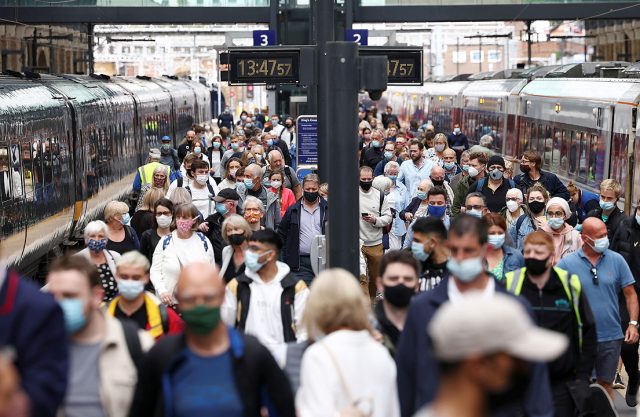
LONDON — Britain’s biggest rail strike in 30 years kicked off on Tuesday as tens of thousands of staff walked out in a dispute over pay and jobs that could pave the way for widespread industrial action across the economy in the coming months.

Picket lines appeared at dawn and will be lined by some of the more than 40,000 rail workers who are due to strike on Tuesday, Thursday and Saturday, bringing the network to a standstill. The London Underground was also shut due to the strike.

Prime Minister Boris Johnson, under pressure to do more to help British households who face the toughest economic hit in decades, said the industrial action would harm businesses as they continue to recover from the pandemic.

Unions have said the rail strikes could mark the start of a “summer of discontent” with teachers, medics, waste disposal workers and even barristers moving towards industrial action as surging food and fuel prices pushes inflation towards 10%.

“Our campaign will run for as long as it needs to run,” Mick Lynch, secretary-general of the Rail, Maritime and Transport Workers (RMT), told reporters on Monday.

The prime minister said the unions were harming the people they claimed to be helping.

“By going ahead with these rail strikes, they are driving away commuters who ultimately support the jobs of rail workers, whilst also impacting businesses and communities across the country,” Mr. Johnson will tell his cabinet later on Tuesday, according to his office.

DESTRUCTIVE INFLATION
Britain’s economy initially rebounded strongly from the COVID-19 pandemic but a combination of labor shortages, supply chain disruption, inflation and post-Brexit trade problems has prompted warnings of a recession.

The government says it is giving extra support to millions of the poorest households but says above-inflation pay rises would damage the fundamentals of the economy.

“Sustained higher levels of inflation would have a far bigger impact on people’s pay packets in the long run, destroying savings and extending the difficulties we’re facing for longer,” Mr. Johnson said.

The outbreak of industrial action has drawn comparison with the 1970s, when Britain faced widespread labor strikes including the 1978-79 “winter of discontent”.

The strikes come as travellers at British airports experience chaotic delays and last-minute cancellations due to staff shortages while many Britons have to wait months for new passports to arrive due to processing delays.

The rail strike means only about half of Britain’s rail network will be open on strike days with a very limited service running on those lines and continued disruption on the days in between strike days. — Reuters

Crypto’s latest meltdown leaves punters bruised, bewildered

FREEPIK

LONDON/MUMBAI/ANKARA — For Jeremy Fong, US crypto lender Celsius was an ideal place to stash his digital currency holdings — and earn some spending money from its double-digit interest rates along the way.

“I was probably earning $100 a week,” at sites like Celsius, said Mr. Fong, a 29-year civil aerospace worker who lives in the central English city of Derby. “That covered my groceries.”

Now, though, Mr. Fong’s crypto — about a quarter of his portfolio — is stuck at Celsius.

The New Jersey-based crypto lender froze withdrawals for its 1.7 million customers last week, citing “extreme” market conditions, spurring a sell-off that wiped hundreds of billions of dollars from the paper value of the cryptocurrencies globally. 

Mr. Fong’s long-term crypto holdings are now down about 30%. “Definitely in a very uncomfortable position,” he told Reuters. “My first instinct is just to withdraw everything,” from Celsius, he said.

The Celsius blow-up followed the collapse of two other major tokens last month that shook a crypto sector already under pressure as soaring inflation and rising interest rates prompt a flight from stocks and other higher-risk assets.

Bitcoin fell below $20,000 on June 18 for the first time since December 2020. It has plummeted around 60% this year. The overall crypto market has slumped to around $900 billion, down from a record $3 trillion in November.

The tumble has left individual investors across the world bruised and bewildered. Many are angry at Celsius. Others swear never to invest in crypto again. Some, like Mr. Fong, want stronger oversight of the freewheeling sector.

Susannah Streeter, an analyst at Hargreaves Lansdown, compared the turmoil to dotcom stocks crash in the early 2000s — with technology and low-cost capital making it easy for individual investors to gain access to crypto.

“We’ve got this collision of smartphone technology, trading apps, cheap money and a highly speculative asset,” she said. “That’s why you’ve seen a meteoric rise and fall.”

‘PACING IN THE DARK AT 2 A.M.’
Crypto lenders, such as Celsius, offer high interest rates to investors — mostly individuals — who deposit their coins with these sites. These lenders, mostly unregulated, then invest deposits in the wholesale crypto market.

Celsius’ troubles appear to be related to its wholesale crypto investments. As these investments turned sour the company was unable to meet client redemptions from investors amid the broader crypto market slump.

The redemption freeze at Celsius was akin to a small bank shutting its doors. But a traditional bank, overseen by regulators, would have some form of protection for depositors.

One of those impacted by the Celsius freeze was 38-year old Alisha Gee in Pennsylvania.

Ms. Gee invested “every last bit” of her paychecks in crypto since 2018, which have built up into a five-figure sum. She has $30,000 of deposits at Celsius — part of her overall crypto holdings — earning her interest of $40-$100 a week, which she hoped would help her to pay off her mortgage.

Just over a week ago, Ms. Gee got an email from Celsius saying she couldn’t make withdrawals. “I just was pacing in the dark at 2 a.m., just back and forth,” she said. “I believed in the company,” Ms. Gee said. “It doesn’t feel good to lose $30,000, especially that I could’ve put towards my mortgage.”

Ms. Gee said she would continue to use Celsius, saying she was “loyal” to the company and hadn’t experienced problems before.

Celsius CEO Alex Mashinsky tweeted on June 15 the company was “working non-stop,” but has given few details of how or when withdrawals would resume. Celsius said on Monday it was aiming to “stabilize our liquidity and operations.”

GUARDRAILS
For some, enthusiasm for crypto is undimmed.

“I have seen multiple bear market cycles by now, so I am avoiding any knee-jerk reaction,” said 23-year old Sumnesh Salodkar in Mumbai, whose crypto holdings are down but still in positive territory.

For others, warnings from regulators across the world about the risks of dabbling in crypto have become reality.

Halil Ibrahim Gocer, a 21-year old in the Turkish capital Ankara, said his father’s crypto investments of $5,000 have tumbled to $600 since he introduced him to crypto.

“Knowledge can only take you so far in crypto,” said Mr. Gocer. “Luck is what matters.”

Another investor, a 32-year old IT worker in Mumbai, said he poured three-quarters of his savings — several hundred dollars — into crypto. Its value has plummeted by around 70%-80%. “This will be my last investment in cryptocurrencies,” he said, requesting anonymity.

Regulators in countries around the world have been working out how to build crypto guardrails that can protect investors and dampen risks to wider financial stability.

The crypto market turmoil sparked by Celsius highlights the “urgent need” for crypto rules, a US Treasury official said last week.

Mr. Fong, the UK investor who has lost access to his crypto at Celsius, wants things to change.

“A bit of regulation would be good, essentially. But then I think it’s a balance,” he said. “If you do not want too much regulation, this is what you get” he said. Reuters

Canada to ban making, importing single-use plastics from December

PRAVEEN KUMAR NANDAGIRI-UNSPLASH

THE GOVERNMENT of Canada on Monday published final regulations to prohibit “harmful” single-use plastics, with a ban on manufacturing and importing most of these items to come into effect in December.

The ban will be on single-use plastics including checkout bags, cutlery, food-service ware made from or containing plastic that is hard to recycle, ring carriers, stir sticks and straws, the Canadian government said in a statement.

Canada said in 2020 it intended to impose binding standards for how much recyclable plastic content there has to be in products and packaging, and added at the time it wanted new rules in place within 24 months.

“The ban on the manufacture and import of these harmful single-use plastics, barring a few targeted exceptions to recognize specific cases, will come into effect in December 2022,” the government said on Monday.

The sale of these items will be prohibited as of December 2023 to provide businesses in Canada with enough time to transition and to deplete their existing stocks, the government said.

“The Government will also prohibit the export of plastics in the six categories by the end of 2025, making Canada the first among peer jurisdictions to do so internationally,” it added.

Up to 15 billion plastic checkout bags are used every year and about 16 million straws are used daily in Canada, according to government figures.

Prohibitions on the manufacture and import of ring carriers and flexible straws packaged with beverage containers will come into force in June 2023 and the prohibition on the sale of these items will come into force in June 2024. — Reuters

Gasoline tax holiday worth considering as anti-inflation tool — Yellen

REUTERS

TORONTO – U.S. Treasury Secretary Janet Yellen said on Monday that a gasoline tax holiday should be considered as a way to address inflation, even if it is “not perfect” and may not result in all of the reduction passed on to consumers.

Yellen, speaking to reporters after meetings with Canadian Finance Minister Chrystia Freeland in Toronto, said that research suggested that there was likely a higher pass-through rate for cutting higher state fuel taxes than the generally lower federal taxes of 18.4 cents a gallon for gasoline and 24.4 cents for diesel. The levels have been unchanged since 1993.

“I think the research suggests that there’s reasonably high pass-through when the state does it to prices at the pump, not full, but reasonably high,” Yellen said. “At the federal level, we have lower much lower gas taxes than at the state level, and the evidence is more mixed.”

High fuel prices have been “a substantial burden on American households,” Yellen said. A fuel tax holiday that temporarily eliminates such taxes, “while not perfect, it is something that should be under consideration” to address inflation, she said.

Yellen rejected the idea of reviving the Canada-U.S. Keystone XL oil pipeline project as a way to ease upward pressure on near-term oil prices caused by Russia’s invasion of Ukraine.

U.S. President Joe Biden on his first day in office rejected the permit for Keystone XL, which would have carried modified bitumen from Canada’s oil sands to refineries in the U.S. Midwest and Gulf Coast, arguing that it would lock in decades of carbon intensive fossil fuel use in the United States.

“I don’t think it’s something that even if it were allowed, would take years to come into completion, so I don’t see it as a short-term measure to address the current situation,” Yellen said. “And longer term, We remain committed to our climate change objectives. But, you know, it’s really up to the president to consider.” — Reuters

ADVERTISEMENT
ADVERTISEMENT