Home Blog Page 6169

UK watchdog seeks review into government use of WhatsApp, messaging apps

STOCK PHOTO | Image by Webster2703 from Pixabay

Britain should review the use of WhatsApp, private emails and other messaging apps by ministers and government officials after an investigation found “inadequate data security” during the COVID-19 pandemic, its data protection watchdog said on Monday.

The Information Commissioner’s Office (ICO) said the review should examine the “systemic risks” around the use of private correspondence channels and to ensure improvements were made.

“I understand the value of instant communication that something like WhatsApp can bring, particularly during the pandemic where officials were forced to make quick decisions and work to meet varying demands.” said John Edwards, the UK Information Commissioner.

“However, the price of using these methods, although not against the law, must not result in a lack of transparency and inadequate data security,” he added.

The recommendation follows a year-long investigation into the use of such messaging channels by government ministers and officials at the Department of Health and Social Care (DHSC) during the COVID pandemic.

The IOC said the investigation found a “lack of clear controls” and the potential of important information “being lost or insecurely handled”. – Reuters

No fries till autumn at some of McDonald’s Russian successor restaurants

STOCK PHOTO | Image by Bella RaKo from Pixabay

Excitement was on the menu when former McDonald’s restaurants reopened in Russia last month under new management and branding, but the successor to the golden-arched throne has a problem: a shortage of French fries.

McDonald’s quit Russia after a Western backlash against Moscow’s military campaign in Ukraine, which included a barrage of economic sanctions, and sold all the restaurants it owned to a local licensee in May.

The new ownership, however, now faces problems securing supplies of potatoes, blaming a poor harvest in Russia and difficulty in importing potatoes due to supply chain disruptions.

Under the new name Vkusno & tochka, or “Tasty and that’s it”, the restaurants started reopening on June 12, and sold almost 120,000 burgers that day. Read full story

But after customers last week began posting pictures of menus without French fries, Vkusno & tochka said it would be leaving fries and potato wedges off the menus of some of the newly opened restaurants until autumn.

It said that while it had for years focused on buying ingredients locally, it was now “impossible to import from markets that might have become temporary suppliers of potatoes”.

“Potatoes will return to the chain’s menu in full at the beginning of the next harvest year, autumn 2022,” it said.

The shortage highlights the challenges facing Russian businesses as sanctions over Moscow’s actions in Ukraine and supply chain disruptions complicate the import of goods.

Vkusno & tochka’s Chief Executive Oleg Paroev told Reuters last month that “a significant percentage” of ingredients were sourced abroad. Read full story

Despite Vkusno & tochka’s problems, Russia’s agriculture ministry said last week that the potato harvest would be bigger than last year’s and that the market was “fully supplied with potatoes, including processed potatoes”.

“The new crop is now arriving, which rules out the possibility of a shortage,” it said. – Reuters

Twitter hits back at Musk, says no deal obligations breached

DANIEL OBERHAUS-FLICKER

Twitter Inc fired back at Elon Musk on Monday, accusing the world’s richest person of “knowingly” breaching an agreement to buy the social media firm, days after the Tesla Inc. chief sought to back out of the $44 billion deal.

In a letter sent to Mr. Musk, dated Sunday and filed with regulators on Monday, Twitter said it had not breached its obligations under the merger agreement as indicated by Musk on Friday for looking to end the deal. (https://bit.ly/3c2QVoP)

Twitter demands that Mr. Musk and the other Musk Parties comply with their obligations under the Agreement, including their obligations to use their respective reasonable best efforts to consummate and make effective the transactions contemplated by the Agreement,” the letter said.

The company has planned to sue Mr. Musk to force him to complete the deal, a threat he laughed off on Monday, when he sent a series of tweets joking about Twitter and its threat to enforce the agreement in court. Twitter is planning to file a lawsuit early this week in Delaware, people familiar with the matter told Reuters. Read full story

Twitter said in the letter that the merger agreement remained in place, adding it would take steps to close the deal. Read full story

Twitter‘s shares ended down 11.3% at $32.65, a 40% discount to Mr. Musk‘s $54.20 bid and the biggest daily percentage drop in more than 14 months. They rebounded less than 1% in extended trading.

Tesla’s shares closed down almost 7%.

Traders short selling Twitter‘s tumbling stock made $148 million in mark-to-market profits on Monday, while short bets against Tesla resulted in $1.3 billion in mark-to-market profits, according to S3 Partners.

Twitter‘s board must contemplate the potential harm to its employee and shareholder base of any additional internal data exposed in litigation,” Benchmark analyst Mark Zgutowicz said.

Francis Pileggi, a corporate litigator with Lewis Brisbois in Delaware, said Mr. Musk could put the social media giant’s so-called “bots” front and center in future litigation if he defends against Twitter‘s lawsuit by claiming the company misrepresented the number of fake accounts.

“I’d be surprised if he’s prohibited from getting that information,” Mr. Pileggi said.

Mr. Pileggi said if the number of fake accounts is many times higher than the 5% estimated by Twitter, it could lead to negotiations for a reduced price for the social media platform.

Legal experts say the 16-year-old social media company has a strong legal case against Musk, but could opt for a renegotiation or settlement instead of a long court fight.

“We believe that Elon Musk‘s intentions to terminate the merger are more based on the recent market sell-off than … Twitter‘s ‘failure’ to comply with his requests,” Jefferies analyst Brent Thill wrote in a note.

“In the absence of a deal, we would not be surprised to see the stock find a floor at $23.5.” – Reuters

Chile currency plunge, inflation rattle Latin America’s copper king

Chile‘s tumbling currency and runaway inflation are testing the Andean copper giant’s economic and financial systems, and complicating President Gabriel Boric’s plans to push through a tax reform bill to fund ambitious social programs.

The Chilean peso has plummeted more than 15% over the last month, briefly hitting 1,000 pesos per dollar for the first time ever, sparking alarms. Yearly inflation hit 12.5% in June, the highest in nearly three decades. Read full story

In an interview with Reuters, Finance Minister Mario Marcel said that the country’s market-orientated model and free-floating exchange rate meant that while the currency could be more volatile, this didn’t necessarily reflect wider strains.

“Because (Chile) has a floating exchange rate, it is more volatile than other Latin American countries, but the difference is that we have an economy that is not dollarized,” Mr. Marcel said.

“Therefore exchange rate volatility does not generate risks for financial stability as can happen in other countries.”

Chile‘s central bank also sought to calm fears over a weaker peso, stating that it does not pose a significant harm to the financial system.

“Our evaluation indicates that up until now, markets have been able to absorb shocks appropriately,” the bank said in a statement issued later on Monday, adding that it will monitor any further fluctuations.

The global economy is facing a rising risk of recession, with concerns over slowing demand from China pulling the global price of copper back sharply from recent highs. Chile is the world’s No. 1 producer of the red metal.

Russia’s invasion of Ukraine has also raised fears over the global supply of grains and energy, pushing up inflation that is rattling countries around the world as rising food and gas prices hurt consumers and stoke unrest.

Mr. Marcel said that to soften the blow to citizens from rising prices, the government is providing a subsidy for low-income families and stabilizing prices for fuel and basic goods.

“What we are doing is using the mechanisms we have to stabilize some prices, so we have a fuel price stabilization mechanism,” Mr. Marcel said. “We have been able to cushion more than countries that have simply eliminated specific taxes.”

The economic turmoil comes as the government is trying to push through a tax reform bill that seeks to collect 4.1 points of GDP over four years by implementing tax hikes on top earners and a mining royalty, as well as eliminating tax loopholes. Read full story

Young, progressive President Gabriel Boric said that the plummeting currency was “tremendously worrying” during a press conference last week, attributing the decline to weakening copper prices, as well as uncertainty over a planned new constitution.

“Uncertainty, without a doubt, plays a role and that’s why it’s important that all the different political actors give signals that promote certainty,” Mr. Boric told reporters.

Chileans will vote in September to approve or reject a new constitution, which focuses on social rights and the environment. It would replace the current market-led text that dates back decades to the Augusto Pinochet dictatorship. Opinion polls currently suggest it lacks enough support to pass. – Reuters

US Treasury’s Yellen, Japan’s Suzuki to discuss weak yen, more sanctions on Russia

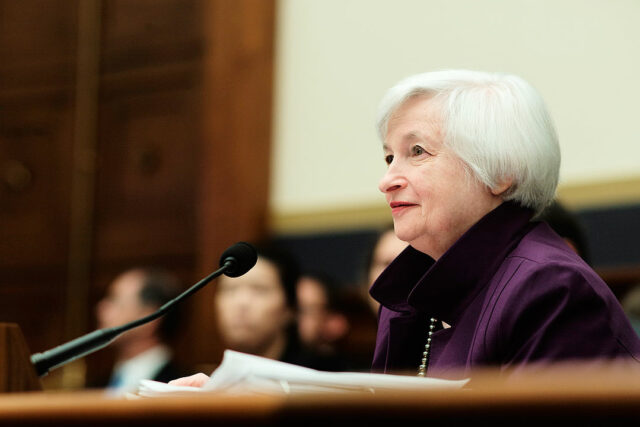
US Treasury Secretary Janet Yellen. — US FEDERAL RESERVE

US Treasury Secretary Janet Yellen will discuss ways to further strengthen Western sanctions against Russia over its war in Ukraine when she meets with Japanese Finance Minister Shunichi Suzuki on Tuesday, the Treasury Department said.

Ms. Yellen‘s meeting will also focus on working with Japan and other trusted partners to build stronger and more resilient supply chains to help lower prices for consumers in the United States, where inflation is running at 40-year highs, it said.

A comprehensive agenda will also include currencies, a Japanese official said, as the yen hit a fresh 24-year low beyond 137 yen to the dollar JPY= on Monday, adding to concerns about the rising cost of living.

“Currencies will be discussed as one of various issues,” the official said speaking on condition of anonymity.

The Japanese finance minister fired off a fresh warning shot against the renewed yen weakness.

“There are various global problems. We’d like to make maximum use of today’s meeting to deepen our coordination to resolve them,” Mr. Suzuki told reporters on Tuesday.

“A sharp yen weakening is seen in recent currency market. I’m concerned,” he said, “The government will watch the currency market even more closely while liaising with the Bank of Japan.”

Japan would respond appropriately as needed while coordinating with currency authorities from other countries in line with a G7 agreement on exchange rates, Mr. Suzuki added.

Meanwhile, the US Treasury secretary paid her respects to slain former Prime Minister Shinzo Abe, Japan’s longest serving modern leader at a private wake on Monday evening, lauding his work to increase Japan’s prosperity and advance the status of women.

She canceled a public speech at the Port of Yokohama out of deference to Mr. Abe’s death, but will still meet privately with Japanese business leaders to discuss how improved supply chain resiliency and greater use of “friend-shoring” can help ease inflationary pressures and address the bottlenecks.

Ms. Yellen will also continue talks with Japan about setting a price cap on Russian oil to limit Moscow’s profits and help lower energy prices.

The two sides will likely affirm conformity to a price cap but stop short of reaching any concrete agreement on a scheme, the Japanese official said.

On Wednesday, Ms. Yellen will travel to Indonesia to meet with Suzuki and other Group of 20 finance officials for their July 15-16 gatherings. – Reuters

May trade deficit widens as imports climb

The country’s trade-in-goods deficit grew slightly in May as imports rose to its five-month high, the Philippine Statistics Authority (PSA) reported this morning.

Preliminary data from the PSA showed the value of merchandise exports went up by 6.2% year on year to $6.310 billion in May, steady from the revised 6.2% in April but lower than 30.8% in May last year.

Likewise, merchandise imports grew by 31.4% annually to $11.989 billion in May. This was faster than the revised 29.4% in April, but slower than the 55.8% growth in May 2021.

This was the highest import growth in five months or since the 39.1% growth in December 2021.

This brought trade-in-goods deficit — the difference between exports and imports — to $5.679 billion in May, wider than the $3.180 billion deficit a year ago. The trade gap that month was also larger than the revised $5.349 billion deficit in April.

Total trade — the sum of exports and imports — grew by 21.5% to $18.299 billion, up from 20.3% in April, but lower than the 44.9% in May 2021.

Year to date, exports rose by 8.4% to $31.874 billion, above the 7% growth projected by the Development Budget and Coordination Committee for 2022.

Similarly, imports grew by 29% year on year to $56.796 billion in the first five months of 2022. This was also above the revised 18% imports growth penciled in by the government this year.

In the five months to May, the trade balance ballooned to a $24.922 billion deficit from $14.623 billion trade gap a year ago.

Total trade in the first five months rose by 20.8% to $88.670 billion from $73.421 billion in the January-May period last year.

FDI net inflows rise to 4-month high

ALEXANDER MIL-UNSPLASH

By Keisha B. Ta-asan

NET INFLOWS of foreign direct investments (FDIs) into the Philippines surged to a four-month high in April as further reopening of the economy and trade liberalization reforms lifted investor confidence.

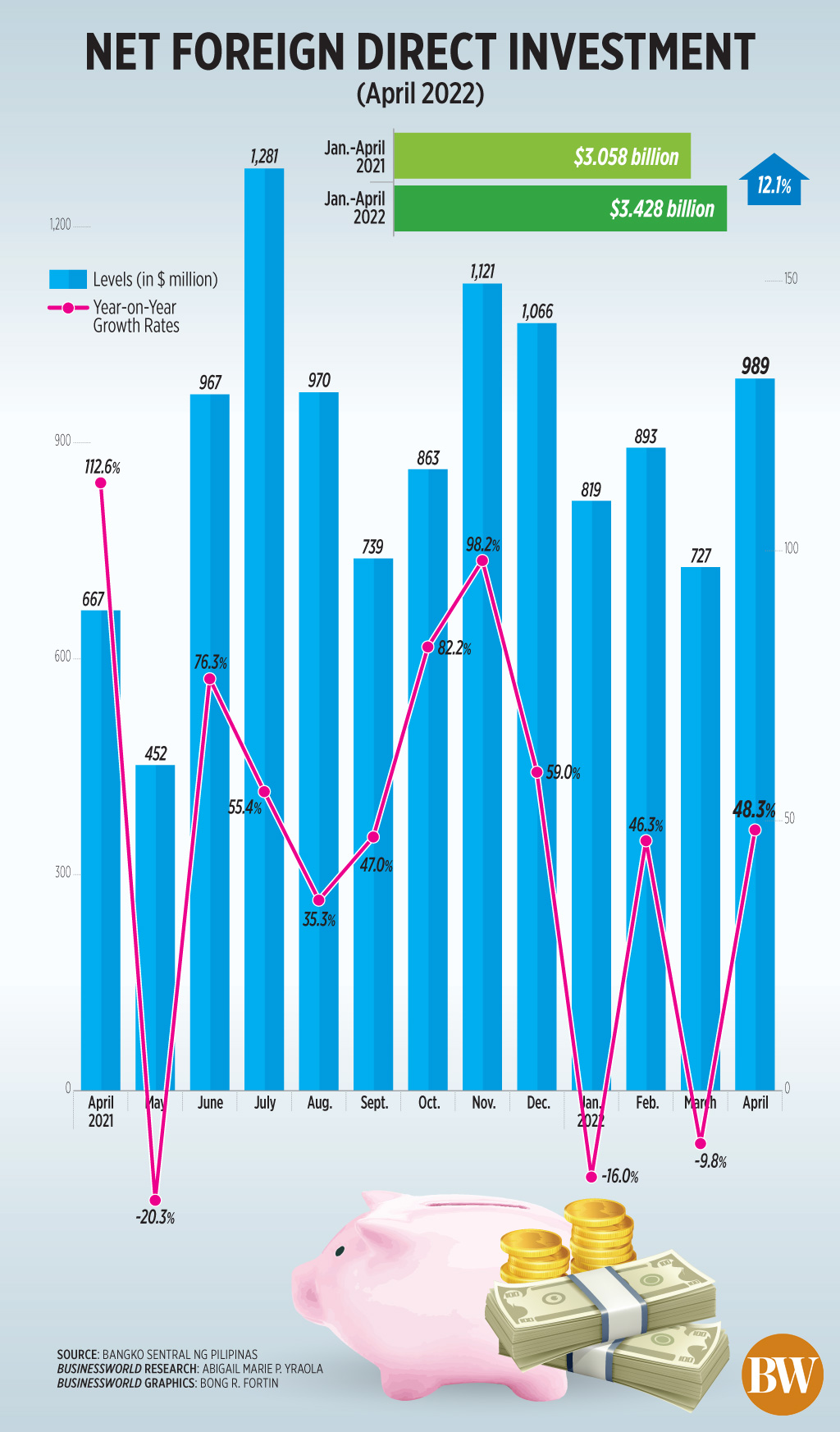
Data released by the Bangko Sentral ng Pilipinas (BSP) on Monday showed that FDI net inflows rose by 48.3% to $989 million in April from $667 million in the same month in 2021.

This was the highest monthly FDI inflow recorded since the $1.06 billion in December last year.

Net foreign direct investmentsMonth on month, net inflows of FDIs, which stand as a key source of jobs and capital for the local economy, grew by 36% from $727 million in March.   

“The pickup in FDI reflects the positive fallout from reopening of the economy. With the Philippines posting a solid 1Q GDP report and with mobility restrictions lowered, this may have prompted investments into the Philippines, including the placement of equity or ‘fresh FDI,’” ING Bank N.V. Manila Senior Economist Nicholas Antonio T. Mapa said in an e-mail.   

Metro Manila and most areas in the country have been under the most lenient alert level since March, as coronavirus infections declined.

“Vaccination rates and the country’s ability to control COVID surges without having to resort to crippling lockdowns also indicated a better business outlook for investors,” China Banking Corp. Chief Economist Domini S. Velasquez said in a Viber message. 

Ms. Velasquez also noted the FDI inflows are mainly driven by the economic reforms put in place by the Duterte administration.

“The amendments to the Public Service Act (PSA) and the Retail Trade Liberalization Act (RTLA) which loosened restrictions of some sectors to foreign ownership likely drew investors’ interests,” she added.

President Rodrigo R. Duterte in March signed into law Republic Act No. 11659, which amended the PSA to allow up to 100% foreign ownership in airports and airlines, subways and railways, telecommunications, domestic shipping, and tollways and expressways.

Mr. Duterte also signed into law the measures amending the RTLA and the Foreign Investment Act, which are expected to boost the competitiveness of the Philippines’ industries and services.

Data from the BSP showed net inflows of FDI went up, following the increases recorded across all components, led by non-residents’ net investments in debt instruments.

April data showed a 40.6% increase in foreign firms’ investments in debt instruments of local affiliates to $684 million from $487 million a year ago.

Foreigners’ net investments in equity capital surged by 127.8% to $206 million in April. Equity capital placements jumped by 103.3% to $224 million, while withdrawals declined by 9.9% to $18 million. 

The equity placements were mainly from Malaysia, the United States, and Japan, and invested mostly in construction, real estate and manufacturing industries.

Reinvestment of earnings fell by 10.2% to $99 million in April.

For the first four months of the year, total FDI net inflows grew by 12.1% to $3.4 billion.

“Cumulative FDI net inflows rose due mainly to the increase in non-residents’ net investments in debt instruments,” the BSP said, referring to the 35.3% jump in foreign investments in debt instruments to $2.5 billion.   

Reinvestment of earnings was flat at $329 million in the January to April period.

Meanwhile, investments in equity capital slumped by 37.2% to $517 million in the four-month period, as placements declined by 39.4% to $576 million. Equity withdrawals also dropped by 53.2% to $59 million.

Net inflows of FDIs are expected to slow in the next few months, amid the darkening global economic outlook.

“We could see a moderation in the near term as the economy faces short-term headwinds but should the Philippines weather the turbulence, we can expect FDI to resume once we have cleared the present challenges,” Mr. Mapa said.   

Aside from economic reforms, Ms. Velasquez said FDI net inflows may get a boost from “infrastructure investments with private sector participation, and efforts to streamline tax administration.”

“Outside of these reforms, ease of doing business, anti-corruption efforts, and firmly instilling the rule of law will be favorable to investors,” she added.   

The central bank projects FDI net inflows will reach $11 billion this year.

Marcos’ planned new taxes may have limited impact

REUTERS

By Diego Gabriel C. Robles and
Alyssa Nicole O. Tan, Reporter

THE ECONOMIC TEAM’S plan to pursue new taxes on digital services and pollutants, as well as “rightsizing” of the bureaucracy, may not generate enough revenues needed to repay the Philippines’ ballooning debt, experts said.

Finance Secretary Benjamin E. Diokno last week said they are considering the imposition of taxes on digital or online transactions, single-use plastics, and carbon emissions. This as the Marcos administration looks for new sources of revenues to lower the fiscal deficit and repay the P3.2-trillion additional debt incurred during the coronavirus disease 2019 (COVID-19) pandemic.

“New taxes on digital transactions, single-use plastics, carbon and online services will likely help deliver fresh revenue streams to government coffers. Estimates have been floated on projected collections although it may be difficult to say whether this will be enough to completely offset the current debt and deficit levels,” said ING Bank N.V. Manila Branch Senior Economist Nicholas Antonio T. Mapa.

Bernardo M. Villegas, economist at the University of Asia and the Pacific, said these additional taxes “will not be enough but they will contribute to reducing the fiscal deficit.”

“We need all the tax increases we can get,” Mr. Villegas said.

The Bureau of the Treasury (BTr) earlier estimated the government needs to raise P249 billion annually in incremental revenues to avoid new borrowings and repay debt.

“Given the amount of plastics, carbon and online services that are being used, this can bring in a sizable amount. This may not be enough to pay for the debt, but its consequences in terms of the environment and the inequality are probably more important than reducing the debt,” said Leonardo Lanzona, director of the Ateneo Center for Economic Research and Development.

John Paolo R. Rivera, economist from the Asian Institute of Management, said a tax on single-use plastics and carbon emissions will have “good environmental implications because it will inhibit its use, which is good for the environment in the long run.”

Finance Secretary Benjamin E. Diokno last week broached the possibility of taxes on single-use plastics and on carbon emissions, which would also aid the country’s efforts against climate change and pollution.

Under the previous administration’s fiscal consolidation plan, a P20 excise tax per kilogram of single-use plastics would generate P1 billion in revenues annually.

A 12% value-added tax on online advertisement services and other digital and online services would also generate P13.2 billion in annual revenues.

SENATE SUPPORT
Several senators backed the proposed tax on single-use plastics and online transactions.

“Goods and services bought through the internet should really be taxable for VAT (value-added tax) as all goods and services are, unless expressly made exempt by law,” Senator Juan Edgardo M. Angara said in a Monday statement.

Other countries already impose a tax on single-use plastics, which is intended to encourage the use of recyclable bags, Mr. Angara added.

In a Viber message, Senator Mary Grace Natividad S. Poe-Llamanzares said taxing single-use plastics would hopefully discourage people from using these, and lessen their impact on the environment.

Also, Senator Ramon B. Revilla, Jr. said Congress should review and update its existing tax laws on the digital economy.

“It is also unfair because local online businesses are covered by taxation laws, but multinational corporations who have less physical presence but a wider reach do not seem to be within the scope. They may have to be properly taxed given the outdated provisions and leakages in tax measures,” Mr. Revilla said in a statement.

The House of Representatives approved in September 2021 a bill seeking to impose a 12% VAT on digital sale of services such as online advertisements, subscription services, etc. However, the Senate did not approve the counterpart measure.

Meanwhile, Senator Francis Joseph G. Escudero said that it may not be the best time to implement the two proposed measures.

“It’s always easier to go for imposing new, or increasing whatever existing, taxes in order to raise revenues for (the) government,” he said in a Monday statement. “However, this is burdensome and is not in keeping with the times of slow economic growth, increased unemployment and rising inflation.”

Mr. Escudero suggested that Mr. Diokno focus on plugging tax loopholes and improving revenue collection by the Bureau of Internal Revenue and Bureau of Customs.

“With nearly P200 billion in uncollected taxes lost to either corruption and/or inefficiency, this is by far more than any projected revenue of the new taxes he is mulling,” he said.

RIGHTSIZING BILL
Economic managers are also pushing for the passage of a government rightsizing law that would eliminate redundancies and duplication in government operations. 

Budget Secretary Amenah F. Pangandaman last Friday said they will endorse the rightsizing bill as one of the legislative priorities.

“It’s fairly unpopular, I think, but with the instructions of the President to the Cabinet members to also look at your existing structures, it’s wise to refile the bill,” she said.

For Security Bank Corp. Chief Economist Robert Dan J. Roces, rightsizing the bureaucracy is fine, “as long as this supports the objective of fiscal consolidation without crimping government functions and the private sector’s recovery.”

Mr. Lanzona noted that reducing the bureaucracy will result in greater savings for the government.

“[But] the amount saved may not be enough relative to the huge debt but its externalities are very important not only for economic but also institutional efficiency,” he added.

Mr. Rivera said the impact of this measure may not be huge, but “some impact is better than no impact.”


NCR prices of building materials surge in April

A construction site is seen in Cubao, Quezon City. — PHILIPPINE STAR/ MICHAEL VARCAS

RETAIL PRICES of building materials in Metro Manila grew at its fastest annual pace in more than 13 years in April amid global supply constraints caused by the ongoing Russia-Ukraine war.

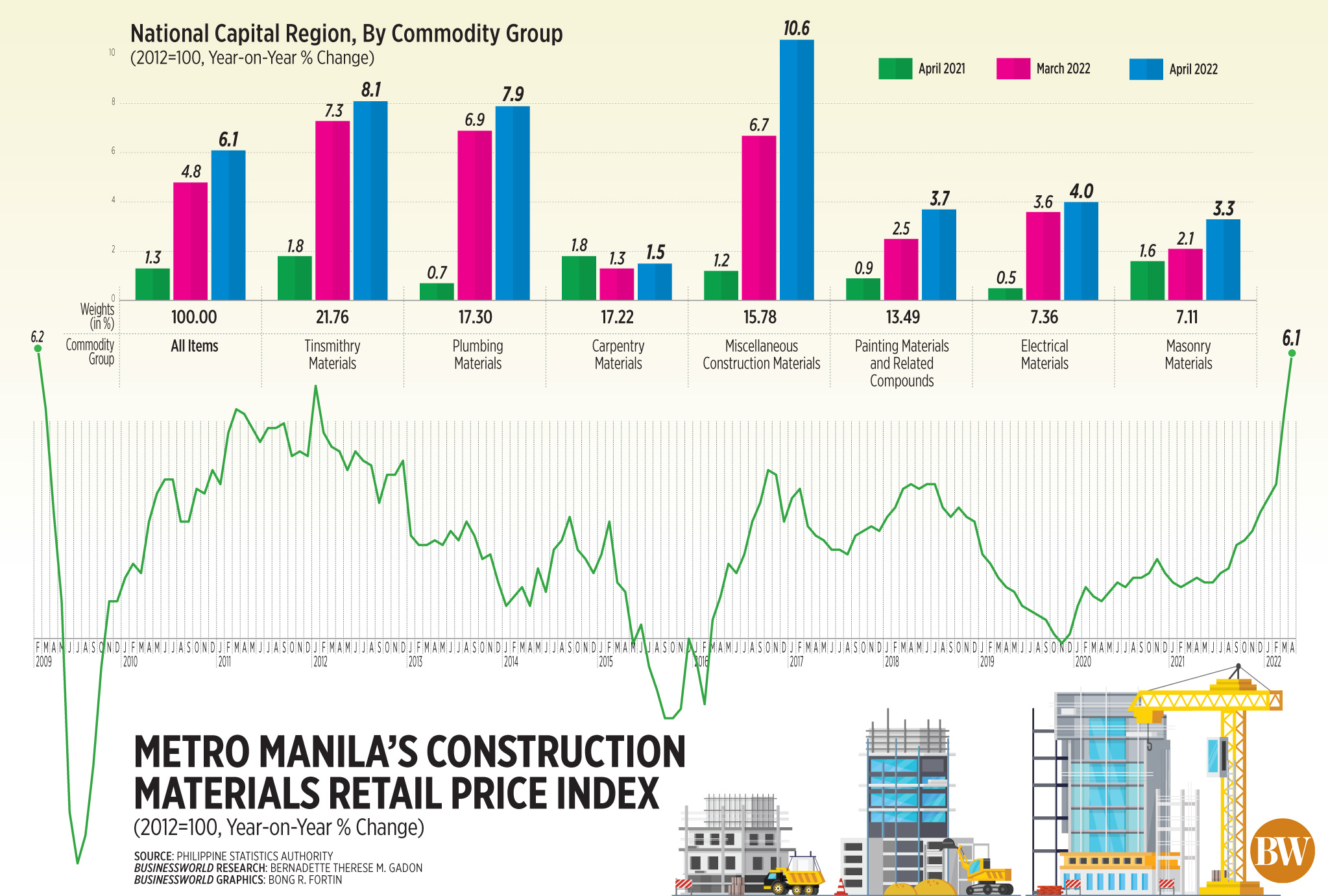
Preliminary data from the Philippine Statistics Authority (PSA) showed the National Capital Region’s (NCR) construction materials retail price index (CMRPI) rose by an annualized 6.1% in April, faster than the 4.8% print in March.

This was also significantly higher than the 1.3% print recorded in April 2021.

Metro Manila's construction materials retail price index

The April print was the highest year-on-year growth for building materials prices in NCR in over 13 years, or since the 6.2% growth logged in February 2009.

For the January to April period, the CMRPI in Metro Manila averaged 4.3%, higher than the 1.2% in the comparable four months a year ago.

Asian Institute of Management economist John Paolo R. Rivera said retail prices of building materials were affected by the ongoing Russia-Ukraine conflict, which disrupted global supply chains. He also cited the higher demand for construction materials as economic activity increased.

“The depreciation of the peso, with respect to the US dollar, made imported construction materials more expensive,” Mr. Rivera said in a text message.

In April, the Philippine peso averaged P51.9760 against the dollar, weaker than the P48.4620 average in April last year, central bank data showed.

The price growth in construction materials was driven by faster year-on-year increase seen in all commodity groups, led by tinsmithry materials (8.1% in April from 7.3% in March).

Retail prices of the following materials also grew annually: plumbing materials (7.9% in April from 6.9% in March), carpentry materials (1.5% from 1.3%), miscellaneous construction materials (10.6% from 6.7%), painting materials and related compounds (3.7% from 2.5%), electrical materials (4% from 3.6%), and masonry materials (3.3% from 2.1%).

Retail construction prices reflect the demand from small-scale building contractors.

Retail prices of construction materials may continue to rise in the next few months, Mr. Rivera said. — Ana Olivia A. Tirona

Lotilla to return to DoE under Marcos

PRESIDENT Ferdinand R. Marcos, Jr. named former Energy Secretary Raphael P.M. Lotilla to lead the Department of Energy (DoE), according to the Presidential Palace.

Mr. Lotilla served as Energy chief from 2005 to 2007 under the administration of former President Gloria Macapagal-Arroyo, Press Secretary Rose Beatrix Laviña Cruz-Angeles said in a statement on Monday.

Prior to that, he was president of the state-run Power Sector Assets and Liabilities Management Corp. (PSALM) and deputy director-general at the National Economic and Development Authority (NEDA).

In a separate statement, Ms. Cruz-Angeles clarified that the designation of Mr. Lotilla is “right now a nomination” pending review of his employment status.

She said Mr. Marcos’ “personal choice to head the DoE” is currently an independent director of Aboitiz Power Corporation and ACE Enexor Inc.

The press chief cited the law that created the DoE, which bars any officer, external auditor, accountant, or legal counsel of any private firm or enterprise primarily engaged in the energy industry from being appointed as secretary of the agency “within two years from his retirement, resignation, or separation therefrom.”

“Thus while the matter is reviewed to determine whether an independent director is considered an officer of the company, Lotilla is considered a nominee,” Ms. Cruz-Angeles said.

In light of Mr. Lotilla’s uncertain appointment to the DoE, Lawmaker Jose Maria Clemente S. Salceda clarified that independent directors “are not officers of the company.”

“By definition, an independent director is ‘a person other than an officer or employee of the corporation’,” he said in a statement.

Mr. Marcos earlier said the role of the Energy secretary will be crucial as the government faces surging prices of fuel and energy.

The Philippine Chamber of Commerce and Industry (PCCI) last week urged the Marcos administration to tackle the continued increase in electricity rates, and the power supply shortages affecting industries. Electricity rates in the Philippines are already one of the highest in Southeast Asia.

The next DoE chief also needs to address the declining output of the country’s Malampaya natural gas field.

Fitch Solutions Country Risk & Industry Research said in a note in August last year that the depletion of the country’s only indigenous gas field is “problematic” since it accounts for 30% of Luzon’s power generation and services 20% of national demand. — Kyle Aristophere T. Atienza


Electricity rates to go down in July, says Meralco

BW FILE PHOTO

CUSTOMERS of Manila Electric Co. (Meralco) will pay a lower rate of about 71 centavos per kilowatt-hour (kWh) in July after the energy regulator called for a refund of a previous over-collection, offsetting an increase in the power generation charge.

“It’s basically good news for Meralco customers as we are announcing a 71-centavo rounded off rate reduction for the residential consumers this month of July 2022,” said Meralco Spokesperson and Head of Corporate Communications Joe R. Zaldarriaga in a press briefing on Monday.

Meralco said the reduction came after the Energy Regulatory Commission (ERC) directed the utility to refund P21.8 billion following the validation of its applicable tariff for July 2015 to June 2022.

As a result, the overall rate in July will go down by P0.7067 per kWh to P9.7545 per kWh from P10.4612 per kWh in June.

Households consuming 200 kWh will see a P141 decrease in their monthly power bill. Those consuming 300 kWh, 400 kWh, and 500 kWh, will see their monthly bills decline by P212, P283, and P353, respectively.

“The immediate implementation of the ERC decision was able to more than offset the impact of higher generation charge this month to the benefit of our customers,” Jose Ronald V. Valles, Meralco’s head of regulatory management, said separately in a press release.

The refund will be 87 centavos per kWh for residential customers and will appear as a separate line item called “Distribution True-up 4” in the power bills starting this July.

On the other hand, there is an increase in the generation charge of 22 centavos per kWh in July to P6.7756 per kWh from the P6.5590 per kWh registered in June.

Mr. Zaldarriaga said that the increase is primarily caused by the increase in the prices at the wholesale electricity spot market (WESM) of P3.9649 per kWh.

Meralco also reported an increase in charges from power supply agreements (PSAs) by P0.3186 per kWh and a decrease in charges from independent power producers (IPPs) by P0.4669 per kWh.

“Mitigating factor however was the rates of the independent power producers, which went down by 47 centavos per kWh,” Mr. Zaldarriaga.

PSAs, IPPs, and the spot market accounted for 50%, 43%, and 7%, respectively, of Meralco’s energy requirement for the period.

“[In] the May versus June 2022 daily Luzon weighted average price, there were a series of yellow and red alerts for the June 2022 supply month which led to the pressure of WESM prices to go up,” Mr. Zaldarriaga said.

The yellow alerts, a warning of thinning power reserves, were placed by National Grid Corporation of the Philippines (NGCP) due to the forced outage of several power plants from June 20 to 22. The red alert was placed on June 18 due to the tripping of NGCP’s Hermosa-BCCP 230 kilovolt lines 1 and 2, which isolated several power plants.

Mr. Zaldarriaga said that 16 out of 41 times last month, the secondary price cap, a price-mitigating mechanism imposed when there are persistent high prices at the spot market. It was triggered 35.71% of the time, the highest incidence of secondary price cap imposition since the start of the year.

He also factored in peso depreciation and continued increase in international coal prices as reasons for higher generation costs.

“There was a steep depreciation of the peso from P52.37 in May to almost P55 in June,” Mr. Zaldarriaga said. “The generating plants utilize majority of their expenses using dollar-denominated expenses.”

Meralco placed the cost components in the July rate as: P0.2166 for power generation; P0.0012 for transmission; P0.8656 for distribution rate true-up; and P0.0565 for other charges such as taxes, subsidies, and feed-in tariff allowance.

Distribution, supply, and metering charges, where Meralco gets its income, remained unchanged since the reduction in July 2015.

Generation charges are paid to the power suppliers, transmission charges are paid to the system operator, and the other charges are all remitted to the government.

On Monday, shares in the company rose by 1.14% or P4 to close at P354 apiece at the stock exchange.

Meralco is the largest power distribution company and the largest private-sector utility in the Philippines. Its controlling stakeholder, Beacon Electric Asset Holdings, Inc., is partly owned by PLDT, Inc.

Hastings Holdings, Inc., a unit of PLDT Beneficial Trust Fund subsidiary MediaQuest Holdings, Inc., has an interest in BusinessWorld through the Philippine Star Group, which it controls. — Justine Irish DP. Tabile

Filipinas eye fifth straight win as it duels archrival Thailand

HAT TRICK for striker Sarina Bolden — PFF

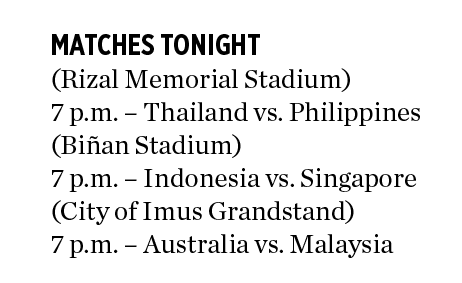
HOST Philippines aims for payback, a record-extending fifth straight win and No. 1 spot in the semifinals as it duels with rival Thailand in the last group match of the AFF Women’s Championship on Tuesday night at the Rizal Memorial Stadium.

The Filipinas hit the pitch at 7 p.m. teeming with motivation to go for maximum points versus the Thais in the marquee Group A matchup.

First, Thailand denied the Philippines a place in the last Southeast Asian Games gold medal match with a 3-0 win in the semis in Hanoi and payback at home is a really tantalizing proposition.

Then there’s this chance to further improve on the team’s best start in the tournament, which currently stands at 4-0-0 (win-draw-loss for 12 points) after that 4-1 come-from-behind verdict over Indonesia on Sunday night.

A winning result against the second-running Thais (10 points on 3-1-0) will land the Filipinas top of the table in Group A for a Final Four duel with the No. 2 team from Group B.

A draw will also suffice for the group’s pole position, but a loss will enable the Thais to climb ahead and send the home squad down to the No. 2.

Alen Stajcic’s Philippine charges look to have more supporters in the stands to draw inspiration from, especially with the most important stages up.

“We want this place rocking. We want it full,” Mr. Stajcic ahead of the clash with 2019 runner-up Thailand.

“It’s so good to have a bigger crowd last Sunday (1,474 strong) and the noise and the atmosphere. The bigger the atmosphere, the more chances we have of winning this tournament. That’s the whole point of having hometown advantage — to help us get over the line.”

Against a regional power, the Filipinas can’t afford a listless start like that of the outing versus Indonesia, which caught them with the opening goal.

If anything, that fightback showed the Philippine booters’ resilience and character.

“It’s an important quality within a team to remain calm and composed. Football’s not always going to go your way, sometimes you have a bad day. So for us to come out on top, 4-1, after starting poorly, it’s a good sign,” said Mr. Stajcic.

“We didn’t let that 1-0 (deficit) stop us; we used it as motivation. We’ve been down before so we’re not scared to be down. I’m glad we stuck with it, kept making the runs, kept defending hard. But we got to be better next game against Thailand,” said striker Sarina Bolden, who fired a hat trick versus Indonesia to up her collection to 14 goals in 22 appearances. — Olmin Leyba