Home Blog Page 6149

Zombies will once again kick off Cannes Film Festival


Z (Comme Z) by Michel Hazanavicius

PARIS — The Cannes Film Festival will open on its 75th anniversary next month with the screening of a film about zombies, Z (Comme Z) by Michel Hazanavicius, director of award-winning film The Artist.

“It’s a zombie comedy that evokes passion for cinema,” festival director Thierry Fremaux told a news conference on Thursday, recalling that the 2019 event had kicked off with a film from Jim Jarmusch on the same theme.

The festival runs from May 17-28 and will feature heavy-hitters including Tom Cruise’s Top Gun sequel and an Elvis biopic by Baz Luhrmann starring Austin Butler and Tom Hanks.

Organizers have said the competition will include James Gray’s Armageddon Time, a drama with Anne Hathaway, Jeremy Strong, and Anthony Hopkins and a screening of Three Thousand Years of Longing by George Miller, with a cast including Idris Elba and Tilda Swinton.

The festival, which announced in March it would ban official Russian delegations from the event unless the conflict in Ukraine ends, will feature Tchaikovski’s Wife by exiled Russian director Kirill Serebrennikov, who has been outspoken about the war.

In the category of first time projects, the festival will feature a debut film from Maksim Nakonechnyi, shot recently in Ukraine. Entitled Butterfly Vision, it traces the story of a young Ukrainian woman who returns to her country after being captured then released in a prisoner swap.

Mr. Fremaux signaled an openness to platforms like Netflix, while acknowledging he still had to try to convince those who disagreed with him.

“It’s clear we have to acknowledge the existence of these new types of distribution and production, I think we need to maintain a dialogue with them,” he said.

Mr. Fremaux drew criticism from the French movie theater industry in 2017 by allowing Netflix films — seen as a threat to the industry because they are streamed to subscribers rather than shown in cinemas — into the Cannes competition.

Meanwhile, movie theaters around the world continue to face the challenge of bringing back audiences.

“I hope the Cannes Film Festival will serve as a spark for the return of audiences to the movies, but for the moment there is not a big return and some countries are suffering from a loss of interest,” he said. — Reuters


San Beda routs Arellano, 82-68, for solo NCAA lead

SAN BEDA Red Lions’ James Kwekuteye — NCAA/GMA

By Joey Villar

SAN BEDA drew strength from its bench in the first half and then went to main man James Kwekuteye in the second as it crushed Arellano University (AU), 82-68, on Sunday and seized the solo lead in the 97th National Collegiate Athletic Association (NCAA) basketball tournament at the La Salle Greenhills Gym.

Mr. Kwekuteye dropped 10 of his team-high 14 points in the final two quarters while relying heavily on a strong bench support in powering the Lions to their fifth straight win and into solo first place.

Gab Cometa, Winston Ynot, Rhayyan Amsali and Justin Sanchez stepped up big early as they came off the bench to combine for 36 of the 41 points from the second stringers in helping the cause.

“I’m so happy that the bench stepped up big today (Sunday). We need everyone to really contribute and help for us to come up with a W (win),” said Mr. Kwekuteye.

Truly, the backups were instrumental in mounting a 47-32 lead at the break.

Mr. Kwekuteye and the San Beda starters feed on the strong play of the second group and led by as much as 22 points twice, the last at 64-42 late in the third period.

The Chiefs tried to whip up a fourth quarter storm but Mr. Kwekuteye and the Lions repeatedly fended them off to preserve the win.

It also helped that the Lions made life difficult for Justin Arana, who was hobbled by foul trouble and was held to just seven shots and made only three of them and finished with just seven points and eight turnovers after coming into the game averaging 16 points.

“Basically, we have to execute coach’s (Boyet Fernandez) plan to play zone and double-team him (Mr. Arana) and make him kick out the ball and we executed that,” said Mr. Kwekuteye.

AU fell from solo sixth to a share of it with University of Perpetual Help and San Sebastian with 2-4 cards apiece.

The Scores:

San Beda 82 – Kwekuteye 14, Cometa 11, Penuela 9, Ynot 9, Bahio 8, Amsali 8, Sanchez 8, Cuntapay 6, Alfaro 4, Gallego 3, Visser 2, Villejo 0, Abuda 0, Andrada 0, Jopia 0

Arellano 68 – Doromal 16, Sablan 10, Valencia 9, Cruz 8, Arana 7, Concepcion 7, Steinl 4, Sta. Ana 3, Abastillas 2, Caballero 2, Oliva 0

Quarterscores: 17-15; 47-32; 66-52; 82-68

Budget carrier CEB resumes more direct domestic flights from Cebu

CEBU PACIFIC

BUDGET carrier Cebu Pacific (CEB) announced on Sunday the resumption of more direct flights from Cebu to Davao.

The move is in line with Cebu Pacific’s goal to restore 100% of its pre-pandemic capacity starting this month, the airline said in a statement.

The budget carrier “will add more flights for its passengers in Visayas-Mindanao to enable them to explore more local destinations without having to pass through Manila,” it added.

Cebu Pacific now operates direct flights to 21 domestic destinations.

It recently resumed direct flights from Cebu to Calbayog, Surigao, Puerto Princesa, and Legazpi.

At the same time, the airline increased flights to its 18 other routes from Cebu, particularly to Manila, Iloilo, Zamboanga, Coron, Boracay, and Cagayan de Oro, among others.

“On top of this, the airline has also resumed four new direct flights from Davao,” Cebu Pacific said.

“Flights to Bohol, Iloilo, and Zamboanga have resumed this month, while Davao-Cagayan de Oro flights will resume in May. These additional connections bring up the hub’s total routes to six, including its Davao-Manila which flies up to 8x daily; and Davao-Cebu up to 3x daily,” it added.

The budget carrier recently reported a net loss of P24.9 billion for 2021, widening from a loss of P22.2 billion a year earlier.

It generated P15.7 billion in revenues in 2021, 30% below 2020.

The airline said the decline in revenues was mostly driven by the 50% drop in passenger revenue to P6.3 billion from P12.6 billion in 2020. — Arjay L. Balinbin

Russian grain still flows to top end users, but prices higher

REUTERS

SEVEN WEEKS after its invasion of Ukraine, Russia is still exporting grain to some of its biggest customers, even as shipping costs soar.

The main buyers remain Egypt, Turkey and Iran, said Dmitry Rylko, general director of the Moscow-based Institute for Agricultural Market Studies. The resilience of grain exports, despite sanctions and moves by some traders to shun Russian commodities, is pushing some market observers to raise their estimates for shipments this season. 

Almost 900,000 tons of wheat have been loaded in Russian ports so far this month, in line with the pace in March, according to Logistics OS. Crop data from AgFlow also show Russian exports of key agricultural commodities, including wheat, fell just shy of 1 million tons in the first 13 days of April, close to level in the same period in March.

Those shipments have spurred analysts like Strategie Grains to downgrade their outlook for wheat exports from the European Union, one of Russia’s biggest competitors. The US Department of Agriculture last week also raised its estimate for Russian wheat exports in the current season to 33 million tons, though that remains short of the 35 million tons it forecast before the war.

Under Russian quotas, exports from February to June are limited to 8 million tons. The Russian Union of Grain Traders said earlier this week that it expects exports to slow in April, according to local newspaper Kommersant. IKAR’s Rylko also expects grain shipments to slow in the coming months compared with March due to a stronger ruble and high export taxes.

The ruble has strengthened to pre-war levels after Moscow imposed capital controls, forcing exporters to convert most of their overseas earnings into the Russian currency. Export taxes, which are linked to wheat prices, are at a record high of $101.40 a ton. That means Moscow generates revenue of about $3 million for every 30,000-ton shipment of wheat.

Shipping costs from the Black Sea region have also soared, climbing 50% to 80% from last year due to war risks, according to UkrAgroConsult. Fleets under non-Russian flags don’t want to enter Russian ports due to high insurance costs and sanctions, Evgeny Popov, chartering manager at St. Petersburg-based shipping company Nitro, said by phone.

Russia’s Black Sea ports are still operating, and traffic is resuming in the Sea of Azov, according to Strategie Grains.

Still, nearby importers will weigh whether Russian wheat remains competitive versus origins further afield, said AgFlow Chief Executive Officer Nabil Mseddi. Egypt booked one cargo from Russia in its latest wheat tender on Wednesday, although France took the bulk of purchases. — Bloomberg

RS models share limelight in 1st Audi Sport Drive

Cars assemble at the Petron Dasmariñas Village take-off point. — PHOTO FROM AUDI PHILIPPINES

AUDI PHILIPPINES recently held a first-ever fun run of Audi Sport models — all Nürburgring-tested vehicles — the largest local gathering of Audi RS owners in the country.

The activity, dubbed “Audi Sport Drive,” involved owners of Audi’s high-performance RS models who purchased their vehicles from Audi Philippines. The road trip took the convoy south of Metro Manila, enjoying their cars in a fun road trip that was followed by a Sunday brunch — “a perfect way for them by which to share their passion for Audi Sport.”

Audi Sport is the high-performance division of Audi AG which develops and produces the RS range. These compacts, sedans, coupes, wagons and SUVs are all the highest versions of their models, “defined by quattro all-wheel drive systems, distinct designs and a capacity to be driven daily even if these are focused on performance.” Audi said that each RS model undergoes development work at the famed Nürburgring track — logging at least 8,000 kilometers of testing each. The lengthy stint on the iconic circuit “determines how RS models’ powertrain and suspension components perform under extreme conditions.”

Some 60 RS owners signed up for the event, which saw a variety of models such as the RS 3 Sedan, RS 4 Avant, RS 5 Coupe and Sportback, RS 6 Avant, RS Q3, RS Q8 and the R8 supercar. The group converged and took off from the Petron Dasmariñas Village service station and headed south before circling back to the Audi Global City showroom in Bonifacio Global City to gather in “a safe, sanitized and relaxing environment.

Along with a presentation of the features which make RS models like the 2022 RS 5 Sportback and RS Q3 Sportback “performance and technology leaders in their respective segments,” Audi Philippines officials announced the arrival of the Audi RS 3 Sportback. Powered by the Ingolstadt-brand’s 10-time Engine of the Year winner — a five-cylinder power plant that produces 400hp and 500Nm — the latest RS 3 Sportback is the first Audi ever to be fitted with the RS torque splitter, which distributes torque between the rear wheels.

Participants and guests were also shown the fully electric Audi e-tron SUV and e-tron GT four-door grand tourer. “The Audi e-tron range proves that electromobility can be as dynamic and fascinating as the high-performance RS models are, thanks to powerful drive systems with electric quattro, stunning designs and luxurious cabins,” said the company. “Directly linking Audi Sport to the e-tron lineup is the RS e-tron GT; also fully electric, it is the most powerful production car Audi has ever produced. And because of their zero-emission fully electric powertrains, extensive use of eco-friendly materials, and the benefit of having been produced in carbon-neutral factories, the e-tron SUV, e-tron GT and RS e-tron GT are able to promote the concept of sustainability as the new luxury.”

UK rock band The Who back on tour after COVID cancellations

THEWHO.COM
THEWHO.COM

NEW YORK — After costly pandemic cancellations, British rock band The Who is back on the road again with THE WHO HITS BACK! tour.

“We’re just hitting back at COVID because it stopped us in our tracks. We were, we were going to call it, Where Were We?” lead singer Roger Daltrey said ahead of the tour starting next week.

Canceled charity concerts for The Who’s foundation, Teenage Cancer, at London’s Royal Albert Hall had cost the group about $3 million, said Mr. Daltrey, 78. The charity works with UK and US hospitals to develop state-of-the-art spaces for teens suffering from cancer to meet and stay connected.

Mr. Daltrey and Pete Townshend, the band’s principal songwriter famed for thrashing his guitar on stage, are the only surviving original members of the group which emerged in 1960s London with drummer Keith Moon and bass player John Entwistle.

The Who has sold more than 100 million records worldwide, with the rock opera Tommy and hits like “Won’t Get Fooled Again” and “I Can See For Miles.”

Mr. Daltrey and Mr. Townshend, along with six band members and an orchestra, will kick off their North American tour on April 22 in Hollywood, Florida, and wrap it up in Las Vegas in November.

The Who’s tours have become a lot more complicated, Mr. Daltrey said. “We were, we were four guys with eight amplifiers, a drum kit and a sound system. That was it. We turn up in a U-Haul truck and three roadies would suit us for the night.”

Mr. Daltrey refuses to worry about COVID affecting the tour, he said at his England countryside home. “We’re just living our lives. And if you get it and die, you get it and die, you know?”

The rock legend, who has worked with many of the world’s top bands, named Mick Jagger as his top rock band frontman followed jointly by Freddie Mercury and Elton John, Bruce Springsteen and David Bowie.

While the band has no plans to stop touring, the time will come, Mr. Daltrey acknowledged.

“I’ve always said about this business. You don’t give it up, it gives you up. I will open my mouth and it won’t come out like it should. And I will go, that’s it, can’t do it anymore.” — Reuters

Yuka Saso finishes joint 56th at LPGA Lotte Championship

YUKA SASO — REUTERS

FIL-JAPANESE Yuka Saso posted the highest finish among the Philippine bets in the Ladies Professional Golf Association (LPGA) Lotte Championship at joint 56th on Saturday at the Hoakalei Country Club in Oahu, Hawaii.

Ms. Saso birdied two of the last four holes to salvage an even-par 72 in the final round and finish the tournament at four-over 292, 15 shots off Korean Hyo Joo Kim’s winning 277.

The 2021 US Open champion Ms. Saso, who had earlier rounds of 73-74-73, netted $5,184 (around P270,000) as she wound up ahead of Dottie Ardina (joint 64th) and Bianca Pagdanganan (joint 67th) in the final standings.

Ms. Ardina closed out with a three-over 75 for a five-over 293 tally while Ms. Pagdanganan fired her best card of the tournament, a three-under 69, that lifted her to a 72-hole aggregate of six-over 294.

The 28-year-old Ms. Ardina, who had three birdies against five bogeys in the last round, went home with  $4,508 (P235,000). Ms. Pagdanganan gained shots on Nos. 1, 3, 10, 11 and 18 to offset bogeys on the sixth and 12th and finish a stroke off Ms. Ardina for a $4,117 (P214,000) take home.

Meanwhile, Ms. Kim signed for a one-under 71 and 11-under total to beat Japanese Hinako Shibuno (279 after a 70) by two.

Ms. Kim, the 2014 Evian Championship ruler, banked $300,000 for this triumph, her fifth in the LPGA. Hinako Shibuno, the 2019 Women’s British Open winner, got $182,956. — Olmin Leyba

Peso may drop vs dollar on rising oil prices, war in Ukraine

BW FILE PHOTO

THE PESO may depreciate versus the greenback this week as fuel prices climbed and as the war in Ukraine rages on.

The local unit ended trading at P52.03 per dollar on Wednesday, gaining seven centavos from its P52.10 close on Tuesday, based on Bankers Association of the Philippines data.

However, it depreciated by 44 centavos from its P51.59 finish on April 8.

Philippine financial markets were closed from April 14 to 15 in observance of Maundy Thursday and Good Friday.

A trader attributed the peso’s appreciation compared with its Tuesday’s finish to remittance flows for the holidays.

Meanwhile, the peso depreciated from its close a week earlier due to investors pricing in aggressive hikes from the US Federal Reserve this year, UnionBank of the Philippines, Inc. Chief Economist Ruben Carlo O. Asuncion said.

A Reuters poll last week showed analysts expect the Fed to raise rates by 50 basis points each for its May and June review to respond to runaway inflation. These analysts also expect a 40% probability of recession by 2023. 

“It’s going to take time for us to appreciate the recent burst of relative prices and how long they’re going to be with us,” Chicago Fed President Charles Evans said last week.

For this week, peso-dollar trading will be guided by market sentiment on oil prices, the trader said.

Oil prices posted weekly gains by Friday as the market priced in supply constraints and the possibility of a ban on Russian oil from the European Union as well as the impact of lockdowns in China on fuel demand.

Meanwhile, Mr. Asuncion said investors will likely remain cautious as the Russia-Ukraine war stretches on.

Russia on Friday warned the US to stop its measures in arming Ukraine as this will have “unpredictable consequences.”

At a briefing on Tuesday, Russian President Vladimir Putin said their peace talks with Ukraine had hit a dead end. He said Kyiv derailed peace talks by what he said were fake claims about war crimes committed by Russian soldiers and by demand security guarantees to cover the whole of Ukraine.

For this week, Mr. Asuncion gave a forecast range of P51.90 to P52.30, while the trader expects a wider P51.80-to-P52.50-per-dollar band. — Luz Wendy T. Noble with Reuters

Shares may climb on election-related spending

PHILIPPINE SHARES are seen to rise on expectations of increased spending as the country is less than a month away from the national elections and despite an aggressive rate hike from the US central bank.

The benchmark Philippine Stock Exchange index (PSEi) went up by 89.54 points or 1.29% to close at 6,984.90 on Wednesday, while the broader all shares rose by 40.74 points or 1.10% to 3,726.58.

Week on week, the PSEi fell by 33.12 points from its finish of 7,018.02 on April 8.

Philippine financial markets were closed on April 14-15 for non-working days in observance of Maundy Thursday and Good Friday.

“The final three weeks of the election campaign could lead to increased election-related spending, both at the local and national levels, that could boost consumption and other business and economic activities, thereby [leading] to higher sales, earnings and income, and valuations for some listed companies,” Rizal Commercial Banking Corp. Chief Economist Michael L. Ricafort said in a text message.

“Note that we are a month away from what is dubbed to be the most polarizing national elections in local history, a possible 50-basis-point rate hike from the US Federal Reserve, and a full blast of first quarter earnings reports,” online brokerage 2TradeAsia.com said in a report.

The national elections will be held on May 9. An estimated 67.5 million are registered to vote, which is approximately 61% of the country’s 110 million population.

Meanwhile, a Reuters poll last week showed analysts expect the Fed to raise rates by 50 basis points each for its May and June review to respond to runaway inflation. These analysts also expect a 40% probability of recession by 2023.

“It’s going to take time for us to appreciate the recent burst of relative prices and how long they’re going to be with us,” Chicago Fed President Charles Evans said last week.

On the other hand, 2TradeAsia.com said sectors like consumer and retail that face margin squeezes due to foreign exchange disadvantages, higher production costs due to rising inflation amid increasing oil prices are showing signs of resilience, and posting better risk-reward ratios.

“Higher cost of debt, further volatility of the peso and oil, and supply chain impact of China’s centers shutting down for brief periods in the first quarter pose macro downside risks that can bring the average to single digits, although on a corporate level, the impact is highly mitigated by capital deployment that is still very aggressive compared to pre-COVID-19 (coronavirus disease 2019) levels — possibly to lock in better rates and take advantage of consolidating distressed assets,” the online brokerage added.

For the coming week, 2TradeAsia.com placed the PSEi’s immediate support at 6,800 and resistance at 7,200.

Meanwhile, RCBC’s Mr. Ricafort put the benchmark index’s immediate major support between the 6,600 to 6,700 levels and resistance at 7,200. — Luisa Maria Jacinta C. Jocson with Reuters

Farm goods stuck at border following Mexico trucker blockade

REUTERS

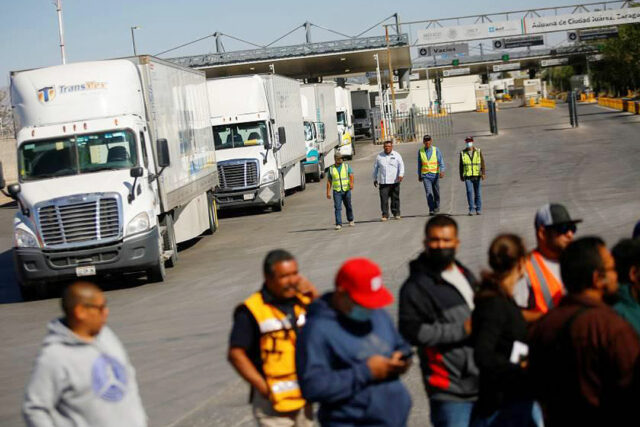
GROCERY STORES in some parts of the US are expected to start running out of certain perishable goods as soon as this weekend because of a Mexican truckers’ blockade that has stranded millions of dollars’ worth of fresh produce.

Roughly $150-million worth of fruit and vegetables are stalled south of the US-Mexico border amid a protest over Texas Governor Greg Abbott’s controversial vehicle-inspection program, according to Texas International Produce Association (TIPA). The blockade, which entered its fourth day on Thursday, is impeding delivery of things like avocados, limes, tomatoes, cucumbers and mangoes.

“Going into this Easter weekend, consumers are going to see store shelves devoid of certain items,” said Dante L. Galeazzi, chief executive officer of the TIPA.

The first impacts probably will be seen in the Midwest and along the East Coast, he added. Although commercial traffic has resumed at the initial blockade site, according to US Customs and Border Protection, local media reported that truckers were shifting their focus to other crossing sites.

“Some retailers, particularly those in the grocery industry, have experienced supply chain delays resulting from the extended wait times along the Texas-Mexico border,” John McCord, executive director of the Texas Retailers Association, wrote in an e-mail.

Little more than a week ago, Mr. Abbott ordered state troopers to begin inspecting northbound Mexican commercial trucks to bolster highway safety in the Lone Star state. Although 25% of inspected vehicles were taken off the road because of bad brakes and other defects, the reaction from business interests and politicians on both sides of the border has been fierce.

Texas Agriculture Commissioner Sid Miller, a Republican like Mr. Abbott, was among the first to sound the alarm, warning earlier this week that the dispute would trigger food shortages and push the price of avocados to $5 apiece.

Meanwhile, temperatures along the border have hovered close to 100°F (33°C), making it hard for refrigerated trucks to keep fresh produce cool enough to avoid spoilage.

Mr. Abbott said on Wednesday that he’s seeking to replicate agreements with Mexican state governors like the one he signed with the leader of Nuevo Leon that would see Texas inspections halted in exchange for increased vigilance south of the border. 

Mr. McCord of the retailers’ association said he’s seeing “signs of a more normalized delivery schedule due to the agreement reached between Governors Abbott and Garcia on Wednesday.”

“The movement of agricultural goods and other products is vital to the Texas agriculture industry and important supply chains,” said Gary Joiner, a spokesman for the Texas Farm Bureau. “We are encouraged by the recent agreement in the Laredo region that is facilitating movement and inspections at the port of entry. We hope other similar measures and agreements can be achieved at other points of entry.” — Bloomberg

Investors cash in on BDO ahead of Holy Week pause

BW FILE PHOTO

BDO Unibank, Inc. shares fell last week as investors took profit ahead of the Holy Week holidays.

A total of 3.89 million BDO shares worth P503.49 million were traded from April 11 to 13, data from the Philippine Stock Exchange (PSE) showed, making it the seventh most actively traded stock in the market.

Local financial markets were closed on April 14 and 15 in observance of the Holy Week.

BDO’s share price dipped by 3% on a week-on-week basis to P128.50 apiece on Wednesday.

Since the first trading day of the year, the stock’s price has risen by 7.1%.

“Investors lock in profits ahead of a long weekend to protect their gains just in case something unforeseen happens to the stock or the economy in general, which I think explains the market’s behavior on BDO this shortened trading week,” said Regina Capital Development Corp. Head of Research Luis A. Limlingan in an e-mail interview.

Similarly, on a separate e-mail interview, I.B. Gimenez Securities, Inc. Research Head Joylin F. Telagen attributed the stock’s movement to investors cashing in gains in anticipation of the long holidays.

“It’s fundamentally good news for long-term investors,” she said. “However, pullback or correction is normal for the stock to move higher after the previous week’s indecision.”

Latest Bangko Sentral ng Pilipinas (BSP) data showed that the Sy-led bank remained the largest lender in the country in terms of total assets with P3.48 trillion in the final three months of 2021. This was 7.1% higher than the previously logged P3.25 trillion in the same period in 2020.

In terms of capital, BDO recorded P423.39 billion while deposits were P2.75 trillion.

Meanwhile, total loans and receivables totaled P2.38 trillion in 2021.

Mr. Limlingan said that market players might have anticipated BDO to keep its crown as the largest universal and commercial bank in the country, that’s why the stock endured a series of profit taking in February and March.

“My thinking is that investors are just looking for a more attractive price level before jumping right back into BDO, since it has recently played at a premium to its short-term moving average for a quite a while.”

Last year, BDO posted an attributable net profit of P42.79 billion, 51.4% higher than the P28.25 billion reported in 2020.

Ms. Telagen expects the bank’s bottom line in the March quarter to end at P11.5 billion, and the full year at P47 billion.

“For 2022, we project at least a double-digit bottom line growth, buoyed by loan book and net interest margin improvement,” said Mr. Limlingan.

As BDO continues to dominate, this is already a good thing market players should consider, Ms. Telagen said.

“However, as cryptocurrencies continue to grow and some big players might be offering crypto (e.g., GCash and Paymaya), I think it will be better if they will be a crypto-friendly bank as well,” she added.

Ms. Telagen sees BDO’s support level this week at P122.00 while resistance is at P140.00

“BDO’s support is at P127.80. If this gets broken, the next support awaits at P126.00. Meanwhile, resistance sits at P130.00. The next resistance is at P132.00,” Mr. Limlingan said. — A.M.P. Yraola