Home Blog Page 6135

Stocks to move sideways ahead of inflation data

PHILIPPINE SHARES may move sideways this week ahead of the release of July inflation data and more second quarter corporate earnings reports.

The benchmark Philippine Stock Exchange index (PSEi) ended its three-day rally on Friday, declining by 63.33 points or 0.99% to close at 6,315.93, while the broader all shares index went down by 26.14 points or 0.76% to 3,398.82.

Still, week on week, the PSEi went up by 52.54 points or 0.84% from its close of 6,263.39 on July 22.

“The local market fell this Friday by 0.99% to 6,315.93 as investors took profits from its preceding three-day rally. Worries over the negative spillovers of the US economy’s weakening on the Philippine economy weighed on sentiment,” Philstocks Financial, Inc. Senior Research Analyst Japhet Louis O. Tantiangco said in a Viber message.

“Assuring statements from [Federal Reserve Chairman Jerome] Powell that the US economy is not in recession guided local gauges on the plus side, as latest Q2 US GDP (gross domestic product) data supported expectations for less aggressive consideration on sequel rate increases,” online brokerage 2TradeAsia.com said in a report.

For this week, Mr. Tantiangco said the market is expected to move sideways as investors wait for catalysts such as the July inflation data on Aug. 5, Friday.

“A slowdown from June’s 6.1% may spur positive sentiment, while a further acceleration may cause selling pressures in the local bourse,” Mr. Tantiangco said in a Viber message.

He added that investors are also expected to take cues from the release of more second quarter corporate earnings reports and foreign exchange trading.

“The peso is now back above the P56 per dollar level, closing at P55.13 last week. If its appreciation continues, then it may help spur optimism in the market,” Mr. Tantiangco added.

2TradeAsia.com said expectations of another rate hike in the Bangko Sentral ng Pilipinas’ meeting this month could also affect market sentiment.

“This would give enough reprieve for interest rate-sensitive sectors, especially those aiming for improved sales take-up for the remainder this year (i.e., property shares),” the online brokerage said.

Philstocks Financial’s Mr. Tantiangco trading could remain tepid amid the start of the “ghost month,” a period in the Lunar calendar when some Asian investors refrain from making big investments or decisions, resulting in lower trading volumes. For this year, the period started on July 29 and will run until Aug. 26.

He placed the PSEi’s immediate support at its 10-day and 20-day exponential moving averages of 6,282.48 and 6,292.59, respectively, and resistance at 6,350-6,400. Online brokerage 2TradeAsia.com put immediate support at 6,100-6,200 and resistance at 6,450-6,550. 

INDEX RECOMPOSITION
Meanwhile, Semirara Mining and Power Corp. (SCC) will join the 30-member PSEi starting Aug. 8, replacing Security Bank Corp. (SECB), after the PSE’s review for 2021, the bourse operator said on Friday.

This is the last index recomposition with a free float requirement of at least 15%, with firms now needing a public ownership level of 20% to qualify for inclusion in the PSEi in the next review period.

The PSE also announced changes in the composition of sectoral indices: Rizal Commercial Banking Corp. will now be part of the financials index; Benguet Corp. will be under mining and oil; 8990 Holdings, Inc. and DDMP REIT, Inc. will be in the property index; and Phinma Corp., Shakey’s Pizza Asia Ventures, Inc., and Synergy Grid & Development Phils., Inc. will be part of the industrial index.

The 20-member PSE MidCap and Dividend Yield indices will also be revamped, with SCC, Cebu Air, Inc., DoubleDragon Corp. and Filinvest Land, Inc. to be taken out of the MidCap index. They will be replaced by AyalaLand Logistics Holdings Corp., DDMP REIT, Inc. (DDMPR), SECB, and UnionBank of the Philippines, Inc.

Robinsons Land Corp., Robinsons Retail Holdings, Inc., SECB, and Universal Robina Corp. will also be removed from Dividend Yield Index to be replaced by DDMPR, Filinvest REIT Corp., MREIT, Inc. and RL Commercial REIT, Inc. — J.I.D. Tabile

Magnitude 7 earthquake death toll climbs to 10

OFFICE OF REP. ERIC GO YAP

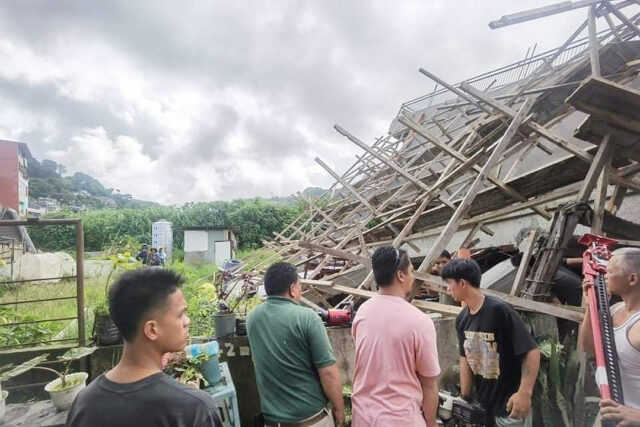
DEATHS from the magnitude 7 earthquake that rocked northern Philippines on Wednesday have climbed to 10, according to the local disaster agency.

More 300,000 people from about 82,000 families were affected by the quake, the National Disaster Risk Reduction and Management Council (NDRRMC) said in an 8 a.m. bulletin on Sunday.

The earthquake also damaged more than 21,000 houses, 302 of which were totally destroyed, the agency said.

Damage to infrastructure has reached P414 million in the Ilocos region, Cagayan Valley and Cordillera Administrative Region.

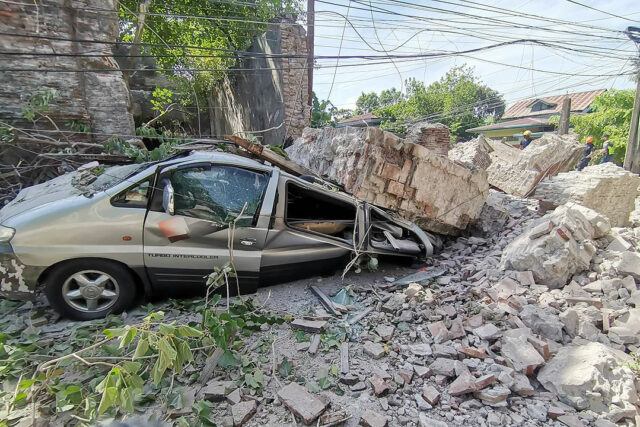
The quake damaged several ancient bell towers, churches and heritage houses as well as cars and other properties in the country’s north.

The tremors were also felt in Manila, the capital and nearby areas, forcing workers to evacuate buildings and halting train operations during rush hour.

The state seismology agency had recorded at least 1,162 aftershocks as 4 p.m. on Sunday the NDRRMC said.

The NDRRMC added that 43 roads and seven bridges got damaged, though cars could now pass through 84% of these.

Electricity to all of the 48 towns that lost power has been restored, while three of four affected areas now had water supply.

Twenty-seven areas have been placed under a state of calamity, the council said.

Meanwhile, agricultural and irrigation damage has climbed to P44.2 million, according to the Department of Agriculture.

Damage and losses were recorded mainly in irrigation systems, farm-to-market roads and other structures.

In the Upper Chico main canal in Tabuk, Kalinga province, four national irrigation systems and two communal irrigation systems were damaged by the quake, according to the National Irrigation Administration.

Pantabangan and Magat dams did not sustain any damage based on initial assessment, it added.

The Agriculture department said it had mobilized two trucks loaded with 2.66 metric tons of assorted highland vegetables, dried fish and other basic food items to municipalities in the province of Abra, where the quake’s epicenter was located.

These included the municipalities of San Quintin, Pidigan, Bangued, Tayum, Dolores, Lagangilang and Bucay.

The country had enough rice buffer stock inventory for immediate relief operations in the northern provinces, the National Food Authority said.

The department was also helping affected farmers and fishers by giving them 126,045 bags of rice seeds, 20,454 bags of corn seeds and 3,379 kilos of assorted vegetable seeds in CAR and the Ilocos, Cagayan Valley and Central Luzon regions.

It added that 1,000 doses of vitamins, 1,000 doses of antibiotics, 500 doses of dewormers and 3,000 doses of vaccines for livestock and poultry had been made available in Cagayan Valley.

The agency said it would fast-track the release of fuel subsidy and cash aid to farmers through the Agricultural Credit Policy Council and Quick Response Fund.

The quake struck about 13 kilometers (km) southeast of the town of Dolores in Abra province at a depth of 10 km on July 27, the US Geological Survey (USGS) said on its website.

Since 1970, 11 other earthquakes of magnitude 6.5 or larger have occurred within 250 km of Wednesday’s earthquake, the USGS said.

The largest of these earthquakes was a magnitude 7.7 earthquake on July 16, 1990 in Baguio City in Benguet, where at least 1,600 people died and more than 3,000 were hurt.

The 1990 earthquake also caused landslides in the Baguio-Cabanatuan-Dagupan area.

The Philippines lies in the so-called Pacific “Ring of Fire,” a belt of volcanoes around the Pacific Ocean where most of the world’s earthquakes strike. — Kyle Aristophere T. Atienza and Luisa Maria Jacinta C. Jocson

Ex-president Ramos, who helped topple Marcos, dies at 94

FORMER Philippine President Fidel V. Ramos, who helped topple the late dictator Ferdinand E. Marcos’ regime as one of his military generals, has died. He was 94.

The death of Mr. Ramos, who was president from 1992 to 1998, was confirmed by Press Secretary Rose Beatrix Cruz-Angeles.

“It is with great sorrow that we learn of the passing of former President Fidel V. Ramos. He leaves behind a colorful legacy and a secure place in history for his participation in the great changes of our country, both as military officer and chief executive,” she said in a statement.

During the 1986 People Power Revolution, he was hailed as a hero by many Filipinos for leading a coup against the dictator and supporting his successor, the late President Corazon C. Aquino.

He was also credited with the creation of the Southern Philippines Council for Peace and Development in 1996, which was part of the final peace agreement with the Moro National Liberation Front. The Moro Islamic Liberation Front, a faction of the MNLF that broke away in 1977, rejected the peace deal for being inadequate.

Mr. Ramos served as Armed Forces chief of staff under Ms. Aquino and later as her Defense secretary.

He was known for his Philippines 2000 socioeconomic program, which envisioned the country achieving a newly industrialized country status by the end of the millennium and beyond.

“President Ramos will always be remembered as one of the most intelligent and accomplished politicians in the Philippines — West Point-trained and a highly decorated officer who rose to the highest position in the military,” Arjan P. Aguirre, a political science professor at the Ateneo de Manila University, said in a Facebook Messenger chat.

“He was a minority president who managed to improve the Philippine economy in the 1990s. He was a known tactician who could stabilize a government through an effective coalition politics,” he added. 

Politicians sought his advice on campaigns, policy making and crisis management, Mr. Aguirre said.

Mr. Ramos was born on March 18, 1928 in Lingayen, Pangasinan. His father, Narciso Ramos, was a lawyer and congressman who later served as Foreign Affairs secretary of Mr. Marcos.

His mother Angela Valdez was an educator and a member of the Valdez clan of Batac, Ilocos Norte, making him a second cousin to Mr. Marcos.

Mr. Ramos got his civil engineering degree from the National University and graduated with a Bachelor of Science in Military Engineering degree from the US Military Academy. He also earned his masters in civil engineering at the University of Illinois. — Norman P. Aquino and Kyle Aristophere T. Atienza

Marcos: ROTC to boost country’s disaster response

PHILIPPINE ARMY RESERVE COMMAND FACEBOOK PAGE

PHILIPPINE President Ferdinand “Bongbong” R. Marcos, Jr. at the weekend said mandatory military training for Filipino students would boost the country’s disaster response.

The training, which was dropped two decades ago after a university student who exposed corruption in the program died, would train students not only for national defense preparedness but also for disaster response, he said in his video blog on Saturday night.

“Although it’s natural for us Filipinos to be helpful, it is still different if there is training and correct response preparation,” the president said in Filipino, based on a statement from his office.

Senator Sherwin T. Gatchalian has a refiled a bill seeking to revive the military training for Grades 11 and 12 students to ensure the country has enough soldiers during war. The bill is part of Mr. Marcos’ priority agenda.

The Child Rights Network last week said mandatory military training for students violates international commitments on child human rights and existing laws.

The state should instead follow the United Nations Convention on the Rights of the Child recommendation in 2008 to promote the values of peace and respect for human rights. These should become basic subjects, it said.

Mr. Marcos again pushed the revival of mandatory student military training days after the country’s north was rocked by a magnitude 7 earthquake, which was also felt in the capital region.

The President said the country should also build “disaster-proof” infrastructure and communities.

Mr. Marcos, meanwhile, thanked the private sector for responding to the needs of quake victims by sending food, water, and generators.

He also pushed the creation of a medical reserve corps under the Department of Health that will be tapped during disasters and public health emergencies.

The corps will be composed of licensed physicians, registered nurses, licensed allied health professionals and medical students who have completed four years of medical course.

But some health groups said the bigger problem is the shortage in health workers. Mr. Marcos should also prioritize raising the salaries of health workers especially those who serve in remote areas, they said. — Kyle Aristophere T. Atienza

Samal resort owners seek review of bridge project’s environmental certificate 

AMBASSADOR HUANG XILIAN FACEBOOK PAGE

A FAMILY that owns beach resorts in Samal Island has asked the new administration to intervene in the Samal-Davao bridge project by canceling its environmental compliance certificate (ECC) and undertake a reassessment.    

Lawyer Julito R. Sarmiento, one of the legal counsels of the Rodriguez family, said the ECC issued by the Department of Environment and Natural Resources (DENR) on January 4, 2021, was null and void as it did not undergo clearance from the Protected Area Management Board.  

Mr. Sarmiento said they sent a letter on July 20 addressed to President Ferdinand R. Marcos, Jr., DENR Secretary Ma. Antonia Yulo-Loyzaga, and Public Works Secretary Manuel M. Bonoan asking them to revisit the bridge alignment.  

The bridges landing site on the Samal side will cover a reef in between Paradise Island Park and Beach Resort and Costa Marina Beach Resort, both owned by the family.    

We are appealing to the current administration to cancel the ECC and conduct a new environmental impact assessment (EIA), honest to goodness, and inform the people,he told the media last week.   

The EIA should look at what are the alternative sites.”  

Another family legal counsel, Marcelino C. Rongo, said all possible alignments should have an EIA to determine which one would be the best option.  

An EIA is a planning tool and if you assessed only one area with the sole purpose to justify a decision that was already made, then that is not a genuine EIA. That makes the ECC void,he said in mixed English and Filipino.   

Mr. Rongo also cited that the entire Samal Island was proclaimed a protected area in 1981 and that a proposal reducing the coverage area of that declaration has yet to be approved either through a presidential order or legislation.   

Mr. Sarmiento said they are prepared to take the matter to court but will first exhaust all other possible appeal routes.   

Part of the key agenda of the present government is for sustainable development and environment protection. This is what the President mentioned in his State of the Nation Address so we are hoping and waiting from the Office of the President to respond to us,he said.    

Mr. Sarmiento emphasized that the resort owners are only calling into question the alignment, and that they fully support the bridge project, which is seen to bring faster economic development to the island.    

The Philippine government under the previous administration of President Rodrigo R. Duterte signed a $350-million loan deal with China on June 13 for the bridge linking Samal Island to mainland Mindanao in the countrys south.   

The bridge was proposed years before Mr. Duterte was elected as the countrys chief executive. It was included in his administrations priority infrastructure program.     

In January 2021, the Department of Public Works and Highways and China Road and Bridge Corporation signed a P19.32-billion design and build contract for the project, which was a prerequisite for the loan agreement application with China. Maya M. Padillo 

Agri experts: Forget zero hunger, focus on farmers

PHILSTAR

ACHIEVING zero hunger in the Philippines, as in any country, is a far-fetched goal, agriculture experts said, and the government should instead focus on the supply side by ensuring sustainable food production by uplifting farmers.   

When asked about a bill seeking to achieve zero hunger in the country within 10 years after its passage, Roy S. Kempis, retired Pampanga State Agricultural University professor, said zero hunger should be viewed as a situation in which Filipinos be given the highest extent of access to food that can be made available within the Philippine economy at any given time of the day.”  

Senate Bill 30, or the Right to Adequate Food Act, aims to bring down the incidence of hunger in the country by 25% every 2.5 years to reach zero within a decade from the level recorded at the time of its passage. 

The proposed measure refers to hunger as a condition in which people are unable to eat enough for the necessary nutrients for a fully productive, active and healthy lifestyle due to unavailability and inaccessibility of food.   

I should say that 10 years is too long a time but we have to have threshold indicators as to what is the highest extent access possible,Mr. Kempis said in a Viber message to BusinessWorld.   

Certainly again, there is no such thing as 100% access.”  

Even in advanced countries, there are still hungry people, so ensuring zero hunger will most probably be just an aspiration also,Federation of Free Farmers National Manager Raul Q. Montemayor told BusinessWorld in a separate Viber message.  

It will take a herculean effort for us to even just reduce hunger, much less eliminate it, he said.   

I think we must also consider that hunger is the effect of poverty, and that people cannot buy food not only because food is expensive but also because they do not earn enough money to feed themselves,he added. 

Jayson H. Cainglet, executive director of farmersgroup Samahang Industriya ng Agrikultura, said addressing hunger fundamentally rests on the governments agriculture policies and programs.   

Decreasing hunger will ultimately be achieved on the overarching agri-food policies that this and succeeding governments will embark on,he said. We really need a comprehensive land-use plan. 

Mr. Montemayor said farmers should first be encouraged to improve production rates with adequate government support and good income.  

Helping farmers earn more is hitting two birds with one stone because they are among the poorest but at the same time, they are the source of food for the hungry.”  

However, Senator Juan Edgardo “Sonny” M. Angara has said that the 2023 national budget will likely increase by only 4%, implying that it will be highly unlikely that the agriculture budget can be tripled, as earlier requested by former Agriculture Secretary William D. Dar.  

Doesn’t need to be tripled immediately,said Mr. Montemayor. Too much too soon will only lead to waste. What is important is that the budget is consistently increased over time so that good programs can be sustained, and new programs can be launched to build on achievement.”  

Food production, he added, should get more priority than national defense or even anti-insurgency. People will not rebel against the government if there is less poverty and hunger.”  

Mr. Cainglet, meanwhile, said that “while there really is a need to increase the budget, the bigger concern is the policy direction and judicious use of the budget.”  

Mr. Kempis said budgetary constraints can be addressed without borrowing or taking funds from other agencies of government.  

He suggested the implementation of financing programs, which can be sourced from public capital through both the national and local governments, or public-private partnerships. He also recommended the use of efficient procurement procedures.  

Farmers need to be encouraged,Mr. Cainglet said, it should be clear to them that the government, this time, will be on their side.Alyssa Nicole O. Tan 

Senate bill lowering retirement age of teachers, DepEd employees refiled 

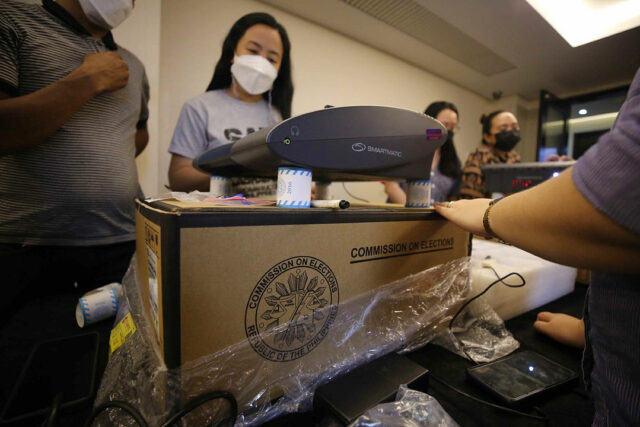
Teachers, who serve as electoral board members during elections, undergo training on vote counting machine operations in this March 11, 2022 photo. — PHILIPPINE STAR/RUSSELL PALMA

A SENATOR has refiled a bill that seeks to lower the retirement age of public school teachers and other Department of Education (DepEd) regular employees to 60 from 65. 

If enacted into law, this proposed legislation will benefit hundreds and thousands of retirable DepEd personnel, both teaching and non-teaching, who would want to spend the prime of their lives doing other occupations other than their usual functions in the government,Senator Francis Joseph “Chiz” G. Escudero, who chairs the Senate Committee on Higher, Technical and Vocational Education, said in a statement on Sunday.  

Senate Bill 58, or the New DepEd Retirement Age Act, will also provide more opportunities for younger teachers and non-teaching personnel to land jobs at DepEd. 

Under the proposed measure, DepEd employees with less than 15 years of service upon turning 60 years old will be allowed to continue working in the agency until they reach 65.    

The present system at the DepEd needs skills updating and professional advancement of their personnel in order that services rendered at the department will be restructured and modernized yet perpetual,Mr. Escudero said. 

“It is better that we give government employees a longer period of time to spend with their families,he said. There is more to life than work.”  

TAX
Meanwhile, House Deputy Minority Leader and ACT Teachers Party-list Rep. France L. Castro criticized President Ferdinand R. Marcos Jr. for vetoing the proposed law granting tax exemption on the honoraria, allowances and other financial benefits given to election workers. 

“The veto of this measure is a slap in the face of every teacher across the country who served the past elections dutifully despite long hours and higher risks of getting COVID-19,” Ms. Castro said in a statement on Sunday. 

“With the additional risks and longer hours of poll service that they had to endure, removing the 20% tax on their honoraria and allowances is only just.”

She said imposing taxes on the honoraria and allowances of election volunteers goes against the intent of Republic Act 10756, or the Election Service reform Act, to compensate the hardships of persons rendering election service.  

They must therefore enjoy the compensation in full and not bear additional burdens,” Ms. Castro said.

Ms. Castro said their party-list will continue to fight for just compensation of election service workers by calling for an override of the veto. 

“We are studying all options to counter this highly unjust move of the President. We urge all teachers and election service volunteers to reach out to their district representatives and senators so that both Houses of Congress can override this unfair veto,” she said. 

The Alliance of Concerned Teachers (ACT) Philippines, a mass organization of teachers and other education workers, also denounced the veto, calling it a callous and shamelessmove by the President.

“We shouldn’t worry about the P1.5 billion tax that will be returned to around 700,000 who worked during the election because it is a thanks for their service and added to the funds for their families during this crisis,” ACT Philippines Chairperson Vladimer Quetua said in a separate statement. 

“The bigger loss for the country is the P203-billion estate tax that the Marcos family still hasn’t paid.” Alyssa Nicole O. Tan and Matthew Carl L. Montecillo 


Power co-ops report P5.18M worth of damage from Luzon quake

UTILITY lines are toppled by a structure in Vigan City, Ilocos Sur that partly collapsed during the magnitude 7 earthquake on July 27. — BUREAU OF FIRE PROTECTION

DAMAGE incurred by electric cooperatives from the magnitude 7 earthquake that hit Luzon on July 27 is now estimated at P5.18 million, according to the Department of Energy (DoE).   

The National Electrification Administration (NEA) reported to the department that the latest estimates cover four cooperatives as of Saturday.  

These include: Abra Electric Cooperative (Abreco) with P4 million;  Ilocos Sur Electric Cooperative, Inc. (Iseco), P637,725; Benguet Electric Cooperative (Beneco), P348,818; and Mt. Province Electric Cooperative (Mopreco), P197,598.  

The earthquake with epicenter in Abra, affected 33 electric cooperatives across the regions of Ilocos, Cagayan Valley, Central Luzon, Calabarzon, Bicol, and Cordillera Administrative Region, based on NEAs monitoring.  

Out of the 33 ECs, 11 had power interruptions but managed to restore their power services within 24 hours, while the rest of the ECs are in normal operations,the DoE said in an update posted on Facebook.  

According to the DoE, Abreco had energized 100% of 27 municipalities and 303 barangays under its service area. However, there are still 78 out of the 61,609 household connections that are awaiting restoration.   

The DoE said all power generation plants in Luzon are under normal operations while oil supply and downstream oil industry facilities reported no damage.  

The National Grid Corporation of the Philippines also said all transmission facilities affected by the earthquake are now operating normally. Ashley Erika O. Jose

Women’s party-list calls for House probe on arrest of 4 activists

GABRIELA Party-list Rep. Arlene D. Brosas has filed a resolution calling for a probe on the recent arrests of four activists, all of whom have unknown locations, she said in a statement on Sunday.  

This is state-enforced ghosting, which the Congress should take seriously,Ms. Brosas said.   

“Four activists have been missing for weeks. Two of them disappeared at the start of the Marcos Jr. regime,she said, referring to President Ferdinand R. Marcos, Jr. who started his term on June 30.   

House Resolution 86 seeks to investigate the detention of activists Elizabeth LoiMagbanua, Alipio AdorJuat, Elgene Mungcal and Ma. Elena ChaCortez Pampoza. 

Ms. Magbanua and Mr. Juat, both members of the labor group Kilusang Mayo Uno (KMU), have been missing since May 3; while Ms. Mungcal, a member of Gabriela, and Ms. Pampoza of Anakpawis, the electoral arm of KMU, have been missing since July 3.  

We join the call to surface Loi, Ador, Cha, Elgene, and others abducted by the AFP (Armed Forces of the Philippines). We also put Marcos Jr. to task in revoking Dutertes Executive Order 70, which has laid the framework for the government’s ‘whole of nation approach’ towards militarization and brutal attacks towards civilian advocates,said Ms. Brosas.  

Kabataan Party-list Rep. Raoul Danniel A. Manuel also condemned the arrests, and further cited the apprehension of brothers Ismael and Mawing Pangdas, both members of the Kabataan Party-list, in Davao City during the State of the Nation Address (SONA) on July 25.  

The two party-lists, along with ACT Teachers Party-list represented by France L. Castro, have filed House Bill 2484 or the Human Rights Defenders Protection Bill.  

“This bill will serve as a deterrent to attacks against human rights defenders or activists especially those sponsored by the government,” said Ms. Castro.  

The three party-lists are the remaining members of the Makabayan bloc with seats in Congress. The coalition is composed of 13 party-lists. Matthew Carl L. Montecillo 

DICT calls for new building code with norms for telco integration

REUTERS

THE Department of Information and Communications Technology (DICT) said it will support legislation that will require telecommunications companies to guarantee minimum internet speeds for consumers and set standards for telco integration in residential property design.

“’Yan ang madalas na reklamo ng ating publiko, na binibigyan sila ng ‘up to’ sa offering nila (This is the most common complaint of our consumers, that they are only guaranteed a maximum speed),” Information and Communications Secretary Ivan John E. Uy told reporters on the sidelines of PLDT, Inc.’s Jupiter Cable System launch on Friday.

Kung up to 50 (megabits per second) Mbps, puwede kang bigyan ng 50 kilobits per second (Kbps),” he added. (If they promise an internet speed of up to 50 Mbps, they can give you 50 Kbps.)

Senator Mary Grace S. Poe-Llamanzares recently refiled Senate Bill No. 329, or the proposed Better Internet Act, which requires service providers to adhere to minimum standards for connection, reception, pricing, and billing practices.

“The internet has become a necessity as indispensable as electricity and water. We rely on it for health, education, business, governance and more,” Ms. Poe said.

Mr. Uy said the department also supports a house bill that seeks to provide telco space for network infrastructure in housing developments.

“Actually, I have been pushing for that, not only in subdivisions, but in the construction of high-rise buildings,” he said.

“I fully support it. In fact, in one of my talks before in the Chamber of Commerce, I pushed for the revision of National Building Code. The building code requires the provision of electricity, water and sewerage, but not telecommunications,” he noted.

He said allocating space for network infrastructure in housing and high-rise building projects will help ensure equitable and expansive internet access across the Philippines.

“You won’t have instances where when you go inside the building, you go inside the elevator and you have no signal. You go to the parking underground, you have no signal. Those buildings were never designed for telco. I think that should be included from the very onset. When you design the building, it should be integrated there,” he said.

Isabela Rep. Faustino A. Dy V has said he would refile the House bill that seeks to require developers to properly provision ICT facilities for telcos.

PLDT’S JUPITER CABLE SYSTEM
The PLDT group announced on Friday that the Jupiter Cable System, the latest addition to its 16 international cables routing critical data traffic in and out of the country, is now servicing the Philippines.

The new cable system traverses the Pacific Ocean from North America connecting directly to Maruyama and Shima in Japan and to Daet, Camarines Norte.

PLDT officials said it is now the fastest cable system between the Philippines and the US.

“It will increase PLDT’s international capacity of 20 Terabit/s to about 60 Terabit/s,” the company said in a statement.

“Jupiter is the first international submarine cable system in the Philippines to use an Open Cable Model that allows PLDT to power up and deliver hyperscale bandwidth more quickly to enterprises across the world,” it added.

This development strengthens the company’s strategy in helping position the Philippines as the next hyperscaler hub of Asia-Pacific, PLDT, Inc. and Smart Communications, Inc. President and Chief Executive Officer Alfredo S. Panlilio said during a briefing.

The new cable system is also expected to support the hyperscale ecosystem, which includes data centers, subsea cables, the domestic fiber network, 5G, cloud, and the Internet of Things, PLDT officials said.

Hastings Holdings, Inc., a unit of PLDT Beneficial Trust Fund subsidiary MediaQuest Holdings, Inc., has a majority stake in BusinessWorld through the Philippine Star Group, which it controls. — Arjay L. Balinbin

Hybrid seed supplier backs five years of farm subsidies

SCREENGRAB FROM YOUTUBE/SL AGRITECH CORPORATION

By Luisa Maria Jacinta C. Jocson, Reporter

SUBSIDIES to farmers will be critical in the first few years of the new administration, which has set a goal of expanding agricultural output, until farmers achieve a measure of self-sufficiency, according to an official from a company that produces high-yielding hybrid rice.

“Government subsidies are critical to growth in agriculture. Not forever, (but) maybe the first five years. At the moment, we need to subsidize them,” SL Agritech Corp. Chairman and Chief Executive Henry Lim Bon Liong said in a Zoom interview.

“President Rodrigo R. Duterte (also provided subsidies) but the budget isn’t enough so there have been lots of issues,” he added. “Subsidies are not bad, every country does it. Even the United States in the early 19th century provided millions for agriculture (including) cotton. Subsidies have always been a way for farmers to become progressive. It is what China is doing now, focusing on agriculture… I think we should follow that.”

SL Agritech develops hybrid rice seed varieties that are suitable for the Philippines and provides technical support to farmers that use its seed.

“Rice is a pollinating flower and plant. In order for this rice to be hybrid then in nature there must be a flower that is self-sterile. If the rice flower is sterile then it cannot self-pollinate. If you cannot self-pollinate, then other male flowers will fertilize the plant thus leading to a hybrid,” Mr. Lim Bon Liong added.

SL Agritech products include the SL-8H, SL-12H, SL-19H, SL-20H, and SL-68H Super Hybrid Rice Seeds.. These hybrid rice varieties can thrive in both wet and dry seasons. For consumers, it offers premium milled rice brands such as Doña Maria Premium Quality Rice and Willy Farms Rice.

“The prices of our variety have not increased, about P5,000 to cover one hectare. We made a lot of farmers millionaires. If you look at Nueva Ecija farmers, they are mostly returning overseas Filipino workers (OFWs). The returning OFWs are really the best farmers because they are educated and know the different techniques,” he added.

The company is developing more varieties to help people with the rice crisis, according to Mr. Lim Bon Liong.

“The Doña Maria program is exporting to many countries like the Middle East. We are putting back Filipino rice to countries around the world,” he said.

During the company’s earlier years, Mr. Lim Bon Liong said he went to China in order to further study and research hybrid rice.

“When I went to China, they were able to feed their entire population and still have some to export…  More than 40 million people died of hunger in China in the sixties. From there I spoke with experts and I learned that agriculture will help the population, but with limited land what do you do? You turn to high yielding rice,” he said.

“When I came back to the Philippines. I met with the International Rice Research Institute. Unfortunately, hybrid rice can only be planted 70 degrees above the equator. The Philippines is a tropical country so it is very difficult to plant it here and I was disappointed,” he said.

Mr. Lim Bon Liong then began experimenting with 75 varieties of hybrid rice from China.

“I started in Laguna, but after one season it was a total failure. It is so hot in the Philippines that it kills the flowering, making it too early so the grains are empty. I was about to give up but my mother told me to make my own variety of hybrid rice,” he said.

In 1998, he started looking for land to establish a research facility. By 2001, he was able to eventually develop hybrid rice that was compatible with the Philippine climate.

Moving forward, SL Agritech will continue its initiatives to attain rice self-sufficiency and increase rice yields with the help of the government.

“We hope to talk to the current President to allow us (to supply) seed for the Masagana programs,” he added.

PHL gross borrowing declines 40.59% at end of June

BW FILE PHOTO

GROSS BORROWING dropped 40.59% from a year earlier to P1.022 trillion in the first half as the government tapped less debt as the economy reopened.

The Bureau of the Treasury (BTr) said that in June, it raised P138.64 billion, down 13.3% from a year earlier.

The government borrows from domestic and foreign creditors to finance the budget deficit, which widened after the pandemic stalled the economy and depressed tax collection.

New domestic debt in June fell 28.71% year on year to P96.45 billion, including P7.51 billion in Treasury bills (T-bills) and P88.94 billion in Treasury bonds (T-bonds).

In June, the Treasury made no redemptions using the government’s Bond Sinking Fund.

External gross borrowing rose 55.83% to P49.72 billion in June. This consisted of P47.53 billion in new program loans and P2.19 billion in project loans.

The government settled P7.17 billion in outstanding foreign debt that month, reducing net external borrowings to P42.55 billion.

The P1.022 trillion in first-half debt included P741.26 billion in domestic debt, down 55.02% from a year earlier.

Domestic debt consisted of P535.38 billion in T-bonds, P457.8 billion in retail T-bonds, and P73.6 billion in T-bills.

During the period, the government paid down P251.92 billion worth of T-bills.

Excluding the P1.09-billion debt that was repaid and obligations settled via the Bond Sinking Fund, the government’s net domestic borrowing was P740.18 billion.

Gross borrowing from foreign creditors rose 15.58% to P329.34 billion in the first half, including P136.6 billion in program loans, P117.33 in global bonds, P46.85 in project loans, and P28.55 in Samurai bonds.

The BTr paid down P47.76 billion in foreign loans during the period, bringing net foreign borrowing to P281.57 billion.

In July, Finance Secretary Benjamin E. Diokno said that the government intends to increase the share of domestic borrowing in the borrowing mix to 80% to reduce its foreign exchange risk.

Gross borrowing in the first half accounted for 41.32% of the P2.47 trillion the government is planning to raise this year from both domestic and foreign lenders. The budget deficit is expected to hit 7.6% of gross domestic product.

In the first six months of 2022, revenue collection increased 15.91% to P1.73 trillion, while expenditure rose 8.85% to P2.4 trillion.

The Philippines’ debt stock hit P12.495 trillion at the end of May. — Diego Gabriel C. Robles