Home Blog Page 612

TV5 serves ABS‑CBN termination notice for content supply deal

BW FILE PHOTO

ABS‑CBN Corp. said it has received a notice of termination from TV5 Network, Inc. for their television content supply agreement.

In a statement on Thursday, ABS-CBN said it “deeply regrets that this action has been taken at this critical juncture in our recovery.”

“We have sought additional time to resolve this matter and are working urgently within the thirty-day period we have been given,” the network added.

It said the “amounts and manner of the claims remain disputed,” and denied any suggestion of deliberate payment delays. “There is no truth to any insinuation that ABS‑CBN willfully delayed payment,” the company said.

The network said that the financial constraints underlying the issue stem from its previous loss of broadcast franchise, which “significantly reduced” its revenues and caused continued losses.

At the same time, ABS‑CBN said its transformation into a storytelling company has shown “steady performance improvement.”

ABS‑CBN said it remains open to “fair and reasonable solutions” and will continue to find ways to reach audiences should the partnership officially end.

TV5 Network is part of MediaQuest Holdings, Inc., whose unit Hastings Holdings, Inc. — under the PLDT Beneficial Trust Fund — holds a majority stake in BusinessWorld through the Philippine Star Group.– Arjay L. Balinbin

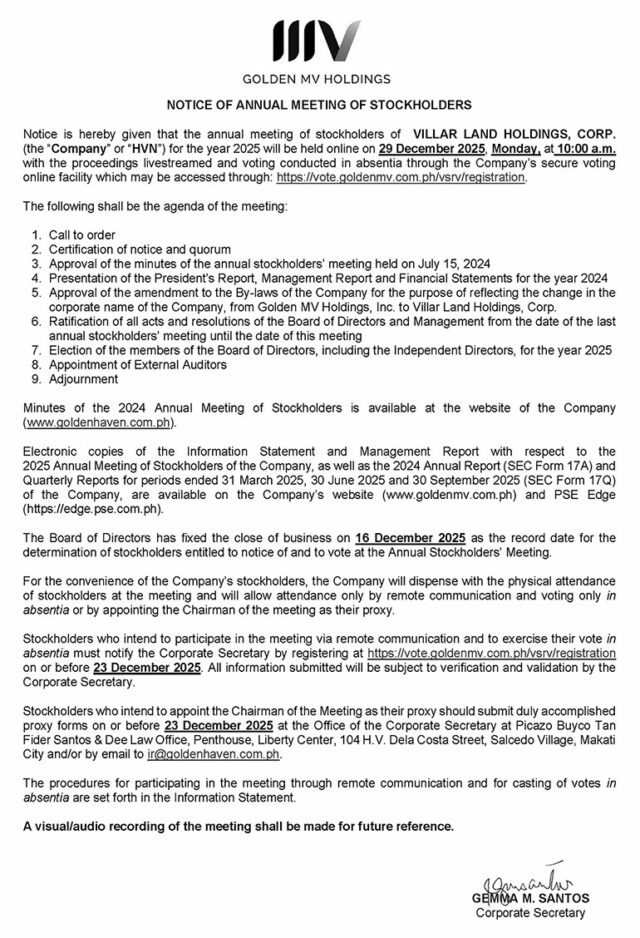
Villar Land Holdings Corp. to hold virtual Annual Stockholders’ Meeting on Dec. 29


Spotlight is BusinessWorld’s sponsored section that allows advertisers to amplify their brand and connect with BusinessWorld’s audience by publishing their stories on the BusinessWorld Web site. For more information, send an email to online@bworldonline.com.

Join us on Viber at https://bit.ly/3hv6bLA to get more updates and subscribe to BusinessWorld’s titles and get exclusive content through www.bworld-x.com.

Honduras again halts release of vote count in presidential election as centrist Nasralla holds narrow lead

STOCK PHOTO | Image by NATANAELGINTING from FREEPIK

TEGUCIGALPA — Honduras again halted the publication of official results in its presidential election, an electoral official said on Wednesday, as centrist Salvador Nasralla maintained a narrow lead ahead of Trump-backed conservative Nasry Asfura.

The release of updated results was halted due to system maintenance but without proper warning, Cossette Lopez-Osorio, an official at Honduras’ electoral council, said on X, adding she considered this an “inexcusable” development.

With 79.60% of votes counted, the Liberal Party’s Mr. Nasralla held 40.27% of support, less than 16,000 votes ahead of the National Party’s Mr. Asfura with 39.64%. Rixi Moncada, of the ruling leftist LIBRE Party, was well behind in third place with 19.01%.

The tightly contested race has been marred by system delays and allegations of fraud, as well as the intervention from US President Donald Trump, who strongly backed Mr. Asfura and alleged there had been fraud, without providing evidence.

Election observers, from the European Union and the Organization of American States, as well as Honduras’ electoral authority have called for calm and patience as the final votes are counted.

Early preliminary results released on Monday had originally shown Mr. Asfura with a slim lead of some 500 votes, with election organizers declaring a “technical tie” and saying votes would have to be counted by hand. When the count was updated on Tuesday, Mr. Nasralla had swung to a narrow lead.

Mark Weisbrot, co-director of the Center for Economic and Policy Research, a Washington-based think tank that promotes democracy, said Mr. Trump’s interference and accusations against Mr. Asfura’s rivals had undoubtedly had an impact.

Mr. Trump’s threat to cut funds if Mr. Asfura did not win “would be considered likely to cause economic harm to Honduras and its people,” he said.

Mr. Trump said on social media that Honduras was “trying to change the results of their Presidential Election.”

“If they do there will be hell to pay! The people of Honduras voted in overwhelming numbers on November 30th,” he said on his Truth Social platform on Monday night.

Ms. Moncada, the ruling party candidate, told Telesur on Wednesday that she rejected the vote transmission system as flawed and criticized its lack of transparency.

Referring to Trump’s interference, which she said violated all international protocols, Ms. Moncada said this marked “a direct intervention that affects the interests of the Honduran people.” — Reuters

France criticizes French journalist’s seven-year jail sentence in Algeria

REUTERS

PARIS — The French government on Wednesday criticized the decision by an Algerian court to uphold a seven-year jail sentence for French journalist Christophe Gleizes despite its efforts to convince Algerian authorities to change the verdict.

“It regrets that its full cooperation with the Algerian authorities and the explanations provided by his defense team were not enough to change the verdict. We call for his release and hope for a favorable outcome so that he can quickly be reunited with his family,” the French foreign ministry said in a statement.

“France reiterates its commitment to freedom of the press throughout the world,” the statement said.

Ties between Paris and Algiers deteriorated sharply after France recognized Morocco’s sovereignty over the disputed territory of Western Sahara. The cases of Mr. Gleizes and French-Algerian writer Boualem Sansal, who was also sentenced to a lengthy prison term, have exacerbated the tensions. Relations were also strained by Algiers’ refusal to take back people who were deported by French authorities.

Mr. Sansal, however, was pardoned last month by Algerian President Abdelmadjid Tebboune.

Mr. Gleizes, a journalist for French magazines So Foot and Society, was arrested in May 2024 in Tizi Ouzou, 100 kilometers east of Algiers, where he was working on a story about sports in the region of Kabylia, French press freedom activist group Reporters Sans Frontieres, RSF, said.

He was charged and convicted of “glorifying terrorism” by a local court in June, RSF said. The ruling was upheld on Wednesday, the Foreign Ministry said.— Reuters

Trump administration orders enhanced vetting for applicants of H-1B visa

STOCK PHOTO | Image from Freepik

WASHINGTON — The Trump administration on Wednesday announced increased vetting of applicants for H-1B visas for highly skilled workers, with an internal State Department memo saying that anyone involved in “censorship” of free speech be considered for rejection.

H-1B visas, which allow US employers to hire foreign workers in specialty fields, are crucial for US tech companies which recruit heavily from countries including India and China. Many of those companies’ leaders threw their support behind Mr. Trump in the last presidential election.

The cable, sent to all US missions on December 2, orders US consular officers to review resumes or LinkedIn profiles of H-1B applicants – and family members who would be traveling with them – to see if they have worked in areas that include activities such as misinformation, disinformation, content moderation, fact-checking, compliance and online safety, among others.

“If you uncover evidence an applicant was responsible for, or complicit in, censorship or attempted censorship of protected expression in the United States, you should pursue a finding that the applicant is ineligible,” under a specific article of the Immigration and Nationality Act, the cable said.

Details on the enhanced vetting for H-1B visas, including the focus on censorship and free speech, have not been previously reported. The State Dept did not respond to a request for comment on the contents of the cable.

The cable said all visa applicants were subject to this policy, but sought a heightened review for the H-1B applicants given they frequently worked in the technology sector “including in social media or financial services companies involved in the suppression of protected expression.”

“You must thoroughly explore their employment histories to ensure no participation in such activities,” the cable said.

The new vetting requirements apply to both new and repeat applicants.

The Trump administration has made free speech, particularly what it sees as the stifling of conservative voices online, a focus of its foreign policy.

Officials have repeatedly weighed in on European politics to denounce what they say is suppression of right-wing politicians, including in Romania, Germany and France, accusing European authorities of censoring views like criticism of immigration in the name of countering disinformation.

In May, Mr. Rubio threatened visa bans for people who censor speech by Americans, including on social media, and suggested the policy could target foreign officials regulating US tech companies.

The Trump administration has already significantly tightened its vetting of applicants for student visas, ordering US consular officers to screen for any social media posts that may be hostile towards the United States.

As part of his wide-ranging crackdown on immigration, Mr. Trump in September imposed new fees on H-1B visas.

Mr. Trump and his Republican allies have repeatedly accused the administration of Democratic former President Joe Biden of encouraging suppression of free speech on online platforms, claims that have centered on efforts to stem false claims about vaccines and elections. — Reuters

BSP: Slow growth raises rate cut odds

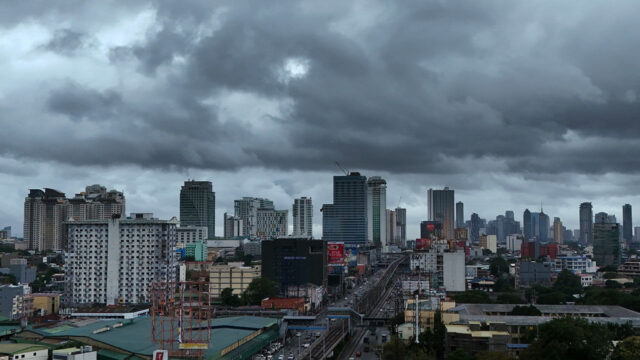
Dark clouds hover over Metro Manila, Sept. 22. — PHILIPPINE STAR/MIGUEL DE GUZMAN

By Katherine K. Chan

THE PHILIPPINE ECONOMY will likely undershoot the target this year amid spending cuts and weak investor sentiment due to the graft scandal, increasing the possibility of further easing this month,  Bangko Sentral ng Pilipinas (BSP) Governor Eli M. Remolona, Jr. said.

Speaking to reporters at the BSP head office in Manila, Mr. Remolona said gross domestic product (GDP) growth could settle between 4% and 5% by yearend, well-below the government’s 5.5-6.5% goal.

Asked if this raises the odds of a rate cut at its Dec. 11 meeting, Mr. Remolona said: “Yeah, most definitely. But it’s not assured.”   

The BSP in October reduced the benchmark interest rate by 25 basis points (bps) for a fourth time in a row, bringing borrowing costs to an over three-year low of 4.75%. It has so far delivered a total of 175 bps in cuts since it began its easing cycle in August 2024.

The Philippine economic outlook has been clouded by a corruption scandal involving anomalous government projects. This has slowed government spending, hurt investor confidence, and dampened business and consumer sentiment.

Mr. Remolona said GDP growth is expected to slump this year with a slight pickup by mid next year. A full recovery is likely by 2027, he added.

“One reason is part of the decline in 2025 is because the government also cut its spending in order to review flood control projects and other projects. But the main reason is probably the loss of confidence by investors,” Mr. Remolona said.

Earlier this week, Economy Secretary Arsenio M. Balisacan conceded that this year’s growth target is out of reach, after a weaker-than-expected third-quarter growth.

In the third quarter, the Philippine economy grew by 4%, the slowest in over four years. This brought the nine-month GDP growth average to 5%.

RRR CUT
Meanwhile, Mr. Remolona said lowering banks’ reserve requirement ratio (RRR) is unlikely to spur economic growth.

“It’s already very low, so a further cut won’t do that much,” he said. “So, when you go from 5% to, say, 2%, it’s not a lot when it comes to the reserve requirement. But still, it might help.”

The BSP governor noted that although they are considering a further reduction in RRR, the timing is uncertain amid excessive liquidity in the financial system.

“I didn’t commit to the timing. At present, we still have too much liquidity in the system. A cut in the reserve requirement will add to that liquidity,” Mr. Remolona said.

In February, the BSP cut universal and commercial banks and nonbank financial institutions with quasi-banking functions’ RRR by 200 bps to 5%. Digital banks’ RRR was reduced by 150 bps to 2.5%, while thrift banks’ RRR was lowered by 100 bps to 0%. The RRR cuts took effect in the week of March 28.

On the other hand, Mr. Remolona said the peso recently gained strength amid the anticipated easing by the US Federal Reserve.

“We’ve had some recovery in the peso, partly because the Fed is expected to cut rates on December 10th, and for other reasons,” he said.

The Fed has so far lowered its key policy rate by 150 bps since September 2024, bringing it to the 3.75-4% range.

It is set to have its last meeting this year on Dec. 10, a day before the BSP’s last policy meeting this year.

SLOWER GROWTH
Meanwhile, Nomura Global Markets Research sees the economy expanding by 5.3% in 2026, a downgrade from its earlier projection of 5.6%.

“We cut our 2026 GDP growth forecast to 5.3% from 5.6%, which is a more modest pickup from 4.7% in 2025, despite low base effects,” Nomura said in its Asia Macro Outlook 2026 released on Wednesday. “We believe the ‘bad scenario’ continues to play out regarding the impact on growth of the ongoing government corruption scandal via a sharp drop in public sector spending.”

Nomura said dismal growth may prompt the central bank to deliver deeper rate cuts until next year to a terminal rate of 4%.

In its report, Nomura said the Philippines may secure a credit rating upgrade from S&P Global Ratings if it ensures timely resolution of the ongoing flood control corruption scandal.

If realized, the country’s credit rating will just be a notch lower than the National Government’s “A” level grade target.

“On credit ratings, we expect… a one-notch upgrade by S&P on the Philippines, assuming a resolution of the graft scandal is not delayed,” it said.

S&P Global Ratings last week kept its long-term “BBB+” and short-term “A-2” credit ratings as well as its “positive” outlook on the Philippines.

The credit rater noted that the economic slowdown due to the flood control fiasco will likely be temporary.

“This implies S&P is likely to wait another year and, in our view, uncertainty remains high: if a resolution to the corruption scandal is somehow reached and signs of an economic recovery emerge, a one-notch upgrade to “A-” is possible; otherwise, the risk we see is the outlook could be put back to ‘stable’ or even reduced to ‘negative,’” Nomura said.

However, Mr. Remolona noted that S&P’s recent affirmation of the country’s credit ratings could help regain market confidence and boost the economy.

“The stock market has recovered, so that kind of shows that confidence is coming back. S&P reaffirmed our positive outlook, which means we’re still on track for an upgrade in our ratings,” he said. “So, the signs suggest that the confidence is returning.”

PHL may grow below target until 2027

Vendors are seen at the Baclaran Market in Parañaque City. — PHILIPPINE STAR/RYAN BALDEMOR

By Aubrey Rose A. Inosante, Reporter

THE PHILIPPINE ECONOMY is expected to miss the government’s growth targets this year until 2027, the Organisation for Economic Co-operation and Development (OECD) said.

In its latest Economic Outlook on Tuesday, the OECD has slashed its Philippine gross domestic product (GDP) growth forecast to 4.7% for this year from 5.6% in its June report.

The OECD also trimmed its GDP growth forecast to 5.1% for 2026 from 6% previously. It sees the economy growing by 5.8% in 2027.

These projections are below the government’s 5.5-6.5% growth goal for this year and the 6-7% target for 2026 to 2028.

“The corruption scandal has actually already weighed on economic activity in the third quarter of 2025. The channel through which it has weighed on activity is public construction, which has collapsed in the third quarter,” OECD economist Cyrille Schwellnus said at a separate briefing on Wednesday.

Philippine GDP grew by a weaker-than-expected 4% in the third quarter, bringing nine-month growth to 5%. This, as household final consumption expenditure and government spending slowed amid the corruption mess.

“This lower growth will bring down annual growth for 2025, but also annual growth for 2026,” he added.

Mr. Schwellnus noted that the growth projections assume that the corruption scandal will be resolved relatively quickly, along with more transparent public procurement. But it is uncertain how quickly public investment and investor confidence will rebound, he added.

Based on the OECD’s latest Economic Outlook, the Philippines will be the fourth fastest-growing economy in Southeast Asia this year, after Vietnam (8.2%), Malaysia (5%) and Indonesia (5%).

For 2026, the Philippines is seen to post the second-fastest growth in Southeast Asia, after Vietnam’s 6.2%. The Philippines and Vietnam are expected to post the fastest growth in the region in 2027 at 5.8%.

In a report, the OECD noted that the Philippine economy will gradually return to its growth path “but risks are tilted to the downside.”

“Private consumption is supported by a strong labor market and contained inflation, but investment has weakened as the execution of public infrastructure projects has slowed on the back of a corruption scandal linked to public works,” the OECD said.

The OECD said private spending, which accounts for more than 70% of the economy, is expected to stay robust as job gains bolster real incomes amid easing inflation.

Household final consumption expenditure is projected to expand by 4.7% this year, slowing from 4.9% in 2024. It is expected to pick up to 5.1% in 2026 and 5.9% in 2027.

“A more persistent-than-expected weakness in public investment related to tighter corruption controls and weaker investor confidence could weigh on domestic demand over 2026,” the OECD said.

Investment may stage a modest rebound in the coming quarters as borrowing costs ease and public investment restarts, it said. However, slower export momentum amid global uncertainties and softening external demand may temper gains.

“On the upside, the recent liberalization of foreign investment rules could help offset export headwinds by attracting higher capital inflows,” it said.

Mr. Schwellnus said the OECD has identified critical areas the Philippines can focus on to boost growth, such as reducing non-wage labor costs and updating employment regulations.

“(There are) barriers to competition in electricity, telecommunications, and transport. These could be further reduced, which would lower costs for businesses and consumers, while encouraging private sector investment,” he said.

INFLATION
At the same time, the OECD sees headline inflation averaging 1.6% this year, with the Bangko Sentral ng Pilipinas (BSP) expected to lower its policy rate to 4.25% in 2026.

“Inflation will remain contained in the near term amid weak domestic demand but will gradually return to the midpoint of the central bank’s target range as food and energy price effects fade, the recent depreciation of the currency is transmitted to domestic prices, and growth gradually recovers,” it said.

The forecast is slightly below the BSP’s 1.7% projection for 2025 and the 10-month average.

With below-target inflation, subdued demand-side pressures and slower growth, the OECD said the central bank is expected to continue easing, with policy rates seen at 4.25% in 2026.

BSP Governor Eli M. Remolona, Jr. said on Wednesday the weaker growth outlook gives the Monetary Board room for another rate cut at its Dec. 11 policy meeting.

The central bank has reduced key borrowing costs by 175 bps since it began its easing cycle in August 2024, bringing the policy rate to a three-year low of 4.75%.

In addition, the OECD said the fiscal policy will likely be “moderately restrictive” through 2027 as the government aims to reduce the budget deficit.

The government aims to cap the deficit at P1.56 trillion this year, equivalent to 5.5% of the GDP, and further narrow the gap to P1.55 trillion or 4.3% in 2028.

“The pace of this consolidation could be stepped up in 2026 to put public debt on a firmer downward path. The overall macroeconomic policy mix is broadly appropriate given that fiscal policy turns moderately more restrictive in 2026,” the OECD said.

‘Generational fluency’ a must for workplaces, say experts

BW FILE PHOTO

By Beatriz Marie D. Cruz, Reporter

PHILIPPINE COMPANIES’ workplace policies must leverage open communication and flexibility to manage employees of different age groups, which could help boost firms’ productivity and competitiveness, experts said.

“When we talk about the future of work, it’s still about people,” Enrique Antonio Reyes, vice-president and head of strategic business partnering at Converge ICT Solutions, Inc., said during a panel discussion at the BusinessWorld Forecast 2026 on Nov. 25.

“The focus of the tenured generation combined with the energy and quickness of the younger generation will lead to better decisions and faster execution,” he said.

Fostering “generational fluency” in the workplace is no longer a human resource (HR) function but a business mandate, Acumen Strategy Consultants President and Chief Executive Officer (CEO) Pauline Fermin told the forum.

The Philippine workforce stands at a critical time where different age groups are interacting in a single work environment, she said.

However, company leaders must address “friction lines” between generations, or this could result in conflicts and weaker productivity.

Over 75% of Philippine CEOs said differences in management and leadership styles is a major workplace issue, according to a 2024 survey by PwC Philippines and the Management Association of the Philippines.

A study by Acumen entitled, “Project Alphabet: Decoding Filipinos Across Generations,” showed how understanding the demographic profile of different age groups can help firms ease inter-generational tensions in the workplace.

The boomers, born from 1940 to 1964, grew up with a militaristic upbringing in the postwar era, and value discipline, loyalty, and hardwork, according to the study presented during the forum.

Generation X, born from 1965 to 1980, lived during the Martial Law years and prefer structure and compliance, but fear getting sick and losing financial security.

Meanwhile, Gen Y or Millennials, born from 1981 to 1996, value collaboration and social awareness, but are worried about burnout and losing work-life balance.

Lastly, Generation Z or Gen Z, born 1997 to 2009, are digital-driven and hyper-empowered, but are concerned about toxic work culture.

“When it comes to generational studies, it’s not just categorizing them, but it’s about seeing how employees view the world through the technology, experiences, and political events that they were born in, and how do you best use those differences to be more collaborative,” Stephanie Angelica S. Naval, founder and CEO at mental healthcare company Empath, told the panel.

Miguel Lim Lanuza, chief head of leadership and culture at Globe Fintech Innovations, Inc. (Mynt), said each generation brings unique value to a company’s workplace.

Older generations, for example, bring in-depth expertise and industry exposure, while the younger employees are more innovative and tech savvy.

“From an HR perspective, managing a multigenerational workforce is really about finding that delicate balance between flexibility and consistency,” he said.

Across multigenerational workplaces, Mr. Lanuza cited the need for training, flexible employee benefits, and updated policies on diversity, equity, and inclusion.

Workplace conflicts among different age groups typically occur due to their different communication styles, Mr. Reyes said.

“Communication will always be a point of tension — the younger generation prefers a more informal, more frequent type of communication, whereas the tenured generation will focus on a more structured, formal type of interaction,” he said.

Company leaders may consider holding one-on-one sessions to better understand their employees’ work and coping styles, Ms. Naval added.

Mr. Lanuza said companies should foster an environment that welcomes feedback across employees’ age groups.

“At least through the feedback loop, you’re able to clarify these things. Eventually, that will lead to some momentum and create more collaboration,” Mr. Lanuza added.

Ms. Naval also noted that Gen Z employees respond better to a teacher-student style of mentorship.

“You don’t spoon feed them with everything, but you mentor them, teach them, let them make mistakes, and you let them learn from it,” she told the panel.

Ms. Naval added that companies should plan ahead to support future workplaces, noting how the next generations, who are growing up in the age of artificial intelligence, will redefine workplace dynamics.

“I think that we require going back to empathy and understanding of people’s different life experiences, what they’ve gone through, how they approach certain situations, and how we can build a workplace that allows people to thrive and contribute to society,” Ms. Naval said.

“It’s a great challenge for all of us to figure out how we can create an environment that allows our teams to bring the best versions of their generation to work,” Mr. Lanuza said.

On the sidelines of the forum, Ms. Fermin said that nonfinancial goals like retention, employee engagement are just as important as a company’s financial targets.

“[Companies must] look at the entire employee journey from talent attraction, salaries and career paths, and how employers can engage, retain, develop their employees into becoming leaders,” she told BusinessWorld.


PHL property market resilient amid challenges — Santos Knight Frank

STOCK PHOTO | Image by Fritz Gabriel Carilo from Unsplash

By Beatriz Marie D. Cruz, Reporter

THE PHILIPPINE real estate sector is expected to remain resilient despite ongoing political controversies, presenting opportunities for developers to reset strategies and increase transparency in their projects, according to Santos Knight Frank (SKF).

“I think real estate is always seen as a safe haven in times of trouble,” SKF Chairman and Chief Executive Officer Rick M. Santos said during a briefing on Wednesday.

He added that today’s political and economic challenges provide an “opportunity for a reset, a repositioning, and a real look at transparency.”

Mr. Santos noted that Republic Act (RA) No. 12252, which extends the allowable lease period for foreign investors to 99 years, is expected to unlock opportunities for large-scale projects.

He also cited the proposed Condominium Redevelopment Act, which seeks to improve the safety of older buildings, as a measure that could reduce the vulnerability of residential towers to disasters such as floods and earthquakes.

Despite reports that corruption scandals have slowed demand for luxury real estate, the high-end residential market remains robust, Mr. Santos said.

“There is demand for the high-end residential market, and there will continue to be demand, whether that’s from local or international investors,” he noted. “Also, with interest rates being lower, we’ll always see buying and selling.”

He added that he “doesn’t see any massive shifts in the market,” amid ongoing political challenges.

“The real estate sector is not as liquid as the stock market. Real estate is generally a generational asset, and there’ll be changes with politics. Some people will make a lot of money, some will lose money. Wealth is passed on, but there will always be turnover, especially in the high-end sector,” Mr. Santos said.

Manila ranked fifth among global cities in Knight Frank’s Prime Global Cities Index, with a 9.1% year-on-year increase in second-quarter prime residential prices.

Anjo L. Sumait, SKF head of residential services & sales, said developers have focused on horizontal residential projects in key areas outside Metro Manila, amid ongoing infrastructure development and growing demand from young professionals and expanding families seeking affordable housing.

“Residential developers are focusing on the stability of the upscale segment while clearing unsold inventories,” he said.

For the office market, developers are expected to add supply through 2029 despite high vacancies, driven by demand for flight-to-quality and sustainable office spaces, SKF Senior Director for Occupier Strategy & Solutions Morgan McGilvray said.

As of end-November, Metro Manila posted a 21% vacancy rate, with the information technology and business process management sectors driving net absorption to 461,245 square meters (sq.m.).

Metro Manila’s office stock now stands at 8.9 million sq.m., reflecting new spaces completed to accommodate companies resuming onsite operations post-pandemic.

SKF projects approximately 1.2 million sq.m. of new office supply through 2029, including 314,300 sq.m. in 2026, 134,500 sq.m. in 2027, 382,100 sq.m. in 2028, and 200,700 sq.m. in 2029.

“There will be global centers of excellence and shared services driving demand, with growth expected from non-US markets such as Europe and Australia,” Mr. McGilvray said.

Taguig City remains the most expensive office submarket, with rents averaging P1,238 per sq.m. per month, followed by Makati City (P1,193 per sq.m.) and the Bay Area (P895 per sq.m.).

Mr. Santos also noted that industrial real estate demand will be supported by data centers, cold storage facilities, and smart manufacturing warehouses.

Repower acquires 95% stake in Bukidnon hydropower project

REPOWERENERGY.COM

RENEWABLE ENERGY developer Repower Energy Development Corp. is expanding its hydropower portfolio with the acquisition of a P6.3-billion facility in Maramag, Bukidnon.

In a disclosure on Wednesday, the company said it is acquiring a 95% stake in Maramag Hydropower Corp., the developer of the 25-megawatt (MW) Pulangi IV project.

Repower President Eric Y. Roxas said the acquisition marks the company’s second investment in the area, which will again utilize the Pulangi River.

The downstream of the river system was tapped for the recently commissioned 18.2-MW Pulangi plant, which straddles the cities of Valencia and San Fernando.

“Harnessing the Pulangi River’s potential through responsible hydropower development allows us to deliver dependable energy generation, while creating meaningful opportunities for the communities of Bukidnon,” Mr. Roxas said.

Repower earlier announced that it is earmarking P10.3 billion for the rollout of four hydropower facilities in the coming months.

The company is also constructing the 4.5-MW Piapi hydropower project in Quezon province, with commercial operations targeted by the end of 2027.

Repower Energy, a unit of Pure Energy Holdings, plans to expand its footprint through both greenfield projects and acquisitions of existing plants.

For the nine months ending September, the company reported a 42% increase in net income year on year to P167 million, while revenues rose 33% to P526.7 million.

On Wednesday, Repower Energy closed at P6.60 per share, down P0.32 or 4.62%. — Sheldeen Joy Talavera

S&P Global affirms PLDT ‘BBB’ rating, cites controlled capex

PLDT

S&P GLOBAL RATINGS has affirmed PLDT Inc.’s “BBB” credit rating with a stable outlook, citing the company’s sustained and moderating capital intensity, which is expected to keep its operating and financial performance aligned with investment-grade standards.

“We affirmed our long-term issuer credit rating on PLDT at ‘BBB’ and our issue rating on the company’s senior unsecured notes at ‘BBB,’” S&P Global said in a report dated Dec. 2. A “BBB” rating indicates that PLDT has adequate capacity to meet its financial commitments but remains more subject to adverse economic conditions.

According to S&P Global, improvements in PLDT’s internal controls, particularly over capital expenditure (capex), have allowed the company to maintain spending in line with its budgets and under control. It added that the company’s capex is expected to continue declining over the next 24 months.

“We believe PLDT has adequately addressed material deficiencies in internal controls,” S&P Global said, noting that it is revising its assessment of the company’s management and governance score to neutral from moderately negative.

The previous assessment factored in cost-monitoring shortcomings, which led to a capex overrun in 2022 covering expenditures from 2019 to 2022. The overrun prompted PLDT to implement operational enhancements to its capex management policies, procedures, and controls.

“We believe these remedial measures are effective, as indicated by PLDT’s actual capex aligning with its budget over the past three years. The company also successfully delivered on its planned capex reduction over the same period,” S&P Global added. For 2025, PLDT reduced its capex to about P60 billion from the P70 billion target range, and it plans to lower the capex budget further next year.

For the third quarter, PLDT posted an attributable net income of P6.93 billion, down 28.26% from P9.66 billion in the same period last year, as higher expenses offset revenue growth. Revenues rose slightly to P53.71 billion from P53.36 billion, while expenses increased to P42.36 billion from P39.62 billion.

“PLDT’s sustained earnings growth and reducing capital intensity will keep its operating and financial performance commensurate with the ‘BBB’ rating. Earnings will rise mainly due to the fixed-line segment, especially in fixed broadband and enterprise revenues,” S&P Global said.

The ratings agency expects PLDT’s annual earnings in the fixed-line segment to expand between 5% and 7% through 2027, citing the company’s position to benefit from the country’s rapid fixed broadband adoption.

“While there could be potential revenue streams from network wholesale and increased flexibility in network expansion, such revenues may not fully offset the effect of more intense competition,” S&P Global noted.

It also flagged uncertainties from the Konektadong Pinoy Act, which aims to promote competition in data transmission and remove barriers to new entrants. 

“We may lower the rating if we believe PLDT’s competitiveness has deteriorated, leading to a decline in operating performance. We may also lower the rating if we believe the company will operate with a higher leverage tolerance over a sustained period,” S&P Global said.

At the local bourse on Wednesday, PLDT shares closed at P1,277 apiece, up P3 or 0.23%.

Hastings Holdings Inc., a unit of PLDT Beneficial Trust Fund subsidiary MediaQuest Holdings Inc., holds a majority stake in BusinessWorld through the Philippine Star Group. — Ashley Erika O. Jose

MPower to energize Aseana City properties

IN PHOTO (L-R) are Aseana City’s Director for Property Management Ritche M. Reperuga, DMWAI President & CEO Delfin Angelo C. Wenceslao, Meralco First Vice-President and MPower Head Redel M. Domingo, and Meralco Senior Assistant Vice-President and MPower Retail Sales Head Eddie John V. Adug. — MPOWER

MPOWER, the retail electricity supplier of Manila Electric Co. (Meralco), is expanding its partnership with listed developer D.M. Wenceslao & Associates, Inc. (DMWAI) as it prepares to energize the company’s properties in Makati and Parañaque.

In a statement on Wednesday, MPower said it had signed an agreement with DMWAI subsidiary Aseana Holdings, Inc. for the transition of its commercial spaces and offices in Aseana City under the government’s retail aggregation program (RAP).

RAP allows end-users within the same franchise area to combine their electricity demand and qualify as a single contestable customer, enabling them to participate more competitively in the retail electricity market.

The move comes a year after DMWAI shifted its properties to the competitive retail electricity market, where businesses with a minimum electricity demand of 500 kilowatts can choose their preferred power supplier.

“Our relationship with Meralco and MPower has grown over the years of working closely together — from planning and building to full operations. Today’s milestone continues that strong partnership, and we are confident the Meralco & MPower team will remain by our side as we move into the next phase,” DMWAI President and Chief Executive Officer (CEO) Delfin Angelo C. Wenceslao said.

DMWAI and MPower began their partnership in 2019, when the property developer first participated in the retail market program.

“This new milestone with Aseana reflects the deep trust and shared goals that have shaped our partnership since 2019. Each collaboration — whether CREM or the recently signed RAP accounts — underscores our commitment to providing reliable energy solutions,” Meralco First Vice-President and Head of MPower Redel M. Domingo said.

MPower serves contestable customers, including large corporations within Meralco’s franchise area, and currently holds over a 30% share of the competitive retail electricity market within Meralco’s coverage.

Meralco’s controlling stakeholder, Beacon Electric Asset Holdings, Inc., is partly owned by PLDT Inc. Hastings Holdings, Inc., a unit of PLDT Beneficial Trust Fund subsidiary MediaQuest Holdings, Inc., holds an interest in BusinessWorld through the Philippine Star Group, which it controls. — Sheldeen Joy Talavera

ADVERTISEMENT
ADVERTISEMENT