Home Blog Page 6045

Despite banking apps, budgeting basics still a problem — study 

TOWFIQU BARBHUIYA-UNSPLASH

Bank customers still struggle with the basics of budgeting and investing amid rapid digitalization, according to a 2021 study on financial wellness by fintech company Backbase. 

“The broader themes they were struggling with was how do I save, how do I invest, and how do I pay my bills in time,” said Riddhi Dutta, Backbase regional head for Southeast Asia and South Asia, in a May 25 webinar organized by Fintech Fireside Asia 

In countries like the Philippines, Malaysia, Vietnam, and Indonesia, the study found that customers did not have enough tools available for savings and budgeting. 

Designing customer experience from a technology perspective is easier if it’s correlated with what customers are looking for and what they aspire to do, Mr. Dutta said.  

RCBC (Rizal Commercial Banking Corporation), for example, has a green time deposit wherein proceeds are used to fund renewable energy projects. “We build experiences in our bank where such advocacies can be furthered by [the use] of the products we build for our customers,” said Eugene S. Acevedo, RCBC president and chief executive officer.   

Tyme, a digital bank set to launch in the Philippines, integrates its onboarding kiosks in retail infrastructure. 

“People don’t wake up in the morning and say, ‘Oh, I want to get a bank account,’” said Rachel Freeman, Tyme chief growth officer, on why it’s better to meet potential clients where they are already in the mindset of using money.

In the Philippines, Tyme will deploy mobile kiosks through the retail outlets of its partner, JG Summit Holdings.  

Meanwhile, Philippine National Bank (PNB) expressed its support for an open finance framework. “You let the customer choose which channel he wants to go to —  but be sure that you’re there,” said Paolo Eugenio J. Baltao, PNB senior vice president and special assistant to the president on digital bank initiatives. — Patricia B. Mirasol

Talk to Ukraine about ports, not us, says Russia ahead of UN talks in Moscow

Aktron/Wikimedia Commons/CC BY 3.0

UNITED NATIONS — A senior United Nations (UN) official is due to visit Moscow in the coming days to discuss reviving fertilizer exports, Russia’s UN Ambassador Vassily Nebenzia said on Wednesday, stressing that the talks were not linked to a resumption of Ukrainian grain shipments. 

Since Russia invaded Ukraine on Feb. 24, Ukrainian grain shipments from its Black Sea ports have stalled and more than 20 million tonnes of grain are stuck in silos, while Moscow says the chilling effect of Western sanctions imposed on Russia over the war have disrupted its fertilizer and grain exports. 

The conflict is fueling a global food crisis with prices for grains, cooking oils, fuel, and fertilizer soaring. Russia and Ukraine account for nearly a third of global wheat supplies, while Russia is also a key global fertilizer exporter and Ukraine is a major exporter of corn and sunflower oil. 

Mr. Nebenzia said that “formally fertilizers and grain are not under sanctions, but there are logistical, transport, insurance, bank transfer problems” created by Western sanctions that “prevent us from exporting freely.” 

“We are prepared to export fertilizers and grain from our ports to the world market,” he said, adding that when it came to Ukrainian grain exports — “I think that should be negotiated with the Ukrainians, not with Russians.” 

However, Western officials say any deal on access to Ukrainian ports would need Russian agreement, citing what they say is a Russian blockade and a need for security guarantees. 

UN Secretary-General Antonio Guterres, who visited Moscow and Kyiv last month, is in “intense contact” with Russia, Ukraine, Turkey, the United States and the European Union in a bid to broker what he calls a “package deal” to resume both Ukrainian food exports and Russian food and fertilizer exports. 

“Turkey is ready to contribute to a kind of monitoring of these exports from Odesa through the Black Sea because Turkey traditionally is very strong in the Black Sea and they are ready to help,” said a senior European diplomat, speaking on condition of anonymity. 

‘CORRIDOR EXISTS’
Mr. Nebenzia said that top UN trade and development official Rebecca Grynspan was due to discuss Russian exports during a visit to Moscow in the coming days. She is coordinator of the UN Global Crisis Response Group on Food, Energy and Finance that aims to combat global economic shocks from the Ukraine war. 

Mr. Nebenzia also said he believed UN aid chief Martin Griffiths was due to visit Moscow sometime in early June, but that he did not know “to what extent” Mr. Griffiths was involved in the discussions on grain and fertilizer exports. 

UN spokesman Stephane Dujarric declined to comment. 

The United States and others accuse Russia of blockading Ukraine’s ports. Mr. Nebenzia has said there is an 80 nautical mile (148 km) long and 3 nautical mile (5.5 km) wide “safe corridor” allowing access to the major Ukrainian Black Sea port of Odesa, but that Ukraine needs to remove mines from the waters. 

“They mined the ports, not us,” Mr. Nebenzia said on Wednesday. “There is a corridor which exists, which they don’t use.” 

Ukrainian Foreign Minister Dmytro Kuleba poured scorn on the suggestion that Moscow wanted to allow Ukraine to ship grain, telling the World Economic Forum in Davos: “You could not find a better example of a blackmail in international relations.” 

Odesa is Ukraine’s main deep-water port and used to handle almost all its grain exports. It has suffered a number of Russian missile attacks, and Kyiv fears that Moscow wants to capture it, potentially through an amphibious assault. 

Russia’s defense ministry said the port of Mariupol, the Ukrainian city on the shallow-water Azov Sea which was taken by Russia after a long siege, was operating normally after Russian forces finished removing mines. — Reuters

Global stocks set for partial, lackluster and uneven recovery

JCOMP-FREEPIK

BENGALURU — Global stocks are forecast to recover from current levels but stay well below record highs this year and next as a majority of more than 150 equity analysts polled by Reuters predicted a rebound that is both lackluster and uneven. 

Unlike previous episodes where investors saw corrections as opportunities to pick up stocks at a bargain, the current downtrend was expected to be more persistent, underscoring the deteriorating outlook for risk assets. 

That shift in view was largely down to stocks no longer having a backstop from central bankers, who are turning off the liquidity taps and are now more focused on fighting decades-high inflation by hiking interest rates, in many cases aggressively. 

While analysts were predicting a dull year for equities in the previous poll, taken only days before Russia’s Feb. 24 invasion of Ukraine, the war threw stocks into disarray, with the US Standard & Poor’s 500 nearly in an official bear market last week. 

The May 12–24 Reuters polls covering 17 major indices showed most major bourses struggling to recoup year-to-date losses by end-2022. Almost all were expected to end the year below lifetime highs, and remain below them by mid-2023. 

“Global equities are in the midst of a bear market that is not yet finished. Macro and earnings data points continue to soften as global economies move toward later-cycle phases. Furthermore, our work shows that earnings revisions are slowing globally,” noted Michael Wilson, chief US equity strategist and chief investment officer at Morgan Stanley. 

Over three-quarters of analysts, 79 of 104, who answered a separate question said the current downturn would last at least another three months. 

While 48 said three to six months, 21 said six to nine months, six said nine to 12 months, and four said over a year. The remaining 25 chose less than three months. 

Underscoring that negative outlook, end-2022 medians for 16 of 17 indices polled were downgraded from the February polls. 

Only the outlook for Mexico’s IPC index was upgraded, and just by a slight amount. 

The wider range of forecasts for end-2022 compared with the February poll, despite being three months closer, shows a greater degree of uncertainty about what lies ahead. 

Nearly 60% of analysts, 61 of 104, who answered an additional question expected volatility, which is off its highs for the year, to increase in their local markets over the coming three months. The remaining 43 said it would decrease. 

“As growth slows, and inflation remains sticky, markets will exhibit more volatility,” said Sameer Samana, senior global market strategist at Wells Fargo Investment Institute. 

Value stocks were expected to outperform growth stocks for the remainder of the year by 82 respondents while 23 said growth stocks would outperform. 

While Wall Street strategists expected the S&P 500 to end 2022 above current beaten-down levels and gain over 10%, it was not expected to recoup all of its near-17% losses for the year. 

Even the volatile Sao Paulo Bovespa stock index, up a little over 5% this year, was expected to rise less than previously forecast as jitters ahead of a national election and double-digit interest rates prompt a switch to deposit accounts. 

European shares, which have sunk over 10% so far this year, suffering their worst start to a year since the coronavirus disease 2019 (COVID-19) outbreak in 2020 and their second-worst start since 2008, were also not expected to mark any significant gains. 

India’s equity markets were expected to mark their first annual decline in seven years in 2022 as higher interest rates and weakening growth prospects reduce the chances of a quick rebound from this year’s already sharp drop. — Reuters

Global automakers face electric shock in China

Image via Ivan Radic/CC BY 2.0

BEIJING — If global automakers think they can extend their dominance in China into the electric era, they may be in for a shock. 

Kings of the combustion age such as General Motors and Volkswagen are falling behind local players in the booming electric vehicle (EV) market in China, a country that’s key to funding and developing their electric and autonomous ambitions. 

For Beijing office worker Tianna Cheng, the main dilemma when she was buying a 180,000-yuan ($27,000) Xpeng electric crossover was whether she should go for a BYD car instead, or a Nio; she did not seriously consider overseas marques. 

“If I was buying a gasoline car, I may have considered foreign brands,” the 29-year-old said as she drove home from work. “But I wanted an EV, and other than Tesla, I saw few foreign brands applying advanced smart technology properly.” 

Buoyed by demand from consumers like Ms. Cheng, electric car sales are rocketing in China’s roughly $500 billion auto market, the world’s biggest. 

In the first four months of 2022, the number of new energy passenger cars — pure EVs and plug-in hybrids — more than doubled from a year earlier to 1.49 million cars, according to data from the China Association of Automobile Manufacturers. 

The cleaner technologies accounted for 23% of China’s passenger car market, where overall vehicle sales fell 12%, reflecting a steep decline in demand for gasoline cars. 

There are no foreign brands among the top 10 automakers in the new energy vehicle (NEV) segment this year, with the notable exception of US electric pioneer Tesla in third place, according to China Passenger Car Association data. 

All the rest are Chinese brands, from BYD and Wuling to Chery and Xpeng. China leader BYD has sold about 390,000 EVs in the country this year, more than three times as many as global leader Tesla sold there. The top-ranked traditional carmaker is Volkswagen’s venture with FAW Group, in 15th place for EV sales. 

Ms. Cheng said that overseas marques, whether the Buick Velite 7 or Volkswagen’s ID. series, failed to provide what she was looking for: an EV capable of giving her the “comfort” of having a smartphone-like experience in her vehicle. 

“Foreign brands are so far from my life and lifestyle,” said Ms. Cheng, whose digital assistant handles connections to apps like Alipay and Taobao and “does everything for me from opening the windows to turning on music,” while her car software provides over-the-air updates. 

It’s quite a reversal. Global brands have dominated in China since the 1990s, typically winning a collective 60–70% share of passenger car sales in recent years. In the first four months of 2022 they captured 52%, with their April monthly share at 43%. 

Signaling the scale of the challenge facing traditional automakers, Nissan Chief Executive Officer Makoto Uchida told Reuters that some brands “could disappear in three to five years” in China. 

“Local brands are becoming stronger,” said Mr. Uchida, who was formerly Nissan’s China chief, adding that the quality of EVs from Chinese makers had improved rapidly, with advances being made in the space of months. 

“There will be a lot of transformation in China and we need to carefully watch the situation,” said the CEO, adding that carmakers had to be nimble in the design, development and launch of new models. 

“In those aspects, if we were slow, we would be left behind.” 

‘HI-TECH NATIVES’
Bill Russo, a former Chrysler executive who now heads Shanghai-based consultancy Automobility, said global brands need to turn the situation around quickly because they controlled less than 20% of China’s only growth auto market. 

“Chinese brands are winning the race to EV,” said Mr. Russo, adding that consumers’ shift to cars that are essentially smartphones on four wheels appeared irreversible and that traditional carmakers were having trouble keeping up. 

“I think it’s a secular shift toward hi-tech,” he said of the consumer demand for a “user-centric digital services experience” with a focus on interface, connectivity and apps. 

“Traditional companies are not hi-tech natives.” 

Volkswagen Group brands, including Volkswagen, Audi, Bentley, Lamborghini, Porsche and Skoda, have led the market for much of the past two decades, alongside General Motors marques such as Buick, Chevrolet, and Cadillac. 

The two global groups had overall auto market shares of almost 13% and 12% respectively in China last year, according to LMC Automotive. Detroit giant GM also has a 44% stake in the locally controlled SAIC-GM-Wuling Auto (SGMW) venture, and includes its sales in group numbers, though SGMW does not make American brands, only Wuling and Baojun cars. 

GM is now focused on winning over younger buyers in big cities that have hitherto largely snubbed its models according to two people familiar with the automaker’s business in China. 

The group has announced electrification plans to spend more than $35 billion globally by 2025, including more than 30 new EVs, over 20 of them in China, starting this year with the launch of the all-electric Cadillac Lyriq crossover SUV. 

The two sources said the Lyriq launch would be followed by an electric Buick SUV and a smaller, sportier electric crossover, both also planned for as early as this year. 

Sales of Buicks have declined 32% over the last five years to 828,600 vehicles in 2021, while Chevrolet has shrunk more than half to 269,000 vehicles, according to LMC Automotive. 

GM told Reuters it was aiming to install capacity to produce 1 million EVs a year by 2025 in China, adding that demand for the Buick Velite NEV family and Chevrolet Menlo EV “both grew significantly” in 2021 and the first three months of this year. 

It said it was deploying smart technologies including hands-free driver assistance on highways, “aviation-grade” cyber security and over-the-air software updates. 

AUTOBAHN SPEED?
Volkswagen, which is spending around $55 billion globally on EVs by 2026, launched its new-generation of ID. series in China early last year but missed its goal of selling 80,000 to 100,000 cars last year. It aims to sell 160,000 to 200,000 ID. cars this year, though it has sold only 33,300 through April. 

A key concern for foreign brands, according to one of the people close to GM plus a Volkswagen insider, is that their new EVs are being designed more for American and European markets in mind, with a heavier focus on performance and durability. 

“Autobahn speeds? In most big cities in China traffic is so congested people can’t even drive above 60 km/h on most days,” said the source close to GM, who is familiar with the automaker’s product plans and product-development processes. 

Volkswagen said NEV demand in China was strongly linked to the “smart car” theme, adding that it was investing in local R&D, especially in software. 

“Our strategy will enable us to achieve our ambitious targets in China. By 2030, we also want to be the market leader in e-vehicles and thus ensure that Volkswagen remains the number one in China in the future,” it added. 

The challenge for global brands is to find the formula to win over consumers in big cities with disposable incomes, like Cheng in Beijing and Li Huayuan, a civil engineer from Shanghai. 

Mr. Li only half-heartedly considered Japanese and German brands when he bought his BYD electric sedan last year for 290,000 yuan including insurance. 

“Seems to me only Tesla stands out when it comes to American brands,” he said from his parked BYD car in the Sichuan provincial city of Mianyang where he’s working on a project. “The other brands don’t even look competitive to me.” ($1 = 6.6499 Chinese yuan renminbi) — Reuters

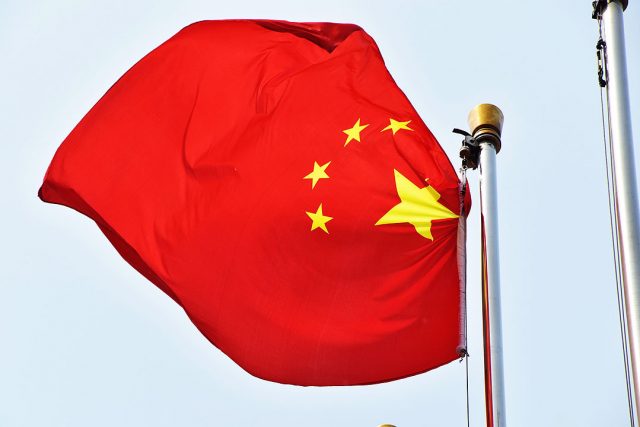
China seeks Pacific islands policing, security cooperation — document

PIXABAY

SYDNEY — China will seek a region-wide deal with almost a dozen Pacific island countries covering policing, security and data communication cooperation when Foreign Minister Wang Yi hosts a meeting in Fiji next week, documents seen by Reuters show. 

A draft communique and five-year action plan sent by China to 10 Pacific islands ahead of a meeting of foreign ministers on May 30 has prompted opposition from at least one of the invited nations, which says it showed China’s intent to control the region and “threatens regional stability.” 

In a letter to 21 Pacific leaders seen by Reuters, the president of the Federated States of Micronesia (FSM), David Panuelo, said his country would argue the “pre-determined joint communique” should be rejected, because he feared it could spark a new “Cold War” between China and the West. 

In Washington, US State Department spokesman Ned Price said the United States was aware of Wang Yi’s plans and was “concerned that these reported agreements may be negotiated in a rushed, non-transparent process.” 

He said recent security agreements reached by China had been conducted with little regional consultation, provoking concern in the United States and across the region. 

“We don’t believe that importing security forces from the PRC and their methods will help any Pacific Island country,” he said. “Doing so can only seek to fuel regional and international tension and increase concerns over Beijing’s expansion of its internal apparatus to the Pacific.” 

Mr. Wang will visit eight Pacific island nations that China has diplomatic ties with between May 26 and June 4. 

He arrives on Thursday in the Solomon Islands, which recently signed a security pact with China despite objections from Australia, the United States, Japan and New Zealand, all of which fear it could upset regional security and give China a military foothold in the Pacific. 

China rejects this, saying the pact is focused on domestic policing and criticism by Western countries was interference in the Solomon Island’s sovereign decision-making. 

Asked to respond to the letter, first reported by Reuters, China’s foreign ministry spokesman Wang Wenbin told a regular media briefing in Beijing that he was unaware of it, adding that China and South Pacific countries “are good friends and partners in mutual respect, equality and mutual benefit and common development”. 

“I do not agree at all with the argument that cooperation between China and the South Pacific island countries will trigger a new Cold War,” he added. 

Mr. Wang’s visit would “consolidate mutual political trust, expand practical cooperation, deepen people-to-people ties and jointly build a closer community of destiny among China’s Pacific island countries”. 

The FSM government, which has a defense agreement with the United States as well as an economic cooperation agreement with China, declined to comment to Reuters on the letter. 

Mr. Price, the US State Department spokesman, said Washington respected the ability of regional countries to make sovereign decisions in the best interests of their people, while adding, referring to China: 

“It’s worth noting that PRC has a pattern of offering shadowy, vague deals with little transparency or regional consultation in areas related to fishing, related to resource management, development assistance and more recently, even security practices.” 

NEW VISION 

A region-wide agreement covering security and trade between China and Pacific islands would represent a shift in Beijing’s focus from bilateral relations to dealing with the Pacific on a multilateral basis. 

China circulated the China-Pacific Island Countries Common Development Vision draft document, as well as a five-year action plan, ahead of the Fiji meeting. 

It states China and the Pacific islands will “strengthen exchanges and cooperation in the fields of traditional and non traditional security.” 

“China will hold intermediate and high-level police training for Pacific Island Countries through bilateral and multilateral means,” the document says. 

The action plan outlines a ministerial dialogue on law enforcement capacity and police cooperation in 2022, and China providing forensic laboratories. 

The draft communique also pledges cooperation on data networks, cyber security, smart customs systems, and for Pacific islands to “take a balanced approach” on technological progress, economic development and national security. 

Chinese telecommunications firm Huawei, which is barred from 5G networks run by several US allies, has been repeatedly thwarted in attempts to build submarine cables or run mobile networks in the Pacific by Australia and the United States, which have offered rival bids for the sensitive infrastructure, citing national security. 

The communique also proposes a China-Pacific Islands Free Trade Area, and support for action on climate change and health. 

In his letter to other leaders, Mr. Panuelo said the communique would draw Pacific islands that have diplomatic relations with China “very close into Beijing’s orbit, intrinsically tying the whole of our economies and societies to them.” 

He highlighted the risk of being caught in conflict as tensions rise between the United States and China over Taiwan. 

“The practical impacts, however, of Chinese control over our communications infrastructure, our ocean territory and the resources within them, and our security space, aside from impacts on our sovereignty, is that it increases the chances of China getting into conflict with Australia, Japan, the United States and New Zealand,” he said. 

China’s provision of customs systems would lead to “biodata collection and mass surveillance of those residing in, entering and leaving our islands”, he added. 

He was also critical of Australia’s lack of action on climate change. 

New Australian Prime Minister Anthony Albanese pledged this week to increase climate financing to Pacific islands, saying climate change was their main economic and security challenge. 

“China has made its intentions clear,” Australia’s foreign minister, Penny Wong, said when asked about the Reuters report. 

“So too are the intentions of the new Australian government. We want to help build a stronger Pacific family. We want to bring new energy and more resources to the Pacific.” 

Ms. Wong, who travels to Fiji on Thursday, has pledged to increase opportunities for Pacific island citizens to work and migrate to Australia. — Reuters

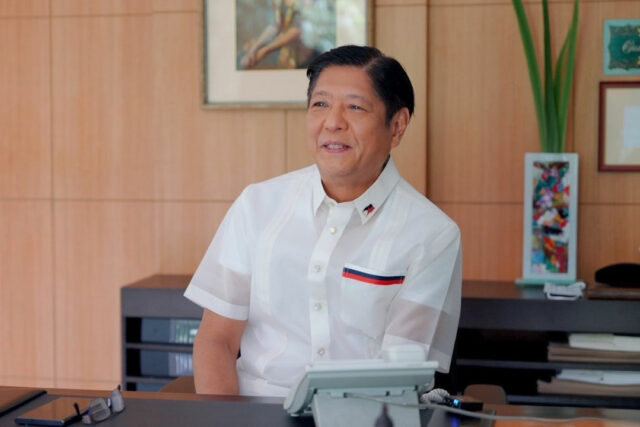
Marcos vows to thwart interference from outside powers

BONGBONG MARCOS FB PAGE

MANILA – Philippines President-elect Ferdinand Marcos on Thursday promised to prevent any foreign interference in the running of his country, and to defend sovereign territory and stand up to any Chinese encroachment in the South China Sea.In his strongest comments yet on how he will handle ties with China, Marcos, who takes office on June 30, said he would resist challenges from Beijing and stick to the 2016 ruling of an international arbitration court that made clear the Philippines’ economic entitlements.“There is no wiggle room there. Our sovereignty is sacred. We will not compromise it in any way,” Marcos said in an interview with his new press secretary, which was shown on his Facebook page.“We are a sovereign nation with a functioning government. We do not need to be told by anyone how to run our own country,” he said.“There is no room for negotiation there. It is sacred, inviolable.”Marcos, the son of the dictator ousted by a 1986 people’s revolt, said he would not allow any of the archipelago nation’s vast coastline or its 200 nautical mile exclusive economic zone to be infringed.“How do we do this? We talk to China consistently with a firm voice,” Marcos said.The 64-year-old, who swept this month’s election with 59% of the vote, is expected to lean towards China and last week promised to elevate and expand their ties to a new level during a phone conversation with President Xi Jinping.However, a pro-China stance could complicate the close relationship with historic ally the United States, a key source of defense and diplomatic support that has long been popular among Filipinos and the military.China’s embassy in Manila did not immediately respond to a request for comment.Marcos said his administration would have an independent foreign policy and recognised that international partnerships were key to a stable region.“Not only economically but geopolitically, as we emerge from the pandemic and the crisis it brought, we have to form alliance and partnerships,” he said.“No country can change the geopolitical situation on their own. And those are the partnerships that will keep things stable.”  — Reuters

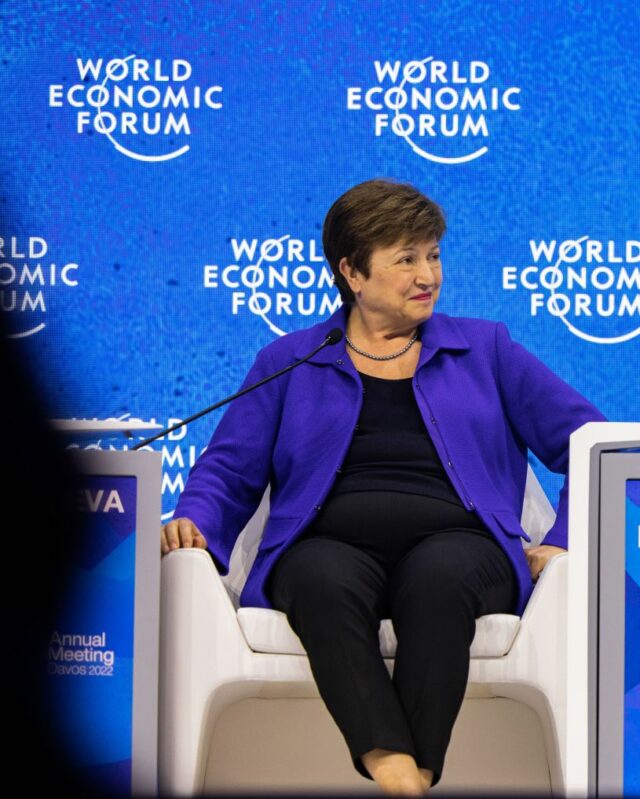
IMF’s Georgieva: ‘Trend of fragmentation is strong’

World Economic Forum / Benedikt von Loebell

DAVOS, Switzerland — International Monetary Fund (IMF) Managing Director Kristalina Georgieva on Wednesday said she worries less about the risk that the war in Ukraine and a further slowdown in China might trigger a global recession than she does about the strength of the trend toward economic and political fragmentation. 

The IMF last month slashed its global growth outlook for 2022 to 3.6% from 4.4%, the second downgrade this year, and she repeated her warning that events since then may prompt additional cuts to the forecast. That, however, is not what weighs most on her mind at present, Ms. Georgieva said during a panel discussion at the World Economic Forum here. 

“What worries us more is not the fact that we had these downgrades, because from 3.6% to get into negative territory for the world economy, there is a long way to go,” she said. 

“What worries us more,” she continued, “is the risk that we are going to walk into a world with more fragmentation, with trade blocs and currency blocs, separating what was up to now still an integrated world economy.” 

Ms. Georgieva’s remarks echoed a prominent concern overhanging this week’s delayed reboot of the annual gathering of global business and government leaders in the Swiss Alps: That events like Russia’s invasion of Ukraine is indicative that the era of globalization that had prevailed for the past three decades is on its last legs. 

“The trend of fragmentation is strong,” Ms. Georgieva said during a session titled “An Economic Iron Curtain: Scenarios and Their Implications.” 

“I was raised on the other side of the Iron Curtain. I hated it. And I can tell you it scares me that we may be sleepwalking after the hot war into another cold war.” — Reuters


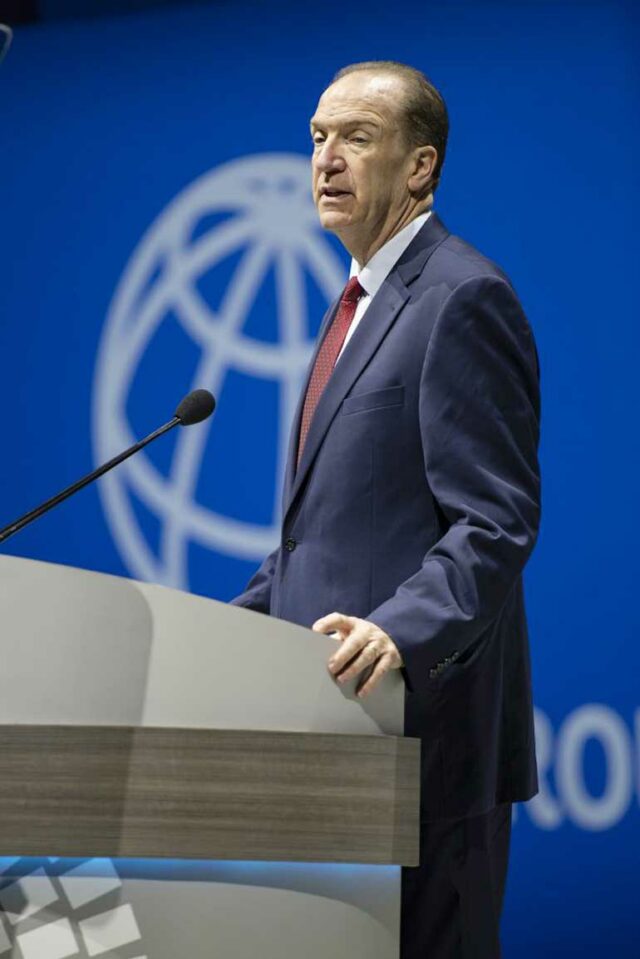
World Bank’s Malpass says war in Ukraine may trigger global recession

IMAGE VIA WORLD BANK / GRANT ELLIS / CC BY-NC-ND 2.0

WASHINGTON — World Bank President David Malpass on Wednesday suggested that Russia’s war in Ukraine and its impact on food and energy prices, as well as the availability of fertilizer, could trigger a global recession. 

Mr. Malpass told an event hosted by the US Chamber of Commerce that Germany’s economy, the world’s fourth largest, has already slowed substantially due to higher energy prices, and said reduced production of fertilizer could worsen conditions elsewhere 

“As we look at the global GDP … it’s hard right now to see how we avoid a recession,” Mr. Malpass said. He gave no specific forecast. 

He said the economies of Ukraine and Russia were both expected to see a significant contraction, while Europe, China and the United States were seeing slower growth. 

Developing countries were being hit even harder given shortfalls of fertilizer and food stocks and energy supplies, he said. 

“The idea of energy prices doubling is enough to trigger a recession by itself,” he said. 

In China, he said the relatively sharp slowdown in growth was based on the coronavirus disease 2019 (COVID-19) pandemic, inflation and the pre-existing real estate crisis the country had been facing. 

The World Bank last month had already cut its global growth forecast for 2022 by nearly a full percentage point, to 3.2% from 4.1%, due to the impacts from Russia’s invasion of Ukraine. 

Mr. Malpass gave no details on when a global recession could begin. — Reuters

Marcos names new finance chief and central bank governor

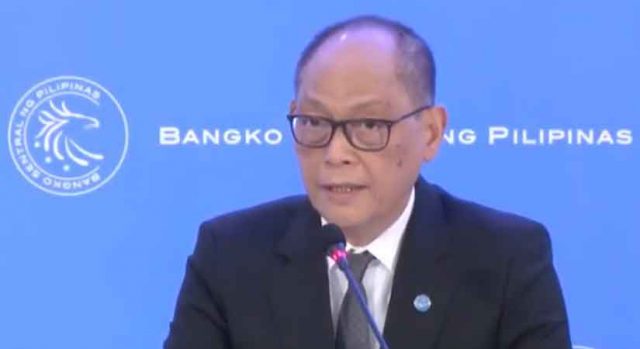
BSP Governor Benjamin E. Diokno

MANILA – Philippine President-elect Ferdinand Marcos Jr. on Thursday announced the current central bank governor Benjamin Diokno would be his finance minister when he takes office next month.

Diokno will be replaced by Felipe Medalla as Bangko Sentral ng Pilipinas (BSP) governor, Marcos said in an interview conducted by his press new secretary, which was streamed on his Facebook page.

Medalla is a member of the central bank’s monetary board.

Marcos said his first priority would be the economy, particularly addressing rising inflation and the need for job generation.

The appointments indicate another continuity move by Marcos, who is expected to expand on many of the economic policies of incumbent Rodrigo Duterte, including a major infrastructure overhaul.

Diokno, a budget secretary under the Duterte administration before he was appointed central bank governor, said he was committed to carefully managing the economy.

“As finance secretary, I will strive to continue prudently and carefully balancing the need to support economic growth, on one hand, and to maintain fiscal discipline, on the other, Diokno said in a statement.

Marcos also named Emmanuel Bonoan as public works secretary and Alfredo Pascual as trade secretary.

The broader stock index was flat on Thursday, after Marcos’s announcements about his economic team.

The BSP raised interest rates for the first time since 2018 on May 19, joining peers around world in a rush to stem intensifying inflationary pressures.

Marcos is inheriting an economy on a stronger footing, having expanded 8.3% in the first quarter from a year earlier.

The current government this week narrowed its growth target to 7.0%-8.0% from the previous range of 7.0%-9.0% to take into account external risks.

Analysts say the new administration will have to deal with huge amount of debt from the current government’s pandemic borrowing, which could limit his room to take on more debt to finance government projects or support growth. — Reuters

Shakey’s announces annual stockholders’ meeting on June 20 via remote communication

Notice of Annual Stockholders’ Meeting

Notice is hereby given that the Annual Stockholders Meeting will be held on Monday, June 20, 2022 at 8:30 in the morning.

The agenda for the said meeting shall be as follows:

  1. Call to Order
  2. Secretary’s Proof of Due Notice of the Meeting and Determination of Quorum
  3. Approval of the Minutes of the Stockholders’ Meeting held on July 15, 2021
  4. Management’s Report
  5. Ratification of Acts of the Board of Directors and Management During the Previous Year
  6. Election of Directors (including Independent Directors)
  7. Appointment of External Auditor
  8. Other Matters
  9. Adjournment

A brief explanation of the agenda items which require stockholders’ approval are provided on the Information Statement. The Information Statement and Annual Report will be uploaded to the Corporation’s website https://www.shakeyspizza.ph/ and PSE EDGE.

In light of current conditions and in support of the efforts to contain the outbreak of COVID-19, stockholders may attend the meeting and vote via remote communication only.

Stockholders should pre-register at this link:

https://www.shakeyspizza.ph/investors/register from May 23, 2022 to May 31, 2022.

Upon registration, Stockholders shall be asked to provide the information and upload the documents listed below (the file size should be no larger than 5MB):


A. For individual Stockholders:

  1. Email address
  2. First and Last Name
  3. Birthdate
  4. Address
  5. Mobile Number
  6. Phone Number
  7. Current photograph of the Stockholder, with the face fully visible
  8. Stock Certificate Number and number of shares held by the stockholder
  9. Valid government-issued ID
  10. For Stockholders with joint accounts: A scanned copy of an authorization letter signed by all Stockholders, identifying who among them is authorized to cast the vote for the account

B. For corporate/organizational Stockholders:

  1. Email address
  2. First and Last Name of stockholder
  3. Address
  4. Mobile Number
  5. Phone Number
  6. Stock certificate number and number of shares held by the stockholder
  7. Current photograph of the individual authorized to cast the vote for the account (the “Authorized Voter”)
  8. Valid government-issued ID of the Authorized Voter
  9. A scanned copy of the Secretary’s Certificate or other valid authorization in favor of the Authorized Voter

Stockholders who will join by proxy shall download, fill out and sign the proxy found in https://www.shakeyspizza.ph/investors/register. Deadline to submit proxy forms is on May 31, 2022.

All registrations shall be validated by the Corporate Secretary in coordination with the Stock Agent. Successful registrants will receive an electronic invitation via email with a complete guide on how to join the meeting and how to cast votes.


Only stockholders of record as of the close of business on May 4, 2022 are entitled to notice and to vote at the meeting. 


Spotlight is BusinessWorld’s sponsored section that allows advertisers to amplify their brand and connect with BusinessWorld’s audience by enabling them to publish their stories directly on the BusinessWorld Web site. For more information, send an email to online@bworldonline.com.

Join us on Viber to get more updates from BusinessWorld: https://bit.ly/3hv6bLA.

Century Pacific Food, Inc. to hold annual stockholders’ meeting on June 30

Notice of Annual Stockholders’ Meeting

Notice is hereby given that the Annual Stockholders Meeting will be held on Thursday, June 30, 2022 at 8:30 in the morning.

The agenda for the said meeting shall be as follows:

  1. Call to Order
  2. Secretary’s Proof of Due Notice of the Meeting and Determination of Quorum
  3. Approval of the Minutes of the Stockholders’ Meeting held on June 30, 2021
  4. Management’s Report
  5. Ratification of Acts of the Board of Directors and Management During the Previous Year
  6. Election of Directors (including Independent Directors)
  7. Appointment of External Auditor
  8. Approval of the Amendment of the Company’s Articles of Incorporation
  9. Other Matters
  10. Adjournment

A brief explanation of the agenda item which requires stockholders’ approval is provided herein. The Information Statement, Management Report, SEC Form 17A will be uploaded to the Company’s Website at https://www.centurypacific.com.ph/ and PSE EDGE under Century Pacific Food, Inc. Company Disclosures.

In light of current conditions and in support of the efforts to contain the outbreak of COVID-19, stockholders may attend the meeting and vote via remote communication only.

Stockholders should pre-register at this link:

https://www.centurypacific.com.ph/investor/register from May 31, 2022 to June 05, 2022.
Upon registration, Stockholders shall be asked to provide the information and upload the documents listed below (the file size should be no larger than 5MB):

A. For individual Stockholders:

  1. Email address
  2. First and Last Name
  3. Birthdate
  4. Address
  5. Mobile Number
  6. Phone Number
  7. Stock Certificate Number and number of stocks held
  8. Current photograph of the Stockholder, with the face fully visible
  9. Valid government-issued ID
  10. For Stockholders with joint accounts: A scanned copy of an authorization letter signed by all Stockholders, identifying who among them is authorized to cast the vote for the account, as well as valid government-issued ID of the authorizing stockholders

B. For corporate/organizational Stockholders:

  1. Email address
  2. First and Last Name of stockholder
  3. Address
  4. Mobile Number
  5. Phone Number
  6. Current photograph of the individual authorized to cast the vote for the account (the “Authorized Voter”)
  7. Valid government-issued ID of the Authorized Voter
  8. A scanned copy of the Secretary’s Certificate or other valid authorization in favor of the Authorized Voter

Stockholders who will join by proxy shall download, fill out and sign the proxy form found in https://www.centurypacific.com.ph/investor/register. Deadline to submit proxy forms is on June 20, 2022.

All registrations shall be validated by the Corporate Secretary in coordination with the Stock Agent. Successful registrants will receive an electronic invitation via email with a complete guide on how to join the meeting and how to cast votes.

Only stockholders of record as of the close of business on May 16, 2022 are entitled to notice and to vote at the meeting. 


MANUEL GONZALEZ
Corporate Secretary


Spotlight is BusinessWorld’s sponsored section that allows advertisers to amplify their brand and connect with BusinessWorld’s audience by enabling them to publish their stories directly on the BusinessWorld Web site. For more information, send an email to online@bworldonline.com.

Join us on Viber to get more updates from BusinessWorld: https://bit.ly/3hv6bLA.

Keppel Philippines Holdings, Inc. to hold annual meeting of stockholders on June 17


Spotlight is BusinessWorld’s sponsored section that allows advertisers to amplify their brand and connect with BusinessWorld’s audience by enabling them to publish their stories directly on the BusinessWorld Web site. For more information, send an email to online@bworldonline.com.

Join us on Viber to get more updates from BusinessWorld: https://bit.ly/3hv6bLA.