Home Blog Page 6035

DMCI Homes reports progress in Satori Residences

DMCI Project Developers, Inc. said on Monday that the first building of Satori Residences, which is scheduled to be turned over in February next year, is already at 84.8% complete.

The developer, commonly known as DMCI Homes, said the 15-storey building, Hacana, is the first of its five-building transit-oriented development.

“The building as of August 2022 is undergoing final touch-ups and is already showing a glimpse of the development’s Neo-Asian minimalist theme,” the company said in a press release.

Meanwhile, the other four buildings of Satori Residences — Lana, Rahu, Yasu and Amani — were reported to be at 69.9%, 54%, 42.4% and 14.39% completion, respectively.

The Lana building is scheduled for turnover in August 2023, Rahu in February 2024, and Amani and Yasu buildings in August 2024.

The development is situated in Santolan, Pasig City which the company said has been becoming a “favored living destination” because of its proximity to institutions like the University of the Philippines and the Ateneo de Manila University, and business districts like Eastwood City and Ortigas.

Units in Satori Residences will be ranging from 27.5 square meters (sq.m.) to 78 sq.m. with an average price of P5.3 million.

The property will have amenities such as a pool complex, landscaped atriums, jogging path, gazebo game area, basketball court, audio-visual room, fitness gym, function hall, picnic grove, and a children’s playground.

DMCI Homes is a wholly owned subsidiary of the Consunji-led DMCI Holdings, Inc. Its main activities include the development, management, and selling of various real estate properties.

On Monday, shares in DMCI Holdings slipped by 15 centavos or 1.49% to P9.95 each. — Justine Irish D. Tabile

Philippines’ banked adults rise to 56% in 2021 as online payments grow

BW FILE PHOTO

ABOUT 22 MILLION Filipinos gained access to formal financial accounts between 2019 and 2021, but 34.3 million adults remained unbanked, the Bangko Sentral ng Pilipinas (BSP) said.

The country’s banked population was at about 56% of all adults in 2021, up from just 29% in 2019, the BSP said in a statement on Monday, citing the results of its 2021 Financial Inclusion Survey (FIS). It said this was the best two-year increase since it began to conduct the survey in 2015.

The increase was driven by the accelerated growth in digital payments, the central bank said.

The BSP wants 70% of Filipino adults to have a formal financial account by 2023.

“Amid the latest figures, the BSP will continue to broaden its efforts to foster the wider adoption of digital technology, which has effectively enabled the onboarding of more Filipinos into the formal financial system,” BSP Governor Felipe M. Medalla said.

“With the National Strategy for Financial Inclusion 2022-2028, the BSP continues to work not only with other government agencies but also with private sector and development partners to achieve our shared vision of accelerating financial inclusion toward broad-based growth and financial resilience,” Mr. Medalla added.

Among the banked population, 36% had e-money accounts in 2021, up from the 8% share in 2019. This became the most used type of account among adults in the middle class, the low-income population and those aged 15 to 49 years old.

Meanwhile, the share of Filipino adults with a bank account is now at 23% from just 12% in 2019.

“Banks remained the preferred formal institution for saving money by a third of those with savings, followed by cooperatives and microfinance institutions,” the BSP said. 

The FIS also showed that six out of 10 Filipinos changed their financial behavior during the coronavirus pandemic, the central bank said.

“Filipinos started saving more for emergencies (37%), began or increased their usage of online banking and digital payments (17%), and borrowed more (15%),” it said.

Among Filipinos with mobile phones and internet access in 2021, 60% made financial transactions online, higher than 17% in 2019, the survey’s results also showed.

In 2021, account ownership in the socioeconomic class ABC (80%) was almost twice the share of class E (44%). E-money was the most common type of account in socioeconomic classes C2, D and E, while classes A, B, and C1 mostly had bank accounts.

The central bank said despite the increase in the country’s banked population, challenges to financial inclusion remain, and their effects are more apparent among lower income groups, highlighting the importance of improving the financial resilience of vulnerable people.

“The main barriers to account ownership such as lack of income and transaction costs persist. In addition, the lack of documents to open an account is still prevalent for a large segment of the population. Moreover, the survey found that over half of savers still keep their money at home,” the BSP said.

FARMERS LEAST BANKED
The survey’s results showed farmers and agriculture workers were the least banked among all types of workers, with 73% having no accounts, the highest financial exclusion level seen in 2021.

Other segments that had a high percentage of unbanked adults were workers for private households (48%) and self-employed individuals (45%). Non-working adults without accounts stood at 52%, equivalent to 15.6 million adults.

Fewer Filipinos also had savings and insurance in 2021. Despite the increase in account ownership, the percentage of adults with savings fell to 37% in 2021 from 53% in 2019, which was equivalent to a 9.7 million decline in savers.

Informal saving remained high, with 52% of savers keeping their money at home. Still, the share of bank savers increased to 31% in 2021 from 21% in 2019. About 81% of savers said they allocate savings for emergencies.

Financial investors among adults rose to 36% in 2021 from 25% in 2019. More Filipinos had borrowings, as the share of adults with outstanding loans jumped to 45% in 2021 from 33% in 2019.

According to the survey, almost half of Filipino adults had difficulty in meeting their cost of living and were concerned that finances controlled their lives and their savings will not last.

More Filipinos generally have a positive outlook as they believed that they were on track to meet their financial goals and felt secure about their future. — K.B. Ta-asan

Construction firm to lease one floor at Blakes Tower

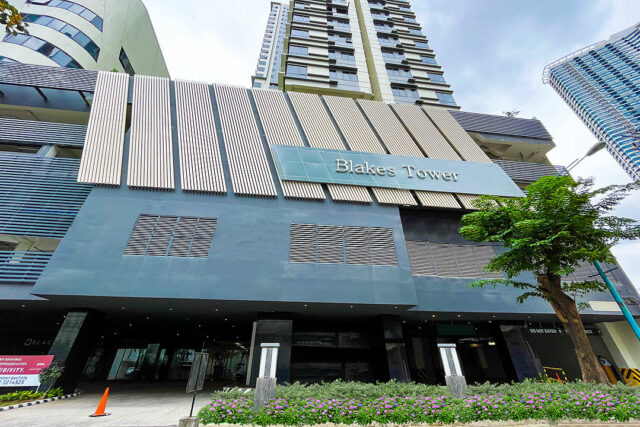
A TRIPLE-A construction company recently signed a three-year lease contract for one floor at Blakes Tower in Makati City, according to Eton Properties Philippines.

“Office leasing remains a priority segment of Eton’s business, as we see a sustained demand following the country’s easing of restrictions. We aim to provide flexible office spaces that would increase productivity of our tenants’ workforce,” Eton Properties Executive Director Kyle Tan said in a statement.

The 36-storey Blakes Tower is a mixed-use building in Eton WestEnd Square. Located along Malugay St., the building offers 11,000 square meters (sq.m.) in gross leasable office area, “which can be retrofitted into hybrid cuts at varying office size requirements ranging from 1,000 sq.m. and above for more functionality.”

Eleven floors are allocated for office spaces, while 15 floors are for residential units.

“By offering flexible office units and residences for employees within the same building located in a prime location, Blakes Tower assures work-life integration for individuals and uninterrupted business operations for companies,” Mr. Tan.

Eton Properties is the real estate brand of the LT Group.

Dragon Ball Super: Super Hero crushes Idris Elba’s Beast with $21-million debut

LOS ANGELES — Dragon Ball Super: Super Hero topped the box office in its debut, beating expectations by collecting an impressive $21 million in North American ticket sales.

The animé film, playing on 3,007 screens, is backed by the production company Crunchyroll, which specializes in Japanese animé film and television. Super Hero is a necessary bright spot in an otherwise dreary August at the movies. The newest Dragon Ball Super installment earned twice as much as the weekend’s other new nationwide release, Universal’s survival thriller Beast, starring Idris Elba. Dinged by mixed reviews, Beast opened to a lackluster $11.5 million from 3,743 North American cinemas.

Dragon Ball Super: Super Hero is the latest example of the passionate audience for animé films in the United States, and Crunchyroll, which is mostly owned by Sony Pictures, has been owning the market in North America. Earlier this year, the company’s PG-13 Jujutsu Kaisen 0 notched a remarkable $17.6 million in its debut, while its 2021 release Demon Slayer the Movie: Mugen Train generated $21.2 million to start, which is even more impressive since cinemas were still operating at reduced capacity. However, these movies tend to play like horror films in terms of ticket sales, withstanding big declines in subsequent weeks.

Dragon Ball Super: Super Hero benefitted from its outsized presence on premium formats, including Imax, 4DX, and Dolby Cinemas. The movie played on 327 Imax screens, which accounted for $3.4 million in domestic ticket sales. At Imax, those returns rank as the widest and highest-grossing opening weekend for an animé film.

“This is another outstanding Crunchyroll animé opening. This has become an impressive niche theatrical business,” says David A. Gross, who runs the movie consulting firm Franchise Entertainment Research. But, he adds, “Crunchyroll movies play fast in the US; their domestic multiples are low.”

Like critics, audiences were similarly mixed on Beast, giving the film a so-so B CinemaScore. Directed by Icelandic director Baltasar Kormákur (Adrift), Beast follows a recently widowed father and his two teenage daughters (Iyana Halley and Leah Jeffries), who find themselves hunted by a massive rogue lion. The movie, which cost $36 million to produce, has raked in $10.2 million to date at the international box office.

Elsewhere on domestic box office charts, Sony’s action-thriller Bullet Train slid to third place after two consecutive weekends at No. 1. The movie brought in $8 million from 3,781 locations in its third weekend of release, taking its domestic tally to $68.9 million. That’s a decent result for a star-driven, original action film in today’s fractured moviegoing landscape. But it cost $90 million to make — and many millions more to promote to the masses — meaning it needs to keep chugging along in theaters to justify its hefty budget. Overseas, Bullet Train has amassed $60 million for a global tally of $123 million.

In fourth place, Paramount’s Top Gun: Maverick pulled in $5.85 million from 2,969 locations in its 13th weekend of release. Tom Cruise’s blockbuster action sequel, which hits home entertainment in the coming days, has grossed an eye-popping $683 million to date, enough to overtake Marvel’s 2018 superhero epic Avengers: Infinity War ($678 million) as the sixth-highest grossing domestic release in history. Since it opened in theaters over Memorial Day weekend, Maverick has only spent one weekend out of the top five on North American box office charts.

The Warner Bros. animated adventure DC League of Super-Pets took the No. 5 slot with $4.9 million from 3,537 venues. After four weeks in theaters, the family friendly film has generated $66.6 million in North America. — Reuters

2023 Proposed National Government budget

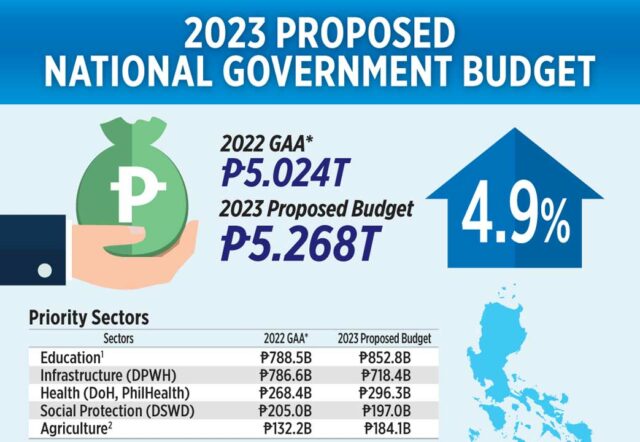
THE MARCOS administration proposed to increase the allocations for education, health, agriculture, and infrastructure under the P5.268-trillion national budget for 2023, while lowering allotments for other priority sectors such as social protection. Read the full story.

2023 Proposed National Government budget

How PSEi member stocks performed — August 22, 2022

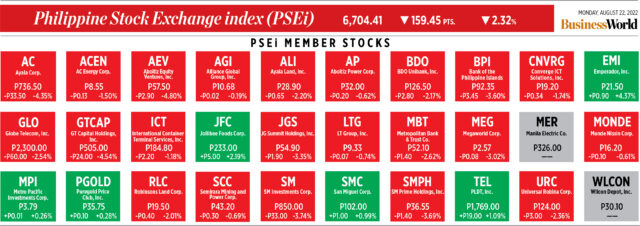
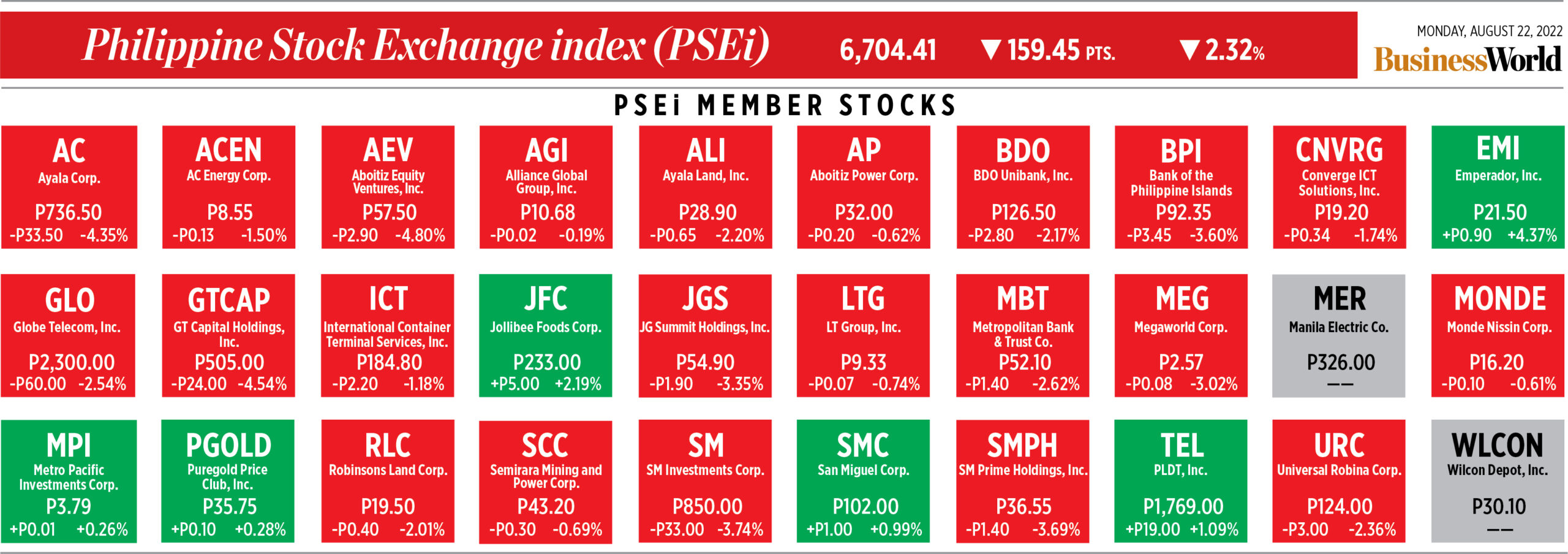
Here’s a quick glance at how PSEi stocks fared on Monday, August 22, 2022.


Shares drop on profit taking, track Wall Street

STOCKS fell on Monday as investors pocketed their gains from last week’s rally amid a weaker peso and following Wall Street decline on Friday.

The Philippine Stock Exchange index (PSEi) slumped by 159.45 points or 2.32% to close at 6,704.41 on Monday, while the broader all shares index went down by 57.64 points or 1.58% to 3,577.93.

“The PSEi fell 159.45 points or 2.32%, reflecting the week-ending performance of the US market, which ended in the red led by mega-cap companies and as US bond yields rose,” Timson Securities, Inc. Head of Online Trading Marc Kebinson L. Lood said in a Viber message.

On Friday, the Dow Jones Industrial Average fell by 292.30 points or 0.86% to close at 33,706.74; the S&P 500 lost 55.26 points or 1.29% to 4,228.48; and the Nasdaq Composite dropped by 260.13 points or 2.01% to 12,705.22.

“Profit taking after the rally last week brought the PSEi to 6,704.41, dropping 159.45 points or 2.32%. Moreover, the depreciation of the peso contributed to the negative sentiment,” Philstocks Financial, Inc. Research Analyst Claire T. Alviar said in a Viber message.

“This is on the back of the expectation that the Federal Reserve could remain hawkish, which may weaken the peso. Moreover, supply concerns over some food items weighed on the sentiment,” Ms. Alviar added.

The peso closed at P55.93 per dollar on Friday, weakening by 4.2 centavos from its P55.888 finish on Thursday. It also depreciated by 32 centavos from its P55.61-per-dollar close a week earlier.

After the stock market closed, the local unit finished Monday’s trading session at P56.21 per dollar, sinking by 28 centavos from its P55.93 finish on Friday. This is the first time the peso closed at the P56-per-dollar level since late July and is its worst finish since July 22’s P56.28.

All sectoral indices ended in the red on Monday. Holding firms went down by 230.85 points or 3.46% to 6,436.98; property dropped by 88.61 points or 2.87% to 2,990.76; financials declined by 39.92 points or 2.46% to 1,581.08; mining and oil lost 192.57 points or 1.56% to end at 12,132.80; services gave up 9.99 points or 0.56% to close at 1,746.18; and industrials decreased by 31.90 points or 0.31% to 9,974.84.

Value turnover increased to P5.44 billion on Monday with 816.98 million shares changing hands, from the P5.15 billion with 1.57 billion issues seen on Friday.

Decliners outnumbered advancers, 132 versus 62, while 39 names were unchanged.

Foreigners turned sellers on Monday, with net foreign selling reaching P342.42 million from the P10.69 million in net buying seen on Friday.

“For the week, investors will turn their attention to the highly anticipated Federal Reserve annual Jackson Hole symposium on Friday, which will serve as a catalyst for a volatile week. Investors will be watching Fed Chair Jerome Powell’s latest remarks on inflation…,” Timson Securities’ Mr. Lood said.

He placed the PSEi’s support at 6,650 and resistance at 7,160, while Philstocks’ Ms. Alviar put support at 6,600 and resistance at 7,000 to 7,100. — J.I.D. Tabile

Peso sinks to one-month low on hawkish Fed bets

BW FILE PHOTO

THE PESO hit a one-month low against the dollar on Monday on expectations that the US Federal Reserve will remain hawkish, and amid global inflation concerns.

The local unit closed at P56.21 per dollar on Monday, weakening by 28 centavos from its P55.93 finish on Friday, based on data from the Bankers Association of the Philippines.

This is the first time the peso closed at the P56-per-dollar level since late July and is its worst finish since July 22’s P56.28.

The peso opened Monday’s session weaker than its Friday close at P56.10 versus the dollar. Its worst showing was at P56.22, while its intraday best was at P56.03 against the greenback.

Dollars exchanged decreased to $804.95 million on Monday from $889.67 million on Friday.

“The peso exchange rate weakened… as the hawkish Fed signals amid the need to fight elevated US inflation supported the upward correction in the US dollar versus major global currencies,” Rizal Commercial Banking Corp. Chief Economist Michael L. Ricafort said in a Viber message.

Fed Chair Jerome H. Powell will lead a host of policy makers at the annual Atlanta Fed’s Jackson Hole Economic Symposium on Friday, with the US central bank facing the fastest inflation since 1980 and raising interest rates fast to counter it.

“The peso weakened after the hotter-than-expected German producer inflation report renewed global inflationary concerns,” a trader said in an e-mail.

German producer prices jumped at the fastest pace in July, pushing investors to buy safe-haven dollars. According to the federal statistics office on Friday, producer prices in Germany surged 37.2% year on year, the biggest rise since records began in 1949. The month-on-month rise of 5.3% was also a record high.

The record increases in producer prices were primarily driven by skyrocketing energy prices, up by 105% from the same month last year.

For Tuesday, the trader said “the local currency might rebound from potential profit taking and weaker US manufacturing and services reports overnight.”

The trader expects the local unit to move from P56.05 to P56.25, while Mr. Ricafort gave a wider forecast range of P56.05 to P56.30 per dollar. — KBT

Ex-USec says Sugar Order 4 was meant to address ‘urgent’ shortage

PHILSTAR

THE Agriculture Undersecretary who resigned following the recall of Sugar Order (SO) No. 4 said he signed the order after a meeting with the President convinced him of the urgent need to import 300,000 metric tons of sugar, adding that he believed he was fully authorized to act in such a manner.

At a joint hearing on Monday of two House committees, the Good Government and Public Accountability and Agriculture and Food panels, former Undersecretary Leocadio S. Sebastian acknowledged that he had signed the order on behalf of President Ferdinand R. Marcos, Jr., in the latter’s capacity as Agriculture Secretary.

He said, however, that the plan went through the proper administrative channels.

“I drafted a memo for the President which I sent to the office of the Executive Secretary. I was also informed that (Sugar Regulatory Administration Head Hermenegildo R. Serafica) also sent the same e-mail (with the draft import order) directly to the office of the Executive Secretary. We waited for an answer but did not get any,” he added.

Mr. Sebastian said that he signed the order due to the “urgency” of the supply situation and based on a “misreading” of Mr. Marcos’ intentions following their meeting.

“I misread the intention of the President… that gave me the feeling that there is an urgency to this matter and that we need to act as soon as possible. I also expressed in my letter to the President that the board will meet as soon as possible to decide on the sugar order,” he said.

“I may have misread the intent of the President when I pushed through with the signing, based on the authorization given to me. That’s why when I realized I had misread the intention of the President, I immediately gave my resignation,” he added.

Mr. Sebastian said during the hearing that his brief allows him to sign sugar orders on behalf of the Agriculture Secretary, citing a memorandum from the Executive Secretary. The Secretary of Agriculture is ex-officio chairman of the SRA board.

Mr. Serafica, who has also resigned as SRA board member, as did the millers’ representative to the board, Roland B. Beltran, said the import plan was made in consultation with the sugar industry and was required to bolster the sugar inventory.

“We really needed additional sugar. We submitted an import proposal. I did ask my immediate supervisor then, Mr. Sebastian. I did not neglect the farmers. In fact, we consulted the farmers, it was a recommendation from almost all the stakeholders and these are written recommendations,” Mr. Serafica said.

On Aug. 1, Mr. Serafica said he was in a meeting with Mr. Marcos, who gave instructions to the SRA and Department of Agriculture to “prepare an import plan.”

The plan was then submitted to Mr. Sebastian on Aug 5. On the same day, Mr. Sebastian also sent a memorandum detailing the Sugar Order to the Palace.

On Aug. 8, the SRA board met prior to the signing of the order.

“I initiated the (meeting). Based on the recommendations of the stakeholders, we took it from there,” Mr. Serafica said.

The issue of whether the SRA board acted with due authority remained contentious among legislators, with Antipolo Rep. Romeo M. Acop saying that the board meeting was “unauthorized” as it was not called by Mr. Marcos.

“The signs are there that SO No. 4 was not right. It did not follow protocols,” he said.

Rep. Florida P. Robes, of the lone district of San Jose Del Monte City, said the manner in which the meeting was called “is illegal and was not authorized by the President. If you had pressures from the stakeholders, I don’t think it’s just that. There might be other reasons.”

Deputy Speaker Rodante D. Marcoleta said at the hearing that the SRA must act in a manner that also considers consumer interests.

“There are representatives for planters and millers but none for consumers. Consumers are the ones hit because (the SRA) doesn’t consult consumers. Consumers are the ones who do not benefit here,” he said.

Ms. Robes concurred, saying that the interests of workers in the sugar industry have also been neglected.

“We need to know the policies (for improving) the situation of the sugar farmers. The SRA has not supported the interests of farmers,” she said. — Luisa Maria Jacinta C. Jocson

MUFG raises 2022 outlook on Philippine growth to 6.7%

PHILIPPINE STAR/ MIGUEL DE GUZMAN

MUFG Bank said it upgraded its view on Philippine economic growth in 2022 to 6.7% from 6.5% previously, citing stronger-than-expected performance in the first half.

MUFG Bank analyst Sophia Ng, in a note issued on Monday, said the upgraded growth outlook was due to the “robust” 7.8% growth posted in the first half.

“Given the robust 7.8% growth rate in 1H22, our revised forecast still reflects our assumption of a slower growth rate in 2H22,” she added.

GDP growth in the second quarter slowed significantly to 7.4% from 12.1% a year earlier and 8.2% in the first quarter, according to preliminary data from the Philippine Statistics Authority (PSA).

“Factors that led to a slowdown in growth in Q2 were within our expectations, but the overall growth rate is higher than what we projected earlier this year,” Ms. Ng said.

MUFG’s new projection falls within the 6.5-7.5% full-year growth target set by the Development Budget Coordination Committee.

According to MUFG, inflation will likely be the main drag on private consumption until 2023, as will volatility in net goods exports.

“Inflation has risen much faster than expected so far this year and is likely to be the main impediment to private consumption through 1H23,” Ms. Ng said.

Preliminary estimates from the PSA indicate consumer price index growth of 6.4% year on year in July, driven by food and transport costs.

July headline inflation was the highest since the 6.9% posted in October 2018. 

In the year to date, inflation averaged 4.7%, up from 4% from a year earlier. This was also lower than the revised 5.4% forecast of the Bangko Sentral ng Pilipinas (BSP). 

“Higher interest rates and elevated levels of inflation are likely to continue to (impede) private consumption in 2H22. This is already evident in Q2 when private consumption added just 5.8 percentage points (ppt) to growth in Q2 from 7.4 ppt in Q1,” Ms. Ng said.

“As inflation is the biggest threat to the consumption-led economy, the BSP would have to continue to tighten monetary policy after 175 bps of cumulative rate hikes done so far this year,” she added.  

The central bank has raised benchmark rates by a total of 175 basis points (bps) so far this year, including the 50-bp increase on Aug. 18, bringing the benchmark rate to 3.75%.

Rates on the overnight deposit and lending facilities were also raised by 50 bps to 3.25% and 4.25%, respectively. MUFG sees the BSP hiking by 75 bps more before the year ends to bring inflation back within target.

Meanwhile, MUFG said the merchandise trade deficit will continue to widen and drag down overall growth for the rest of the year.  

“This is particularly in view of widening trade deficits brought about by the higher import value of oil and non-oil commodities and greater demand for capital goods as the government ramps up infrastructure spending,” Ms. Ng said.

The merchandise trade deficit hit another record in June despite slowdowns in the growth of imports and exports, according to the PSA.

Preliminary data show imports growing 26% year on year to $12.487 billion in June. This was lower than the revised 30.2% in May and 42.4% in June 2021.

Exports rose 1% year on year to $6.644 billion in June, against the revised 6.4% posted in May and 18.9% a year earlier.

This brought the balance of trade in goods — the difference between exports and imports — at a record monthly deficit of $5.843 billion in June.

Still, the Philippines is expected to be one of the fastest growing economies within the Association of Southeast Asian Nations region.

“A growth rate of 6.7% is also considered to be robust and slightly stronger than the average growth rate recorded during pre-pandemic times between 2012-2019 at 6.6% and last year’s 5.7% expansion,” Ms. Ng said.

MUFG said disruptions to economic activity look unlikely as President Ferdinand R. Marcos, Jr., promised not to re-impose lockdowns and the administration’s intent to continue the ‘Build, Build, Build’ infrastructure program.

This will likely increase government spending and attract more investment in the construction sector, she said. — Keisha B. Ta-asan

Foreign investors wary of RCEP delay, Trade department says

THE Department of Trade and Industry (DTI) said the ratification of the Regional Comprehensive Economic Partnership (RCEP) remains one of its top priorities due to the unease that failure to sign on to the trade deal has caused investors.

The DTI was briefing the Senate Trade, Commerce and Entrepreneurship Committee on Monday on its policy priorities. Trade Secretary Alfredo E. Pascual said that “most of the investors in these industry clusters will most likely come from abroad.”

The priorities include industrials, manufacturing and transport; technology, media and telecommunications; health and life sciences; and modern basic needs; and measures to make the economy more resilient.

“There are the foreign investors setting up these enterprises here in partnership with local investors, and the target of these industry clusters is the export market,” Mr. Pascual said. “We want these enterprises to be participating in the global value chains in the products produced under these clusters.”

He said through industrialization, especially in the priority areas, the Philippines will be able to offer better-quality and higher-paying jobs.

“So it is very important, I’d like to emphasize, that RCEP be ratified or be confirmed by the Senate because we’ve always been asked by prospective investors, foreign chambers about how soon (we can ratify) RCEP because their own people, the companies in their respective regions, are asking them, before they consider investing in the Philippines,” he added.

RCEP, which started coming into force in participating countries on Jan. 1, involves Australia, China, Japan, South Korea, New Zealand and the 10 members of the Association of Southeast Asian Nations (ASEAN).

The Philippines is one of three countries that have not ratified RCEP, along with fellow ASEAN members Indonesia and Myanmar.

President Ferdinand R. Marcos, Jr. has said that he wanted to review the trade agreement to protect the agriculture sector.

Senator Pilar Juliana S. Cayetano said the DTI must work closely with the Commission on Higher Education (CHED) and public and private universities, to better align job creation efforts with academic training being received by future workers.

“A lot of (students) will end up going abroad or end up in unrelated fields which is kind of sad, so as early as now, we have six years, let’s plan this carefully, work with the state universities on what the demand is, what the particular specifications you are looking for,” she said.

“We need to understand what we really expect from our human resource pool and align this with the demand,” she added, noting that since becoming a senator in 2004, she has not seen adequate coordination between agencies and the education industry.

Mr. Pascual said that when he “made this presentation to the Cabinet, I highlighted, very specifically, the need to collaborate with CHED, DepEd (Department of Education) and TESDA (Technical Education and Skills Development Authority) for purposes of developing the necessary skills among our human resources, our workers.”

Ms. Cayetano said she has never seen a sustained effort in this regard.

“The coordination… rarely happens. Maybe you can form a committee that really sits down together because otherwise, it doesn’t happen,” she said.

The DTI’s other priorities are the Omnibus MSME Code to support small businesses, and the proposed Internet Transactions Act.

The Internet Transactions measure seeks to protect consumers and merchants via the creation of an e-commerce bureau.

Trade Assistant Secretary Mary Jean T. Pacheco, speaking at the hearing, said the department is proposing exempting newly registered e-commerce micro-enterprises from all national and local taxes in their first three years, as long as the enterprise is not an affiliate, subsidiary or a franchise of any other existing company.

If it is a one-person corporation or partnership, it must not have any previous or other existing registered companies, partnerships or businesses. For corporations, each stakeholder must have at least a 5% stake with no shareholders holding stock in trust for others.

“This will allow micro-businesses to pivot from offline to online, and it will also encourage them to register and take care of the business for the first two to three years as they grow into a bigger business,” Ms. Pacheco said.

The measure seeks to establish effective regulation for commercial activities performed on the internet.

“We’d like to see a robust e-commerce sector that will also ensure consumer protection, data privacy, intellectual property and security, as well as adhere to product and safety standards,” she said.

The Philippines has the fastest-growing digital economy in Southeast Asia, according to the e-Conomy Southeast Asia Report, which projects the Philippines’ overall internet economy in terms of gross merchandise value (GMV) at $40 billion by 2025.

Philippine internet economy GMV was estimated at $17 billion in 2021, up 93% from a year earlier, due to government initiatives and mass digital adoption, aided by double-digit growth in sectors such as food delivery services.

The Philippines also added 12 million new digital consumers since the pandemic started in March 2020. Of this, 63% are from non-metro areas. A majority also said they plan to continue using these services after the pandemic.

Ms. Pacheco said the Trade Secretary “should be granted the authority to issue take down orders, including the regulatory jurisdiction…over digital platforms.”

“One of the most contentious issues is the issue of liability for the platforms,” she added. “There are also penalties provided under the law, but the private sector can make a comment about removing the criminal aspect of penalties.”

The bill was earlier approved by the House of Representatives on final reading but remained pending on second reading at the Senate by the end of the 18th Congress. — Alyssa Nicole O. Tan


Thailand seeks to address hotel worker shortage by recruiting Filipinos

REUTERS

THE Department of Tourism (DoT) said Thailand is experiencing a shortage of hotel workers as demand in that industry recovers, and will seek to employ Filipinos to fill the gaps.

In a statement on Monday, the DoT said Secretary Maria Esperanza Christina G. Frasco and Thai Minister of Tourism and Sports Phiphat Ratchakitprakarn, at an Aug. 18 meeting, reached an agreement on offering jobs to Filipinos.

“With the lifting of travel restrictions and resumption of tourism activities, the Thai tourism industry is currently facing a shortage in their workforce of 60% in hotel staff up to middle manager positions,” Mr. Phiphat said.

“There is preference towards professionals from the Philippines due to the Filipinos’ impressive command of the English language — a requirement in accommodating Thailand’s increasing foreign tourists and guests,” he added.

Ms. Frasco said that the DoT is currently in talks with the Department of Labor and Employment to conduct job fairs for such workers. The job fair will be held between Sept. 22 and 24.

She added that the DoT is currently surveying the Philippines’ own tourism workforce following the pandemic.

 “We note with serious consideration the shortage in the tourism workforce coming out of the coronavirus disease 2019 pandemic… (The job fairs will also be) for the purpose of ensuring that those that left the industry or may have been laid off from the industry during the time of pandemic would once again have the opportunity to be employed,” Ms. Frasco said.

Thailand and the Philippines have agreed to update their tourism cooperation agreement covering the period 2017-2022, which was signed on March 21, 2017.

The agreement covers travel facilitation, research, and development, education and training, tourism initiatives, human capital development and employment generation. — Revin Mikhael D. Ochave