Home Blog Page 5972

Philippine office market occupancy stabilizes (part 2)

(Part 2 of 2)

IN the first part of this article, we highlighted an initiative of Colliers’ Office Services – Tenant Representation called The New Normal Paper Series, which sought to guide office market stakeholders how to survive the challenges of the coronavirus disease 2019 (COVID-19) pandemic.

In this series, our hope was to encourage our clients and partners to continuously swim through murky waters so as not to stagnate, since inaction and paralysis could be worse for all of us.

When we were tallying the results of the first quarter performance of the office market, we were so glad to see that the office market occupancy has stabilized as we recorded the net take-up to be positive.
VACANCY TO INCREASE, THEN PLATEAU BEFORE FALLING
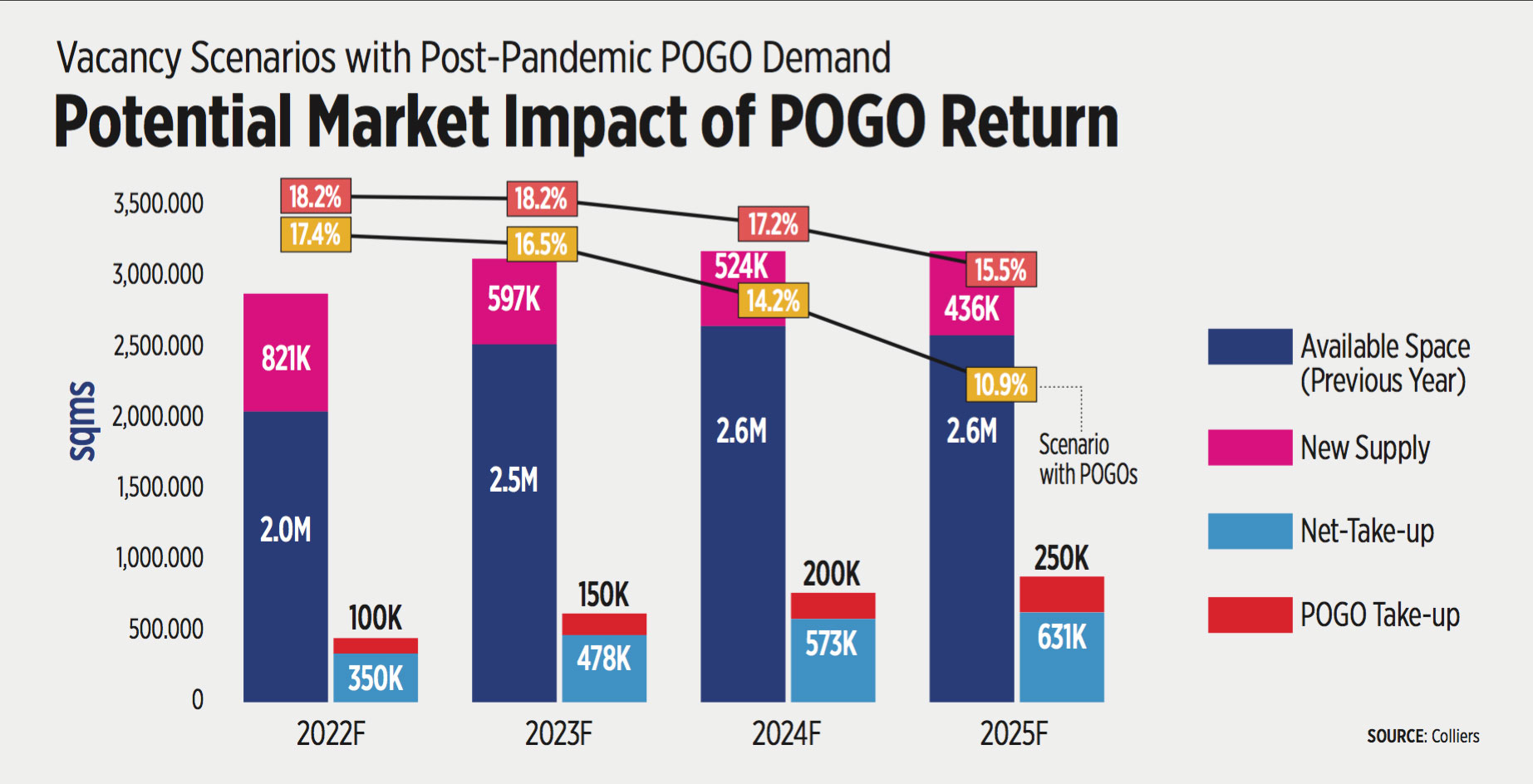
While the net office take-up turned a corner already in the first quarter of 2022, vacancy is still expected to increase to the 18% level within 2022 as Colliers projects an annual office addition of 822,000 square meters (sq.m.).

Based on the first quarter results, Colliers maintained the projected year-end vacancy of 18% despite the high level of supply as the project annual net take-up was adjusted upwards in view of the increasing demand from the traditional occupiers and business process outsourcing (BPOs) companies.

The 2.3 million sq.m. of available spaces are expected to be absorbed in three to four years’ time considering the demand level and office market size of between 500,000 to 600,000 sq.m. before the POGOs entered the Philippine office market.

This means that vacancy and rental recovery to pre-pandemic level will be gradual, so our advice is for both tenants and landlords to continue working very closely during this period.

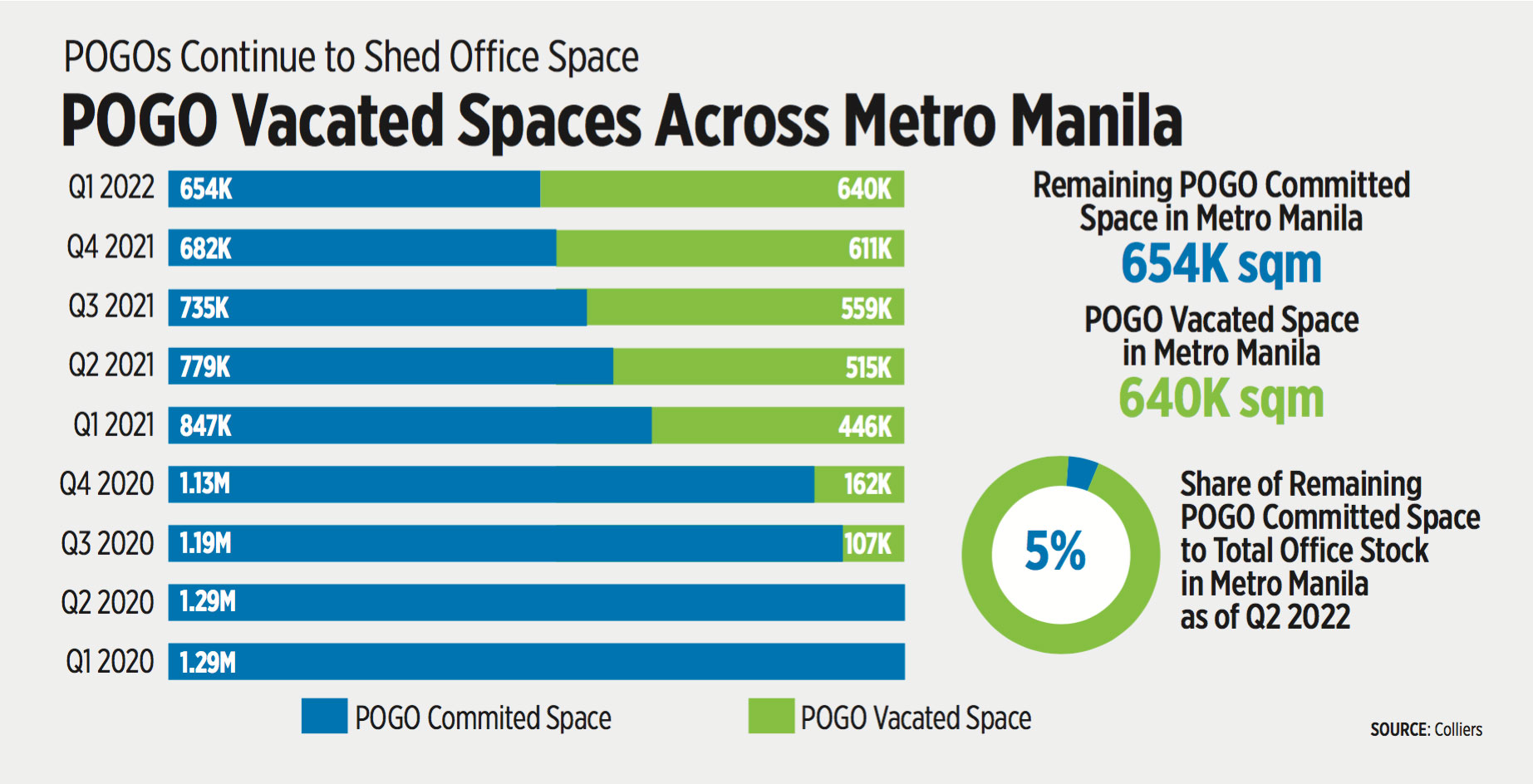
The POGOs remained to quiet in the first quarter as Colliers did not record any transaction from this industry. As of the first quarter this year, approximately 640,000 sq.m. of office space has been shed by POGOs in Metro Manila, which reduced its share to just 5%.

The issues hounding the industry are being addressed one-by-one like the tax system and the inbound flights. It remains to be seen though if the POGOs will grow again, but a POGO return will certainly help the office market recover faster.

The first chart shows a simulation of a POGO comeback which can help reduce the office vacancy close to 10%, instead of 15% without the POGOs.
OUTLOOK
As COVID-19 restrictions are quickly loosening and workers are now returning to office, Colliers sees that the Metro Manila office market is set improve further for the latter part of the year.

In our view, the return-to-office and expansion plans of companies, coupled with greater resiliency to COVID-19 and economic stimulus legislations should accelerate take-up for the remainder of 2022.

Given this backdrop, Colliers recommends that occupiers who plan to expand, relocate, or set up a new office to streamline their site selection timelines.

With the ongoing rental corrections and tenant-favorable market conditions, companies who are in a wait-and-see may want to implement flight-to-quality or flight-to-cost measures as soon as possible to secure office spaces at more competitive terms before the market rebound increases occupancy in highly sought-after properties in prime locations, such as Ortigas central business district, Bay Area, Quezon City and Alabang.

With the recent passage of key investment-related legislation, Colliers also suggests that landlords proactively capture demand from incoming foreign players as their entry should improve the country’s investment climate. The relaxed regulations on foreign ownership and taxation will likely translate to multiplier effects on the economy and increased demand for office space in the country.

Lastly, landlords are encouraged to remain flexible and accommodate the requests of their existing tenants (both commercial and operational in nature) to aid in the business recovery of companies and maintain their occupancy.


Dom Fredrick Andaya is the senior director and head of Office Services, Tenant Representation, Colliers Philippines
Inflation fight, monsoon may take pressure off RBI, former official says

REUTERS
COORDINATED fiscal and monetary efforts may take the pressure off India’s central bank to aggressively hike interest rates. — REUTERS

INDIA’S coordinated fiscal and monetary efforts to tame inflation, plus a good agricultural production outlook, may take pressure off the central bank to aggressively raise interest rates later in the year, according to a former Reserve Bank of India (RBI) official.

Interest rate increases by the RBI “should be very moderate” after an expected 50-basis-point rise at its next meeting in June, Rama Subramaniam Gandhi, who was a deputy governor from 2014 to 2017, said in a Bloomberg Television interview on Monday.

The government’s recent $26-billion fiscal package, which includes tax cuts and subsidies, as well as the RBI’s rate increase earlier this month, should be able to cool inflation to 6%, which is the top end of the central bank’s target range, he said. Gandhi also expects that a forecast normal monsoon rainfall could bring food prices “well under control.”

India’s central bank is struggling to contain surging prices as war and supply chain disruptions pushed retail inflation to the highest in eight years, and producer price inflation to over a three-decade high. The RBI governor, Shaktikanta Das, signaled last week that a rate hike is coming at the next meeting in an interview.

Gandhi sees the RBI likely raising the benchmark repurchase rate by an additional 25 basis points during the current fiscal year through March, depending on inflation. That would take the rate higher by a cumulative 75 basis points to 5.15%, its pre-pandemic level.

The former deputy governor’s rate expectations compares with a forecast for peak interest rate of 6% in the current cycle by economists such as Pranjul Bhandari from HSBC Holdings Plc. and Samiran Chakraborty Citigroup, Inc. — Bloomberg

Ayo, Escueta shortlisted as San Beda head coach

ANY day now, San Beda will have a new coach in either Aldin Ayo or Yuri Escueta.

Sources told The STAR that the coaching search has now been trimmed down to just between Messrs. Ayo and Escueta after Boyet Fernandez bids farewell to a proud Benedictine school he steered to four National Collegiate Athletic Association (NCAA) championships.

“Down to (Aldin) Ayo and Yuri (Escueta),” said an insider.

Mr. Ayo has proven his mettle by winning a title for Letran in the NCAA and La Salle in the University Athletic Association of the Philippines (UAAP) while steering University of Santo Tomas to the UAAP finals before losing to Ateneo not so long ago.

Mr. Escueta, for his part, is a former Ateneo stalwart and served as an assistant both at Ateneo and TnT in the Philippine Basketball Association.

Mr. Fernandez’s exit was a result of the Lions not making the NCAA finals in Season 97, a first in the last 15 seasons spanning 17 years.

Originally, Mr. Fernandez and former Letran and Phoenix coach Louie Alas were part of the shortlist for the coaching search.

Now, the much-sought job will be between a tried and tested mentor or a greenhorn seeking a chance to prove his worth. — Joey Villar

General retail price index in the National Capital Region

THE growth in Metro Manila retail goods prices was 2.2% in February, the highest in three months as countries recover from the coronavirus disease 2019 (COVID-19) pandemic and economies reopen. Read the full story.

General retail price index in the National Capital Region

How PSEi member stocks performed — May 30, 2022

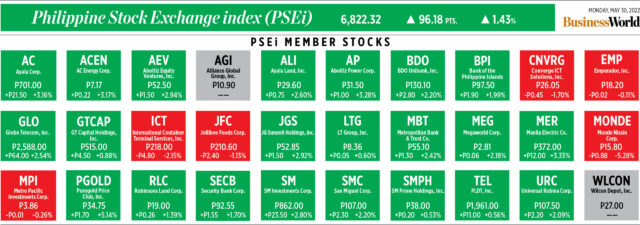
Here’s a quick glance at how PSEi stocks fared on Monday, May 30, 2022.


PHL stocks rise on Wall St. gains, China reopening

STOCKS continued to improve on Monday amid Wall Street’s rebound amid easing economic concerns and with China loosening mobility restrictions.

The benchmark Philippine Stock Exchange index (PSEi) climbed by 96.18 points or 1.43% to close at 6,822.32 on Monday, while the broader all shares index went up by 36.94 points or 1.02% to 3,633.07.

“Local shares opened the week on an upbeat note as share prices rallied for the fourth straight day. The local stock market gained, taking its cue from the sustained rally on Wall Street,” Papa Securities Corp. Equities Strategist Manny P. Cruz said in a Viber message.

“The local bourse rose this Monday as global economic concerns ease. The market took cues from Wall Street’s positive performance last Friday backed by the growth slowdown of the US’ core personal consumption expenditures price index from March’s 5.2% to April’s 4.9%,” Philstocks Financial, Inc. Senior Research Analyst Japhet Louis O. Tantiangco said in a Viber message.

Although Wall Street will be shut for Memorial Day, US futures were trading. S&P 500 e-minis rose 0.9%, having rallied 6.6% last week in their best run so far this year, while Nasdaq e-minis added another 1.3%, Reuters reported.

With the Dow Jones snapping out of its longest weekly losing streak in nearly a century and scoring its best week since 2020 on Friday, the narrative across stock markets has swiftly moved from meltdown fears to hopes of a rebound.

Mr. Tantiangco added that investors also cheered the easing of restrictions in China.

“Positive sentiment was [impacted] by major Chinese cities like Beijing and Shanghai starting to relax pandemic measures as the local case count declined significantly. Major shopping centers in Beijing have announced that they had reopened already last weekend,” Papa Securities’ Mr. Cruz said.

Authorities in China’s commercial hub of Shanghai will cancel many conditions for businesses to resume work from Wednesday, easing a city-wide coronavirus disease 2019 (COVID-19) lockdown, Reuters reported.

At home, the majority of the sectoral indices ended in the green on Monday except for services, which declined by 0.91 point or 0.04% to 1,906.21.

Meanwhile, holding firms advanced by 154.26 points or 2.50% to 6,306.99; mining and oil gained 243.49 points or 2.08% to 11,897.99; financials rose by 31.40 points or 1.95% to 1,638.33; property added 32.91 points or 1.07% to end at 3,093.52; and industrials closed higher by 17.17 points or 0.18% to 9,452.46.

Advancers outnumbered decliners, 114 against 76, while 51 names ended unchanged.

Value turnover increased to P7 billion with 890.17 million shares changing hands from the P5.96 billion with 917.39 million issues seen on Friday.

Net foreign buying dropped to P69.01 million on Monday from the P160.15 million seen the previous trading day. — Luisa Maria Jacinta C. Jocson with Reuters

Peso inches up vs dollar on BSP signals

BW FILE PHOTO

THE PESO inched higher against the dollar on Monday after the Bangko Sentral ng Pilipinas (BSP) chief hinted at another rate increase next month.

The local unit closed at P52.31 per dollar on Monday, moving sideways from its P52.32 finish on Friday, based on data from the Bankers Association of the Philippines.

The peso opened Monday’s session at P52.20 versus the dollar. Its weakest showing was at P52.33, while its intraday best was at P52.16 against the greenback.

Dollars exchanged rose to $1.19 billion on Monday from $1.05 billion on Friday.

“The peso appreciated after the BSP hinted at a potentially stronger rate hike in its upcoming June policy meeting,” a trader said in an e-mail.

The BSP is likely to raise key interest rates by another 25 basis points (bps) at its next policy review on June 23, its chief said last week.

“We are probably inclined to have another 25-basis-point adjustment on our next Monetary Board meeting which is on June 23,” BSP Governor Benjamin E. Diokno said.

The BSP raised benchmark interest rates by 25 bps on May 19, marking its first hike since November 2018, as it tries to temper rising inflationary pressures.

The Monetary Board increased the key policy rate by 25 bps to 2.25%. Interest rates on the overnight deposit and lending facilities were also hiked by 25 bps to 1.75% and 2.75%, respectively.

At that meeting, the central bank upwardly revised its average inflation forecast for 2022 to 4.6% from the previous forecast of 4.3%, exceeding the 2-4% target band. For 2023, the BSP’s inflation forecast was hiked to 3.9% from 3.6% previously.

Inflation climbed to 4.9% in April, the highest in more than three years.

Meanwhile, Rizal Commercial Banking Corp. Chief Economist Michael L. Ricafort said in an e-mail that the peso rose slightly after the market factored in gains in the local stock market.

Stocks continued to improve on Monday amid Wall Street’s rebound amid easing economic concerns and with China loosening mobility restrictions.

The benchmark Philippine Stock Exchange index climbed by 96.18 points or 1.43% to close at 6,822.32 on Monday, while the broader all shares index went up by 36.94 points or 1.02% to 3,633.07.

Mr. Ricafort said lower US yields also reduced demand for the dollar.

The dollar was pinned near five-week lows on hopes of an eventual slowdown in US monetary tightening following sharp interest rate hikes in June and July, Reuters reported.

Investors have seized on hints that the US Federal Reserve, once it has hiked aggressively over the next two months, might then slow its tightening.

The chance of a less hawkish Fed was enough to see Treasuries rebound, with 10-year note yields above a six-week low at 2.743%. That is down from a peak of 3.203% on May 9.

“Peso also slightly stronger after Metro Manila and 62 other areas were placed at the lower at Alert Level 1 from June 1-15, 2022,” Mr. Ricafort added.

The trader said the peso might weaken anew against the dollar on Tuesday due to Federal Reserve Board Governor Christopher J. Waller’s speaking engagement overnight.

The trader and Mr. Ricafort both expect the peso to move within P52.20 to P52.40 versus the dollar on Tuesday. — KBT with Reuters

DTI nominee Pascual to focus on digitalization, tech investment

REUTERS

INCOMING Trade Secretary Alfredo E. Pascual said his focus will be to promote the economy’s  digital transformation, adding that he expects to redirect the effort to attract foreign direct investment (FDI) towards technology industries, particularly data centers.

Mr. Pascual said the digitalization effort will begin with his own future agency, the Department of Trade and Industry (DTI).

“One of my priorities is to promote digital transformation of the DTI and all our functions as well as (the transformation of) micro, small, and medium enterprises (MSMEs) and other enterprises,” Mr. Pascual said in a television interview on Monday.

“Government agencies like DTI that do both regulation and development work will be more efficient and effective (with digitalization),” he added.

Mr. Pascual added: “Bringing in FDI is one of my priorities given that we need the capital to support economic growth and provide jobs. We will try to give priority to investors that are in high-tech industries. There is the growing need for data center(s) in various cases outside, for example, the US. Since we are connected by fiber optic cable to important countries, then we could be a logical location,” Mr. Pascual said.

He said one of the consequences of digitalization is to enhance consumer protection by providing “information on suggested retail prices (SRPs) of practically any commodity. That is the way to approach it. Provide the consumers with the information to serve as the basis for their decision so that there will be no retailer or seller who takes advantage of their lack of knowledge,” he added.

Mr. Pascual said he is also studying on a “recovery package” targeted at MSMEs that have suffered from the coronavirus disease 2019 (COVID-19) pandemic.

“Most of those… are actually in frontline businesses like restaurants, tourism, (and) entertainment. We’ll see whether a recovery package is in order. I have to look closely at the situation before deciding on this. But there are tools that we can use… It’s a matter of matching the need with the right instrument,” Mr. Pascual said.

The current Trade Secretary, Ramon M. Lopez, said in a statement on Monday that the 2022 Strategic Investment Priority Plan (SIPP), which was approved by President Rodrigo R. Duterte on May 24, will spur a revival of industry.

“The approval by the President of the SIPP is opportune, as the country is heading towards economic recovery. This will catalyze industrial development,” Mr. Lopez said in his statement.

“The SIPP serves as an engine toward the national industrial revolution to beef up industries and yield more diversified, complex, and sophisticated products and services,” he added.

Ceferino S. Rodolfo, Trade Undersecretary and Board of Investments (BoI) managing head, said that the SIPP will help the economic recovery continue.  

“The SIPP has an enormous role in our goal of bouncing back from the economic ramifications brought about by the pandemic. The SIPP will sustain the momentum towards economic recovery, as it will urgently create and recover jobs,” Mr. Rodolfo said.

The 2022 SIPP outlines the economic and business activities that will be preferred for investment incentives under Republic Act No. 11534 or the Corporate Recovery and Tax Incentives for Enterprises (CREATE) Act. SIPP takes effect 15 days upon publication in a newspaper of general circulation.

“Particularly, the SIPP adopts the 2020 Investment Priorities Plan (IPP) as Tier I — the base structure for Philippine development; it (identifies) products or services which are not locally produced, for consideration for Tier II; and identifies high technology activities critical to the transformation of the economy and attracting technology investments for Tier III,” the DTI said.  

“The SIPP supersedes the 2020 IPP which served as the transitional SIPP to ensure the continued promotion of investment and processing of qualified projects,” it added.

Under the new SIPP, Tier 1 consists of preferred activities listed by the 2020 IPP, which include all qualified activities related to the COVID-19 pandemic containment effort.

Tier 2 refers to activities that will plug gaps in the industrial value chains such as those related in promoting green ecosystems, develop a dependable health system, attain self-reliance in defense systems, and transform agriculture.

In Tier 3 are activities that will boost the transformation of the economy and use technologies such as automation, smart machines, industrial internet of things (IIOT), cloud computing, cognitive computing, advanced robotics, artificial intelligence, and 3D printing.

“We are truly making it happen in the Philippines, as the SIPP aims to hasten the transformation of the economy into a modern and efficient one with highly-developed infrastructure,” Mr. Rodolfo said. — Revin MIkhael D. Ochave

Dominguez says Nat’l ID, reduction of unbanked among admin’s wins

FINANCE SECRETARY Carlos G. Dominguez III said the widespread adoption of the National Identification (ID) System and the boost this provided to expanding banking services for all are among the government’s top achievements over the past six years.

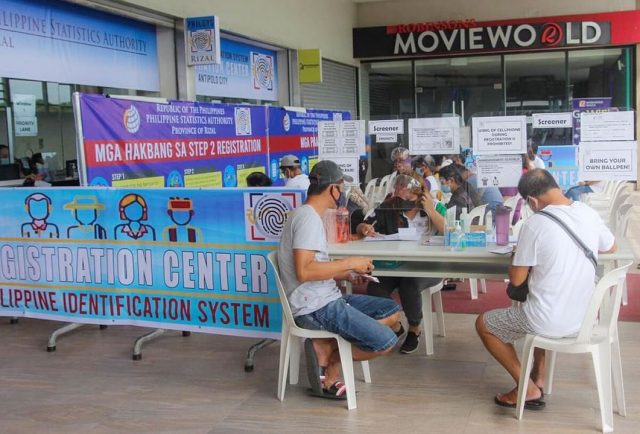
Mr. Dominguez cited data from the National Economic Development Authority (NEDA) indicating that as of May 3, 64.8 million persons have registered for the National ID, while 7.9 million unbanked individuals now had accounts with the Land Bank of the Philippines (LANDBANK).

He added that the National ID system helped people become “part of the formal banking system” because they now possessed a universally-accepted form of ID.

Because of know-your-customer rules to deter money laundering and other financial crimes, banks typically require multiple forms of identification, deterring those who could not produce documents. Minimum maintaining balance requirements have alone proved to be a hurdle for poor would-be depositors.

Over 10 million IDs have been delivered to individuals as of April 30, according to the Philippine Statistics Authority (PSA), or about 33.7% of the PSA’s target for the year.

“In addition, we fulfilled President (Rodrigo R.) Duterte’s promise of establishing a bank dedicated to the needs of Filipinos working abroad,” Mr. Dominguez said at the Duterte Administration’s Legacy Summit on Monday. “The Overseas Filipino Bank is our first branchless digital-only bank in the country. It now serves overseas Filipinos in 116 countries.”

Mr. Dominugez also called the “Build, Build, Build” infrastructure program and the tax reform program as enduring legacies which helped steer the Philippines “towards more inclusive growth and prosperity.”

He called the outgoing government “among the most productive in our history.”

The Tax Reform for Acceleration and Inclusion (TRAIN) law, he said, has had the effect of “basically (giving out) 14th-month pay every year to our wage earners.”

He said the Rice Tariffication Law has removed rice as a major driver of inflation, while giving farmers at least P10 billion each year to fund modernization via mechanization, improved seed, and training.

Mr. Dominguez said that these measures and reforms have set the country on a firm path to recovery, noting the 2021 growth rate of 5.7%, as well as first quarter growth of 8.3%, the highest in the region.

Malaysia, Vietnam, and Indonesia posted growth rates of 5% for the quarter, with Thailand the laggard at 2.2%.

The Philippines was hit hard by the pandemic, causing gross domestic product (DGP) to contract by 9.5% in 2020. The government borrowed extensively from both foreign and domestic lenders in order to finance its pandemic response.

The incoming administration is inheriting debt of about P12.63 trillion, equivalent to a debt-to-GDP ratio of 63.5%.

Subway tunnel boring machine expected to be in place before Duterte leaves

PHILSTAR FILE PHOTO

THE Department of Transportation (DoTr) said Monday that the lowering of the tunnel boring machine to start actual construction of the Japan-funded Metro Manila Subway project will take place in June, before President Rodrigo R. Duterte steps down.

“In the first or second week of June, the Transportation department will perform an activity to convince the people of the Philippines that the subway is real… Ibababa na natin ‘yung (we will lower the) tunnel boring machine,” Transportation Secretary Arthur P. Tugade said during the Duterte Legacy Summit.

“Once we put down the tunnel boring machine, the actual construction will start. In the first or second week of June, we will do a simulation on what to do with the subway,” he added.

The Transportation department signed on May 5 a contract with Tokyu Construction Co., Ltd, Tobishima Corp. and Megawide Construction Corp. (Tokyu-Tobishima-Megawide Joint Venture) for the construction of two underground stations and tunneling works of the Metro Manila Subway Project Phase 1.

According to the Embassy of Japan in the Philippines, the Japan International Cooperation Agency has provided assistance amounting to 104 billion yen in the first tranche and 253 billion yen in the second tranche for the construction of the first phase of the subway project.

“After the Duterte administration, tuloy po ba ang subway? (Will the subway go ahead?) Yes, tuloy na tuloy (yes it will)… The funds are in place, most of the contracts involved have been awarded and in fact have already started, at ‘yung right of way, nasimulan na (work on acquiring the right of way has started),” Mr. Tugade said.

Sana lang pabaunan niyo ng dasal at tulong ang mga darating na administrasyon upang matuloy na itong proyekto na ito (I hope you welcome the new administration with prayers and cooperation so this project goes through),” he added.

Once fully operational, the 17-station subway project will cut travel time between Quezon City and the Ninoy Aquino International Airport to 35 minutes from one hour and 10 minutes currently. It is expected to serve 370,000 passengers per day.

Transportation Undersecretary for Railways Timothy John R. Batan said at a forum in April that the Metro Manila Subway involves 13 contracts, six of which have been awarded. This includes a P26.75-billion contract to supply 240 train cars that was awarded to the joint venture of Japan Transport Engineering Co. and Sumitomo Corp.

The government initially planned to launch partial operations this year and full operations in 2025, but Mr. Tugade has said this is no longer possible due to the limitations imposed by the pandemic.

Partial operation of the subway is now expected in 2025, while full operation is eyed by 2027.

Two out of 25 tunnel boring machines from Japan that will be used for the project arrived in Manila in February.

The project was first proposed and planned in 1973 as part of the Urban Transportation Study in the Manila Metropolitan Area, according to the DoTr. — Arjay L.Balinbin

NCR Feb. retail price growth accelerates to 2.2%

PHILSTAR FILE PHOTO

THE growth in Metro Manila retail goods prices was 2.2% in February, the highest in three months as countries recover from the coronavirus disease 2019 (COVID-19) pandemic and economies reopen.

According to preliminary data from the PSA, growth in the general retail price index (GRPI) accelerated from 1.9% in January and from 1.6% a year earlier.

In November, the GRPI grew 2.3%.

General retail price index in the National Capital Region

In the year to date, retail price growth in the National Capital Region (NCR) averaged 2%, up from 1.5% a year earlier.

China Banking Corp. Chief Economist Domini S. Velasquez said that the elevated price growth was due to the “optimistic global outlook” from the reopening of economies and the decline in Philippine COVID-19 infections.

“In the Philippines, although there was a surge in the Omicron variant in January to around mid-February, mobility was almost reaching pre-pandemic levels and already up from 2021,” she said in a Viber message.

Ms. Velasquez said Russia’s invasion of Ukraine on Feb. 24 has not yet been reflected in the February reading, but she expects the GRPI to trend upwards in the coming months because of the war’s impact on oil and food prices.

The statistics agency attributed February’s uptick to food, the largest component of the basket of goods used to compute the index. Food price growth was 2.1% in February from 1.8% in January.

Other commodities that recorded increases in price growth were mineral fuels, lubricants and related materials (20.5% in February from 18% in January); manufactured goods classified chiefly by materials (1.4% from 1.3%); and miscellaneous manufactured articles (0.5% from 0.4%).

Meanwhile, price growth in beverages and tobacco eased to 2.8% in February from 3.4% the previous month. Price growth in crude materials, inedible, except fuels came in at minus 0.3%, from 0.1% growth in January.

Ms. Velasquez said the disruption of domestic food production could have accounted for the increase in Metro Manila’s GRPI reading in February.

“Hog raisers shied away from repopulating their herds due to the continued presence of ASF (African Swine Fever). February is also part of the closed fishing season (usually from mid-November to mid-March) which could have also pushed up prices for the month,” Ms. Velasquez said.

Second-round effects of high oil prices will lead to higher GRPI in Metro Manila for the rest of the year, she said. In addition, supply chain disruptions due to China’s zero-COVID policy will push up prices of manufactured goods.

“Recent actions of countries banning exports of key commodity items risk driving up the cost of food,” she added. — Bernadette Therese M. Gadon

Canadian chamber pushes for FTA with PHL 

REUTERS

THE Philippines should seek a free trade agreement (FTA) with Canada to keep Philippine trade goods competitive and make it a better destination for foreign direct investment (FDI), Canadian Chamber of Commerce of the Philippines President Julian H. Payne said.

Speaking at the Kapihan sa Manila Hotel Monday, Mr. Payne said: “We need an FTA between Canada and the Philippines. It can be multilateral or bilateral. For the benefit of the Philippines, any would work.”

“If you don’t have an FTA, you face tariffs when you enter Canada that you will not face if you have an FTA. The one that looks most likely is the ASEAN-Canada (agreement). I believe that foreign direct investment serves both parties. I also believe that the Philippines should be investing in Canada,” he added.

On May 5, the Philippine Tariff Commission conducted a public consultation on the proposed Association of Southeast Asian Nations (ASEAN)-Canada FTA (ACANFTA).

According to the Department of Trade and Industry (DTI), Philippine service exports to Canada are set to grow. Canada is a net importer of services from the Philippines.

It added that with ACANFTA, Canada will serve as a gateway for Philippine goods to North America.

ASEAN and Canada announced ACANFTA negotiations in November. A feasibility study conducted in 2018 indicated that the Philippines would grow its gross domestic product (GDP) by 2.63%, equivalent to $7.4 billion, after joining ACANFTA. The trade deal will also boost ASEAN GDP by 1.6% while Canada’s GDP will increase by 0.3% if it signs on to the deal.

Mr. Payne noted that investors are awaiting the implementing rules and regulations (IRRs) of the economic liberalization measures, particularly the amended Foreign Investments Act (FIA) and the Public Service Act (PSA).

“Until you get the IRRs, companies are not going to just jump in. The IRR for the PSA, that’s a very complicated issue, we’re waiting to see how it works. But I think there’s no question that those two acts will increase foreign investment,” Mr. Payne said.

Under the amended PSA, full foreign ownership was allowed for more industries such as telecommunications, airlines, railways, and shipping. These were previously covered by the 40% foreign ownership limit.

The amended FIA allows foreigners to own 100% of small and medium enterprises.  — Revin Mikhael D. Ochave