Home Blog Page 597

Wealthy ancient Roman’s tomb discovered in Albania

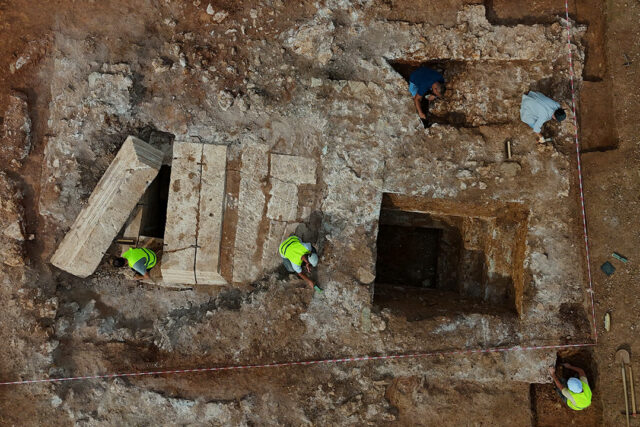
A DRONE view shows archaeologists working on Albania’s first discovered monumental tomb, which they suggest may be a mausoleum, dated to the Roman period III–IV century AD in Strikçan, Albania, Sept. 4. — REUTERS/FLORION GOGA

STRIKÇAN, Albania — Archaeologists in Albania have discovered a large Roman burial chamber dating from the third to fourth century AD, the first of its kind found in the Balkan country that was once part of the Roman Empire.

Tipped off by locals who had noticed some unusual stones on a plateau near the North Macedonia border, staff from the Institute of Archaeology began excavating in early August and found the underground structure whose large limestone slabs were inscribed with Greek lettering.

“The inscription tells us that the person buried here was named Gelliano, a name typical of the Roman period. We are uncertain about the identity of the second individual, but it is likely a family member,” said Erikson Nikolli, the project’s lead archaeologist.

The tomb, which measures nine meters by six meters (29 ft by 19 ft), is the first discovery in Albania of what the experts believe to be a wealthy person’s resting place, grander than other burial sites found in the area.

Local authorities in Albania, where tourism is booming, are already planning to develop the site into a tourist attraction, while residents flocked to the area upon hearing the news of the discovery.

Last week, Mr. Nikolli’s team used brushes to reveal the intricately carved edges of the tomb’s white roof stone and walls.

“We also uncovered a piece of fabric embroidered with gold thread, which confirms our belief that we are dealing with a member of the upper class.”

Other findings include glass plates and knives.

Mr. Nikolli said that the tomb had been looted at least twice — once in antiquity and later when heavy machinery was used to move a massive rock on top of the chamber.

He explained that the occupant’s name was inscribed in Greek letters but carried a Latin meaning, while a second inscription indicates that the tomb was dedicated to the god Jupiter.

Experts have yet to decipher additional inscriptions on stones found nearby, which are believed to have belonged to another monument now surrounded by cornfields and a quarry. — Reuters

Islamic insurance’s growth in PHL may take years as awareness remains low

PHILIPPINE STAR/EDD GUMBAN

PRU LIFE Insurance Corp. of UK Philippines (Pru Life UK) expects takaful or Islamic insurance to start gaining momentum in two to three years as companies take a cautious approach towards what is a relatively new market for most players.

“Actually, overseas, it usually takes two to three years. That’s the standard for not only for takaful but product development,” Pru Life UK Vice-President and Sustainability and Takaful Head Maricel Estavillo said at a media briefing on Tuesday.

“For now, at least for the life sector, we are the first [to offer a takaful product], and there’s a second insurer with a takaful window. And we feel like they’re also on a wait-and-see [stance],” she added.

The Insurance Commission (IC) last year issued takaful operator licenses to Pru Life UK and Etiqa Life and General Assurance Philippines, Inc.

Takaful is a type of Islamic insurance where members contribute a certain sum of money to a common pool to guarantee each other against loss or damage. It needs to be compliant with Shari’ah law, which prohibits riba (interest), al-maisir (gambling), and al-gharar (uncertainty) principles.

Instead of paying premiums, parties in a takaful arrangement agree to contribute to a pool or mutual fund from which claims are paid out of. A contract will specify the risks covered and the length of coverage.

These takaful pools or funds are managed and administered by a takaful operator that charges fees for sales, marketing, underwriting, and claims management.

In June, Pru Life UK launched its takaful product called PruTerm Lindungi.

Ms. Estavillo said they expect a shortfall as claims are likely to exceed the available funds for the product.

“It’s not a risk but it’s a real possibility, especially if you have a product that is very small. In terms of contributions or premium, it’s very small, and the benefit is P100,000. So, it’s really a mass game. You need to onboard a sufficient number of participants,” she said.

“So far, the take-up has been very encouraging, but of course, since this is a very new — not only a new product, but also it’s a new concept, new model as a whole — we need to continue investing in public education and awareness. So, at least for now, we’re focusing on marketing and selling the first product.”

For the first year of the product, the company will focus on educating both the public and its agents on takaful, she said, adding that they currently have almost 300 appointed takaful agents.

Ms. Estavillo cited a study commissioned by the insurer, which found that only 2.5 million out of the 7 million Filipino Muslims in the country can afford financial protection.

She added that there are limited Shari’ah-compliant investment options in the country. “But if you check the guidelines, it doesn’t prohibit a takaful window operator to also invest overseas.”

Pru Life UK booked a premium income of P48.15 billion and net profit of P3.72 billion in 2024, IC data showed. — A.M.C. Sy

The critical infrastructure imperative: Powering growth and resilience

PHILIPPINE STAR/RYAN BALDEMOR

As of last month, the Marcos Jr. administration has identified 207 infrastructure flagship projects (IFPs) under the Build Better More program. These projects, whose cost amounts to P10.433 trillion, are intended to facilitate smoother trade flows, attract long-term investments, and support inclusive national development.

Additionally, 49 of these IFPs have been declared open to public-private partnership (PPP) funding. They are in various sectors such as physical connectivity, housing, power and energy, digital connectivity, health, and water resources.

The IFPs that have been identified are complemented by the Luzon Economic Corridor (LEC), launched in April 2024 during the US-Japan-Philippines Trilateral Summit. The LEC serves as a platform to accelerate industrial development, enhance regional connectivity, and integrate the Philippines more deeply into global supply chains. It also links key growth centers through modern railways, roads, ports, and energy systems. The corridor provides a platform to expand trade, foster innovation, and generate quality jobs for Filipinos.

More importantly, the LEC reflects the government’s vision of positioning the Philippines as a competitive, resilient, and reliable economic partner in the Indo-Pacific region. In August last year, the Department of Economy, Planning and Development listed 21 projects for the LEC, focusing on infrastructure development, modernization projects, and food production.

In an era marked by intensifying geoeconomic confrontation, investment in modern transport systems, energy facilities, digital networks, and climate-resilient structures is not only a development imperative but a national security priority.

Let me cite a few of the commendable initiatives toward these objectives.

Railway projects are truly vital to the government’s objective of enhancing connectivity. Most recently, last June, the Philippines signed an agreement with the US for technical assistance in the construction of the Subic-Clark-Manila-Batangas Railway, a major component of the LEC. The North-South Commuter Railway System is currently being implemented by the government through the Department of Transportation (DoTr), with financial assistance from the Japanese Government and the Asian Development Bank.

Ports are equally essential in advancing the country’s national development agenda since the Philippines is an archipelago. Modernizing and expanding port infrastructure is essential to facilitating the efficient movement of goods, reducing logistics costs, and supporting the country’s integration into regional and global value chains. These include the New Container Terminals 1 and 2, located within the Subic Bay Freeport Zone, as well as the Luzon International Container Terminal, located in Bauan, Batangas, both of which are being managed and developed by the International Container Terminal Services, Inc.

Airports are also part of critical infrastructure as they facilitate trade and tourism, and support economic activity across regions. At present, seven airports have been placed under PPP, while the government plans to have 10 more airports placed under PPP by 2028.

Dams and power generation facilities are other vital components of national infrastructure. They serve key functions in water security, irrigation, flood control, and energy supply. A significant milestone in this area is the completion of the Prime Infrastructure Capital, Inc.-developed Upper Wawa Dam in June, which is expected to make a major contribution to enhancing the country’s water security and supporting the growing needs of Metro Manila and surrounding regions.

Energy security is another paramount concern. The country’s capacity to maximize and diversify its energy resources, particularly indigenous natural gas and renewable energy sources, will be essential to ensuring both the reliability of supply and the affordability of power.

Currently, the Philippines relies on a single indigenous natural gas asset: the Malampaya Deep Water Gas-to-Power Project. Supplying about 20% of Luzon’s electricity demand at present and having powered as much as 40% at its peak, Malampaya fuels the Batangas power generation complex that underpins the LEC, a critical hub of industrial and economic activity. Its ongoing expansion through Phase 4, which involves drilling new wells, is expected to extend the field’s life by seven to 10 years, ensuring a continued supply of reliable indigenous natural gas.

Among renewable energy sources, solar power stands as one of the most abundant and readily available resources in the Philippines. Meanwhile, offshore wind remains untapped, still in the early stages of development. These will be critical pillars of the country’s clean energy transition.

Beyond roads and ports, today’s critical infrastructure also includes fast, reliable digital networks and world-class data centers. These facilities are essential for cloud computing, e-commerce, fintech, and secure government services.

There is also a surge of private and foreign capital flowing into ICT infrastructure nationwide, with the LEC emerging as a focal point. International and local players are jointly financing new facilities and long-haul networks, turning the corridor into a magnet for technology investment.

This week, I was a speaker at the CSIS Manila Strategy Forum, where I talked about 21st Century Infrastructure. Today’s global environment is marked by geoeconomic confrontation, investments in modern transport systems, energy facilities, digital networks, and climate-resilient structures. These are not only imperatives for development — critical infrastructure projects support industrial growth, yes, but these are also a national security priority.

Critical infrastructure, in all its many forms, is the backbone of long-term economic growth as well as national resilience. Achieving our country’s lofty aims will entail close strategic collaboration with the private sector and with international allies. Whatever other issues may come up, the government must not lose focus.


Victor Andres “Dindo” C. Manhit is the president of the Stratbase ADR Institute.

New York Fashion Week opens this week amid fragmented luxury backdrop

ESTABLISHED apparel brands including Coach, Michael Kors, and Calvin Klein will hit the runway alongside emerging labels at the New York Fashion Week (NYFW), which kicks off on Sept. 11.

Yet, the event’s unity is being tested as some of its most influential designers are opting to stage their shows outside the official calendar.

Marc Jacobs, owned by French luxury conglomerate LVMH, presented his Fall 2025 collection back in July at the New York Public Library, while Ralph Lauren will host a private showing at his studio on Sept. 10, ahead of the official start.

Their absence from the core schedule has sparked renewed concerns about the relevance and reach of New York’s biggest fashion event.

“When big anchor designers like that leave, it inevitably means fewer people from out of town are going to make the trip,” Nicole Phelps, global director of Vogue Runway and Vogue Business, said in an interview.

The New York event’s fragmented structure has prompted calls for reform, with critics arguing NYFW lacks the cohesion and prestige of its European counterparts.

In response, fashion platform KFN, created to reform the NYFW, is spearheading a revitalization effort in partnership with the Council of Fashion Designers of America (CFDA).

The initiative aims to expand NYFW’s physical and digital footprint and create more accessible avenues for designers to showcase their work.

One of the most ambitious proposals slated for this season includes a network of 10 venues set within a 15-minute perimeter of each other, offered free of charge for designers. In recent years, NYFW shows have been scattered around the city since the elimination of a central hub for shows.

“You might have bigger venues for big shows, smaller spaces for appointments or presentations, and even shared spaces where designers could pool resources,” said Ms. Phelps. Staging a single runway show can cost up to a million dollars.

One of the biggest changes could be streamlining NYFW into just one season in September, instead of having another one in February, though that has not yet been confirmed by the CFDA, the organizer of the official NYFW schedule.

“I definitely know that some people are agitating for one New York Fashion Week a year and for one New York Fashion Week to be in September. It’s glorious out here. It’s a great time to be here in the city,” said Ms. Phelps, although adding that big labels like Tory Burch and Michael Kors were unlikely to support such a move.

The broader luxury industry is meanwhile grappling with consumers pulling back on discretionary spending, with a wave of executive and creative director changes across major fashion houses adding to the sense of instability.

New York Fashion Week will run through Sept. 16, with over 60 brands debuting new collections. — Reuters

RLC to build green office tower in Davao

ROBINSONS LAND CORP.

ROBINSONS OFFICES, the office development and leasing arm of Robinsons Land Corp. (RLC), is developing a new office building on JP Laurel Street in Davao, with completion slated for early 2027.

“Upon its completion in the first half of 2027, this 9-storey development will showcase a modern and iconic façade, complemented by a premium lobby design that redefines office space standards in the region,” the company said in a stock exchange disclosure on Tuesday.

The new tower will rise on a property acquired from Great Earth Marketing & Development Corporation (GEMDC), which is majority owned by New City Commercial Corp.

The building will feature a sustainable design and have access to a transport system on all nine floors, it said.

The development forms part of RLC’s growing portfolio in Mindanao, which includes eight shopping malls, three GoHotels properties, one Grand Summit Hotel, and two office buildings.

Robinsons Offices reported a 5% increase in its second-quarter revenues to P4.11 billion. It recorded about 50,000 square meters in new office leases during the period, with an occupancy rate of 87%.

Robinsons Offices operates towers in Metro Manila, Bulacan, Ilocos Norte, Pampanga, Bicol, Cebu, and Bacolod.

These mainly serve business process outsourcing firms, as well as local and multinational corporations operating in the Philippines.

RLC shares rose by 2.27% or 34 centavos on Tuesday to close at P15.30 apiece. — Beatriz Marie D. Cruz

Peso weakens as volatility hits markets

BW FILE PHOTO

THE PESO dropped versus the dollar on Tuesday as global markets were hit with volatility due to political concerns in various countries and prospects of a US Federal Reserve rate cut next week.

The local unit closed at P56.98 against the greenback, weakening by 29 centavos from its P56.69 finish on Monday, Bankers Association of the Philippines data showed.

The peso opened Tuesday’s session almost flat at P56.69 versus the dollar. It climbed to as high as P56.66, while its worst showing was at P57 against the greenback.

Dollars traded increased to $1.72 billion on Tuesday from $1.32 billion on Monday.

“The dollar-peso had a corrective bounce during the London session amid political uncertainty in France. The peso tracked the dollar’s strength during the session,” a trader said in a phone interview.

The peso corrected following its over one-month high close on Monday due to political concerns here and abroad and before the release of US inflation reports that could further support a Fed cut next week following the weak jobs data released recently, Rizal Commercial Banking Corp. Chief Economist Michael L. Ricafort said in a Viber message.

For Wednesday, the trader sees the peso moving between P56.80 and P57.20 per dollar, while Mr. Ricafort expects it to range from P56.85 to P57.10.

Overnight, US Treasury yields declined with the dollar on the prospects of lower interest rates and investors around the world grappled with political uncertainty in countries from Japan and Indonesia to France and Argentina.

A heavy election defeat for Argentina President Javier Milei’s ruling party in Buenos Aires province sent the Argentine peso to a record low.

Japanese Prime Minister Shigeru Ishiba resigned on Sunday, ushering in a potentially lengthy period of uncertainty at a shaky moment for the world’s fourth-largest economy, prompting the yen to fall against the dollar.

France’s fourth prime minister in less than two years, Francois Bayrou, lost a confidence vote on Monday, and parliament brought down the government in the euro zone’s second-largest economy over its plans to tame the ballooning national debt, deepening a political crisis.

And in Indonesia, stocks gave up early gains to finish down more than 1%, while the rupiah rose after Finance Minister Sri Mulyani Indrawati was ousted in a cabinet shake-up.

US investors were focused on the prospects for easier monetary policy, however, after Friday’s weaker than expected US labor data for August appeared to seal the case for a Federal Reserve interest rate cut this month. Traders’ expectations of more aggressive Fed easing are gradually increasing. — A.M.C. Sy with Reuters

What the White House doesn’t get about ‘war’

STOCK PHOTO | Image by Nils Huenerfuerst and Edgar Serrano from Unsplash

By Andreas Kluth

I HAVE no problem with renaming the Department of Defense into the Department of War, as Donald Trump is trying to do. (It’s technically not up to the president but to Congress, but the Republicans there will oblige him.) After all, that martial label was good enough from George Washington to Harry Truman. And “war” is more honest and descriptive than the somewhat euphemistic “defense.” As Trump put it, “we want to be offensive too if we have to be.” Even that holds water.

But that’s the end of my concurrence with this cosmetic and ridiculous stunt of showmanship.

Trump likes to rename things — the Gulf of Mexico/America and such — because doing so looks bold while skirting the complexities and nuances of real policy. Naming is part of turning his presidency into reality TV, and it works to the extent that it grabs our attention. But a new shingle (and URL) outside the Pentagon does not solve the fiendish challenges of running the Army, Navy, Marine Corps, Air Force, Coast Guard, and Space Force. Nor does it signal anything, positive or negative, about strategy.

Strategy — the word comes from the Greek strategos, meaning “general” or “commander” — is the domain that Trump and his Secretary of War, Pete Hegseth, should be concerned with but aren’t. The Prussian strategist Carl von Clausewitz famously wrote that war is the continuation by other means of policy — or of politics, the German word politik could mean either. That has often been misinterpreted as a cynical endorsement of warfare. In fact, Clausewitz meant something closer to the opposite: the need to limit war and subordinate it to achieving clearly defined political objectives. This is what Trump and Hegseth don’t get.

When Trump announced the name change, Hegseth, the Fox News personality who is all-in on Trump’s reality-TV shtick, bloviated again that the new label expresses the “warrior ethos” that he and the president are trying to revive after its alleged near-death under “woke” leaders and elites. The Department of War, Hegseth said, is henceforth about “maximum lethality, not tepid legality, violent effect, not politically correct. We’re going to raise up warriors, not just defenders.”

To people who think deeply about war, and know that it is hell, this vacuous bellicosity is hard to bear. Christopher Preble, who runs a “grand strategy” program at the Stimson Center in Washington, thinks that the Trump-Hegseth obsession with lethality “risks a focus on killing for killing’s sake, and comes at the expense of strategic clarity.”

Even and especially when a nation has the most powerful military in world history, its leaders need humility and wisdom in deploying that force. America didn’t lose in Iraq and Afghanistan because it was insufficiently lethal — “because it didn’t kill enough Iraqis and Afghans,” as Preble puts it — but because it lacked a strategy that was well considered, realistic, and attainable.

What is observable during the second Trump administration so far is not the alignment of military and other means to clearly defined ends, but random displays of violence intended to shock and awe audiences foreign and domestic and to keep up the ratings on the reality-TV presidency.

Thus, Trump just ordered a military strike on a skiff in the Caribbean, killing the 11 men on board, who may or may not have been drug smugglers, and whom Trump called “terrorists.” Normally, the Coast Guard would have picked up and dealt with such people. The strike was almost certainly unlawful (notice Hegseth’s disdain for “tepid legality”). But it made for a suspenseful video clip, which Trump of course shared, hinting of more strikes to come.

He and Hegseth seem equally ready to use war — the word and the threat — at home.

The president has already deployed the National Guard in some American cities he considers disloyal, forcing Hegseth’s warriors to take a break from lethality to pick up trash and blow leaves. Chicago could be next and, as Trump posted, is “about to find out why it’s called the Department of WAR.” He illustrated his threat with an AI image of himself à la Apocalypse Now, with Chicago in the background in place of a burning Vietnam.

This is the same president who habitually confuses aggressor and victim in the war between Russia and Ukraine. Who keeps alienating America’s brothers-in-arms, most recently by ending training programs in Lithuania, Latvia, and Estonia, NATO’s front line facing Russia. Who drives a potential ally, India, into the arms of America’s likeliest adversary, China. Who lacks any observable notion of grand strategy — that is, of a plausible plan to Keep America Great and achieve peace through strength.

So go ahead and rename that department. And do prepare for war. But do so with the goal of preventing war, as Harry Truman did when he chose the label “defense” just after witnessing the full genocidal and even nuclear horror of World War II. He and other American leaders of his time had glimpsed hell and wanted to save humanity from it. They hated war far too much to play with the word.

With or without bone spurs, Trump can’t keep impersonating a warrior while calling himself the President of PEACE. And America can’t keep letting him disdain strategy for the sake of show.

BLOOMBERG OPINION

Toronto Film Festival: Russell Crowe and Rami Malek captivate in historical drama Nuremberg

Russell Crowe in a scene from Nuremberg.

TORONTO — Academy Award winners Russell Crowe and Rami Malek captivated their Toronto audience in historical drama Nuremberg, which received a roaring four-minute standing ovation after its world premiere on Sunday.

Director James Vanderbilt’s film chronicles the eponymous war crimes trials of 22 major Nazi figures after the end of World War II.

Mr. Crowe plays the role of infamous German Nazi leader Hermann Göring, while Mr. Malek portrays US Army psychiatrist Douglas Kelley, who is assigned the task of evaluating him and other Nazi captives.

“There have been a lot of World War II movies but there haven’t been a lot of post World War II movies,” Mr. Vanderbilt told Reuters on the red carpet ahead of the premiere at the Toronto International Film Festival.

He said having an all-star cast that also includes Michael Shannon, Richard E. Grant, John Slattery, and Leo Woodall, made working on the project easier, which is based on Jack El-Hai’s 2013 non-fiction book The Nazi and the Psychiatrist.

Göring was a fascinating character to play, Mr. Crowe said, as he dipped into explaining the different stages of the Nazi leader’s life and ambitions, leading into the Nuremberg trials.

“You get to the end of the war, they decide there’s gonna be a trial. And Hermann, he still thinks he can talk his way out of this,” Mr. Crowe said.

Mr. Grant, who dons the role of British lawyer David Maxwell Fyfe, spoke of Mr. Vanderbilt’s exhaustive research on the topic.

“There wasn’t a question that anybody could ask that he didn’t have the answer to,” the English actor said.

The movie will be released in theaters in November. — Reuters

Livingsprings launches first horizontal project outside Metro Manila

Cypress Place Woodland Community

BOUTIQUE DEVELOPER Livingsprings Communities Realty and Development Corp. (LCRDC) has launched its first horizontal residential project Cypress Place Woodland Community, Silang, Cavite, to cater to the growing demand for house-and-lot (H&L) developments in the countryside.

“It’s the first horizontal development and the first outside Metro Manila,” LCRDC Co-founder Monique C. Albert-Lopez told BusinessWorld on the sidelines of a property tour for the media on Tuesday.

LCRDC, which has existing condominium towers in Taguig City and Quezon City, is expected to meet the demand for H&L properties outside Metro Manila, especially among young families, overseas Filipino worker retirees, and those on vacation.

The 5.8-hectare (ha) development, located in Barangay Santol, Silang, Cavite, is about an hour away from the Philippine capital.

“Because we’re right at the foothills of Tagaytay, we decided to make it cabin-themed,” Ms. Albert-Lopez told reporters.

Cypress Place features 304 house and lot (H&L) properties with a modern cabin design. The first set of houses are expected for turnover by 2027.

The lot properties will occupy 4.4 ha, while certain parts of the property will be used for condominium and commercial segments, Ms. Albert-Lopez said.

Cypress Place’s units are priced between P5.5 million and P16 million. These include its premium single cabin, “Irina,” and its attached cabin, “Alaia.”

About 42% of the property will be allotted for open spaces, including tree-lined roads for jogging, strolling, and picnic areas. The roads will be sized between eight to 12 meters.

It will also adopt green technology practices, such as creating green zones, home gardening spaces, and the maximum use of natural light and ventilation.

The development will have key amenities such as a clubhouse, a gym, a pool and lounge, separate men’s and women’s showers, a playground, a basketball court that can be converted to a pickleball court, a driveway and parking, a co-working space, a water feature at the entrance, and a function room.

It also provides 24-hour security, power and water supply, and internet connection from Converge FiberX.

The property is accessible via the Cavite-Laguna Expressway (CALAX East), Cavite-Batangas Expressway, and the Manila-Cavite Expressway link. It is also near key landmarks such as Bonifacio Global City, Alabang Town Center, and Nuvali in Laguna.

“As we expand Livingsprings’ footprint beyond the capital region, every development we envision aims to lower the environmental impact of local properties while enhancing community well-being,” Ms. Albert-Lopez said. — Beatriz Marie D. Cruz

MSMEs told to harness TikTok for growth

STOCK PHOTO | Image by Collabstr from Unsplash

By Edg Adrian A. Eva, Reporter

LAGUNA-BASED cookie brand Drip and Bites wants micro, small and medium enterprises (MSME) to embrace social commerce as a way to scale their businesses, drawing from its own experience of moving from bazaars to a viral TikTok success.

“Social media gave us an even playing ground,” Precious P. Silva, co-founder and president at Drip and Bites, told BusinessWorld via Zoom. “When you’re starting out, the exposure is very limited.”

Founded in 2020 by Ms. Silva and her brother PJ, the business began as a modest venture out of their family kitchen. They sold cookies at local bazaars, earning small but steady returns. At first, sales were small.

“We only sold one or two pieces,” Ms. Silva said. “Eventually, we had this idea that e-commerce is the next frontier — that if you really want to have a business, most likely it’s e-commerce.”

That belief paid off in 2023 when the siblings turned to TikTok Shop. A video review from a customer — later revealed to be an influencer — helped the brand go viral.

“Someone ordered from us — just a random customer. It turns out she was an influencer, and she really loved the product,” Ms. Silva recalled. “When she posted the review, overnight, we were able to gain more than a million views.”

The sudden exposure helped Drip and Bites expand beyond its small-scale operations. It now runs its own production facility, though Ms. Silva admitted the business is still catching up to meet strong demand from TikTok Shop orders.

The experience, she said, shows how social commerce can help MSMEs overcome barriers such as limited capital for physical stores. “Social commerce gave us reach that we wouldn’t have been able to afford otherwise,” she said.

The Department of Trade and Industry (DTI), citing Statista data, said social commerce in the Philippines is steadily growing. Its share of total e-commerce revenue is forecast to climb from 3.6% in 2024 to 4.39% by 2029.

Facebook leads the local social commerce space, with revenue projected at $269.31 million in 2024 and expected to more than double to $559.59 million by 2029, according to DTI. Instagram and TikTok are also expanding, though from a smaller base.

Despite the opportunities, Ms. Silva said online success could be fleeting. Businesses, she said, need more than viral marketing to sustain growth.

“You have to have a product that you really worked on, or a product you’re truly proud of,” she said. “Mimicking trends is okay, but the ones that stand the test of time are those that really worked on their product.”

Drip and Bites is setting ambitious targets for the coming months, aiming to lift its performance by more than 50% during the peak “ber” season. The brand is also preparing to roll out flavors and expand into other food products, with a long-term vision of becoming a food group.

Ishiba’s departure gives Bank of Japan pause for thought on rate hikes

THE JAPANESE national flag is hoisted atop the headquarters of Bank of Japan in Tokyo, Japan Sept. 20, 2023. — REUTERS

TOKYO — The appointment of a new Japanese prime minister next month could give the central bank more reasons to go slow on its next interest rate hike, especially if the next leader is wary of seeing borrowing costs rise too quickly.

While the Bank of Japan’s (BoJ) main concern remains domestic inflation and the economic hit from US tariffs, uncertainty around who becomes next leader or what their policies might be adds a layer of risk to deliberations around monetary settings.

Prime Minister Shigeru Ishiba announced his decision to resign on Sunday after a string of election defeats including a July upper house poll. The focus has now shifted to who will replace him.

Japanese bond yields fell on Tuesday on reports Sanae Takaichi, a proponent of government stimulus and monetary easing, would run in the Liberal Democratic Party’s leadership race in October, which could make her the next prime minister.

“The resignation of Japan’s prime minister Ishiba and the unfolding leadership contest at the ruling LDP will likely deter the Bank of Japan from raising rates in October,” analysts at Evercore ISI wrote in a research note, adding they were pushing back their call for the next hike provisionally to January.

The departure of Ishiba, seen as a fiscal hawk who gave a nod to gradual BoJ rate hikes, pushed down the yen and bond yields as investors reduced bets of a near-term rate hike. Money markets now show about a 20% chance the BoJ will hike rates by the end of October, down from 46% odds a week ago.

The LDP will choose his successor in a vote on Oct. 4, who will then seek parliament approval to become head of government. A new administration may not be formed until mid-October, creating an uneasy political vacuum ahead of the BoJ’s policy meeting on Oct. 29-30.

While the wider political uncertainty won’t derail the BoJ’s plan to continue raising rates gradually, it could affect the timing of the next hike, said three sources familiar with its thinking.

“The BoJ doesn’t need to hike in the midst of turbulence,” one of the sources said. “It is in no rush and has a free hand on the timing, as long as it gets another rate hike done possibly by early next year.”

“The key is whether the hit from US tariffs on Japan’s economy would be within expectations, rather than what happens with politics,” another source said on the rate-hike timing.

FISCAL COMPLICATIONS
Who wins the race will also have a significant impact on the pace and timing of BoJ rate hikes, analysts say.

Conservative lawmaker Ms. Takaichi is one of the frontrunners and previously a strong advocate of “Abenomics”-style mix of fiscal and monetary stimulus of deceased premier Shinzo Abe. She stands out for her criticism of the BoJ’s rate hikes.

Another contender is Shinjiro Koizumi, a proponent of deregulation whose views on monetary policy are little known. Both were top candidates in the LDP leadership race in September 2024 with Ms. Takaichi winning the most votes in the first round, only to be defeated by Mr. Ishiba in the run-up.

There is uncertainty on whether Ms. Takaichi will do as well this time, with some of her political backers having lost their jobs or clout due to a scandal that hit the former Abe faction.

Even if she wins, Ms. Takaichi may need to water down calls for ultra-low rates with rising inflation, rather than the risk of deflation, now a bigger problem for the public, analysts say.

“Support for reflationist-minded lawmakers has shrunk within the LDP. As such, Ms. Takaichi will need to restrain her calls for reflationist policies to some extent to win broad support within the party,” said BNP Paribas chief Japan economist Ryutaro Kono.

Whoever ends up winning the leadership race would ultimately run a minority coalition and need support from opposition parties to pass the budget through parliament.

Small opposition parties seen as candidates for forming an alliance are against an early BoJ rate hike, or have called on the central bank to tread carefully in rolling back stimulus.

While politics may create hurdles for a near-term rate hike, growing calls from most candidates and opposition parties for bigger spending could require the BoJ to lift rates over the longer-term to tame inflationary pressures.

The worst-case scenario for policymakers would be a sustained, sharp rise in bond yields triggered by investors’ concern over Japan’s loss of fiscal discipline.

In such an event, the government may pressure the BoJ to halt its quantitative tightening (QT) plan and step into the market with emergency bond purchases, some analysts say.

Such a move would be a major setback in the BoJ’s efforts, which began last year, to gradually taper its huge bond buying.

All this would give the BoJ reason to sit on the sidelines until the political dust settles. But waiting too long also carries risks.

Inflation has held above the BoJ’s 2% target for three years, and price pressures have broadened beyond stubbornly high food costs as a tight labor market pushes up wages.

“The BoJ must be cautious. But it also understands that waiting too long is not without risk,” a third source said. — Reuters

SEC ZERO: Revolutionizing Philippine company registration

STOCK PHOTO | Image by DC Studio from Freepik

In line with Republic Act No. 11032 or the Ease of Doing Business and Efficient Government Service Delivery Act of 2018, the Securities and Exchange Commission (SEC) took another bold step in digital transformation with the launch of the SEC Zuper Easy Registration Online (SEC ZERO) on July 17, 2024, which was subsequently made mandatory under SEC Memorandum Circular No. 3, Series of 2025.

This initiative makes company registration in the Philippines completely paperless, digital, and available 24/7. SEC ZERO is a game-changer in ease of doing business as it modernizes one of the most fundamental processes in corporate law.

SCOPE, FEATURES, PROCESS
SEC ZERO currently applies to all corporations, including domestic corporations, foreign corporations, and One Person Corporations. Other company types like financing and lending companies are currently covered under regular processing for incorporation but are expected to transition fully soon.

The core features of SEC ZERO include the use of an Electronic SEC Universal Registration Environment (eSECURE) account for all signatories and the online authentication of signatures through the SEC Electronic Submission Authentication Portal (eSAP). The incorporation process starts with each signatory creating a verified eSECURE account, then paying the verification fee online, submitting two government-issued IDs, and completing a live photo capture using the in-app camera.

Once the accounts are set up, the applicant inputs the eSECURE IDs of all signatories into the application form within the SEC’s Electronic Simplified Processing of Application for Registration of Company (eSPARC) platform. The system then generates draft documents such as the Articles of Incorporation, By-Laws, and Certificate of Authentication. After an initial review, the SEC issues its pre-approval and instructs the signatories to individually authenticate their signatures on the drafts electronically via eSAP.

Following successful authentication, the applicant proceeds to pay the filing fees. Once the application passes post-audit, the SEC issues a digitally authenticated Certificate of Incorporation, which holds the same legal validity as a traditional hard-copy certificate.

BENEFITS
The shift to SEC ZERO offers several benefits that improve the ease of doing business. Entrepreneurs can register companies anytime and anywhere, removing the need for in-person visits to SEC offices and cutting down the long queues often associated with traditional registration. This is particularly beneficial to foreign applicants since they need not personally appear or place their wet signatures on documents, plus it does away with the tedious and costly process of authenticating the documents executed abroad.

Processing times are shortened, as the elimination of notarization, courier services, and physical submissions streamlines the entire workflow. Applicants are no longer required to prepare their own Articles of Incorporation and By-Laws, as SEC ZERO automatically generates draft versions. This not only reduces the need for legal or professional assistance in the initial stages, but also ensures that the drafts follow SEC-prescribed formats, minimizing errors and expediting the approval process.

The integration of identity verification through eSECURE and document authentication via eSAP likewise adds a layer of security, helping reduce the risk of fraud and falsification. Taken together, these gains highlight SEC ZERO’s potential not only to modernize registration but also to foster a more dynamic business climate in the Philippines.

ISSUES
Although SEC ZERO marks a significant step forward, certain challenges persist.

Digital inclusion remains a pressing issue, as applicants in remote areas may struggle with limited internet access or lack of digital resources.

Those accustomed to traditional methods may also face a learning curve in adapting to the new system. The system poses difficulties for less tech-savvy individuals, who may encounter problems such as incorrect verification codes, mismatched information, invalid government IDs, or exceeding the three-attempt limit during the verification process.

For instance, some applicants encounter issues when the names on their government-issued IDs do not exactly match the details in their eSECURE accounts. Even if the ID itself is valid, the system may reject it due to discrepancies such as the use of a maiden name, middle initial variations, or differences in suffixes. These mismatches, though minor, can prevent successful verification and delay the registration process.

Another challenge is that applicants may not always possess the two valid government-issued IDs required by eSECURE for verification, making it difficult for some individuals, especially those with limited identification documents, to complete the process.

Finally, system reliability and cybersecurity risks also demand careful oversight, especially as personal data is increasingly digitized.

MILESTONE
SEC ZERO marks a milestone in Philippine corporate law, ushering in a fully digital era for company registration. By streamlining incorporation processes, the SEC positions the Philippines closer to global best practices in ease of doing business. While challenges in access must be addressed, the benefits of SEC ZERO point to a future where incorporation is not just faster but smarter, safer, and more inclusive.


Sabrina Marie E. De Guia is an associate of ACCRALAW’s Corporate and Special Projects Department.

sedeguia@accralaw.com

8830-8000