Home Blog Page 596

Hong Kong braces for Super Typhoon Ragasa; schools, businesses shut

A taped store window stands in preparation for Typhoon Ragasa, with the International Finance Centre in the background, in Hong Kong, China, September 22, 2025. REUTERS/TYRONE SIU

HONG KONG – Hong Kong braced for Super Typhoon Ragasa on Tuesday, the world’s most powerful tropical typhoon this year, shutting schools and some businesses, while most passenger flights were scheduled to be suspended later in the day until early Thursday.

Ragasa, packing hurricane-force winds of up to 220km/h (137 mph), is edging closer to the coast of neighbouring southern Guangdong province in China, the Hong Kong Observatory said.

Authorities in the financial hub are set to raise the typhoon signal to 8, its third highest, by 2.20 p.m. (0620 GMT), which will prompt most businesses and transport services to shut down. About 700 flights have been disrupted.

The observatory said it will assess if it needs to issue a higher warning late on Tuesday or early Wednesday.

Ragasa swept through the northern Philippines on Monday, prompting President Ferdinand Marcos Jr to order the country’s disaster response agency to go on full alert and mobilise all government agencies.

The Hong Kong Observatory said hurricane-force winds offshore and on high ground were likely in Hong Kong on Wednesday, with heavy rain expected to lead to a significant storm and sea surge in the densely packed city.

It warned of rising sea levels, which it said would be similar to those seen during Typhoon Hato in 2017 and Typhoon Mangkhut in 2018, both of which caused billions of dollars in damage.

Water levels will rise about two metres (six feet) along Hong Kong’s coastal areas and maximum water levels could reach up to 4-5 metres (12-15 feet) in some areas, the observatory said, urging residents to take appropriate precautions.

Local authorities handed out sandbags on Monday for residents to bolster their homes in low-lying areas, while many people stockpiled daily necessities.

Long queues formed at supermarkets; milk and meat sold out and vegetable prices at fresh-produce markets tripled, according to Reuters witnesses on Monday.

Hong Kong’s Stock Exchange will remain open. It changed its policy late last year to continue trading whatever the weather.Chinese authorities have activated flood control measures in several southern provinces, warning of heavy rain from late on Tuesday.

Residents in the world’s largest gambling hub of Macau are also bracing for significant impact, with school closures and evacuation plans under way.

In China’s technology hub Shenzhen, authorities said they have prepared more than 800 emergency shelters.

Taiwan’s government has evacuated more than 7,600 people from mountainous southern and eastern areas, while transport disruption continued for a second day on Tuesday with 273 flights cancelled and some rail services suspended. — Reuters

World leaders rally behind Palestinian statehood at UN, defying US and Israel

A PALESTINIAN flag flies during a protest in front of the Gare du Nord railway station in Paris as part of a day of nationwide strikes and protests against the government and cuts in the next budget, with supporters of the “Bloquons Tout” (Let’s Block Everything) movement, France, Sept. 18. — REUTERS/BENOIT TESSIER

UNITED NATIONS – Dozens of world leaders gathered at the United Nations on Monday to embrace a Palestinian state, a landmark diplomatic shift nearly two years into the Gaza war that faces fierce resistance from Israel and its close ally the United States.

President Emmanuel Macron announced that France would recognize Palestine statehood at a meeting he convened with Saudi Arabia – a milestone that could boost Palestinian morale but appeared unlikely to change much on the ground.

The most far-right government in Israel’s history has declared there will be no Palestinian state as it pushes on with its fight against militant group Hamas in Gaza following the October 7, 2023, attack on Israel that killed some 1,200 people.

Israel has drawn global condemnation over its military conduct in Gaza, where more than 65,000 Palestinians have been killed, according to local health authorities. In recent weeks, Israel has begun a long-threatened ground assault on Gaza City with few prospects for a ceasefire.

“We must pave the way for peace,” Macron said at the start of the session at the United Nations in New York.

“We must do everything within our power to preserve the very possibility of a two-state solution, Israel and Palestine living side by side in peace and security,” he said before announcing the diplomatic move drawing lengthy applause from the audience.

Israel has said such moves will undermine the prospects of a peaceful end to the conflict.

Turkish President Tayyip Erdogan, Canadian Prime Minister Mark Carney and United Nations Secretary-General Antonio Guterres were among those who also spoke during the event.

Spanish Prime Minister Pedro Sanchez, whose leftist government recognized the state of Palestine in 2024, told Reuters in an interview on Monday that the recent recognition moves were very important.

“You have two countries from the Security Council, the UK and France, recognizing the state of Palestine, and second, within the Western society… there’s a large majority nowadays of countries that already recognize (the) Palestine state,” he said.

Macron outlined a framework for a renewed Palestinian Authority under which France would open an embassy subject to factors such as reforms, a ceasefire and the release of all remaining hostages taken from Israel and held by Hamas in Gaza.

Ahead of this week’s UN General Assembly, Luxembourg, Malta, Belgium and Monaco on Monday also joined the more than three-quarters of the 193 UN members who already recognize a Palestinian state.

Macron’s July pledge on recognition set the latest push in motion, with Britain, Canada and Australia later saying they would follow, and eventually doing so on Sunday.

“We call on those who have not yet done so to follow suit,” Palestinian President Mahmoud Abbas said via video link, as he was unable to attend the milestone events after being refused a US visa.

“We call for your support so that Palestine becomes a full-fledged member of the United Nations,” he added, promising reforms and elections within a year of a ceasefire.

A delegation representing the State of Palestine has observer status at the United Nations – but no voting rights. No matter how many countries recognize Palestinian independence, full UN membership would require approval by the Security Council, where the US has a veto.

The two-state solution was the bedrock of the US-backed peace process ushered in by the 1993 Oslo Accords. The process suffered heavy pushback from both sides and has all but died.

No such negotiations over a two-state solution have been held since 2014.

The United States and Israel boycotted Monday’s meeting. Israel’s UN Ambassador Danny Danon said Israel would discuss how to respond to the announcements of recognition after Prime Minister Benjamin Netanyahu returns to Israel next week.

“Those issues were supposed to be negotiated between Israel and the Palestinians in the future,” Danon told reporters ahead of the meeting. Netanyahu is scheduled to meet US President Donald Trump on September 29 in Washington before returning to Israel.

Netanyahu has rejected numerous calls to end the campaign until Hamas is destroyed and has said he will not recognize a Palestinian state.

The United States has told other countries that Palestinian recognition will create more problems.

Amid Israel’s intensified Gaza offensive and escalating violence by Israeli settlers in the West Bank, there is a growing sense of urgency among some nations to act now before the idea of a two-state solution vanishes forever.

EUROPEAN DIVISIONS AND ISRAELI RESPONSE
While the majority of European countries now recognize a Palestinian state, two of the continent’s largest economies, Germany and Italy, have signaled they are unlikely to make such a move soon.

Germany — long a strong supporter of Israel because of its responsibility for the Holocaust — has grown more critical of Israeli policy, while insisting that recognition of a Palestinian state should come at the end of a political process to agree on a two-state solution.

A German government spokesperson also said on Monday there must be no further annexations in Israeli-occupied territory.

Italy said recognizing a Palestinian state could be “counterproductive.”

Israel is considering annexing part of the occupied West Bank as a possible response as well as specific bilateral measures against Paris, Israeli officials have said, even though the recognitions are expected to be largely symbolic.

Annexation could backfire and alienate such countries as the United Arab Emirates, a global oil power and trade hub with wide diplomatic clout across the Middle East.

The United Arab Emirates, the most prominent of the Arab states that normalized ties with Israel under the US-brokered Abraham Accords in 2020, has said such a move would undermine the spirit of the agreement.

The USUS has warned of possible consequences for those who take measures against Israel, including France as host of the summit. — Reuters

Nvidia to invest up to $100 billion in OpenAI, linking two artificial intelligence titans

FILE PHOTO: The logo of technology company Nvidia is seen at its headquarters in Santa Clara, California February 11, 2015. REUTERS/Robert Galbraith/File Photo

Nvidia will invest up to $100 billion in OpenAI and supply it with data center chips, the companies said on Monday, marking a tie-up between two of the highest-profile players in the global artificial intelligence race.

The move underscores the increasingly overlapping interests of the various tech giants developing advanced AI systems. The deal gives chipmaker Nvidia a financial stake in the world’s most prominent AI company, which is already an important customer.

At the same time, the investment gives OpenAI the cash and access it needs to buy advanced chips that are key to maintaining its dominance in an increasingly competitive landscape. Rivals of both companies may be concerned the partnership will undermine competition.

The deal will involve two separate but intertwined transactions, according to a person close to OpenAI. Nvidia will start investing in OpenAI for non-voting shares once the deal is finalized, then OpenAI can use the cash to buy Nvidia’s chips, the person said.

“Everything starts with compute,” OpenAI CEO Sam Altman said in a statement. “Compute infrastructure will be the basis for the economy of the future, and we will utilize what we’re building with Nvidia to both create new AI breakthroughs and empower people and businesses with them at scale.”

The two companies signed a letter of intent to deploy at least 10 gigawatts of Nvidia systems for OpenAI and said they aim to finalize partnership details in the coming weeks. The power for those chips is equivalent to the needs of more than 8 million U.S. households.

Nvidia shares rose as much as 4.4% after the announcement to a record intraday high, while data center builder Oracle gained about 6%. Oracle is working with OpenAI, SoftBank and Microsoft on a $500 billion project called Stargate, a plan to build massive AI data centers around the world.

Under the new deal, once the two sides reach a definitive agreement for OpenAI to purchase Nvidia systems, Nvidia will invest an initial $10 billion, the person familiar with the matter said. OpenAI was most recently valued at $500 billion.

Nvidia will start delivering hardware as soon as late 2026, with the first gigawatt of computing power to be deployed in the second half of that year on its upcoming platform, named Vera Rubin.

Analysts said the deal was positive for Nvidia but also voiced concerns about whether some of Nvidia’s investment dollars might be coming back to it in the form of chip purchases.

“On the one hand this helps OpenAI deliver on what are some very aspirational goals for compute infrastructure, and helps Nvidia ensure that that stuff gets built. On the other hand the ‘circular’ concerns have been raised in the past, and this will fuel them further,” said Bernstein analyst Stacy Rasgon.

OpenAI, like Google, Amazon and others, has been working on plans to build its own AI chips, aiming for a cheaper alternative to Nvidia. A person familiar with the matter said the deal does not change any of OpenAI’s ongoing compute plans, including that effort or its partnership with Microsoft.

OpenAI was working on a custom chip with designer Broadcom AVGO.O and Taiwan Semiconductor Manufacturing Co 2330.TW, Reuters reported earlier this year. Broadcom shares were down 0.8% after the news.

BROADER INDUSTRY MOVES
The pact is the latest in a series of agreements between major technology players.
Microsoft has invested billions in OpenAI since 2019, and Nvidia last week unveiled a collaboration with Intel on AI chips. Nvidia also committed $5 billion to Intel earlier this month and backed OpenAI in a $6.6 billion funding round in October 2024.

The scale of Nvidia’s latest commitment could attract antitrust scrutiny. The Justice Department and Federal Trade Commission reached a deal in mid-2024 that cleared the way for potential probes into the roles of Microsoft, OpenAI and Nvidia in the AI industry. However, the administration of U.S. President Donald Trump has so far taken a lighter approach to competition issues than the previous Biden administration.

OpenAI and its main backer Microsoft also announced earlier this month that they had signed a non-binding agreement to restructure OpenAI into a for-profit entity, signaling further changes in the governance of the fast-growing AI company.

“The deal could change the economic incentives of Nvidia and OpenAI as it could potentially lock in Nvidia’s chip monopoly with OpenAI’s software lead. It could potentially make it more difficult for Nvidia competitors like AMD in chips or OpenAI’s competitors in models to scale,” said Andre Barlow, an antitrust lawyer with Doyle, Barlow & Mazard.

He added that the Trump administration has taken a pro-business approach to regulations, removing hurdles that would slow AI growth. — Reuters

DHSUD, SHDA lead call to recalibrate housing strategies at the 33rd National Developers Convention

As the Philippines marks National Shelter Month this October, housing developers, policy makers, and industry leaders are set to gather on October 9-10, 2025, at the Rizal Ballroom, Makati Shangri-La, Manila, Makati City, Metro Manila for the 33rd National Developers Convention to recalibrate strategies for delivering affordable, inclusive, and sustainable homes for Filipino families.

Organized by the Subdivision and Housing Developers Association, Inc. (SHDA) in partnership with the Department of Human Settlements and Urban Development (DHSUD), the event carries the theme “ReCalibrate: Upgrading Housing Strategies for a Better Tomorrow.” The event will spotlight urgent housing challenges and sector commitments, including SHDA’s pledge to deliver part of the 250,000 housing units committed by private developers in support of the government’s Pambansang Pabahay Para sa Pilipino Program (4PH). This contribution forms part of the administration’s target of building one million housing units annually.

“By working hand in hand with the DHSUD, we aim to align the industry’s efforts with the government’s housing priorities, especially in expanding affordable housing and building sustainable communities,” said SHDA National Chairman, Ar. Leonardo Dayao, Jr. “This convention is not only a celebration of National Shelter Month but also a call to action for all stakeholders to shape a better housing future for Filipinos.”

The gathering is expected to draw around 200 stakeholders, including top developers, policy makers, investors, and allied partners. Keynote speeches and panel discussions will cover innovative financing models, resilient and sustainable housing design, digital transformation in real estate, and regulatory reforms to accelerate the 4PH rollout.

“This convention is a testament to the strength of collaboration between the public and private sectors,” said SHDA National President, Engr. Francis Richmond Villegas. “Our shared goal is not just to build houses, but to build communities that uplift the lives of Filipino families.”

Through the National Developers Convention, the SHDA reaffirms its role as the unified voice of the housing industry, bridging public and private sector efforts for inclusive growth, innovation, and long-term sustainability.


Spotlight is BusinessWorld’s sponsored section that allows advertisers to amplify their brand and connect with BusinessWorld’s audience by publishing their stories on the BusinessWorld Web site. For more information, send an email to online@bworldonline.com.

Join us on Viber at https://bit.ly/3hv6bLA to get more updates and subscribe to BusinessWorld’s titles and get exclusive content through www.bworld-x.com.

Palace, LGUs halt classes, work as Nando batters Luzon

PAGASA.DOST.GOV.PH

By Edg Adrian A. Eva, Reporter

Malacañang and several local governments across Luzon suspended classes and government work on Tuesday as Super Typhoon Ragasa, locally named Nando, unleashed torrential rains and destructive winds.

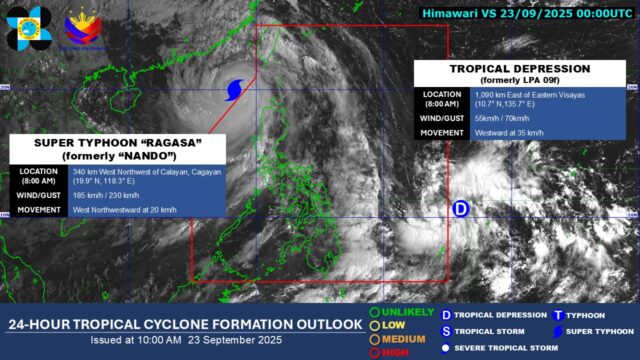
Nando had left the Philippine area of responsibility just as a low-pressure area outside it has developed into a tropical depression, the state weather bureau said in a Facebook post on Tuesday morning.

The presidential palace said classes at all levels and work in government offices were suspended in Ilocos Norte and Ilocos Sur, while class suspensions were declared in Abra, Apayao, Batanes, Benguet, Cagayan and La Union.

Local governments in Metro Manila also suspended classes at all levels as early as Monday covering Caloocan, Las Piñas, Makati, Malabon, Mandaluyong, Manila, Marikina, Muntinlupa, Navotas, Parañaque, Pasay, Pasig, Pateros, Quezon, San Juan, Taguig and Valenzuela.

In Northern Luzon, classes at all levels were called off in Ilocos Norte, Ilocos Sur, La Union and parts of Pangasinan. Batanes, Cagayan and Isabela.

Class suspensions extended to major Calabarzon areas including Cavite, parts of Batangas, Laguna and Rizal, affecting key cities such as Antipolo, Calaca, and Lipa.

In Central Luzon, suspensions were declared in Bataan, several areas in Bulacan, Pampanga, Tarlac, Zambales, and Nueva Ecija. In the Cordillera Administrative Region, Abra, Apayao, Benguet and Mountain Province also canceled classes.

The Philippine Atmospheric, Geophysical and Astronomical Services Administration (PAGASA) said Nando’s center was spotted 340 kilometers west-northwest of Calayan, Cagayan province and was moving west at 20 kph with sustained winds of 185 kph near the center and gusts of up to 230 kph.

Despite its exit, Ragasa was still expected to bring storm-to-gale-force winds across Northern Luzon, while enhancing the southwest monsoon that will bring heavy to torrential rains over the western sections of the country.

The Department of the Interior and Local Government (DILG) said 24,788 people from 7,922 families had been evacuated across Northern and Central Luzon as of Tuesday morning.

Cebuana Lhuillier wins 10 Gold Globee Golden Bridge Awards, setting the standard for excellence in microfinance

Cebuana Lhuillier, the country’s leading microfinance services provider, has once again placed the Philippines on the global stage by winning an extraordinary 10 Gold Globee® Awards at the prestigious 2025 Globee® Awards for Innovation, also known as Golden Bridge Awards. The recognition highlights the company’s role as a pioneer in financial inclusion, innovation, and community empowerment.

Reflecting on the milestone, Jean Henri Lhuillier, President and CEO of Cebuana Lhuillier, shared: “To bring home 10 Gold Globee Awards for Innovation in one sweep is nothing short of extraordinary. These awards are proof that our drive for innovation, our commitment to financial inclusion, and our relentless pursuit of excellence are second to none. Cebuana Lhuillier isn’t just participating in global conversations — we’re leading them, and we intend to keep raising the bar for what Filipino companies can achieve.”

This year, Cebuana Lhuillier received Gold distinctions spanning leadership, corporate excellence, and social impact. Jean Henri Lhuillier personally secured three of the highest honors — Executive Achievement of the Year, Lifetime Achievement Award, and Maverick of the Year — underscoring his reputation as a visionary leader.

The company’s strength was also recognized across corporate categories, earning Gold for Achievement in Finance, marking a back-to-back win, along with Company of the Year | Diversified Services, and Company of the Year | Financial. In addition, Mike Sena, Cebuana Lhuillier’s First Vice-President and Chief Marketing and Communications Officer, was once again named Marketing Executive of the Year.

On the community front, Cebuana Lhuillier’s pioneering programs earned top recognition. Money Guro, a financial education video series featuring Jean Henri Lhuillier sharing practical guidance on budgeting, saving, investing, managing debt, and building wealth, secured Gold for Corporate Social Responsibility Program of the Year (Asia-Pacific) and Excellence in Content Marketing. Meanwhile, Iponventure, a program that promotes early savings among Filipino youth, was awarded Gold for Best Corporate Social Responsibility (CSR) Initiative.

With 10 Gold Globee® Awards for Innovation to its name, Cebuana Lhuillier has not only raised the flag for Filipino excellence but also reaffirmed its mission: to make financial tools and opportunities accessible to all. This clean sweep is more than a collection of awards — it is proof of Cebuana Lhuillier’s enduring leadership in building a more financially inclusive future.


Spotlight is BusinessWorld’s sponsored section that allows advertisers to amplify their brand and connect with BusinessWorld’s audience by publishing their stories on the BusinessWorld Web site. For more information, send an email to online@bworldonline.com.

Join us on Viber at https://bit.ly/3hv6bLA to get more updates and subscribe to BusinessWorld’s titles and get exclusive content through www.bworld-x.com.

Top diplomats from US, South Korea, Japan voice concern on Taiwan Strait

https://bit.ly/3M35ndK

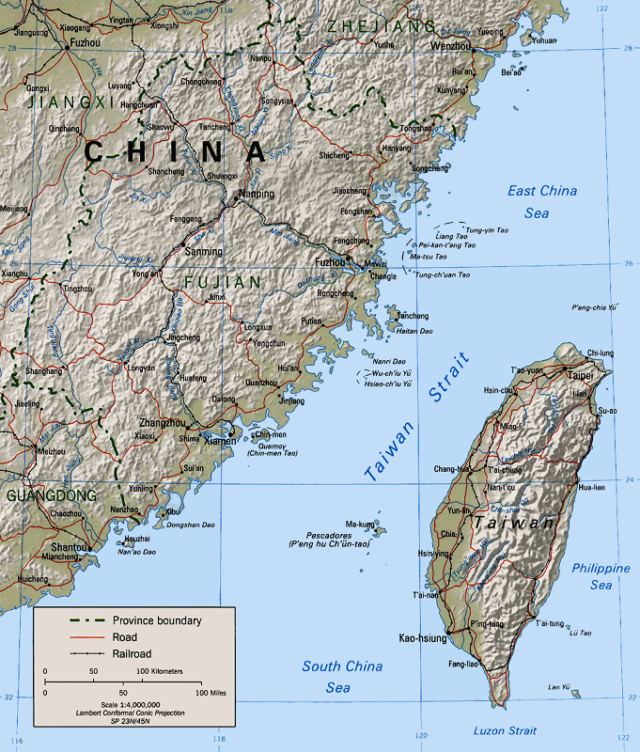
SEOUL – The foreign ministers of South Korea, Japan and the United States expressed concern about increasingly frequent destabilizing activities around Taiwan in a joint statement issued after their meeting on Monday.

The three also expressed strong opposition to “unlawful maritime claims” in the South China Sea and attempts to enforce such claims, the statement said.

The statement did not specifically mention China, but comes amid simmering tension between Beijing and Washington and its allies over the disputed South China Sea.

China claims almost the entire South China Sea, overlapping the exclusive economic zones of Brunei, Indonesia, Malaysia, the Philippines and Vietnam. Unresolved disputes have festered for years over ownership of various islands and features.

U.S. Secretary of State Marco Rubio, South Korean Foreign Minister Cho Hyun and Japanese Foreign Minister Iwaya Takeshi met in New York and also discussed the three countries’ continued commitment to ending North Korea’s nuclear program, their joint statement said. — Reuters

Philippines’ Duterte faces three counts of murder before ICC

PCOO.GOV.PH

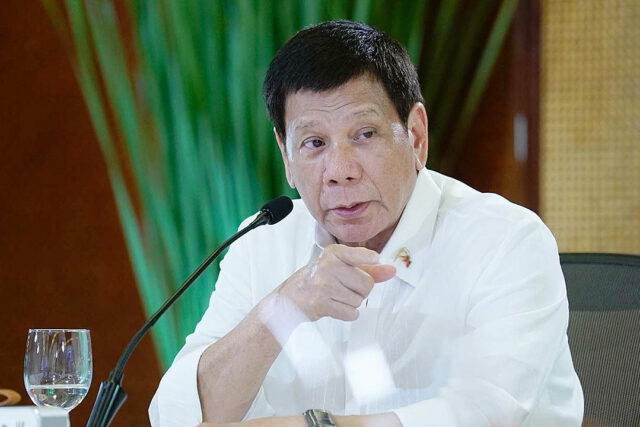
Former Philippine leader Rodrigo Duterte has been charged by International Criminal Court prosecutors with three counts of murder for the killings of alleged drug suspects while he was mayor and president.

“Duterte and his co-perpetrators shared a common plan or agreement to ‘neutralise’ alleged criminals in the Philippines (including those perceived or alleged to be associated with drug use, sale or production) through violent crimes including murder,” read the prosecution’s July 4 filing, which was made public only on Monday.

The prosecution also accused Mr. Duterte as an indirect co-perpetrator, and of ordering and aiding the commission of the crimes. The former president has repeatedly denied having a hand in the killings.

Mr. Duterte is currently detained in the ICC after President Ferdinand Marcos Jr.’s government allowed the ex-leader’s arrest as their ties frayed. The ICC early this month postponed a hearing on the confirmation of charges against Duterte to determine whether he is well enough to stand trial. — Bloomberg

Trump links autism to Tylenol and vaccines, claims not backed by science

WASHINGTON – US President Donald Trump on Monday linked autism to childhood vaccines and also to the use of popular pain medication Tylenol for pregnant women and children, claims which are not backed by decades of science.

In an extraordinary news conference at the White House, the Republican president delivered medical advice to pregnant women and parents of young children, repeatedly telling them not to use or administer the over-the-counter pain killer.

The advice from Trump, who has no medical training and also pointed out “I’m not a doctor,” goes against that of medical societies, which cite data from numerous studies showing acetaminophen plays a safe role in the well-being of pregnant women.

“I want to say it like it is, don’t take Tylenol. Don’t take it,” Trump said. “Fight like hell not to take it. There may be a point where you have to, and that you’ll have to work out with yourself, so don’t take Tylenol.”

Standing next to Health Secretary Robert F. Kennedy Jr., a vaccine critic who has argued that no vaccine is safe, Trump called for a reexamination of a link between vaccines and autism, a theory that has been repeatedly debunked, and a series of changes not grounded in science.

“We believe independent, sound science clearly shows that taking acetaminophen does not cause autism. We strongly disagree with any suggestion otherwise and are deeply concerned with the health risk this poses for expecting mothers,” Kenvue, the maker of Tylenol, said in a statement ahead of the announcement.

Shares of KenvueUS slid more than 7% during Monday’s stock market session as investors braced for Trump’s announcement. But the shares recovered 5% in extended trade.

Trump said he is a big believer in vaccines, having led in his first-term the pandemic initiative to speed COVID-19 vaccine development. Still, he called for the removal of mercury from vaccines and said children should not get the hepatitis B vaccine before the age of 12. It is given in the first 24 hours after birth. He also said the measles-mumps-rubella combination vaccine should be split into three separate vaccines.

The announcement was reminiscent of Trump’s regular press briefings in the early months of the pandemic when he would frequently dispense advice that was not founded on science, including his suggestion that people drink bleach, which his supporters later said was not serious.

Studies have shown vaccines are safe and have saved millions of lives, eradicating childhood diseases such as polio and measles in the US.

Over the last 50 years, it is estimated that essential vaccines have saved at least 154 million lives, UNICEF USA President & CEO Michael J. Nyenhuis has said.

Only one in four Americans believe recent recommendations for fewer vaccines from the Trump administration were based on scientific evidence and facts, a Reuters/Ipsos poll showed this month.

“I cannot say that I’ve ever experienced anything like this in vaccines,” said Dr. Norman Baylor, former director of the FDA’s Office of Vaccines Research and Review.

TRUMP ADMINISTRATION ANNOUNCES STEPS IT WILL TAKE
The Trump Administration also suggested leucovorin, a form of folic acid, as a treatment for autism symptoms.

The Food and Drug Administration approved a version of the drug made by GSK it had previously withdrawn for a condition it associated with autism. Once it is established for the use, the administration said, Medicaid insurance for low-income people would cover the drug for autism symptoms.

The FDA, in its approval, cited a review of the use of leucovorin in 40 patients with a rare metabolic disorder called cerebral folate deficiency that can lead to a range of neurological symptoms, some of which are seen in people with autism.

The FDA will notify doctors that using Tylenol during pregnancy can be associated with a very increased risk of autism, Trump said, without presenting evidence for the claim.

The Trump administration said it plans to initiate a change to the safety label on Tylenol, which would say that research shows it can lead to adverse neurological outcomes.

Researchers say there is no firm evidence of a link between the use of Tylenol and autism. A 2024 study of nearly 2.5 million children in Sweden found no causal link between in utero exposure to acetaminophen and neurodevelopmental disorders.

A 2025 review of 46 earlier studies did suggest a link between prenatal acetaminophen exposure and increased risks of these conditions, but the researchers from the Icahn School of Medicine at Mount Sinai, Harvard University and others said the study does not prove the drug caused the outcomes. They advised that pregnant women should continue to use acetaminophen as needed, at the lowest possible dose and for the shortest possible period.

Tylenol is made by consumer health company Kenvue KVUE.N, which was spun off from Johnson & Johnson JNJ.N in 2023, and generic versions of acetaminophen are also available. The company said on Monday it disagreed with the suggestion of a link which it said was not based in science.

Researchers say leucovorin, used to treat some cancer patients on chemotherapy, has shown some promise in very small trials, but that large, randomized trials are still needed. — Reuters

New Zealand loosens path to residency for some migrants

STOCK PHOTO | Image by Kerin Gedge from Unsplash

WELLINGTON – The New Zealand government said on Tuesday it was introducing two new pathways for migrants to gain residency as part of their efforts to boost the country’s economy.

Economic Growth Minister Nicola Willis said in the statement that skilled and experienced migrants play an important role in plugging workforce gaps, and in turn help businesses to grow.

“Businesses told us it was too hard for some migrants to gain residence, even when they had crucial skills and significant experience that was not available in the existing workforce. We’re fixing it,” she said.

The new pathways are for skilled workers and tradespeople and technicians, and require them to have relevant experience both overseas and in New Zealand and to meet salary thresholds, the statement said.

New Zealand’s economy has been struggling having seen negative growth in three of the last five quarters and the government has been introducing a number of policies aimed at supporting it, including boosting foreign investment in the country.

While the country’s net migration has remained positive, it has come off the highs seen following the reopening of the borders in 2022 as a historically high number of New Zealanders leave.

Government coalition partner New Zealand First said it does not support the policy. — Reuters

House finalizing budget amendments

Teachers and parents help repaint armchairs inside classrooms at Pinyahan Elementary School in Quezon City. — PHILIPPINE STAR/MIGUEL DE GUZMAN

By Kenneth Christiane L. Basilio, Reporter

A HOUSE of Representatives committee on Monday moved to channel billions worth of flood control funds to education and health as they began revising the proposed P6.793-trillion national budget for 2026.

The House sub-committee on Budget Amendments Review redirected P255 billion in flood control funding originally allocated for the Public Works department next year towards the Health and Education departments, in line with President Ferdinand R. Marcos, Jr.’s call to strengthen human capital development.

“We want to ensure that we are able to reallocate it in a way that the budget will be most responsive to the needs of the Filipino people,” said Nueva Ecija Rep. Mikaela Angela B. Suansing, who chairs the House Appropriations Committee.

The reallocation follows allegations of irregularities in flood control projects, including substandard, incomplete or nonexistent infrastructure, in a country prone to flooding.

The House sub-committee overseeing fund rechanneling is part of a broader push to improve transparency in budget deliberations, replacing the previously opaque “small committee” that handled revisions to the national spending bill.

The House will begin plenary deliberations on the proposed national spending plan today (Sept. 23), Ms. Suansing said, over a month after the Budget department submitted the National Expenditure Program to Congress.

Ms. Suansing said deliberation on the budget will continue until the House passes the budget bill on second reading before the end of September.

Congressmen raised the Department of Education’s (DepEd) proposed budget by 2.8% or P26.54 billion to P955.04 billion for 2026.

The bulk of the proposed funding increase would go towards DepEd’s classroom construction efforts amid a shortage in government schools, more than doubling the allocation to P36.5 billion from P13.2 billion.

The boost in classroom construction budget could fund additional 19,300 classrooms nationwide, helping ease classroom shortages in government schools, Party-list Rep. Brian Poe Llamanzares, vice-chairman of the House Appropriations Committee, told lawmakers.

Other programs that received additional funding include the school-based feeding program (P1.5 billion), additional compensation for teachers providing tutoring (P984.11 million) and teaching overload pay for teachers (P579.55 million), among others.

The House sub-committee also separately added P6.61 billion for the Commission on Higher Education’s (CHED) Tertiary Education Subsidy to P22.17 billion and hiked the Tulong Dunong Program budget by P2.69 billion.

CHED Chairperson Shirley C. Agrupis earlier told lawmakers that about 300,000 college students could lose access to government grants if Congress does not increase the budget for the programs that cover the full or partial cost of college education for students enrolled in state colleges.

Lawmakers also increased the Department of Health’s proposed budget for next year by 3.2% to P948.07 billion from P918.79 billion initially earmarked under the National Expenditure Program.

Of the amount, P26.73 billion would be channeled towards the government’s health financial assistance for poor patients, with P2.4 billion allotted for the completion of key government hospitals nationwide.

Congressmen also tweaked the government’s subsidy for the Philippine Health Insurance Corp. (PhilHealth) to P60 billion, aligning with Mr. Marcos’ directive to restore part of the P89.9 billion the National Government took from the state health insurer last year.

“This is in line with the pronouncement… to return back what was taken from the budget of PhilHealth,” Surigao del Sur Rep. Romeo S. Momo, Sr., vice-chairman of the House appropriations panel, told lawmakers.

The Budget department is “working on identifying the appropriate funding source to effect the return” of the P60-billion PhilHealth funds, Budget Secretary Amenah F. Pangandaman told BusinessWorld.

“While other options — such as the use of savings, unprogrammed appropriations, or a supplemental budget — exist under current budgetary frameworks, these are subject to strict constitutional and legal requirements,” she said, noting that providing funding to PhilHealth via Congress is the “clearest and most transparent path.”

Congressmen also increased the Social Welfare department’s budget for the Assistance to Individuals in Crisis Situations (AICS) program by P32 billion to P59.04 billion. AICS provides financial assistance to individuals in crisis, including medical, burial, transportation, and educational assistance.

They also hiked the Department of Agriculture’s budget by P41.08 billion to P176.01 billion.

About P8.98 billion would be redirected towards the construction of additional farm-to-market roads, with P9.21 billion going towards the construction of post-harvest facilities and rehabilitation of existing structures, among others, a presentation by the House Appropriations Committee showed.

The House sub-committee also channeled about P1 billion to the Transportation department for its Metro Rail Transit Line 3 rehabilitation project, and an additional P266 million for its operations.

Lawmakers also added an additional P900.56 million for the acquisition of 40 fast patrol ships for the Philippine Coast Guard (PCG), and P656.86 million to acquire a “dark vessel” detection system for ships operating in Philippine waters.

The PCG has been at the forefront of Manila’s efforts to assert its territorial claims in the South China Sea, where China’s expansive nine-dash line overlaps with the exclusive economic zones of the Philippines, Vietnam and Malaysia.

Congressmen also agreed to provide the Defense department with an additional P556.86 million for the development of a forward operating base in Palawan province, which faces the disputed waterway. Another P300 million was earmarked for the acquisition of land lots for the construction of an air force base in Laoag, Ilocos province.

The decision to reallocate flood control funds toward human capital development is a step in the right direction for the government, said John Paolo R. Rivera, a senior research fellow at the Philippine Institute for Development Studies.

“Lawmakers must ensure that these funds go beyond recurring costs and are directed toward systemic improvements such as teacher training, health infrastructure, digital access and nutrition,” he said in a Viber message.

Congress should also consider revisiting the broader proposed national budget rather than focusing solely on the P255-billion flood control funds, Mr. Rivera said.

“Without it, this reallocation may just be a temporary fix rather than a transformative pivot,” he said.

“The issue is that we should place our funds in investments with higher gains,” Leonardo A, Lanzona, an economics professor at the Ateneo de Manila University, said in a Facebook Messenger chat. “We should target these funds to the poor since these are the households that need the resources the most and hence produce the greatest gains.” — with inputs from Aubrey Rose A. Inosante


PHL third-hardest hit in Southeast Asia by US tariff shocks — UNDP

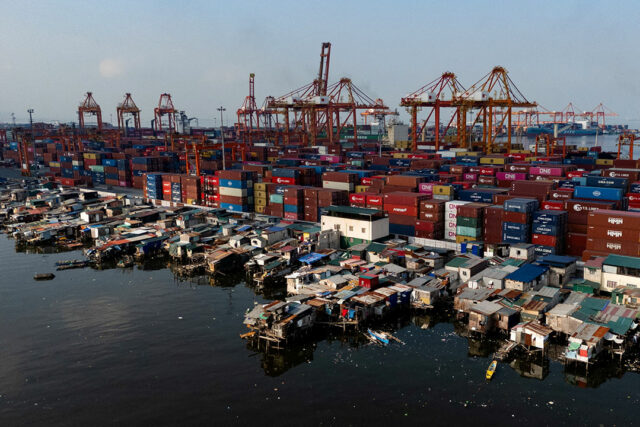
A drone view shows shanties around the Manila International Container Terminal at the Port of Manila, Aug. 11, 2025. — REUTERS/ELOISA LOPEZ

THE PHILIPPINES is projected to be the third-most affected economy in Southeast Asia by US tariffs, as its exports to the US are expected to contract by 13%, a United Nations Development Programme (UNDP) report showed.

In its report “Disruption, Diversification, and Divergence” released on Sept. 18, the UNDP said the Philippine exports to the US could potentially drop by 13.1%, due to the newly imposed tariffs.

“The imposition of steep US tariffs is projected to trigger a significant demand-side shock, particularly for Asia-Pacific economies with high trade exposure,” it said.

“The Asia-Pacific region as a whole faces a 6.4% decline in total exports to the US due to tariff-induced price increases, with Southeast Asia hit the hardest at 9.7%,” it added.

In Southeast Asia, Cambodia is the most vulnerable to the US tariffs, with an expected 23.9% drop in total exports to the US.

Vietnam is the second-most affected by tariffs, with a likely 19.2% decline in total exports.

Other Southeast Asian economies are also expected to see a decline in exports to the US with Thailand exports likely to fall by 12.7%, followed by Malaysia (10.4%), Indonesia (6.4%), and Singapore (3.8%).

These estimates are based on US tariff rates as of July 31.

In an executive order signed on July 31, US President Donald J. Trump imposed a 19% duty on many goods from five members of the Association of Southeast Asian Nations (ASEAN) — the Philippines, Cambodia, Malaysia, Thailand and Indonesia. These rates took effect on Aug. 7.

The US is the Philippines’ top export destination, receiving $12.14 billion in shipments last year.

The UNDP said that small, highly trade-dependent economies that focus on lower-value products are the most exposed to tariff shocks.

“Their reliance on narrow export baskets and limited markets leaves them without meaningful buffers against external volatility. In such settings, tariff increases are transmitted directly into export losses, foreign exchange constraints, and employment pressures, with limited scope for policy mitigation given constrained fiscal space and less flexible labor markets,” it said.

Meanwhile, larger economies which concentrate on higher-value products are more likely to absorb the impact of tariff shocks, UNDP said.

According to the UNDP, the Philippines had one of the highest shares of exempted goods relative to its total exports to the US at 27%.

This was behind Malaysia (39%) and Vietnam (28%), but ahead of Thailand (26%), and China (24%).

US TARIFF RULING
Meanwhile, the Philippine government is still waiting for the final decision of the US Supreme Court on the legality of Mr. Trump’s global tariffs.

“We still have to wait for the final decision of the Supreme Court on this,” Special Assistant to the President for Investment and Economic Affairs Undersecretary Ma. Angela E. Ignacio said during the Philippine Economic Briefing in Clark.

Reuters reported the US Supreme Court has scheduled arguments that will hear the legality of the Trump tariffs on Nov. 5.

The High Court is taking up the case after a lower court ruled that Mr. Trump had overstepped his authority in imposing most of his tariffs under the 1977 law known as the International Emergency Economic Powers Act. The tariffs are still in effect during the appeal to the SC.

Ms. Ignacio said the Philippine government is still looking to secure an “optimal and mutually beneficial agreement” with the US, which has previously expressed interest in securing tariff exemptions for selected US imports and a free-trade agreement.

Ms. Ignacio also said the country is looking at alternative export markets such as the European Union, the Middle East and Australia. — ARAI