By Erika Mae P. Sinaking
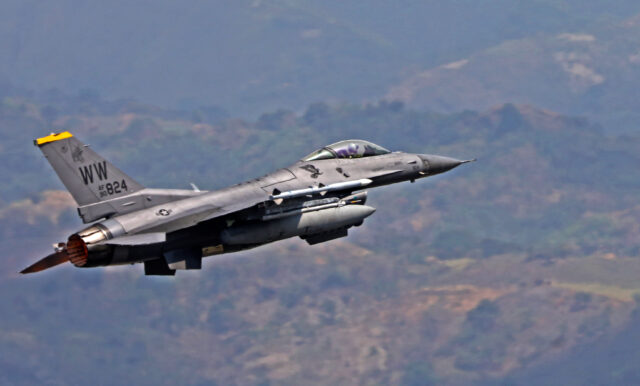
THE PHILIPPINE government’s plan to acquire 20 F-16 fighter jets from the US remains stalled due to funding constraints, officials said on Tuesday, even as Manila deepens its defense cooperation with Washington and other partners to address growing security challenges.
At the two-day Manila Strategy Forum in Parañaque, Philippine Ambassador to Washington Jose Manuel D. Romualdez confirmed that the $5.5-billion deal, which received in-principle approval from the US in April, has yet to move forward.
“The last time I heard, it’s been on hold, mainly because of funding,” he said. “At the end of the day, a lot of it boils down to the money, the availability of the funds.”
He noted that the Armed Forces of the Philippines (AFP) has other priorities under its modernization program. “I think at this point, the AFP has other priorities which they feel are much more important,” he said, though talks on the fighter jets remain open.
Philippine Navy spokesman for the South China Sea Roy Vincent T. Trinidad said the military modernization is structured in phases, with each branch submitting its own procurement plans.
“The modernization program is a multi-year program,” he told BusinessWorld. “The major services have already submitted their modernization plans. The details… are with the Department of National Defense.”
Some acquisitions under the current phase are expected by 2026, though he did not confirm if the F-16s are included.
The forum also highlighted regional issues, including maritime security and supply chain resilience. US Ambassador MaryKay Carlson said ties with the Philippines are in “hyperdrive,” citing President Ferdinand Marcos, Jr.’s state visit to Washington in 2023 as a turning point.
“When President Marcos took over… We’ve seen an upward trajectory that has been faster, stronger, better, more with each passing day,” Ms. Carlson said.
Former US envoy John Negroponte, co-chairman of the US-Philippines Society, pointed to Manila’s 2016 arbitral victory over China as a milestone. “The initiative of the Philippine government to challenge China’s nine-dash line was a very forceful and courageous action,” he said.
On economic ties, Mr. Romualdez said energy and digital infrastructure remain top priorities for cooperation. He cited efforts to reduce power costs and expand digital systems as central to the Marcos administration’s investment agenda.
The envoy also noted that Taiwan’s stability is closely tied to the welfare of Filipino migrant workers. “Our main interest in Taiwan is the fact that there are hundreds of thousands of Filipinos working there,” he said, adding that diplomacy remains Manila’s first line of defense.
Ms. Carlson said humanitarian relief remains another pillar of the alliance. “After the recent flooding and typhoons in July, the US committed $500,000 in immediate emergency relief and sent a dedicated airlift capability to assist,” she said.
Meanwhile, Philippine Defense Secretary Gilberto C. Teodoro, Jr., speaking at a separate forum in Seoul, urged China to halt its nuclear buildup and adhere to the Nuclear Non-Proliferation Treaty (NPT).
“We call upon nuclear weapon states, most especially in this region — China — to undertake concrete measures to reverse the recent increase in stockpiles, reduce the risk of nuclear conflict and maintain strategic stability,” he said.
A June report by the Stockholm International Peace Research Institute (SIPRI) estimated China has 600 nuclear warheads, adding about 100 per year, and could rival US and Russian arsenals by decade’s end.
Mr. Teodoro said the Philippines remains committed to global disarmament but warned that Beijing’s actions undermine trust. “We have tried the path of cooperation, the path of negotiations, the path of even accommodation to no avail,” he said. “For dialogue to be effective, it must be coupled with trust.”
His remarks come amid worsening tensions in the South China Sea, where Philippine and Chinese vessels have clashed repeatedly in disputed waters. Manila has accused Beijing of harassment through water cannons and dangerous maneuvers.
A 2016 tribunal ruling invalidated China’s sweeping claims, but Beijing has rejected the decision and continues to build military outposts in contested areas.
“China has no business policing that area, much less erecting any permanent structure in that area,” Mr. Teodoro said.
Meanwhile, the Philippine Navy said its second Miguel Malvar-class guided missile frigate arrived from South Korea on Monday. The vessel was welcomed off Zambales by BRP Jose Rizal and the Coast Guard’s BRP Gabriela Silang.
The 118-meter warship will undergo final checks before being commissioned as BRP Diego Silang. Built by HD Hyundai Heavy Industries Co., Ltd., it is part of a P28-billion contract signed in 2021 for two corvettes.
“The second Miguel Malvar-class frigate will enhance the Philippine Navy’s operational readiness, maritime domain protection and capability to uphold a free, secure and rules-based international order,” the navy said.
Manila has increasingly relied on Seoul as a supplier of defense equipment, with additional contracts signed for at least 10 naval ships.
Mr. Romualdez said despite challenges in major acquisitions such as the F-16s, the alliance with the US and partnerships with other allies show the Philippines’ modernization efforts are “very much stable, sustainable, and expanding.”