MAPÚA UNIVERSITY CARDINALS — FACEBOOK.COM/GMASYNERGY
Games on Wednesday (Smart Araneta Coliseum) 12 nn. – Opening Ceremony 2:30 p.m. – Mapúa vs LPU (srs) 5 p.m. – CSB vs San Beda (srs)
AND so it begins.
Just a year after claiming its first championship in more than three decades, Mapúa University sets its sights on another one as it clashes with Lyceum of the Philippines University in Wednesday’s start of the 101st NCAA basketball tournament at the Smart Araneta Coliseum.
But Cardinals coach Randy Alcantara admitted the road back to the top would be harder this season after losing Chris Hubilla and Laurence Mangubat, vital cogs in their magnificent title run a season back.
Messrs. Hubilla and Mangubat ended up transferring to Jose Rizal University where Nani Epondulan, who was also part of Mr. Alcantara’s coaching staff, took over as head coach from Louie Gonzales early this year.
“It would be tougher this year because we lost some key players,” said Mr. Alcantara. “But we’re hoping our new guys will fill those gaps.”
Mr. Alcantara was referring to new recruits Cyrus Nitura from University of Perpetual Help, Cyril Gonzales from University of the Philippines, and Drex delos Reyes from National University.
Game time is set 2:30 p.m., which will be followed by the duel between last year’s runner-up College of St. Benilde and a dangerous San Beda University at 5 p.m., in a pair of explosive matches that pitted the same schools that made the Final Four a year ago.
Philippine Sports Commission Chair Pato Gregorio will be the league’s guest of honor in the inaugural rites set at 12 noon with GMA 7 as the official broadcaster.
The season will also mark the league’s decision to change format for the first time since the 90s where champions were decided using the pennant system.
From the double round-robin style, it will now be a two-group system where pool mates will play each other twice and opposing bracket teams only once for a total of 13 elimination round games from the original 18 assignments each.
Apart from Mapúa and LPU, Group A has San Sebastian, Perpetual Help and Arellano University while Group B has Colegio de San Juan de Letran, Emilio Aguinaldo College and Jose Rizal University aside from CSB and San Beda.
The top three teams per bracket will advance straight to the quarterfinals with the top two earning a critical twice-to-beat edge.
Practically gone was the old Final Four format and was replaced by a best-of-three semifinal series.
The winners advance to the finale, which will be another best-of-three affair. — Joey Villar
The Fever had been there and done that. After all, theirs was a season spent patching holes, surviving injuries, and leaning on whoever was left standing. And so they wound up oddly prepared for the challenge; down 2–1 in the semifinals and with elimination one bad stretch away, they summoned a sense of desperation that was anything but reckless. Instead, it was sharp, insistent, and disciplined. Against the heavily favored Aces, they played with conviction and refused to fold, in the process claiming victory and forcing a winner-take-all encounter on Thursday for a spot in the finals.
Fittingly, the Fever’s campaign was spearheaded by All-Star Aliyah Boston, hitherto overworked on defense and all but forgotten on the other end of the floor. Her 24, 14, five, two, and two mattered, needless to say, but it was the constant pressure she applied — drawing fouls, carving space, imposing her will — that shifted the balance in favor of the hosts. Most Valuable Player candidate Kelsey Mitchell complemented her presence with a polished 25, including a late jumper through contact that gave them breathing room. Hardship pickup Odyssey Sims chipped in 18, steady in moments when order was most needed. And then there was the unheralded work around them that carried equal weight: Lexie Hull on the floor for loose balls, Shey Peddy disrupting passing lanes, Makayla Timpson covering the paint with authority.
In a nutshell, Game Four of the semis was a story of intent. The Fever forced 17 turnovers, converted them into 25 points, and outrebounded the Aces by a whopping 14. If nothing else, the numbers underscored their status as the aggressors dictating terms rather than the underdogs reacting. Newly minted MVP A’ja Wilson poured in 31, nine, three, four, and three, touching the ball on just about every possession and subsequently encountering success. Still, they refused to let her brilliance dictate the outcome; they found ways to blunt those around her, thus daring her to craft the triumph by shouldering a historically ridiculous load. And by the closing minutes, they had tilted the contest into preferred circumstances: close, frantic, and decided by force.
Interestingly, what sealed the set-to was not a highlight but a mistake. With half a minute and change left, the Aces, already down seven, burned a timeout they did not have; it was a shocking slip from the experienced coaching staff led by decorated Becky Hammon that handed the Fever a free throw and possession. In an encounter where the latter had thrived on making little things count, the error was fatal. The ensuing three charities stretched the margin, and composure ensured the outcome. Certainly, it was an ending that validated their ethos all season: endure the blows, stay upright, and then wait for the opponents to fold.
Forcing a do-or-die Game Five is no small feat, especially against determined competition. That the Fever have done so versus the heavily favored Aces reflects their identity; they have become used to the uncomfortable, seasoned in marching on with the cliff at their heels. The final challenge awaits at the Michelob ULTRA Arena, where the partisan crowd, the pedigree, and the poise will appear to lean toward their rivals. But they have already shown that the gravity of the situation does not scare them. To the contrary, they welcome it, having carried throughout their campaign a conviction that when everything is at stake, nothing is impossible.
Anthony L. Cuaycong has been writing Courtside since BusinessWorld introduced a Sports section in 1994. He is a consultant on strategic planning, operations and human resources management, corporate communications, and business development.
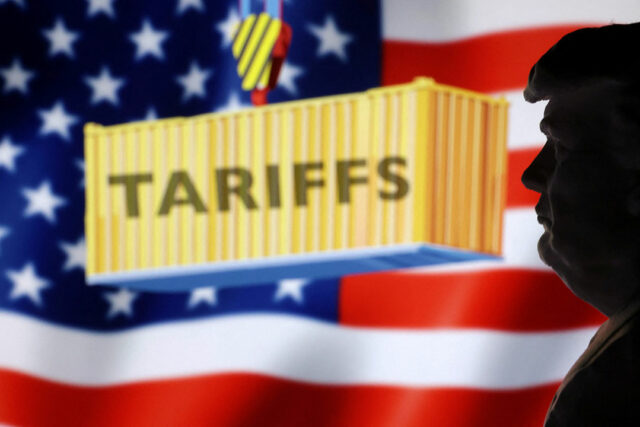
US President Donald J. Trump announced he will impose a 10% baseline tariff on all imports to the United States. — REUTERS
WASHINGTON — US President Donald J. Trump said on Monday he was slapping 10% tariffs on imported timber and lumber and 25% duties on kitchen cabinets, bathroom vanities and upholstered furniture, continuing his tariff assault on global trading partners.
The action is the first in three sectors that Mr. Trump said last week would get steep new duties as early as Oct. 1, including patented pharmaceutical imports, and heavy truck imports. Monday’s proclamation sets the start of the lumber and furniture duties two weeks later, at 12:01 a.m. EDT (0401 GMT) on Oct. 14.
Mr. Trump signed a presidential proclamation laying out his argument that timber, lumber and furniture imports are eroding US national security to justify the new duties under Section 232 of the Trade Act of 1974.
Mr. Trump’s increasing use of Section 232 comes as he awaits a Supreme Court ruling on the legality of his broader “reciprocal” tariffs on global trading partners, which two lower courts have struck down.
The proclamation said the tariff rates would start on Oct. 14 but added that duties would increase on Jan. 1 to 30% for upholstered wooden products and 50% for kitchen cabinets and vanities imported from countries that failed to reach an agreement with the United States.
Mr. Trump’s proclamation said wood product imports were weakening the US economy, resulting in the persistent threat of closures of wood mills and disruptions of wood product supply chains and diminishing utilization of the US domestic wood industry.
“Because of the state of the United States wood industry, the United States may be unable to meet demands for wood products that are crucial to the national defense and critical infrastructure,” the statement said.
The order added that wood products were used for “building infrastructure for operational testing, housing and storage for personnel and materiel, transporting munitions, as an ingredient in munitions, and as a component in missile-defense systems and thermal-protection systems for nuclear-reentry vehicles.”
PAIN FOR CANADA, VIETNAM, MEXICO Mr. Trump’s use of tariffs has beena feature of his second term, throwing new obstacles at businesses already struggling with disrupted supply chains, soaring costs and consumer uncertainty. His administration has highlighted the surge in duties paid into government coffers.
The action heaps more tariffs on Canada, the biggest softwood lumber supplier to the US, where producers already face combined US anti-dumping and anti-subsidy tariffs of about 35% due to a long-festering dispute over timber harvested from Canadian public lands.
Canada, which hopes to negotiate US tariff reductions through a broader revamp of the 2020 US-Mexico-Canada agreement on trade, has said it would provide up to C$1.2 billion ($870 million) in aid to its softwood lumber producers to cope with the prior duties.
Mexico and Vietnam are growing suppliers of wooden furniture to the US after Mr. Trump hit Chinese furniture products with tariffs of up to 25% during his first term starting in 2018 — duties which have since been raised to about 55% and now could nearly double for cabinets and vanities.
Mr. Trump’s proclamation offered some countries that have struck tariff-reducing trade deals with the US some relief from the higher wood products duties.
It said that US tariffs on wood products from Britain would be capped at 10% and those from the European Union and Japan would be capped at 15% — rates in line with the base tariff rate in those framework agreements.
But Mr. Trump’s statement made no mention of his trade deal with Vietnam for a 20% tariff rate in July, an agreement that still has not been formally documented.
In April, after the Commerce department opened the national security probe into US lumber imports, the US Chamber of Commerce announced its opposition to any restrictions on imports of timber, lumber and their derivative products, including wood pulp, paper and cardboard.
“Imports of these goods do not represent a national security risk,” the Chamber wrote. “Imposing tariffs on these goods would raise costs for US businesses and home construction, undermine the export success enjoyed by the US paper industry, and reduce incomes in many US communities.” — Reuters
WASHINGTON — US President Donald J. Trump and his Democratic opponents appeared to make little progress at a White House meeting aimed at heading off a government shutdown that could disrupt a wide range of services as soon as Wednesday.
Both sides emerged from the meeting saying the other would be at fault if Congress fails to extend government funding beyond a Tuesday midnight deadline (0400 GMT Wednesday).
“I think we’re headed to a shutdown,” Vice-President JD Vance said.
Democrats say any agreement to extend that deadline must also preserve expiring health benefits, while Mr. Trump’s Republicans insist health and government funding must be dealt with as separate issues.
Senate Democratic Leader Chuck Schumer said the two sides “have very large differences.”
If Congress does not act, thousands of federal government workers could be furloughed, from NASA to the national parks, and a wide range of services would be disrupted. Federal courts might have to close and grants for small businesses could be delayed.
Budget standoffs have become relatively routine in Washington over the past 15 years and are often resolved at the last minute. But Mr. Trump’s willingness to override or ignore spending laws passed by Congress has injected a new dimension of uncertainty.
Mr. Trump has refused to spend billions of dollars approved by Congress and is threatening to extend his purge of the federal workforce if Congress allows the government to shut down. Only a handful of agencies have so far published plans detailing how they would proceed in the event of a shutdown.
The White House released an executive order Monday evening extending the life of more than 20 federal advisory committees through 2027. It remains unclear how these committees — which advise the president in areas including trade and national security — will be funded amid ongoing shutdown uncertainty.
FIGHT ABOUT SMALL SLICE OF BUDGET At issue is $1.7 trillion in “discretionary” spending that funds agency operations, which amounts to roughly one-quarter of the government’s total $7-trillion budget. Much of the remainder goes to health and retirement programs and interest payments on the growing $37.5-trillion debt.
Prior to the White House meeting, Democrats floated a plan that would extend current funding for seven to 10 days, according to Democratic sources, which could buy time to hammer out a more permanent agreement. That is shorter than the timeline backed by Republicans, which would extend funding to Nov. 21.
After returning to the Capitol, Mr. Schumer told reporters he would not accept a shorter funding bill.
Senate Republican Leader John Thune sought to pile pressure on Democrats by scheduling a Tuesday vote on the Republican bill, which has already failed once in the Senate.
There have been 14 partial government shutdowns since 1981, most lasting just a few days. The most recent was also the longest, lasting 35 days in 2018 and 2019 due to a dispute over immigration during Mr. Trump’s first term.
This time healthcare is at issue. Roughly 24 million Americans who get coverage through the Affordable Care Act will see their costs rise if Congress does not extend temporary tax breaks due to expire at the end of this year.
House Democratic Leader Hakeem Jeffries said Congress needs to make those tax breaks permanent now because higher health insurance premiums are being finalized and the new signup period starts Nov. 1.
“We believe that simply accepting the Republican plan to continue to assault and gut healthcare is unacceptable,” Mr. Jeffries said at a Monday press conference.
Republicans say they are willing to consider the issue, but not as part of a temporary spending patch.
“They had some ideas that I actually thought were reasonable, and they had some ideas that the president thought was reasonable. What’s not reasonable is to hold those ideas as leverage and to shut down the government,” Mr. Vance said.
Democrats want to energize their voting base ahead of the 2026 midterm elections, when control of Congress will be at stake, and have broadly lined up behind the healthcare push.
But Democratic aides have privately expressed concerns that a shutdown could create a public backlash if Democrats do not effectively argue their case and instead come off sounding like just being opposed to whatever Mr. Trump wants — a stance Republicans like Mr. Thune have derided as “Trump Derangement Syndrome.” — Reuters
INCHEON — From the muddy grounds of a former amusement park on South Korea’s coast, tens of thousands of vehicles are being packed for shipment overseas as booming used car exports help to mitigate the impact of US tariffs on new car sales.
Soaked in sweat from the outdoor heat, workers are loading and strapping cars into containers around the clock for shipment from the makeshift facilities at South Korea’s largest used car export hub in Incheon, west of Seoul.
“It is embarrassing for us to say ourselves our business is a star export item,” said Kevin Seol, a trader who ships about 100 used cars monthly. “But the industry keeps growing by numbers, so I think we are contributing to the national exports.”
South Korea’s auto shipments to the US have declined for six consecutive months since President Donald J. Trump announced 25% tariffs.
But its global car exports have risen for three straight months, supported by record-high second-hand vehicle sales, which accounted for a quarter of the total auto exports by volume and 13% by value, according to trade ministry and customs data.
South Korea exported $5.5 billion of cars in August, up 9% from a year earlier and the highest monthly total on rec ord, the trade ministry said. Used car exports jumped 35% to $711.5 million the same month, according to the Korea Used Car Distribution Research Institute.
The used vehicle growth is largely propelled by insatiable demand for older Hyundai and Kia cars in Russia and in the Middle East and a weaker won, traders and experts said.
“Exports to the US don’t account for much of our business,” Mr. Seol said. “Demand from other countries is strong, so the tariffs haven’t really hurt us.”
TARIFFS COULD RAISE USED CAR PRICES South Korea exports most of the used cars that are sold to the Middle East, Central Asia and Russia, according to government data and traders.
In those markets, Korean cars can be more attractive than those from export rival Japan because they are designed for driving on the right side of the road, whereas Japan drives on the left, traders said.
In South Korea’s biggest new car export market, the US, exports have been hobbled by a 25% tariff that remains higher than the 15% rate for Japanese and European cars, though Seoul is in negotiations for a reduction.
But while US tariffs are a negative for the new car market, they could lead to further demand and higher prices for used vehicles, said Shin Hyun-do, director of the Korea Used Car Distribution Research Institute.
“If US tariffs on new cars rise, car prices will go up. That will lead to a rise in car prices globally,” he said. “In that case used car prices are likely to follow suit.”
In the first half of the year, South Korea’s used car exports jumped 72% to $3.9 billion, with 437,151 vehicles shipped abroad, accounting for about a quarter of total auto exports by volume, Mr. Shin said.
South Korea sold more used cars to the Middle East than new vehicles between January and June and reported a 40% rise in monthly average sales to Russia, he added.
POOR INFRASTRUCTURE THREATENS GROWTH POTENTIAL Demand from Russia and its trade partners like Kyrgyzstan has surged since the outbreak of the war in Ukraine.
In response to the invasion, Japan curbed trade in used vehicles in 2023 by banning all but used compact cars from being sold directly to Russia.
South Korea added restrictions in 2024, but only for new or used vehicles with 2,000 cc engines or larger, such as bigger SUVs, and some of those are being sold to Russia through Central Asian countries, market participants said.
South Korea’s used car exports are expected to set a new record high in volumes and value this year, experts say, even though fast-growing market Syria banned used car imports in July, according to state media.
But traders said the growth in overseas sales risked being capped by poor infrastructure at the country’s export hubs, including the one at Incheon, a dirt field with makeshift offices and inadequate facilities.
“Private businesses rent these dirt lots here and park their cars there,” said Park Young-hwa, a trader who runs the Korea Used Car Export Association. “In summer, conditions are so bad that buyers with their feet are stuck in mud find it difficult to inspect the cars.”
Ruling Democratic Party lawmaker Heo Jong-sik proposed a bill in April to establish a registration system for used car exporters and develop dedicated export complexes.
Used car exports and cosmetics were the fastest-growing export industries by value for small and medium-sized companies in the first half of 2025, according to government data.
“Since used car exports have already become one of our country’s main export items, the government should step in to manage and foster the industry through policies,” Mr. Heo said. — Reuters
A project to build part of a $3.9-billion bridge in the Philippines attracted interest from Chinese companies, as the nations seek to insulate their economic ties from tensions in the South China Sea.
Chinese firms dominated Tuesday’s bidding in Manila for a P7.25-billion ($125 million) land approach project, the first structure in a plan for a 32-kilometer (20 miles) bridge across the mouth of Manila Bay.
The project, which is expected to help ease traffic in the capital by linking the provinces of Cavite and Bataan, will be financed by Manila-based Asian Development Bank and Beijing-headquartered Asian Infrastructure Investment Bank.
The Chinese firms’ interest in a key Philippine infrastructure project comes as both Manila and Beijing are embroiled in a tense territorial dispute in the South China Sea. Vessels from both nations collided near a disputed shoal in the resource-rich waterway earlier this month.
Chinese firms that offered bids include Beijing Urban Construction Group Co. Ltd., China Harbour Engineering Company Ltd. and Sino Road and Bridge Group Co. Ltd. A consortium by China Wu Yi Co. Ltd. and Fujian Road & Bridge Construction Group Co Ltd. and a joint venture of Hunan Road & Bridge Construction Group Co. Ltd. and China Civil Engineering Construction Corporation also submitted offers.
Other participants include local firms EEI Corp. and a unit of DMCI Holdings Inc., according to the livestreamed proceedings. The financial bids will be subject to review, Manila’s public works department said.
Despite their maritime dispute, the trading partners have worked to keep their economic ties stable. Philippine President Ferdinand Marcos Jr. told outgoing Chinese Ambassador Huang Xilian last week at the latter’s farewell call to “not allow these differences to define our relationship,” saying that the maritime dispute isn’t the sum-total of the two countries’ relations. — Bloomberg
People have an increased consciousness about keeping their employees healthy, said Dr. Beverly Lorraine C. Ho, chief health officer of Ayala subsidiary AC Health.
“Hopefully, in the near future, we’ll be able to integrate PhilHealth’s YAKAP [Yaman ng Kalusugan ng Pamahalaan] program as part of the offerings for employees by employers, and we can help them integrate this into their benefits,” she told BusinessWorld at the 5th Health Leadership Summit.
YAKAP, an initiative by national health insurer PhilHealth, aims to make preventive healthcare more accessible through services like routine check-ups and cancer screening.
Health secretary Teodoro J. Herbosa emphasized the need to shift healthcare’s focus from illness to wellness at the 2025 summit.
In this video, Dr. Ho talks more about primary care’s integral role in the Philippine healthcare system.
Interview by Patricia Mirasol Video editing by Jayson Mariñas
Thousands participate in the Trillion Peso March against corruption in Quezon City, Sept. 21. — PHILIPPINE STAR/MIGUEL DE GUZMAN
Philippine stocks extended their slump, underperforming Asian peers as corruption allegations on government officials eroded investor sentiment and triggered foreign outflows. The peso also weakened.
The Philippine Stock Exchange Index fell as much as 1.5% on Tuesday, declining for the seventh straight session in its worst run of losses since December 2024. The benchmark is now at a five-month low. Offshore investors have been retreating in recent sessions, unloading a net $7 million on Monday after pulling $9.5 million on Friday, according to data compiled by Bloomberg.
The equity selloff and a slide in the peso followed scandals in the government’s flood-control projects that triggered mass protests earlier this month, amplifying pressure on President Ferdinand Marcos Jr. to push through reforms. How his administration responds may determine whether investor confidence stabilizes or erodes further in the months ahead.
Philippine assets are “weighed down by political jitters amid the probe on massive government corruption on flood control projects,” said Marlyne Fernandez, president of Unicapital Securities Inc. in Manila. “Investors continue to assess the potential economic fallout of the corruption scandal, with close attention on how the government responds to restore confidence and contain risks.”
The Philippine peso has been Asia’s worst performer this month, as a resurgent dollar added further pressure. A Bloomberg index of Philippine bonds has handed dollar-based investors a 1.4% loss in September, the worst performer in emerging Asia. Bonds have come under pressure after inflation picked up in the latest data. This came on the back of comments from the Bangko Sentral ng Pilipinas governor at the end of August that the central bank may stand pat on its policy rate for the remainder of the year.
“Political and corruption news just add uncertainty, which funds and investors do not like,” said Jasper Timoteo Ondap, equity research analyst at Regina Capital Development, adding that foreigners sold stocks as the peso remained under pressure. — Bloomberg
MANILA — The Asian Development Bank forecast a slight improvement in its growth outlook for developing Asia and the Pacific for this year, reflecting robust expansion in the first half, but trade headwinds continue to cast a shadow over expectations.
Growth in 2025 is now projected at 4.8%, up slightly from 4.7% in July, the ADB said it an update to its Asian Development Outlook, but it remains below the 4.9% forecast made when the report was first released in April.
The ADB defines developing Asia and the Pacific as 46 economies ranging from China to Georgia to Samoa, and excluding countries such as Japan, Australia and New Zealand.
Developing Asia grew 5.4% in the first half of 2025, faster than the 4.9% expansion in the second half of 2024, driven by the front loading of exports of electronics and artificial intelligence-related goods to head off the higher tariffs.
“Front loading ahead of tariff hikes boosted growth in some economies this year, but this momentum is expected to fade as tariff hikes come into full effect,” ADB Chief Economist Albert Park said at a press briefing.
The ADB trimmed is growth projection for the region in 2026 to 4.5%, compared with 4.6% in July and 4.7% in April, citing the drag from higher US tariffs on external demand.
“Trade risks pose the main threats to the outlook,” Park said, pointing to unresolved USUSChina trade tensions, the risk of further tariff hikes, and sector-specific duties on semiconductors and pharmaceuticals.
The average effective US tariff rate has jumped to 17.4%, the highest since the Great Depression of the 1930s, from 2.4% in 2024, after new duties took effect in August, the ADB said.
While Washington has signed several new trade agreements, many remain incomplete, fuelling policy uncertainty.
“Uncertainty eased after trade deals were announced in May to August, but it remains elevated. This reflects lack of clarity on the implementation of trade deals and other expected tariffs,” Park said.
Subregional prospects remain mixed. The ADB now expects Southeast Asia to grow 4.3% this year, up slightly from its 4.2% forecast in July, but below the 4.7% projection in April.
South Asia is forecast to grow 5.9% this year, unchanged from July, but below ADB’s 6.0% estimate in April.
China’s outlook is unchanged at 4.7% this year, supported by policy measures, export diversification, and strong first-half growth of 5.3%, the ADB said. Even so, the projection remains below Beijing’s target of 5.0%.
Inflation is forecast to ease to 1.7% in 2025, from 2.3% in April, before rising slightly to 2.1% in 2026 as food prices normalize, the ADB said. — Reuters
Actual photo of the Cypress Model Unit at Terrace Homes, a ready-for-occupancy dressed-up townhome for effortless move-in
Reimagining exclusive suburban living in the South
Terrace Homes of Brentville International Community rises as a new residential offering designed for families who want quiet living without giving up access to Metro Manila.
Situated within the residential enclave’s Prominence II cluster, Terrace Homes was recognized by the 2025 Asia Pacific Property Awards under the 20+ Residential Units category for delivering a well-planned, upscale community that upholds international standards for suburban living in the South.
Gateway to Metro Manila
Connected to the South Luzon Expressway (SLEX) and the Cavite-Laguna Expressway (CALAX), Terrace Homes’ location in Biñan, Laguna offers families and investors a prime, accessible location for suburban living. The development is accessible to major economic centers, such as Filinvest City in Alabang, Makati City through Skyway, and industrial zones in Laguna.
For families, Brent International School is located within the community, while other educational institutions in Metro Manila are accessible via the aforementioned thoroughfares.
The proximity to NAIA provides additional convenience for families who travel frequently. The location also connects to hospitals, offices, and leisure areas, making it a practical choice for individuals who want fewer compromises between suburban living and urban access.
Compared with the congestion of Metro Manila, the area offers lighter traffic, more breathing room, and a lower population density. Families who move here often cite the ability to enjoy a calmer pace of living while remaining within commuting distance of major business and commercial centers.
A standard-setting community
Championing a forward-thinking approach to home ownership, Terrace Homes operates under a Condominium Certificate of Title (CCT), which combines the convenience of condominium living ownership and maintenance with the benefits of a landed property. The CCT framework opens a unique opportunity for foreign buyers to homeownership in the Philippines.
The CCT arrangement is coupled with a unique buyer-centric sell-to-build model, where construction starts once payments reach a specific, yet accessible milestone. This way, potential homebuyers feel more secure that their investment is immediately channeled into the building of their future home.
These structures enhance flexibility and marketability, making Terrace Homes a standout choice for both end-users and investors seeking high-value, hassle-free property ownership in the South.
Artist’s render of the Mahogany Duplex Unit within Terrace Homes
Designed with intention
Defining this upscale development are single-detached and duplex homes within this low-density neighborhood, each set on larger lots compared with most urban housing projects.
These intricately-designed spaces offer ample room for growing families. With lot sizes ranging from 185-230 square meters, each unit gives residents generous spaces for daily living and leisure such as gardening and other backyard activities. In addition, the design of units can be customized according to homeowners’ preferences.
Further, families can enjoy these spaces with peace of mind and a stronger sense of neighborhood exclusivity. Situated in the Prominence II cluster, which has its own gated entrance, Terrace Homes is safeguarded by multiple layers of security inside the wider Brentville community.
Terrace Homes also benefits from Brentville’s master plan—a carefully designed layout of residential clusters, amenities, road networks, and commercial areas.
Pedestrian-friendly and open spaces are also carefully laid out to encourage a sense of harmony and safety among residents. And while development of clusters is carried out in phases to allow each neighborhood to grow cohesively, unified design principles create visual consistency across clusters while preserving individuality.
Within one’s house and around the neighborhood, Terrace Homes enables a seamless, organized, and high-quality living experience.
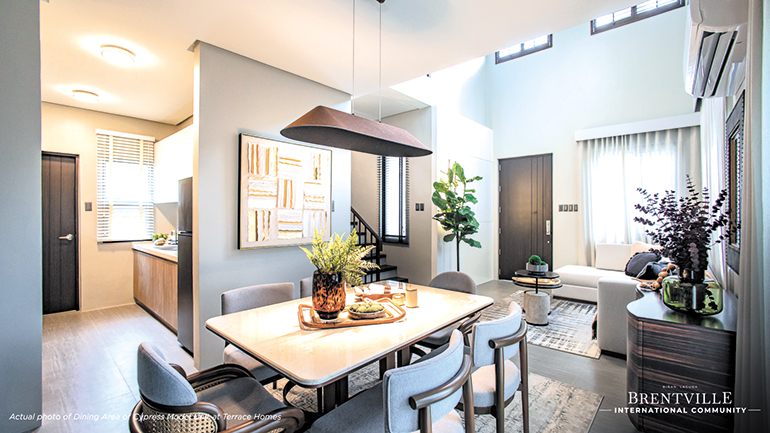
Actual photo of the dining area at the Cypress Model Unit with a thoughtfully designed interior
Lifestyle amenities within reach
Terrace Homes in Prominence II forms part of a broader vision for Brentville International Community. Filinvest developed the township to serve families who seek secure environments, wide open spaces, and amenities that fit an upscale lifestyle.
Residents of Terrace Homes enjoy access to a main clubhouse, swimming pools, and jogging trails. The presence of playgrounds makes the neighborhood especially appealing for families with young children. These amenities serve as places of meaningful convergence for the residents.
With leisure and convenience integrated within the community itself, families do not need to drive far for daily needs or recreational breaks. From fitness to play, the facilities mirror the lifestyle priorities of households who balance work, school, and quality time together.
Soon to rise amid it all is The Village Front Lifestyle Retail, Brentville’s upcoming dedicated commercial hub. The construction is already underway, with the project expected to bring dining, shopping, and leisure options right at the residents’ doorstep.
An enduring investment
With its accessible location, master-planned design, and premium approach that garnered it global recognition, Terrace Homes offers a worthwhile, enduring investment for both families and investors.
Large lot cuts and a carefully planned neighborhood appeal to families who want space and stability while preserving investment potential. Industry analysts often point to communities with consistent upkeep and resident-led growth as properties that sustain high resale values. Terrace Homes fits that profile, making it a reliable choice for those who weigh returns alongside livability.
For families looking for sanctuaries with award-winning design and thoughtful amenities enclosed in a vibrant international community, Terrace Homes offers a starting point for comfort, convenience, and long-term value.
Spotlight is BusinessWorld’s sponsored section that allows advertisers to amplify their brand and connect with BusinessWorld’s audience by publishing their stories on the BusinessWorld Web site. For more information, send an email to online@bworldonline.com.
Join us on Viber at https://bit.ly/3hv6bLA to get more updates and subscribe to BusinessWorld’s titles and get exclusive content through www.bworld-x.com.
FUJIFILM Philippines, Inc. is holding its Nationwide Photo and Video Walk (NPVW) on Oct. 5 (Sunday) across 32 cities in the country.
“This event marks a renaissance for photographers and videographers to reinvigorate the joy of capturing moments in the country, as we showcase the art of photo and video through the lens of our beloved cities,” Glenn Gatan, head of Marketing and Imaging Solutions at Fujifilm Philippines, said.
“Fujifilm continues to support the local scene by spreading passion for the wonders of our very own urban landscapes, and with this nationwide photo and video walk, we encourage photographers and videographers of all levels from all over the country to bring pride to their city and show it to the world through their art.”
The event is open to photographers and videographers of all skill levels, regardless of camera brands used.
FUJIFILM PHILIPPINES
Registration ends at 11:59 p.m. on Sept. 30. Interested participants can access the registration forms via Fujifilm’s official Facebook and Instagram pages (@fujifilmphilippines).
The event starts at 7:30 a.m. (6 a.m. call time) at the designated locations.
The 32 participating cities for the NPVW 2025 are: Alabang, Muntinlupa; Angeles, Pampanga; Angono, Rizal; Bacolod, Negros Occidental; Baguio City; Baliwag, Bulacan; Binangonan, Rizal; Bonifacio Global City, Taguig; Borongan, Eastern Samar; Cagayan De Oro; Calamba, Laguna; Cebu City; Dagupan, Pangasinan; Davao City, Davao; Dumaguete City; General Santos City; Iloilo City; Ipil, Zamboanga Sibugay; Kabankalan, Negros Occidental; Koronadal City, South Cotabato; Laoag, Ilocos Norte; Legazpi City, Bicol; Lingayen, Pangasinan; Lipa City, Batangas; Manila; Naga, Bicol; Puerto Princesa, Palawan; Quezon City; Rosario, Cavite; San Fernando, La Union; Tarlac City, Tarlac; and Zamboanga City.
Participants will get a kit that contains an official NPVW shirt and other exclusive Fujifilm merchandise.
Prizes will also be awarded for the top photos and videos selected during the NPVW 2025.
“Three winners in the Open to All Photo category will win a Fujifilm X-E5 camera with a XF23mm f/2.8 kit lens, with one winner each from Luzon, Visayas, and Mindanao,” the brand said. “Fujifilm users will also have a chance to win some top-tier gear, with one winner in the Fujifilm-exclusive Photo category receiving the Fujifilm X-T5 with an XF16-80mm kit lens, and one winner of the Fujifilm-exclusive Video category taking home the Fujifilm X-H2S paired with the XF23mm f/1.4 II lens.”
Industry leaders will be mentoring photographers and videographers during the event, including the winners of the top prizes at last year’s NPVW.
“In line with Fujifilm’s global mission of ‘giving our world more smiles,’ this highly anticipated nationwide event invites budding photographers and videographers to showcase the unique beauty of their cities — capturing city pride, the urban culture, and everyday moments through the art of digital imaging and video.” — BVR
SEOUL — South Korean Finance Minister Koo Yun-cheol said on Tuesday the government and the ruling party would ease some criminal punishments for businesses to allow more leeway for corporate activities.
“Concerns have consistently been raised that excessive economic punishment restricts creative human economic activity,” Koo said at a meeting with leaders of the ruling Democratic Party.
Democratic Party floor leader Kim Byung-kee said the party planned to abolish breach of trust in criminal charges to reduce excessive punishments that stifle business activities.
President Lee Jae Myung in July had ordered officials to review and restructure the criminal punishment system for businesses to promote corporate investment, citing abuse of breach of trust charges.
While easing criminal penalties, Finance Minister Koo said, the government would first impose administrative punitive actions against minor misconduct. — Reuters