Home Blog Page 59

BoI approves P1.56 trillion in investments in 2025

PHILIPPINE STAR/ MICHAEL VARCAS

THE BOARD of Investments (BoI) said it has approved a total of P1.56 trillion in investments in 2025, registering the second-highest level of investment approvals in the agency’s 58-year history.

Investment approvals by the BoI declined by 3.7% in 2025 from P1.62 trillion in 2024, but still marked the second consecutive year that it breached the P1.5-trillion level.

In a statement, Trade Secretary and BoI Chairperson Ma. Cristina A. Roque said the approved investments are expected to generate 40,175 jobs nationwide across 322 projects.

According to the BoI, the energy sector secured the most investment approvals with P970.09 billion worth of projects. The agency said this reflects sustained momentum in power generation and related infrastructure projects.

Also approved were P241.65 billion worth of investments in mass housing, and transportation and storage projects worth P230.06 billion.

The manufacturing sector also secured P62.16 billion worth of investments, while the information and communication sector got P26.56 billion in investments. The BoI said investments in this sector reflect growing demand for industrial expansion and digital infrastructure.

Of the total approved investments, local investments accounted for P1.41 trillion, the BoI said.

The National Capital Region is the leading investment destination, attracting P383.71 billion in approved investments. This was followed by the Cordillera Administrative Region with P373.39 billion and the Calabarzon Region with P257.83 billion.

Meanwhile, foreign investments approved in 2025 amounted to P149.45 billion, led by investments from Singapore with P80.37 billion. This was followed by the Netherlands and Thailand with P33.29 billion and P7.75 billion, respectively.

Ms. Roque said maintaining investment approvals above the P1.5-trillion level for two consecutive years reflects policy credibility and strong investor confidence.

“Breaching the P1.5-trillion mark for two consecutive years and posting the second-highest investment approvals in BoI’s 58-year history highlights the Philippines’ growing competitiveness and the sustained trust of both local and foreign investors,” she was quoted as saying in the statement.

The BoI said there are also other investment prospects in sectors such as renewable energy, electric vehicle components, semiconductors and electronics, smart manufacturing, digital infrastructure, high-tech agriculture, and data center development.

In a separate statement, BoI Managing Head Ceferino S. Rodolfo said the agency is still assessing its target sectors for development and promotion this year, but focus will be given on sectors such as mining, mineral processing and digital infrastructure. — Vonn Andrei E. Villamiel

Rice farmers in the Philippines face more pressure as imports resume

Farmers manage their patch of land in Bustos, Bulacan in this file photo taken on Aug. 13, 2025. — PHILIPPINE STAR/MIGUEL DE GUZMAN

By Vonn Andrei E. Villamiel

FILIPINO RICE FARMER Elvira C. Fadriquelan knew the numbers would not work long before she sold her wet-season harvest in October.

The 60-year-old farmer, who works almost a hectare of rice land with her son in Lubao, Pampanga in northern Philippines, accepted P13 a kilo for palay, or unmilled rice. Her production costs, which include seeds, fertilizer, labor and land preparation, run closer to P16 to P20 a kilo.

“With the P13 per kilo selling price of palay, we did not even recover our capital,” Ms. Fadriquelan told BusinessWorld by telephone in Filipino.

In some parts of Central Luzon, she said, farmgate prices fell as low as P8 a kilo, forcing farmers to absorb losses they could not offset elsewhere. Weather risks made the situation worse. Flooding and strong winds can cut her harvest from more than three metric tons per cropping season to about half that amount, while costs stay the same.

“When typhoons hit, the harvest is cut in half,” she said. “We had to sell everything just to recover costs, instead of keeping rice for our own consumption.”

Her experience reflects broader pressure across Central Luzon, the Philippines’ biggest rice-producing region. The average palay price there fell to P15.14 a kilo in October, down 24.4% from P20.02 a year earlier, according to data from the Philippine Statistics Authority.

Nationally, farmgate palay prices averaged P16.92 a kilo in November, a 16.6% drop from P20.28 a year ago.

Farmers say the temporary restrictions on rice imports imposed in the second half of last year offered little relief. Prices stayed weak, they said, and many are bracing for renewed pressure as imports resume under a revised tariff regime.

“The import ban did not significantly raise palay prices,” Ms. Fadriquelan said. “It could become more difficult once the ban is lifted, because traders can stock up on cheaper imported rice.”

Starting this year, rice imports will resume under a “flexible” tariff scheme that lets duties rise or fall in response to global prices. Executive Order (EO) No. 105 allows tariff adjustments in increments of 5 percentage points, with rates capped at 15% and 35%.

The benchmark for those adjustments is the monthly average price of Vietnam 5% broken rice, the grade that accounts for most Philippine imports, as reported by the Food and Agriculture Organization (FAO). When prices move beyond specified thresholds, tariffs can be adjusted at quarterly intervals.

Vietnam 5% broken rice costs about $361 per metric ton, based on FAO data, a level that would translate into a 20% tariff under the formula.

The starting tariff for January is scheduled to be announced by Jan. 15, based on December price data, and will remain in effect until May 15, according to the implementing rules.

The government has framed the flexible tariff scheme as a way to stabilize supply while managing price volatility.

“If the global price of rice falls too low, the tariff should be set at 35%,” Agriculture Secretary Francisco P. Tiu Laurel, Jr. earlier told reporters. “But if the price rises again to $720 per ton, it should be reduced to 15% to maintain stable palay prices for farmers and for the Filipino people.”

Supporters say the approach prioritizes consumers in a country where rice is a political and economic staple. Former Agriculture Undersecretary Fermin D. Adriano said variable tariffs would help keep retail prices affordable for most Filipinos.

“I agree [with the flexible tariff scheme] because I favor the interest of the majority of Filipinos, who are rice consumers… We have more than 115 million consumers,” he said, adding that he has advocated for a variable tariff system since the 1980s.

He added that farmers who are hurt by lower tariffs could be supported through direct cash transfers, which he said would cost less than the savings enjoyed by consumers through cheaper rice.

Agriculture groups counter that the flexible system offers too little protection at a time when global prices have eased. They argue that the tariff should return to a fixed 35%, the rate originally imposed on Southeast Asian rice imports when the Rice Tariffication Law took effect in 2019.

“We should start at least at 35% to prevent the death of the local rice industry,” Danilo V. Fausto, president of the Philippine Chamber of Agriculture and Food, Inc., said in a Viber message. He added that the rate could be reviewed after six months and adjusted only during harvest periods or in response to sharp international price swings.

The tariff was cut to 15% in June 2024 under EO No. 62 to help contain inflation. Since then, global rice prices have fallen sharply.

‘BIASED AGAINST FARMERS’
“When EO 62 was issued, prices were hovering at $600 to $650 per metric ton,” Jayson H. Cainglet, executive director of the Samahang Industriya ng Agrikultura, told BusinessWorld via Viber. “Now it’s only $359 to $363.”

Under the EO 105 formula, a full 35% tariff would apply only if Vietnam 5% broken rice falls to $315 per metric ton. Critics say the scheme systematically favors imports over domestic production.

Raul Q. Montemayor, national manager of the Federation of Free Farmers, said simulations conducted by the group show that imported rice would remain cheaper than locally produced rice, even when tariffs rise.

“The variable tariff formula is biased against farmers,” he said in a Viber message. The landed cost of imported rice, inclusive of tariffs, would always be lower than the wholesale price of local rice, he added.

He also questioned whether the system could respond quickly enough to protect farmers during harvest seasons.

“Changing tariffs requires a lengthy process,” he earlier told BusinessWorld. “I’m skeptical that adjustments can react promptly to price movements, particularly for palay during a short three-month harvest period.”

Tariff rates under EO 105 can only be adjusted once every three months, taking effect in January, April, July and October, and based on the previous month’s global prices.

Mr. Fausto earlier warned that the structure could invite speculation. Traders anticipating tariff changes could hoard imports or engage in technical smuggling to maximize margins, he said.

Lower tariffs also carry fiscal implications. Reduced duties are weighing on collections that fund the Rice Competitiveness Enhancement Fund (RCEF), according to a report by the House of Representatives Congressional Policy and Budget Research Department (CPBRD).

Tariff revenues reached a record P34.18 billion in 2024, up 13.8% from the previous year, but collections in the second half were hit after tariffs were lowered, the think tank said.

Data from the Bureau of Customs show tariff revenues in the latter half of 2024 fell 34.4% to P10.81 billion from P16.48 billion a year earlier. In the first half of 2025, collections dropped 58.6% to P9.67 billion from a year earlier.

The RCEF provides funding for seeds, mechanization, credit and extension services for rice farmers. The law requires P30 billion a year for the program.

Even if first-half 2025 collections were doubled, revenues would reach only about P20 billion, falling short of the annual requirement, the CPBRD said.

The Agriculture department said lower tariff revenues would not disrupt RCEF programs. Mr. Laurel said the P30-billion allocation is already included in the agency’s budget under the General Appropriations Act, regardless of tariff collections.

Under Republic Act No. 12078, which amended the Rice Tariffication Law in 2024, any revenue shortfall must be covered by the department’s budget. The CPBRD cautioned that this could force trade-offs with other agriculture programs.

For farmers like Ms. Fadriquelan, the debate over tariffs feels distant from the realities of production. She said policies should reflect domestic conditions, not just global benchmarks.

“Why are we letting international prices dictate our policies?” she asked. “Tariffs should also consider local production. Don’t we have the power to keep the tariff at 35%?”

With imports to resume under the flexible system this month, uncertainty hangs over the next harvest season.

“Our next harvest is around April,” Ms. Fadriquelan said. “If they reopen rice imports, when will they stop? Farmers will end up suffering even more.”


Debt service bill falls in Nov. — BTr

BW FILE PHOTO

By Aubrey Rose A. Inosante, Reporter

THE NATIONAL Government’s (NG) debt service bill slipped in November amid a sharp drop in amortization payments, the Bureau of the Treasury (BTr) said.

Latest data from the Treasury showed that the debt service bill fell by 4% to P89.97 billion in November from P93.7 billion in the same month in 2024.

However, month on month, the debt service bill rose by 36.8% from P65.78 billion in October.

Debt service refers to the payments made by the government on domestic and foreign borrowings.

The bulk, or 85.91%, of debt payments consisted of interest payments, while the rest were amortization payments.

In November, amortization payments declined by 53.13% to P12.68 billion from P27.05 billion in the same month in 2024.

Principal payments on domestic debt plunged by 99.03% to P177 million in November from P18.3 billion in the previous year.

Meanwhile, amortization paid on foreign debt jumped by 42.83% to P12.5 billion in November from P8.75 billion in 2024.

On the other hand, interest payments stood at P77.29 billion in November, up 15.96% from P66.65 billion in the same month in 2024.

Domestic interest payments increased by 16.24% to P56.88 billion in November from P48.93 billion a year ago.

This consisted of P32.22 billion for fixed-rate Treasury bonds (T-bonds), P21.09 billion for retail T-bonds, P3 billion for Treasury bills (T-bills), and P563 million for others.

Interest payments for foreign borrowings went up by 15.17% to P20.41 billion in November from P17.72 billion in the same month in 2024.

Jonathan L. Ravelas, a senior adviser at Reyes Tacandong & Co., said in a Viber message the year-on-year drop in the November debt service bill reflected “lower interest costs and a stronger peso, which eased foreign debt payments.”

“This could be largely due to relatively less maturities of National Government (NG) securities towards the end of the year,” Rizal Commercial Banking Corp. Chief Economist Michael L. Ricafort said in a Viber message over the weekend.

In the 11-month period, the NG debt service bill stood at P2.02 trillion, up by 3.59% from P1.95 trillion in the same period in 2024.

The 11-month tally was already 98.56% of the P2.05-trillion debt service program for 2025.

Amortization payments fell by 2% to P1.22 trillion in the January-to-November period from P1.25 trillion in 2024. This exceeded the P1.21-trillion full-year amortization program by 1.48%.

Principal payments on domestic debt slipped by 0.88% to P1.01 trillion, while external payments increased by 6.95% to P214.92 billion.

Meanwhile, interest payments rose 13.49% to P800.51 billion in the January-to-November period from P705.33 billion in 2024. This was 94.4% of the P848.03-billion programmed interest payments for 2025.

Interest payments on domestic debt stood at P593.07 billion, up by 18.05% from P502.39 billion in 2024.

This was composed of P399.3 billion in fixed-rate T-bonds, P143.56 billion in retail T-bonds, P41.21 billion in T-bills, and P9 million in others.

On the other hand, external debt inched up by 2.21% to P207.44 billion as of end-November from P202.95 billion in 2024.

SEASONAL BORROWINGS
Analysts expect the Philippines’ debt service bill to rise in early 2026, reflecting seasonal borrowing patterns and the maturity of government securities.

“This could increase in the coming months in view of large government securities/Treasury bonds maturing worth at least P200 billion each in February 2026 and April 2026,” Mr. Ricafort said.

In 2026, the government plans to spend P2.01 trillion on debt service, with P1.06 trillion for principal amortization and P950 billion for interest payments.

“But expect debt service to climb in December and early 2026 as seasonal spending boosts borrowing and global rates stay high,” Mr. Ravelas said.

“A stronger dollar will also make foreign obligations pricier, so fiscal discipline will be key,” he added.

The peso closed at P58.79 per dollar on Dec. 29, the last trading day for 2025. It weakened by 94.5 centavos from P57.845 at the end of 2024.

Now serving

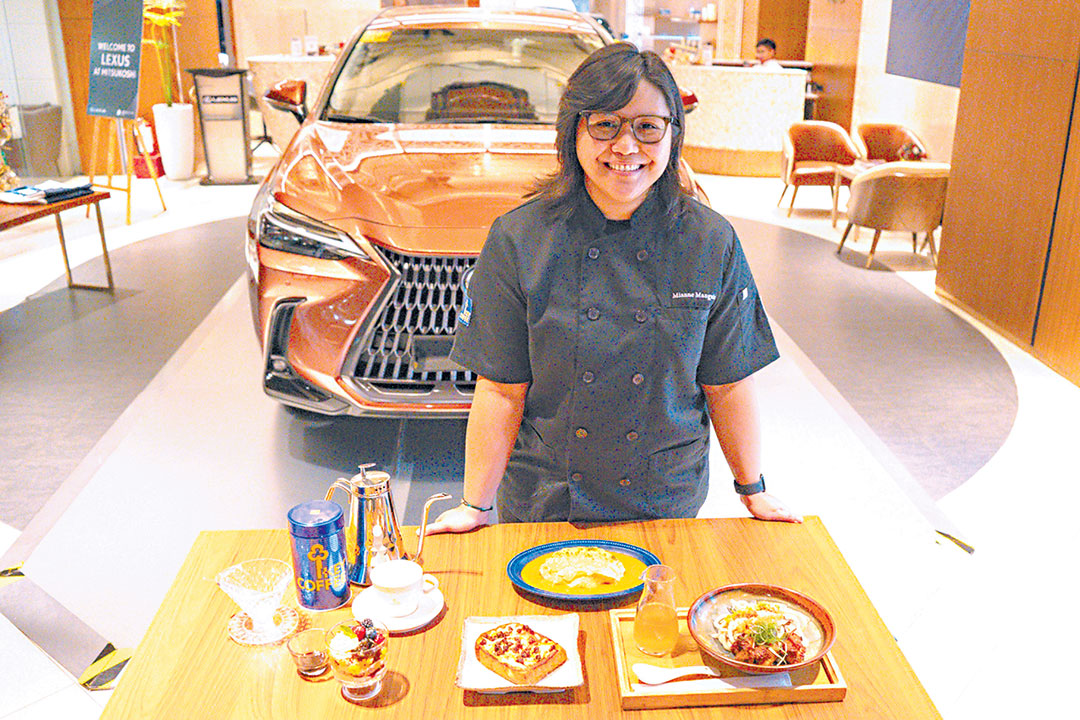
Key Chef Mianne Manguiat adds to the tempting selections available for diners of both Lexus at Mitsukoshi and Key Coffee BGC. For diners of the latter, ask for the Lexus menu. — PHOTO BY KAP MACEDA AGUILA

New palatal reasons to linger at Lexus Mitsukoshi

CONTEMPORARY CAR dealerships have been — for quite a while now, if I’m being honest — known for other things beyond actual cars on the showroom floor. As the truest touchpoint of auto marques, well, anything they do can and will be used for or against them, if you really think about it.

For customers waiting for their customary PMS work to be done, there are well-appointed lounges usually offering coffee or even snacks. For the showroom visitor browsing his or her next vehicle, there also “lifestyle items” to further pitch the brand and what it stands for.

These are standard fare compared to the extra touches that luxury brands like Lexus offer. Take the newly opened Lexus Manila Gallery — now just farther down Bonifacio Global City’s 8th Avenue from its original location. Four floors of everything Lexus and its ethos, which is, said Lexus Philippines Chairman Alfred Ty, “(The) philosophy… to treat each customer as we would a guest in our own home. It is what we call the omotenashi spirit. Our goal is to provide number-one quality in every vehicle and deliver the omotenashi experience to every single guest.”

At the Mitsukoshi mall, still on 8th Avenue, is a “semi-permanent” brand space for Lexus simply called Lexus at Mitsukoshi. It’s a pure showcase for the luxury automaker — one that leans more heavily on the lifestyle component to more clearly convey the values of the marque.

Attached to the Key Coffee Kissaten restaurant/coffee place, Lexus at Mitsukoshi leverages a natural affinity with the iconic Japanese coffee company which started in 1920. As you might have guessed, the brands share more than just their roots in Japan. As a number of Key Coffee tables “cross over” to the Lexus showcase, a dedicated “Lexus selection” has been concocted — a menu that can be had at either Key or Lexus establishment (you just have to ask for the “Lexus menu”) to peruse the choices.

Just before the end of the year, we were invited over to the Lexus side to be among the first to sample several of the newest additions to the Lexus menu. Eight new entries (five food selections, three drinks) have been imagined by Key Chef Mianne Manguiat. A handful are interpretations of familiar Japanese faves, while the drinks are imaginative yet homey renditions that should keep you coming back for more.

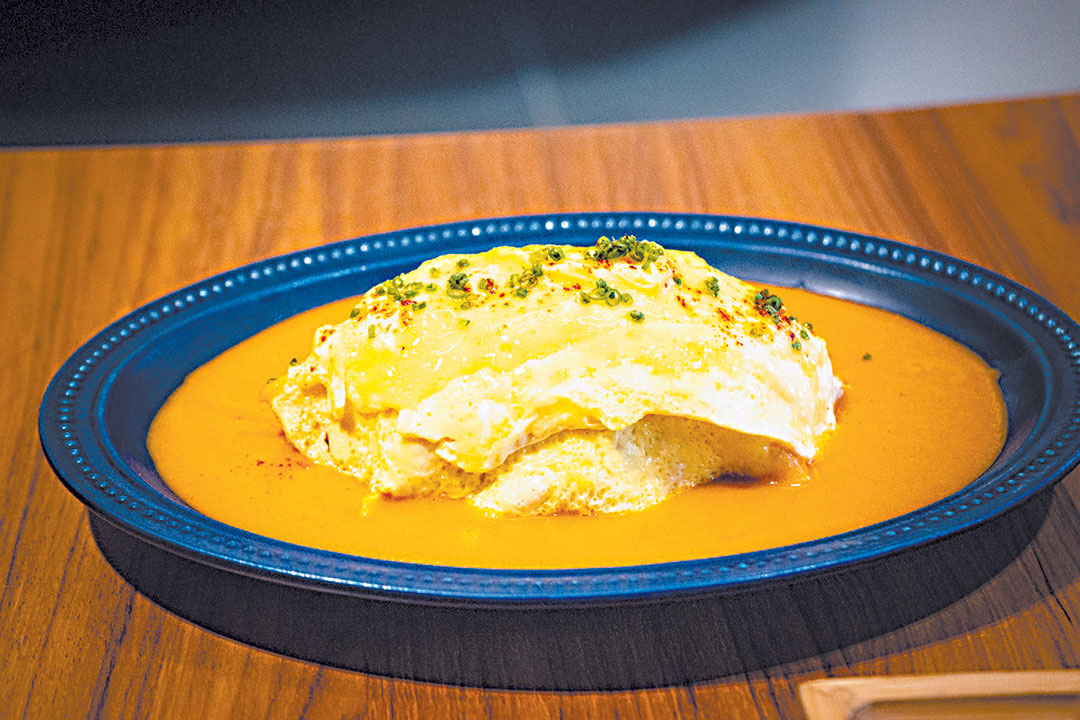
The new additions are headlined by the Karaage Udon (P530), which is served with the dashi consommé on the side so you can have your druthers on how much liquid you want to pour onto the crispy chicken bites and udon. The Omurice (P530) is Chef Manguiat’s take on the familiar soft scrambled egg that the Japanese always seem to do just right. It melds chicken fried rice with tomato demi-glace as counterpoint. Who doesn’t love rice, right?

For those who want to opt for lighter indulgence to perhaps pair with Key coffee (or the drinks below), Pomodoro Toast (P320) is shokupan (soft white bread) with pomodoro, tsukune (chicken meatballs), bell pepper, and cheese — like a slice of fluffy pizza. Something a little more filling is the classic Katsu Sando (P480), a mouthful of juicy pork katsu “sandwiched with slaw and special sauce in shokupan bread.”

Leave some room for dessert — specifically, the new Berry Parfait (P320) with crumble, vanilla Diplomat Cream (or Crème Diplomate, a light blend of pastry cream, whipped cream, and gelatin), and mixed berry compote with balsamic vinegar and fresh berries.

I mentioned drinks, right? I went for the Melon Citrus Cream Soda (P190), a pleasant, moderately sweet (I was expecting it to be sinfully sweet) thirst quencher that blends melon, lime, and soda water — topped off with milk foam. I’ll take another one, thank you very much.

If you’re a little more adventurous or your tastebuds are ready to step out of their comfort zone, let me know how the Velvet Peach and Toffee (P285) is. It’s a melange of ginger ale, peach, brown toffee crumble, and milk foam. Finally, because it’s Key Coffee, there’s Chili Mint Nama Latte (P210), a coffee creation for those craving something out of the ordinary. Chili, mint, and nama chocolate (that soft Japanese confection made from high-quality chocolate, fresh cream, and butter — cubed and dusted with cocoa powder) put a twist on No. 18 espresso. These new drinks are additions to the staple signature Sakura Fizz (P170).

That Lexus at Mitsukoshi is conveniently located within a mall means it gets the foot traffic and attention outside of those actively looking for their next vehicle. For Lexus Philippines, it’s all good. Even if people come in just to marvel at the vehicles, browse Lexus-brand merchandise or, now, indulge in a growing number of palatal selections, at the end of the day if they come away feeling that omotenashi feeling/filling, then it’s a job well done.

For more information, visit the Lexus website at https://www.lexus.com.ph/en.html or its social media pages on Facebook and Instagram (@lexusph); download the MyLexus App available on both Android and iOS users to receive live updates and access other premium services.

SAIC Motor Philippines has new president

New SAIC Motor Philippines/MG Philippines President Wei Wei Zhang — PHOTO FROM MG PHILIPPINES

SAIC MOTOR PHILIPPINES, INC. (SMPI), official distributor of MG vehicles in the Philippines, recently announced the appointment of Wei Wei Zhang as its new president. He replaces Felix Jiang, the pioneering SMPI president, who will be reassigned to MG Australia.

In a release, SMPI said that “Felix Jiang led SMPI for the past three years, playing a crucial role in establishing MG as a key player in the Philippine automotive market. Under his leadership, MG Philippines not only achieved record-breaking sales in 2024 and secured segment leadership in the 1.5L sedan category, but also maintained its position as a solid mainstay, consistently ranking among the top 10 automotive brands in the country.”

MG Philippines now has a wide portfolio of vehicles — encompassing petrol and diesel internal combustion engines, hybrids, and fully electric vehicles. The company added that under Mr. Jiang’s tenure, the company strengthened the “nationwide presence of the MG brand.”

Mr. Zhang was president of MG Indonesia and, later, was part of the ASEAN Partner Group at SAIC Motor’s Shanghai headquarters — overseeing all ASEAN markets. He is said to have been instrumental in “driving growth and strategic initiatives across multiple Southeast Asian markets.”

“We are deeply grateful to Mr. Jiang for his visionary leadership and significant contributions to MG Philippines’ success,” said MG Philippines Vice-President Karl Magsuci. “At the same time, we are confident that Mr. Zhang’s experience, regional insight, and strategic vision will lead MG Philippines into its next phase of growth, further strengthening our commitment to delivering innovative, sustainable mobility solutions to our customers.”

Listed telecommunication firms poised for growth

BW FILE PHOTO

By Ashley Erika O. Jose, Reporter

LISTED telecommunication and information and communications technology (ICT) companies are expected to post growth in 2026, backed by sustained demand for fiber data services and expanding opportunities in nontelecommunication businesses such as digital finance and data centers, analysts said.

“We see growth from both Maya and GCash amid greater adoption and shift to digital transactions,” Peter Louise D. Garnace, an equity research analyst at Unicapital Securities, Inc., said in a Viber message.

He said the telecommunication sector is likely to remain resilient this year, with nontelecommunication segments emerging as key growth drivers. These include digital wallets and data center operations, which are gaining traction alongside rising data usage.

“The growth in data centers will be driven by increased local data consumption, increased use of artificial intelligence (AI) and the government’s strategic push to position the Philippines as a regional hyperscaler hub,” Mr. Garnace said.

In the nine months to September 2025, listed telecommunication and ICT firms posted mixed financial results, largely due to higher operating expenses.

Globe Telecom, Inc. posted a 14.04% decline in attributable net income to P17.69 billion from a year earlier, while revenue slipped to P131.59 billion from P134.74 billion. PLDT Inc.’s attributable net income fell 10.69% to P25.07 billion, while revenue rose 1.45% to P163.28 billion.

Both companies said their digital banking operations continued to support earnings. PLDT’s Maya sustained profits, with deposit balances reaching P57 billion as of end-September and cumulative loan disbursements since launch hitting P187 billion.

Globe, meanwhile, said GCash is expanding its user base to support its push for financial inclusion. GCash has 94 million registered users across at least 16 markets worldwide.

Other listed players posted stronger results. Converge ICT Solutions, Inc.’s net income rose 8.4% to P8.9 billion in January to September, while revenue climbed 10.12% to P32.97 billion. DITO CME Holdings Corp. narrowed its attributable net loss to P9.65 billion from P11.05 billion, as gross revenue rose 25.28% to P14.92 billion.

Mr. Garnace said the Konektadong Pinoy Act, which liberalizes data transmission, is expected to reshape the industry landscape.

“We view the regulation not necessarily as a pure headwind,” he said. “Rather, it represents a structural shift that may challenge legacy business models while creating opportunities through wholesale and digital inclusion plays.”

The law, which lapsed into effect in August, streamlines licensing for new players. The Department of Information and Communications Technology (DICT) said seven companies have signified interest in operating locally.

Michael L. Ricafort, chief economist at Rizal Commercial Banking Corp., said continued investments in data centers and AI are key growth drivers.

“New technologies and innovation could lead to potential game-changers and market disrupters in their respective industries,” he said.

The DICT expects the country’s data center capacity to reach 1.5 gigawatts by 2028, supporting longer-term prospects for the sector.

A new year for Rajo Laurel

KADAYAWAN

THE first month of the year is turning up roses for designer Rajo Laurel: he’s set to represent the Philippines in Thailand in an artistic presentation on Jan. 30.

The presentation, titled Malikhaing Pinoy: Lahi (roughly translated: Creative Filipino: Race) is part of the partnership Thailand’s Creative Economy Agency (CEA) established with the Philippine Creative Industries Development Council (PCIDC), under the Department of Trade and Industry.

The Malikhaing Pinoy Program is a flagship initiative of the government designed to champion and support the Philippines’ creative industries. In line with Republic Act No. 11904 (An Act Providing for the Development and Promotion of the Philippine Creative Industries, and Appropriating Funds Therefor) or PCIDA (The Philippine Creative Industries Development Act), the program aims to nurture Filipino creativity, protect cultural heritage, and promote local artisans and entrepreneurs on both domestic and international stages.

Mr. Laurel is leading the pack, with other designers set to show their accessories alongside his clothes in Thailand. These collaborators include Arnel Papa, Celestina Maristela Ocampo, Cholo Ayuyao, Monchét Diokno Olives, and MX Studios by Maxine Santos Tuaño.

During a preview last month at Bonifacio Global City’s Manila House, Mr. Laurel showed off some of the creations, each with names evocative of Philippine culture, set to show in Bangkok

The Mestiza (a word used for a mixed-race woman) reinterprets the traditional palda (skirt) and camisa/blusa (shirt/blouse) ensemble using woven and dyed jusi from Iloilo, paired with a skirt in raw silk and abaca from Abra. The ensemble is accentuated by black silk royal blooms with coq feathers crafted in Pampanga by Mr. Ayuyao, demonstrating meticulous Filipino artistry.

The Kadayawan, inspired by Mindanao’s festive celebrations, features a bodice made of hand-woven straw from Sorsogon and cropped culottes using a nipa hut-inspired technique made from rayon and silk woven in Ilocos, highlighting regional weaving traditions.

Datu (the title for a local pre-Hispanic chieftain) draws from the heritage of the T’boli tribe, combining paper silk with ramie linen trousers and the traditional malong (tube skirt), accented with a tampipi (woven box) from Benguet and a giant bead tassel from Dumaguete.

The Manileña (a woman from Manila) and Bagong Barong (new barong — a translucent Filipino formal shirt) offer modern interpretations of the barong Tagalog, crafted in jusi and styled with farmer-inspired silhouettes and jute bibs.

The ensembles are completed with handmade stampitas (small devotional picture cards) by Mr. Ayuyao and lanyard abaniko (hand fans) by Mr. Olives of Casa Mercedes.

Inspired by world-renowned Baguio weaver Narda Capunan, another ensemble brings together the Mountain Province’s earthy hues and storytelling through weaving techniques. It is paired with a crocodile bag by Masbate-born Ms. Ocampo.

Finally, the Paradiso, developed in collaboration with Arnel Papa, pays homage to the natural beauty of Palawan. The gown incorporates Palawan’s world-class shells from Bacolod, paired with an oversized raffia straw clutch.

In a statement, Mr. Laurel said, “Who is the Filipino? This is the question I explore in this collection, Lahi. Fashion has been my medium to understand heritage, identity, and culture — not only through materials, but through how our people interact, the values that guide us, and how these stories can remain relevant for today and for future generations.” He added, “Being Filipino can mean many things. There is no single definition of our culture. With Lahi, my perspective bridges who we are and who we can become. Understanding our roots empowers the future.”

In a group interview, he discussed what he wants the Thai people to say when they see his clothes: “I want them to say, ‘Wow. I want to go to the Philippines.’ I want them to say, ‘Oh my God. The Philippines is incredible.’

“It’s easy because Thailand is like our sister. We basically share a lot of similar things. But the way we approach things is quite different,” he said. “I wanted to showcase a fresh new identity; of what it is to be a modern Filipino.

“This is the Filipino today; and we’re beautiful.”

Having celebrated the 10th anniversary of The Rajo Store in Rockwell late last year, his flagship will face a revamp and will open two more branches. The partnership in Thailand is also an opening for the designer, celebrating more than 30 years in fashion, to go regional. “Definitely. 100%.”

He’s in talks to open collaborations and pop-ups abroad: “Unahan natin sa Thailand, kasi doon tayo mag-uumpisa (let’s start in Thailand, because that’s where we’ll begin).” — Joseph L. Garcia

‘Dashing Through the Glow’ promo extended by Jetour, Araneta City to Feb. 1

A Jetour T2 Lightning i-DM is up for grabs in a raffle for Araneta City shoppers. — PHOTO FROM JETOUR AUTO PHILIPPINES

JETOUR AUTO PHILIPPINES, INC. (JAPI) and Araneta City partnered for the “Dashing Through the Glow” promo that gives shoppers a chance to win a brand-new Jetour T2 Lightning i-DM plug-in hybrid electric vehicle (PHEV) SUV. In a recent announcement, the companies revealed the extension of the campaign to Feb. 1.

Every P1,500 single-receipt purchase made at participating Araneta City malls: Gateway Mall 1 and 2, Ali Mall, and Farmers Plaza earns shoppers a raffle entry for a chance to win the Jetour T2 Lightning i-DM, “an advanced plug-in hybrid SUV that blends bold design, intelligent technology, and efficient electrified performance.”

Aside from the raffle promo, the partnership extends well into 2026 with Jetour vehicle displays set to tour Araneta City malls throughout the year. Shoppers can view the Jetour lineup, “explore key features, and experience the brand’s design philosophy in a dynamic retail setting.” These displays aim to bring Jetour closer to consumers, allowing them to engage with the vehicles beyond traditional showroom visits.

“This collaboration with Araneta City allows us to meet customers where they are at the heart of lifestyle, retail, and community spaces,” said JAPI Marketing Director Cherry May De Los Santos. “Through the raffle promo and the ongoing mall displays in 2026, we’re making it easier and more exciting for Filipinos to discover what Jetour has to offer.”

For more information, visit https://jetourautophilippines.com/.

Rates of T-bills, bonds to track secondary market

BW FILE PHOTO

RATES of the Treasury bills (T-bills) and Treasury bonds (T-bonds) to be offered this week could end mixed as players await the release of December inflation data.

The Bureau of the Treasury (BTr) will auction off P27 billion in T-bills on Monday, or P9 billion each in 91-, 182-, and 364-day papers.

On Tuesday, the government is targeting to raise up to P50 billion from a dual-tenor T-bond offering, as it could borrow between P20 billion and P30 billion each in reissued seven-year papers with a remaining life of two years and seven months and via reissued 10-year debt with a remaining life of nine years and three months.

Yields on T-bills and T-bonds could rise slightly this week and mostly track secondary market rates amid some consolidation as there have been no auctions since early December, Rizal Commercial Banking Corp. Chief Economist Michael L. Ricafort said in a Viber message.

The next catalyst for the market will be the Philippine consumer price index (CPI) report to be released this week, he added.

“The GS (government securities) market was still sluggish to start the year. Levels were just flat to a basis point (bp) lower despite offers being heavy for most of the day,” a trader said in an e-mail.

The trader expects the seven- and 10-year T-bonds to fetch average rates ranging from 5.45% to 5.5% and 6% to 6.025%, respectively.

At the secondary market on Friday, yields on the 91-, 182-, and 364-day T-bills went up by 1.13 bps, 0.44 bp, and 0.58 bp week on week to end at 4.8547%, 4.9769%, and 5.0375%, respectively, based on PHP Bloomberg Valuation Service Reference Rates data as of Jan. 2 published on the Philippine Dealing System’s website.

For its part, the seven-year bond rose by 5.26 bps week on week to close at 5.9409%, while the three-year debt, the tenor closest to the remaining life of the papers on offer this week, increased by 1.59 bps to 5.5143%.

Meanwhile, the 10-year rate inched down by 0.22 bp week on week to end at 6.0517%.

The Bangko Sentral ng Pilipinas (BSP) said headline inflation could have settled within the 1.2%-2% range in December, slowing from the 2.9% clip seen in the same month a year ago.

At 2% or the upper end of the forecast, inflation may have picked up from 1.5% in November and would be the fastest clip in 10 months or since the 2.1% clip in February. It would likewise mark the first time in 10 months that inflation returned to the BSP’s 2%-4% annual target.

Meanwhile, at the bottom end of the forecast, inflation would have eased to its slowest pace in five months or since the 0.9% in July.

The Philippine Statistics Authority will release the December CPI data on Jan. 6 (Tuesday).

During its last T-bill auction for 2025 held on Dec. 15, the BTr raised P20 billion as planned via the T-bills it placed on the auction block as the offer was more than four times oversubscribed, with total tenders reaching P87.456 billion.

Broken down, the government raised P6 billion as planned from the 91-day T-bills as demand for the tenor reached P30.985 billion. The three-month paper fetched an average rate of 4.731%, down by 2.8 bps from the previous auction. Yields accepted were from 4.709 to 4.779%.

The Treasury also made a full P7-billion award of the 182-day debt as bids hit P28.9 billion. The average rate of the six-month T-bill rose by 3 bps to 4.903% from the previous week. Tenders awarded carried yields from 4.848% to 4.943%.

The BTr likewise sold the programmed P7 billion in 364-day securities as the tenor attracted bids totaling P27.571 billion. The one-year paper’s average yield was at 4.924%, declining by 3.8 bps. Accepted rates were from 4.91% to 4.924%.

Meanwhile, the Treasury last auctioned off the reissued seven-year bonds on offer this week on April 19, 2022, where the government borrowed P35 billion as planned at an average rate of 5.779%, well above the 3.75% coupon rate.

On the other hand, the reissued 10-year T-bond was last auctioned off on Dec. 2, where the government raised P15 billion as planned at an average rate of 5.876%, above the 6.375% coupon.

The Treasury is looking to raise P268 billion from the domestic market this month, or P106 billion in T-bills and P160 billion in T-bonds. — A.M.C. Sy

PHL’s 99-year land lease may boost property activity

REUTERS

By Beatriz Marie D. Cruz, Reporter

A LAW extending land lease terms for foreign investors to as long as 99 years is expected to boost activity in the Philippines’ industrial and hospitality real-estate sectors this year, analysts said.

“Industrial and hospitality projects are expected to benefit the most from the law, which can support the already solid interest in these sectors,” Janlo C. De Los Reyes, head of research and strategic consulting at JLL Philippines, said in a Viber message.

He added that the longer lease period could boost the value of real-estate developments starting this year, as it provides investors with greater security and predictability.

“The extended land lease law grants them comfort in developing large-scale and complex projects as it offers stability of tenure to afford longer investment horizons,” he said.

President Ferdinand R. Marcos, Jr. signed Republic Act No. 12252 or the Investors’ Lease Act into law in September, extending the maximum lease term for foreign investors to 99 years from 50 years.

On Dec. 19, the Department of Trade and Industry (DTI) and Land Registration Authority signed the rules that will enforce the law. The DTI said the rules lay out administrative safeguards to protect landowners and lessees, while establishing clear procedures and timelines for government agencies to process lease applications.

“If you’re a major manufacturer investing billions of dollars in the Philippines and you want to have greater economies of scale, a longer land lease is more stable,” Joey Roi H. Bondoc, director and head of research at Colliers Philippines, said by telephone.

Mr. Bondoc said the measure could also encourage more foreign hospitality brands to expand their presence in the country, potentially boosting tourism activity and employment.

“There could be some strategic joint ventures and partnerships between a foreign player and local [hospitality] brands,” he said.

Rick M. Santos, chairman and chief executive officer at Santos Knight Frank, said a 99-year land lease could lead to deeper partnerships between local landowners and foreign investors.

He added that the law supports the growth of real estate investment trusts, citing Santos Knight Frank’s third-quarter property report.

However, analysts said structural challenges still need to be addressed to fully attract foreign investments into the sector. Mr. Bondoc said issues such as ease of doing business and governance concerns remain key considerations for investors.

Data from the Philippine Statistics Authority showed that approved foreign investment pledges fell 48.7% to P73.68 billion in the third quarter of 2025 from a year earlier, partly due to weaker investor sentiment amid a corruption scandal involving flood-control projects.

A Birkin looks better on your arm than in a hedge fund

HERMES.COM

By Allison Schrager

SOCIAL MEDIA algorithms know me better than I do. Who knew I’d get such joy from watching Love Luxury, a handbag reseller with a YouTube channel that typically features bereft women trying to sell Birkin bags gifted from former lovers? “It is just too painful to keep,” one says. “Oh, and the stickers are still on … can I get $50,000 for it?”

It is everything I want to see: beautiful and inaccessible fashion, romantic drama, and regularly updated economic lessons about artificial scarcity. What’s not to love?

Now I can even partake. Luxus, the aptly named asset manager, has a hedge fund that buys Hermès Birkin and Kelly bags on the secondary market and then flips them. The first round raised $1 million, bought 36 bags, sold them and claimed it earned a 40.6% return. There are plans to grow in 2026.

That return would’ve been even higher if the fund had bought on the primary market (in this case, a Hermès boutique). But it is nearly impossible to buy a bag that way, as I know from personal experience: You need a relationship with a sales associate who will advocate for you when a bag becomes available. If you then turn around and resell your bag, you could destroy your relationship and be shut out of the primary market forever.

So the fund buys and sells in the secondary market, where the bags are sold to anyone, at a high markup. It is the scarcity in the primary market that drives up prices in the secondary market.

Which is not to say that making money in the bag-flipping business is easy. One of the reasons is that it requires anticipating trends. The retail price at Hermès is based on material and bag size. On the secondary market, certain colors and sizes command a bigger premium, which changes from year to year; bigger bags and certain colors were less popular in 2025. Who knows what next year will bring? Maybe the mini Kelly trend has already peaked.

Fashionable women may rationalize their expensive handbag habit as an investment strategy, not decadent consumption, because they can see rising prices on the secondary market. The secondary market for luxury goods has exploded in the last decade, growing at more than 10% a year — more than the primary market — and is now worth more than $200 billion.

There has always been a market for collectables on the secondary market: watches, sneakers, art and the like. You would sell your high-end good to a dealer, but the prices were not as transparent and the market was much smaller. Once reselling went online and luxury secondary retailers gained the ability to verify authenticity, it achieved a scale that made prices more transparent and the market more liquid.

Now the secondhand-luxury-goods market is part of a larger trend affecting all sorts of markets and industries, which is the financialization of everything. An actual fund that attempts to make money off the secondary luxury handbag market is the next logical step.

In some ways it is comparable to the market for options. The ability to observe and assign a price to stock options is what created the modern derivatives market, and it transformed all of finance. In theory, a large secondary market could do the same for retail goods. But the odds are against it. Consumption goods aren’t stocks. They go out of fashion for arbitrary reasons and they depreciate with each use, which normally lowers their value.

What’s feeding this Birkin frenzy is the bull market — in the stock market, which is up some 15% this year. People have more money and are more open to risk. Despite claims that Birkin bags are a good way to diversify your portfolio, the market for luxury goods tends to be pro-cyclical. A recession will probably lower demand for $30,000 used handbags. Most shoppers on the secondary market look for discounts, but owners who see their bags as an asset will expect to earn a premium.

Still, I do love watching those videos. — Bloomberg Opinion

Planting, demand data seen key to averting sili price spikes

PHILIPPINE STAR/MICHAEL ESCOBAR

THE Department of Agriculture (DA) said it is hoping to prevent swings in the price of chili pepper (siling labuyo) by compiling better data on planting, yields, and consumption, as well as encouraging other regions to plant the high-value crop.

In a statement, Agriculture Secretary Francisco P. Tiu Laurel, Jr. said the DA is focusing on improving data to guide production targets for chili pepper.

“We need to know how much we consume, how much we produce, and where the gaps are,” Mr. Laurel was quoted as saying in a statement. He said these statistics will determine how many hectares should be planted and how quickly the supply can be expanded.

The DA said the Bicol region, a leading production area, is typically in the path of many typhoons, leading to price volatility during the rainy season.

In September, prices hit P800 per kilo following weather-related supply disruptions, it said.

To address weather-related problems, the DA added that it is also looking into growing the crop in greenhouses and other typhoon-resistant structures designed to withstand strong winds, flooding, and prolonged rainfall.

Access to planting materials for chili and grafted bell peppers will also be expanded through the “Gulayan sa Bayan” program, it said.

The initiative aims to strengthen agri-entrepreneurship in 1,370 municipalities through the commercial production of high-value crops.

Mr. Laurel said more stable chili output could temper the downstream price impact on restaurants, food processors, and retailers. — Vonn Andrei E. Villamiel