Home Blog Page 5892

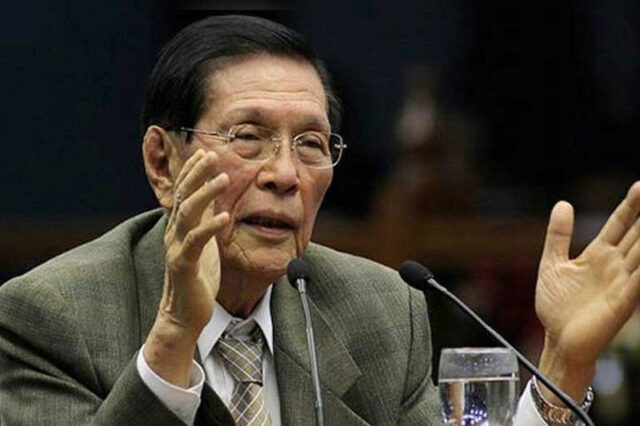
Enrile floats return to 1935 Constitution  

PHILSTAR FILE PHOTO

PRESIDENTIAL Legal Counsel Juan Ponce Enrile on Wednesday floated the idea of reverting to the Philippines 1935 Constitution, which has a broader provision for declaring martial rule.  

“We should follow the system under the 1935 Constitution,” he said. “Take the 1987 Constitution out; it has many inconsistencies,” said Mr. Enrile at a Senate hearing on constitutional amendments.  

The 98-year-old lawyer served as minister for justice and defense under the late dictator Ferdinand E. Marcos, father and namesake of the current Philippine president.   

Mr. Enrile pointed out the condition of “imminent danger” of insurrections or rebellions in declaring Martial Law, which is specified in the old Constitution.   

Under the current Constitution framed in 1987 after a popular street uprising toppled the Marcos dictatorship, the president can only declare martial law in an event of invasion or rebellion, and the period of effectivity is set at a maximum of 60 days.  

“They messed with the Martial Law provision. What use is martial law if the threat has come to pass?” Mr. Enrile said referring to the framers of the 1987 Constitution.  

Neri J. Colmenares, former representative of Bayan Muna Party-list and chair of the National Union of Peoples Lawyers, countered Mr. Enrile during the same hearing.   

“Our poverty now is not caused by the Constitution, so amending it is not the solution,” he said during the same hearing.   

“We keep on fighting against the Martial Law era because of the hardships experienced by the Filipino people,” said Mr. Colmenares, who was imprisoned as a student activist during the Marcos regime.  

“It should not be repeated because once the military rules and civilian authority is supplanted, we have a big problem,” he said. John Victor D. Ordoñez 

Minority House reps move to restore budget of state universities, colleges 

THE UNIVERSITY of the Philippines Diliman campus in Quezon City. — UP.EDU.PH 

MINORITY lawmakers in the House of Representatives on Wednesday filed a resolution calling for the restoration of the proposed budgets of state universities and colleges (SUCs).    

House Resolution 403 asks the House Committee on Appropriations to restore the budget cuts on SUCs and allocate P122 billion in supplementary funds for the safe reopening of schools.    

The budget for SUCs in the 2023 National Expenditure Program amounts to P93.08 billion, 10.48% lower than this years budget of P103.97 billion.   

Cuts in operating costs will adversely impact the capacity of SUCs to safely reopen their campuses for full face-to-face classes amid the COVID-19 pandemic. SUCs have also been given limited fiscal space for capital outlay which they strive to augment with their own revenue-generating sources,the resolution stated.  

The resolution was filed by Representatives Raoul Danniel A. Manuel of Kabataan, Arlene D. Brosas of Gabriela, and France L. Castro of ACT Teachers Matthew Carl L. Montecillo 

Senate OK’s bill deferring village elections 

PHILIPPINE STAR/ MIGUEL DE GUZMAN

THE SENATE on Wednesday approved on second reading a bill that seeks to postpone village and youth council elections to next year.   

Senate Minority Floor Leader Aquilino Martin D. Pimentel III and Deputy Minority Floor Leader Senator Ana Theresia N. Hontiveros voted against the measure, saying the postponement would also delay a democratic process.  

“Elections are essential in strengthening our democracy, especially at the grassroots,” Ms. Hontiveros said in plenary.  

“By holding elections, our young leaders asserted, which I also agreed with in principle, we guarantee the right to vote, create opportunities to hold barangay leaders accountable, and incentivize leadersperformance for good barangay governance,” she added.  

Ms. Hontiveros proposed to move the date of the elections to May 2023 instead of December, which was rejected. 

The House of Representatives on Tuesday approved a counterpart bill on its third and final reading. 

Under the bill, future elections will be held every three years starting December 2026. 

The elections for youth leaders and village officials were set for May last year but were postponed amid a coronavirus pandemic.  

The Commission on Elections (Comelec) has already spent more than a billion pesos on preparations for the elections, Comelec Chairman George Erwin M. Garcia earlier said. 

Mr. Garcia said all equipment and materials bought for the village and youth council elections could still be used if lawmakers decide to postpone these. John Victor D. Ordoñez

Zamboanga City buys 20 of 44 lots for new airport  

ZAMBOANGA CIO
ZAMBOANGA CIO

ZAMBOANGA City Mayor John M. Dalipe has signed the deed of sale for 20 of 44 lots that will be used as site for the new Zamboanga International airport.  

In a statement on Wednesday, the city government said the contracts were signed Friday following the recent installation of a marker for the airport project located about 17 kilometers east of the city center. 

State-owned LANDBANK of the Philippines has appraised the 44 properties needed for the airport, of which 10 are pending negotiations for purchase.   

An ordinance issued by the city council has designated the entire 175 hectares as a Utility, Transportation, and Services Zone for the airport, which means any structure built within the area starting Sept. 1 will no longer be compensated by the government.  

The city said the planned international airport will cost about P13.9 billion.  

Once completed, the new airport is expected to accommodate eight million passengers a year.   

An initial funding of P200 million has been allocated for the land acquisition, with P180 million already downloaded to the local government.    

The existing Zamboanga International Airport, located in the congested city center area, is planned for conversion into a commercial complex. MSJ 

National gov’t formally transfers 6 airports to Bangsamoro management 

BARMM MOTC

SIX airports owned and managed by the national government have been formally transferred to the Bangsamoro regions autonomous government, the  Civil Aviation Authority of the Philippines (CAAP) announced on Wednesday.  

In a press statement, CAAP said the agreement was signed Sept. 20 in Cotabato (Awang) Airport in Datu Odin Sinsuat, Maguindanao del Norte, one of the facilities covered by the transfer.   

The five other airports within the Bangsamoro Autonomous Region in Muslim Mindanao in southern Philippines are: Sanga-Sanga and Mapun airports in Tawi-Tawi, Jolo Airport in Sulu, and Wao and Malabang airports in Lanao del Sur.  

Under the memorandum of agreement, the Bangsamoro Ministry of Transportation and Communications through the Bangsamoro Airport Authority will take over the assets as well as management and supervision of the airports.   

The transfer of various national assets to the regional government is provided under Republic Act No. 11054 or the Bangsamoro Organic Law (BOL). MSJ 

Preparing the future

CHANG DUONG-UNSPLASH

There is a lot of talk nowadays about people quitting their jobs and looking for better opportunities. And, one of the issues of present is RTO or return-to-work orders. With the COVID-19 pandemic having forced a lot of people to make work-from-home arrangements since 2020, many now would rather leave their jobs than report back at the office full-time.

It is in this context, among others, that we hear older people complain about “millennials.” And many of their comments highlight negatives about this particular generation’s attitude, behavior, and work ethic. Older folk usually see younger ones as lacking in grit or resourcefulness, and determination to succeed. Of course, the older folk still measure “success” by way of wealth, asset ownership, and social status.

To put things in perspective, let us first define the generations: The Silent Generation (born 1928-1945), Baby Boomers (1946-1964), Generation X (1965-1980), Generation Y or “millennials” (1981-1996), and Generation Z (1997-2012). Borrowing these definitions, millennials, as of 2022, will be in the age range of 26-41 years.

Relative to Philippine population, as of 2020, the biggest segment is that of 25-54 years (37%), followed by 0-14 years (33%), 15-24 years (19%), 55-64 years (6%), and 65-above (5%). About 70% of the population is aged 54 and below, and 56% include millennials or Gen Y. Of the labor force, statistics also indicate that most employed Filipinos are males from the millennial age group.

Given these statistics, it is unsurprising that millennials are the subject of many of today’s discussions concerning changing work ethics and attitude. They are in focus primarily because of their numbers and dominance in the present labor force. Over time, the focus will shift to the succeeding generation, and with the comments — perhaps still generally negative — coming from millennials themselves.

I believe it is common for older generations to complain about the younger ones, and to compare their experiences — their successes and failures — with that of their children and grandchildren. It is also but normal, I believe, for grandparents and parents to be apprehensive and concerned about their children’s future, based on what they see in the present.

Frankly, I am just as guilty as others in quickly pointing out the perceived flaws of the younger generation, and how they don’t seem to measure up to the standards of my generation or the generation before me. But I have also come to realize that nothing can be more unfair, both to the present and to the past generations. After all, to do so is like comparing sweet apples to sour oranges.

Everything about their time and history and economy are different. And various external factors like geography, politics, economics, science, and technology all impact their respective eras or time. The world has changed significantly since the early 1900s, undergoing various kinds of evolutions and revolutions. Invariably, people have also changed over the same period.

But, as a matter of nature, each past generation always believes itself to be better than the present one. And each past generation always thinks that it had things worse during its time. The fact is, however, that each generation dealt with its problems using solutions limited to the resources available at the time. Successes in dealing with problems, in this regard, are always relative.

The benefit of hindsight is available only to the present. But history also shows us that the problems of the present are more complex than those of the past, while science reveals to the present that the problems of the future can be far worse. This situation raises the question of whether we, at present, are preparing for the future.

Towers always start with a strong foundation, then go up one segment at a time, with each segment building on top of the other. A weak foundation, or segment, or section will eventually lead to the tower’s collapse, whether partial or in full. Then, one needs to start all over again. Despite setbacks, however, a strong tower can eventually be completed, perhaps to stand the test of time.

It is the same way in building a nation. The thing is, in nation building, there is no reset button. There is no rewind. There is no going back, only moving forward. Starting over again is not an option. And, one can only hope that the future will always be better than the past. The burden is almost always on the present, to make sure that it is building on the past in a way that will ensure a better future.

One should thus be less critical of the weaknesses or shortcomings of the present generation, considering that the weakening of the present is also the failure of the past. The present is the reflection or manifestation of what the past had failed to do, while the future is the consequence of the failures of both past and present.

So, to the question which is the better generation, ultimately, the answer is, and should always be, the succeeding generation. Otherwise, there is no progress, no improvement of people’s lives. Only of the present adding its own failures to that of the past — and all these failures, to be inherited by the future. In this sense, one can assume that mankind is doomed, no matter what.

The challenge, I believe, is for older generations to be less critical. Instead, they should guide and assist the present generation in making sure that future generations will always do better than everybody else before them. Even if the present generation refuses to listen. For it is only in giving up on the present that we are truly, surely dooming the future.


Marvin Tort is a former managing editor of BusinessWorld, and a former chairman of the Philippine Press Council

matort@yahoo.com

The era of the global central bank may have arrived

JAY CASTOR-UNSPLASH

THE HAZARDS of keeping up with the Joneses. The relentlessness with which central banks are increasing interest rates reflects alarm at rising prices — and an aversion to being portrayed as insufficiently courageous at a time of economic peril. With so much hiking, officials should fret about the broader impact of the course they are on. The recession they are courting may be no ordinary downturn.

We are experiencing one of the most synchronized bouts of monetary and fiscal tightening in the past five decades, according to the World Bank. While the Federal Reserve may steal the show on Wednesday with a third consecutive hike of 75 basis points, rates will almost certainly march higher in coming days in places as diverse as the UK, Indonesia, the Philippines, and Norway. Earlier this month, the European Central Bank pulled off its first 75 basis-point jump, and left the door open for more. Sweden’s Riksbank shocked markets on Tuesday by lifting its main rate by a full percentage point.

It’s the countries that haven’t ratcheted up borrowing costs — often by significant margins — that stand out. The era of the global central bank may be with us in all but name, as much as policy makers themselves would bristle at the suggestion. About 90 central banks have raised rates this year, and half of them have increased by at least three-quarters of a percentage point in a single bound, based on Bloomberg News calculations. This week’s hikes alone may exceed 500 basis points.

Even the outliers are less than comfortable. The Bank of Japan, which has refused to budge, faces hard questions about why it clings to an ultra-easy stance when inflation has well and truly breached its 2% target. Inflation climbed to the highest in more than three decades last month. China is trying to support a fragile expansion, though authorities fret about inflation and are hesitant to unleash massive stimulus. (Such an approach by the People’s Bank of China would be limited in effectiveness, given Beijing’s COVID-zero strategy that has locked down huge cities.)

It’s a brave central banker who worries too loudly about other countries when headlines scream about inflation at home and politicians pile on. Most monetary agencies have at least some autonomy, but they still operate in a political environment. Policy makers face hostile questions in parliamentary hearings and some legislators go so far as to call for resignations. That’s an understandable, if disappointing, reaction when jumps in CPI lead the evening news. If officials harbor concerns about the subpar performance of the global economy — and there are sound reasons to be anxious — they tend to be publicly muted about it.

One person who has flagged the need to think globally is Fed Vice-Chair Lael Brainard. While not for a minute challenging the desirability of reining in demand and prices, she did keep an eye on the potential consequences of the global policy lockstep. “The rapidity of the tightening cycle and its global nature, as well as the uncertainty around the pace at which the effects of tighter financial conditions are working their way through aggregate demand, create risks associated with over-tightening,” Brainard said in a Sept. 7 speech. A bleak global outlook may also keep the Fed from moving by a full percentage point today, according to Bloomberg Economics.

In other words, the collapsing world picture will prevent a jumbo hike from turning into a mega hike. But that’s about it, for now. While World Bank economists don’t have a global slump as their baseline scenario, they are pessimistic. Drawing on insights from earlier recessions, a paper released last week noted that every world downdraft since 1970 has been presaged by significant weakness the prior year. “These developments do not auger well for the likelihood a global recession can be avoided,” wrote Justin Damien Guenette, M. Ayhan Kose and Naotaka Sugawara. It might conceivably resemble the 1982 vintage, they said. That was the slide that followed then-Fed Chair Paul Volcker’s assault on inflation. While inflation was beaten and Volcker earned his place in the pantheon of economic history, the economy was strangled in the process.

There’s danger today that, acting out of domestic concerns, the response to higher inflation will ricochet far beyond national boundaries. “Because these policies are highly synchronous across countries, they could be mutually compounding in their effects — tightening financial conditions and steepening the global growth slowdown more than envisioned,” according to Guenette, Kose and Sugawara.

A rallying cry for fans of central banks, whenever politicians make noises about rates, is to protect autonomy at almost any cost. But what about central banks being independent of each other, especially the Fed? The impact of the whole may be more consequential — and keenly felt — than the sum of the parts. An atlas may be as useful as dot-plots at this point.

BLOOMBERG OPINION

Alex Eala: A refreshing change

ALEXANDRA EALA with her US Open junior trophy. — ALEX EALA FB PAGE

Just as the world was mourning the death of Queen Elizabeth II, elsewhere in the news (aside from the Russian invasion of Ukraine), two sports icons announced their retirement from tennis while a 17-year-old Filipina achieved history by being the first tennis player from the Philippines to win a Junior Grand Slam in the US Open.

Serena Williams announced her retirement a few weeks ago after earning 23 Grand Slam titles over a 23-year period, having turned professional in 1995 at the age of 14, the same age that sister Venus turned pro after having shunned the juniors circuit. Serena turns 41 on Sept. 26. Serena, who played second fiddle to older sister Venus for a number of years before breaking into her own, is believed to have earned close to $100 million throughout her career.

In the movie King Richard and in interviews, Serena’s father-coach, Richard, revealed that “it was part of the plan to first develop Venus and later on, Serena, the better player capable of becoming world number one.” Serena so dominated the women’s circuit that she was ranked world number one by the Women’s Tennis Association (WTA) for 310 weeks.

It was clear that from the moment Williams announced her retirement that she had, unlike other athletes who lacked cerebral qualities and suffered from some kind of mental health issues, a vision of life to which she had given some serious and intelligent thought.

Joseph Coughlin, senior contributor of Forbes, wrote in mid-August that, “tennis star Serena Williams, announced her ‘retirement’ from tennis this week while challenging the very idea of retirement.” In an article she wrote for Vogue magazine, Williams said, “I have never liked the word ‘retirement.’ It doesn’t feel like a modern word to me… Maybe the best word to describe what I’m up to is ‘evolution.’ I’m here to tell you that I’m evolving away from tennis, toward other things that are important to me.” The other things important to Serena is motherhood and having another baby with husband, American born Armenian Alexis Ohanian, a well-known internet entrepreneur.

Another tennis great, “evolving away from tennis” is 41-year-old Swiss player, Roger Federer, winner of 20 Grand Slam singles titles.

Sports journalist Tom Goldman narrated on Twitter his own thoughts on Federer’s retirement and shared Federer’s sentiments.

Goldman states that: “he (Federer) is 41 (like Serena Williams) and done. He’s had three straight years of dealing with injuries and surgeries, mainly a bulky knee. And its proving to be too much.” Goldman then provides some quotes from Federer: “I’ve worked hard to return to full competitive form. But I also know my body’s capacities and limits, and its message to me lately has been clear.”

Federer will reportedly play one more event, the Laver Cup in London around the third week of September after the United Kingdom has buried Queen Elizabeth. By that time, King Charles III and Prime Minister Liz Truss would have been firmly ensconced in their respective positions as head of state and head of government.

The timing of Federer’s announcement, coming as it did after Serena Williams played and lost her farewell match to the 29-year-old Croatian-born Australian, Ajla Tomljanovic (who is 12 years Serena’s junior) in the third round, 7-5, 6-7 (3), 6-1, was not lost on keen observers of the international tennis scene. Federer saw for himself the young (almost half his age), fast, hard-hitting athletic players like eventual winner Carlos Alcaraz. As these same observers pointed out, Federer must have factored these into his decision to retire.

Those who have followed Federer’s career like Goldman point out the transformation of Federer, from a bratty 19-year-old to a “flowing, elegant, player who always seemed in position and never looked awkward. He had a grace and sportsmanship that seemed to fit Wimbledon best with its manners and history. He won a record eight singles titles there. Interestingly, that sportsmanship as an adult player is quite the opposite of him as a kid. He was often a terror on the court, throwing his racquet, swearing. He said it took till about the age of 19 to get that under control and to stop embarrassing his parents who threatened to watch him if he kept up his bad behavior.”

At the other end of the spectrum, in the women’s juniors ranks, comes Alexandra Maniego Eala, claiming and creating a real and international distinction as the first player from the Philippines to win a Grand Slam junior singles title, defeating Lucie Havlickova in the US Open girls final on Sept. 10 at the Billie Jean King Tennis Center in New York City.

The 17-year-old, 5’9”, 10th seed Eala claimed her first Grand Slam junior singles title with a 6-2, 6-4 win over number two seed Lucie Havlickova in the US Open girls’ final. The WTA Tour reported that Eala had already captured two Grand Slam junior doubles crowns, winning the 2020 Australian Open with Piska Nugroho and Roland Garros 2021 with Oksana Selekhmeteva. The WTA pointed out that Eala’s previous best performance in junior singles had been a semifinal run at Roland Garros 2020, where she fell to the eventual champion, France’s Elsa Jacquemot.

Eala had not competed at the junior level since December 2021 at the Orange Bowl tournament. During her absence from juniors’ competitions, Eala had competed among the pros as part of a plan to further sharpen her physical and mental skills. All throughout that period, she made sure she continued to be physically able to perform specific skill sets that would give her a competitive edge.

Eala revealed that her return paid off as the WTA reported she stormed through all six matches without dropping a set. Only Taylah Preston and Victoria Mboko managed to take her as far as a tiebreak, in the third round and semifinals respectively.

In the US Open finals, Eala spoiled Havlickova’s bid to become the first player to win two Grand Slam titles in one season since 2013. The Czech’s attempt to impose her power game on Eala did not work as the former buried herself under 21 unforced errors.

The thousands who listened to Eala speak in English and Tagalog after winning the crown were one in saying that such a speech was truly refreshing. Alex simply said that her victory was for Philippine tennis. No hackneyed, so-called obligatory declarations “that this victory was for flag and country” which create obvious disconnects as such assertions come from personalities who face all sorts of integrity and, possibly, even mental health issues.

However, here is a young well-bred lady who admits that she is ambitious enough to chase bigger dreams. She will, however, do it honestly, one step at a time, step-by-step, with the support of equally well-mannered parents who do not depend on media-driven propagandists, influencers, and politicians to launch an orchestrated lobby for support for their talented, obedient, and polite daughter.

Those familiar with sports politics know that Alex Eala stands for a refreshing change in a polluted and toxic environment. We pray and hope she remains an authentic role model who brings hope.


Philip Ella Juico’s areas of interest include the protection and promotion of democracy, free markets, sustainable development, social responsibility and sports as a tool for social development. He obtained his doctorate in business at De La Salle University. Dr. Juico served as secretary of Agrarian Reform during the Corazon C. Aquino administration.


Postcards from life’s journeys

KHAMKEO VILAYSING-UNSPLASH

AT A LUNCH get-together at Rockwell in January of 2020 (just before the hatches were slammed shut by the pandemic a couple of months after), some of us classmates with their WAC (Written Analysis of Cases) professor, Santi Dumlao, were wondering how best to celebrate a milestone event. The 50th anniversary of the Asian Institute of Management’s (AIM) batch ’71 was coming up in 2021.

“Why not a book?,” our former professor Santi suggested. Maybe letters to our grandchildren or life stories after AIM? It was one of those “nice to do” projects that could so easily get shelved after the photos were taken of the lunch. A book project was not really the stuff that bucket lists are made of.

To mark the golden jubilee of our AIM class in 2021, in the first quarter of that year AIM organized for our class a case discussion of Parasite, the best movie at the 2020 Oscars. The case discussion was done via Zoom and the class was asked to watch the movie beforehand. The case method was applied to the Korean movie about a downscale family taking over the household of an upper-class counterpart. (How should they have handled the exposure?) That mock classroom exercise (with an actual professor conducting the two-hour session) brought back memories from 50 years back… except that thankfully there were no grades given.

Again, the book project came up.

A rough organization was formed to shepherd the now-getting-more-concrete prospect of a book. There were guidelines given on the subject (life stories and lessons learned from AIM) and a word count of 1,000 to 1,500 words. Why not different lengths including what we eventually called “vignettes” of about 500 words? Easier to edit and read, and good as fillers between epic struggles of a few.

We really didn’t expect an avalanche of entries that would bury the editorial staff. We were not disappointed.

Just to prime the literary pump, Marily Orosa, our eventual publisher and adviser on the process of printing books (and award-winning Annual Reports) but not including marketing these (not a priority for this anyway improbable bestseller), arranged for a writer’s workshop, also by Zoom, to be run by distinguished author and columnist (“Penmanship”) Butch Dalisay. About 15 attended the virtual workshop.

This session on how to tell a story (begin in the middle) was intended to lower the fear factor for those who have limited their writing skills to marginal notes on business proposals (needs some work). Not sure if the workshop boosted literary skills or confidence. Anyway, the entries started trickling in.

The editorial board cast an even wider net for contributors by inviting family and friends to write about classmates who had passed on. Carlo Katigbak contributed a piece on his father, Nick. Rufo Colayco did a touching tribute to his brother Boy, part of Class ’71. Art Macapagal, the class president of our batch, was remembered by his widow (Mariter) and son (Alex). Mariel Francisco, a writer herself, had a moving Valentine piece for husband Chito.

The Class of 1971 had 70 graduates (well, 69 — but that’s another story). Of these, 26 contributed pieces to the book. Since the book turned out to be 289 pages with almost 100 entries, a few contributors submitted more than one entry. Add to this the relatives and friends who posted memories of their dearly departed ones.

The process of putting together a book with over 40 contributors can be daunting. The editorial board, mostly its managing editor, Emmy Hayward, living in Sydney and hosting most of the executive sessions on the project from there, was “not passive.” (This is a synonym for cracking the whip.) While there was an effort to preserve the distinct voices and style of the contributors, the narrative flow, grammatical correctness, and clarity of the prose needed to be upheld.

Of course, some contributors needed no editorial interference or pruning. Nards Silos’ essay citing the different approaches in education and management between Europe and America citing the book by Jean Jacques Servan-Scheiber, Le Defi Americaine, as he was deciding on a business career takes the reader on an intellectual trip, no less delightful for that. Nards was very involved with AIM in later years as a professor.

The book is done.

This is not a book review of First Fruits but a story of how we collected the postcards of our classmates’ journeys. It is a tribute to our Alma Mater, now headed by Dr. Jikyeong Kang, who also contributed the Afterword in the book.

AIM this year celebrates its 52nd year as an institution put together by Harvard Business School, Ateneo de Manila, and De La Salle as the first Asian Business school. The journey continues.


Tony Samson is chairman and CEO of TOUCH xda

ar.samson@yahoo.com

Putin mobilizes more troops, says West wants to destroy Russia

RUSSIAN PRESIDENT VLADIMIR PUTIN — KREMLIN.RU-COMMONS.WIKIMEDIA.ORG

KYIV/LONDON — Russian President Vladimir Putin on Wednesday announced a partial military mobilization, as Russian forces battle a Ukrainian counter-offensive that has regained some occupied territory.

In a televised address, Mr. Putin said the partial mobilization of its 2 million-strong military reserves was to defend Russia and its territories, claiming the West wants to destroy Russia and did not want peace in Ukraine.

“To protect homeland, its sovereignty (…), I consider it necessary to support the decision of the General Staff on partial mobilization,” he said.

Russian Defense Minister Sergei Shoigu said on Wednesday that President Putin’s decree on partial mobilization would see 300,000 additional personnel called up to serve in Russia’s military campaign in Ukraine.

In an interview with Russian state television, Mr. Shoigu said that students and those who served as conscripts would not be called up, and that the majority of Russia’s millions-strong reserves would not be drafted.

NOT BLUFFING
Mr. Putin restated his aim was to “liberate” east Ukraine’s Donbas industrial heartland region and that most people in the region did not want to return to what he called the “yoke” of Ukraine.

Mr. Putin said the West had engaged in nuclear blackmail, but Russia had “lots of weapons to reply” and that he was not bluffing.

Mr. Putin’s speech was a worrying escalation and the threats he made in it must be taken seriously, British foreign office minister Gillian Keegan told Sky News.

“Clearly it’s something that we should take very seriously because, you know, we’re not in control — I’m not sure he’s in control either, really. This is obviously an escalation,” she said.

Russia already considers Luhansk and Donetsk, which together make up the Donbas region Moscow partially occupied in 2014, to be independent states. Ukraine and the West consider all parts of Ukraine held by Russian forces to be illegally occupied.

Russia now holds about 60% of Donetsk and had captured nearly all of Luhansk by July after slow advances during months of intense fighting.

Those gains are now under threat after Russian forces were driven from neighboring Kharkiv province this month, losing control of their main supply lines for much of the Donetsk and Luhansk front lines.

In an apparently coordinated move, pro-Russian figures on Tuesday announced referendums for Sept. 23-27 in Luhansk, Donetsk, Kherson, and Zaporizhzhia provinces, representing around 15% of Ukrainian territory, or an area about the size of Hungary. — Reuters

China willing to make effort for peaceful ‘reunification’ with Taiwan

BEIJING — China is willing to make the utmost effort to strive for a peaceful “reunification” with Taiwan, a Chinese government spokesperson said on Wednesday, following weeks of military maneuvers and war games by Beijing near the island.

China claims democratically governed Taiwan as its own territory. Taiwan’s government rejects China’s sovereignty claims and says only the island’s people can decide their future.

China has been carrying out drills near Taiwan since early last month, after US House Speaker Nancy Pelosi visited Taipei, including firing missiles into waters near the island.

Ma Xiaoguang, a spokesperson for China’s Taiwan Affairs Office, told a news conference in Beijing ahead of next month’s once-in-five-years Communist Party congress that China was willing to make the greatest efforts to achieve peaceful “reunification.”

“The motherland must be reunified and will inevitably be reunified,” Mr. Ma said.

China’s determination to safeguard its territory is unwavering, he added.

China has proposed a “one country, two systems” model for Taiwan, similar to the formula under which the former British colony of Hong Kong returned to Chinese rule in 1997.

Mr. Ma said Taiwan could have a “social system different from the mainland” that ensured their way of life was respected, including religious freedoms, but that was “under the precondition of ensuring national sovereignty, security, and development interests.”

All mainstream Taiwanese political parties have rejected that proposal and it has almost no public support, according to opinion polls, especially after Beijing imposed a national security law on Hong Kong in 2020 after the city was rocked by sometimes violent anti-government and anti-China protests.

China has also never renounced the use of force to bring Taiwan under its control, and in 2005 passed a law giving the country the legal basis for military action against Taiwan if it secedes or seems about to.

China has refused to talk to Taiwan President Tsai Ing-wen since she first took office in 2016, believing she is a separatist. She has repeatedly offered to talk on the basis of equality and mutual respect.

But Ms. Tsai’s predecessor Ma Ying-jeou held a landmark meeting Chinese President Xi Jinping in Singapore in 2015.

Speaking at the same news conference, Qiu Kaiming, head of the research department at the party’s Taiwan Work Office, said the Xi-Ma meeting showed their “strategic flexibility” towards Taiwan.

That “showed the world that Chinese people on both sides of the Strait are absolutely wise and capable enough of solving our own problems,” he added.

Taiwan’s government says that as the island has never been ruled by the People’s Republic of China, its sovereignty claims are void. — Reuters

Defying Vatican, Flemish bishops allow blessing of same-sex unions

VATICAN CITY — Flemish Roman Catholic bishops on Tuesday issued a document effectively allowing the blessing of same-sex unions, in direct defiance of a ruling against such practices by the Vatican’s doctrinal office.

The document published on the website of the Bishops’ Conference of Belgium suggested a ritual that included a prayer and a benediction for stable same-sex unions. But it stressed that it was not “what the Church understands by a sacramental marriage.”

It said the Church wanted to be “pastorally close to homosexual persons” and be a “welcoming Church that excludes no one.”

The ritual would start with prayers and includes a commitment by the two people in front of family and friends to be faithful to each other. It would end with more prayer and what the document called a “benediction.”

A Vatican spokesman had no immediate comment.

In March 2021, in response to formal questions from a number of Roman Catholic dioceses on whether the practice of blessing same-sex unions was allowed, the Vatican’s doctrinal office, the Congregation for the Doctrine of the Faith (CDF), ruled that it was not.

At the time, the CDF said its ruling was “not intended to be a form of unjust discrimination, but rather a reminder of the truth of the liturgical rite” of the sacrament of marriage and the blessing associated with it.

In response to that ruling, Bishop John Bonny of Antwerp said he felt “shame for my Church” and apologized to those he said had been hurt by the “painful and incomprehensible” decision.

POPE SUPPORTS CIVIL UNIONS BUT NOT MARRIAGE
Pope Francis has said he is opposed to same-sex marriage in the Church but supports civil union legislation to give same-sex couples legal protection and rights such as inheritance and shared health care.

A spokesman for the bishops, Geert De Kerpel, said their intention was not to defy the Vatican ruling.

“This is first and foremost a positive message,” he told Reuters, adding that it conformed with the pope’s calls for a more inclusive Church.

The Flemish bishops document said that some Catholic gays remained celibate and that the Church appreciated it. The Church teaches that while homosexual orientation is not sinful, homosexual acts are.

But the document added that “some prefer to live as a couple, in lasting and faithful union with a partner” and that such a relationship “can also be a source of peace and shared happiness.”

The bishops denounced “homophobic violence,” and said they wanted to “structurally anchor their pastoral commitment to homosexual persons.”

They announced the appointment of Willy Bombeek, a gay Catholic, as an additional staff member to their department for pastoral care of families to oversee care of gay Catholics.

One with similar duties would be appointed to each diocese in Flanders, the Dutch-speaking part of Belgium.

“I’m proud to belong to the Flemish Church,” Bombeek told Reuters. “I hope that religious people in other countries will also get to experience this, and hopefully, this is only the beginning.”

Francis DeBernardo, executive director of US-based Catholic LGBTQ group New Ways Ministry, said the move would be a blessing for both the couple and for the Church.

“These prelates recognize that love is love. Love is more important than sexual behavior, and love is something that the Church should always bless,” he said in a statement. — Reuters