Home Blog Page 5882

SM makes going green easier


IN the past, if one wanted more sustainable finds to place in the home or wardrobe, one needed to go to some obscure little shop run by some free spirit. This means that living sustainability, now a bit of an urgency, would have been inaccessible to many. SM Retail, Inc., the retail arm of SM Investments Corp., is now making sustainable living easier to achieve with SM Green Finds.

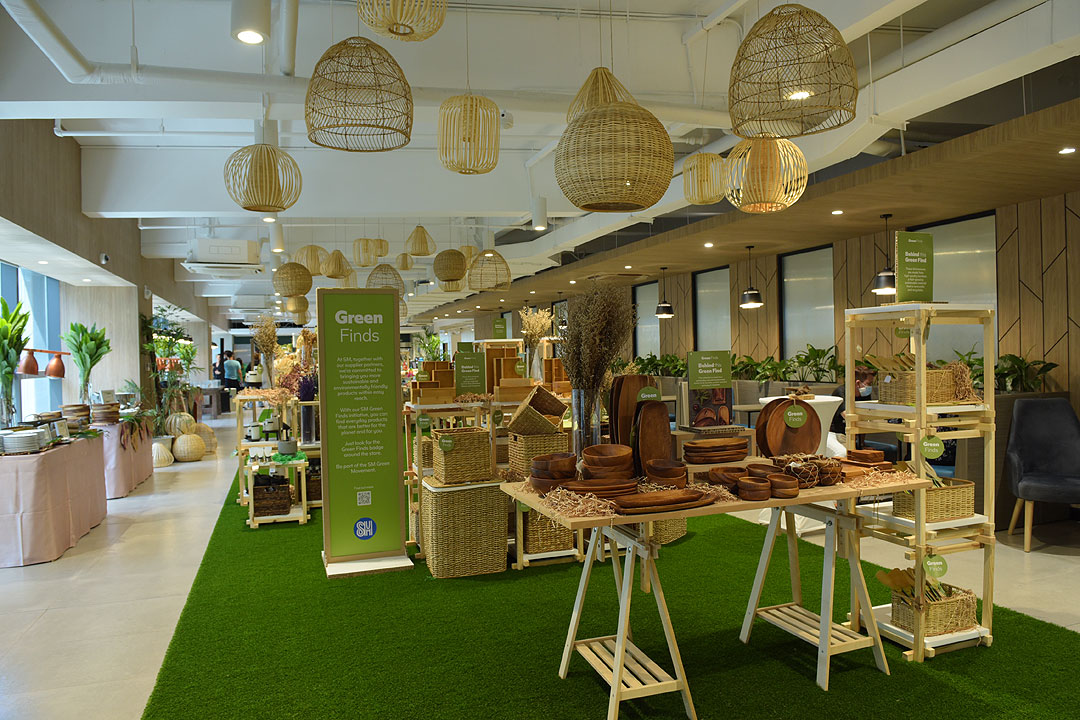
Like charity, sustainability begins at home, so on June 10, media guests were taken on a tour of SM Retail’s new headquarters in the Mall of Asia complex. The new building boasts of lighting automation, centralized air, recycled water, energy-saving glass, and waste management programs.

The tour ended with a display of their green products. One can expect to see wooden bowls and woven grass baskets and such in a store like Kultura, SM’s Filipiniana store, but apparently, SM’s green initiatives extend to other parts of the home. Watsons, and other beauty brands, for example, boasted bottles of lotion and conditioner in recycled (and recyclable) plastic, made with natural and biodegradable ingredients. Catherine Ileto, Vice-President for Corporate Communications for SM Retail, pointed to baby toys made with silica (no plastic), and bedsheets made with bamboo fibers (bamboo uses less water and resources to grow), packaged in cardboard bundlers instead of plastic. Selections from their own stocks have also done away with a lot of plastic, using paper bags and paper packaging in stores.

They’ve also been partnering with a lot of micro, small to medium enterprises (MSMEs) for sourcing products made with sustainable materials, consulting with the Department of Trade and Industry (DTI).

Speaking about mainstreaming sustainability, Ms. Ileto said, “That’s really the intent: to make all of these green finds accessible.”

Still, it’s a business, and businesses need to make profit. In the long run, does SM see green in going green?

In response to a question about sustainability translating into profitability, SM Retail, Inc. President and CEO Ponciano C. Manalo, Jr., said in an interview, “It will have to be. We’ll have to be able to find the right scale among our local producers to be able to make it really profitable and make it sustainable for them. But for us, it’s also (for) our suppliers.

“When we give them work to do, and we feature their products, what happens is people buy it, and there’s a ripple effect,” said Mr. Manalo in a mixture of English and Filipino. “We have a lot of MSMEs that we partner with, and we help them. Over time, that should build itself up.

“The question is not: ‘is it expensive?’ The question is, ‘is it a good investment?’ As an investment, what it does is it pays out in the end.”

He says that the Filipino mindset has always been geared towards sustainability, or at least recycling. He points out how our elders used to keep and pack away packaging for future use, among other practices. “It’s now aligned with what is now being a global phenomenon.”

According to the SM Investments Corp. website, as of the fiscal year ending 2020, SM Retail operates 66 SM Stores, 59 SM Supermarkets, 52 SM Hypermarkets, 209 Savemore stores, 71 WalterMart stores, 1,012 Alfamarts, and 1,550 specialty stores scattered over several brands. Its sister, SM Prime Holdings, is the largest mall operator in the Philippines.

On a related note, both sources said that SM Malls have sustainability measures in place, such as using LED lighting, water efficiency measures, among other green building initiatives.

Asked why sustainability measures have become so important to SM, Ms. Ileto said, “We’re the largest retail brand in the Philippines. We can really launch this at scale. We can advocate being the brand that advocates for green lifestyles. There’s really an awakening for the consumer now —  even in the little choices they make.”

“Sustainability is a growing phenomenon in the world. It’s not just SM. Everybody in the world is looking at sustainability,” said Mr. Ponciano. “I think my generation, probably, we’re part of the modern generation where we waste everything. But younger people… they’re becoming more conscious.

“It’s because of you. It’s your future. We can just make money and forget about everything else. I’m being very candid, or almost joking, in a way,” he said.

“But we understand what it’s all about. It’s a big word. It’s education, it’s social, it’s economic; it’s everything that you can think of. You can put all the labels that you want. At the end of the day, we know it’s important. It’s for the generation that’s coming. We know that. The earlier that we’re able to get people to be aware and conscious: that’s our part to play.” — Joseph L. Garcia

Common tower providers see no threat from satellite firms

By Arjay L. Balinbin, Senior Reporter

SOME telecommunication tower companies operating in the Philippines said the entry of satellite firms into the local scene poses no threat to their business or to that of traditional telco providers, as the technology complements terrestrial connectivity, which does not reach many of the country’s remote areas.

“If you look at the geographical situation in the Philippines, some areas will be best served by satellite technology,” edotco Group Chief Executive Officer Adlan Tajudin told BusinessWorld in a recent interview.

“They complement us. We still need towers. It’s just that instead of transmitting the signal through microwave or through fiber, they transmit through satellite. I think it really, really complements us,” he added.

“Typically, that solution is for the rural areas. It helps in terms of accelerating rural coverage.”

Rahul Singh, country manager of Singapore-based iSON Tower Ltd. Inc., which is set to build digital infrastructure in the Philippines, said in an e-mailed reply to questions: “Well, the Philippines as a country needs 50,000 towers, fiber connectivity, high-speed voice and internet, and all telecom ecosystem players together are addressing these needs.”

“Typically, satellite connectivity companies coexist with traditional MNOs (mobile network operators)/tower companies, and are not considered to be a threat to traditional telecommunications operators as the service will serve roughly 3% to 4% of the customers that traditional providers find most difficult to reach,” he added.

“From ISON Tower perspective, we are committed to working with mobile network operators enabling voice and high-speed broadband internet for Philippine consumers.”

He noted that the company is rolling out tower sites in Mindanao and the Visayas to enable voice and high-speed internet along with telecom operators.

Alliance Towers Corp. President and Chief Operating Officer Alvin D. Tolentino said the entry of foreign satellite companies into the Philippines will be “good for the economy,” as local telecommunications providers will be forced to keep up.

“It’s a question of scale. If you are just serving one barangay on a remote island, it doesn’t make sense for you to invest in a submarine cable… just to connect one barangay. In that sense, it’s cheaper to do satellite,” he said.

“But if you’re looking at Cebu or places where you can get more users, I think the traditional (connectivity) is still more economical,” he added.

The National Telecommunications Commission (NTC) recently approved the registration of Starlink Internet Services Philippines, Inc. as a value-added service provider (VAS). Starlink is a subsidiary of Elon Musk’s Space Exploration Technologies Corp.

The agency expects more foreign satellite broadband providers to enter the Philippines because of the amended Public Service Act, which eases the restrictions on full foreign ownership of businesses in key sectors such as telecommunications, shipping, airlines, railways, and subways.

Starlink’s registration as a VAS provider allows it to directly access satellite systems, as well as build and operate broadband facilities to offer internet services in the country. The company’s certificate of registration is valid until April 14, 2023. It is expected to cover villages in urban and suburban areas and rural areas that remain unserved or underserved with internet access services.

“The service is expected to bring cost-effective internet access in these areas,” the NTC said in a statement.

Bandage made with coconut wins Good Design Awards 2022

A WOUND dressing made from nata de coco (coco cellulose) bagged several major awards at the second Good Design Awards on June 14, held at the Ayala Museum in Makati City.

The Good Design Award Philippines is a national design excellence recognition program initiated by the Design Center of the Philippines — an attached agency of the Department of Trade and Industry (DTI), and mandated to promote design as a tool for Philippine product quality, competitiveness, and branding.

Launched in 2019, the Good Design Award Philippines as described in a briefer as seeking “to discover local artists, designers, and businesses with outstanding designs that embody the universal design values of form, function, innovation, plus the Philippine value of malasakit (compassion).”

The program is held bi-annually in partnership with the United Nations Development Program in the Philippines (UNDP Philippines), the ASEAN Japan Center, and the Japan Institute of Design Promotion.

The competition highlights malasakit as “the heart of good design” and “its ability to improve lives and to address social, economic, and environmental sustainability.”

This year, the Good Design Jury was tasked to evaluate 161 entries. Out of 150 entries, 45 were shortlisted among the following categories: object-making (two); image-making (16); place-making (16); and systems/services design (11).

The entries were evaluated according to form, functionality, innovativeness, and malasakit  which were all given equal weight.

This year’s competition jury was composed of by architect Royal Pineda of BUDJI+ROYAL Architecture + Design who chaired the jury, architect Joey Yupangco, creative director Jowee Alviar, entrepreneur Reese Fernandez-Ruiz, industrial designer Kenneth Cobonpue, and jewelry designer Bea Valdes.

Out of the shortlisted entries, 11 finalists received awards.

THE WINNING DESIGNS
The awards are classified into Red, Gold, Green, and Malasakit Award Grand Prix. The Red Award “entails that an idea showcased good design with innovation and function in mind”; the Gold Award: Best in Show, “exemplifies the best application in each design category”; the Green Award (Special Award), is “a special award for outstanding entries that address the United Nation’s Sustainability and Development Goals (UN SDGs) related to the environment and sustainability”; and the Malasakit Award Gran Prix, is “the highest form of recognition for the best entry exemplifying design excellence and having the most impact in addressing the UN SDGs.”

The winners of the Red Award for Image-making (advertising) are the Macho Choir by the DDB Tribal Worldwide Philippines; Tubbataha Coral Rip by the TBWA\Santiago Mangada Puno Advertising, Inc.; Boysen, This Is a Tree by TBWA\Santiago Mangada Puno Advertising, Inc.; and the CCP Baybayan by TBWA\Santiago Mangada Puno Advertising, Inc. In Place-making, the winners are Streetlight Tagpuro by Leandro V. Locsin Partners; and Museo Ni Jesse Robredo by GPAD Studio. In Services and Systems Design, the winner is the Mechanical Water Kiosk by Alternative Indigenous Development Foundation, Inc.

The Gold Award winners in Object-making are the Nata De Coco Wound Dressing by Patchmed Cosmetic Trading; and Tumindig by Komiket, Inc. In Place-Making, the winner is MLR Polo Pavilion by Sangay Architects; while sakay.ph by Sakay Mobility Philippines, Corp. won for Service/Systems Design.

The Green Award and Malasakit Gran Prix Award were both given to the Nata De Coco Wound Dressing by Patchmed Cosmetic Trading.

Winners received the Arturo Luz Tribute trophy. Winners also get the lifetime use of the Good Design Award seal of excellence, and an appearance in the Good Design Award Philippines Yearbook and Winners gallery.

COCONUT DRESSING
“I had the idea (for the product) when I was still working at the Philippine General Hospital (PGH). Every time I see a patient in PGH, nakaka-awa (it’s pitiful). They don’t have money for the treatment,” Malasakit Award Gran Prix winner Denver O. Chicano said in his acceptance speech.

“Care is very important. Everything that we do is service…Care is creativity, attentiveness, resourcefulness, and enthusiasm,” he said of his profession as a nurse.

After resigning from the PGH, Mr. Chicano and his wife (who is a cosmetic surgeon) set up a wound clinic that catered to patients who cannot afford treatment in hospitals.

It was also at this time that Mr. Chicano began developing the coconut cellulose wound dressing called CocoPatch through PatchMed Cosmetic Trading, a pioneering biotechnology company focused on wound care and bio-engineered coco cellulose technology. Mr. Chicano is the company’s managing director.

The CocoPatch’s active ingredient, monolaurin is also derived from coconuts. According to the CocoPatch Facebook page, monolaurin is “a monoester formed from lauric acid and derived from virgin coconut oil, has profound antibacterial, antiviral, and anti-fungal properties.” Mr. Chicano said that it has a shelf life of two years, and can last three days on a wound before needing to be changed.

“There was a German company [Lohmann & Rauscher] who went here to buy the technology from me pero hindi ko siya binenta (but I did not sell it),” Mr. Chicano said. “Kailangan makilala ang Filipino with the product (The Filipino needs to be recognized with the product).”

PatchMed also provides products for cosmetic and industrial application of coconut cellulose. They have partners abroad and export to other countries.

“I invented it to provide availability of wound dressing specializing our coconuts,” Mr. Chicano told BusinessWorld before the awarding ceremony.

“Information dissemination that the product exists would really help. Right now, we are supported by the Department of Science and Technology (DoST) in continuing to improve the product,” he said. 

WHAT’S NEXT FOR THE AWARDEES
Executive Director of the Design Center of the Philippines Rhea Matute says that this year, the Good Design Award winners will participate at the ASEAN Japan Center’s Good Design Selection.

“ASEAN Japan Center will help find buying agents, and trade networks to make it a sustainable business opportunity for the winners of the Good Design Awards,” Ms. Matute told BusinessWorld, shortly after the ceremony.

“Since 2017, we’ve been trying to get a way to connect Good Design Philippines with [Japan’s seal of excellence for quality design] G-Mark,” Ms. Matute said. “Today, when they formalized that there will be a network established between Good Design Philippines, and bring all these new awardees, we need to prepare them so that it will be communicated with the Japanese jurors.”

Earning the G-Mark Seal of distinction, Ms. Matute said, “… commands a premium and earns a trust of Japanese consumers.”

The judging period will be in August, while the awarding is slated around the yearend. — Michelle Anne P. Soliman

Tax court affirms trading firm’s tax refund of around P13 million

THE Court of Tax Appeals (CTA) has affirmed a division ruling on PTT Philippines Trading Corp.’s refund of P13.35 million representing its erroneously paid advance value-added tax (VAT) on its importation of diesel fuel for the period covering Sept. 20, 2013, to Jan. 20, 2014.

In a decision on June 14 and made public on June 16, the CTA full court denied the appeal of the commissioner of internal revenue (CIR) to reverse the ruling, as it agreed with the Third Division granting the company’s refund.

“The Court in Division is correct in granting the refund of the VAT collected by petitioner (CIR) from the respondent (PTT) on the imported fuel in the total amount of P13.3 million since it is an illegal or erroneous tax or one which was levied without statutory authority,” according to the ruling written by CTA Associate Justice Marian Ivy F. Reyes-Fajardo.

PTT is a domestic corporation that engages in the distribution, marketing, and selling of petroleum and petroleum-related products within the Subic Bay Freeport Zone and other special economic and export processing zones in the Philippines.

It had previously imported diesel fuel from the Cayman Islands, British West Indies from Sept. 20, 2013 to Jan. 20, 2014, and paid VAT worth P13.35 to the Bureau of Customs.

Republic Act No. 7227, or the Bases Conversion and Development Act of 1992, grants locators in the former Subic and Clark military bases incentives such as tax and duty-free importation. PTT operates a fuel receiving terminal in the Subic Special Economic Zone.

The tax court noted that the company was duly registered with the Subic Bay Freeport Enterprise, which grants tax and duty-free importation of raw materials and fuel.

Under Republic Act No. 7916, or the Special Economic Zone Act of 1995, no taxes shall be imposed on business establishments within economic zones.

The Bureau of Internal Revenue’s (BIR) Revenue Regulations No. 2-2012, which imposes taxes on Freeport and Economic Zone (FEZ) enterprises, had been declared by the Supreme Court as unconstitutional for illegally imposing taxes on these areas that should enjoy tax exemptions.

PTT had sold the imported diesel fuel to Clark Development Corp., which the CTA said is a tax-exempt entity.

“Adverting to our earlier discussion, the diesel fuel imported by the respondent (PTT) is exempt from VAT,” it said.

The CTA noted the laws previously cited consider FEZs as foreign territories and when resources are brought to these areas, the goods remain in foreign territory and are not subject to Philippine customs and tax laws. — John Victor D. Ordoñez

Rates of Treasury bills, bonds may rise ahead of BSP review

BW FILE PHOTO

RATES of government securities are expected to climb this week ahead of the central bank’s policy review where it is widely expected to raise borrowing costs, which would cause investors to ask for higher yields.

The Bureau of the Treasury (BTr) will offer P15 billion in Treasury bills (T-bills) on Monday, or P5 billion each in 91-, 182-, and 364-day debt papers.

On Tuesday, the BTr will auction off P35 billion in fresh 10-year Treasury bonds (T-bonds).

Two traders in a Viber message said that rates are expected to climb this week ahead of the central bank’s policy meeting on June 23 where it is expected to raise rates by 50 basis points (bps), bigger than the 25-bp hike at its May 19 meeting that kicked off its tightening cycle and despite incoming Bangko Sentral ng Pilipinas (BSP) Governor Felipe M. Medalla’s earlier signals of a gradual policy normalization.

“I think it is market consensus that rates will be higher [this] week, [especially] with a growing number of analysts expecting a 50-bp hike from BSP. This [is] despite earlier guidance that they will do a gradual tightening,” the first trader said,

The first trader said the 10-year bonds on offer this week could fetch yields between 7% and 7.5%.

The second trader said T-bill yields could move 5-10 bps higher and the 10-year bond’s rate could be quoted from 7.125% to 7.5%.

Rizal Commercial Banking Corp. Chief Economist Michael L. Ricafort likewise sees rates moving slightly higher this week to track the rise in secondary market yields after the US Federal Reserve’s 75-bp hike last week and signals on the BSP’s path towards normalization from its incoming chief.

Mr. Ricafort said while Mr. Medalla signaled gradual tightening and ruled out hikes bigger than 25 bps ahead of the Fed’s decision last week, this could change following the US central bank’s bigger-than-expected increase.

The Monetary Board is holding a policy meeting on Thursday, June 23. Mr. Medalla last week said a rate increase this week is a “sure thing,” with hikes at subsequent meetings also possible.

Analysts in a BusinessWorld poll were divided on the magnitude of the BSP’s move on Thursday, with nine expecting another 25-bp increase and six betting on a 50-bp hike. 

At the secondary market on Friday, the 91-, 182-, and 364-day T-bills were quoted at 1.5705%, 1.9366%, and 2.2014%, respectively, based on the PHP Bloomberg Valuation Reference Rates published on the Philippine Dealing System’s website.

Meanwhile, the 10-year bond fetched a yield of 6.9816%.

Last week, the BTr raised just P14 billion from its offer of T-bills, even as total bids reached P29.68 billion, nearly double the P15-billion offer.

Broken down, the Treasury raised P5 billion as planned through the 91-day T-bills, with total bids reaching P12.33 billion. The average rate of the tenor went up by 13.2 bps to 1.572% from 1.44% previously.

The government also made a full P5-billion award of its offer of 182-day T-bills as tenders reached P15.02 billion. The average rate of the six-month tenor went up by 10 bps to 1.934% from 1.834%.

Meanwhile, the BTr partially awarded its offer of one-year securities, raising just P3.924 billion out of the P5-billion program even as tenders reached P6.84 billion in bids. The average rate of the one-year papers went up by 2.8 bps to 2.325% from the 2.297% seen at the previous auction, where it made a full award.

The Treasury wants to raise P250 billion from the domestic market in June, or P75 billion through T-bills and P175 billion through T-bonds.

The government borrows from local and external sources to help fund a budget deficit capped at 7.6% of gross domestic product this year. — T.J. Tomas

Two more gold for Yulo at the Asian Championships in Qatar

CARLOS Yulo with GAP president Cynthia Carreon. — GYMNASTICS ASSOCIATION OF THE PHILIPPINES

By Joey Villar

IN 2018 in Doha, Qatar, Carlos “Caloy” Yulo stood at the podium and shed tears of joy after delivering the Philippines a historic first Artistic Gymnastics World Championships medal — a bronze.

Four years into the present and the diminutive but big-hearted gem from Leveriza, Manila has harvested gold after gold in the international stage like he’s picking grapes from a vineyard.

And the most recent of this mighty conquests by the 22-year-old, three-time world champion came in the Asian Championships held in the exact, same place in the Arab country where plucked two more glittering gold in vault and parallel bars on Saturday night.

The quintuple Southeast Asian Games gold winner was nothing short of spectacular in vault where he registered an average of 14.884 from his two attempts of 14.967 and 14.800 as well in parallel bars where he tallied 15.167 on a degree of difficulty scale of 6.300 and execution score of 8.867.

Mr. Yulo’s splendor reduced the rest of the field in awe of the spectacle they were left to witness and settled for crumbs — a silver and bronze to South Korea’s Kim Hansol and Japan’s Shiga Tachibana in vault and Japan’s Tsuyoshi Hasegawa and China’s Yin Dehang in parallel bars, respectively.

Gymnastics Association of the Philippines (GAP) president Cynthia Carrion, who was in Doha to accompany Mr. Yulo, said the latter could have dominated the Asian Games in Hangzhou, China had it not been postponed due to the coronavirus disease 2019 (COVID-19) pandemic.

“This Asian Championships is the same as the Asian Games because all of the region’s best are here,” Ms. Carrion told The STAR. It capped a glorious performance for Mr. Yulo, who also struck gold in his pet floor exercise on Friday and snared silver in the individual all-around on Thursday.

It also opened the boundless horizon for Mr. Yulo in this year’s World Championships in October in Liverpool, England where he is a heavy favorite not just in floor exercise and vault where he was world titlist in 2019 in Stuttgart, Germany and last year in Ktakyushu, Japan, but also other apparatuses plus the individual all-around.

While Mr. Yulo was expected to reign supreme in vault, there were some doubts if he would perform better in the parallel bars as he came in sixth in the qualifying round on Friday.

That effort costs Mr. Yulo the individual all-around gold that was snatched by Chinese Shi Cong.

But when Mr. Yulo summoned the same force, power and grace in the finale that made him one of the best, if not the best, male gymnasts in the world, there was little doubt of the outcome where the pocket-sized wunderkind stood on top of everyone, received his glimmering medal and sang the national anthem while the country’s flag is being raised.

Refurbishing old jeans is one way to be sustainable

Levi’s new flagship store offers hand-painting, pins, patches, and embroidery to make the old look new

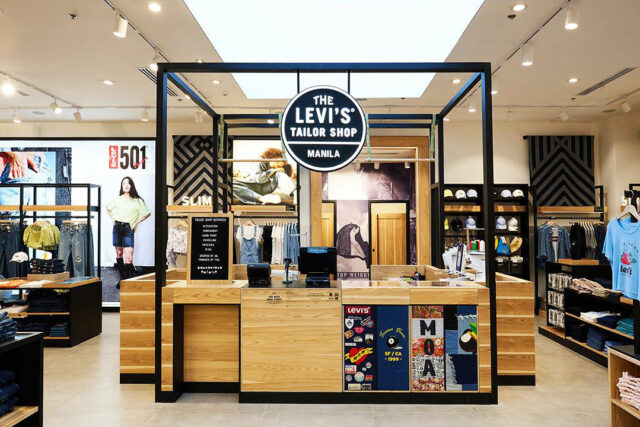
FANCY a pair of hand-painted jeans? At Levi’s new flagship store at the SM Mall of Asia, one can have any old Levi’s outfits (jackets included) refurbished, either with digital embroidery, painting, pins, and patches.

The tailor station at the store that does this is one of several around the country, but the one in the Mall of Asia flagship is the only one that offers hand-painting and embroidery. Refurbishing old Levi’s is a way for the company, founded in 1873, to prove its sustainability goals, as part of a campaign called Buy Better, Wear Longer.

Marielle M. Ardiente, VP for Marketing and Customer Experience for Signature Lines, Inc. (which distributes Levi’s in all the SM stores in the country) said, “Levi’s has efforts to, as much as possible, keep your clothes as long as you can.” She pointed out that her own jean jacket was about four years old, and has steadily grown its own collection of patches and pins, during the opening earlier this month.

“Foot traffic has already returned to its pre-pandemic levels,” she said, in response to a question about opening a flagship store in the (hopefully) last days of the pandemic.

These are not the only sustainability measures that the company has since adopted, in light of pollution, climate change, and other issues. Ms. Ardiente pointed out that the Fresh line is dyed in pale pastels made with plant-based dyes.

The official Twitter account of the United Nations posted that “10,000 liters of water are needed to make a single pair of jeans.”

“By shopping 2nd-hand, buying eco-friendly clothes & donating what you no longer use, you can reduce the environmental impact of your (jeans emoji) & protect our (planet Earth emoji),” the tweet continued.

Mindful of this, Levi’s has released a line called Waterless (styled as Water<Less). Its website says that the initiative came from people looking for the rugged, beat-up look for jeans, achieved with stonewashing and other techniques. “Sometimes we simply use a thimble of water and a bit of ozone instead of detergent. To get a soft feel typically achieved by using fabric softener, we might tumble jeans with bottle caps and golf balls, taking the water out of the wash altogether. The end result remains the same: the jeans you love made by using less water.”

On another note, Ms. Ardiente points out that Levi’s 501’s use organic cotton. She noted, “The younger generation is very, very particular with the companies that have sustainability as a value.”

Levi’s was founded in 1873 by immigrant Levi Strauss and his business partner, Jacob Davis, who both patented denim work pants with copper rivets, suitable for miners in California — the company is gearing up to celebrate its 150th anniversary. Since then, blue jeans have entered popular culture as a chameleonic piece in anyone’s wardrobe: a good pair can make one look cool, hardworking, casual, or sexy. The late Vogue editor Diana Vreeland pronounced: “Blue jeans are the most beautiful thing since the gondola.”

In those 150 years, the whole world has picked up on jeans, and any clothing company worth their salt has sold at least a pair. How does Levi’s keep its edge still? “Basically, they’re the inventor of denim (jeans),” said Ms. Ardiente. “In terms of the design, construction, durability and the trust in the brand — when you say Levi’s, they know it’s going to last.” — Joseph L. Garcia

Higher capital requirement for rural banks ‘necessary’

BW FILE PHOTO

A HIKE in rural banks’ minimum capital requirements is “necessary” to protect depositors and ensure a healthy financial system, the Bangko Sentral ng Pilipinas’ (BSP) incoming chief said.

Monetary Board member and incoming BSP Governor Felipe M. Medalla said in a virtual roundtable discussion with BusinessWorld editors last week that some rural banks are operating in an unsustainable manner and requiring them to have more capital buffers will benefit the depositing public.

“Every time we close a rural bank, it’s because even without bad loans, they are having difficulty making a profit,” Mr. Medalla said. “For instance, there are rural banks with annual operating costs say P5 million, which is not [good] because you have a lot of expenses and the interest margins are about exactly that or even less. One little mistake and they’re dead… They cannot even have checks and balances.”

“In other words, size is necessary. Clearly, the justification for higher capitalization is you want to protect the depositors. A rural bank that could barely earn interest margins to cover electricity and salaries is always a disaster waiting to happen,” he said.

The BSP plans to increase the minimum capital requirement of rural banks to strengthen and enhance the capacity of these smaller lenders.

A draft circular showed the central bank wants to require rural banks to put up capital of at least P60 million for those with just head offices and less than five branches) and P200 million for those with more than five branches. The office count excludes branch-lite units.

Under the current regulations, rural banks and cooperatives must have a minimum capitalization of P10 million to P200 million depending on the location and number of branches.

Under the draft, rural lenders will have three years to comply with the new rules.

The planned adjustment forms part of initiatives under the Rural Bank Strengthening Program, which was approved by the Monetary Board on March 3.

Industry players have said some rural banks would find it difficult to meet the proposed requirement and would be forced to shut down, adding the increase should not be done across the board as this could stunt financial inclusion gains, as these lenders mostly serve the agricultural sector as well as small businesses in the countryside.

For his part, Mr. Medalla said the BSP would be willing to give rural banks a reprieve on a case-to-case basis.

“My view is if there are rural banks that are below the targets, the regulations, but they have fantastic records, then of course, we can probably say, ‘Oh, you’re the exception, we’ll give you time,’” he said.

“But if you’ve lost money in the past two years, there’s no prospect of you making money because you can barely cover operating costs. We would rather let you voluntarily exit. Either you merge with somebody, get a bigger player that can come in and help you expand, or of course you can voluntarily close,” Mr. Medalla added.

He, however, emphasized the need to implement the new capital requirements “in the most reasonable amount of time as possible,” saying the 10-year compliance period proposed by one rural banker would be “too long” because prices are not constant.

“Of course, the discussions with the rural bankers will continue. And if we can find a tweak…that can help us achieve our objectives, to give them time, we are willing to look at that,” Mr. Medalla said. — Keisha B. Ta-asan

TKC Metals widens net loss to nearly P50M

TKC Metals Corp. incurred P49.68 million in first-quarter net loss attributable to parent equity holders, wider by 41.8% compared with the P35.04 million recorded a year earlier.

The negative bottom line comes despite gross revenues improving by 66.4% to P195.23 million from P117.34 million, driven by higher nominal sales value generated by the operations of its subsidiary,  Zhangzhou Stronghold Steel Works Co. Ltd. (ZZS).

TKC’s two main subsidiaries are Treasure Steelworks Corp. (TSC) and ZZS. TSC manufactures steel billets used as raw materials for downstream steel products such as bars, wire rods, and sections. ZZS makes various types of steel pipes and distributes its products in China and other export markets.

“ZZS is still operating, however, the overall market conditions is still unfavorable coupled with a very volatile steel prices in China due to higher steel supply and the long-term effect of the COVID-19 pandemic,” the firm said in a disclosure.

TKC said that ZZS is in talks for a partnership for the necessary working capital and machinery for the fabrication, coating, and galvanizing facilities that will add more value to its existing facilities. 

The subsidiary will also develop land to build its own port or berth to service the housing requirements of heavy industrial structures.

In 2013, TSC suspended its plant operations in Iligan City and terminated its contract with plant employees due to a shortage in power supply in Mindanao.

“TSC, however, is planning to produce nickel concentrate and nickel pig iron instead to lessen the plant’s power supply requirement. By shifting to nickel concentrate and nickel pig iron, the power supply requirement will drop to 5 megawatts per hour (MWPH) as compared to producing steel billets at 15 to 20 MWPH,” the company said.

The firm has almost completed the refurbishment and upgrade of the billet manufacturing plant and the installation of the iron ore beneficiation plant, the sintering plant, and the first blast furnace plant.

TSC will also be looking into new technology for nickel leaching, which is a chemical process that will take only two hours to extract nickel from laterite ores and will result in a nickel recovery rate of 20-50%.

As of May 31, TKC shares remained unchanged at P0.77. — Luisa Maria Jacinta C. Jocson

‘A Mitsubishi for every lifestage’

PHOTO BY KAP MACEDA AGUILA

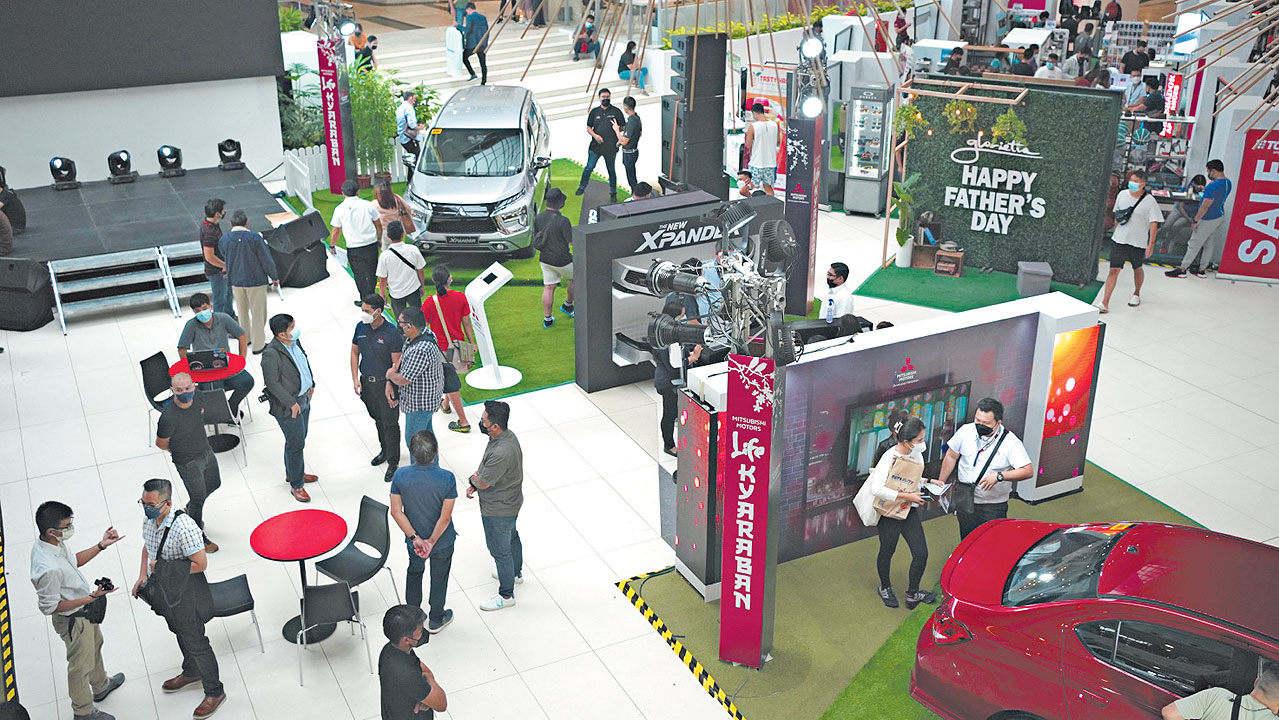
“WHAT WE want to do is to showcase the different lifestyles and lifestages of our customers. There’s a Mitsubishi Motors vehicle for each Filipino,” said Mitsubishi Motors Philippines Corp. (MMPC) Assistant Vice-President for Brand Communications Mark Parulan in an interview with “Velocity” at the Glorietta Activity Center of Ayala Malls in Makati.

Over the weekend, the Makati mall was the venue of the initial staging of “Life Kyaraban,” a series of roadshows to serve as way for customers and customers-to-be to not only see the latest Mitsubishi vehicles, including the recently refreshed Xpander, up close, but to also “thoroughly experience the essence of the brand’s local slogan, ‘Life Made Better.’”

In a release, MMPC President and CEO Takeshi Hara said that “Life Kyaraban” is a “fusion of two concepts. ‘Life’ that echoes Mitsubishi Motors’ commitment to add value and further enrich the lives of Filipinos. Then ‘kyaraban,’ which actually means “caravan” in Nihongo, representing (the) commitment to reach customers in all parts of the country.”

Beyond a typical car display, “Life Kyaraban,” also featured several lifestyle, technology and fuel partners which helped “to convey and let everyone discover the holistic and enjoyable ownership experience they can get with Mitsubishi Motors.”

Attendees were given freebies, including a limited-edition Kool Cloud Water Bottle, and discounts of up to P5,000 on reservations. Partner merchants held interactive activities and games with prizes like Caltex SavePlus Cards and 40% off Combi coupons. Realme 8i phone were raffled off throughout the day as well. Meanwhile, accessorized vehicles showcased Black Rhino Wheels Philippines, Concept One Wheels Philippines, and Overland Kings products. Last Saturday, singer Kyla capped off the pre-Father’s Day treat for families dropping by.

“Aside from our grand roadshow, there’s no better way to celebrate ‘Life Made Better’ in the presence of our Filipino customers than by presenting our new service motto to them which is Mitsubishi Motors Cares. After-sales has always been one of the core strengths in MMPC’s 59 years of existence in the local automotive scene. This program is our way of solidifying that legacy and a recommitment to better service quality that forms part of their car life journey as a Mitsubishi owner,” added Mr. Hara.

More information about Mitsubishi Motors Cares can be gleaned from https://www.mitsubishi-motors.com.ph. For more information, subscribe to the official accounts of Mitsubishi Motors Philippines on Facebook, Instagram, and YouTube. — KMA

Abarrientos joins Belangel in Korean Basketball League

FEU rookie and Gilas stalwart RJ Abarrientos — THE UAAP

THE Far Eastern University (FEU) super rookie and Gilas Pilipinas stalwart RJ Abarrientos is joining Ateneo’s SJ Belangel in the Korean Basketball League (KBL) with an impending contract with Ulsan Hyundai Mobis Phoebus.

Barring any hitches, the Tamaraws shooting guard is scheduled to be announced as the newest Filipino player in the KBL under the Asian Player Quota program this week as reported by Korean sports outlet Jumpball.

Mr. Abarrientos’ looming signing came just two weeks after Mr. Belangel forged a deal with Daegu Kogas Pegasus as the first Filipino player in Korea.

If becomes official, Mr. Abarrientos would be foregoing his remaining years with FEU in the University Athletic Association of the Philippines (UAAP) after a one-and-done season. The STAR has sought for a comment from FEU on the possible departure of its prized cager, but has yet to respond as of press time.

Mr. Abarrientos, nephew of Philippine basketball legend, led FEU’s Final Four finish in his lone season behind averages of 13.8 points, 4.4 rebounds, 2.5 assists and 1.3 steals.

The streaky guard was also part of the Gilas team that trooped to South Korea over the weekend as part of its preparation for the International Basketball Federation (FIBA) World Cup Asian Qualifiers and FIBA Asia Cup.

He registered 12.5 points, 2.0 rebounds and 2.0 assists as Gilas fell short in two friendly games, 96-92 and 106-102.

In the KBL starting the 2022-2023 Season, Mr. Abarrientos is expected to carry over his scoring pedigree for Ulsan Hyundai that finished fourth last season with a 30-24 card. — John Bryan Ulanday

At avatar fashion store, Meta to sell virtual clothes for real money

PHOTO FROM TWITTER.COM/METANEWSROOM

FACEBOOK owner Meta Platforms is launching a digital clothing store where users can purchase designer outfits for their avatars, Chief Executive Mark Zuckerberg said on Friday.

Virtual outfits designed by fashion brands Balenciaga, Prada and Thom Browne will be available for purchase to start, said Zuckerberg, speaking in a live video stream with Instagram’s head of fashion.

A Meta spokesperson said they would be priced between $2.99 and $8.99, much less than the real outfits by those designers. Prada’s Matinee ostrich leather bag, for example, sells for $10,700.

Mr. Zuckerberg said he hoped to build the store out into an open marketplace where developers can create and sell a wide array of digital clothes.

Avatars have emerged as one way for Meta to link user identity across Facebook, Instagram and its other services, as it increasingly ties the platforms together and steers toward building an immersive “metaverse” of shared, interconnected digital worlds where users can gather.

Users of the company’s virtual reality headsets set up avatars to play video games, take exercise classes and participate in conference calls, although initially the digital outfits will be available only on Facebook, Instagram, and Messenger, Meta said in a statement.

The company redesigned its virtual reality avatars last year to be more expressive and three-dimensional, then made them available on Facebook, Instagram, and Messenger starting in January. — Reuters