Home Blog Page 5881

Uy-led Conti’s, Wendy’s open new branches in Luzon areas

DENNIS A. UY-LED Conti’s Bakeshop and Restaurant and Wendy’s Philippines are set to open new branches across Luzon to reach more Filipinos and provide employment opportunities.

“Expanding allows us to bring the taste of home closer to more and more Filipinos and provide employment to communities as we hire local staff to spread the delightful Conti’s experience with our customers,” Eight-8-Ate Holdings, Inc. President and Chief Executive Officer Joey R. Garcia said in a press release.

Conti’s started opening stores in new sites, including San Jose Del Monte, Bulacan; SM Sta. Mesa; Lipa, Batangas; Marilao, Bulacan; Tarlac; San Fernando, Pampanga; SM City Grand Central, Caloocan; Trece Martires, Cavite; and Udenna Tower in Taguig.

To date, it has close to 70 stores, with the company saying Conti’s “will only continue to expand and grow.”

“This year, more branches are expected to launch to cater to the increasing number of Conti’s lovers — a testament to the brand’s commitment to delight more and bring Conti’s closer to Filipinos,” Mr. Garcia said.

Meanwhile, Wendy’s is set to open branches in Caltex EDSA Caloocan, Fisher Mall Malabon, Sierra Valley Cainta, FTI (Food Terminal, Inc.) Taguig, Phoenix Tandang Sora and Pioneer Shaw.

To date, it has over 55 franchises and corporate stores across the nation with selected 24/7 stores.

“Wendy’s eyes a growth-ready future with more locations and modern store model format that mixes experience and convenience,” the company said.

Recently, it has added new food to its menu by offering Bacon Jalapeño Chicken Sandwich, BBQ Bacon Melt, Beef Bulgogi Salad, Red Velvet Frosty Overload, and Peach Iced Tea.

“Innovation has always been at the heart of Wendy’s growth strategy,” Mr. Garcia said.

“For years to come, we hope to delight and serve more people as they enjoy our fresh offerings,” he added.

Eight-8-Ate, Udenna Corp.’s food group subsidiary, is the operator and manager of Conti’s and Wendy’s. — Justine Irish D. Tabile

Treasury bills, bonds seen to fetch higher rates

BW FILE PHOTO

RATES of government securities (GS) on offer this week could rise on expectations of aggressive tightening by the US Federal Reserve and the Bangko Sentral ng Pilipinas (BSP) at their meetings this week.

The Bureau of the Treasury (BTr) will offer P15 billion in Treasury bills (T-bills) on Monday, made up of P5 billion each in 91-, 182-, and 364-day debt papers.

On Tuesday, the BTr will auction off reissued seven-year Treasury bonds (T-bonds) with a remaining life of six years and eight months.

A trader expects T-bill and T-bond yields to move higher at this week’s auctions ahead of the two central bank meetings, with the Fed seen to hike by 75 basis points (bps) and the BSP likely to raise rates by 50 bps.

The trader expects T-bill rates to rise by 10-20 bps from last week’s awarded yields and sees the seven-year paper to be quoted at 6.5% to 6.75%.

Rizal Commercial Banking Corp. Chief Economist Michael L. Ricafort said aggressive moves from the Fed and the BSP could cause T-bill and T-bond rates to rise.

“The markets anticipate a large Fed rate hike of about 0.75-1% after the higher-than-expected US CPI (consumer price index) that was still elevated at 8.3% in August,” Mr. Ricafort said in a Viber message.

“The new record peso exchange rate could also lead to more aggressive local policy rate hikes to help stabilize the peso as well as overall inflation,” he added.

Mr. Ricafort said T-bill rates may rise by 11-17 bps, while the yield on the T-bonds may jump by 11-19 bps from the previous award to track secondary market levels.

The US consumer price index rose in August amid rising rent and healthcare costs, strengthening the case for another aggressive Fed rate hike this week.

Consumer inflation edged up by 0.1% to 8.3% last month after being unchanged in July. In the 12 months through August, the CPI increased to 8.3%.

Fed Chair Jerome H. Powell earlier said the central bank was “strongly committed” to fighting inflation. The Fed is meeting to review policy on Sept. 20-21 and has raised rates by 225 bps since March, including two 75-bp moves in June and July.

Meanwhile, the BSP will hold its policy meeting on Sept. 22. It has hiked borrowing costs by 175 bps since May to rein in rising prices.

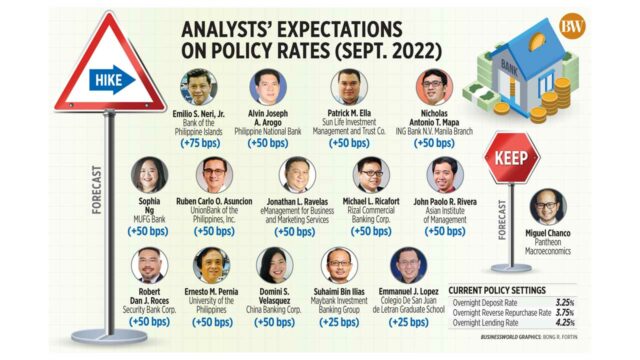
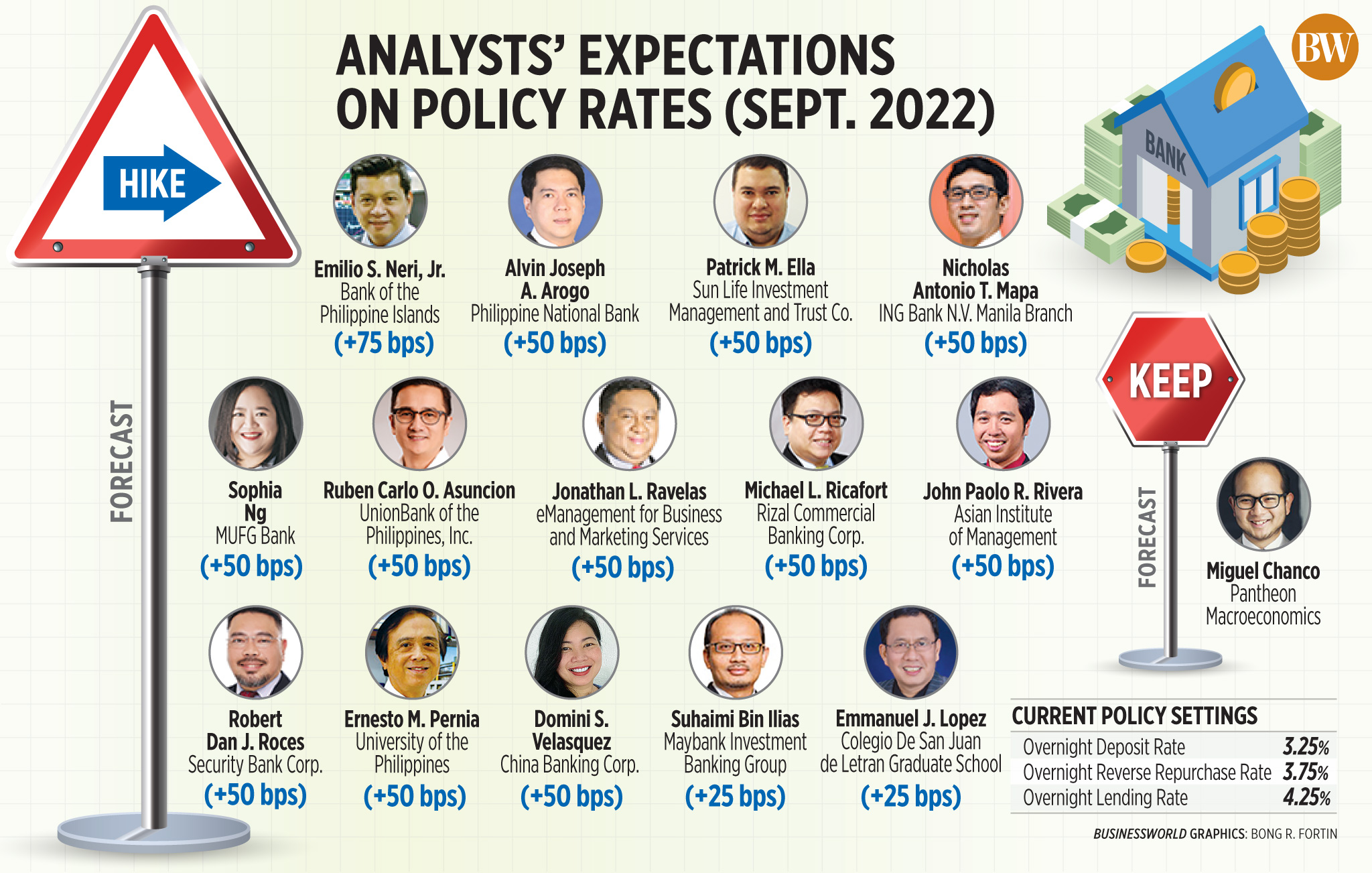
A BusinessWorld poll last week showed 14 out of 15 analysts expect the BSP to fire off another rate hike on Thursday. Eleven see a 50-bp increase, while two expect a moderate hike worth 25 bps. Meanwhile, one is betting on a big 75-bp move.

BSP Governor Felipe M. Medalla said last month the central bank has room to hike borrowing costs further as inflation remains stubbornly high, with the Fed’s aggressive tightening also posing an additional risk to prices due to its effect on the peso.

Headline inflation eased to 6.3% in August from a near four-year high of 6.4% in July. This brought the eight-month average to 4.9%, higher than the central bank’s 2-4% target but still below its 5.4% forecast for the year.

The peso closed at an all-time low P57.43 per dollar on Friday, losing 27 centavos from its P57.16 finish on Thursday, Bankers Association of the Philippines data showed.

At the secondary market on Friday, the 91-, 182-, and 364-day T-bills were quoted at 2.5669%, 3.4690%, and 3.9147%, respectively, based on the PHP Bloomberg Valuation Reference Rates published on the Philippine Dealing System’s website. 

Meanwhile, the seven-year bond was quoted at 6.4569%.

Last week, the Treasury partially awarded its T-bill offer, only accepting bids for the six-month debt, even as total demand reached P19.481 billion, above its P15-billion offer.

The Treasury borrowed P5 billion as planned via the 182-day securities, with bids reaching P9.975 billion. The average rate of the tenor went up by 14.9 bps to 3.634% and accepted rates ranged from 3.498% to 3.8%.

Meanwhile, the government rejected all bids for 91-day T-bills, with tenders for the tenor at just P4.65 billion, below the P5-billion program. Had they been awarded, the average rate of the three-month paper would have gone up by 103.1 bps to 3.349% from the 2.318% fetched last week.

The BTr also refused to award 364-day debt papers, with demand only reaching P4.856 billion versus the P5 billion on the auction block. Had the government accepted all bids, the debt paper’s average rate would have climbed by 61 bps to 4.392% from 3.782% fetched for the tenor on Aug. 22, which was the last successful award.

Meanwhile, the reissued seven-year bonds to be offered on Tuesday were last auctioned off on June 28, where the BTr rejected all bids for the papers amid higher rates.

The last successful award for the bond series was on June 14, with the Treasury raising just P19.551 billion from the papers, less than the programmed P35 billion, even as the offering attracted P62.69 billion in bids.

The papers were awarded an average rate of 6.74% at that auction, higher by 24 bps versus the 6.5% coupon fetched for the bonds when they were offered for the first time on May 17.

The BTr wants to raise P200 billion from the domestic market this month, or P60 billion through T-bills and P140 billion via T-bonds.

The government borrows from local and external sources to help fund a budget deficit capped at 7.6% of gross domestic product this year. — D.G.C. Robles

DAR to train land reform beneficiaries via pilot farm network

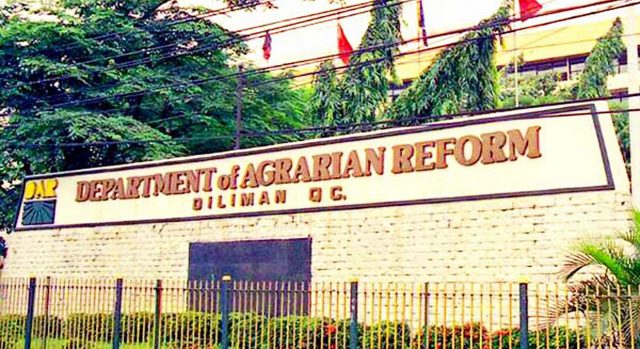
THE Department of Agrarian Reform (DAR) said it is launching a program to train agrarian reform beneficiary organizations (ARBOs) in new farming technology via a network of demonstration farms.

The new techniques are intended to help farmers improve productivity and quality, according to Agrarian Reform Secretary Conrado M. Estrella III.

“The training is in line with President Ferdinand R. Marcos, Jr.’s directive to maximize food production,” he said.

There are about 7,500 ARBOs nationwide which DAR is planning to tap for its food security efforts.

The department said it partnered with the Department of Agriculture to mobilize ARBOs and implement demonstration farms under the Farm Business School (FBS) project.

“The idea here is to determine the technical capability and readiness of our ARBOs to develop demonstration farms where fellow, but less technically abled ARBOs, can learn,” Milagros Isabel A. Cristobal, Agrarian Reform Undersecretary for support services, said.

Ms. Cristobal said the FBS is a long-standing project of the DAR which exposes ARBOs to innovative techniques that they can replicate in their respective areas.

“We wanted to convince at least one ARBO in every region to take the challenge, as part of our food security program, and be among the pioneers in this undertaking,” she added. — Luisa Maria Jacinta C. Jocson

Audi PHL brings in long-wheelbase A8 L flagship

PHOTO FROM AUDI PHILIPPINES

AUDI PHILIPPINES announced the arrival of the 2023 Audi A8 L which, the distributor said, “exudes more authority” and showcases the brand’s “revolutionary” Audi Space Frame (ASF) technology.

Aluminum is used in 58% of the structure, allowing the vehicle to weigh some 40% less than a comparable model using steel.

The new Audi A8 L’s ASF body is based on a frame comprised of sections and parts made from aluminum, supplemented by other aluminum panels, such as the roof and the body’s side. Carbon fiber-reinforced polymer and magnesium are also used to complement steel components. Combined, the ASF structure ensures exceptional rigidity that enhances handling while also significantly reducing vibration. It lessens weight as well, improving efficiency.

The vehicle’s front is marked by a more angular Singleframe grille with chrome elements, increasing in size from the bottom to the top. Flanking the grille are newly designed Digital Matrix LED headlights, as well as side air intakes that are more upright and whose lower edge has distinctive contours.

Viewed from the side, the A8 L’s sleek roof dome is apparent — as are sweeping lines across the body that emphasize the vehicle’s length, concave contours at the bottom, and wide wheel arches that hint at Audi’s quattro drive system. At the rear are wide chrome clasps, a customizable taillight signature with digital OLEDs, and a continuous, segmented light strip. The diffuser insert in the bumper is accentuated and redesigned with horizontal bars.

Inside, the driver gets vehicle and navigation information via a 12.3-inch high-definition Virtual Cockpit display. MMI navigation with MMI touch response also allows the driver and passengers to control various infotainment and convenience features via touchscreen displays, handwriting recognition, or natural voice commands.

The longer wheelbase means more cabin space, one that is fitted with, declared Audi, luxurious accoutrements, especially for rear-seat passengers. Among these features is the Rear Seat Entertainment system comprised of two Audi tablets and the Rear Seat Remote. With these, passengers can enjoy watching movies on streaming sites, browse the internet, and access other apps. The system also boasts Apple CarPlay and Android Auto connectivity. Audi also fits a cool box in the rear to accommodate chilled drinks.

Other premium features include the 360-degree 3D-view camera, panoramic sunroof, four-zone automatic climate control, an air quality package with ionizer and perfume, multifunction massage in all seats, and a Bang & Olufsen audio system.

Powering the new Audi A8 L is a 3.0-liter, turbocharged V6 gasoline engine delivering 335hp and 500Nm. The engine is equipped with a mild-hybrid system composed of a belt alternator starter and a lithium-ion battery, which aid in reducing fuel consumption and emissions. Paired to the engine is a quick but smooth-shifting eight-stage Tiptronic transmission. Audi’s quattro permanent all-wheel drive system and 21-inch alloy wheels are fitted as standard.

Nu Skin launches collagen drink for skin care

COLLAGEN, a protein that makes up the framework of cells and tissues, is found in our skin, tendons, bones, and other parts of the body. It’s also the newest beauty ingredient being touted — but unfortunately, collagen molecules are much too large to penetrate the skin. The best way to get more collagen into the body is to ingest it, which would include eating food rich in it.

Or you can go down the route of taking supplements.

Multi-level marketing company Nu Skin Enterprises launched its Inner Focus Collagen Plus orange-flavored drink on Sept. 14 in Ortigas, though it hits direct sellers on the first quarter of 2023, where it will cost P6,000 for 30 sticks; about a month’s supply. A special preview for their brand affiliates is slated for October.

The drink contains collagen peptides (a unique peptide “fingerprint” that is shown to stimulate collagen and elastin production, according to a company release). These collagen peptides are from type-1 bovine collagen, sourced from predominantly pasture-raised cows with grass and mixed vegetable diets. The product also contains marigold-derived lutein (promoting skin’s radiance and further helping protect it from oxidative stress), and phytoceramides (taken from wheat lipid extract, which are similar to the ceramides found in skin, and claimed to help keep skin’s moisture barrier healthy and hydrated all day long).

Through a double-blind, placebo-controlled clinical study commissioned by Nu Skin, the company found that participants that received Inner Focus Collagen Plus experienced improvement in texture, radiance, and overall appearance of their skin, according to a statement, and according to a presentation by Nu Skin’s Executive Vice-President of Product Development and Chief Scientific Officer, Dr. Joseph Chang during the launch.

Mr. Chang earned his doctorate in Pharmacology at the University of London. He said that the clinical testing involved participants taking the powder for about 12 weeks, while another group took a placebo.

Asked if the product helps in improving other parts of the body other than the skin, he said, “At this time, [we] only focused on skin. I don’t have any studies to be able to claim any of these.”

The press release did contain a disclaimer that: “This statement has not been evaluated by the Food and Drug Administration. This product is not intended to diagnose, treat, cure, or prevent any disease.”

In any case, Mr. Chang says, “In order to have true beauty, you have to get beauty from the inside out.” — JLG

Yields on gov’t debt rise as US CPI stays elevated

YIELDS on government securities (GS) rose last week as August US consumer inflation exceeded market expectations, strengthening the possibility of another aggressive rate hike from the US Federal Reserve this week.

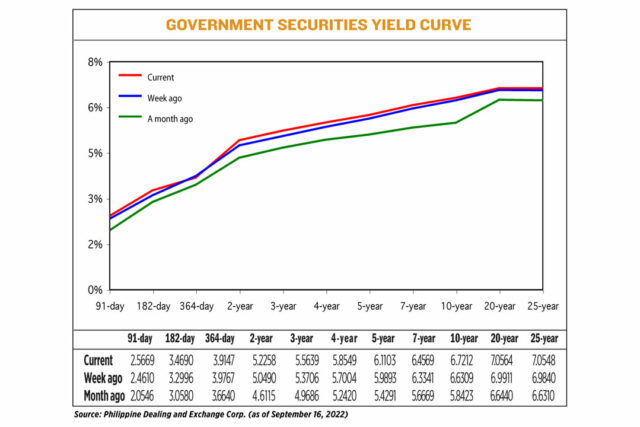
GS yields at the secondary market rose by an average of 10.98 basis points (bps) week on week, based on the PHP Bloomberg Valuation Service Reference Rates as of Sept. 16, published on the Philippine Dealing System’s website.

Rates at the short end of the curve were mixed, with the 91-, and 182- Treasury bills (T-bill) rising by 10.59 bps, and 16.94 bps to fetch 2.5669% and 3.469%, respectively, while the yield on the 364-day T-bill fell by 6.2 bps to 3.9147%.

Meanwhile, the belly of the curve climbed. Yields on the two-, three- four-, five-, and seven-year Treasury bonds (T-bond) went up by 17.68 bps (to 5.2258%), 19.33 bps (5.5639%), 15.45 bps (5.8549%), 12.10 bps (6.1103%) and 12.28 bps (6.4569%).

On the other hand, the long end of the curve moved upwards as yields on the 10-, 20-, and 25-year debt papers rose by 9.03 bps (6.7212%), 6.53 bps (7.0564%) and 7.08 bps (7.0548%).

Total GS volume traded reached P6.563 billion on Friday, lower than the P12.402 billion recorded on Sept. 9.

The first bond trader attributed the lower trading volume seen last week to cautiousness ahead of central bank meetings this week.

“GS yields increased during the week after US consumer inflation reports came out stronger than market expectations, bolstering views of potentially stronger Fed rate hike next week. Yields likewise rose from hawkish remarks by Fed officials Waller and George,” the first trader said in an e-mail.

“Local participants remained cautious ahead of the US consumer inflation report last week. As soon as the report indicated that the US central bank might consider a stronger 100-bp rate hike, participants dismissed any possibility for dovish policy hints from the Fed,” the trader added.

The second bond trader likewise said in a Viber message that the US consumer price index (CPI) was the catalyst for last week’s trading as it could prompt another aggressive rate hike from the Fed.

“That means there will also be pressure on other central banks, including BSP (Bangko Sentral ng Pilipinas), to raise rates as well due to the narrowing interest rate gap,” the second trader added.

The trader said players were defensive, pushing yields up.

US consumer prices rose in August amid rising rent and healthcare costs, strengthening the case for another jumbo-sized Fed hike this week.

Consumer inflation edged up by 0.1% to 8.3% last month after being unchanged in July. In the 12 months through August, the CPI increased to 8.3%.

The Fed is meeting to review policy on Sept. 20-21 and has raised rates by 225 bps since March, including two 75-bp hikes in June and July.

Meanwhile, the BSP will hold its own policy meeting on Sept. 22. The Monetary Board (MB) has hiked borrowing costs by 175 bps since May to rein in rising prices.

The first trader sees domestic yields moving with an upward bias this week on hawkish Fed bets.

“Bond yields might also increase as the BSP is likewise expected to respond with a substantial local policy rate hike in order to arrest any further weakening of the peso. However, the magnitude of increases might remain contingent on whether the policy rate hikes will be within or beyond market expectations,” the first bond trader added. 

“The market will test BTr’s (Bureau of the Treasury) aggressiveness during Tuesday’s auction and wait for any clues ahead of MB meeting,” the second bond trader said. 

On Tuesday, the BTr will auction off P35 billion in reissued seven-year bonds with a remaining life of six years and eight months. — A.M.P. Yraola

Indonesia mangrove restoration engages coastal villagers

REUTERS

SEMARANG, Indonesia — In a coastal community on Indonesia’s Java island, villagers must constantly take soil and stones to local graveyards to secure the resting places of their dead friends and relatives — fearful that frequent flooding will sweep away the deceased.

Like other flood-prone villages in the northern Demak regency, Timbulsloko’s problems are threefold — with over-extraction of groundwater causing sinking, aquaculture contributing to some of the worst coastal erosion across the archipelago, and sea levels rising due to climate change.

The more than 3,000 people in Timbulsloko, who refuse to abandon their homes, often pay for trucks to transport dirt and rocks from nearby mountainous areas in order to protect graves, and to elevate their houses above the rising waters.

“Since 2008, there is more flooding because of coastal erosion,” said fisherman Suratno, who like many Indonesians goes by one name, sitting on the floor of his one-storey house, where the front door was blocked by ankle-deep flood waters.

“Every day there is flooding — the morning, afternoon or at night,” the 51-year-old told the Thomson Reuters Foundation last month.

Located along the Pacific Rim of Fire, Indonesia is made up of more than 17,000 islands, and faces many natural threats — ranging from earthquakes and tsunamis to volcanic eruptions. And the effects of climate change, such as worsening floods, present ever-greater risks to the Southeast Asian nation.

In a bid to protect Timbulsloko, Suratno and other locals took part in a pilot project that sought to reintroduce previously removed mangroves in several villages to rejuvenate and protect at-risk fishing communities and their livelihoods.

Unlike many mangrove restoration initiatives, the seven-year scheme by Netherlands-based environmental group Wetlands International did not replant the trees — which are considered a key defense against flooding and coastal erosion.

Instead, the project — which ended in October 2021 — tapped into expert and local knowledge and manpower to convert degraded aquaculture ponds into green-belts and sedimentation basins to help mangroves regrow naturally and boost fish stocks.

Indonesia is home to the world’s largest area of mangroves — which have an outsize role in absorbing carbon emissions — and the nation is on an ambitious restoration drive. It is a priority for President Joko Widodo, who is due to showcase these efforts to leaders during a G20 summit in Bali later this year.

About 30 million people suffer from the impacts of coastal flooding in northern Java, with communities being displaced and livelihoods destroyed, according to Wetlands International.

In Demak, where villagers build bamboo bridges to access their flood-hit homes, sea levels are expected to cause flooding up to 6 km (3.7 miles) inland by 2100. Flooding in Timbulsloko is largely due to the clearing of mangroves over many decades to make way for aquaculture ponds.

Government-built concrete flood barriers are crumbling and have had limited impact as over-extraction of groundwater by industry and households on Java also causes widespread sinking. So in 2015, Wetlands International teamed up with nine villages along a 20 km stretch of coastline in Demak.

Instead of replanting — which can focus on the wrong species or wrong areas and has a success rate of 10-15%, mangrove experts say — the scheme enlisted Dutch and Indonesian experts to map the best places where the trees would regrow naturally.

Then, with the involvement and knowledge of local communities, the €5-million project built permeable bamboo structures in the sea to trap sediment and create the best conditions for mangroves to regenerate.

Wetlands International’s advocacy officer Susanna Tol said the project had a success rate of up to 75%, based on increased sediment and mangrove regrowth, although areas with heavy subsidence hindered progress.

From a cost perspective, it is hard to compare this nature-based approach with efforts that purely replant mangroves or if the villages did nothing but boost flood defenses, as Wetlands International’s project also involved funding to boost livelihoods, she added.

The methods have been replicated in 13 other districts, led by Indonesia’s fisheries ministry, and the group is helping the national mangrove restoration agency draft a best-practice document.

“We integrate mangroves and the economy as much as possible because this is the only way you get local support,” said Ms. Tol.

The project also formed community groups which are still active and have established green-belt areas, taught mangrove conservation, promoted sustainable fishing and aquaculture practices, and had access to small loans linked to restoration.

Suratno said he installed “bamboo sea walls” to protect the village against future flooding, and used a loan to purchase nets and an additional boat that he rents to other fishermen.

“Mangroves have many, many benefits,” he said, adding that the number of birds and fish had increased locally. “The (flooded) coastal areas will come back and we will still be able to live here.”

There are about 80 different species of mangroves, which are largely found in the equatorial region. They support a range of wildlife and provide nutrients to the wider ecosystem, which are vital for fisheries.

Although mangroves make up less than 1% of tropical forests globally, they store a significant amount of carbon underground, prevent coastal erosion, and reduce the power of strong waves.

However, they are in decline, with the world’s mangrove area decreasing by about 1 million hectares between 1990 and 2020, although the rate of loss has slowed in recent years, according to the United Nations Food and Agriculture Organization.

Drivers of this loss include harvesting timber and charcoal, clearing for fish farms and urbanization in coastal areas, said Chris Mcowen, lead marine scientist at the UN Environment Programme’s World Conservation Monitoring Centre.

Recognizing their value, Indonesia launched a program last year to restore 600,000 hectares of degraded mangroves by 2024, although this drive has been hindered by the pandemic.

Such targets provide a sense of urgency and are good for publicity and engaging with donors, said Mr. Mcowen.

However, local people are too often not consulted in restoration efforts, said Mr. Mcowen, adding that without buy-in from communities, such projects can be doomed to failure.

And in the face of rising seas and storm surges, mangroves should be grown where the survival rate will be highest rather than simply where they were lost previously, the scientist said.

“We’re only going to see the benefits in 20 to 30 years and restoration should be forward-looking, not just backward,” he added.

In the village of Tambakbulusan in Demak, where the sinking is not as severe as in nearby Timbulsloko, many mangroves have returned — having benefited from the reclamation of old aquaculture ponds and creation of green-belts. Flooding in the village is less common, while local fishermen sell their organic fish at a premium.

Abdul Ghofur, who catches shrimp and milk fish using sustainable fishing methods, joined the Wetlands International project at its launch and is the head of a community group. The father-of-three said that people in his village believed mangroves provided cleaner air and kept them healthier.

“I see in my village that people now care about mangroves — they no longer cut them down,” the 53-year-old added. In Tambakbulusan, Mr. Ghofur remembers walking with his son around the family fish farms during school holidays many years ago — teaching the boy about the importance of mangroves.

The project’s resulting increase in fish quantities and quality helped pay for his son’s education and more recently, for him to study aquaculture at university.

“I want my son to become a teacher (of aquaculture),” Mr. Ghofur said. “Mangroves have changed my life.” — Thomson Reuters Foundation


Pedigree offers new treats for dogs

PET owners will agree that just the sound of a treat package opening excites dogs. While it is fun to bond while giving your pet treats, part of being a responsible pet owner is to also be aware of their oral hygiene. This is where Pedigrees new products come in.

Pedigree has new treats for dogs Pedigree DentaStix Chewy Chunx, and Pedigree Good Chew that were developed with veterinarians and nutritionists from Waltham Petcare Science Institute, the science and research center for Mars Petcare.

“Not all treats are the same. You can’t just give any treats to your dogs because dogs have different needs, and treats have different purposes,” General Manager of MARS Philippines Johnny Racoma said in a statement. “When it comes to treats, we want our treats to satisfy our dogs and we want them also to address specific aspects of their health.”

Pedigree DentaStix Chewy Chunx is a daily oral care treat that comes in a bite-sized format to help clean dog’s teeth and improve their oral hygiene.

“With DentaStix Chewy Chunks, pets can maintain their teeth and gum health while enjoying the treats,” Mr. Racoma said during an online launch on Sept. 6. “This is extremely important because dental diseases in dogs happen five times more often than in humans,” he added.

Veterinarian and Scientific Communication Manager for MARS Philippines Saza Curaming that the ingredients zinc sulphate and sodium tripolyphosphate (STPP) can “help reduce the tartar build up” and also “clean your dog’s teeth and protects their gums.”

Ms. Curaming reminded owners that neglecting a dog’s oral health can lead to more serious diseases.

“Four out of five dogs have periodontal disease when they reach the age of three and sadly, 90% of owners think their dog’s oral health is good or perfect,” she said.

Dr. Curaming explained that periodontal disease carries bacteria, then travels to the dog’s bloodstream, and can affect the heart, liver and lungs. “Small dogs are more susceptible because of the structure of their mouth.” She advised pet owners to also establish a dental routine and make regular dental appointments for their dogs.

Another new product is the Pedigree Good Chew which is a long-lasting treat with a unique texture that is soft enough to chew. It has no rawhide and instead contains beef collagen. It is also easily digestible for dogs.

The hardness of rawhide can harm the dogs’ teeth and tongue, Ms. Curaming said. “The worst thing that can happen is [that] they can cause intestinal blockage” and emergency cases “will require surgical removal.”

Ms. Curaming added that pet owners must make it a habit of reviewing product ingredients.

“We should remember, that as much as we treat our pets like babies, pets have different needs from humans. All ingredients found in treats must be tested safe for pets,” Ms. Curaming said.

Pedigree DentaStix Chewy Chunx and Pedigree Good Chew are available at pet shops, supermarkets, convenient stores, hardware chains, and online at Shopee or Lazada. — Michelle Anne P. Soliman

Hino 300 Series trucks unveiled

PHOTO FROM HINO MOTORS PHILIPPINES

HINO MOTORS PHILIPPINES (HMP) recently rolled out its latest 300 Series lineup. Comprised of the new 414i, 414i Long, 414i 6W, 814i and 814i Extra Long, the trucks are said to be loaded with features to address a wide range of business needs. The new Hino 300 Series trucks are positioned as “perfect logistics partners” for any entrepreneur.

All models in the new 300 Series come with a refreshed fascia featuring a new Hino grille design, reshaped headlights, bumper, and foglamps. A spacious cabin gets luxurious brown interiors, ergonomic seats, and convenient storage spaces.

Powering the trucks is the Hino N04C-WW Euro-4 Engine delivering 142ps and 400Nm, “making them the superior product at the 4,000-to-4,490 GVW (gross vehicle weight) range.” The drivetrain is powered by the new Aisin RE50 transmission. With an alternator generating 12 volts and 130A, the vehicles are also ideal for refrigerated transport.

The new Hino 300 series come in a wide range GVW options from 4,490 kg up to 7,500 kg — the largest and the longest being the new 814i Extra Long. The 18-foot loader has an impressive space to carry large hauls, translating to less operating costs as it can accommodate more cargo in one go.

“Hino is determined to serve the Filipino entrepreneur as we are the only commercial vehicle brand in the nation to provide a full one-stop shop advantage. From the delivery of truck chassis through manufacturing of the rear body and all phases of aftersales, we strive to provide increased uptime while reducing operational cost. That is the pledge of total support from Hino,” said Hino Motors Philippines President Mitsuharu Tabata.

For more information, visit hino.com.ph. Announcements are also available at Hino Motors Philippines’ official Facebook and Instagram pages.

Globe’s pricing of SRO shares and PSE tie-up pique investors

INVESTORS were piqued with Globe Telecom, Inc. last week after the company announced the pricing of its stock rights offering (SRO) and the tie-up with the local bourse for easier trading using its e-wallet app.

Data from the Philippine Stock Exchange showed Globe trading P848.41 million worth of 394,550 shares from Sept. 12 to 16.

Shares in the Ayala-led telecommunications company went up by 1.3% to close at P2,118 a piece last Friday. Since the start of the year, however, Globe has declined by 35.4%.

“The news of the SRO has piqued the interest of the investors, given that the offer price per entitlement ratio offers above 22% discount to its 30-day VWAP (volume-weighted average price),” Regina Capital Development Corp. Head of Sales Luis A. Limlingan said.

In an e-mail, he added that the collaboration of GCash with the stock exchange was also good news for investors as the tie-up could result in higher transactions on both ends.

Last Sept. 12, the telecommunications company announced its SRO price at P1,680 per share for one entitlement right for every 13.2366 shares owned by investors.

With a total of 10.12 million shares up for sale, Globe plans to raise P17 billion, which according to the press release will be used on the following: pre-payment or repayment, repurchase of all or a portion of certain borrowing, including interest, and other liabilities availed of by the company for capital expenditures; and capital expenditure plans.

The rights offering will begin on Oct. 3 until Oct. 7.

Meanwhile, the Philippine Stock Exchange said on Sept. 14 that it had tied up with the e-wallet company GCash to offer stock trading via the app.

In an interview on BusinessWorld Live, PSE President and Chief Executive Officer Ramon S. Monzon said that GCash users will be able to start investing via the app in November.

Mr. Limlingan said the partnership will be good for Globe’s stock in the future, more so if this provides ease and accessibility in trading for investors.

AAA Southeast Equities, Inc. Research Head Christopher John Mangun said in a Viber message that the partnership will be good for Globe and its subscribers as this will allow app users to have more features to take advantage of.

Globe earlier reported that its second-quarter attributable income reached P6.01 billion, up nearly 6% from P5.68 billion a year earlier.

This put Globe’s first-half attributable income at P19.65 billion, up by 51% from P12.99 billion in the same period in 2021. Analysts are looking forward to Globe’s upward trajectory for the rest of the year.

Mr. Mangun gave his third- and fourth-quarter income expectation for Globe to reach around P6 billion to 6.2 billion. 

“The tower sale and leaseback transaction [are] expected to boost GLO’s 3Q22 performance. For the whole year, we think a double-digit bottom-line growth is achievable,” Mr. Limlingan said, referring to the ticker symbol of Globe.

He sees the stock’s immediate support at 2,050, while its resistance at P2,220.

“Hard to say where the stock is headed in the coming months, but in the near term looks like its current support will hold and it could possibly go above the 2,200 mark,” Mr. Limlingan added.

Mr. Mangun placed Globe’s support and resistance levels at P2,000 and P2,300, respectively, adding that he sees the company to continue trading within this range until the end of the rights offering. — Bernadette Therese M. Gadon

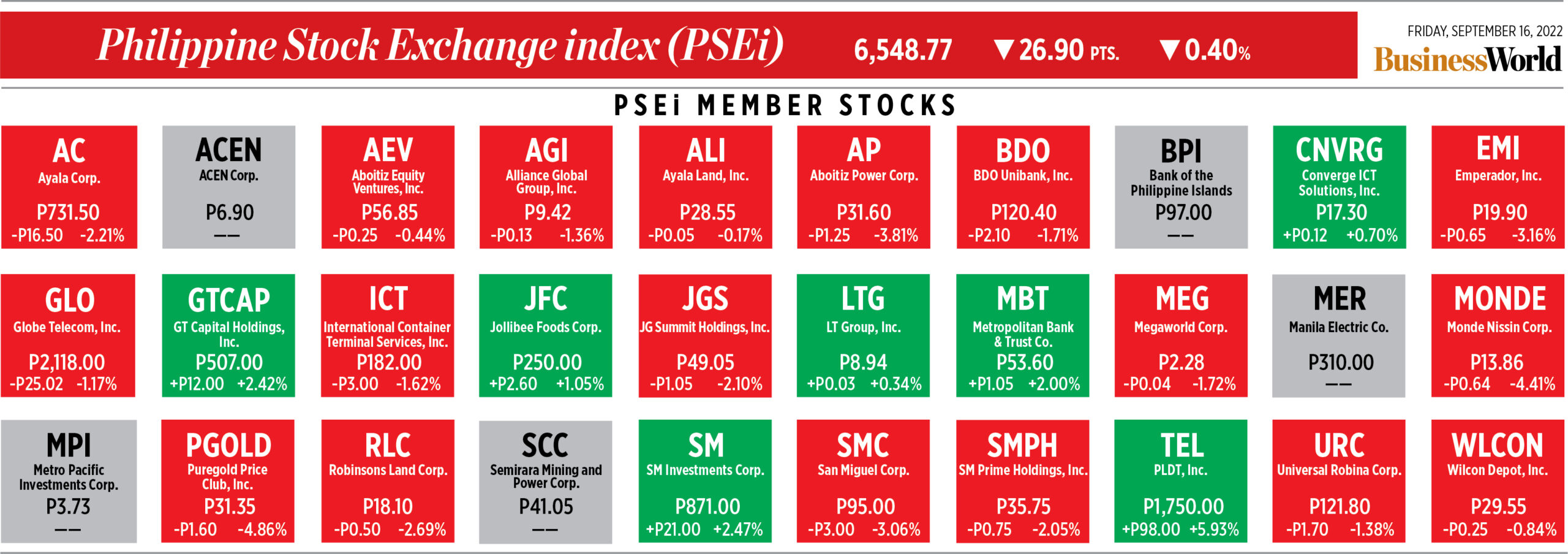
How PSEi member stocks performed — September 16, 2022

Here’s a quick glance at how PSEi stocks fared on Friday, September 16, 2022.


Analysts’ expectations on policy rates (Sept. 2022)

THE BANGKO SENTRAL ng Pilipinas (BSP) is likely to continue its rate hike cycle on Thursday, with several analysts forecasting a 50-basis-point (bp) increase as the US Federal Reserve is also expected to further tighten policy this week. Read the full story.

Analysts’ expectations on policy rates (Sept. 2022)