Home Blog Page 5857

Banks must upskill employees as sector’s digitalization continues


JOHN SCHNOBRICH-UNSPLASH
FINANCIAL INSTITUTIONS must upgrade the skills of their employees to keep up with latest digital trends and threats as more customers shift online. — JOHN SCHNOBRICH-UNSPLASH

FINANCIAL INSTITUTIONS should craft programs to upgrade the digital skills of their employees to help them adapt to current trends in the industry, Coursera said.

Coursera Managing Director for India and Asia-Pacific (APAC) Raghav Gupta said in an interview with BusinessWorld that as clients become more digitally savvy, employees should also be literate in cybersecurity and data privacy.

“I think it’s important to call out that a lot of things obviously accelerated through the course of the pandemic,” Mr. Gupta said, adding that the necessary skills for working professionals have changed due to clients becoming more comfortable with digital technology. 

“A lot of… the customers for banks and insurance companies are increasingly digital natives. Younger people are very comfortable using digital platforms,” Mr. Gupta said.

He said this is driving the digitalization of products and services globally.

“While this might vary from industry to industry, we’ve seen a general focus on skills around digitalization skills, around data and skills, around working remotely,” he said. “We’ve seen that many banking companies have adopted a digital-first strategy because the customer is digitally savvy.”

Mr. Gupta said in the Philippines, around 1.7 million people have tapped Coursera and about 400,000 people enrolled in 2021. He added that Filipinos saw a lot of value in learning new skills online during the pandemic.

When asked how financial institutions should start upskilling their employees, he said they do not need to invest a lot of time to acquire a new skill and instead should consume easy to understand content that would help them learn faster. 

“If I’m a data analyst at a bank and I’m building a business model on an Excel sheet and I’ve forgotten how to do pivot tables, I can quickly go and watch a 10-minute to 20-minute video, which reminds me how to do a pivot table and then come back to my business model,” Mr. Gupta said.

“Banks are saying maybe 20-30% of our workforce needs deep skilling, and we’re working with them and helping them plan for that. And then we are saying, maybe 70-80% of your workforce needs what I would call ‘learning in the flow of work’ bite-sized learning. And we are enabling that as well,” he added.

He added that programs and academies in the Coursera platform will enable guided and skill-first learning. These programs focus on delivering skills that will have a large impact on businesses.

“We’ve seen that with BPI (Bank of the Philippine Islands), leveraging the Coursera platform, especially in the areas of technology,” he said. “And over the course of time that we worked together, almost 10,000 courses have been consumed by BPI employees. They’ve spent upwards of 60,000 hours learning on the Coursera platform.”

Mr. Gupta said improving banks’ digital capability will also help improve financial inclusion in the country.

“I would imagine that the ability to reach a lot more people, especially in tier two, tier three rural locations as well, is possible through digital channels,” he said, adding that Coursera has been focused on trying to reduce the digital divide. 

“Digital divide applies to every industry. In our case, it is education. In the case of banking, of course, it is financial inclusion, and in general, the digital channel allows us to reach a lot more people at a much lower cost,” he said.

“So yes, I would imagine that financial inclusion can be met as a result of digitalization. And so, building the skills to be able to enable this is super important for banks in the country.” — Keisha B. Ta-asan

Manufacturing Purchasing Managers’ Index (PMI) of select ASEAN economies, September 2022

THE PHILIPPINES’ manufacturing sector expanded for an eighth month in a row in September, as better demand led to growth in output and new orders, S&P Global said on Monday. Read the full story.

Manufacturing Purchasing Managers’ Index (PMI) of select ASEAN economies, September 2022

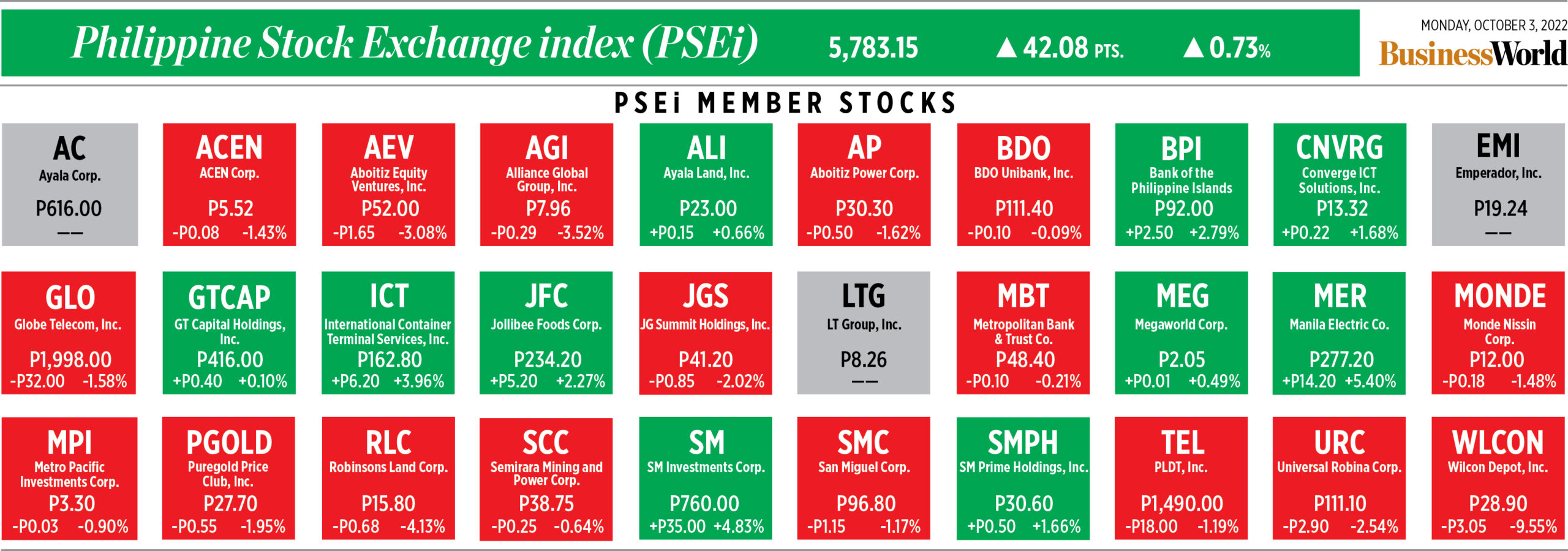
How PSEi member stocks performed — October 3, 2022

Here’s a quick glance at how PSEi stocks fared on Monday, October 3, 2022.


Shares rebound as investors pick up bargains

BW FILE PHOTO

PHILIPPINE STOCKS closed higher on Monday on bargain hunting following their decline last week, with investors also betting on further monetary tightening to arrest rising inflation.

The benchmark Philippine Stock Exchange index (PSEi) went up 42.08 points or 0.73% to close at 5,783.15 on Monday, while the broader all shares gained 6.23 points or 0.2% to end at 3,114.13.

“Philippine shares were bought up towards closing after bargain hunters made bets that central bankers across the globe would step in to combat inflation while making sure growth would not falter. Reports have been circulating that the Fed (Federal Reserve) itself will hold an emergency meeting in light of the recent development in the currency and fixed-income securities market,” Regina Capital Development Corp. Head of Sales Luis A. Limlingan said in a Viber message.

Mr. Limlingan said investors also made bets ahead of the release of key economic data, including the September Philippine inflation report and US jobs numbers.

“The PSEi inched higher today… primarily driven by bargain hunting activities on select index names spurred by the past several weeks of decline and the market finding support at the 5,700 level,” Unicapital Securities, Inc. Equity Research Analyst Ralph Jonathan B. Fausto said in a Viber message on Monday.

“The local market jumped at the last minute as investors sought bargains and wedged their hopes on the resilience of some local companies’ third-quarter earnings,” Timson Securities, Inc. Head of Online Trading Marc Kebinson L. Lood said in a Viber messsage.

“Investors found it difficult to regain their base following a horrific September drubbing reflecting the worst US market monthly and quarterly performance in nearly 14 years as a result of historic hot inflation, rising borrowing costs, recession fears, and hawkish Fed,” Mr. Lood said.

The majority of the sectoral indices ended higher on Monday except for mining and oil, which went down by 143.28 points or 1.37% to 10,312.40, and services, which slipped by 2.92 points or 0.19% to 1,500.77.

On the other hand, holding firms went up by 58.73 points or 1.06% to 5,557.62; property gained 15.17 points or 0.61% to end at 2,469.97; financials climbed by 8.37 points or 0.57% to 1,474.97; and industrials rose by 9.27 points or 0.1% to 8,585.48.

Decliners outnumbered advancers, 139 versus 51, while 43 names closed unchanged.

Value turnover went down to P3.95 billion on Monday with 613.35 million shares changing hands from the P6.69 billion with 1.01 billion traded on Friday.

Net foreign selling dropped to P691.88 million on Monday from P1.04 billion on Friday.

Unicapital Securities’ Mr. Fausto placed the PSEi’s support at 5,600-5,700 and resistance at the 5,900 to 6,000 levels, while Timson Securities’ Mr. Lood put support at 5,400 and resistance at the 6,400 area. — A.E.O. Jose

Daily coronavirus infections likely to stay at 2,000

PHILIPPINE STAR/ WALTER BOLLOZOS

By Alyssa Nicole O. Tan, Reporter

DAILY coronavirus infections in the Philippines would probably stay at 2,000 for the rest of the year, according to a health expert, noting that the pandemic is far from over.

“The number of cases will hover around 2,000,” Jomar R. Rabajante, a researcher from the University of the Philippines COVID-19 Pandemic Response Team, told the ABS-CBN News Channel on Monday. “This implies the pandemic is far from over.”

The country’s healthcare use rates remained manageable, he added.

Mr. Rabajante urged authorities to continue monitoring the pandemic situation after it did away with the mask mandate outdoors.

“We can suppress the cases but our borders are open,” he said. “People can still import COVID-19 to the Philippines, possibly new variants.” People should continue wearing face masks especially in crowded areas, he added.

Mr. Rabajante warned of a potential coronavirus outbreak inside classrooms after millions of students returned to schools in August. Schools must enforce daily face-to-face classes starting next month.

The Philippines on Sunday posted 2,117 coronavirus cases, bringing the total to 3.95 million. Of the new cases, 908 were from the capital region, the Health department said.

Thirty-two more people died, bringing the death toll to 63,013. Almost 29,000 Filipinos were still infected with the virus, while 3.86 million have recovered.

Health officer-in-charge Maria Rosario Vergeire earlier traced the rise in infections to easing restrictions and more contagious subvariants.

About 73 million Filipinos have been fully vaccinated against the coronavirus. More than 19.3 million have been injected with their first booster shot, while more than 2.8 million have received their second booster.

Also on Monday, the Health department asked the Senate to increase the budget of attached agencies and corporations and agencies.

Its proposed budget of P301 billion is 10% higher than this year and accounts for 5.72% of next year’s P5.268-trillion budget. The secretary’s budget makes up 65% of the total and is 4% higher than this year.

“The budget level of most of our attached agencies and corporations has decreased in the 2023 National Expenditure Program,” Ms. Vergeire told the Senate finance committee at a hearing. Attached corporations account for 35% and attached offices make up 0.15% of its budget.

“We have submitted to Congress our request for additional funding for our government-owned and -controlled corporations to cater to more patients through its additional capital outlay requirements, information technology and other operational expenses,” she said.

The Department of Health (DoH) sought P500 million more for the Lung Center of the Philippines, P500 million more for the National Kidney and Transplant Institute, P200 million more for the Philippine Heart Center and P468 million more for the Philippine Children Medical Center.

It also proposed P70 billion more for Philippine Health Insurance Corp. (PhilHealth), P36 million more for the National Nutrition Council and P59 million more for the Philippine Institute for Traditional and Alternative Healthcare.

Senator Emmanuel Joel J. Villanueva said the DoH budget is P27 billion higher than this year, but “the increase was mainly for the subsidy of PhilHealth at P20 billion.”

Senator Joseph Victor “JV” G. Ejercito also brought up Universal Healthcare Law, which mandates a 0.5% increase in yearly premiums starting at 3% in 2020 until it hits 5%.

He asked if it was possible to keep the current premium rate. “How much is needed to reach a status quo of 3% or 3.5% so that it won’t be too heavy for employees, direct contributors and overseas Filipino workers (OFW)?”

PhilHealth officer-in-charge Eli Dino D. Santos said they had no choice but to enforce the law, noting that they started collecting a 4% premium starting this year.

“We agree with Senator JV Ejercito on the situation of the OFWs, but to my mind, we need to balance the ability of PhilHealth to finance the benefits that it is mandated to provide under the Universal Healthcare Act,” he said.

Mr. Ejercito also asked why no budget was allotted for cancer patients.

Ms. Vergeire said they have appealed to the Budget department to restore the P500-million budget for the program, which along with mental health is the only noncommunicable disease line item.

“Our budget for the cancer program increased from P786 million in 2022 to P1 billion in 2023, so it’s good that they’re together but if it’s going to be separated, it’s going to be sustained through the years which is better for our program,” she added.

Mr. Villanueva said that the government should continue boosting its support for cancer patients.

Palace: President’s Singapore trip for F1 race productive

By Kyanna Angela Bulan

THE PALACE on Monday confirmed Philippine President Ferdinand R. Marcos, Jr. had attended the Formula One (F1) Grand Prix at the weekend, calling it a productive trip.

His trip to Singapore “was productive,” Press Secretary Trixie Cruz-Angeles said in a Facebook post. “He affirmed major talks in his last state visit to this state and continued to urge investments into the Philippines,” she said in Filipino.

The president’s Singapore trip showed his insensitivity to the plight of poor Filipinos, including recent typhoon victims, congressmen said on Monday.

The president managed to spent for the race with his family while Filipinos suffer from spiraling prices and the recent typhoon, Party-list Rep. Arlene D. Brosas said in a statement.

“If the president used government resources for an obviously personal, extravagant and frivolous trip in time of economic hardship then it is like a punch in the gut of hungry Filipinos,” Party-list Rep. France L. Castro said in a separate statement.

Filipinos expect the president to attend to the victims of Typhoon Karding, Arjan P. Aguirre, a political science professor at the Ateneo de Manila University, said in a Facebook Messenger chat.

“Going to the Singapore F1 Grand Prix is not something that this country needs, especially now that we are recovering from the devastation of the recent typhoon,” he added.

State affairs were not discussed at the event and the public did not benefit from the overseas trip, Terry L. Ridon, a public investment analyst and convenor of InfraWatch PH, said in a Messenger chat.

“Certainly, the president’s time could have been better spent visiting typhoon-affected communities than sneaking out of the country to witness high-profile events with clearly little public impact,” he added.

A single-day pass for the Sunday race costs as much as SG$988 (P40,600), while a three-day pass costs as much as SG$1,288, Mr. Castro said. Hospitality packages that include prime views and exclusive access with food and beverage cost as much as SG$9,898.

It doesn’t matter if he used his own money for the trip, said Hansley A. Juliano, a political economy researcher studying at Nagoya University’s Graduate School of International Development in Japan.

Any trips by officials are given the spin that they are there on state business, he said in a Messenger chat. “Even then, state functions in the past were clear about international trips being documented to be limited to state and official events.”

Mr. Marcos was accompanied by his wife, his son Ilocos Norte Rep. Ferdinand Alexander and his cousin, Speaker Martin G. Romualdez and his wife.

“No matter how Malacañang spins the trip, it was clearly an indulgent family weekend by the president with his wife, son, and cousin in tow,” Sonny A. Africa, executive director of think tank IBON Foundation, said in a Messenger chat.

“The president and indeed, all our government officials really do have to be held to a high standard of ethics in line with their choice to enter public service,” he said. “Leading a modest life is the least of what is expected of them.”

As head of state, Mr. Marcos has a huge responsibility to the people all the time, policy analyst Michael Henry Ll. Yusingco a said in a Messenger chat.

“Going on an unannounced and unscheduled trip overseas is just disrespectful to the job and to the people who depend on him doing his job,” he added.

The weekend getaway in Singapore is “insensitive, unnecessary and irresponsible,” Bagong Alyansang Makabayan Secretary General Renato Reyes said in a statement on Sunday.

“We are in the middle of an economic crisis where inflation will again reach record highs, public debt has breached P13 trillion and millions of Filipinos are reeling from the effects of Typhoon Karding,” he said. “So why does the president think it’s OK to take a private jet to Singapore to watch the return of the F1 Grand Prix?”

“We are approaching the first 100 days in office of Marcos and it has been one party after another since he returned to Malacañang. The jet-setting lifestyle is incompatible with the Office of the President.”

PUV modernization to proceed after being left off 2023 budget

Hyundai’s fleet of Modern PUVs in San Jose Del Monte, Bulacan — PHOTO FROM HYUNDAI ASIA RESOURCES, INC.

By Arjay L. Balinbin, Senior Reporter

THE Transportation department said it will proceed with the public utility vehicle modernization program (PUVMP) after funding for the program was left off the department’s 2023 budget proposal.

Kung sakaling hindi mabigyan ng pondo o hindi magkaroon ng amendment upang magkaroon ng budget ang PUVMP, hindi pa rin magkakaroon ng suspensyon sa implementasyon ng programa (In the event that no funds are allocated or an amendment in the budget does not materialize to allow funding for the Public Utility Vehicle Modernization Program, it will not be suspended),” Transportation Undersecretary Mark Steven C. Pastor told BusinessWorld recently.

The department had proposed a P788-million 2023 budget for the program, but this item was not included in the National Expenditure Program, the document outlining the government’s budget proposal to Congress.

Mr. Pastor said the requested funding was meant to support the PUVMP’s “stakeholder support programs and the operationalization of PUVMP Project Management Offices.”

Kaya naman patuloy na nila-lobby ng DoTr ang kaukulang pondo para sa PUVMP upang walang maantalang mga aktibidad (The DoTr continues to lobby for funding to ensure the program is not disrupted),” Mr. Pastor said.

He said the department remains hopeful for funding. The project was one of the previous administration’s leading modernization initiatives.

Naniniwala ang Department of Transportation (DoTr) na mabibigyan pa rin ang programa ng kinakailangan nitong budget sa tulong at suporta ng ating mga mambabatas through an amendment (The DoTr believes legislators will support the program by intervening via amendments to the budget),” he said.

Last week, Transportation Secretary Jaime J. Bautista welcomed the House’s approval of the 2023 DoTr budget, which amounts to P167.12 billion.

The PUVMP calls for a “restructured, modern, well-managed and environmentally sustainable transport sector where drivers and operators have stable, sufficient and dignified livelihoods while commuters get to their destinations quickly, safely and comfortably,” according to a Land Transportation Franchising and Regulatory Board (LTFRB) description of the program on its website.

In an appearance on Monday on the One Balita Pilipinas program of One PH, the Filipino-language cable news channel of Cignal TV, Elvira Medina, chairperson of the National Center for Commuter Safety and Protection, said the commuters she represents want “full modernization” of PUVs.

Liga ng Transportasyon at Operators President Orlando Marquez said 50% of the traditional jeepneys have yet to display the new fare matrix.

LTFRB Chairperson Cheloy Velicaria-Garafil has required PUVs to display prominently the new fare matrix before they are allowed to collect new fares.

The LTFRB announced on Sept. 16 new fares for PUVs to take effect on Oct. 3.

The minimum fare for traditional jeepneys is now P12, up from P11 previously. Modern jeepneys can charge P14, up from P13; ordinary city buses P13 (from P11), air-conditioned city buses P15 (from P13), ordinary provincial buses P11 (from P9), and deluxe provincial buses P2.10 per kilometer (from P1.55).

The flag-down rate for taxis is now P45, up from P40 previously.

ERC expecting transmission charges to fall

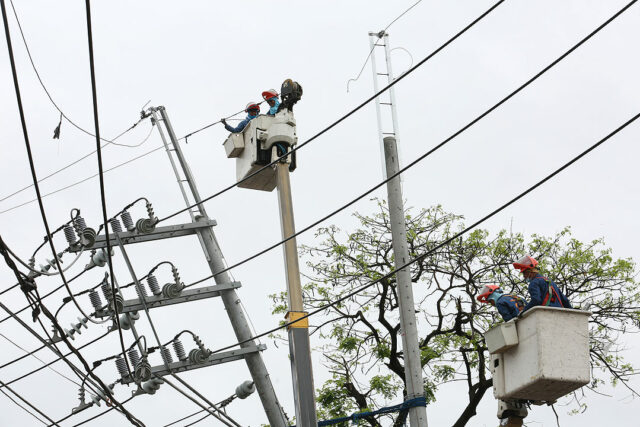
WORKERS fix an electric line in Payatas, Quezon City, March 13. — PHILIPPINE STAR/ MICHAEL VARCAS

THE Energy Regulatory Commission (ERC) said on Monday that transmission charges are likely to fall after revamping the process for computing the fees collected by the National Grid Corp. of the Philippines (NGCP).  

In a briefing, ERC Chairperson and Chief Executive Officer Monalisa C. Dimalanta said that the commission is expecting to complete by year’s end the reset of the NGCP’s transmission charge for 2023-2027.

Ms. Dimalanta said the impact of the reset will be apparent by January.

“We are targeting to complete (the review) by the end of the year so we can start with new rates in January,” Ms. Dimalanta said.

On Sunday, the ERC said it promulgated the Amended Rules for Setting Transmission Wheeling Rates (RTWR), which triggers the rate reset process for the NGCP.

Transmission wheeling rates are the direct charge for the use of transmission facilities in delivering electricity.  

“The science behind rate setting is not perfect because it is based on forecasts, but for this regulatory review, it will be based on actual figures,” Ms. Dimalanta said.

Ms. Dimalanta said the reset was long overdue and that rates needed to be adjusted for current conditions. 

The ERC said on Sunday that the amended RTWR will eliminate over recoveries, double compensation, and redundant inflationary considerations. — Ashley Erika O. Jose

Prices steady for Christmas feast goods, supermarket industry says

PHILSTAR FILE PHOTO/KNORR RELEASED

PRICES are steady for groceries associated with the traditional Christmas feast, known in the Philippines as ”noche buena,” the supermarket industry said on Monday.

Steven T. Cua, Philippine Amalgamated Supermarkets Association president, said in an interview on One News Channel’s BusinessWorld Live program that it is “too early” for noche buena goods prices to rise.

“No prices increases yet. It is still a bit too early. The advice of the Department of Trade and Industry (DTI) is to go out and buy if you can, if you have the money — that may be a good idea this year in particular because we do not know what’s going to happen,” Mr. Cua said.

“If consumers go out and buy now and manufacturers see that there is demand, maybe they will be reluctant to increase prices,” he added.

The DTI has advised consumers to start stocking up on ingredients for the Christmas feast to take advance of these products’ long shelf lives. It also urged manufacturers of noche buena products to cap their price hikes to 10%.

Separately, Mr. Cua said the price of the most popular brand of imported US luncheon meat has risen 15% in the last two weeks due to the weaker peso.

“Businesses will take advantage of the fact that there are increases in the prices of imported goods,” Mr. Cua said, noting that domestic brands can offer alternatives that are still priced competitively.

“Everyone’s going to be more creative in stretching their pesos… We can still have a Merry Christmas. Just keep it simpler and be more creative. There will be some good buys in the market for sure,” he added.

The Bankers Association of the Philippines said the peso closed at P59 against the dollar on Monday, against its P58.625 finish on Friday. — Revin Mikhael D. Ochave

BIR says small taxpayers won’t be focus of agency’s enforcement efforts

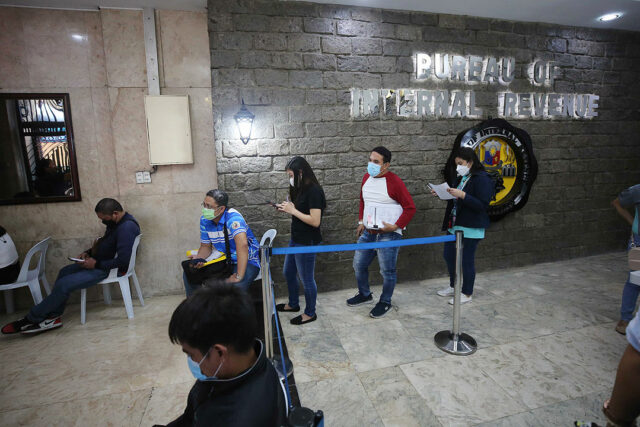
People line up to file their income tax returns at the Bureau of Internal Revenue office in Intramuros, Manila, April 18, 2022. — PHILIPPINE STAR/ RUSSELL A. PALMA

THE Bureau of Internal Revenue (BIR) said on Monday that small taxpayers will not bear the brunt of its enforcement actions, adding that its efforts will be focused on medium-sized and large companies.

“In this administration, we will really focus on large taxpayers and medium taxpayers,” BIR Commissioner Lilia Catris Guillermo said at the Senate budget hearing for the Department of Finance (DoF). “The ease of paying taxes bill will segment taxpayers into small, medium and large, and the requirements for small taxpayers will be simplified.”

“We really will not hold anything against small taxpayers; instead, we will give them good service so that their businesses will grow – only then will we (exert more effort in) taxing them,” she added.

Senator Rafael T. Tulfo, speaking at the hearing, alleged that the bureau is placing undue burdens on pedicab drivers, tricycle drivers, thrift stores, and bloggers.

“Whenever the BIR needs to increase tax collection, it’s the poor that are being targeted,” he said. “If the BIR really wants to raise collections, why doesn’t it target the rich, like oil companies.”

Mr. Tulfo noted in particular the proliferation of smuggled oil products, which generate no taxes for the government.

“The basic principle of taxation is to be just and fair, so it’s not true that small taxpayers are our focus. In fact, we have (an agency) which is focusing on large taxpayers,” Ms. Guillermo said, referring to the BIR’s Large Taxpayers Service.

“Small taxpayers are not being singled out; everyone must issue receipts, whether small, medium or large taxpayers,” she added. However, she specified that the agency is not strict with pedicab drivers’ transactions.

Senate Minority Leader Aquilino Martin L. Pimentel III said “the impression is that we would rather squeeze… those who want to follow the law since they are the ones in our database.”

“But the brave syndicates who have not been paying tax for years remain out of the system, undetected, unfelt by the revenue collection agencies,” he added in a mix of English and Filipino.

Ms. Guillermo said taxpayers currently filing manually are slowly being incorporated into the database to allow them to be served more efficiently in the future.

Finance Secretary Benjamin E. Diokno said the efforts to collect such data are part of a broader effort to expand the tax base. “When you have a broader base, you can lower the tax rate because revenue is rate times base.”

Mr. Tulfo said he has been receiving many complaints from business owners, particularly Chinese-Filipinos in the provinces, who are visited by revenue agents presenting letters of authority (LoA) as a preliminary to an audit. 

“Most of the time, once a business is issued an LoA, this means money for the (official),” he said. “On the other hand, the big companies are often not (targeted). They will instead have discussions on the side (with the auditor)… where they can make arrangements. Sorry again for saying this, but this is the reality.”

Ms. Guillermo said the BIR’s digitalization efforts will resolve such issues.

“Our first program right now is digitalization, and new audits are currently suspended because our plan is for LoAs to become automated,” she said. “These can no longer be issued by auditors whenever.”

“We have a risk-based criteria (for determining which taxpayer to audit), and we are already preparing the program for this. What the auditors are doing now is clearing their backlog (of) prescribing… and that is being monitored properly using technology,” she added.

The DoF’s proposed 2023 budget allocates the most funding to three of the government’s leading money-generating agencies, with the BIR getting P13.1 billion, the Bureau of Customs P6 billion, and the Bureau of the Treasury P4.2 billion. — Alyssa Nicole O. Tan

BoI pitching investors to locate in South-Central Mindanao, Western Visayas 

THE Board of Investments (BoI) said it is hoping to persuade investors to locate their operations in South-Central Mindanao and the Western Visayas.

In a statement Monday, the BoI said that it recently conducted Strategic Investment Priority Plan (SIPP) roadshows in Iloilo City and General Santos City last month.

Rachel B. Echague, BoI director for resource-based industries, said Republic Act No. 11534 or the Corporate Recovery and Tax Incentives for Enterprises (CREATE) Act details the incentives investors are eligible for regardless of which investment promotion agencies (IPA) a business registers with.

“No matter which IPA you register your project with, you will still be given or granted the same package of incentives and they only differ in terms of industry tier classification, location, and whether you are export-oriented or geared towards the domestic market,” Ms. Echague said.

According to the BoI, General Santos City is home to six of the seven major tuna companies, with the industry’s overall workforce estimated at 120,000 and exports at $58 million.

“The CREATE Law positions our region to be a (potential) metropolitan development… We are confident that the SIPP will maximize business opportunities and investors will consider our region as their destination,” General Santos City Economic Development Office Head Leonard V. Flores said.

Teresa Socorro C. Ramos, National Economic and Development Authority (NEDA) regional director for Soccsksargen, said that the region’s economy posted 5.2% growth to P472.5 billion in 2021.

“Soccsksargen is among four regions… whose output returned to pre-pandemic levels. In 2021, the region was the country’s largest coffee producer at 21,588 metric tons (MT) and Mindanao’s top rice producer with 1.265 million MT,” she said.

Department of Trade and Industry Western Visayas (Region VI) Regional Director Rebecca M. Rascon said she hopes the region will attract “construction, Information Technology-Business Process Management (IT-BPM), tourism (and) manufacturing projects to generate employment.”

Arecio A. Casing, Jr., NEDA Region VI OIC-regional director, said the region offers investors ample agricultural land, a favorable energy mix, and promising locations.

He added that some of the ongoing infrastructure projects in the region include the proposed Iloilo-Capiz-Aklan Expressway, the proposed Panay Guimaras-Negros Island Bridge, and the Panay River Basin Integrated Development Project.

The SIPP, which took effect on June 11, is the list of priority industries the government wishes to develop by offering preferential incentives to the private sector. — Revin Mikhael D. Ochave

POGO revenue well below forecast at P4.4 billion

THE Bureau of Internal Revenue (BIR) said on Monday that taxes generated by the Philippine Offshore Gaming Operator (POGO) industry amounted to P4.4 billion in the eight months to August, up from the P3.91 billion collected over the full year in 2021 but significantly lower than the bullish pre-pandemic projections for the industry.

The Department of Finance (DoF) had expected a law regulating POGOs to raise P32.1 billion in 2021, on the assumption that operations will return to pre-pandemic levels.

“However, contrary to the lofty expectations, POGO entities have not returned to the Philippines and the number of foreign nationals employed by POGOs has not equaled pre-pandemic levels but has drastically decreased,” the DoF said. Registered POGOs have declined steadily to 163 from 191 in 2021, 244 in 2020 and 281 in 2019.

The number of workers in the POGO industry has risen to 34,245 at the end of August from 30,583 in 2021, though the total was well below the 42,385 tallied in 2020 and 144,605 in 2019.

The DoF said the industry has fled the Philippines because of tax rules and the Chinese government’s hostility to all forms of gambling.

At a Senate Ways and Means Committee hearing, the Philippine Amusement Gaming Corp. (PAGCOR) reported income of P1.912 in the eight months to August, putting it behind the pace of previous years. It generated P3.47 billion in 2021, P5.28 billion in 2020, and P8.02 billion in 2019.

The DoF said in a letter to the Senate dated Oct. 3, that POGOs’ “modest contribution to the economy does not outweigh the social costs of (their) continued operations, especially (with the) alarming increase in undesirable criminal activities. It estimated that the industry accounted for 0.03% of gross domestic product in 2021 and the current year.

According to the Philippine National Police, POGO-related crimes included prostitution, the employment of minors, violations of labor law, and kidnapping.

The Anti-Money Laundering Council has reported that POGOs and service providers are a money laundering risk given that the financial transactions of internet-based casinos are based on opaque remittance.

“This can frustrate the government’s efforts to get out of the Financial Action Task Force grey list by January 2023,” the DoF said.

The Philippines, it added, may be exposed to reputational risk by allowing the industry to operate even as it remains illegal in China, and is at any rate in position to tap other forms of investment.

“We have (prepared) the ground for foreign direct investment to come in through economic liberalization measures and by modernizing our tax incentives system through the Corporate Recovery and Tax Incentives for Enterprises (CREATE) Act,” the DoF said.

“It is time to pursue investments that will create value and high-quality jobs for our people, in line with our vision of an inclusive and sustainable economic development,” it added.

Senator Mary Grace Natividad S. Poe-Llamanzares said the Philippines must turn away from offshore gambling.

“This is an opportune time to weigh whether the POGO industry plays a significant role in our bid for economic recovery and growth,” she said.

“We need to have the policy framework and the political will to invite strategic investment from industries that are actually worthy of our focus,” she added. — Alyssa Nicole O. Tan