Home Blog Page 582

The rise of AI reasoning models comes with a big energy trade-off

FREEPIK

NEARLY ALL leading artificial intelligence (AI) developers are focused on building AI models that mimic the way humans reason, but new research shows these cutting-edge systems can be far more energy intensive, adding to concerns about AI’s strain on power grids.

AI reasoning models used 30 times more power on average to respond to 1,000 written prompts than alternatives without this reasoning capability or which had it disabled, according to a study released on Thursday last week. The work was carried out by the AI Energy Score project, led by Hugging Face research scientist Sasha Luccioni and Salesforce, Inc. head of AI sustainability Boris Gamazaychikov.

The researchers evaluated 40 open, freely available AI models, including software from OpenAI, Alphabet, Inc.’s Google and Microsoft Corp. Some models were found to have a much wider disparity in energy consumption, including one from Chinese upstart DeepSeek. A slimmed-down version of DeepSeek’s R1 model used just 50 watt hours to respond to the prompts when reasoning was turned off, or about as much power as is needed to run a 50 watt lightbulb for an hour. With the reasoning feature enabled, the same model required 7,626 watt hours to complete the tasks.

The soaring energy needs of AI have increasingly come under scrutiny. As tech companies race to build more and bigger data centers to support AI, industry watchers have raised concerns about straining power grids and raising energy costs for consumers. A Bloomberg investigation in September found that wholesale electricity prices rose as much as 267% over the past five years in areas near data centers. There are also environmental drawbacks, as Microsoft, Google and Amazon.com, Inc. have previously acknowledged the data center buildout could complicate their long-term climate objectives.

More than a year ago, OpenAI released its first reasoning model, called o1. Where its prior software replied almost instantly to queries, o1 spent more time computing an answer before responding. Many other AI companies have since released similar systems, with the goal of solving more complex multistep problems for fields like science, math and coding.

Though reasoning systems have quickly become the industry norm for carrying out more complicated tasks, there has been little research into their energy demands. Much of the increase in power consumption is due to reasoning models generating much more text when responding, the researchers said.

The new report aims to better understand how AI energy needs are evolving, Ms. Luccioni said. She also hopes it helps people better understand that there are different types of AI models suited to different actions. Not every query requires tapping the most computationally intensive AI reasoning systems.

“We should be smarter about the way that we use AI,” Ms. Luccioni said. “Choosing the right model for the right task is important.”

To test the difference in power use, the researchers ran all the models on the same computer hardware. They used the same prompts for each, ranging from simple questions — such as asking which team won the Super Bowl in a particular year — to more complex math problems. They also used a software tool called CodeCarbon to track how much energy was being consumed in real time.

The results varied considerably. The researchers found one of Microsoft’s Phi 4 reasoning models used 9,462 watt hours with reasoning turned on, compared with about 18 watt hours with it off. OpenAI’s largest gpt-oss model, meanwhile, had a less stark difference. It used 8,504 watt hours with reasoning on the most computationally intensive “high” setting and 5,313 watt hours with the setting turned down to “low.”

OpenAI, Microsoft, Google and DeepSeek did not immediately respond to a request for comment.

Google released internal research in August that estimated the median text prompt for its Gemini AI service used 0.24 watt-hours of energy, roughly equal to watching TV for less than nine seconds. Google said that figure was “substantially lower than many public estimates.”

Much of the discussion about AI power consumption has focused on large-scale facilities set up to train artificial intelligence systems. Increasingly, however, tech firms are shifting more resources to inference, or the process of running AI systems after they’ve been trained. The push toward reasoning models is a big piece of that as these systems are more reliant on inference.

Recently, some tech leaders have acknowledged that AI’s power draw needs to be reckoned with. Microsoft CEO Satya Nadella said the industry must earn the “social permission to consume energy” for AI data centers in a November interview. To do that, he argued tech must use AI to do good and foster broad economic growth. — Bloomberg

Observations from my five foreign trips in 2025

I was lucky to have taken five foreign trips this year — to Hong Kong and China last April, Spain in September, and Vietnam and Japan in November. All were work-related except the Vietnam trip, which was a vacation with my ex-UP Narra dormmates with our spouses and friends.

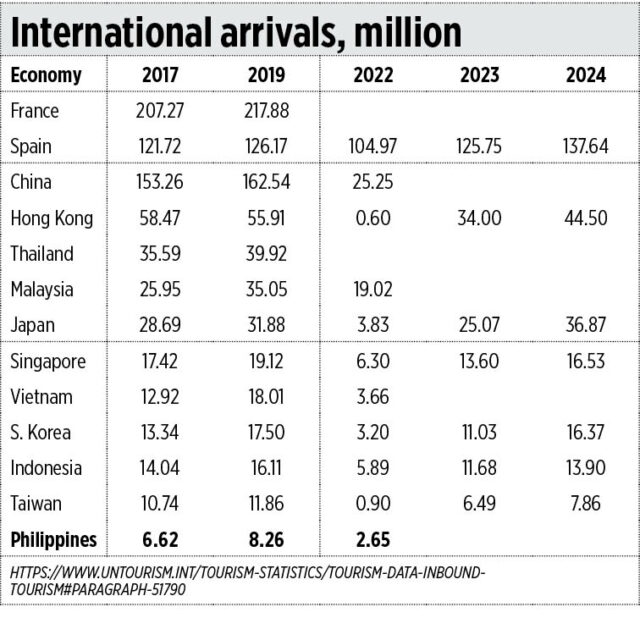
To help provide context to the observations I made about tourism during my travels, I constructed this table based on information from the UN Tourism website. I added a few other countries I have been to — like France as I had gone to Nice in 2023. I also added other East Asian neighbors to this table.

The Philippines has the smallest number of tourist arrivals in the table, mainly because of its geography. It is far away from the Asian mainland where visitors can go from, say, Vietnam to Cambodia to Thailand by car or bus aside from airplane. Add to this our generally poor infrastructure.

Here are some observations, some of which we can possibly adapt in the Philippines.

1. Hong Kong’s huge airport is directly connected to the city by high-speed train, then one can go by taxi or subway to stations near hotels. There are also buses from the airport to major hotel corridors. The city’s long and modern subway trains and the huge skyscrapers continue to amaze me. It’s main attraction for international visitors is its unilateral free trade policy, with zero tariffs for exports and imports so visitors can find many items from China and many other countries at competi-tive prices. This is a combination of tourism and trade policy that the Philippines should consider.

2. While Beijing international airport is also huge and is connected to the city by a fast airport express train, our host picked us up by van as we stopped by a nice restaurant before going to our hotel. We took the toll road, but it was congested even on a Sunday night. China has become a car culture country unlike many decades ago where it was a bicycle and motorcycle riding country.

3. Madrid’s international airport is also huge, but our landing terminal was far away from the baggage claim. It took about an hour from landing to get the luggage, a very long time! Going from the airport express train to the high-speed train station going to Valencia (where I was attending my annual international free market network conference) and other cities is very confusing as there were no clear signs. I missed my train to Valencia and had to buy another train ticket. SMC’s Bulacan airport should avoid this kind of lousy airport design.

4. Ho Chi Minh international airport is also big, but the country is getting a lot more visitors now as many Chinese tourists are avoiding Japan and the US, going instead to Vietnam and other East Asian nations. Flying back to Manila, it took us more than one hour just queuing at immigration, then the security check for passengers and their hand-carry. I think Ho Chi Minh airport should move elsewhere, like a wide reclaimed area near the sea where further expansion is possible.

5. The Narita-Tokyo international airport is really huge and modern. But I noticed it was not as busy as before, probably due to millions of China tourists avoiding Japan due to the ongoing diplomatic spat over Taiwan. Nagoya airport is also huge, but we landed at the domestic terminal. Flying back to Manila we took the Haneda-Tokyo airport, also huge but not as big as Narita.

6. China is careful to preserve its historic structures that are up to 1,500 years old. The Great Wall of China attracts 15-17 million tourists a year, with the Badaling section near Beijing attracting some 10 million. Our host brought me there in the afternoon after our morning meeting and lunch, and I was amazed by the huge number of visitors coming in even in late afternoon — many white people, then locals from other provinces, then other Asians.

The Forbidden City or Palace Museum in the center of Beijing attracted up to 19 million visitors in 2019. When I was there, my host said it gets an average of 40,000 visitors a day, peaking at 80,000 a day in the summer months. One must reserve tickets several days ahead. Again, I was amazed at the hugeness of the area, the wood carvings, and architecture.

7. I was impressed by the high-speed trains I took during my trips. There was China’s train, which runs up to 350 kph from Chengde to Beijing; then Spain’s train which runs up to 300 kph from Madrid to Valencia and back; then Japan’s shinkansen or bullet train which runs up to 280 kph from Nagoya to Tokyo. There are trains going at up to 320 kph in other destinations. All arrive and depart on schedule, but in terms of a smooth ride, I think Chi-na’s more modern trains are better. The Philippines should aspire to have these high-speed trains someday, say from Manila to Laoag City in the north and to Legaspi City in the south.

8. They use tunnels instead of zigzag roads to traverse hills and mountains. Going from Beijing to a pumped-hydro storage power plant in the mountains, we passed by a long elevated toll road, then through so many tunnels — ranging in length from 200 meters to two to five kms long — that I lost count. Smooth, well-paved, and well-lit, there was even an internet signal inside the long tunnels. The Philippines should have these tunnels too someday: these would re-duce road accidents and road closures from landslides. They would also do for horizontal mining.

9. There were no tricycles, no jeepneys, and no stray dogs in sight. The five places I went to have none of these while the Philippines has a lot. Even Vietnam has none of these, only motorcycles, cars, and aircon buses. And even in rural areas of Ho Chi Minh, all the houses have fences and gates except those with shops and restaurants. The gates are about two to three meters from the road, with no vehicles — even motorcycles — parked on road shoulders. The motorists are disciplined and considerate.

10. The rule of law protects peace and order, and private property. I saw few or no security guards at shops, malls, and hotels. Plus, there were lots of bright lights at night (no issues with the electricity supply) and wide pe-destrian walkways.

There are more observations, but I limit myself this time to those 10 points.


Bienvenido S. Oplas, Jr. is the president of Bienvenido S. Oplas, Jr. Research Consultancy Services, and Minimal Government Thinkers. He is an international fellow of the Tholos Foundation.
minimalgovernment@gmail.com

BSP, SEC ink deal on PERA data sharing

Photo credit | THE PHILIPPINE STAR

THE BANGKO SENTRAL ng Pilipinas (BSP) has signed a memorandum of agreement (MoA) with the Securities and Exchange Commission (SEC) to exchange and manage information on Personal Equity and Retirement Account (PERA) contributors.

The partnership signed on Dec. 3 will help safeguard the retirement savings of Filipinos, the central bank said in a statement on Wednesday.

The agreement covers data sharing and the access to and use of information from the Personal Equity and Retirement Account System or PERASys.

PERASys is managed by the BSP and is the central database of all PERA contributors.

“It helps ensure that every contributor’s hard-earned savings and corresponding tax incentives are accurately recorded and well-protected,” it said.

Under the MoA, the two regulators will ensure that data on PERA contributors are shared and used securely and responsibly.

The agreement ensures full compliance with data privacy laws and sets “high” standards for confidentiality, recordkeeping, and data security, the BSP said, as it outlines the procedures for reporting, handling of operational issues, and safeguarding information.

“When you put aside part of your income for your future, you trust us to protect that investment,” BSP Governor Eli M. Remolona, Jr. said,

“With this partnership, we are building a system that keeps your information safe and your future more certain. It is one more step toward helping every Filipino retire with dignity and peace of mind.”

PERA, created under Republic Act No. 9505 in 2016, is a voluntary retirement saving program that aims to supplement benefits from the Social Security System, Government Service Insurance System, and employer-provided plans.

BSP data showed that accumulated PERA contributions rose by 24% year on year to P491.4 million at end-2024 from P396.3 million the previous year.

The total number of PERA contributors likewise grew by 6.4% to 5,912 by the end of last year from 5,555 in 2023. — Katherine K. Chan

Ray-Ban Meta glasses take off but face privacy and competition test

https://www.ray-ban.com/usa/ray-ban-meta-ai-glasses

MILAN — EssilorLuxottica is betting big on smart eyewear and the gamble is about to be tested. Its Ray-Ban Meta glasses, powered by artificial intelligence (AI), have delivered their first meaningful revenue boost this year, but analysts warn that privacy concerns and a wave of new rivals could limit their growth.

The frames, launched in 2021, promise to upend the smartphone era by letting wearers take photos and videos through tiny cameras in the lenses, stream content to Meta apps and talk to an AI assistant.

Yet the same features that promise to make the AI-powered frames — born from the collaboration between Mark Zuckerberg’s Meta and French-Italian eyewear giant EssilorLuxottica — into a must-have device are sparking concerns, as bystanders have little control over being recorded or how their data is handled.

“AI smart glasses raise significant privacy concerns,” said Kleanthi Sardeli, a lawyer at European digital rights advocacy group NOYB. “The main issues are linked to the use of people’s personal data to train AI models and transparency for bystanders.”

Meta Platforms, which owns Facebook, Instagram and WhatsApp and generates the bulk of its revenue from advertising, is leveraging user data to power artificial intelligence tools, a move that brought the company to face scrutiny over data practices.

REGULATORY SCRUTINY IN EUROPE

European regulators have flagged risks since 2021, when Italy and Ireland asked Meta to clarify how it complied with local privacy laws.

Ireland’s Data Protection Commission questioned whether a tiny LED indicator was enough to alert people they were being filmed, prompting Meta and EssilorLuxottica to enlarge the light and add a blinking pattern.

Privacy concerns are particularly strong in the European Union (EU), where stricter regulations have slowed adoption of some AI features.

AI-enabled wearables are regulated by the EU’s AI Act and the General Data Protection Regulation, or GDPR.

“Any recording of individuals must be clearly communicated and must have a legal basis to record individuals,” unless the data was processed for purely personal or household reasons, a European Commission spokesperson said.

But enforcing those rights is difficult when the device owner is unknown, says NOYB.

A 2024 Monash University survey of more than 1,000 Australians found owners see smart glasses as boosting their self-image and social ties, while non-users fear privacy breaches and social disruption.

EssilorLuxottica said it partners “with competent authorities to drive innovation, safeguard privacy and set new industry standards.”

A Meta spokesperson declined to comment beyond referring to EssilorLuxottica’s statement.

COMPETITION HEATS UP

Ray‑Ban Meta glasses lead the AI eyewear market thanks to a partnership that bridges tech and fashion, analysts and experts say, a gap that doomed Google Glass a decade ago.

According to Barclays, EssilorLuxottica currently holds a 60% share of the smart glasses market.

“Instead of trying to make something cool, Meta partnered with people who know what’s cool,” said Ross Gerber, Chief Executive Officer (CEO) of California-based wealth management firm Gerber Kawasaki, which holds Meta shares.

But its first-mover advantage may fade as rivals launch better products, said Bernstein analyst Luca Solca. Smart glasses could also cannibalize traditional eyewear, which accounts for about a quarter of EssilorLuxottica’s revenue.

Several tech giants aim to catch up.

In November Alibaba released its new Quark AI-powered glasses in China, where Ray-Ban Meta are not sold.

Apple is expected to unveil its own model next year and release it in 2027, Bloomberg News reported.

Google is working with Warby Parker and luxury fashion house Kering to develop its own version, announcing on Monday it expected to launch a first product in 2026, sending EssilorLuxottica shares lower. Amazon is also reportedly exploring the market and Xiaomi launched a similar product in June.

LEVERAGING ITS BRAND PORTFOLIO

EssilorLuxottica, the world’s biggest eyewear maker, can lean on its 18,000-store network and brands such as Prada, Armani and Chanel.

“One of the key differentiating elements for them is not just their ability to produce, but also their ability to distribute, and their ability to leverage a portfolio of brands,” said Bassel Choughari, Paris-based portfolio manager at Comgest, which holds EssilorLuxottica shares.

“That is an element that shouldn’t be underestimated.”

EssilorLuxottica CEO Francesco Milleri, who took over as head of the company in 2020, is steering the group towards medical technology.

Smart glasses, central to this strategy, contributed more than four percentage points to EssilorLuxottica’s nine-month sales growth, sparking a 14% market rally for the €140-billion company, even though they account for just 2% of global sales, investor CCLA estimates.

EssilorLuxottica is looking to build on this momentum. It has widened its portfolio to sports brand Oakley and held exploratory talks with Prada, heir to the luxury brand, Lorenzo Bertelli told Reuters. In September it introduced a model with an in-lens display, operated through a bracelet that converts hand gestures into commands.

Competition is welcome, the company says: “A vibrant ecosystem will help us drive market growth, fuel innovation and expand consumer choice.” — Reuters

Hendrix classic albums under spotlight in UK rights battle with Sony

https://en.wikipedia.org/wiki/File:Are_You_Experienced_-_US_cover-edit.jpg

LONDON — Jimi Hendrix’s classic 1960s albums are the focus of a London lawsuit over performers’ rights asserted on behalf of his British bassist and drummer against Sony Music Entertainment, which warns that a win for the claimants could “throw the music industry into chaos.”

Guitarist Noel Redding, who had recently auditioned for the 1960s blues-rock band The Animals, and pioneering drummer Mitch Mitchell joined The Jimi Hendrix Experience in 1966 and created some of the most renowned mu-sic of the decade.

Mr. Redding and Mr. Mitchell played on the group’s three studio albums Are You Experienced, Axis: Bold As Love, and Electric Ladyland, released in 1967 and 1968 and featuring “Hey Joe,” “Purple Haze,” “Foxy Lady” and other hits.

The recordings helped usher in the psychedelic music age and made Mr. Hendrix a rock superstar before his untimely death in London in September 1970, aged 27. Five decades on, The Jimi Hendrix Experience’s music remains both popular and profitable.

Their albums are at the center of a trial that began on Tuesday and seeks a share of potentially lucrative streaming royalties — a claim Sony says should be rejected.

LAWSUIT CITES UNFORESEEN RISE OF STREAMING
Mr. Redding and Mr. Mitchell died in 2003 and 2008 respectively and their descendants later assigned any rights they might have had to two companies, Noel Redding Estate Limited and Mitch Mitchell Estate Limited.

The companies sued Sony at London’s High Court in 2022 and are seeking a declaration that they own a share of the sound recording copyrights of, and performers’ property rights in, the three Jimi Hendrix Experience albums.

Sony’s lawyers argue that in 1966 the band signed away the rights to exploit the recordings “by any method now known or hereafter to be known.” They also cite releases agreed by Mr. Redding and Mr. Mitchell to drop lawsuits in the early 1970s.

But the companies’ lawyer Simon Malynicz said Sony’s case relied on deals signed “long before the internet revolutionized music” and the rise of streaming platforms like Spotify.

“The agreements from the 1960s and 1970s simply do not extend to the radically different modes of digital exploitation which underpin (Sony’s) current business model,” he said in court filings.

Sony, however, raised concerns about the wider impact of the companies’ case if they succeed, which it said could prompt a slew of lawsuits from session musicians and backing vocalists.

Sony’s lawyer Robert Howe said in court filings that “deals done with virtually every 1960s and 1970s artist, from The Beatles to the Berlin Philharmonic… would be vulnerable to retrospective attack.” — Reuters

Whose turn is it?

STOCK PHOTO | Image by FREEPIK

Queuing is expected in self-service restaurants, ATM withdrawals, and buying tickets from the box office. Exceptions allowed for jumping the queue may apply to the elderly or privileged. But even here, a separate queue maintains an orderly progression. Maybe online transactions have made queuing less important too.

Taking turns is part of our social scene. Even treats for lunch or breakfast where small groups (sometimes just a pair) that meet regularly understand whose turn it is to pick up the bill: Please, no second cup of coffee.

Corporate rules, even if unwritten, are well understood and followed when it comes to whose turn it is to speak.

This queuing rule is not a problem at conferences. Attention is focused on the speaker on stage doing his slide presentation. It is impolite to chat while the session is going on. It is likewise déclassé to be texting on the sly. The open forum allows the facilitator to pick which one can ask the question from the resource person. In such a big crowd, no shouting from the floor is allowed. (Sir, use the mic in the aisle.)

In board meetings, turn-taking is more formal. The rule is simple: never interrupt the conversational flow of someone who outranks you. Conversely, anyone with a higher rank can derail somebody’s opinion on the disruption of traffic by motorcycles. Even the chair is just there to open the session and have the minutes of the last meeting approved.

If the CEO has the floor, even if he is only describing his day at the golf course and his lousy swing, lower life forms need to show rapt attention to the topic at hand. Only when the CEO needs to excuse himself for a washroom break does the normal flow of conversation resume.

What is the rule in table conversations when the CEO of one company is seated next to another CEO? Is market cap to be the designator of hierarchy? What if one CEO is taciturn and concentrating on his soup with no inten-tion of saying anything, or having anything said to him? Who regulates the conversation traffic in a 12-seater of all CEOs? Just talk to the one beside you.

Hierarchies are only applied in military organizations and religious organizations. Even here, the retired status can throw off the pecking order. Business associations are tricky as the officers who should have the upper hand may belong to smaller companies than those with lower ranks in bigger conglomerates. The rule here is even simpler — Just greet your friends.

Interruptions are seldom carried out with grace. It is best to let someone finish his sentence before attempting to jump into the verbal queue. But even this seemingly safe assumption leads to tension if a split-second later someone else wants to say something.

Is it worth the bother to even understand these niceties of authorized interruptions? Are these rules even still in place? Who legislated the rules?

With the rise of social media, the rules for taking turns have been upended. Anyone can post at any time. But is anybody reading these midnight rants? Are there rules in responding to unwelcome posts — that’s fake news.

What about online meetings? There are protocols for raising the hand to be acknowledged and given the screen. But interruptions are avoided by putting observers and minor characters on “mute.” Still, jumping in (I have a question) cannot be avoided, except by “technical glitches.” (Ma’am, you are garbled.)

Rules on turn-taking for debates during a political contest need to be negotiated. One rule is to disallow the interruption of the one speaking when it is his turn on the screen. The microphones of others are muted to prevent any unauthorized turn-taking.

In a free-for-all milieu like a Viber group, postings can just pop up along with vehement reactions to them. There is no need to wait for anyone’s turn. Even the language is unfettered. So, chats can turn into debates and bruised feelings.

The adept social player can opt to be quiet and just watch the verbal tennis going on at a table, feigning disinterest in what anyone is saying. She waits for the conversation to come to her and even then, she may just shrug and proceed with putting lettuce in her mouth. (Are you talking to me?)


Tony Samson is chairman and CEO of TOUCH xda
ar.samson@yahoo.com

Cityland says Congressman Villanueva resigned as independent director

Listed property developer Cityland Development Corp. (CDC) on Wednesday announced the resignation of Congressman Eduardo C. Villanueva as independent director, citing personal reasons.

In a disclosure to the stock exchange, the company said its board accepted and approved Mr. Villanueva’s resignation, effective Dec. 10.

CDC also said the submission of his Securities and Exchange Commission (SEC) Form 23-B has been discontinued.

Mr. Villanueva is a lawmaker and representative of the Citizens’ Battle Against Corruption (CIBAC) Party-list.

The company likewise announced the resignation of Hazel Anne C. Paule as head of internal audit, effective Dec. 31, also due to personal reasons.

She will be replaced by Rudy Go, who will assume the role of senior vice-president and head of internal audit effective Jan. 1, 2026.

CDC also reappointed Emma A. Choa as executive vice-president and chief operating officer and Melita L. Tan as vice-president and treasurer.

The developer focuses on acquiring and developing land for residential, office, commercial, institutional, and industrial use.

Its projects include the 50-story CityNorth Tower condominium in Quezon City and the 24-story Pioneer Heights 1 condominium in Mandaluyong City.

CDC shares closed down 1.85% or one centavo at P0.53 on Wednesday. — Beatriz Marie D. Cruz

BPI taps Savers Depot as agency banking partner

BANK of the Philippine Islands has opened a “prime phygital” branch in Davao City.

BANK of the Philippine Islands (BPI) has tapped retail chain Savers Depot to help expand its presence in Visayas and Mindanao via agency banking, offering its products and services at the latter’s stores.

Savers Depot will be BPI’s first partner in the do-it-yourself (DIY) retail store category to offer the full range of BPI Partner Store services under its Agency Banking initiative, including product onboarding, deposits, with-drawals, cash-outs, and the BPI OneQR scan and pay payment solution.

“This will allow customers to enjoy seamless banking experiences while doing their usual store visits,” BPI said in a statement.

“This partnership reflects BPI’s commitment to financial inclusion, community development, and customer convenience by leveraging trusted establishments to deliver secure and seamless banking services.”

Savers Depot branches in Lapu-Lapu and Ormoc are already offering BPI’s products and services in-store. Five more stores are expected to follow suit before yearend to bring the total to seven locations.

“This initiative means a lot to us. For years, our goal at Savers Depot has been simple: to serve, to build value. We understand that not everyone has easy access to a bank branch or an ATM (automated teller machine), especially in busy or remote areas. By bridging that gap, we’re helping make financial transactions more accessible, more convenient, and more personal. That’s something we can all be proud of,” Savers Depot Chief Executive Officer Kendrick Sia Sulay said.

Savers Depot is the bank’s 32nd partner store for its “May BPI Dito” agency banking initiative, which aims to make financial services more accessible.

BPI’s attributable net income inched up by 0.6% to P17.526 billion in the third quarter amid lower trading gains.

This brought its nine-month profit to P50.48 billion, up by 5.21% from the same period last year.

BPI’s shares went down by P1.30 or 1.13% to close at P113.70 apiece on Wednesday. — A.M.C. Sy

How PSEi member stocks performed — December 10, 2025

Here’s a quick glance at how PSEi stocks fared on Wednesday, December 10, 2025.


Breaking down LoA controversies: Lessons for businesses

BW FILE PHOTO

As 2025 draws to a close, taxpayers are looking forward to a stabler and more predictable tax audit environment following the Bureau of Internal Revenue’s (BIR) Revenue Memorandum Circular (RMC) No. 107-2025. The circular suspended the issuance of Letters of Authority (LoAs) and Mission Orders (MOs), as well as the examination of taxpayer records, following numerous complaints regarding irregularities and inconsistencies in the tax audit process. While the BIR typically suspends audits during the holiday season, the RMC stands out for starting the suspension earlier and extending it until the Commissioner formally lifts it.

The RMC also underscored a lingering concern among taxpayers: the issuance and handling of LoAs and tax assessments, being criticized by some as leading to costly disputes and prolonged uncertainty for businesses.

By itself, an LoA formally initiates a tax investigation and authorizes BIR officers to review a taxpayer’s records. Its issuance must strictly comply with the Tax Code and BIR regulations. Failure to do so ren-ders assessments void, as affirmed by jurisprudence and Court of Tax Appeals (CTA) rulings.

Here are recent court decisions from the recent years that reveal systemic challenges regarding the proper issuance of LOAs that businesses should take note of:

TAX INVESTIGATIONS MAY ONLY BE CONDUCTED BY AUTHORIZED REPRESENTATIVES INDICATED IN THE LOA
In multiple 2025 CTA rulings, the Court invalidated BIR assessments for lack of proper LoA. In March, the CTA canceled the Warrant of Distraint and/or Levy along with the Assessment Notices because the reassigned Revenue Officer acted under a Memorandum of Assignment, without the authority of an LoA. Similarly, the tax court voided assessments where the revenue officers solely relied on a Memorandum of Assignment, with the LoA issued belatedly two years after the assessment notices were issued. In one other case, the Court struck down all Assessment Notices as the recommending Group Supervisor was not named in the LoA.

In these cases, the CTA cited a 2021 Supreme Court ruling which held that substituting revenue officers named in an LoA without issuing a separate or amended LoA: (i) violates taxpayers’ due process rights; (ii) usurps the CIR’s statutory au-thority to authorize audits; and (iii) breaches BIR rules, particularly Revenue Memorandum Order (RMO) No. 43-90.

ASSESSMENTS BASED ON LETTER NOTICES ARE NOT VALID
The CTA likewise held in a 2024 case that Assessment Notices based on Letter Notices (LN), which were not converted to LoAs, are void. In its decision, the Court cited a Supreme Court case that differentiated LNs from LoAs. An LoA addressed to a revenue officer is specifically required under tax law before an examination of a taxpayer may be conducted. On the other hand, an LN is not specifically provided under the law and is only issued for the purpose of notifying the taxpayer that a discrepancy was found based on the BIR’s RELIEF System. Due process demands, as recognized under RMO No. 32-2005, that after an LN has served its purpose, the revenue officer should have properly secured an LoA before proceeding with the further examination and assessment of the petitioner.

LOAS MUST BE PROPERLY SERVED
In another CTA ruling, the Court voided the Formal Letter of Demand, Assessment Notices, and Warrant of Garnishment because the LoA was improperly served. The Revenue Officer admitted resorting to substituted service by delivering the LoA to a barangay traffic enforcer after the taxpayer’s employees refused to receive it. The Court held that this violated prescribed procedures on the service of LoAs.

Under RMO No. 9-2015 and Revenue Regulations (RR) No. 12-99, as amended by RR No. 18-2013, LoAs must be served personally, by delivering a copy thereof to the party at his registered or known address or wherever he may be found. If the party is not present at the registered or known address or refuses to accept the notice, substituted service may be conducted. Substituted service entails leaving the LoA with a clerk or person in charge at the registered or known business address; or a responsible adult at the taxpayer’s residence. If there is no one available, the revenue officers concerned may bring a barangay official and two disinterested witnesses to the address so that they may per-sonally observe and attest to such absence. The notice (including the LoA) may then be provided to the said barangay official. Such facts shall be contained in the bottom portion of the notice, as well as the names, official positions, and signatures of the witnesses. Lastly, service by registered mail to the registered address or known address can also be done with instructions to return if undelivered within 10 days.

Based on the above rules, the Court found the LoA invalid as it was improperly served on an unauthorized person.

LOAS COVERING TWO TAXABLE YEARS ARE INVALID
In another 2024 CTA case, the Court ruled that an LoA covering two taxable years is void. It cited a Supreme Court case which held that under RMO No. 43-90, an LoA should cover a period not exceeding one taxable year. If the audit of a taxpayer includes more than one taxable period, the other periods or years must be specifically indicated in the LoA.

These CTA rulings reaffirm several key principles: (1) LoAs must be issued to carry out tax investigations; (2) only the revenue officers authorized under an LoA must conduct tax audits; (3) reassignment of revenue officers requires a new LoA; (4) each taxable year needs a separate LoA; and (5) proper service of an LoA is crucial. For businesses, these decisions highlight the importance of monitoring audit procedures and asserting their rights when due process is compro-mised.

The recent CTA decisions serve as a wake-up call for both the BIR and taxpayers. Strict adherence to LoA rules is not just a legal requirement but a cornerstone of fair tax administration. While RMC No. 107-2025 temporarily halted audits, systemic reforms are needed to restore confidence in the tax administration.


The views or opinions expressed in this article are solely those of the author and do not necessarily represent those of Isla Lipana & Co. The content is for general information purposes only and should not be used as a substitute for specific advice.


Nestine P Buisan is a senior manager at the Tax Services department of Isla Lipana & Co., the Philippine member firm of the PwC network.

+63 (2) 8845-2728
nestine.p.buisan@pwc.com

NAIA operator sets July date for terminal reassignments

PHILSTAR FILE PHOTO

NEW NAIA Infra Corp. (NNIC), the operator of the Ninoy Aquino International Airport (NAIA), said terminal reassignments at the main gateway will be implemented by July, coinciding with the expected opening of Terminal 4.

“Terminal reassignments will be by July, the expected (completion of) Terminal 4 will trigger it,” NNIC Adviser Cesar M. Chiong told BusinessWorld on the sidelines of a committee hearing on Wednesday.

The plan calls for terminals 1 and 3 to continue serving international passengers, with low-cost carriers taking Terminal 1 and full-service airlines assigned to Terminal 3, Mr. Chiong said.

Terminals 2, 4, and the proposed Terminal 5 will be reserved for domestic operations, which account for the majority of NAIA’s passenger traffic, he said.

For the nine months to September, passenger volume at NAIA rose 3.96% to 38.86 million, according to the Manila International Airport Authority (MIAA).

It said NAIA domestic passenger volume for the first nine months rose to 20.75 million, up 3.29% from a year earlier. International passenger volume rose 4.74% to 18.11 million.

NNIC said in April that the construction of the proposed Terminal 5 on the site of the former Philippine Village Hotel will take about two years.

NNIC won in 2024 the P170.6-billion contract to operate, maintain, and upgrade NAIA. The government hopes to earn P900 billion from the project, equivalent to P36 billion per year. This projection compares with the P1.17 billion aver-age annually remitted by the MIAA over the 13 years ending 2023, according to the Department of Transportation.

NNIC’s plan for NAIA includes four years of initial works. Mandatory works will take place within five years, and Civil Aviation Authority of the Philippines (CAAP) works taking place within six years.

The initial works phase for NAIA includes rehabilitating and enhancing existing facilities, including road improvements, terminal expansion, and new parking. — Ashley Erika O. Jose

Biz chambers call for power to be VAT-exempt

ROBERT LINDER-UNSPLASH

THE exemption of electricity from value-added tax (VAT) will help ease the burden on consumers and improve Philippine competitiveness, business groups said.

“Electricity is a basic and indispensable input affecting households, small and large enterprises, and key industries,” the Philippine Chamber of Commerce and Industry (PCCI) said in a statement on Wednesday.

“Exempting electricity from VAT would provide immediate relief to consumers,” it added.

In particular, the PCCI, with the Philippine Exporters Confederation, Inc., expressed support for House Bill No. 6740.

Written by Trade Union Congress of the Philippines Rep. Raymond Democrito C. Mendoza, the bill seeks to exempt electricity sales from VAT.

“This is not only an economic measure; it is a social protection that safeguards workers and families,” he said.

“The benefits of cheaper power for both small entrepreneurs and major industries to grow, attract more investment, and generate decent employment for our people do not merely offset but far outweigh the cost to the gov-ernment,” he added.

PCCI President Enunina V. Mangio said that high power costs remain a barrier to competitiveness, especially in the manufacturing sector.

“Removing VAT on electricity would reduce operating costs, helping factories expand production, attract new investments, and increase the sector’s contribution to gross domestic product and job creation,” she said.

“If we want to attract investors and grow our industrial base, we must address power costs head-on … Removing VAT on electricity is a concrete step toward making the Philippines more competitive,” she added.

PCCI Chairman George T. Barcelon said lower power costs could also support the creation of new jobs.

“With more affordable power, industries can scale up operations, while micro, small and medium enterprises can better manage rising expenses and sustain employment,” he said.

The groups also noted that lower power costs would help attract energy-intensive projects in data centers, advanced manufacturing, and digital infrastructure.

“The proposed VAT exemption should be viewed not as a loss in revenue, but as a strategic investment — one that will yield returns through stronger economic activity, increased business confidence, and broader tax bases in the long run,” they said.

“By reducing the cost of electricity, the government empowers industry to grow, enhances productivity, and creates a more dynamic and resilient economy,” they added. — Justine Irish D. Tabile

ADVERTISEMENT
ADVERTISEMENT