Home Blog Page 5807

Atlanta Braves clinch NL East crown

JAKE ODORIZZI pitched five strong innings and the Atlanta bullpen finished with four scoreless frames to help the visiting Braves beat the Miami Marlins 2-1 on Tuesday and clinch their fifth straight N.L. East Division championship. Kenley Jansen retired the side in order in the ninth inning, striking out two, to post his league-leading 41st save. Jordan Groshans flew out to end the game. It was the 22nd division title for the Braves (101-60), the most in major league history. The defending world champions were 10 1/2 games behind the New York Mets on May 1 before winning 77 of their final 110 games. The Marlins dropped to 68-93. Mr. Odorizzi (6-6) worked five innings and allowed one run on two hits, one walk and matched his Atlanta season high with seven strikeouts. He retired 10 of the last 11 batters he faced. Collin McHugh worked a scoreless sixth inning, Raisel Iglesias struck out the side in the seven and A.J. Minter got out bases-loaded trouble in the eighth when pinch-hitter Nick Fortes popped out. — Reuters

Liverpool beats Rangers, 2-0

LIVERPOOL — Liverpool put their recent stutters behind them to comfortably beat Rangers 2-0 in the Champions League on Tuesday and move into second spot in Group A. The win, thanks to a sumptuous first-half free kick from Trent Alexander-Arnold and a second-half penalty by Mohamed Salah, put the six-times European champions on six points after three games — three points behind leaders Napoli. The Scots, who barely threatened Liverpool to the disappointment of their passionate fans complete with a bagpipe-player, remain bottom of the group on zero points. In need of a morale booster after their poor start to the Premier League, Liverpool’s four-man attack of Salah, Diogo Jota, Luis Diaz and Darwin Nunez swarmed over Rangers from the off. By contrast, the visitors’ Colombian striker Alfredo Morelos was largely isolated. Liverpool manager Juergen Klopp was delighted by his team’s tidy and confident performance, albeit against obviously weaker opposition, especially the first goal from Alexander-Arnold whom he had defended from recent criticism. Liverpool’s Mr. Nunez could have had a hat-trick in the first half as Mr. McGregor pulled off four saves in succession from the Uruguayan striker. — Reuters

Inter Milan sinks Barcelona, 1-0

INTER MILAN bounced back after two consecutive losses in Serie A with a crucial Champions League 1-0 win against Barcelona on Tuesday thanks to a Hakan Calhanoglu goal. The Turkish midfielder slotted home a clinical strike from just outside the area, with the ball going into the corner to the goalkeeper’s right in added time before the break. The home win lifted Inter to second place in Group C on six points, three behind leaders Bayern Munich and three in front of Barcelona. Inter and Barca will face each other again next week at the Camp Nou when a third loss in four games would leave Barca in danger of being knocked out of the Champions League at the group stage for the second consecutive season. four points from the European qualification spots and eight behind leaders Napoli and Atlanta. Barcelona, by contrast, arrived as the new LaLiga leaders and with striker Robert Lewandowski on a roll, having scored in six consecutive LaLiga match weeks. But the Polish star forward made no impression at the San Siro, ending with no shots on target.In the 24th minute, Barcelona got a break when a potential penalty for a handball by Eric Garcia inside the box was ruled out by the VAR check which spotted a close offside in the build-up. — Reuters

Divided European aviation sector seeks cure to travel chaos

STOCK PHOTO | Image from Pixabay

European airlines and airports, reeling from delays that caused widespread disruption as demand roared back after COVID-19, are counting the cost of efforts to avoid a repeat next summer.

Industry leaders meeting at the headquarters of air traffic control agency Eurocontrol sparred on Wednesday over who was to blame for the chaos that upset passengers and politicians.

“We found ourselves more in the news than we would have wished over the summer,” Olivier Jankovec, director general of airports association ACI Europe, told a Eurocontrol conference.

Labour or parts shortages and strikes led to cancellations of hundreds of flights, prompting some airports to introduce capacity curbs and exposing slim margins for error.

“We somehow survived the summer but it was not great and it should not be happening again. We have to put appropriate resources in the system to deal with the challenges,” Wizz Air Chief Executive Jozsef Varadi said.

For the budget carrier, that may mean unusually recruiting more people than it needs for the time being.

“We are redesigning the operating model to make sure that we build … more slack in the system so we’re going to be losing some efficiency,” Varadi said.

“I’m not optimizing for today, but optimizing for demands to make sure that we remain as low-cost as possible.”

Airports too are increasingly upping pay or handing out recruitment bonuses to hire back workers laid off during the pandemic. Many defected to new-economy jobs like ride-sharing.

Officials gave no estimate for the overall cost of making the network more delay-proof but airports said they were facing a 7 billion euro ($6.98 billion) funding crunch.


RECRUITMENT WOES

“We are not attractive any more and that is one of the problems that airports face,” said Arnaud Feist, chief executive of Brussels Airport. Automation will increase, he added.

Those left behind were exposed to “unprecedented levels of violence” as tempers rose over the summer, said Livia Spera, general secretary of the European Transport Workers Federation.

The airline industry’s overall drive to contain costs is unlikely to take a backseat for long.

“I think this is temporary. I don’t think this is a structural change,” the head of the International Air Transport Association, Willie Walsh, said in an interview.

Airlines say they are squeezed between regulations requiring them to compensate consumers for delays while bearing the full cost of disruption from a long list of suppliers from manufacturers to airports, air controllers or ground handlers.

Airports complain they did not get state support available to traditional carriers and point the finger back at airlines.

“Some airlines were hiding their own staffing issues behind airports and that wasn’t helpful,” Jankovec told Reuters.

Walsh, who regularly clashed with Heathrow while running British Airways, pulled out official airport data showing security waiting times well above target at the London hub.

“If customers aren’t getting through in time then you’re getting into delayed departures, delayed arrivals. So everything gets knocked out,” he told Reuters.

Heathrow has said rebuilding capacity quickly after the pandemic is “challenging” but that the entire aviation supply chain is affected.

Now, airlines and airports are once again at odds over rules for the usage of airport slots over the coming winter.

A series of air traffic controller strikes is adding to the tensions.

Eurocontrol, a 41-nation coordination agency, called for measures to soften the impact of strikes such as an abrupt one-day action that closed much of French airspace last month.

“Workers have the right to strike and that should be protected, but overflights should be facilitated,” Director General Eamonn Brennan told Reuters.

Controllers say curbs would be hard to achieve in one part of Europe without infringing rights of controllers elsewhere. – Reuters

Bangladesh plunged into darkness by national grid failure

STOCK PHOTO | Image by 41330 from Pixabay

Large swathes of Bangladesh were left without electricity on Tuesday after a grid failure, a government official said, adding that authorities were working to gradually restore power supply in the country of 168 million people.

The country’s power grid malfunctioned at around 2 p.m. (0800 GMT) on Tuesday, leading to blackouts across 75-80% of the Bangladesh, Bangladesh Power Development Board official Shameem Hasan told Reuters.

An investigation was underway to ascertain the reason for the grid‘s collapse and power had been restored in 45% of the regions hit by the blackouts, he said. By nightfall, it was still not clear when power would be fully restored.

Bangladesh, which gets three quarters of its electricity from imported natural gas, has been facing frequent power cuts this year due to its inability to address higher power demand.

The country has rationed some gas supplies amid high global prices driven up by Russia’s war in Ukraine. The government vowed frugal spending after reporting a record fiscal deficit last year.

Over a third of the country’s 77 gas-powered units were short of fuel, government data showed on Tuesday.

Grid failures generally happen when there is a high mismatch between demand and supply, potentially due to unexpected or sudden changes in power use patterns.

Bangladesh‘s peak power demand on Tuesday was 3% higher than the 13,800 MW forecast by the Bangladesh Power Development Board, according to government data.


GARMENT FACTORIES HIT

Operations at Bangladesh‘s lucrative export-oriented garment industry, which supply to clients such as Walmart, Gap Inc., H&M, VF Corp., Zara and American Eagle Outfitters were hit by the power outage on Tuesday.

“To cope with the (power) crisis, we have been using generators. Today’s outage was unpredictable. We had to shut our offices,” because generators can not run for long periods, Shahidullah Azim, Vice President of the Bangladesh Garment Manufacturers and Exporters Association told Reuters.

The association represents members that have more than 4,500 garment factories nationwide. Bangladesh is the world’s second-biggest garment exporter after China.

“We can’t run factories without power,” Azim added.

Zunaid Ahmed Palak, a junior minister in Bangladesh, said on Facebook it was “risky to restore (power) with a heavy load”.

The load on the power grid generally increases in the evenings in Bangladesh, when citizens return home after work. Demand growth in the recent years has largely been driven by the residential segment.

“If the stability of the system is fairly satisfactory, the power lines of all area of Dhaka will be activated. We sincerely apologize for the inconvenience,” Palak said.

The Association of Mobile Telecom Operators of Bangladesh said on Tuesday mobile and internet services may be disrupted in some parts of the country due to the national power grid failure. – Reuters

From stubs to soft toys, an Indian factory reprocesses cigarette ends

STOCK PHOTO | Image by Hans from Pixabay

Sitting on the floor of a house on the outskirts of New Delhi, women smile and chat as they fill brightly coloured toy bears with white stuffing made from a product more commonly found in a trash can.

The material is composed of cigarette stubs, separated into fibres and cleaned and bleached after being gathered from the city streets where they had been discarded along with millions of others.

Reprocessing them into a range of products including toys and pillows is the brainchild of businessman Naman Gupta.

“We started with 10 grams (of fibre per day) and now we are doing 1,000 kilogrammes … Annually we are able to recycle millions of cigarette butts,” he told Reuters from his factory on the outskirts of the Indian capital.

His workers also separate out the butts’ outer layer and tobacco, which are turned into recycled paper and compost powder respectively.

The World Health Organization estimates that nearly 267 million people, nearly 30 per cent of India’s adult population, are tobacco users, and butts litter urban streets where general cleanliness standards are abysmally low.

“(So) working here also helps keep our environment clean,” said Poonam, a worker in Gupta’s factory who gave only her first name. – Reuters

Exxon signals strong Q3 earnings on natural gas pricing

Exxon Mobil Corp. on Tuesday signaled strong third quarter operating profits on the heels of the prior quarter’s all-time high as earnings from natural gas offset weaker refining and chemicals, according to a securities filing.

The largest U.S. oil producer issued a snapshot of factors affecting its third quarter that showed results could land near the company’s $17.9 billion second quarter profit.

Exxon and rivals this year have posted sky-high earnings on rising energy prices and demand aided by cost-cutting. Gas prices, in particular, have soared this year on strong demand from Europe since Russia’s invasion of Ukraine.

In the third quarter, U.S. natural gas prices averaged $7.95 per million British thermal units (mmBtu), up from $7.17 mmBtu in the second quarter. Brent prices eased to $98 per barrel in the same period, from an average of $109 between April and June. Exxon‘s official results are due on Oct. 28.

The snapshot showing more stellar profits comes after Exxon Chief Executive Darren Woods and U.S. Energy Secretary Jennifer Granholm clashed over White House criticism of fuel prices last week.

In a breakdown of individual business units, Exxon indicated natural gas boosted operating results by about $2 billion, offsetting an about $1.6 billion decline in oil profits. Earnings from pumping oil and gas could reach about $13 billion, compared to Wall Street’s forecast of a $10.1 billion operating profit.

Weak refining margins reduced profits from selling gasoline and diesel by about $2.6 billion, offset by lower maintenance costs and an additional business day during the quarter. Operating profit could fall to about $3.4 billion from $5.3 billion in the second quarter, the filing indicated.

Chemical results also will slip by about $300 million from the prior period’s $1.07 billion operating profit, and motor oil results will double to about $800 million, offsetting the chemicals drop, the filing showed.

Overall, a tally of changes show an operating profit of about $17.8 billion, above IBES Refinitiv forecast of a $14.68 billion, or $3.44 per share, profit. Exxon earned $17.9 billion, or $4.21 per share, an all time record, in the prior quarter.Reuters

Sept. inflation zooms to over 13-year high

The OVERALL year-on-year increase in prices of widely used goods and services rose to its highest pace in more than 13 years in September as food costs spiked.

Preliminary data from the Philippine Statistics Authority (PSA) showed headline inflation rose to 6.9% in September from 6.3% in August and 4.2% in September 2021.

September’s inflation print matched September and October 2018’s 6.9% and was the fastest in over 13 years or since the 7.2% print in February 2009, during the global financial crisis, PSA’s Undersecretary Claire Dennis S. Mapa said during the press conference.

September print marked the sixth straight month inflation breached the Bangko Sentral ng Pilipinas (BSP) 2-4% target this year.

The latest headline figure was higher than the 6.7% median in a BusinessWorld poll conducted last week but fell within the 6.6%-7.4% estimate given by the BSP for that month.

Inflation averaged 5.1% in the nine months to September, higher than 4% last year. This remained below the BSP’s 5.6% forecast for 2022.

Core inflation, which discounted volatile prices of food and fuel, stood at 4.5% in September, slower than the previous month’s 4.6% but higher than 2.6% a year earlier.

“The main source of the higher trend of September 2022 overall inflation was due to the rising of prices of food and non-alcoholic beverages at 7.4% in September, from 6.3% in August 2021,” the PSA said in a statement.

The PSA also noted increases in the vegetables, tubers, etc. (3.5% in September from -2.7% in August), fish and other seafood (9.1% from 7.2%), and sugar, confectionery, and desserts (30.2% from 26%).

Other commodity groups also picked up in September. Housing, water, electricity, gas, and other fuels picked up to 7.3% in September from 6.8% in August, followed by restaurants and accommodation services picking up slightly by 4.6% from 4.2%.

Similarly, September inflation rate for the bottom 30% of households, which remained under 2012 prices, surged to 6.7% from 5.9% in August, and 5.3% in September 2021. This was the highest inflation rate for this segment in almost four years or since the 7.3% print in November 2017.

For the year, bottom 30% inflation averaged 4.8%. — Bernadette Therese M. Gadon

New M Safe film assures safe, feel-good family moments at McDonald’s

In the recently released M Safe film, McDonald’s brings to screen shared, feel-good moments that parents and their children have missed in the past 2 years.

While kids learn to adjust to being outside once again, McDonald’s shows that starting at a place they have always loved—like their favorite McDonald’s branch—is a safe place to visit as they ease back into pre-pandemic routines.

In the short film, viewers get to see an adorable little kid in a dinosaur costume practicing some safety procedures at home. These practices are then mirrored in the following scenes when, after two long years, the little girl’s mother brings her back to McDonald’s. The kid is in awe, and we see that everything she’s practiced is put to good use as they enjoy dining safely at McDo. Like most parents, there is no better feeling than seeing children experience firsthand those same feel-good moments they have missed.

“While more Filipinos continue to seek missed and new experiences outside their homes, we encourage families, parents, and kids to experience those same feel-good moments while staying safe at McDonald’s. With our M Safe practices in place, every McDonald’s store is a safe space where families can enjoy quality time together without worry,” says Kenneth S. Yang, President and Chief Executive Officer of McDonald’s Philippines.

McDonald’s remains committed to safety across all channels with the strict implementation of M Safe practices for all customers and employees at all times. For dine-in, families can have peace of mind as McDonald’s stores are equipped with hand sanitizers, proper ventilation, and a fresh air supply system. Frequent sanitation of customer areas is continuously done while customers continue to wear face masks except when eating.

To ensure a safe dining experience for everyone in-store, 100% of McDonald’s employees nationwide are fully-vaccinated and continue to apply the protocols set in place. Whether dine-in, delivery, or ride-thru—all families are assured that their food is safely prepared by fully-vaccinated employees in a safe environment that follows stringent global food quality standards.

To stay updated, please visit McDonald’s website at www.mcdonalds.ph for more information. McDonald’s also encourages customers to send their feedback to msafe@ph.mcd.com.


Spotlight is BusinessWorld’s sponsored section that allows advertisers to amplify their brand and connect with BusinessWorld’s audience by enabling them to publish their stories directly on the BusinessWorld Web site. For more information, send an email to online@bworldonline.com.

Join us on Viber to get more updates from BusinessWorld: https://bit.ly/3hv6bLA.


BSP warns against peso speculation

BW FILE PHOTO

THE BANGKO Sentral ng Pilipinas (BSP) on Tuesday warned currency speculators not to take “undue advantage” of the Philippine peso, which has slumped to a fresh low against the US dollar on Monday.

The Philippine peso closed at P58.65 per dollar on Tuesday, gaining 35 centavos from a record-low P59 a day earlier.

“We ask those who have the means not to take undue advantage of changing market conditions. This does not help the Philippine peso; it does not help the Philippines,” the BSP said in a statement.

“What we can do is to bring all transactions into an organized and accessible formal market that offers consumer protection,” it added.

The BSP said financial markets around the world have been disrupted by the strong US dollar, which has caused other currencies like the peso to depreciate.

Year to date, the peso has so far weakened by P7.65 or 15% from its P51 close on Dec. 31, 2021 .

“The BSP is taking steps to manage any disruption in our financial market. We look forward to servicing all legitimate dollar transactions. The USD spot market remains open and active while forwards and repos are available facilities,” the central bank said.

Nicholas Antonio T. Mapa, senior economist at ING Bank in Manila, said the BSP’s statement shows it is “recognizing the importance of legitimate transactions for commerce as this will spur economic growth.”

“What they are hoping to minimize and mitigate are speculative moves which tends to drive undue pressure and panic on the spot market,” Mr. Mapa said.

The peso opened Tuesday’s session at P58.88 versus the dollar. Its weakest showing was at P58.98. The peso recorded its intraday best at P58.64 against the greenback after BSP’s statement was released.

Dollars exchanged inched up to $779 million on Tuesday from $666 million on Monday.

“The peso appreciated amid expectations of a stronger Philippine inflation report for September 2022,” a trader said in an e-mail. “The local currency is expected to move in line with the release of the official report tomorrow.” 

A BusinessWorld poll of 13 analysts yielded a median estimate of 6.7% for September inflation, well within the 6.6-7.4% forecast of the BSP.

If realized, September inflation would be quicker from the 6.3% seen in August and the 4.2% last year. It would also mark the highest print in 45 months or since the 6.9% print in October 2018.

“While the consensus remains below 7%, should the official inflation report for September breach the 7% mark it could bolster expectations of more aggressive rate hikes from the BSP,” the trader said. 

For Wednesday, the trader gave a forecast range of P58.55 to P58.75.

UNAVOIDABLE
Meanwhile, Cielito F. Habito, former Socioeconomic Planning secretary, said the further depreciation of the peso will depend on the US Federal Reserve’s next move.

“Given impending further increases in US interest rates, unless we try to match each of those interest rate hikes point by point, then we cannot avoid further depreciation of the peso,” he said in an interview on BusinessWorld Live on One News Channel.

Mr. Habito said the BSP is closely watching if the peso depreciation is exceeding the inflation rate.

“When that happens then clearly, the exchange rate itself is actually feeding into inflation and of course the BSP is primarily focused on inflation and if the exchange rate depreciation becomes a factor for inflation, they will in fact have to act,” he said.

Since the economy continues to grow, Mr. Habito said this will give the BSP confidence to raise rates “a little bit… if only to arrest again the inflationary impact of peso depreciation.”

In a research note dated Sept. 27, Nomura Holdings, Inc. said the Philippine central bank should start looking for alternative ways to support the peso.

“Rollback the amount of FX that firms and individuals can buy, scrutinize local demand for FX deposits,” Nomura said, adding that the Philippines can reduce trade deficits by seeking Russia’s commodities such as oil and agriculture.  K.B.Ta-asan

Meralco vows to prevent termination of SMC deals

A contractor from Manila Electric Co. (Meralco) is seen at work in Mandaluyong City, June 1, 2021. — PHILIPPINE STAR/ MICHAEL VARCAS

MANILA ELECTRIC Co. (Meralco) said on Tuesday that it intends to comply with the order of the Energy Regulatory Commission (ERC) and exert all remedies to prevent the termination of its power supply deals with companies under San Miguel Corp. (SMC).

The company’s statement comes after the ERC, in separate orders promulgated on Sept. 29 and posted on its website on Monday night, denied the joint petitions filed by the SMC units and Meralco, saying the rate increase sought by the contracting parties is not based on a valid “change of circumstance” as called for under their power supply agreements (PSAs).

Jose Ronald V. Valles, head of Meralco’s regulatory management office, said that the power distribution utility has also “sought offers and entered into emergency power supply agreements (EPSAs) with other generation companies to ensure continuity of stable, reliable and adequate supply to Meralco customers.”

“However, in the event that SPPC (South Premiere Power Corp.) and SMEC (San Miguel Energy Corp.) will be unable to actually deliver power to Meralco for whatever reason, we are constrained to source up to 1,000 MW (megawatts) from WESM without prejudice to the resolution of whatever legal remedies Meralco may pursue against SPPC/SMEC under the PSA,” he said in a statement sent via Viber.

Ahead of the release of the ERC order, SMC President Ramon S. Ang told reporters on Monday: “Kung ayaw nila kaming bigyan ng temporary relief, tapos na. Kung bibigyan naman nila, ito yung mas makabubuti sa consumer (If they do not want to give temporary relief, it’s over. If they will give it, then it will be better for the consumer).”

At a press briefing on Tuesday, ERC Chairperson Monalisa C. Dimalanta said the petition was denied on the grounds that Meralco and SMC had a financial contract with a fixed price and that both parties did not exhaust all options before seeking a rate increase. 

“The cost of operations of a particular plant is really not that material to the fulfillment of obligation of the supplier to Meralco because they are permitted to get from another source,” she said.

Ms. Dimalanta noted Meralco’s estimate on the impact of the PSA termination is higher than the ERC estimate.   

In August, SMC said that SPPC and SMEC, the administrators of the coal power plant in Sual, Pangasinan, and natural gas-fired power plant in Ilijan, had incurred a combined loss of P15 billion.

Mr. Ang said in an earlier statement that they had absorbed P10 billion of the said loss, and were only looking to recover the P5-billion loss.

However, Ms. Dimalanta said SMEC and SPPC only submitted an unaudited financial statement to show the losses.

SMC earlier said that SPPC and SMEC have already issued termination notices to Meralco, effective on Oct. 4, if the regulatory body denied its appeal for relief.

Had the ERC approved the petition for temporary relief, it said electricity prices in Luzon would go up by 30 centavos per kilowatt-hour (kWh) over a period of six months.

However, in SMC’s previous statement it said that if ERC failed to act on its petition, electricity prices in Luzon and adjacent provinces will rise by as much as 30% starting this month.

Aaron Pedrosa, secretary-general of Sanlakas — a member organization of Power for People, urged the ERC and the Department of Energy (DoE) “to hold SMC accountable for economic sabotage should it really back out of its contract obligations to provide power to consumers.”

“In their scenario, it would force Meralco to buy from the Wholesale Electricity Spot Market (WESM), which will again push up prices for consumers. We’ve had enough of this blackmail,” he said in a statement.

For its part, the DoE said it is confident that SMC and Meralco “will be guided accordingly by the ERC Order and ensure uninterrupted power supply to our people and the country, notwithstanding the denial of their joint petition.”

Meralco’s controlling stakeholder, Beacon Electric Asset Holdings, Inc., is partly owned by PLDT, Inc. Hastings Holdings, Inc., a unit of PLDT Beneficial Trust Fund subsidiary MediaQuest Holdings, Inc., has an interest in BusinessWorld through the Philippine Star Group, which it controls. — A.E.O.Jose

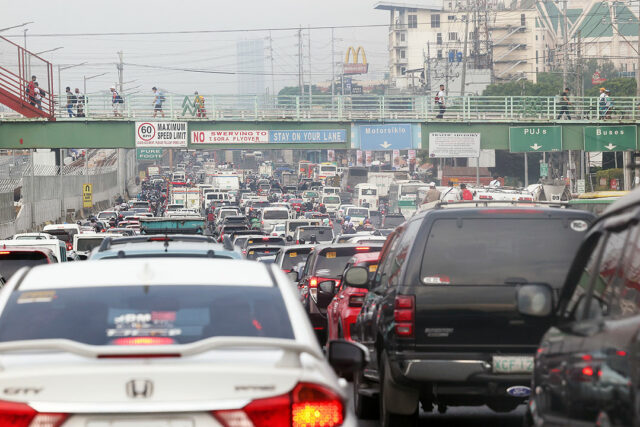
Filipinos brace for ‘Carmageddon’ as students return to school

Motorists endure heavy traffic along the westbound lane of Commonwealth Avenue in Quezon City, July 28. — PHILIPPINE STAR/ MIGUEL DE GUZMAN

By Kyle Aristophere T. Atienza and Alyssa Nicole O. Tan, Reporters

KURTSON ROWEEN C. GAMBOA, 22, doesn’t look forward to more traffic jams in November, when more students are expected to be in school.

The office clerk wakes up before dawn and takes a train and jeepney to get to work in Manila. He spends much of his commute waiting in line.

“Traffic has worsened when physical classes resumed,” he said in a Facebook Messenger chat. “Commuting to work has become as tiring as ever. Going home is the same and I’ve had to rest less because of this.

Millions of Filipino students returned to classrooms for the first time in more than two years in August amid a coronavirus pandemic.

Transport problems are nothing new in the Philippines especially in the capital, which is connected to other cities by poor infrastructure.

Manila is the eighth among cities in the world with the worst traffic, according to GoShorty, a British insurance technology website.

It found that Manila, along with Tel Aviv in Israel and Tokyo in Japan, had a 43% congestion level, and citizens in these cities lose 98 hours to traffic every year.

The government failed to fix the problem during the pandemic, when it had the chance to do so, according to transport experts.

A number of transport operators had to fold up during the pandemic, when most people stayed home, transport economist Robert Y. Siy, Jr. said in a Messenger chat.

“The pandemic lockdowns and physical distancing made many public transport services financially unviable,” he said. “Many operators closed shop or went bankrupt.”

These days, when most restrictions have been eased as coronavirus infections fell, the No. 1 challenge is spiraling fuel prices.

School bus operators were among those severely affected by the pandemic, and their closure has affected the transport supply, Mr. Siy said.

“Many school bus operators have gone out of business. Two years without any income forced some operators to dispose of their vehicles,” he said.

Those who survived have increased their rates, forcing parents to opt out, said Jose Regin F. Regidor, a research fellow at the University of the Philippines’ National Center for Transportation Studies.

“This is to make up for the increase in fuel prices and vehicle maintenance as well,” he said. “The last two years when schools operated online were a backbreaker for many school services.”

Mr. Regidor expects most parents not to use a school bus service due to virus fears.

“The return to face-to-face classes this school year will perhaps help determine if the pandemic will have a long-term effect on the industry or if the trust in school bus services will return in the short term.”

The demise of school bus operations could lead to more private cars on the road, Mr. Siy said.

“Wealthier families will choose to use private motor vehicles to bring their children to school,” he said. “Government and schools should encourage such families to shift to school and shuttle buses so that the roads fronting schools won’t be severely congested during drop-off and pickup times.”

“Families from the same neighborhood can pool their resources to organize school buses/shuttles to serve all students in their community,” he added.

The state could also help school bus operators by waiving penalties for failing to register or renew their franchises during the pandemic, Mr. Siy said.

They should also streamline the process for new operators. “If an incentive or subsidy can be provided to help them restart operations, that would also be a big help.”

The country loses about P3 billion daily due to the traffic congestion in Metro Manila, according to the Japan International Cooperation Agency (JICA). This could balloon to P5.4 billion by 2035, it said.

Transport experts expect students and more workers to rely on ride-hailing services to get through traffic.

“The large deficit in public transport supply will mean more demand for ride-hailing services, though the cost could be prohibitive for most students,” Mr. Siy said.

The country needs to boost public transportation capacity to address increased demand, Mr. Regidor said.

‘ESSENTIAL SERVICE’
Calls to address the sad state of the country’s public transport system began as early as March, with civic groups pressing the government to set up infrastructure support for commuters. Reclaiming roads from private cars and encouraging more people to cycle or walk would significantly cut traffic congestion, they said.

“All roads leading to schools should have safe pathways in the form of either car-free roads or very low speed limits, with priority given at all times to pedestrians and bicycles,” Mr. Siy said. “Where needed, there should be protected bike lanes and sidewalks, even if some need to be created using traffic cones and plastic bollards.”

Schools should also provide “end-of-trip” facilities for those who walk or cycle such as bicycle parking and shower rooms, he added.

The Philippines should look at best practices in other countries, including “walking school buses” in Norway, which seek to improve students’ health by encouraging walking and to save transportation costs, Mr. Siy said.

“Parents and local governments can organize assembly points for students willing to walk or bike to school; then, with school marshals, groups of students can walk or bike together in a group,” he said. “Cycling in numbers or groups is a very good way to enhance the safety of cyclists.”

Students and teachers should also consider studying and working at a nearby school, Mr. Regidor said.

“Still, mobility is a basic human need and should be given due priority and importance. Because public transport is an essential service, it should not be allowed to deteriorate or disappear.”

He said the government should subsidize transport operators and drivers affected by the pandemic and rising fuel costs.

“If public transport services diminish, many Filipinos will not be able to get to their schools, clinics or other public services,” he said. “The school year is a crucial challenge for our government.”

Xander Xeballos, a student from Manila whose university has yet to enforce face-to-face classes, is worried about his commute next month, when daily physical classes will have been enforced.

“It would be better to limit in-person classes and spare us the hassle of daily commutes,” he said. “Blended learning is still the way to go.”


ADVERTISEMENT
ADVERTISEMENT