Home Blog Page 5799

Ayala Land relaunches Parklinks South Tower 

A UNIT of Ayala Land, Inc. recently relaunched its second tower in Parklinks, achieving 17% reservation sales in its first weekend.

Parklinks South Tower, which was originally launched in 2019, is a residential, high-rise tower in Ayala Land’s Parklinks development.

“We just launched Parklinks South Tower just last weekend. And we are already 17% taken up for that second tower. So, we had a very successful launch weekend,” AyalaLand Premiere, Inc. Project Development Manager Cherryl Nera-Uy said during the Parklinks media tour on Wednesday.

The first tower — Parklinks North Tower — was reported to be 80% taken up.

“We have very good sales here in this estate, which really speaks about the confidence our market has in this estate,” Ms. Uy said.

The 4,145-square meter (sq.m.) Parklinks North Tower has 280 units in total, with 55 floors, while the 4,002 sq.m. Parklinks South Tower has 313 units.

Units in the towers can be a one-bedroom unit, which has 70 sq.m., to a four-bedroom unit, which has 306 sq.m. with only four to nine units per floor.

Parklinks North Tower will be turned over in 2025 while Parklinks South Tower is set to be turned over in 2029.

Total potential sales for the first tower are P13 billion, while Ayala Land expects P15 billion in sales for the South Tower.

AyalaLand Premiere said that it has seen an appreciation by 23.2% in capital values for its Parklinks North Tower from P280,000 per sq.m. in late 2018 to P345,000 per sq.m. at present.

The 35-hectare Parklinks is a 50-50 venture between Ayala Land and LT Group, Inc. It is being developed by ALI Eton Property Development Corp. in Brgy. Ugong Norte, Quezon City.

AyalaLand Premiere is a real estate subsidiary of Ayala Land that engages in first-class residential developments offering luxury living. It is also the developer of Parklinks North and South Towers. — Justine Irish D. Tabile

How PSEi member stocks performed — September 29, 2022

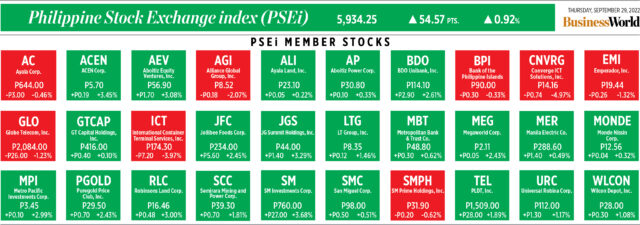
Here’s a quick glance at how PSEi stocks fared on Thursday, September 29, 2022.


Philippines drops in global attractiveness index

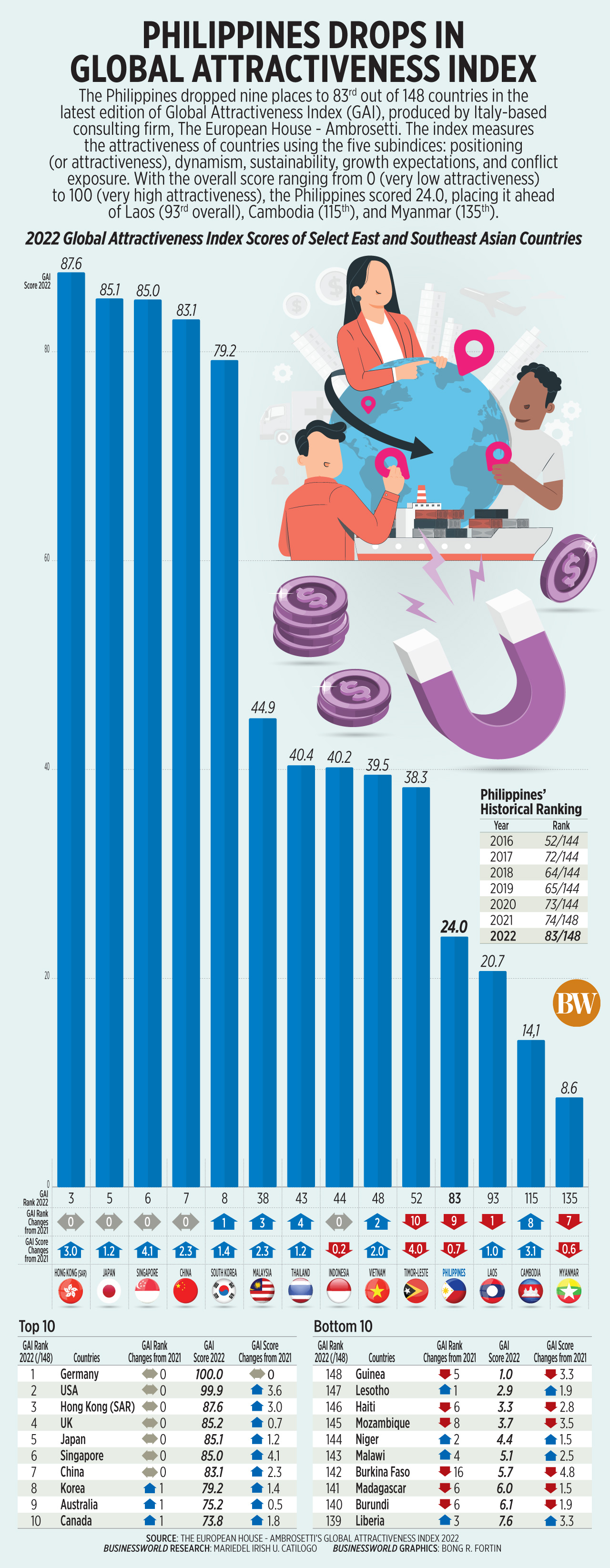
The Philippines dropped nine places to 83rd out of 148 countries in the latest edition of Global Attractiveness Index (GAI), produced by Italy-based consulting firm, The European House – Ambrosetti. The index measures the attractiveness of countries using the five subindices: positioning(or attractiveness), dynamism, sustainability, growth expectations, and conflict exposure. With the overall score ranging from 0 (very low attractiveness) to 100 (very high attractiveness), the Philippines scored 24.0, placing it ahead of Laos (93rd overall), Cambodia (115th), and Myanmar (135th).

Philippines drops in global attractiveness index

Peso closes stronger as dollar demand eases

BW FILE PHOTO

THE PESO appreciated on Thursday as demand for dollars declined due to the Bank of England’s (BoE) emergency action to launch a bond program to avoid a meltdown in the gilts market.

The local unit closed at P58.97 against the greenback on Thursday, gaining one centavo from its P58.98 finish on Wednesday, Bankers Association of the Philippines data showed.

The peso started trading at P58.87 per dollar on Thursday. Its weakest showing was at P59, while its intraday best was at P58.75 versus the greenback.

Dollars exchanged fell to $902 million on Thursday from $1.19 billion on Wednesday.

The peso slightly strengthened due to the effect of the BoE’s intervention through purchases of long-dated bonds, Rizal Commercial Banking Corp. Chief Economist Michael L. Ricafort said in a Viber message.

The BoE said on Wednesday it would start a temporary program of bond purchases to stabilize the market and postpone the planned start of its gilt sale program.

“As the Governor said in his statement on Monday, the Bank is monitoring developments in financial markets very closely in light of the significant repricing of UK and global financial assets,” the BoE said in a statement.

“In line with its financial stability objective, the Bank of England stands ready to restore market functioning and reduce any risks from contagion to credit conditions for UK households and businesses,” it added.

“To achieve this, the Bank will carry out temporary purchases of long-dated UK government bonds from 28 September. The purpose of these purchases will be to restore orderly market conditions.”

MUFG Bank Currency Analyst Sophia Ng in a report said even though this move tamed the volatility in the market, it is seen to be inflationary in nature and may have an impact on the pace and magnitude of subsequent rate hikes.

Ms. Ng said the improvements in risk appetite overnight following the launch of the BoE’s emergency bond-buying program “should bring a reprieve for Asian currencies today.”

The peso also strengthened as the local stock market gained on Thursday, Mr. Ricafort said.

The bellwether Philippine Stock Exchange index climbed by 54.57 points or 0.92% to close at 5,934.25 on Thursday, while the broader all shares index inched up by 25.24 points or 0.79% to 3,190.88.

“The peso [was] slightly stronger after crude oil prices [were] still among 8-month lows,” Mr. Ricafort added.

Brent crude futures fell $1.18 or 1.3% to $88.14 a barrel by 0823 GMT and US crude futures dropped by $1.11 or 1.4% to $81.04.

Both benchmarks rebounded in the previous two sessions from nine-month lows earlier in the week, buoyed by a temporary dive in the dollar index and a larger than expected US fuel inventory drawdown.

For Friday, Mr. Ricafort gave a forecast range of P58.80 to P59 per dollar. — Keisha B. Ta-asan

Philippine stocks recover as foreign markets climb

REUTERS

THE LOCAL INDEX snapped out of its four-day decline on Thursday following Wall Street’s positive movement overnight as the Bank of England’s intervention in the UK bond market doused investors’ fears.

The bellwether Philippine Stock Exchange index (PSEi) climbed by 54.57 points or 0.92% to close at 5,934.25 on Thursday, while the broader all shares index inched up by 25.24 points or 0.79% to 3,190.88.

“The index staged an oversold rally today as it tracked similar moves in offshore markets. Today’s temporary reprieve comes on the heels of an overnight decline in the US treasury yields and a surprise intervention of the Bank of England in the UK bond market,” China Bank Securities Corp. Research Director Rastine Mackie D. Mercado said in an e-mail.

Philstocks Financial, Inc. Senior Research Analyst Japhet Louis O. Tantiangco said what the local bourse saw was a “technical bounce” supported by possible spillovers from Wall Street.

“However, over the medium term, we’re still seeing bearish bias due to [the] confluence of headwinds. Of course, we still have peso depreciation, which may likely continue due to the hawkish outlook of the Federal Reserve,” Mr. Tantiangco added during an interview with BusinessWorld Live.

Global equities staged a partial comeback on Wednesday as the Bank of England said it would temporarily buy long-dated bonds to dampen investors’ fears of contagion across the financial system, Reuters reported.

On Wednesday, Wall Street rebounded, with the Dow Jones Industrial Average adding 1.88% to close at 29,683.74, the S&P 500 Index gaining 1.97% to 3,719.04, and the Nasdaq Composite going up by 2.05% to 11,051.64.

Back home, the peso closed at P58.97 against the greenback on Thursday, gaining a centavo from its P58.98 finish on Wednesday, data from the Bankers Association of the Philippines show.

Most of the sectoral indices closed higher on Thursday. Holding firms gained 126.90 points or 2.26% to close at 5,729.84; mining and oil went up by 191.63 points or 1.84% to 10,575.30; industrials climbed by 108.87 points or 1.25% to 8,771.10; financials added 11.67 points or 0.79% to 1,484.20; and property inched up by 7.69 points or 0.30% to end at 2,545.67.

Meanwhile, services retreated by 13.94 points or 0.88% to end Thursday’s session at 1,555.75.

Value turnover went down to P5.19 billion with 658.93 million shares on Thursday changing hands from the P6.79 billion with 815.83 million issues traded on Wednesday.

Advancers outnumbered decliners, 121 to 76, while 42 names closed unchanged.

Net foreign selling went down to P491.71 million on Thursday from P588.99 million the previous trading day.

“Based on our outlook, we’re seeing bearish bias moving forward,” Philstocks Financials’ Mr. Tantiangco said, pointing to the index going below the 6,041-bear- market line

“At the same time, it has breached below the support range of 6,000-6,100,” he added.

China Bank Securities’ Mr. Mercado said: “We expect overnight developments in offshore markets to once again factor into investor sentiment and the market move for tomorrow (Friday).”

He placed the PSEi’s immediate support at 5,830 and its resistance moving within the 6,000-6,050 range. — Justine Irish D. Tabile

Philippines 4th deadliest country for eco-activists

KALIKASAN-PNE

THE PHILIPPINES was the fourth deadliest country in the world for land and environmental defenders last year, according to an international report, which noted that killings of indigenous peoples were rampant in the Southeast Asian nation.

The report by non-profit organization Global Witness said the country’s key institutions were weak, allowing perpetrators to commit crimes with “little accountability.”

Global Witness cited 19 environmentalists and land defenders killed in the Philippines in 2021, making the country the most dangerous country for green advocates in Asia.

“Steaming ahead with development projects without any consideration for human rights raises serious concerns about the future of land and environmental defenders in a country with one of the highest levels of killings of defenders in the world,” the report said, referring to the Philippines.

Latin American countries were at the top of the global list with Mexico ranking first with 54 killings, followed by Colombia with 33, and Brazil with 26 killings, the report said. Nicaragua was placed after the Philippines, with 15 killings.

Philippine Solicitor General Menardo I. Gueverra, the justice chief during the last years of former President Rodrigo R. Duterte’s six-year term, did not immediately reply to a Viber message seeking comments. The new administration has yet to issue a statement on the report.

While the Philippines saw a drop in killings of defenders in 2021 from 30 in 2020, the country recorded at least 270 killings between 2012 and 2021, the report said.

The report said that globally, 40% of all “fatal” attacks targeted indigenous peoples (IPs) “despite them only making up 5% of the world’s population.”

These were documented predominantly in Mexico, Colombia, Nicaragua, Peru, and the Philippines.

It said 40% or 114 of the defenders murdered in the Philippines in the last 10 years were IPs “campaigning to protect their land and the environment.” Nearly 80% of these took place in the southern region of Mindanao.

Most of the killings were linked to the mining sector, with 27 related deaths, the group said. Most of these occurred in Mexico (15), the Philippines (6), Venezuela (4), Nicaragua (1) and Ecuador (1).

The report also cited Mr. Duterte’s lifting of a nine-year-old moratorium on new mining projects on April 14, 2021, just over a year before he stepped down in end-June 2022. The moratorium was issued by his predecessor in 2012.

Global Witness said green advocates criticized the move, “warning that the new order could further endanger defenders as well as negatively impact key biodiversity areas, local water and food supplies, and Indigenous communities.”

“There is very little transparency in the Philippines’ mining sector, with mining contracts and data seldom made public,” according to the report, noting that rules mandating mining firms to get the consent of affected communities are “not consistently implemented.”

It said Mr. Duterte’s successor, President Ferdinand R. Marcos, Jr., “raised a red flag” during his first address to Congress in July, where he emphasized  “investment incentives including within the energy sector” and did not talk about the country’s human rights condition.

“Impunity is rife: it is suspected that state forces are behind the majority of killings in the few cases where the identity of the perpetrators is documented,” the report said. “Key state institutions, including the judiciary and law enforcement agencies, are weak, and the military and police commit human rights violations with little accountability.”

The Philippines is among the top five countries rich in mineral resources, the report noted, adding that nearly 30% of the country’s land is known to hold high mineral deposits, of which over 8% is covered by mining concessions as of July.

“It’s clear that the government has not taken this crisis seriously,” Philippine-based Kalikasan People’s Network said in a Facebook Messenger chat.

“While the slight drop in killings should be noted, unless specific measures are in place to protect environmental defenders — least of all even just recognizing the problem on a national level — these killings will undoubtedly continue at a systematic level,” the green network’s national coordinator, Jon Bonifacio, was quoted as saying.

The network said it will push for the refiling of an environmental defense bill, which seeks to establish appropriate mechanisms to hold perpetrators into account. “We only hope it gains traction under an administration that supposedly cares for the climate and the environment.” Kyle Aristophere T. Atienza
DoTr to push budget for jeepney revamp

BW FILE PHOTO

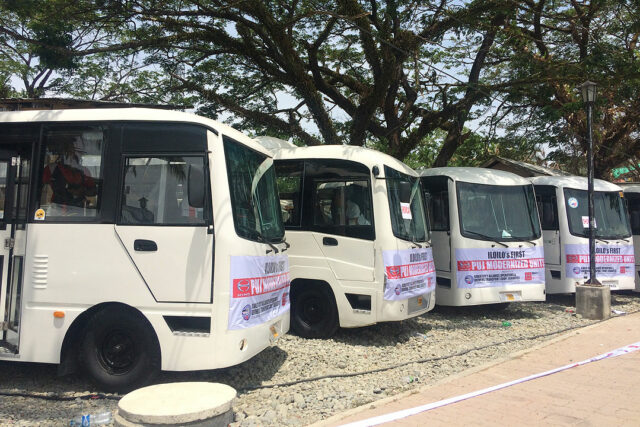
THE TRANSPORTATION department said it will continue to push for funding for its public utility vehicle modernization program (PUVMP) in 2023.

The department had proposed a P788-million budget for the program for next year, but it was not included in the national expenditure program.

“We continue to advocate funding for the PUVMP to our lawmakers… so that the program could be given funding during the deliberations,” Transportation Undersecretary Mark Steven C. Pastor said in Filipino at a briefing on Wednesday.

The PUVMP was a flagship program of the previous administration. It envisions a “restructured, modern, well-managed and environmentally sustainable transport sector where drivers and operators have stable, sufficient and dignified livelihoods while commuters get to their destinations quickly, safely and comfortably,” the Land Transportation Franchising and Regulatory Board said on its website.

Even without the PUVMP allocation, Secretary Jaime J. Bautista welcomed the final approval of the 2023 budget of the Department of Transportation (DoTr) and its attached agencies, amounting to P167.12 billion.

He said the House’s approval of the DoTr’s 2023 budget “highlights the need to provide Filipinos with safe, accessible, comfortable, and affordable transportation, as well as transform the country’s transportation system into global standards and fulfill the ‘full speed ahead’ order of President Ferdinand R. Marcos Jr.”

CASHLESS PAYMENT
Meanwhile, state-owned Land Bank of the Philippines (LANDBANK) has launched its mobile transit application for cashless and contactless payment in public utility vehicles, it said in a press release on Thursday.

The application can be used in transport units with an Automated Fare Collection System (AFCS) and the EMV standard which uses smart chips for transactions.

“The LANDBANK mCommuter app supports the government’s transport modernization agenda, geared towards enhancing the daily travel experience of commuters,” LANDBANK President and CEO Cecilia C. Borromeo was quoted as saying.

“This is part of our continued efforts to leverage digital technology to serve commuter needs.”

The LANDBANK and the DoTr launched the first six units of modern public utiltiy vehicles with AFCS capabilities this month. These were owned by the PM Jeepney Drivers Operators and Services, Inc.

Another 144 units will soon be deployed in selected pilot sites in the National Capital Region, Central Luzon, Calabarzon, and Metro Cebu.

The application has been available for download in Google Play Store since Sept. 13, while it is yet to be released in the Apple App Store. — Arjay L. Balinbin and Diego Gabriel C. Robles

Philippines eyeing ‘green investments’ despite tight fiscal space, Diokno says

PHILIPPINE STAR/KRIZ JOHN ROSALES

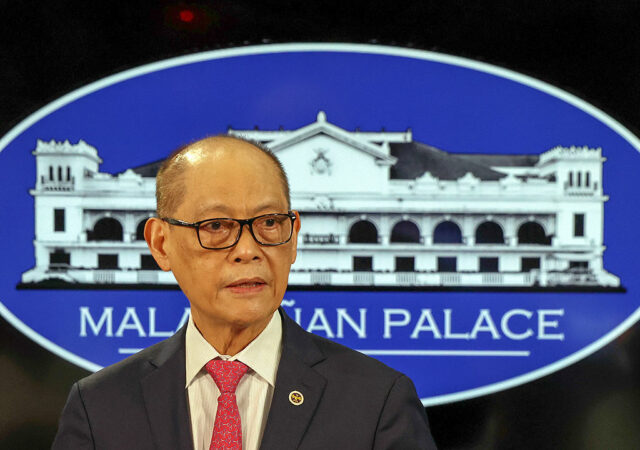
THE government can pursue green investments despite the limited fiscal space, Finance Secretary Benjamin E. Diokno told an Asian Development Bank (ADB) conference, adding that such investments were factored in when the Philippines started drafting its medium-term goals.

“All these programs are embedded in our medium-term development plan that we are designing at the moment,” Mr. Diokno said during the ADB Governor’s Seminar on Thursday.

“We’re not so much concerned about the fiscal space because, to me, given what we have done, the fiscal space is still there, (and) we have embedded the important greening programs moving forward.”

ADB President Masatsugu Asakawa told the gathering, however, that fiscal consolidation in many countries is only a matter of time.

“I think (the time will come for) every country to shift the gears (from) fiscal expansion to fiscal consolidation. Of course, countries should pick the right time to do so. It cannot be too early; it cannot be too late,” he said.

The Philippines’ debt-to-gross domestic product (GDP) ratio was 62.1% in the second quarter, above the 60% threshold deemed sustainable for developing countries, and reflecting the debt taken on to finance the response to the coronavirus disease 2019 (COVID-19) pandemic.

Still, “the Philippines has maintained its financial footing,” Mr. Diokno said, crediting recent structural reforms and the reopening of the economy.

The government intends to bring debt-to-GDP to 52.5% by 2028, as well as reduce its budget deficit from 7.6% to 3% over the same period via higher tax collections, rightsizing, and projected growth of 6.5%-8%.

Pasi Hellman, a Finnish foreign ministry official sitting on the ADB board, said official development assistance may be harder to come by with even donor countries having limited fiscal space.

“That’s why we need to work even harder to ensure different development financing institutions and entities have shared goals and better coordination,” he said. “For climate mitigation, there is clearly more private and commercial financing available.” He proposed that public money be focused on “facilitating (and) catalyzing by preparing and making projects bankable.”

“The world really needs renewable energy, and energy efficiency solutions that are scalable also in developing countries and make good business sense,” he added. “This, again, is where public funding can help to mitigate risks to pave way for private sector to enter the markets.”

The Philippine government recently revised the implementing rules and regulations (IRR) of its Build-Operate-Transfer Law, in response to concerns from economists and business groups that the government remains too insulated from risk even if project delays are the result of delayed government deliverables.

“It has cured a number of perceived defects of the old IRR. (I) think the new IRR is more responsive and clearer to potential investors,” Mr. Diokno told reporters on Tuesday.

At the same event, Mr. Diokno also expressed the Philippines’ interest in participating in the ADB’s $14-billion food security and climate change facility, which was announced on Tuesday.

“The short answer is definitely,” Mr. Diokno said. “Definitely we will avail of this facility.”

“I have looked at the performance of the Philippine economy for the last two decades. Industry and services are growing, but agriculture has been in and out of recession. It’s what I call a laggard, and this is because of many structural defects in the sector,” he added, mentioning the “mild” failure of the government’s agrarian reform program. 

Funding for the $14-billion program will be sourced from the ADB’s sovereign and private sector operations, with assistance starting this year until 2025.

Meanwhile, Mr. Diokno said that the government is also looking to focus on developing Mindanao.

“I love to say that Mindanao is so rich that it can feed the whole country… Now that we have achieved peace in Mindanao, we will focus on Mindanao,” he said.

“We have a new government setup there, and there is a lot of interest from our development partners,” he added. — Diego Gabriel C. Robles

Small committee tasked to amend House’s P5.268-trillion budget bill

PHILIPPINE STAR/ MICHAEL VARCAS

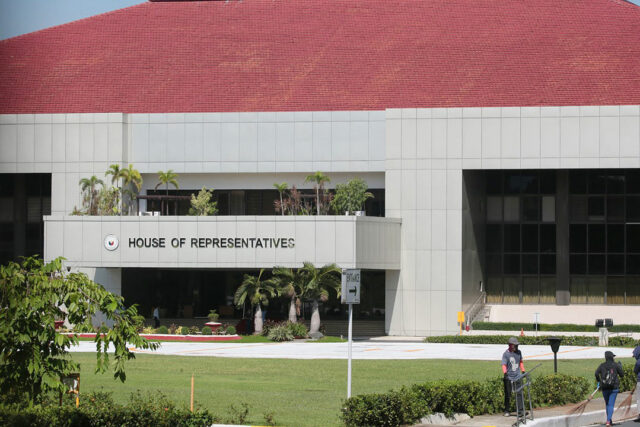
A SMALL committee has been appointed to amend the P5.268-trillion budget bill, which passed on third reading this week before the House of Representatives went on recess, according to majority leader Manuel Jose M. Dalipe, who will himself be a member of the amending team.

Mr. Dalipe said the other members are House appropriations chairman and AKO-BICOL Party-list Representative Elizaldy S. Co, Marikina Rep. Stella Luz A. Quimbo, and Minority leader Marcelino C. Libanan.

Terry L. Ridon, a public investment analyst, said via Facebook chat that the small committee follows the precedent of the last Congress, but called for further scrutiny of opaque budget items.

“All the proposed changes, particularly those covering massive intelligence and confidential funds, should still be pushed in this small committee and through the entire budget process in the Senate and the bicameral conference committee,” Mr. Ridon said.

Voting 289-3, the chamber approved House Bill 4488, or 2023 General Appropriations Bill, before adjourning for recess. 

The proposed spending plan is 4.9% higher than this year’s budget and the highest on record. President Ferdinand R. Marcos, Jr. on Tuesday certified it as urgent, allowing legislators to approve the measure on second and third reading on the same day.

“The expeditious passage of the proposed 2023 budget is the product of the collective effort of the entire House, in transparent and open proceedings where the majority accorded ample opportunity for the constructive inputs of our friends from the minority bloc,” Speaker Martin G. Romualdez said in a statement.

The bill allocates education P858.8 billion, up 8.2% from the 2022 level.

Mr. Romualdez said the budget is in line “with the eight-point socio-economic agenda of the Marcos administration to achieve sustainable growth.” 

Infrastructure funding across various agencies was P1.196 trillion, up 1.54%, including P140.4 billion for the Network Development Program, P88.5 billion for the Asset Preservation Program and P38 billion for the Bridge program.

Minority leader Marcelino C. Libanan said in his turno en contra speech that the minority does not necessarily oppose the budget but must do its duty in examining all spending programs.

“The scrutiny of the minority members of the proposed budget does not mean we absolutely disagree with it,” Mr. Libanan said.

Legislators with the Makabayan bloc voted against the bill, noting its swift passage.

ACT-Teachers Party-list Rep. France L. Castro said in her turno en contra speech that the proposed budget was not responsive to the needs of the people, saying that the need to meet fiscal targets appear to have taken priority.

The cuts to key programs of the Department of Social Welfare and Development (DSWD) and Department of Labor and Employment (DoLE) will affect the lives of the poor, Gabriela Party-list Rep. Arlene D. Brosas said in plenary.

“This national budget banners the theme ‘Agenda for Prosperity’ when in reality it is an ‘Agenda for Austerity,’ as funds for social safety nets and social services were drastically cut,” Ms. Brosas said. 

The DSWD’s proposed budget for 2023 is P197 billion, 3.8% lower, while DoLE was allocated P25.9 billion, down 29.9%. 

“The funds allocated for COVID-19 response are not enough, despite the claims of the current administration that it will strengthen the monitoring and surveillance capacity of the health system,” Kabataan Party-list Rep. Raoul Danniel A. Manuel said. — Matthew Carl L. Montecillo

Bill seeks VAT threshold indexed to inflation

PHILIPPINE STAR/ GEREMY PINTOLO

A BILL filed by Senator Sherwin T. Gatchalian to amend the tax code will index the threshold for value-added tax (VAT) exempt taxpayers to inflation, adjustable every three years.

Mr. Gatchalian, who chairs the Senate Ways and Means Committee, filed Senate Bill 1346, dated Sept. 27, which adjusts the tax administration rules via amendments to the National Internal Revenue Code of 1997.

The start date proposed for the indexing exercise is Jan. 1, 2023.

He also hopes to expand the number of banks eligible to receive tax payments to ease the process for taxpayers, who currently must transact at an authorized agent bank in the revenue district where they are registered.

Mr. Gatchalian also proposed online channels for making tax payments.

“For the benefit of our taxpayers, we need to simplify the process of paying taxes as we endeavor to enhance tax compliance and strengthen taxpayer’s rights,” Mr. Gatchalian said in a statement on Thursday.

The bill seeks to remove the option to pay internal revenue taxes to a city or municipal treasurer with jurisdiction over the taxpayer, while eliminating the distinction between documentation and basis of sales of goods and services, which will then require a sales invoice for both.

The bill states: “For purposes of value-added tax (VAT), the term ‘gross sales’ means the total amount of money or its equivalent which the purchaser pays or is obligated to pay to the seller in consideration of the sale, barter or exchange of services and the use or lease of properties, excluding value-added tax. The liability to pay VAT shall be at the time of the issuance of the invoice.”

“The value of services sold and subsequently refunded or for which allowances were granted by a VAT-registered person may be deducted from the gross sales for the quarter in which a refund is made or a credit memorandum is issued,” it added.

Any sales discount granted and indicated in the invoice, at the time of sale but not for a future purpose, may be excluded from gross sales in the quarter it was given.

It seeks to provide registration channels for taxpayers living overseas.

“Our bill seeks to modernize tax administration and establish mechanisms so that we can further improve and make tax collection more effective,” Mr. Gatchalian said. “We hope that these measures will further encourage our taxpayers to do their duty to pay proper taxes.”

The bill, a priority measure of President Ferdinand R. Marcos, Jr., remains pending in the Senate Ways and Means Committee.

The House of Representatives on Monday passed on third and final reading its counterpart bill, which its backers said would generate an estimated P73.1 billion in additional revenue over five years. — Alyssa Nicole O. Tan

Farm damage from typhoon estimated at P2.02 billion

PHILIPPINE STAR/KRIZ JOHN ROSALES/PPA POOL

AGRICULTURAL damage caused by Typhoon Karding (international name: Noru) has hit P2.02 billion, the Department of Agriculture said.

The storm damaged an estimated 150,693 hectares of farmland and affected over 91,944 farmers and fisherfolk, resulting in lost production of 117,663 metric tons.

Damage and losses were reported in the Cordillera Administrative Region, Ilocos, the Cagayan Valley, Central Luzon, Calabarzon, Bicol, and the Western Visayas.

The department said that it is providing assistance in the form of P170.34 million worth of rice seed, P23.16 million worth of corn seed and P13.55 million worth of assorted vegetable seed.

It will also provide P2.45 million in replacement animals, drugs and biologics for livestock and poultry, as well as fingerlings and fishing equipment.

Separately, farmer organizations are calling on the National Food Authority (NFA) and local government units to step up procurement of palay (unmilled rice) to support farmers in typhoon-hit areas.

The NFA should help farmers from Nueva Ecija and nearby provinces with crop insurance, the National Movement for Food Sovereignty and the Alliance for Resiliency, Sustainability and Empowerment (ARISE) said in a joint statement. 

“There is an urgent need to procure from farmers their produce without the usual stringent requirements. Procurement should also include additional dryers, hauling trucks and increased budgets for the NFA,” ARISE Convenor Arze G. Glipo said. — Luisa Maria Jacinta C. Jocson

BoI approves P560.4-M mattress project

SHANGRI-La Sealy Sleep Boutique

THE Board of Investments (BoI) has approved a P560.4-million project of Maxiflex Philippine Corp. in Plaridel, Bulacan, which will export mattresses.  

In a statement on Thursday, the BoI said the project will have an annual capacity of 680,000 all-foam and spring mattresses.

The BoI added that the funding for the plant will include an investment from mattress brand Uratex. Maxiflex and Uratex are affiliates of the RGC Group. The manufacturing plant will begin commercial operations in October.  

Uratex aims to export around 79% of its production to the US, New Zealand, Papua New Guinea, and Southeast Asia. The company’s export sales are projected to top P2.1 billion a year once at full capacity.

“This will provide a boost to the international footprint of our locally produced mattresses since a great majority of Uratex’s production will cater to foreign markets, leveling up our exports of high-value and high-quality products,” Trade Undersecretary and BoI Managing Head Ceferino S. Rodolfo said.  

“Uratex has long been known in the Philippines as it is the leading manufacturer of mattresses. The exports of its Maxiflex product around the globe will provide greater traction and awareness for Uratex as a world-class brand,” he added.

According to the BoI, the new facility will have bedding and mattress testing machineries that can carry out various performance and durability tests.

The BoI said Philippine exports of mattresses totaled $102 million against imports of $36 million, amounting to a surplus of $66 million in 2021. It was citing data from Tradeline Philippines.  

The top export markets for Philippine mattresses are the Netherlands ($58 million), the US ($35.4 million), and Japan ($8.1 million).

“According to Statista.com, the domestic mattress market is expected to reach $41 million in 2022. It added that the market is projected to grow yearly at 9.45% annually in the next four years with the market reaching nearly $60 million by 2026,” the BoI said. — Revin Mikhael D. Ochave