Home Blog Page 5747

Transport groups seek ‘surge’ charge on fares during rush hour

Motorists are stuck in traffic in Manila, Aug. 21. — PHILIPPINE STAR/EDD GUMBAN

By Arjay L. Balinbin, Senior Reporter

JEEPNEY and bus operators want to impose a “surge” charge on top of base fares during rush hour, amid worsening traffic conditions and rising oil prices in Metro Manila.

The Land Transportation Franchising and Regulatory Board (LTFRB) on Tuesday said it had received a petition from three transport groups that seek to charge commuters an additional P1-P2 during peak hours of 5-8 a.m. and 4-8 p.m., Monday to Saturday due to the spike in pump prices.

Pasang Masda, Alliance of Transport Operators and Drivers Association of the Philippines (ALTODAP) and Alliance of Concerned Transport Organization (ACTO) filed the petition before the LTFRB on Oct. 14.

Traditional and modern jeepneys want to impose an additional P1 on top of the current minimum fare during peak hours, while buses are seeking additional P2.

Based on the petition, the additional charge will not be collected on Sundays and national holidays.

As of Oct. 11, the year-to-date increases in per-liter prices for gasoline and diesel are P15.65 and P35.80, respectively, according to the Energy department.

Traditional and modern jeepneys recently raised the minimum fare to P12 and P14.

However, the transport groups said this “would not be enough to alleviate” the losses incurred by jeepney operators and drivers.

They said a traditional jeepney driver’s gross income averages P1,800 from the Tayuman-Pritil route in Manila, which includes a boundary charge of P450 and P1,000 for about 15 liters of diesel.

“This would result in a driver’s take-home pay of P350, which is only P61.4% of the P570 minimum wage in the National Capital Region,” the transport groups said.

Some modern jeepney units incur a net loss of P478.90 a day, the groups noted, adding that this makes their operation “not sustainable.”

“Allowing a surge price of P1 on top of the base fare of P14 for [modern jeepneys] during rush hours at an average of 230 passengers per day can increase the daily gross income of a Parang to Cubao modern jeepney to P9,670, yielding a negative daily net income of P248,” they said. “This is still operation at a loss, but not as worse as negative P478.90 per day.”

For city buses, the groups said allowing a surge price of P2 on top of the P15 base fare for an air-conditioned one and the P13 base fare for an ordinary one during rush hours would “be a big help” to stay operational.

Public buses experience the same difficulties as traditional and modern jeepneys during rush hours, the groups noted.

“This surcharge is the remedy that can most expediently give help to public utility vehicle operators and drivers,” they said.

The LTFRB said that while it recognizes the plight of drivers and operators, it also understands commuters’ concerns that another fare increase will burden them even more.

It also cited the inflationary effect of fare hikes.

Transport expert Rene S. Santiago said the transport groups’ petition is reasonable due to the recent oil price hikes.

“The recent fare adjustment was too low relative to diesel price movements. Imposing higher charges during peak hours is valid, but messy to implement on a per kilometer basis. A fixed surcharge of P3-5 is simpler,” he said in a mobile phone message.

Okada arrested over grave coercion charges, says UEC

Universal Entertainment Corp’s founder Kazuo Okada attends a news conference at the Tokyo District Court in Tokyo, Japan September 14, 2017. — REUTERS

PHILIPPINE POLICE on Monday arrested Japanese gaming tycoon Kazuo Okada over the grave coercion charges filed by officials of Tiger Resort Leisure and Entertainment, Inc. (TRLEI) related to the “forceful takeover” of a casino-resort in Manila, according to Universal Entertainment Corp. (UEC).

UEC, Okada Manila’s parent company, said in a statement members of the Philippine National Police (PNP) Aviation Security Group had arrested the businessman after he arrived at the Ninoy Aquino International Airport Terminal 1 from Haneda, Japan.

The Metropolitan Trial Court Branch 91 issued warrants of arrest against Mr. Okada on Oct. 11, and set the pre-trial hearing for his coercion case on Oct. 28, UEC said.

“We will continue to work with law enforcement units to bring Kazuo Okada to justice, as we have done in the past in other jurisdictions,” Tiger Resort Asia Ltd. Director Kenshi Asano said in the same statement.

Tiger Resort Asia is the parent company of TRLEI, which operates Okada Manila. Both are units of UEC.

In a separate statement, Mr. Okada said he returned to the Philippines to face the charges against him and show he was “not afraid.”

“I am confident that the legal process within the Philippine court system will vindicate us in all the cases filed against me and my business associates,” he said, adding he would post bail.

It was not immediately clear if Mr. Okada had posted bail as of press time.

TRLEI legal counsel Estrella C. Elamparo earlier filed criminal complaints against Mr. Okada and his associates Antonio O. Cojuangco, Dindo A. Espeleta and Florentino “Binky” Herrera III before the Department of Justice (DoJ) in relation to the takeover of Okada Manila on May 31.

The DoJ earlier indicted the Japanese billionaire and his associates as they were “deemed to have taken the law into their hands.”

It added that despite their claim to a status quo ante order issued by the Supreme Court, it does not absolve them of criminal liability for the takeover of the casino resort. 

Under the law, an act is considered grave coercion if a person is prevented by another from doing something not prohibited by law against his will not be, and if the prevention is caused by violence, threats or intimidation.

In July, the Japanese businessman’s camp issued a statement citing the Supreme Court ruling ordering an SQAO, identifying him as the lone representative of TRAL.

The tribunal upheld the SQAO order in August, which temporarily reinstated Mr. Okada as chairman of Okada Manila.

Mr. Okada was previously removed as chairman of TRLEI in 2017 due to alleged mismanagement. — J.V.D. Ordoñez

DataLand to launch P11-B project in Q1 2023

PROPERTY developer DataLand, Inc. plans to launch a two-tower mixed-use residential and office development worth P11 billion by the end of the first quarter of next year.

“We have to change the business model. Previously, the business model was purely an office project,” DLI Vice President for Development and Customer Turnover Group Felimon G. Yee Jr. said on the sidelines of the company’s 10th-anniversary media briefing.

The development is described by the property development arm of building construction firm DDT Konstract, Inc. as “one of the future landmarks of the EDSA skyline standing at 55 and 54 floors.”

DLI originally launched the project as an office development before the pandemic. The former DDT Sky Towers will be relaunched in March 2023 as a mixed-use development under the name 947 Sky Towers.

Mr. Yee said that after the pandemic, demand from companies for co-working spaces grew as some industries adopted hybrid and work-from-home arrangements.

“The demand is there for residential [units] and the office has been quite passive because [of the pandemic]. We tried to shift the business model and we have tried as well to honor the buyers of offices,” Mr. Yee added.

DLI’s 947 Sky Towers is situated in a 5,250-square-meter (sq.m.) lot. It will have two towers with 1,735 residential units and will be the third vertical project of DLI in Metro Manila.

The first tower will have 54 floors and 880 residential units and the second tower will have 55 floors and 855 residential units, 80% of which will be studio-type units.

Units in the development will range from a studio unit with sizes from 28 sq.m. to 30 sq.m. to a three-bedroom unit at 98 sq.m. to 100 sq.m.

Four floors will be allocated for office developments, which will translate to 56 units of office spaces ranging from 100 sq.m. to 120 sq.m. in size.

“We are looking at launching prices of about P170,000 to P180,000 [per sq.m.]. It really depends since there is already a change in price. We might have to study again and probably get another updated market scan,” Mr. Yee said.

DLI Executive Vice President Joseph Ramil B. Lombos said the edge of DLI is the group’s own construction arm.

“Among the different developers, I know there are only three who have their own construction company,” he said. “DLI has its own construction company that differentiates us from the others.”

In the fourth quarter of next year, DLI also plans to launch two-tower mixed-use high-rise development in Santa Ana, Manila. It will be situated in a 4,855-sq.m. lot and will have 40 floors in each tower, translating to 1,480 residential units.

During DLI’s 10 years, its completed projects include The Silk Residences in Santa Mesa, Manila; The Olive Place in Mandaluyong; MyCube in Biñan, Laguna; and The Miren Enclaves in Palawan. — Justine Irish D. Tabile

PLDT says DITO open to settle P430-M contractual obligation

BW FILE PHOTO

PLDT, Inc. said on Tuesday that DITO Telecommunity Corp. has expressed openness to amicably settle its unpaid contractual obligation of P430 million to the Pangilinan-led company.

The amount is for “services that PLDT continues to deliver so that DITO can in turn provide telco services to its subscribers,” the former said in an e-mailed statement.

“PLDT welcomes the amicable settlement of accounts by its debtors even if those debtors are PLDT’s competitors,” it noted.

The company also said DITO must “demonstrate its good faith by ceasing its attempts to confuse the issue and to mislead the public by claiming that PLDT’s efforts to collect on DITO’s debt is somehow an anticompetitive activity or interconnection issue that merits some unspecified ‘legal process’ rather than just DITO’s simple payment of its defaulted P430-million debt.”

DITO Chief Administrative Officer Adel A. Tamano told state media PTV News on Oct. 15 that the company’s issue with PLDT “is not an issue of money, it’s an issue of interconnection.”

“This matter is already pending with the Philippine Competition Commission,” he added.

For its part, PLDT said that it reserves all of its legal options, including suspension or termination of services, in case DITO does not remedy its “material breach” by Nov. 4.

DITO previously filed competition complaints against the Ayala-led Globe Telecom, Inc. and Smart Communications, Inc. of the PLDT group.

Globe Telecom, Inc. had requested the National Telecommunications Commission to compel DITO to pay a P622-million fine for allegedly violating their interconnection agreement.

Hastings Holdings, Inc., a unit of PLDT Beneficial Trust Fund subsidiary MediaQuest Holdings, Inc., has a stake in BusinessWorld through the Philippine Star Group, which it controls. — Arjay L. Balinbin

Filipino youths have low awareness of STIs, HIV, and EC

CRISTINA PONCIANO-UNSPLASH

By Patricia Mirasol, Reporter 

ONLY a third of Filipino youth aged 15-24 years have an awareness of sexually transmitted infections (STIs) and emergency contraceptive (EC) pills, according to the fifth iteration of the Young Adult Fertility and Sexuality  study (YAFS5) conducted by the University of the Philippines Population Institute (UPPI). The percentage of those with a comprehensive knowledge of the human immunocompromised virus (HIV) and acquired immunodeficiency syndrome (AIDS) was also below 20%, the study also found. 

Awareness of STIs was at 35% among males and 34% among females in 2021. Awareness of HIV and/or AIDS, meanwhile, was 74% among males and 78% females for the same year, a decrease from 82% and 85% in 2013, respectively, or when the fourth round of YAFS was conducted.   

This is a growing trend, said Christian Joy P. Cruz, UPPI associate professor, in an Oct. 14 dissemination forum of the study. She noted that the second YAFS study in 1994 showed that awareness of HIV and/or AIDS was 95% for both sexes.  

The study further reported that more than half (52%) of Filipino youths believed that a person can get HIV by sharing food with someone who is infected. About a quarter (24%) likewise believed a person can get HIV from mosquito bites. 

“Sex is still apparently a taboo topic at home,” said UPPI associate professor Maria Paz N. Marquez, who presented at the same event. Only 12% among males, and 13% among females, had discussions at home about sex in 2021.  

“What is increasing is those consulting no one,” Ms. Marquez added. Thirty-three percent of males and 23% of females did not consult anyone about sex, up from 24% and 20%, respectively. 

For males that did consult others, however, friends are the top choice (40% in 2021, down from 50% in 2013). Females, on the other hand, preferred both their mother (39% in 2021, down from 43% in 2013) and friends (22% in 2021 from, down from 26% in 2013).  

A majority (68% of males and 58% of females) used protection during sexual initiation.   

“Condoms and the withdrawal method were more commonly used, given that a [majority] of the sexual initiation was not planned but happened anyway,” Ms. Marquez told the event audience.  Over a quarter (28%) of males and a third (32%) of females did not plan their sexual initiation when it happened. Moreover, 17% of males and 18% of females did not want it to happen, but went along with it.  

A new inclusion in the fifth YAFS was the question on EC pills. The study found that — although awareness of this contraception option is low — 31% of males and 24% of females would consider using it if it was made available.   

A majority got their male condoms at drugstores (77%). Only 3% bought them at online shopping platforms. Nearly one-tenth (11% among males; 3% among females) said they always carried a condom with them.  

YAFS5 commenced in August 2021 and was completed in January 2022. Covering 17 regions, the study approached 10,949 youth from 974 sample barangays. It contains 14 major topics, including those about puberty, dating, sex, lifestyle, health, and media.  

The study proponents took measures to ensure the respondents’ forthrightness, Ms. Marquez said.  

“One of these measures was for the female respondents to be interviewed with female interviewers — same with the males — para ma-minimize ’yung hiyaan [so embarrassment is minimized],” she said. Sealed questionnaires were also provided for 10 questions pertaining to sensitive subjects such as abortion and illegal drug use.  

“We compared the answers from the sealed questionnaires [versus] the answers they gave in the face-to-face interviews, and hindi nagkakalayo ang answers [the answers are consistent],” she said.   

The hope is that there will be a convergence among policy makers and those in congress, said Grace T. Cruz, UPPI professor.   

“The whole idea of why we’re in the business of data gathering,” she said at the Oct. 14 forum, is so the data could be “used as a scientific basis for the formulation of appropriate policies for the welfare of young people.”

The YAFS5 report will be available in 2023. The UPPI said it is “targeting to release the raw data by the middle of 2023.” Previous YAFS studies were conducted in 1982, 1994, 2002, and 2013.

CREIT set to issue ASEAN green bonds to expand its real estate portfolio

UNSPLASH
PART of the proceeds of the issuance of ASEAN green bonds will be used to acquire land parcels to host affiliate solar power developers. — UNSPLASH

CITICORE Energy REIT Corp. (CREIT) said on Tuesday that it will be tapping the capital markets for the issuance of ASEAN green bonds in the fourth quarter of this year to expand its real estate asset portfolio.

“We want to fast-track this initiative to facilitate our growth trajectory, as disclosed in the REIT plan, at the same time keep our borrowing costs at manageable levels, considering the continued pressure on global interest rates,” Oliver Y. Tan, president and chief executive officer of CREIT, said in a stock exchange disclosure.

In its registration statement filed with the Securities and Exchange Commission, the company said it is offering bonds worth P3 billion, with an oversubscription allotment of up to P1.5 billion.

CREIT added that it also intends to use part of the proceeds to acquire land parcels totaling 500 hectares to host affiliate solar power developers.

ASEAN green bonds’ proceeds are meant to be exclusively used to finance or refinance, in part or in full, new or existing eligible green projects that comply with regulatory standards.

CREIT said that the move is part of its “levering up program” from zero-debt to minimum leverage of 35% of its invested capital to fund the acquisition of new properties, and to maintain its growth momentum.

“With the investment grade rating, CREIT effectively increased its debt headroom and allowable leverage from 35% to 70% of deposited properties, currently at P14.5 billion, before acquisition of the new target assets,” Mr. Tan said.

In a separate regulatory filing, CREIT said that it had disbursed to date P308 million of its initial public offering (IPO) proceeds for its AFAB solar rooftop project through wholly owned subsidiary Sunny Side Up Power Corp.

Meanwhile, P1.55 billion from the IPO proceeds had been used for the first phase of the Arayat solar farm, which is a joint venture with ACEN Corp.

A total of P966 million was allocated for the second phase of the Arayat-Mexico solar farm, which is expected to be completed by the first quarter of 2023.

CREIT said that its Batangas A and Batangas B solar farms had been allocated a total of P1.42 billion and P377.1 million, respectively, for the construction of their 90 megawatts (MW) and 40-MW projects.

Further, P1.49 billion was set aside for the 20-MW Isabela run-of-river hydro project. Of the amount, P444.6 million had been disbursed as of Sept. 30.

On Tuesday, shares in CREIT closed 1.36% higher to finish at P2.23 apiece. — Ashley Erika O. Jose

Tam-awan Arts Fest returns to the village

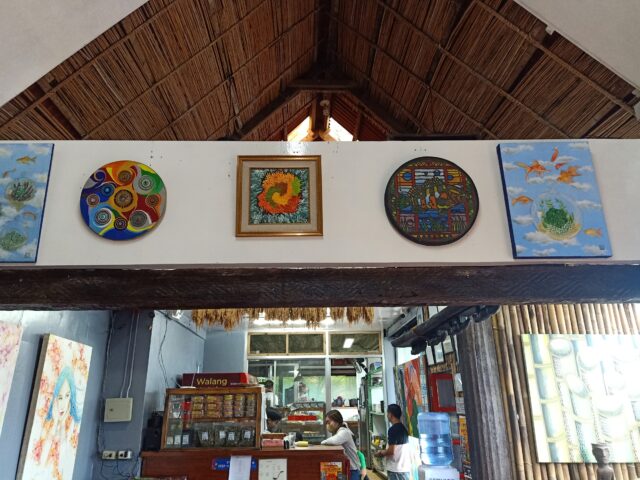
TAM-AWAN Cafe — PHOTO BY MICHELLE ANNE P. SOLIMAN

AFTER two years of online festival activities, the 12th edition of the Tam-awan International Arts Festival (TIAF) returned to the village on Oct. 5 to 9.

Upon arrival at Tam-awan Village in Baguio City, visitors were greeted by images outlined on the main venue’s façade that was yet to be fully painted. Upon entering, artists were seated at tables and concentrating on finishing their pieces. A group of cultural performers danced to entertain guests before the next talk or workshop began.

Built in 1998, Tam-awan Village is a three-hectare space that resembles a traditional Cordillera village. Its Ifugao houses serve as the venues for art exhibits, workshops, and live cultural showcases. It was established by the Chanum Foundation, Inc., an organization dedicated to the promotion of arts, culture, and heritage. Tam-awan Village is now a popular hub for artists and art enthusiasts. It also has a café and offers lodging in the traditional houses to tourists and workshop participants.

THE FESTIVAL
With the growing population of artists in the area, the Tam-awan International Arts Festival was established in 2010 after years of Tam-Awan having hosted art workshops.

Nagkaroon ng art festival dahil sa mga nangyayari na art workshops (The art festival came about because of the art workshops),” solar artist Jordan Mang-osan, who is the president of the Chanum Foundation, told BusinessWorld during the festival on Oct. 8.

He said that the Foundation and local artists mounted the festival with the goal of inviting artists and groups from outside the city of Baguio, and “to help our local artists showcase their craft,” he said.

“Art is a very powerful tool to preserve visual records of time and experiences and it is a visual aid for people to see the world in different and innovative ways. Art is a vehicle that can transport ideas and the wisdom of cultures to the current generation,” Mr. Mang-osan said.

The first TIAF was held at the Baguio Convention and Cultural Center and officially moved to Tam-awan Village itself in its second year. The village has hosted the arts festival ever since.

This year’s festival had the theme “Hapit Di Aammod: Wisdom in Shapes, Colors, and Words.” “Hapit di Aammod” translates to “voice of the ancestors” in Tuwali, an indigenous language spoken in Ifugao.

The festival was held in partnership with the National Commission for Culture and the Arts (NCCA).

This year’s festival had 189 participating artists and almost 70 cultural workers in attendance. Activities included workshops on coffee painting, stone art, digital art, statue making, cultural performances, and Cordillera rituals.

INTELLECTUAL PROPERTY RIGHTS
During the festival, the Chanum Foundation and the Intellectual Property Office of the Philippines (IPOPHL) signed a memorandum of understanding in an effort to educate artists on copyright and protection of their works.

“Like the Tam-awan Village, I hope the partnership we seal today deepens your people’s perspectives not only on indigenous art but also on copyright and intellectual property,” IPOPHL Directory General Rowel S. Barba said at a press conference during the festival.

“Together, we would like to see the Cordilleras harvest the full rewards from your creation, and the intellectual property system helps you safeguard your works in all their authenticity and value — not only in terms of monetary value but, more profoundly, its value to Cordillera’s culture,” he added.

Following the signing of the agreement was a seminar on copyright and resale rights in the visual arts.

The IPOPHL has conducted more than 200 webinars on intellectual property. Mr. Barba said that his office is committed to bringing education on intellectual property to other cities. “’Iyung mga pwedeng puntahan na probinsya at barangay, pupuntahan namin (We will visit the provinces and barangays which we can go to),” he said

“It’s a universal principle that copyright starts from the moment of creation… but for practical purpose because sometimes your collaborators or partners will ask for it. The proof copyright is your registration. We encourage artists to have it recorded,” Mr. Barba explained.

The National Library is the primary institution that registers copyright. “But IPOPHL has been licensed by the National Library to accept registry,” he said.

OUTREACH PROGRAMS
The TIAF has also embarked on a series of outreach programs called Art Caravans benefitting teachers and students at the Santol Central School in La Union with workshops on acrylic paint, wire rings, pastel, sand art, stone art, and screen printing.

The festival closed with the unveiling of murals and art collaborations and ceremonies marked with rituals and thanksgiving.

Harinawa, ito’y magpatuloy para maging maayos at mas lalo pang mapalaganap ang produkto, kultura at sining ng mga Pilipino (May it be that this will continue and strengthen the products, culture, and arts of the Filipino,” NCCA Chairman Rene Escalante said, adding that the festival’s online activities have widened the reach to new audiences in the past two years.

As pandemic restrictions ease, Mr. Mang-osan hopes that next year’s festival will include more international participants.

“We will strive to continue the Tam-Awan International Arts Festival,” he said.

For more information, visit https://tamawanvillage.com/tiaf-2022-virtual-exhibit/ and https://www.facebook.com/TamawanOfficial. — Michelle Anne P. Soliman

BTr fully awards new 10-year T-bonds on strong demand

BW FILE PHOTO

THE GOVERNMENT fully awarded the fresh Treasury bonds (T-bonds) it offered on Tuesday on strong demand for higher-yielding instruments amid expectations of more rate hikes here and abroad.

The Bureau of the Treasury (BTr) raised P35 billion as planned via the fresh 10-year T-bonds it auctioned off on Tuesday, with total tenders reaching P58.411 billion.

The debt papers were awarded at a coupon rate of 7.5%, 29.81 basis points (bps) higher than the 7.2019% quoted for the 10-year tenor at the secondary market before the auction, based on the PHP Bloomberg Valuation (BVAL) Service Reference Rates data provided by the Treasury.

Accepted rates ranged from 7% to 7.5% for an average of 7.344%.

National Treasurer Rosalia V. de Leon said in a Viber message to reporters after the auction that the full award was made “seeing rates are within secondary levels for comparable maturities.”

A trader likewise said the auction result was “well-within our expectations given recent statements from the Bangko Sentral ng Pilipinas (BSP).”

“With analysts now thinking that overnight reverse repurchase rate will reach 5%, seven- to 10-year tenors will likely be 250 to 300 bps higher,” the trader said in a text message.

Rizal Commercial Banking Corp. Chief Economist Michael L. Ricafort said the full award is “consistent with the fact that the average yield of 7.344% is close to the comparable PHP BVAL yield.”

“The increase in the 10-year T-bond yield is also in line with the higher benchmark 10-year US Treasury yield amid aggressive Federal Reserve rate hikes in the quest to significantly bring down elevated US inflation,” Mr. Ricafort said in a text message.

BSP Governor Felipe M. Medalla last week said the central bank will consider another big rate hike in their Nov. 17 policy meeting to support the peso and prevent its depreciation from further stoking inflation.

Mr. Medalla said they are looking at a 50-bp or 75-bp increase next month to help cool inflation and ease currency pressures stemming from a strong dollar amid the Fed’s hawkish stance.

The BSP has raised benchmark rates by 225 bps since May, with its policy or overnight reverse repurchase facility rate now at 4.25%.

Philippine headline inflation was at 6.9% last month, up from 6.3% in August and 4.2% in the same month last year. It matched the 6.9% print in October 2018 and was the fastest since the 7.2% pace logged in February 2009.

The September print marked the sixth straight month that inflation breached the central bank’s 2-4% target for the year.

For the first nine months, headline inflation averaged 5.1%, faster than the 4% seen in the same period last year but below the BSP’s 5.6% forecast for 2022.

Meanwhile, the Fed is likely to deliver another large rate hike at its November meeting as inflation remains high, with more increases also expected to be on the table until next year.

The US central bank has raised rates by 300 bps since March and will next meet on Nov. 1-2.

The BTr wants to raise P200 billion from the domestic market this month, or P60 billion through Treasury bills and P140 billion from T-bonds.

The government borrows from local and external sources to help plug a budget deficit capped at 7.6% of gross domestic product this year. — Luisa Maria Jacinta C. Jocson

Obesity as a growing concern among Filipinos

PIXABAY

Around 27 million Filipinos are overweight and obese, based on the latest survey of the Department of Science and Technology (DoST) Food and Nutrition Research Institute (FNRI).  

If no action is taken, overall rates of overweight and obesity will continue to rise, with more than 30% of Filipino adolescents projected to be overweight and obese by 2030, warned the Department of Health (DoH), the National Nutrition Council (NNC), the Philippine Association for the Study of Overweight and Obesity (PASOO), the Nutrition Center of the Philippines (NCP), the World Health Organization (WHO), and the United Nations Children’s Fund (UNICEF) on the occasion of World Obesity Day.  

Overweight and obese Filipino adults increased to 36.6% of the population in 2019 from 20.2% in 1998. Meanwhile, the prevalence rates of overweight and obesity among Filipino adolescents more than doubled to 11.6% in 2018 from 4.9% in 2003. 

The WHO defines overweight and obesity as abnormal or excessive fat accumulation that may impair health. Overweight and obesity in adults are commonly classified using body mass index (BMI) defined as a person’s weight in kilograms divided by the square of their height in meters (kg/m2).  

Overweight is a BMI greater than or equal to 25. Obesity is a BMI greater than or equal to 30. In children, overweight and obesity are classified based on the number of weight-for-height standard deviations above the WHO Child Growth Standards median. 

The fundamental cause of obesity and overweight is an energy imbalance between calories consumed and calories expended —too much drinking and eating but not enough physical activity.  

Globally, there has been an increased intake of energy-dense foods that are high in fat and sugars. Moreover, there has also been an increase in physical inactivity due to the increasingly sedentary nature of many forms of work, changing modes of transportation, and increasing urbanization, the WHO explained. 

The coronavirus disease 2019 (COVID-19) pandemic, which limited mobility for health and safety reasons, has compounded the growing obesity concern.  

According to the WHO, overweight and obesity are linked to more deaths worldwide than underweight. There are more people who are obese than underweight in every region of the world, except parts of sub-Saharan Africa and Asia.  

Raised BMI is a major risk factor for noncommunicable diseases (NCDs) such as cardiovascular diseases, mainly heart disease and stroke; diabetes; musculoskeletal disorders, especially osteoarthritis, a highly disabling degenerative disease of the joints; some cancers including endometrial, breast, ovarian, prostate, liver, gallbladder, kidney, and colon. As a person’s BMI increases, so does the risk for these NCDs. 

Childhood obesity is associated with a higher chance of obesity, premature death and disability in adulthood. On top of increased future risks, obese children experience breathing difficulties, increased risk of fractures, hypertension, early markers of cardiovascular disease, insulin resistance and psychological effects, the WHO stated. 

To address the growing problem of obesity in the Philippines, the DoH, NNC, and national partners recommend specific actions: 

  • Implement policies, legislation, and interventions to promote physical activity including active transport and promotion of green, blue, and open spaces in communities and workplaces. As in other health priorities, strengthen and sustain appropriate social and behavior change communication on healthy diet and physical activity.  
  • Implement policies and interventions to promote, protect, and support infant and young child nutrition, especially in the first 1000 days of life to prevent stunting and reduce risk for children to become obese in their later lives.  
  • Develop a strategy with corresponding funds, human resources, and accountability mechanisms, including empowering the health system with dedicated programs on obesity across the life stage.  
  • Improve data, monitoring, and enforcement of laws relating to food products.  
  • Provide subsidies to farmers and fisherfolk and increase access to nutritious food.  
  • Use social protection programs such as 4Ps to improve access to healthy food, especially in times of disasters.  
  • Promote healthy school food environments for children. 
  • In the case of obesity, it has once again been proven that prevention is better than cure.  


Teodoro B. Padilla is the executive director of Pharmaceutical and Healthcare Association of the Philippines (PHAP), which represents the biopharmaceutical medicines and vaccines industry in the country. Its members are at the forefront of research and development efforts for COVID-19 and other diseases that affect Filipinos. 

Airbnb expects more bookings, says holidays to boost travel

REUTERS

ONLINE home-sharing platform Airbnb is projecting higher bookings as the holiday season approaches, carried by strong demand from domestic travel.

Amanpreet Bajaj, Airbnb general manager for Southeast Asia, India, Hong Kong, and Taiwan, said the increase is expected since more Filipinos are looking to travel, adding that many new areas are getting their first bookings.

“It is the holiday season. There is a pent-up demand for travel. All the trends of increased searches and many new cities and towns getting their first bookings clearly shows a very positive outlook in terms of travel,” Mr. Bajaj said during an interview on the sidelines of Airbnb’s inaugural Future of Travel event in Makati City on Tuesday.

“In the Philippines, we see that there is a lot of interest in domestic travel, for people to capture interest around newer cities and newer places and to connect with family again. I think that is a very positive outlook for us,” he added.

Mich Goh, Airbnb Southeast Asia head of public policy, said Baguio City is the top searched destination by Filipinos in the second quarter this year, followed by Quezon City and Tagaytay City.

She added that trending destinations outside of tourist hotspots include Guagua, Pampanga; Unisan, Quezon; and Jala-Jala, Rizal.

“Tagaytay leads with the largest surge in guest searches on Airbnb in Q2 (second quarter) 2022 up from Q2 2019 pre-pandemic, followed by Dumaguete and Calaca,” Ms. Goh said.

Further, Mr. Bajaj said that Airbnb is looking to establish more partnerships to improve its platform and its presence in the country.

“I think the Philippines is a very important market for Airbnb and for the region as a whole. We will continue to look at partnership opportunities. We will continue to work with more partners in the country and work with our host community, and government stakeholders to ensure that we get an ecosystem that benefits all,” Mr. Bajaj said.

“We have already a vibrant host community in the Philippines. 65% of the host community is female-led. About 15% of our hosts in the Philippines are super hosts, which means that they provide a very high level of hospitality that is appreciated across the world,” he added.

Meanwhile, Airbnb said that longer travel was still a key trend in the second quarter of 2022, with 28-day-stays or higher posting a 25% increase from last year and by almost 90% from the second quarter of 2019.

“As more new destinations are getting the number of searches, we are very positive about the future outlook,” Mr. Bajaj said.

“But we should also be conscious of the fact that we are still in the middle of the pandemic. It will be important from a flexibility perspective to ensure that people have more flexible options in travel and that’s where a platform like Airbnb becomes very important,” he added.

The Tourism department on Monday announced that the Philippines has logged 1.77 million foreign visitors as of Oct. 17, breaching the 1.7 million visitors projected before June 30. — Revin Mikhael D. Ochave

Sri Lankan author Shehan Karunatilaka wins 2022 Booker Prize

SRI LANKAN writer Shehan Karunatilaka with his second novel The Seven Moons of Maali Almeida — THEBOOKERPRIZES.COM

LONDON — Sri Lankan writer Shehan Karunatilaka won the Booker Prize on Monday for his second novel The Seven Moons of Maali Almeida, about a dead war photographer on a mission in the afterlife.

Mr. Karunatilaka received a trophy from Queen Consort Camilla at the English language literary award’s first in-person ceremony since 2019. He also gets a £50,000 ($56,810) prize.

Set in 1990 Sri Lanka during the country’s civil war, Mr. Karunatilaka’s story follows gay war photographer and gambler Maali Almeida, who wakes up dead.

Time is of essence for Maali, who has “seven moons” to reach out to loved ones and guide them to hidden photos he has taken depicting the brutality of his country’s conflict.

“My hope for Seven Moons is that in the not-too-distant future… it is read in a Sri Lanka that has understood that these ideas of corruption, race-baiting, and cronyism have not worked and will never work,” Mr. Karunatilaka said in his acceptance speech.

“I hope it is read in a Sri Lanka that learns from its stories and that Seven Moons will be in the fantasy section of the bookshop and will… not be mistaken for realism or political satire.”

This year’s shortlist of Booker Prize contenders included British author Alan Garner’s Treacle Walker, Zimbabwean author NoViolet Bulawayo’s Glory, Small Things Like These by Irish writer Claire Keegan, US author Percival Everett’s The Trees, and Oh William! by US author Elizabeth Strout.

“This is a metaphysical thriller, an afterlife noir that dissolves the boundaries not just of different genres, but of life and death, body and spirit, east and west,” judges chair Neil MacGregor said of Mr. Karunatilaka’s book.

“It is an entirely serious philosophical romp that takes the reader to ‘the world’s dark heart’ — the murderous horrors of civil war Sri Lanka,” Mr. MacGregor added. “And once there, the reader also discovers the tenderness and beauty, the love and loyalty, and the pursuit of an ideal that justify every human life.”

Past winners of the Booker Prize, which was first awarded in 1969, include Margaret Atwood, Salman Rushdie, and Yann Martel. Reuters

The Medical City to launch diagnostic medicine, remote care centers

THE Medical City (TMC), a healthcare network with a flagship complex in Ortigas Avenue, Pasig City, is set to launch a remote care center as well as a center for diagnostic medicine in October. It has also launched its participatory medicine campaign on Oct. 14. 

“Part of our quest to deliver the best of healthcare to our patients is to develop more groundbreaking services and programs,” said Dr. Christian G. Delos Reyes, TMC’s chief marketing officer, in an Oct. 17 Zoom call. “It’s not just about buying the most advanced technology. It’s creating programs that would address a certain population of patients who need that specific type of program.”

TMC will be launching a center for diagnostic medicine next week, Dr. Delos Reyes said. Gathering specialists from multiple fields, the center will be a hub for those who wish to seek a second opinion or want their cases re-analyzed. 

“We want to position ourselves as the hospital that can diagnose the hard-to-diagnose diseases,” he said. 

Another upcoming development in the coming week is the healthcare network’s remote care center, which targets to provide hospital care from a patient’s home. 

“It goes beyond X-rays at home or mobile clinics,” Dr. Delos Reyes told BusinessWorld. “For patients who want to stay at home and be treated at home, [this] will now be a reality… the future of healthcare is coming home.” 

The 24-hour service features a command center where patients are monitored online by healthcare staff, and includes thrice a day tele-rounds (doctors’ virtual rounds). Each patient’s bedroom at home will likewise be outfitted with cameras as well as gadgets that monitor vital signs, which inputs will be relayed back to the command center in real-time. Field nurses and doctors will further be deployed on occasion to check on the patient’s condition, as well as deal with any intravenous (IV) fluid bags, catheters, and the like.

By treating patients with illnesses such as pneumonia and dehydration at home, Dr. Delos Reyes added, TMC’s hospitals will be freed up to treat more of those who need critical care. 

The healthcare network also launched on Oct. 14 “In Health and In Sickness,” a campaign that puts patients at the center of healthcare, and recognizes them as partners of their own health.

TMC puts “a lot of premium” on participatory medicine, according to Lawrence Y. Sibayan, marketing and business development division head of TMC. “It’s not just doctors telling, but patients also sharing what they want to do.” 

“You have to know where the patient comes from [to] engage them in active participation,” Mr. Sibayan said in the same Zoom call. 

Dr. Delos Reyes added that practicing certain methodologies and acquiring certain technologies — such as in the case of Jehovah’s Witnesses who practice bloodless medicine — are examples of how hospitals can listen to and respect patients’ values. 

The videos in the “In Health and In Sickness” campaign highlights “not just the patient, but the culture of [collaborative] healthcare we have here, and the nurses and doctors who are part of our success story,” he said. “It’s a celebration of that relationship.” — Patricia B. Mirasol

ADVERTISEMENT
ADVERTISEMENT