Home Blog Page 5726

Digital payments rose, made up 30.3% of retail transaction volume in 2021

BW FILE PHOTO

DIGITAL PAYMENTS rose in terms of volume and value in 2021 as consumers and businesses used online channels amid mobility restrictions brought by the pandemic, the Bangko Sentral ng Pilipinas (BSP) said on Wednesday.

The share of digital payments in the total volume of retail transactions in the country rose to 30.3% in 2021 from 20.1% a year earlier, according to latest data from the BSP.

Meanwhile, the value of payments done online represented 44.1% of total retail transactions last year, higher than the 26.8% share in 2020.

“The latest results show we are closer to meeting our objective of converting at least 50% of retail payment transactions to digital form by the end of 2023, under the BSP Digital Payments Transformation Roadmap,” BSP Governor Felipe M. Medalla said in a statement.

Merchant payments, peer-to-peer (P2P) remittances and business transactions of salaries and wages to employees were the key contributors to the progress of digital payments, all of which are high-frequency, low-value retail transactions.

The volume of merchant payments grew by 43.8%, while P2P remittances rose by 268.6%.

Meanwhile, payments of salaries and wages to employees increased by 170.2% last year. This reflects the transition of businesses using digital channels such as electronic fund transfers to bank or e-money accounts.

The increase in electronic fund transfers could be seen as a result of expanding access to transaction accounts and the shifting preference of clients toward digital modes for payments, the BSP said.   

The central bank also said that during the pandemic, clients who had financial accounts were able to safely and conveniently conduct digital transactions using their mobile devices in their homes.

“This capability for digital transactions should be within reach of every Filipino in our increasingly digital economy,” Mr. Medalla said.

“Hence, the BSP, with the support of the payments industry led by the Philippine Payments Management, Inc., continues to promote a vibrant and inclusive digital payments ecosystem where every Filipino can actively participate and enjoy its benefits,” the central bank chief added. 

The BSP wants digital payments to make up 50% of all transactions both in volume and value by 2023.

The central bank also wants the country to become a cashless society by 2025.

In 2019, the central bank launched the national Quick Response (QR) Code Standard or QR Ph which has contributed towards the BSP’s financial inclusion goals. The facility is used for digital P2P transfers and person-to-merchant (P2M) payments through the InstaPay rail.

Under the BSP Circular No. 1055, the central bank required all participating payment service providers to adopt QR Ph for interoperability. As of April, there were 28 and 17 financial institutions participating in the P2P and P2M facilities, respectively. — Keisha B. Ta-asan

Philippines ranks 30th in Global Business Complexity Index

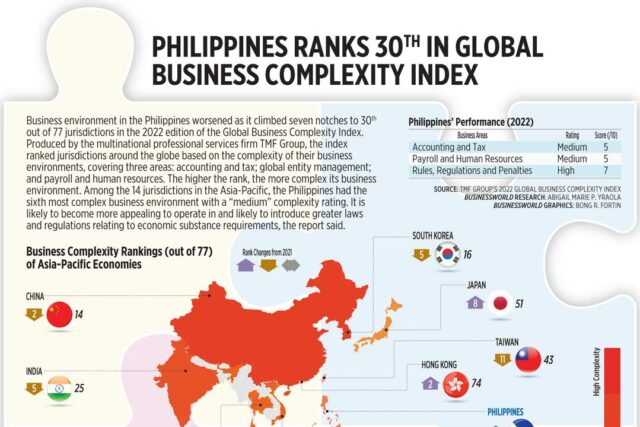
Business environment in the Philippines worsened as it climbed seven notches to 30th out of 77 jurisdictions in the 2022 edition of the Global Business Complexity Index. Produced by the multinational professional services firm TMF Group, the index ranked jurisdictions around the globe based on the complexity of their business environments, covering three areas: accounting and tax; global entity management; and payroll and human resources. The higher the rank, the more complex its business environment. Among the 14 jurisdictions in the Asia-Pacific, the Philippines had the sixth most complex business environment with a “medium” complexity rating. It is likely to become more appealing to operate in and likely to introduce greater laws and regulations relating to economic substance requirements, the report said.

Philippines ranks 30<sup>th</sup> in global business complexity index

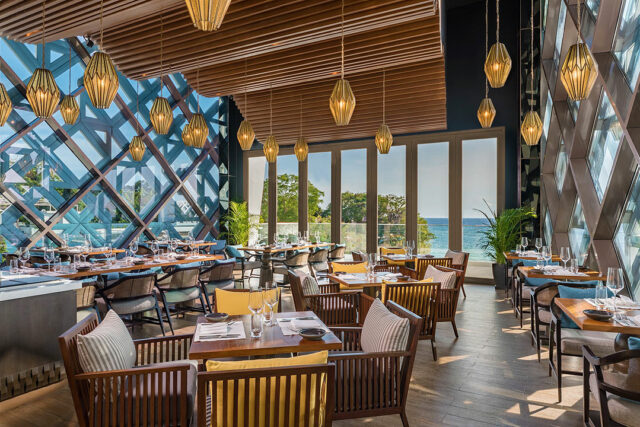
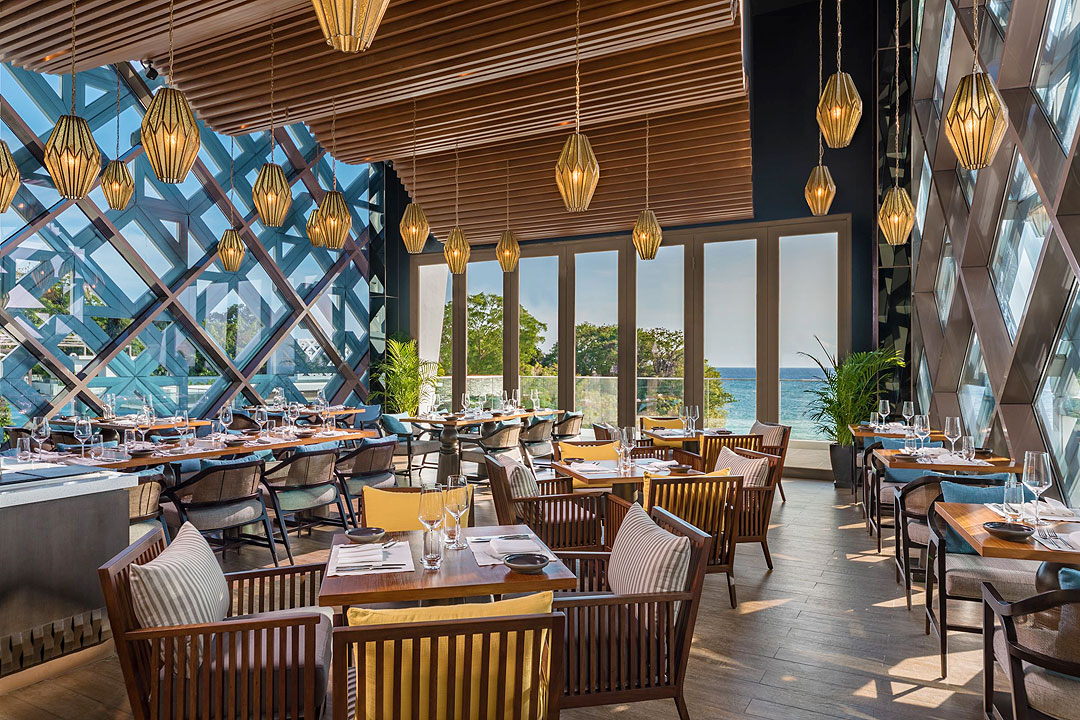
New restaurants open in City of Dreams Manila

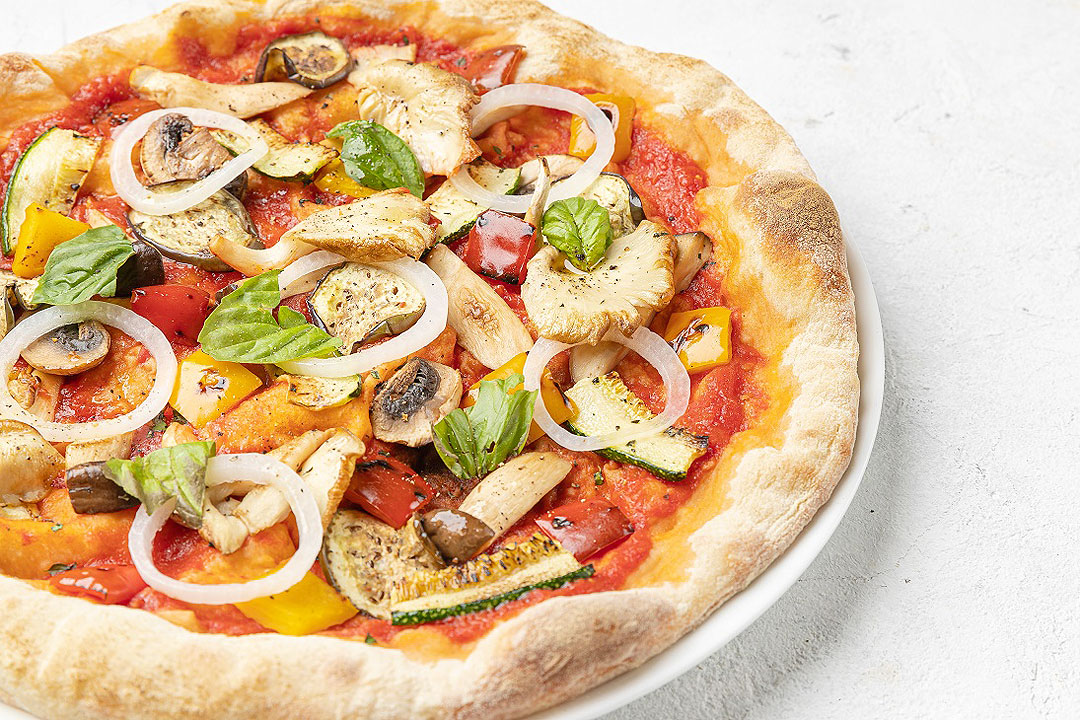
ROSSI Pizza’s Vegana

CITY of Dreams Manila has opened new restaurants at The Shops at the Boulevard. Here is a rundown of the establishments offering Italian, Thai, and Korean cuisine.

ROSSI PIZZA

Adjacent to Jing Ting and Hidemasa, Rossi Pizza is a casual trattoria that serves Roman-style pizza, known for its scrocchiarella (light, crispy texture), which consists of a mix of five different flours made with Italian grains, water, olive oil, and salt that has been matured in 18 hours of low temperature.

Among the chef’s recommendations are: Capricciosa pizza (with, prosciutto cotto, champignon, artichokes, and olives); the classic Margherita with basil; Quattro Formaggi (with parmesan, gorgonzola and taleggio cheeses). Vegetarians will delight in the Funghi (creamed mushrooms, roasted mushrooms, vegan TVP and arugula); and Vegana (eggplant, zucchini, mushrooms, and onion).

Rossi seats 72 guests and is open daily from noon to 9 p.m.

MANGO TREE

Explore Thai cuisine served in a contemporary 148-seater restaurant with private dining rooms that seat 10 to 70 diners.

Founded in 1994, the restaurant chain’s bestsellers are: Pla Neung Ma-naow or Steamed Sea Bass with Lime Sauce (sea bass, chili, lime, lemongrass, basil, tom yum, served with seafood sauce) Phad Phong Ka Ree or Stir-fried Crab in Curry Sauce (signature crab meat with egg and yellow curry sauce); Massaman Kha Gae or Mussaman Australian Lamb Shank (slow cooked lamb shank with mussaman curry, potatoes, peanuts, onion); and Phad Thai Goong (stir-fried rice noodles with shrimp, roasted peanuts, tofu, chili flakes, bean sprouts, lime, and egg net).

Mango Tree is open from 11 a.m. to 11 p.m., Sunday to Thursday; and until midnight on Friday and Saturday.

J. PARK GARDEN KOREAN RESTAURANT

Korean barbecue restaurant J. Park Garden serves samgyeopsal on a traditional grill-in-table albeit in a modern setting. Premium samgyeopsal, Korean beef, Wagyu, and US beef ribs are available, along with ala carte fare that includes Korean stews and soups such as Bulgogi Jeongol (beef hotpot) and Kimchi Jjigae (kimchi stew); noodle dishes such as Mul Naengmyeon (cold wheat noodles), and Japchae (stir-fried glass noodles and vegetables); and other well-loved snack items like teokbokki (spicy stir-fried rice cake), gimbap (seaweed rice roll), and mandu (dumpling).

J.Park Garden seats 76 guests and is open daily from 9 a.m. to 3 a.m.

CAFÉ MARY GRACE

Café Mary Grace is the home of ensaymadas, cheese rolls, and fresh-from-the-oven pastries and cakes. It also offers all-day breakfast items, soups, salads, pastas, and sandwiches complemented by signature drinks — including their famous hot chocolate.

Café Mary Grace is open from 11 a.m. to 11 p.m., Sunday to Thursday; and from 10 a.m. to midnight on Friday and Saturday.

For more information, visit www.cityofdreamsmanila.com.

Using cloud intelligence for retail growth opportunities

By Allen Guo

FOR MANY bricks-and-mortar retail brands, the global pandemic was the catalyst that accelerated their plans to establish an online presence. In order to survive during — and after — the pandemic, many brands have realized that they need to swiftly adapt their business strategy in a significant way, while revamping their entire IT infrastructure. Such measures are necessary if they want to respond effectively to the changes in consumer behavior, and to seize retail opportunities as they evolve in the post-pandemic digital economy.

It is my belief that the retail sector will be receptive to new digitalized businesses models, and willing to explore emerging technologies as well as cloud-based solutions. From an operational perspective, there are many benefits for them to enjoy; cloud-based solutions reduce retailers’ overheads with respect to managing a complicated IT infrastructure. They also provide useful resources to stimulate innovation, which is just what is needed as today’s consumers are eager to explore unique and ultimate shopping experience.

Retailers in the Philippines are also being supported and encouraged by the government to look to the opportunities posed by digitalization and e-commerce. This year, the Philippine Department of Trade and Industry (DTI) launched the e-Commerce Philippines 2022 Roadmap. In it, the department outlines the strategies, agenda, and road map for a thriving Filipino e-commerce industry. The document also speaks of the huge potential for growth in the sector, which can be stimulated through the digital transformation of Philippine businesses and investment in technological tools.

Therefore, to remain competitive, it is essential that bricks-and-mortar retailers look to adopt cloud-based intelligent solutions to underpin their digital transformation process.  Retailers can leverage intelligent solutions to build a cloud-first and secure infrastructure, to expand their omni-channel operational footprint, enhance the customer engagement experience and utilize smart supply chains to optimize brands’ digital business models. In short, all of the measures needed to streamline their business while presenting retailers with innovative offering for their customers.

CLOUD-FIRST INFRASTRUCTURE AND OMNI-CHANNEL SALES
During the pandemic, many retailers discovered to their advantage how analytics-driven, cloud-based technologies, were able to support the huge increase in the number of online shoppers. Underpinning their ability to deliver their online offering reliably and consistently during that time of crisis, was a cloud-first and secure infrastructure. This enabled retailers to adopt cloud-native technologies that can easily scale up or down the infrastructure based on their real-time business needs. Features like a globally accelerated network, cloud-native container management, and unified backup and recovery services, gave retailers peace of mind that their platform is robust, irrespective of the extreme demand it was subject to.

Adding further reassurance, are the host of essential security solutions that the cloud offers which provides comprehensive compliance and protection against a range of ever-present and increasingly sophisticated security threats. For example, retailers can build anti-fraud risk engines based on Apache Flink — an open-source stream processing framework — to defend against the ever-evolving tactics of fraudsters.

In a bricks-and-mortar business model, there are other operational essentials a retailer has to deal with daily. These range from processing orders, to dealing with payments, product assortments, inventory information, supply chain processes and so on. All of those can be digitalized and reviewed visually to help management make informed business decisions. Perhaps most importantly, when they are optimized, it is easier for digital channels to reach end customers directly while facilitating a seamless online and offline shopping experience for shoppers.

THE CLOUD ROUTE TO AN OPTIMIZED CUSTOMER EXPERIENCE
Innovative technology plays a key role in recreating a fabulous in-store experience when consumers order online. Livestreaming is one useful tool for further enhancing the customer engagement experience to help drive sales. For example, ApsaraVideo Live, Alibaba Cloud’s end-to-end livestreaming solution, supports retailers’ engagement with shoppers. It does this via a live shopping platform that reaches across social media, apps and websites with high definition and low latency livestreaming capabilities, as well as personalized services such as real-time audio and subtitle translation, human interaction, and in-picture product promotion.

Using cloud computing, AI and AR/VR technologies for creating 3D virtual spaces and digital ambassadors, retail brands can attract consumers and create a shopping ‘buzz’. In particular, using cloud-based XR solutions to build a “metaverse” presence, is considered essential for retailers looking to engage with Gen-Z customers. They have different expectations when it comes to the online experience, so gearing up to successfully meet their needs can only be accomplished by adopting the latest in retail technology.

A SEARCH THAT GOES BEYOND WORDS
Meanwhile, ‘back at the store’, some products – like Image Search and Chatbots – have added a new dimension to how customers interact with sites and how they search for products. The technologies provide the necessary insights and real-time information to optimize the shopping experience for the customer, encouraging them to return time after time.

For example, image search utilizes machine learning to analyze images. It enables shoppers to upload a photo or a screenshot of the product they’re interested in, rather than trying to locate it by typing in a vague keyword into the search box. Retailers can implement image search as added functionality to improve the effectiveness of the search, yielding better results for the customer and increasing customer satisfaction.

Retailers can also tap into services like Alibaba Cloud’s OpenSearch, a one-stop platform for developing intelligent search services. It was built on the large-scale distributed search engine developed by Alibaba, with the aim of helping retailers to develop high quality, maintenance-free, and high-performance intelligent search services with high search efficiency and accuracy.

Another innovative tool is the chatbot. Leveraging cloud-based, AI-powered chatbots, retailers can deliver engaging and memorable services when answering customer questions relating to product information, delivery status, shipment schedules and product recommendations. An added benefit for retailers is that the technology can help retailers save on customer service-related expenses and gain a more detailed understanding of customers’ overall inquiry trends.

KEEPING STOCK OF IT ALL, ALL YEAR AROUND AND BEYOND
In scenarios where stocks of essential supplies are low, technology can be used to steer customers to retailers that do have the essential supplies they need. This is made possible by retailers developing smart supply chain and inventory management solutions for asset and inventory tracking, which gives them visibility into the supply chain. From a retailer’s perspective, such solutions can also save them from the time spent cataloging items and conducting stock-taking activities. With automation, retailers can also match inventory and order status in real time, and – at the end of the customer journey – offer suitable delivery options to customers.  Furthermore, retailers can forecast sales demand so they can better plan the product assortment and optimize the management of inventory.

While the pandemic has given every single sector a considerable jolt, it has also been an opportune time for retailers to use cloud-based intelligent technology to finesse their online and offline offerings to meet the expectations of the post-pandemic consumers, as well as develop innovative models to capture new business growth in the digital economy era.


Allen Guo is the Alibaba Cloud Intelligence country manager for the Philippines.

How much does each commodity group contribute to June inflation?

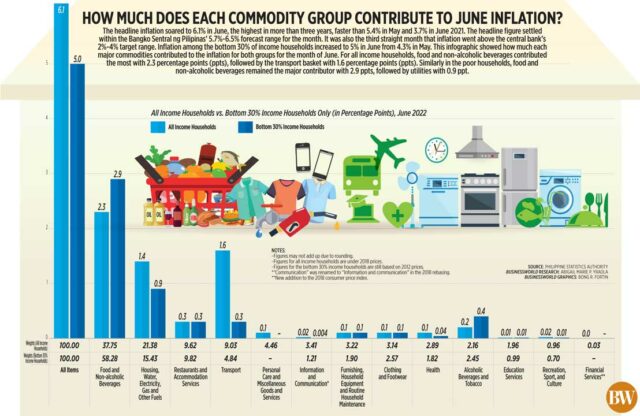
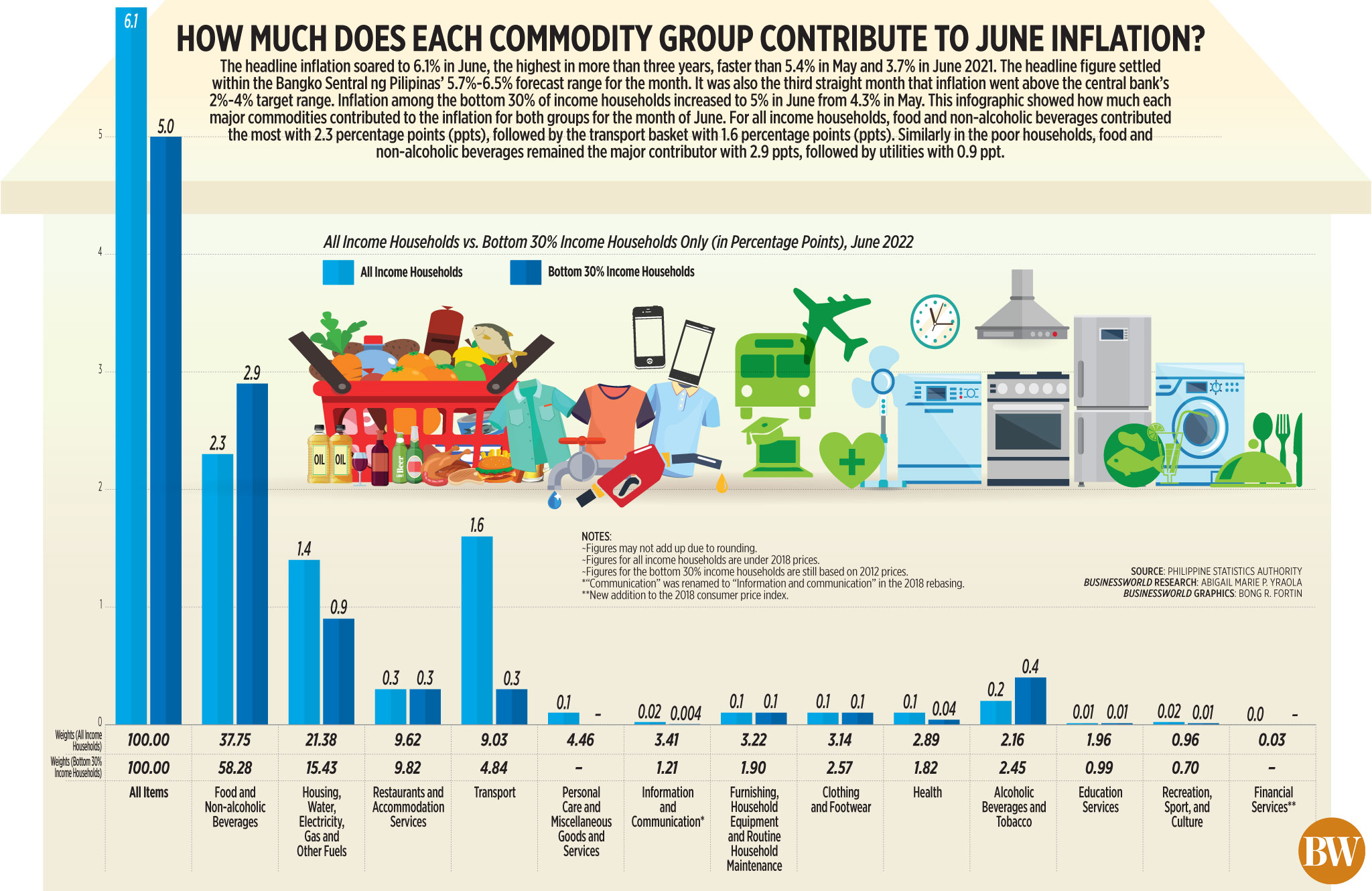
The headline inflation soared to 6.1% in June, the highest in more than three years, faster than 5.4% in May and 3.7% in June 2021. The headline figure settled within the Bangko Sentral ng Pilipinas’ 5.7%-6.5% forecast range for the month. It was also the third straight month that inflation went above the central bank’s 2%-4% target range. Inflation among the bottom 30% of income households increased to 5% in June from 4.3% in May. This infographic showed how much each major commodities contributed to the inflation for both groups for the month of June. For all income households, food and non-alcoholic beverages contributed the most with 2.3 percentage points (ppts), followed by the transport basket with 1.6 percentage points (ppts). Similarly in the poor households, food and non-alcoholic beverages remained the major contributor with 2.9 ppts, followed by utilities with 0.9 ppt.

See related story: Inflation nears 4-year high in June

How much does each commodity group contribute to June inflation?

Ayala Land lists P33-billion fixed-rate bonds

AYALA Land, Inc. (ALI) successfully listed its new P33 billion fixed-rate bonds due 2024, 2027, and 2029 on July 4 at the Philippine Dealing & Exchange Corp. (PDEx).

The two, five, and seven-year bonds are ALI’s largest issuance to date and its second for the year in the local capital debt market.

“With this latest bond offer, we raised P45 billion in debt capital, representing a 90% utilization rate of our P50-billion shelf registration in less than a year,” ALI Deputy Treasurer Jose Emilio B. Jamir said.

ALI reported that the proceeds of the offering will be used for refinancing, funding general corporate requirements, and capital expenditures for upcoming real estate projects.

Its total outstanding listed bonds are now at P120.3 billion, representing 8.9% of the total outstanding listed corporate bonds on PDEx.

“This could only be a positive signal of the corporate sector’s continued thrust for economic revival even in the face of stresses brought on by global events,” PDEx President and Chief Executive Antonino A. Nakpil said.

In May this year, ALI also issued P12-billion six-year fixed-rate bonds with an interest rate of 5.81% per annum.

ALI’s total outstanding listed bonds are now at P120.3 billion, representing 8.9% of the total outstanding listed corporate bonds on PDEx.

ALI is the largest property developer in the country, with more than 12,000 hectares of land bank and a track record in developing large-scale, integrated, mixed-use, and sustainable estates.

It has 47 estates and hosts a diversified portfolio of complementary businesses.

ALI’s shares showed an increase of P0.50 or 1.89% closing at 26.90 apiece on Wednesday. — Justine Irish DP. Tabile

PBA D-League kicks off with battle of collegiate champions

TOP contenders Wangs Basketball @26-Letran and Adalem Construction-St. Clare collide in a battle of collegiate champions to usher in the much-awaited comeback of the Philippine Basketball Association (PBA) D-League Aspirants Cup at the Smart Araneta Coliseum.

Game time is at 10:30 a.m. with the Knights as the back-to-back National Collegiate Athletic Association (NCAA) champions and the Saints as the reigning five-time National Athletic Association of Schools, Colleges and Universities (NAASCU) king going for the first blood in D-League’s return after more than two years of break due to the pandemic.

Established collegiate programs in AMA Online and Centro Escolar University (CEU) then follow suit at 12:30 p.m. to complete the twin-bill opener of the eight-team tourney hat also includes EcoOil-La Salle, Marinerong Pilipino, Builders Warehouse–UST and Apex Fuel–San Sebastian.

Parading an intact core from its perfect title run in NCAA Season 97, Letran looms the team to beat but coach Bonnie Tan remains wary of the competition.

“Medyo kulang pa ang preparations namin. We just resumed practicing this week, so mate-test talaga ‘yung tibay ng mga bata,” said Mr. Tan, tasking seasoned guard Fran Yu to lead the way with the possible unavailability of NCAA Rookie of the Year and Most Valuable Player (MVP) Rhenz Abando due to his national team duty.

A champion of its own, St. Clare vows an all-out fight even against the NCAA title holder.

“Lalaban lahat yan, kaya importante sa amin na makasabay. Hindi naman kami sumali dito para tumakbo-takbo lang,” coach Jinino Manansala said with NAASCU MVP behind the efforts of MVP Johnsherick Estrada and Senegalese big man Babacar Ndong at helm. — John Bryan Ulanday

Dining In/Out (07/07/22)

Crimson Boracay offers ‘Art On a Plate’

CRIMSON Resort and Spa Boracay brings back its “Art On a Plate” dinner event at the Mosaic Latin American Grill. On July 8 and 9, the resort will feature a spread by the chefs by Hapag MNL and chocolate creations by award-winning company Auro Chocolates. Crimson Boracay artist-in-residence Eric Egualada will present visual art while music will be provided by saxophonist Nicole Tejedor and guitarist John Reluya. For reservations, call or message 0998-5964629 or e-mail boracay.fbsec@crimsonhotel.com.

Jollibee brings back ube cheese pie

THE UBE cheese pie is back on Jollibee’s menu this July for P35 for one piece, P100 for three, and P199 for six. It is available via the Jollibee Delivery App, JollibeeDelivery.com, or #87000. Also available in Drive-Thru and Take Out. For updates, follow @jollibee on Twitter, Instagram, and TikTok.

McDonald’s goes strawless

QUICK service restaurant giant McDonald’s Philippines will use strawless lids in an effort to reduce waste. Under its Green & Good platform, McDonald’s has also installed solar rooftop panels on some of its branches, introduced bike racks and bike-and-dine areas, and partnered with eSakay to provide e-charging stations. Updates can be found on McDonald’s PH on facebook.com/McDo.ph, twitter.com/McDo_PH, and instagram.com/mcdo_ph.

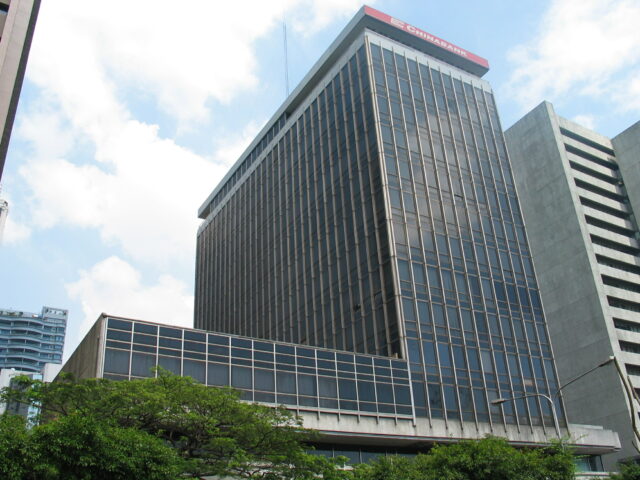
Moody’s affirms China Bank’s credit rating

MOODY’S Investors Service has maintained China Banking Corp.’s (China Bank) Baa2 credit rating with a stable outlook, citing the lender’s strong capitalization and profitability.

“The international credit watcher cited stable capitalization and profitability, which support business expansion, and sound liquidity as China Bank’s credit strengths,” the bank said in a disclosure to the local bourse on Wednesday.

China Bank’s rating from Moody’s is a notch higher than the minimum investment grade and is in line with the country’s sovereign credit rating.

“The improvement in the bank’s capital since 2019 has been higher than the average of its peers, reflecting a combination of low loan growth from the pre-pandemic level in 2019 and increased profitability,” China Bank quoted Moody’s to have said in its report.

China Bank booked a higher net profit in the first three months of the year as interest earnings improved and loan loss provisioning declined.

The lender’s net income was at P4.9 billion in the first quarter, rising by 37% from P3.6 billion in the same period of 2021.

The bank’s common equity Tier 1 (CET1) capital ratio has also increased through the years: from 13.8% in 2020, to 14.9% in 2021, and to 15.5% as of end-March 2022

Its assets likewise grew by 12% year on year to P1.1 trillion as of end-March.

As of March, China Bank reported higher core operating profitability of 1.9%. The lender’s return on average assets was at 1.7%, the highest among its rated domestic peers.

Moody’s said the improvement in the bank’s profitability in the first quarter of 2022 was driven by a higher net interest margin (NIM), rising to 4.3% during the period from 4.2% a year prior.

This was driven by low interest and an easy liquidity environment, which led to a significant reduction in funding costs, the credit rater said.

Meanwhile, the bank may face asset quality risks resulting from the concentrated loan book and a modest funding profile, with a relatively high share of corporate deposits, Moody’s said.

Business loans, which are less susceptible to economic disruptions, comprised 80.1% of China Bank’s gross portfolio. The bank’s nonperforming loans (NPL) ratio also improved to 2.4% year on year from 3.8% as of end-March.

“While China Bank’s market funds/total tangible assets is lower than most of its peers that Moody’s rate, the bank’s liquid assets/total tangible assets remained largely stable at 30.8% as of end-March 2022,” China Bank said.

Moody’s said it could upgrade China Bank’s baseline credit assessment “if the bank’s asset quality reverts to pre-pandemic levels and NIM improves in a rising interest rate environment.”

The debt watcher last week also affirmed its Baa2 long-term deposit ratings on Metropolitan Bank & Trust Co. and Bank of the Philippine Islands, also assigning a stable outlook.

China Bank’s shares closed unchanged at P27 apiece on Wednesday. — K.B. Ta-asan

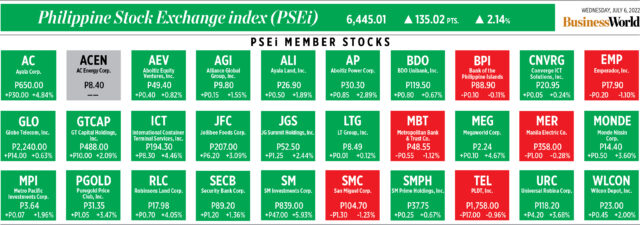
How PSEi member stocks performed — July 6, 2022

Here’s a quick glance at how PSEi stocks fared on Wednesday, July 6, 2022.


Three shots needed for full vaccination

PHILIPPINE STAR/ WALTER BOLLOZOS

President Ferdinand R. Marcos, Jr. has agreed to a proposal by health authorities to consider one as having been fully vaccinated only if they have been injected with at least one booster shot, according to local state media.

“The move was also in preparation for the impending full implementation of face-to-face classes this year,” the Philippine News Agency said in a report. 

Health Undersecretary Maria Rosario S. Vergeire asked the president to redefine the term “fully vaccinated” to encourage people to get a booster shot, it said.  

Meanwhile, Mr. Marcos met with health officials to discuss the government’s pandemic situation, according to the Department of Health (DoH). They also talked about vaccination efforts. 

DoH said Ms. Vergeire had recommended to improve the country’s response to the health crisis, which forced the Duterte government to enforce stringent lockdowns that were opposed by businesses. 

Mr. Marcos has yet to name his health chief, as well as the heads of Energy, Environment, and Science and Technology departments. 

His Finance chief Benjamin E. Diokno said the government would no longer enforce general lockdowns under the Marcos administration. 

“I think no country now — except maybe China — will go into general lockdowns,” he told a news briefing. “We have to live with the virus.” — Kyle Aristophere T. Atienza 

Peso sinks to new over 16-year low

BW FILE PHOTO

THE PESO ended weaker against the dollar on Wednesday as expectations of more monetary tightening from the US Federal Reserve amid rising inflation made the market more risk averse.

The local unit closed at P55.67 versus the dollar on Wednesday, sinking by 44 centavos from its Tuesday finish of P55.23, data from the Bankers Association of the Philippines’ website showed.

This was the local unit’s worst close in nearly 17 years or since it ended at P55.71 against the dollar on Oct. 20, 2005.

The peso opened Wednesday’s session at P55.42 against the dollar, which was also its intraday best. Its weakest showing for the day was at P55.72 versus the greenback.

Dollars exchanged went down to $1.245 billion on Wednesday from $1.285 billion on Tuesday.

“The peso exchange rate weaker versus the US dollar for the second straight day… amid a stronger US dollar versus major global currencies partly brought about by some risk aversion emanating from possible US economic slowdown or even recession amid more aggressive Fed rate hikes/monetary tightening in an effort to clamp down elevated US CPI (consumer price index) towards the long-term target of 2%, from the new 40-year high of 8.6% in May 2022,” Rizal Commercial Banking Corp. Chief Economist Michael L. Ricafort said.

Still, the peso was supported by lower global oil prices, gains in the local stock market, as well as hawkish signals from the Bangko Sentral ng Pilipinas chief on more rate hikes to curb rising inflation, Mr. Ricafort said.

A trader said the peso closed lower due to broad dollar strength amid fears of a recession in the US.

“All eyes will be on FOMC (Federal Open Market Committee) later,” the trader said, referring to the release of the minutes of the Fed’s June meeting overnight.

The dollar stood tall on Wednesday, holding at a 20-year peak against the euro and multi-month highs against other major peers as higher gas prices and political uncertainty renewed recession fears and sent investors scrambling to the safe-haven currency, Reuters reported.

For Thursday, Mr. Ricafort gave a forecast range of P55.50 to P55.75, while the trader said the peso could move from P55.50 to P55.80 against the dollar. — with a report from DGCR