Home Blog Page 5722

CA rejects plea by Ampatuan for hospital transfer

PHILSTAR FILE PHOTO

THE COURT of Appeals (CA) has rejected the appeal of the principal convict in the massacre of more than 50 people in Maguindanao province in 2009 to be transferred to a hospital to avoid being infected with the coronavirus.

In a nine-page decision dated July 4, the appellate court affirmed a Quezon City trial court decision against former Autonomous Region in Muslim Mindanao (ARMM) Governor Zaldy U. Ampatuan as it ruled the petition had become moot due to decreasing infections and the availability of vaccines.

The appellate court cited government data that said 27,879 of 50,000 inmates at the national jail in Muntinlupa City had been fully vaccinated as of March 14.

Metro Manila is under Alert Level 1, the most relaxed quarantine status.

“An actual case may become moot and academic, however, when, by virtue of supervening events, the conflicting issue that may be resolved by the court ceases to exist,” Associate Justice Angelene Mary W. Quimp-Sale said in the ruling.

The court also said Mr. Ampatuan had failed to expound on the “clear and present danger” that he mentioned in his pleading.

Mr. Ampatuan and his brother, former Maguindanao Mayor Andal “Datu Unsay” U. Ampatuan, Jr. are serving life sentences after being convicted of 57 counts of murder for the massacre.

The massacre took place when journalists and family members of Esmael G. Mangudadatu, a political rival of the Ampatuan family, were accompanying him to the Commission on Elections to file his certificate of candidacy on Nov. 23, 2009.

Mr. Mangudadatu was running for governor of ARMM to end the 20-year rule of the Ampatuan family. The Committee to Protect Journalists, a global media watchdog, said the massacre was the “worst single incident of journalist killing.” — John Victor D. Ordoñez

PHL, US reaffirm commitment to strengthen supply chains, climate crisis response 

DFA.GOV.PH
DFA.GOV.PH

THE PHILIPPINES and the United States have reaffirmed their commitment to jointly reinforce supply chains and address the climate crisis, according to their foreign affairs leaders.  

Secretary Blinken and I agreed to continue working together on building resilient supply chains, addressing the climate crisis and transitioning to clean energy,Foreign Affairs Secretary Enrique A. Manalo said in a tweet on Sunday after speaking with US Secretary of State Antony J. Blinken at the weekend. 

Appreciate US commitment to alliance and to PH as equal and sovereign partner in promoting peace, prosperity & international law-based order in the region,he said.  

State Department spokesperson Ned Price in a statement on Saturday also said the conversation highlighted the increasing significance of the US-Philippine bilateral alliance to security and prosperity in the Indo-Pacific region and around the world.”  

US President Joseph R. Biden, Jr. earlier said he looked forward to working with Philippine President Ferdinand R. Marcos, Jr. to continue strengthening the US-Philippine bilateral relations.  

Mr. Biden said he wants to expand cooperation on such issues as the fight against the coronavirus, climate crisis response, promoting broad-based economic growth, and respect for human rights.  

Mr. Marcos has assured the US leader that the Philippines has always held the United States in high regard as a friend, an ally, and a partner.Alyssa Nicole O. Tan 

Galvez says Marcos gov’t committed to Bangsamoro transition as he stays on as peace adviser

SECRETARY Carlito G. Galvez, Jr. is keeping his post as presidential peace adviser on holdover capacity, according to a memo released by the Office of the President on Saturday.  

He will stay on until the end of the year or until a replacement has been designated, or if he is reappointed, according to the memo signed by Executive Secretary Victor D. Rodriguez.  

In order that there will be no disruption in the activities of the Office of the Presidential Peace Adviser on Peace, Reconciliation and Unity and the implementation of the comprehensive peace process,it said.   

Mr. Galvez, a retired military general, was appointed by former President Rodrigo R. Duterte in 2018 to head what was then the Office of the Presidential Adviser on the Peace Process.   

He was one of the top commanders that led security forces against Islamic State-linked local terrorists in the 2017 Marawi siege. He retired in December 2018 as chief of the Armed Forces of the Philippines.   

In his message during Saturdays celebration of Eid al-Adha or the Muslim Feast of Sacrifice, Mr. Galvez said the new leadership is committed to pursuing peace programs, particularly in the Bangsamoro region in the countrys south.  

The Marcos administration is inspired by the lessons imparted by the Eid al-Adha, and is determined to continue the implementation of the comprehensive Philippine peace process, especially in the Bangsamoro Autonomous Region in Muslim Mindanao,he said.   

He was also designated by Mr. Duterte as chief implementer of the inter-agency task force against coronavirus. MSJ 

SWS April poll: 46% of Filipinos optimistic economy will improve in a year

PHILIPPINE STAR/ MICHAEL VARCAS

MORE than 40% of adult Filipinos expect the Philippine economy to recover in the next 12 months, according to a Social Weather Stations (SWS) poll conducted in April.

Citing its survey from April 19 to 27, SWS said 46% of adult Filipinos were optimistic that the country’s economy will improve, which is four points below the result in December 2021.

The local pollster said 28% believed that the Philippine economy will stay the same, while 6% said it will worsen.

The resulting Net Economic Optimism score is +40, a score classified by SWS as excellent.

SWS said the economic optimism score used to be “mediocre” -9 in July 2020 and mediocre -5 in September 2020. It  was a “high” +24 in November 2020, it added.

The survey, in which 1,440 adults were interviewed, was conducted before the Philippines held a presidential election on May 9.

Optimism was highest in Luzon excluding the capital region Metro Manila at +46, followed by Metro Manila at +43, Mindanao in the south at +43, and the Visayas in central Philippines at +18.

“The 4-point decline in the national Net Economic Optimism score from December 2021 to April 2022 is due to slight decreases in all areas except in the Visayas,” it said.

The SWS concluded that the results of the economic optimism survey was directly tied to its April 2022 personal optimism poll, which found that 44% of adult Filipinos believed their quality of life will improve.

“Net economic optimism is higher among personal optimists (+63) than among those who said ‘no change’ (+31) and among personal pessimists (-35).”

SWS said the economic optimism score was highest among adults who belong to families who consider themselves as not poor at +54, “compared to +39 among those who belong to families who consider themselves as borderline poor and +32 among those who belong to families who consider themselves as poor.” — Kyle Aristophere T. Atienza

Metro Manila public transport system not ready for return to in-person classes — commuter network

PHILIPPINE STAR/ MICHAEL VARCAS

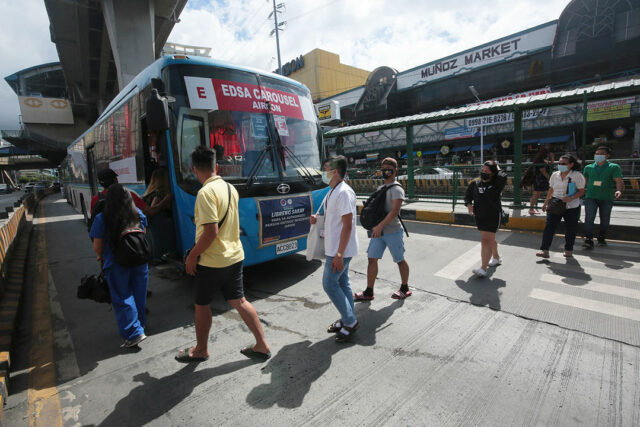
A TRANSPORT advocacy network has warned that the current situation of public transportation in Metro Manila, the countrys capital region, is not yet ready for a shift to face-to-face classes.  

The government should be wary of the additional demand to our already heavily-burdened public transport system,The Passenger Forum (TPF) said in a statement at the weekend.   

Metro Manila or the National Capital Region, composed of 16 cities and one municipality within a 636-square kilometer area, has a population of almost 13.5 million as of 2020. 

This problem needs to be addressed for us to successfully phase back into normal classroom-based education.” 

President Ferdinand R. Marcos, Jr. last week announced that his government is targeting to fully implement in-person classes nationwide by November this year, citing his education chief.   

The group said the government should not ignore the connection between the transport crisis and the target to return to in-person classes. Physical fatigue will add to the mental exhaustion of our students and teachers.”  

Another group, the Move as One Coalition, which has been asking the next administration to promote and set aside enough funds for active transport, has said the public transport sector is now in a deadly spiraland collapsing.”  

Transport was the second biggest driver of overall inflation in May at a rate of 14.6%, according to the Philippine Statistics Authority.  

On the other hand, a group of 2,500 private schools on Sunday backed the administrations plan to fully implement in-person classes nationwide, noting that its members have been preparing for the plan for months.   

In general, we are ready to comply with the directive of the President to go back to full face-to-face classes until November,” the Coordinating Council for Private Educational Associations (COCOPEA) said in a statement.  

The group asked the government to expedite its vaccination efforts for members of the education sector. 

The government should also simplify and streamline procedures and requirements for the return to face-to-face classes to encourage more schools to participate in the plan, it added.  

If face-to-face classes are to be mandated in September, private schools [should] still be given the flexibility to offer hybrid or full online classes,it said. The final decision on whether the learner returns to face-to-face classes or attends hybrid or full online classes [should also depend] on the parents.”  

In May, the government said about 73% of public schools in the country were already qualified for face-to-face classes.  

More than 34,000 schools have been nominated for the face-to-face classes as of May 26. Of these, 33,000 are public schools, while 1,174 are private schools.  

The Philippine government had ordered the closure of schools soon after a coronavirus pandemic was declared in March 2020. The country was the last in the world to reopen schools for physical classes. — Kyle Aristophere T. Atienza 

VP Sara to relocate office to Mandaluyong 

VICE President Sara Z. Duterte-Carpio meets with Education officials at the department’s office in Pasig City on July 6, 2022. — INDAY SARA DUTERTE OFFICIAL FACEBOOK PAGE   

VICE President Sara Z. Duterte-Carpio will relocate her office to Mandaluyong City to enhance its efficiency, her spokesman said.  

This will enhance efficiency, economy, and result in streamlined processes since all the OVP employees are within the same area,Reynold Munsayac, Ms. Duterte-Carpios spokesman, said in a statement at the weekend. 

Mr. Munsayac said they decided to move out of the state-owned Quezon City Reception House in New Manila used by her predecessor, former Vice President Maria Leonor G. Robredo, after inspection and human resource inventory.  

He said the new office will be more accessible to the public due to its proximity to major roads and public transportation facilities.  

Ms. Duterte-Carpio also has an office at the Department of Education in Pasig City, which is near Mandaluyong. 

Ms. Duterte-Carpio, Mr. Marcos’ education chief, last month disclosed a plan to build a permanent residence for future vice presidents.  

In the Philippines, the president and vice-president are elected separately and may come from different political parties. Kyle Aristophere T. Atienza 

House bill modernizing immigration bureau to generate more funds refiled 

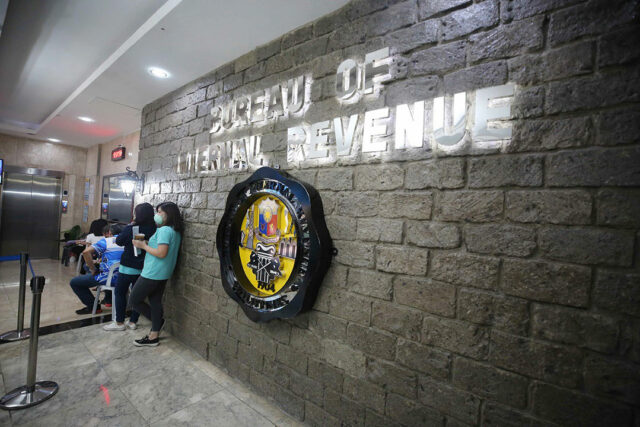
A BILL seeking to modernize the Bureau of Immigration (BI) for improved efficiency and revenue collection has been refiled at the House of Representatives.  

Theres no question that the BI can easily raise between P10 billion to P12 billion in annual revenues, possibly more,Pantawid Pamilyang Pilipino Program Party-list Rep. Marcelino NonoyC. Libanan, who refiled House Bill 1069 or the proposed Bureau of Immigration Modernization Act, said in a statement on Sunday. 

Before the pandemic, the BI already managed to produce P9.3 billion in revenues in 2019, up 32% from the P7.03 billion it collected in 2018,he added.  

The measure failed to pass the Senate in the 18th Congress, which held several probes on reported illegal activities in the bureau, including bribery and human trafficking.   

The proposed law seeks to reorganize and further professionalize the BI, upgrade its systems, and increase staff pay.  

Under the bill, the BI will be required to retain no more than P1.2 billionof its annual income so that it can invest in automation projects, such as a fully online application and payment system that may help eliminate corruption.  

The bureau generates income from visa processing and extension fees; fines and penalties; clearance and certification taxes; and immigration tax.  

The bill also mandates the establishment of a new Immigration Academy for career advancement, and an Internal Affairs Service which will serve as a watchdog against illegal and unethical conduct by staff. Alyssa Nicole O. Tan 

Access to Banaue road sections still limited after mudslide

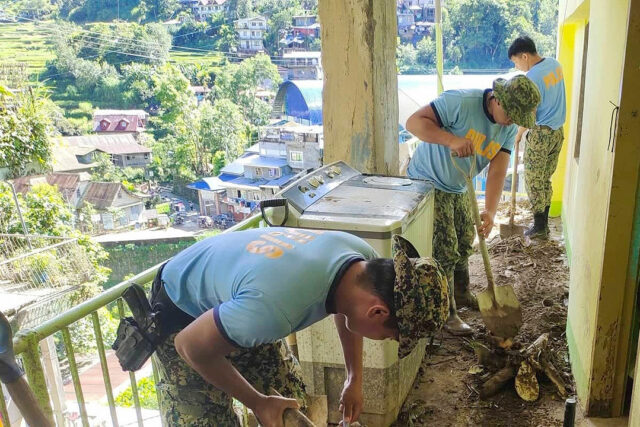
MEMBERS of the police and Bureau of Fire Protection clear out mud on town center streets after a flash flood and mudslide in Banaue on July 7. — BFP

SEVERAL sections of roads to and from Banaue that were cut off by last weeks flash flood and mudslide have been partially reopened, according to the regional office of the Department of Public Works and Highways (DPWH).   

The DPWH-Cordillera Administrative Region office said as of Saturday, total clearing operations are still ongoing while punch thruopenings have been made at the following affected road segments: Banaue-Hungduan-Benguet, Banaue-Mayoyao-Isabela, and Nueva Vizcaya-Ifugao-Mt. Province boundary road.   

However, the Poblacion part of the Banaue-Hungduan-Benguet highway that was closed on June 27 due to a road slip remains inaccessible.   

Banaue, home of what forms part of the Rice Terraces of the Philippine Cordilleras recognized as a UNESCO Heritage Site, was struck by a rampaging flash flood on July 7 that swept away vehicles and damaged structures in the town.   

We will look into the cause of the floods to prevent a repeat any time this rainy season, Mayor Joel B. Bungallon said in a statement on Friday. He has since declared a state of calamity in the municipality.   

Among the affected structures are the state-owned Banaue Hotel and Youth Hostel. 

Tourism Secretary Christina Garcia C. Frasco, in a statement at the weekend, said the 81-room facility is temporarily closed until the damage has been fully assessed and fixed.   

The Department of Tourisms Cordillera regional office said 55 domestic tourists who were in town during the disaster and staying in nine accommodation establishments were unharmed. They are being given assistance until they can leave.   

Communication remains a challenge since electricity has not yet been restored in the affected areas,the department said on Saturday as it appealed to tourists to suspend travel plans while clearing operations are ongoing.  

The Department of Social Welfare and Development, through its Cordillera field office, said it is providing food and non-food relief packs to affected residents.   

In a statement on Friday, the agency said it initially distributed family packs to about 500 displaced households in Barangay Amganad, Poblacion, Tam-an, Viewpoint, Bocos, and Poitan.  

Another 1,000 packs were delivered to the local government of Banaue while relief goods have also been prepositioned at the provincial satellite warehouse in Ifugao. MSJ 

Sri Lanka’s president, premier to quit over economic collapse

DEMONSTRATORS celebrate after entering the president’s house during a protest in Colombo, Sri Lanka, July 9. — REUTERS

COLOMBO — Calm returned to the streets of Sri Lanka’s commercial capital Colombo on Sunday and protesters were jubilant as President Gotabaya Rajapaksa agreed to resign after his house was stormed amid outrage over the South Asia nation’s collapsing economy.

Protesters, many wrapped in the Sri Lanka flag, swarmed into his whitewashed colonial-era residence on Saturday, jumped into the swimming pool and sat on a four-poster bed. Others set fire to the private home of Prime Minister Ranil Wickremesinghe, who also agreed to resign to make way for an all-party government.

Rajapaksa, a hero of the quarter-century civil war against Tamil rebels, plans to resign on Wednesday, the parliament speaker said.

Thousands had descended on the seaside city demanding Rajapaksa resign after months of mismanaging the crisis, a dramatic escalation of largely peaceful anti-government protests on the island that sits near key shipping lanes.

On Sunday protesters were still milling about in the president’s residence, parts of which had been smashed.

Some took selfies of the polished interiors, a striking contrast to the misery many have endured. The nation of 22 million people is short of food and fuel, and inflation hit a record 54.6% in June.

Sri Lanka’s economic crisis developed after the COVID-19 pandemic hammered the tourism-reliant economy and slashed remittances from overseas workers.

It has been compounded by large and growing government debt, rising oil prices and a ban on importing chemical fertilizers last year that devastated agriculture. The fertilizer ban was reversed in November.

Rajapaksa’s “decision to step down on 13 July was taken to ensure a peaceful handover of power,” Speaker Mahinda Yapa Abeywardena said in a video statement on Saturday. “I therefore request the public to respect the law and maintain peace.”

Wickremesinghe, a six-time premier also seen as part of an uncaring ruling elite, agreed to step down, his office said. Local news channels showed a huge fire and smoke coming from his home in an affluent Colombo suburb.

Neither Rajapaksa nor Wickremesinghe were in their residences when the buildings were attacked.

Rajapaksa had left on Friday as a precaution before the planned demonstration, two defense ministry sources said. Reuters could not immediately confirm his whereabouts.

Details of a transition of power were not yet clear. The speaker had outlined proposals from a meeting of political parties on Saturday that would include parliament picking an acting president within a week.

The International Monetary Fund (IMF), which has been in talks with the Sri Lankan government for a possible $3-billion bailout, said on Sunday it was monitoring the situation closely.

“We hope for a resolution of the current situation that will allow for resumption of our dialogue on an IMF-supported program,” the global lender said in a statement.

It said it was deeply concerned about the impact of the economic crisis on the people. — Reuters

Japan ruling party set for strong election showing after Abe killing

A Japanese flag is seen as people pray next to tributes laid at the site where late former Japanese Prime Minister Shinzo Abe was shot while campaigning for a parliamentary election, near Yamato-Saidaiji station in Nara, western Japan, July 8, 2022. — REUTERS/ISSEI KATO

TOKYO/NARA — Japanese voters went to the polls on Sunday for a parliamentary election that may give the ruling Liberal Democratic Party (LDP) a surge of support after the assassination of former Prime Minister Shinzo Abe, a dominant politician and power broker.

Abe, Japan’s longest-serving modern leader, was gunned down on Friday during a speech in support of a local candidate in the western city of Nara — a killing the political establishment condemned as an attack on democracy itself.

Turnout as of 11 a.m. (0200 GMT) was 10.44%, the Ministry of Internal Affairs said. That was up from 9.7% at the same time on the day of the last upper house election, in 2019. Media said 15.3% percent of voters had cast absentee ballots in advance.

Polls will close at 8 p.m., when initial exit poll results are expected.

“We just lost Mr. Abe. I would like the LDP to win many votes so that they can run the country in a stable manner,” said Sakae Fujishiro, a 67-year-old pensioner who cast his vote for the ruling party in Tokyo’s eastern Edogawa ward.

Elections for seats in parliament’s less powerful upper house are typically seen as a referendum on the sitting government, and opinion polls before the assassination already pointed to a strong showing for the ruling bloc led by Prime Minister Fumio Kishida, an Abe protege.

As the nation mourns, the LDP and its junior coalition partner Komeito could gain from a potential wave of sympathy votes, political analysts said.

“The ruling LDP-Komeito coalition was already on course for a solid victory,” James Brady of the Teneo consultancy said in a note. “A wave of sympathy votes now could boost the margin of victory.”

Campaigning was halted on Friday after Mr. Abe’s killing, but politicians resumed pre-election activities on Saturday.

There was an increased police presence when Mr. Kishida appeared at a campaign event in a city southwest of Tokyo and a metal detection scanner was installed at the venue — an unusual security measure in Japan.

Meanwhile, the Nara prefectural police office said on Sunday it had seized a motorcycle and a vehicle belonging to the man arrested for the shooting, Tetsuya Yamagami.

From the vehicle, police retrieved trays wrapped in aluminum foil that the suspect said he had used for drying gunpowder, and wooden boards with holes that he said he had used for test-firing his home-made weapon, according to the police office.

The unemployed 41-year-old has said he spent months planning the attack, accusing the former prime minister of links to a religious cult that he blames for his mother’s financial ruin, according to local media reports.

With the potential for a wave of sympathy votes following the slaying, a strong showing at the polls could help Mr. Kishida consolidate his rule, giving the former banker from Hiroshima a chance to carry out his goal of boosting defense spending.

It might also allow him to revise Japan’s pacifist constitution — something even the hawkish Mr. Abe was never able to achieve.

“In the months ahead, the government is certain to seek to strengthen domestic security,” Brady said. “By undermining the public’s general sense of safety and order, the event could also add further momentum to those key Abe causes like defense build-up and constitutional revision.”

PARTY POWER VACUUM
Polls last week showed the LDP winning at least 60 of the 125 seats being contested on Sunday, up from the 55 it now holds, allowing it to maintain the majority in the chamber that it holds with Komeito.

Reaching 69 seats in the upper house would give the LDP a majority, a threshold that had been seen as a stretch before Mr. Abe’s killing.

Not all voters were swayed by the assassination.

“The Kishida administration is well regarded, but if the LDP is in power too long, there will be too much collusion as a result,” said Yoshio Yamamoto, a 40-year-old civil servant who cast his vote in Tokyo’s central Nakano ward for the Democratic Party for the People.

Mr. Kishida, once on the more dovish side of the LDP, has shifted towards the right and said parts of the constitution may have elements that “are outdated and lacking”.

Opinion polls show a majority of voters favour greater military strength.

But even a strong LDP performance will be overshadowed by the murder of Abe, who as a lawmaker leading the party’s largest faction still wielded considerable strength over policy and personnel decisions.

His death raises the specter of a power vacuum and potential turmoil within the party, analysts said.

The small, populist Japan Innovation Party, which gained seats in a general election last year, could siphon off votes from the LDP. But since the party also backs constitutional revision, any advances it makes would be likely to bolster the LDP’s goals. — Reuters

Biden defends decision to visit Saudi Arabia, says rights are on his agenda

OFFICIAL WHITE HOUSE PHOTO BY ADAM SCHULTZ

WASHINGTON — President Joseph R. Biden on Saturday defended his decision to travel to Saudi Arabia saying human rights would be on his agenda as he gave a preview of a trip on which he aims to reset ties with the crown prince, who he previously denounced as a pariah.

Mr. Biden will hold bilateral talks with Saudi King Salman bin Abdulaziz and his leadership team, including Crown Prince Mohammed bin Salman on his visit to the Middle East next week.

The Crown Prince Mohammed, Saudi Arabia’s de facto leader, was believed to be behind the 2018 murder of Washington Post journalist and political opponent Jamal Khashoggi, according to the US intelligence community.

In a commentary published in the Washington Post late on Saturday, Mr. Biden said his aim was to reorient and not rupture relations with a country that has been a US strategic partner for 80 years.

“I know that there are many who disagree with my decision to travel to Saudi Arabia. My views on human rights are clear and long-standing, and fundamental freedoms are always on the agenda when I travel abroad,” Mr. Biden wrote.

Mr. Biden needs oil-rich Saudi Arabia’s help at a time of high gasoline prices and as he encourages efforts to end the war in Yemen after the Saudis recently extended a ceasefire there. The United States also wants to curb Iran’s influence in the Middle East and China’s global sway.

Mr. Biden argued that Saudi Arabia had recently helped to restore unity among the six countries of the Gulf Cooperation Council, had fully supported the truce in Yemen and was working to stabilize oil markets with other OPEC producers.

Mr. Biden said he will be the first president to fly from Israel to Jiddah, Saudi Arabia, next week, which he said would be a small symbol of “budding relations and steps toward normalization” between Israel and the Arab world.

“I will be the first president to visit the Middle East since 9/11 without US troops engaged in a combat mission there. It’s my aim to keep it that way.” Mr. Biden said.

The president will first stop in Israel on his July 13-16 trip. — Reuters

China tells Australia to act as partner, not opponent

REUTERS

SHANGHAI — Chinese Foreign Minister Wang Yi has urged his Australian counterpart Penny Wong to treat China as a partner, not an opponent, and to accumulate “positive energy” to improve ties between the two countries.

On the sidelines of the G20 Foreign Ministers Meeting in Bali on Friday, Mr. Wang expressed hope that Australia could “seize the opportunity, take concrete actions and come to a correct understanding of China,” according to a summary published late on Saturday by China’s foreign ministry.

“The root cause of the difficulties in Chinese and Australian relations in recent years lies in the insistence of previous Australian governments to treat China as an ‘opponent’ and even a ‘threat’,” Mr. Wang said, adding that Australia’s words and actions had been “irresponsible”.

China has been restricting imports of Australian coal and other products since 2020. Among Beijing’s grievances were Canberra’s call for a full probe into the origins of COVID-19, an investigation into Chinese interference in Australian politics, and a ban on China’s Huawei from participating in Australia’s 5G rollout.

Australian Foreign Minister Wong said on Friday that the meeting with her Chinese counterpart was a first step towards stabilizing the relationship but that it would take time for Beijing to remove trade blockages on Australia.

Australia has also expressed concern about China’s growing presence in the Pacific region, with Prime Minister Anthony Albanese warning on Friday that Beijing had become “more aggressive”.

Mr. Wang told Ms. Wong at the Friday meeting that China was conducting “equal exchange and cooperation” with sovereign island nations based on their requests and needs, the Chinese foreign ministry said. — Reuters