Home Blog Page 5702

Minimal lahar flows from Bulusan during thunderstorm, alert level remains low 

LOCAL emergency response teams and members of the Philippine Red Cross-Sorsogon check the lahar flow along the southwestern side of Bulusan Volcano on the evening of June 26. — PHILIPPINE RED CROSS-SORSOGON CHAPTER

A SMALL volume of mudflow was recorded along the southwestern slope of Bulusan on Sunday evening, but no major change was detected in the volcanos low level of unrest, according to state volcanologists. 

In an advisory on Monday, the Philippine Institute of Volcanology and Seismology (Phivolcs) said the lahar flow lasted for 54 minutes along Calang Creek during a thunderstorm in Sorsogon province.  

The creek located in the town of Irosin is the major channel along the southwestern slopes of Bulusan. 

The provincial government of Sorsogon said in a separate report on Monday that minimal lahar flow was also recorded along several communities in Juban town.  

Alert level 1 still prevails over Bulusan Volcano, which means that it is currently at low-level unrest,said Phivolcs, which has a five-level alert system for volcanoes.   

In the 24-hour period from 5 a.m. Sunday, Phivolcs recorded seven volcanic earthquakes in Bulusan, 559 tons of sulfur dioxide flux and a moderate plume emission of up to 150 meters high.  

The four-kilometer permanent danger zone around the volcano remains strictly off limits. 

Sudden steam-driven eruptions remain a threat under alert level 1, according to Phivolcs.   

The provincial government said disaster management teams are monitoring the situation and are prepared to evacuate 19 households that are at high risk should the lahar flow continue. 

Bulusan erupted on June 5 and 12, prompting evacuation of residents in some areas that were affected by ash fall. Phivolcs raised the alert level to one after the first eruption this month. 

Light to moderate rains with possible sudden heavy downpour are expected in the province and the rest of Bicol Region due to a low pressure area east of the country, according to state weather bureau PAGASA.   

This weather disturbance remains less likely to develop into a tropical depression in the next 48 hours,PAGASA said in an advisory issued at 11 a.m. Monday. MSJ 

De Lima back in detention as she recovers from major surgery 

OFFICE OF SEN. LEILA DE LIMA/RELEASE

DETAINED SENATOR Leila M. de Lima is now recovering after undergoing a major surgery at the Manila Doctors Hospital last week. 

In a handwritten statement posted on her Twitter account on Monday, Ms. De Lima said she was discharged from hospital on Sunday and feel generally fine” despite still experiencing some pains.”   

The senator was granted by the Muntinlupa Regional Trial Court a five-day medical furlough after being diagnosed with a stage 3 pelvic organ prolapse.  

Ms. De Lima, who has been locked up at the Philippine National Police Custodial Center since 2017, is on trial for allegedly allowing the illegal drug trade in the countrys jails when she was still Justice secretary.       

At least four key witnesses have retracted their allegations relating to her supposed crime. One of three cases against her have been dismissed. Alyssa Nicole O. Tan 

In Gee Chun blows lead, rallies to win Women’s PGA Championship

Despite shooting a second straight 3-over-par 75 and blowing her chance at a wire-to-wire victory, In Gee Chun sank clutch putts down the stretch to outlast Lexi Thompson on Sunday in a dramatic finish for her third major title in the KPMG Women’s PGA Championship at Bethesda, Md.

Chun’s 5-under 283 finish completed a roller-coaster day at Congressional Country Club that began with her giving up a lead that was as large as seven shots a day earlier. The South Korea native instead shook off four bogeys on the front nine to play flawlessly over the final six holes and rally from a two-stroke deficit against Thompson.

Chun, 27, capped her comeback by salvaging par on the tournament’s 72nd hole after her second-shot approach took an unfortunate bounce and rolled off the green. She putted from the fringe to get within 5 feet.

That put the focus on Thompson, the Florida native who has endured a series of close calls in the past. Thompson missed her birdie putt from 12 feet. After Thompson tapped in for par, all that was left was Chun to sink her par putt for her fourth career LPGA victory.

Thompson (73) and Australia’s Minjee Lee (70) both finished a shot off the lead at 4 under.

“It just means a lot because I didn’t have any wins the last, almost 3 1/2 years, so I really appreciate it,” a visibly emotional Chun said through tears.

After tying a tournament record with an 8-under-par 64 on Thursday to grab a five-shot lead after the first round, Chun led by six strokes after a second-round 69. Her lead was down to three after Saturday’s third-round struggles, and by the fourth hole Sunday she was already looking up at Thompson.

Chun caught Thompson on the pivotal 16th, when she birdied the par-5 hole while Thompson had her fourth bogey in a six-hole span. Since winning her only major at age 19 at the 2014 Kraft Nabisco Championship, it marked the ninth major in which the 27-year-old finished in the top three without victory.

Lee, this year’s US Open champion, fought her way into contention by tying for the second-lowest round of the day in windy conditions.

“After my start, I really just wanted to get back to even, but I hit some really good shots out there and gave myself little birdie opportunities despite a little bit harder conditions,” Lee said. “I’m quite happy with how I finished.”

Rounding out the top five was 19-year-old Atthaya Thitikul of Thailand, who finished two shots back at 3 under after a 73 Sunday. Five players tied for fifth at 1 under — including Japan’s Nasa Hataoka (low-round 69), Australia’s Hannah Green (75), and South Koreans Hyo Joo Kim (71), Hye-Jin Choi (76) and Sei Young Kim (76). — Reuters

Kupp says Rams have what it takes to repeat as Super Bowl champions

LOS ANGELES — Los Angeles wide receiver Cooper Kupp said the Rams have the passion and personnel to win back-to-back Super Bowls and can do so if they focus on getting better every week.

In his breakout fifth season, Kupp led the league in receptions, receiving touchdowns, and receiving yards and saved his best for last, catching two touchdown passes including the dramatic game winner to earn Super Bowl MVP honors.

“Winning the Super Bowl is an incredibly challenging thing to accomplish,” Kupp told Reuters.

“So much has to go right including things that are outside of your control. All you can do is trust your process and trust that you can put yourself in the best position possible to win.

“And then, week after week, try to be a better football team. We want be a better football team in Week 17 than we were in Week One.”

Kupp, who suffers from seasonal allergies and who has partnered with Pataday to promote their once-a-day eye drops, earlier this month signed a massive three-year, $80 million contract extension with the Rams.

The contract’s guarantee of $75 million is the highest amount of guaranteed money ever given to an NFL wide receiver — not bad for a third-round draft pick out of Eastern Washington.

The selfless Kupp, who wore quarterback Matthew Stafford’s jersey while inking the eye-popping deal, credited his team mates, coaches and family for his success.

“It’s the culmination of so many people who have had a hand in my life and my wife’s as well,” he said.

“That was what was on my mind as we were headed up to the facility to finalize things — how lucky and blessed we have been to have the people in our lives that have touched us and given us guidance.

“I’m just a small piece of the whole. I’m incredibly thankful to be able to secure my family and my boys and their children in the future.

“We don’t take that lightly.”

Kupp, 29, grew up in the small Washington town of Yakima but said he is embracing big city life in Los Angeles.

“It is a long way from Washington but we love it here,” he said.

“It is such an incredible melting pot of people. You see people from all different walks of life.”

With the new contract secured, he said he is looking to give back to the region.

“There’s obviously some great needs in the city of LA and that is something that we’re diving into because we are a part of this community,” he added. — Reuters

Yanks avoid another no-no, rally to win on Aaron Judge walk-off blast

DJ LeMahieu hit a tying two-run homer with two outs in the eighth inning and Aaron Judge hit a three-run walk-off homer in the 10th as the New York Yankees went from potentially being no-hit for the second straight day to rallying for a 6-3 victory over the Houston Astros on Sunday afternoon at Yankee Stadium.

The Yankees gained a split of the series against the American League West leaders a day after Cristian Javier combined with Hector Neris and Ryan Pressly on a no-hitter Saturday afternoon. Both of the Yankees’ wins in the series came via walk-off hits by Judge, whose ninth-inning single won Thursday’s series opener.

LeMahieu tied the game at 3-all by lifting a 2-2 slider into the left field seats for his seventh homer of the season and the Yankees got their 10th walk-off win after Michael King (5-1) escaped a bases loaded jam in the top half.

After automatic runner Aaron Hicks moved to third on a sacrifice bunt, pinch hitter Matt Carpenter was intentionally walked. After LeMahieu struck out, Judge won it by slamming an 0-1 slider by Seth Martinez (0-1) over the left-field fence into Houston’s bullpen for his fourth career walk-off hit.

Before rallying the Yankees were held hitless for 6 1/3 innings by Jose Urquidy until Giancarlo Stanton homered in the seventh.

A day after Houston’s 14th no-hitter in team history, Urquidy delivered a strong follow-up performance for the AL West leaders, allowing just one run in seven innings.

Urquidy lost his no-hit bid on his 91st pitch when Stanton blasted a 436-foot homer by hitting a 92-mph fastball onto the netting above Monument Park beyond the center-field fence for his 17th homer. Stanton made the final out when he grounded out Saturday and it marked New York’s first hit since LeMahieu singled in the eighth Friday.

New York’s 16 1/3 straight innings without a hit was the longest by any team since at least 1961, according to the Elias Sports Bureau.

Jose Altuve smacked a leadoff homer and Maurcio Dubon added a two-run single for the Astros, who also blew a three-run lead in the series opener.

New York starter Nestor Cortes allowed three runs and five hits in five innings. He struck out seven and walked two. — Reuters

Japan braces for power crunch amid unseasonably intense heat

OFFICE BUILDINGS are seen in the night at a business district in Tokyo, Japan, Nov. 10, 2016. — REUTERS

TOKYO — Japan prepared on Monday for a possible power crunch as temperatures climbed nationwide, with authorities warning of higher-than-expected demand as the rainy season ended in the capital, Tokyo, at the earliest since record-keeping began.

Less than two weeks ahead of an election for the upper house of parliament, surging electrical prices are making life tougher for Japanese customers, following higher fuel costs brought by Russia’s invasion of Ukraine.

A power shortage could batter the fortunes of the ruling Liberal Democratic Party (LDP), already under fire for its handling of higher consumer prices.

“Electricity demand has been staying above yesterday’s forecast since this morning, amid unseasonably intense heat,” an official of the Ministry of Economy, Trade and Industry told a news conference, adding that demand had outstripped predictions.

By 1 p.m., temperatures in downtown Tokyo stood at 34.7 C (94.46 F), while in Sano, slightly to the north, they were at 38.6 C (101.48°F).

Ministry officials had warned reserve generating capacity would drop as low as 3.7%, close to a minimum of 3% that ensures stable supply, from 4:30 p.m. to 5 p.m. (0730 GMT to 0800 GMT) on Monday in Tokyo and eight surrounding prefectures.

“The supply-demand outlook, based on the latest weather forecast and other factors, is still expected to remain below the 5% reserve ratio during some evening hours,” the official added.

If temperatures rose further and demand increased, or power supply was suddenly disrupted, the ratio could fall below the 3% minimum, he said.

“We encourage people to cut back on energy use to a reasonable degree,” deputy chief cabinet secretary Yoshihiko Isozaki told a news conference.

He advised turning off lights not in use, limiting use of air conditioners and guarding against the risk of heat stroke.

Weather officials said the end of the annual rainy season across much of Japan, including the Tokyo metropolitan area, had come at its earliest since the data began to be kept in 1951.

Summer heat starts with the end of Japan’s rainy season. In 2018, the June 29 end of the season brought an extremely hot summer with several heat waves that put thousands in hospital.

Though expected to do well in the election, Prime Minister Fumio Kishida’s ruling LDP faces headwinds from rising prices, worsened by a weak yen currency.

Support for his government, while still strong, has been edging lower in opinion polls, with a majority of voters unhappy about its efforts to rein in prices. — Reuters

EU set to bring Croatia into Schengen zone

REUTERS

AS RUSSIA’s invasion of Ukraine wreaks destruction on the fringes of the European Union (EU), the bloc is poised to pull its newest member closer into the fold.

Croatia, which joined the EU almost a decade ago, is on the verge of joining the Schengen zone — the passport-free area stretching from Norway’s Arctic coast to Spain’s Atlantic seaboard and the Greek isles in the Aegean. It’s hoping to secure approval so it can remove its border crossings to the EU when it also joins the Euro area on Jan. 1.

Once granted, Schengen entry will ease passage for more than 10 million Europeans who travel to Croatia’s Adriatic shores for holidays each year in a boost to its economy. For the EU, it means deepening a commitment to a once-tumultuous Balkan region where the war in Ukraine has highlighted the risk of failing to more closely engage with countries that are also targets in a struggle for influence with Russia.

“The war in Ukraine, led by Russia, is calling us Europeans to be more united than before,” Gael Veyssiere, French ambassador to Zagreb, told Bloomberg. “Schengen would be stronger with Croatia inside its ranks, rather than outside.”

The decision carries risks, however. While it’s aimed at strengthening unity in the EU, Croatia will effectively leapfrog two other members — Romania and Bulgaria — that have been jostling to enter Schengen since they joined the bloc in 2007. They’ve been held back due to concerns over corruption and their ability to secure their borders.

There’s also concern among some EU countries that Croatia will struggle to protect its 1,000 km (621 mile) border with Bosnia-Herzegovina, a country that ranks as one of Europe’s poorest and most corrupt nations and lies along a prominent route taken by migrants from the Middle East and Africa to Western Europe. By comparison, Schengen’s current external border between Slovenia and Croatia is 668 km.

According to Croatian Prime Minister Andrej Plenkovic, EU leaders will probably make a final decision for his country to become the Schengen area’s 27th member sometime in the fall. France will put forward a proposal before its stint holding the EU’s rotating presidency ends on June 30, according to a French official who wished not to be named because of the sensitivity of the discussions.

“We worked very hard to fulfill the criteria,” Mr. Plenkovic told lawmakers at the European Parliament on Wednesday. “We should join this deeper integration on Jan. 1.”

Aside from adding Croatia’s 3.9 million people to the more than 400 million who can already travel freely in the Schengen area, it may also send a signal to other western Balkan countries, particularly the remnants of the former Yugoslavia, that the path isn’t closed to deeper integration with the EU.

Concern has been growing across the region after Ukraine was given EU candidacy status — even as aspirants including North Macedonia and Albania have been blocked from starting membership negotiations. The efforts of candidates Serbia and Montenegro to advance their membership processes have also stalled, giving an opening to Moscow and Beijing, which have plied the region with investment.

“Russia’s strategic goal is to destabilize that part of the Balkans,” Vedrana Pribicevic, senior lecturer at Zagreb School of Economy and Management, said by phone. “The EU has a chance to tie these countries to itself even more strongly and prevent conflicts brewing in the region.”

There are still outstanding concerns. Some Schengen members, such as the Netherlands, have raised concerns about Croatia’s preparedness to control its borders. Slovenia supports letting Croatia in but has signaled that reforms, including on internal border controls that sporadically reappeared during the pandemic, may need to happen before new entries are accepted.

Joining Schengen — the area is named after the Luxembourg town where it was created in 1985 — will mainly benefit Croatia’s economy. While it will make the country more attractive to investors, it will be a boon for tourists, whose visits make up about a fifth of the economy. Once inside Schengen, people visiting Europe from overseas can cross borders with no stops and Europeans will have less trouble getting to the beach.

“Not having to worry about backups at the border with Slovenia will take a lot of the hassle out of the trip,” said Richard Swartz, a Swede who often spends hours waiting to cross into Croatia from its northern neighbor Slovenia when he drives to the Istrian peninsula every year.

Almost four-fifths of tourists come to Croatia by car and bus, according to the Zagreb-based tourism institute. And while the pandemic undercut their numbers last year, there were more than 10.6 million foreign arrivals, who spent 9.1 billion euros.

“The benefits of Croatia’s Schengen entry would certainly go beyond tourism,” Goran Saravanja, chief economist at the Croatian chamber of commerce, said last week. “Being part of Schengen would increase investment in border counties, lower transport costs, generally make life easier.” — Bloomberg

Ecuador cuts gasoline prices as protests continue

PHILSTAR

QUITO — Ecuadorean President Guillermo Lasso said on Sunday he would cut prices for gasoline and diesel by 10 cents a gallon, the latest concession to try to end nearly two weeks of anti-government protests in which at least six people have died.

The sometimes-violent demonstrations by largely indigenous protesters demanding lower fuel and food prices, among other things, began on June 13 and have slashed Ecuador’s oil production.

Mr. Lasso, whose adversarial relationship with the national assembly has worsened during the protests, had already withdrawn security measures and announced subsidized fertilizers and debt forgiveness, and his government met this weekend with indigenous groups.

The leader of the CONAIE indigenous organization, Leonidas Iza, had flagged gasoline prices and other issues as still outstanding earlier on Sunday, promising to keep up the demonstrations until they were settled.

“Everyone considers that gas prices have become the cornerstone of maintaining the conflict and though we as a government are very clear that this factor isn’t the origin of Ecuadoreans’ problems, we must think of the common good and citizens’ peace,” Mr. Lasso said.

“I have decided to reduce the price of gasoline extra and Ecopais (gasoline) by 10 cents per gallon and also diesel by 10 cents per gallon,” Mr. Lasso said.

Mr. Lasso froze prices for gasoline extra at $2.55 a gallon and diesel at $1.90 a gallon in October last year, setting off an initial series of protests.

Gasoline extra will now cost $2.45 per gallon, while diesel will cost $1.80, both still higher than CONAIE had requested.

Ecuador’s oil production has fallen by more than half because of road blockades and vandalism linked to the protests, the energy ministry said earlier.

“Oil production is at a critical level. Today the figures show a reduction of more than 50%,” the ministry said in a statement. “In 14 days of demonstrations, the Ecuadorean state has stopped receiving around $120 million.”

Vandalism, the takeover of oil wells and road closures have prevented transport of necessary supplies, the ministry said.

Before the protests, oil production was about 520,000 barrels per day.

The public oil sector, private producers of flowers and dairy products, tourism and other businesses have lost about $500 million, the ministry of production said.

Residents of Quito have complained of product shortages and Lasso said earlier on Sunday hospitals in the city of Cuenca were suffering an oxygen shortage.

CONAIE has tallied five protester deaths, while the government says four civilians have died during protests and two died in ambulances delayed by blockades.

Lawmakers continued debate on Sunday on an effort to remove Lasso from office, though it appears opposition groups do not have the necessary support to do that. — Reuters

Casino hub Macau launches third round of COVID testing as infections rise

Visitors take photos in front of a scale replica of Eiffel Tower in Macau, China, Aug. 16, 2016. — REUTERS/BOBBY YIP

HONG KONG — Macau launched a third round of mandatory coronavirus disease 2019 (COVID-19) testing for its more than 600,000 residents on Monday, in a push to curb a rise in infections in the world’s biggest gambling hub.

Authorities in Macau have locked down multiple buildings and put more than 5,000 people in quarantine in the past few days, the city’s government said. Health authorities said 38 new COVID cases were recorded on Sunday, taking the total number of infections to 299 in the latest outbreak.

Two rounds of COVID tests were conducted in Macau in the past week. The latest round is expected to end on Tuesday.

Authorities have asked people to remain at home as much as possible with most of the city effectively closed, including bars, hair salons and outdoor parks. Only takeaway is allowed from dining facilities.

Casinos, while mostly deserted, are allowed to stay open, the city’s government said, in a move to protect local jobs.

The stringent measures come after the Chinese special administrative region has been largely COVID-free since an outbreak in October 2021. It has not previously had to deal with the highly transmissible Omicron variant.

Macau adheres to China’s “zero COVID” policy which aims to eradicate all outbreaks, at just about any cost, running counter to a global trend of trying to co-exist with the virus.

Macau’s cases are still far below daily infections in other places, including neighboring Hong Kong where cases have jumped to close to 2,000 a day this month.

This year Hong Kong’s outbreak saw more than 1 million confirmed infections, and more than 9,000 deaths, swamping hospitals and public services. Officials there are looking to ease some restrictions.

Macau only has one public hospital with its services already stretched on a daily basis. The territory’s swift plan to test its population comes as it keeps open the border with mainland China, with many residents living and working in the adjoining city of Zhuhai. — Reuters

Is there wisdom in being small?

GREENFORCE STAFFING-UNSPLASH

We always think of scale in everything. Every other business person will ask of an idea: is it scaleable? If there is no scale, it is not worth it, some may say. But, really, is there wisdom in staying small?

I recently shared our ECHOstore experience with some tribal leaders from across the country, and told them of our mission to give the small producer a stage, a space for their products no matter how small they may be. At the same time, I asked them to look at their own backyards for the solution to today’s crisis— the looming food crisis.

Then I went on to share with them the idea of Slow Food (www.slowfood.com) and how we encourage the preservation of natural food, heritage food and food culture. And that it is okay to not scale, if you are able to feed your family three times a day with food you grow. Not food you need to buy. I spoke about adlai, a grain healthier than rice, that they can grow besides heirloom rice varieties.

I talked about People, Planet, Profit — the triple bottom-line often shared by business people but a concept even mountain dwellers can and should be able to relate to. “Feed yourselves first,” I told them, before thinking of selling anything. Feed your family, your community. That’s the People part. The Planet part is about the Sustainability of your environment. Are you removing from Nature and not replacing or regenerating it? And the profit comes last — if you have excess, then sell it. I saw nodding heads, as they realized, they were in a much better place than most city slickers.

After all, why do we ask farmers to scale up, only to sell at low prices so they can buy food that otherwise they should have grown themselves? Think about it. We give them an ecosystem of seeds, fertilizer, pesticides so they can grow corn, for instance, that they cannot eat. Instead, they have to sell the corn so they can buy rice. Why did they not plant rice in the first place so they can eat?

Many business people will argue that my idea, or that of Slow Food, is a pipe dream. It is an idea for food activists who are not in business. But take a second and sit and think. Reflect on what we have been doing to our farmers. We make them grow our food while they cannot have any for themselves. We make them grow food for animals, when the animals should have been partners on the farm, instead of cattle and other livestock that grow in feed lots.

After this sharing with our Indigenous people, hailing from Kalinga to South Cotabato, we all got to reflect on why we do what we do. These are some of their reflections:

1. They always looked at sardines as a prize for doing good financially. A can of sardines is a welcome treat while eating chicken is considered ordinary. Can you beat that? Now they realize sardines are so ordinary for city people and chicken is the more precious commodity or food item.

2. They never thought there was money in growing coffee. Instead, they gave up growing coffee and planted carrots. Now they realize coffee is more stable, more important, of higher value than carrots which are even perishable. So, after failing in carrots, they will be going back to planting coffee. So, we shared the concept of being market-driven with them. If there is a market for coffee, then plant what the market wants, not what you like to grow.

3. All things “natural” are also in demand. This is the most important realization they made as they thought “I was poor when I could not buy Vetsin or MSG,” one said. Imagine, a food additive that many city people are allergic to, avoid like the plague, and specify to NOT add to food, was a prize and treat for some of our tribal leaders. Now they know better as exposure in the city told them otherwise. “People here in Manila do not like Vetsin and yet we think of it as gold, as a prize,” she continued.

Different strokes for different folks, you may say. But after our intimate sharing about food concepts and the importance of preserving natural food systems, they all agreed they are far better off in the mountains with natural food like vegetables, root crops, and grains.

Now, we have to work on the elders who have given up teaching their young about cultural practices and just want them to study to become seamen, BPO clerks, and other cityfied jobs. They do not encourage the young to follow in their footsteps of “perceived poverty” because of the lure of what is seen on social media — travel, nice clothes, “good” food, and other trappings of city life. We need to let them appreciate Nature, its gifts to their people, and how to preserve the environment.

One may be a small farmer, but one who eats well three times a day from what he grows on his or her farm. That is wealth. It is not being poor. After all, what would you define as poor? One who cannot eat and has no shelter. They are far from not eating if they grow their own food.

Feed yourself first. Then the excess can be sold so you can buy other things to improve your living conditions.

Let us stop asking farmers to scale up, because scaling up is not always the answer to living.

This article reflects the personal opinion of the author and does not reflect the official stand of the Management Association of the Philippines or MAP.


Chit U. Juan is a member of the MAP Diversity and Inclusion Committee, and the MAP Agribusiness Committee. She is chair of the Philippine Coffee Board, councilor of Slow Food for Southeast Asia, and is an advocate for organic agriculture.

map@map.org.ph

pujuan29@gmail.com

What $200 per barrel oil would mean for Asia

PIXABAY

AT THE BEGINNING of Russia’s invasion of Ukraine, the crude oil price breached $130 per barrel in March 2022, the highest since 2008. Since then, it retreated to about $100 in April, before rising again to $120 following the European Union’s (EU) partial ban on Russian oil in May. Some worry that the oil price could spike to $200 per barrel in the coming months and how such a shock would impact on the economic prospects of Asia’s developing countries.

While many institutions, including the Asian Development Bank (ADB), project a significantly higher oil price in 2022 compared with 2021, these predictions do not foresee $200 per barrel because they attach a low probability of a sudden shock to global oil supply. A sudden shock is unlikely given the EU’s decision to gradually phase out Russian oil imports by end of 2022, allowing an orderly transition to alternative supplies and keeping prices stable and affordable for consumers.

However, the possibility of a supply shock that leads to a large spike in the price of oil as high as $200 per barrel cannot be ruled out. For instance, an escalation of the war in Ukraine could be followed by an immediate EU ban on Russian oil. It is unlikely that other oil exporting countries would fill the resulting shortfall of 3.5-7 million barrels per day in the short run.

For instance, Saudi Arabia recently agreed to increase supply by 200,000 barrels per day and US shale oil producers have been reluctant to boost output despite the oil price exceeding $100 per barrel due to supply-chain disruptions and rising costs. And diverting Russian oil to third countries has challenging logistics.

In this scenario, a price of $200 per barrel would be possible given that oil markets can overshoot and the previous peak of $140 in June 2008, which equates to over $180 in today’s dollars, was driven by a series of supply disruptions and did not comprise similar geopolitical issues involving sanctions against a major oil producer.

Impacts of a $200 per barrel oil price shock range from small to severe, depending on the nature of the scenario and its associated knock-on effects. A relatively benign scenario is a short-lived oil price shock in the second half of 2022 with no significant knock-on effects. In this case, Gross Domestic Product (GDP) growth in the region is virtually unaffected, while inflation edges up to 4.6% — about one percentage point above the Asian Development Outlook (ADO) baseline — before receding to 2% in 2023.

It is more plausible, however, that an escalation of the invasion together with an oil price shock of this size will set off significant secondary effects. One possibility is an increase in inflation expectations that requires additional monetary policy tightening, and which also results in falling consumer confidence and business sentiment.

Under such a scenario, developing countries in Asia experience a marked growth slowdown to 3.8% in 2022, which is 1.4 percentage points below baseline. In 2023, growth accelerates to 4.5% but remains 0.7 percentage points below the baseline. Headline inflation would surge even higher to 5.3% and 3.4% in 2022 and 2023, respectively.

A further plausible scenario is that the spiral of higher inflation expectations and monetary policy tightening result in global financial turmoil in early 2023, in part due to rising concerns over a global recession. In this case, developing countries in Asia would only grow by 2.3% in 2023, while the G3 and several economies in the region see contractions. In this scenario, the GDP level by the end of 2023 would be about 4% lower than in the baseline, which is about two-thirds the size of the COVID-19 shock in 2020.

Governments can help mitigate the impact of a high oil price. Over the short-term, they should implement measures to improve energy efficiency and other conservation policies to reduce petroleum fuel imports.

Over the medium-term, governments should implement pricing and subsidy reforms in the energy sector, which will free up fiscal resources to enable adequate targeted support for vulnerable groups that are most impacted by high energy prices.

And over the long-term, measures should be undertaken to strengthen energy security by diversifying the energy mix away from fossil fuels, and towards low or zero-carbon energy resources for power, heating, and cooling, as well as promote and invest in e-mobility vehicles and infrastructure.


Marcel Schröder is an economist at the Economic Research and Regional Cooperation Department of the Asian Development Bank.

Inflation, transportation, internet, and outgoing secretaries

The developed countries of North America and Europe continue to experience record-high inflation rates and their interest rates follow the upward trend hoping that the measure will help cool down prices. High inflation discourages more household and corporate consumption, which pulls down overall GDP. And this pulls the developed world into a possible situation of stagflation — stagnant growth with high inflation — this year.

INFLATION, INTEREST RATES AND ENERGY COMMODITIES
The US and UK inflation rates of 8.6% and 9.1% respectively in May were their highest levels in 40 years. Germany’s 7.9%, also this May, was the highest since 1973-74. And US 10-year bonds reached 3.48% two weeks ago, the highest since February 2011. European rates this month are the highest since 2014.

Behind these high inflation rates are high energy and electricity prices, high fertilizer and food prices. The TTF-EU (Title Transfer Facility-EU) gas price was only €10 per megawatt-hour (MWH) on June 30, 2019, and reached €180/MWH on Dec. 21, 2021, and peaked at €227/MWH on March 7 this year. Urea ammonium nitrate (UAN) was only €178/ton on June 30, 2019, and peaked at €860/ton in late March 2022, cooling down to €582/ton last week (see Table 1).
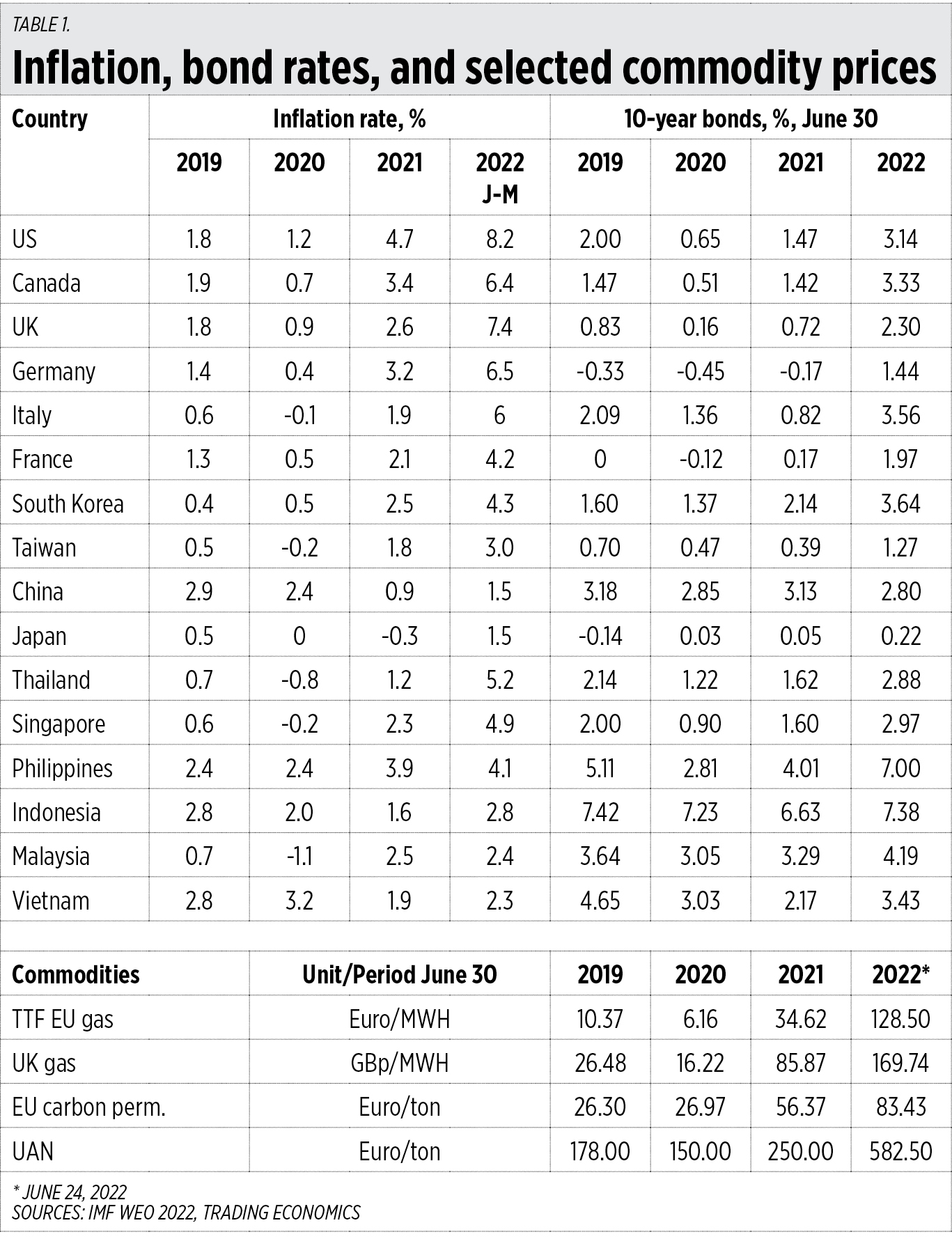
This trend towards high prices of energy, fertilizer, and food in Europe and America is not transitory but for the medium to long-term. There was prolonged, decades-old demonization and under-investment in fossil fuels (oil, gas, coal) and crude oil refineries in the West and it will take at least half a decade of re-investment in fossil fuels to expand output and refineries, especially for diesel, fertilizers, and other petrochemical products.

A big challenge for the Philippines and our ASEAN neighbors is how to attract many American and European companies who will get out of their continents and go to Asia where consumers number in the hundreds of millions, and where inflation rates and electricity prices are not as bad as theirs.

The incoming Ferdinand Marcos, Jr. administration can attract many of these migrating companies from the West — provided we do not do what their governments did: over-taxing and over-regulating fossil fuels, imposing high-priced carbon permits, and under-invest in exploration, extraction and refinery.

In short, avoid or slow down climate-related regulations and taxation. Europe is realizing that now. The threat of power blackouts and high food prices today are much scarier than a hypothetical climate catastrophe 50 or 100 years from now.

LAND TRANSPORTATION WOES
A report by News5 TV and Radyo Singko 92.3 News FM on June 10 showed very long lines of commuters in Metro Manila seeking a ride in jeepneys, vans, and buses. Then a friend who owns a van for hire commented that the last time the Department of Transportation (DoTr) and Land Transportation Franchising and Regulatory Board (LTFRB) issued a van franchise was 2013, that instead of expanding the number of van franchises, they prefer the supply of legal vans to remain small so that the supply of non-franchised vans will naturally increase because of high passenger demand, then apprehend these “colorum” vans which gives space for corruption because the fine can go up to P200,000.

The same LTFRB also restricts and puts a cap on the number of technology-based ride sharing cars and motorcycles. Instead of expanding the number of motorcycle taxis (MCT) and transport network companies (TNCs), the agency restricted the industry to a few favored players. Vans, TNC cars, and MCTs can bring their passengers right to their office buildings so there is no need for them to drive their cars, add to traffic congestion and enduring expensive oil and parking.

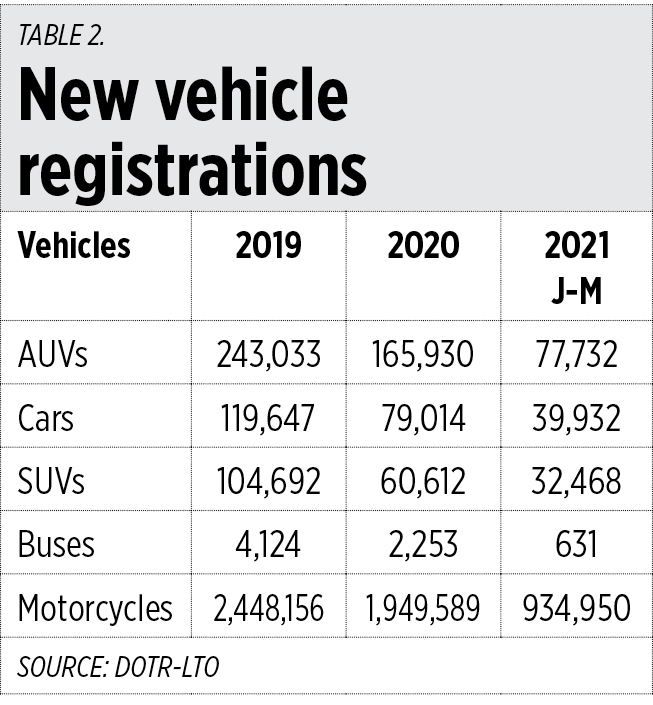
The latest public data from the DoTr Land Transportation Office (LTO) shows that private vehicle registrations in January-March (J-M) this year were almost half of those in the full year of 2020 and about one-third of full year 2019 registrations, but new buses are few (see Table 2). This implies more traffic congestion by cars, SUVs, AUVs and motorcycles, coupled with more commuter woes as they are unable to get faster and comfortable rides.
While the outgoing DoTr leadership can penalize hapless passengers with no vaccination cards in their recent “no vax card, no ride” policy, they cannot control the leadership of the LTFRB, an agency under the DoTr, when it comes to this ongoing practice of restricting the supply of legal vans, TNCs and MCTs.

Good thing that this political class are all leaving by June 30 after inflicting huge damage to the commuting class. I am hoping that the new leaderships of the DoTr, LTFRB, LTO and other agencies will not follow their policies. Transport competition is good for commuters and the country.

More choices, more options in vehicle types, faster mobility at competitive fares. This is what the public needs and I am hoping that the incoming administration will support this public need.

FIBER INTERNET
Good thing that there are many internet companies now in the Philippines that offer fiber optic services. We used to have PLDT DSL internet at home until last year and it could be slow at times. Then we tried Globe broadband pre-paid, and saw that it can be fast but load is easily consumed.

A friend referred me to his friends at Red Fiber, and gave them my mobile number and address. Within an hour I got a call, the lady explained Red Fiber’s internet package and promos to me, then I asked her when they can install our internet. To my surprise, she replied in two days.

We got the 50 Mbps with cable Cignal TV package at P2,399/month. One afternoon all four of us were on streaming. My wife was in a Zoom meeting, I was watching Netflix on the TV, our two girls were watching YouTube/TikTok on their laptops, plus our respective mobile phones were active with Messenger and Viber messages. Streaming was continuous, with no interruption. We are happy. Good service, Red Fiber.

OUTGOING SECRETARIES
The Duterte administration and its Cabinet Secretaries will be leaving this coming June 30. I want to commend two of the business-friendly secretaries.

First, Energy Secretary Alfonso Cusi. He resisted the mandatory energy mix, like 30-30-30-10 for coal-natgas-renewables-oil that his two predecessors imposed. The ones who should set the right energy mix should be the consumers, not the Department of Energy (DoE) or Malacañang, not Congress or the Energy Regulatory Commission (ERC), not the climate activists or media. He also resisted oil price control and reviving the Oil Price Stabilization Fund (OPSF) scheme.

The second is Trade and Industry Secretary Ramon Lopez. He championed the de-bureaucratization of business registration via the Ease of Doing Business law and related policies. He supported stronger intellectual property rights (IPR) to strengthen consumer awareness of product brands. In 2019, I organized a regional conference in Makati on IPR and health innovation in the ASEAN, then co-organized with the Foundation for Economic Freedom (FEF) the global launching of International Property Rights Index (IPRI) 2019. In both international events, I invited Secretary Mon to be the Keynote Speaker, he agreed and came to grace the two events. Thanks again, Secretary Mon.


Bienvenido S. Oplas, Jr. is the president of Minimal Government Thinkers.

minimalgovernment@gmail.com