Home Blog Page 5691

How Halloween parties turned deadly in Seoul’s popular Itaewon district
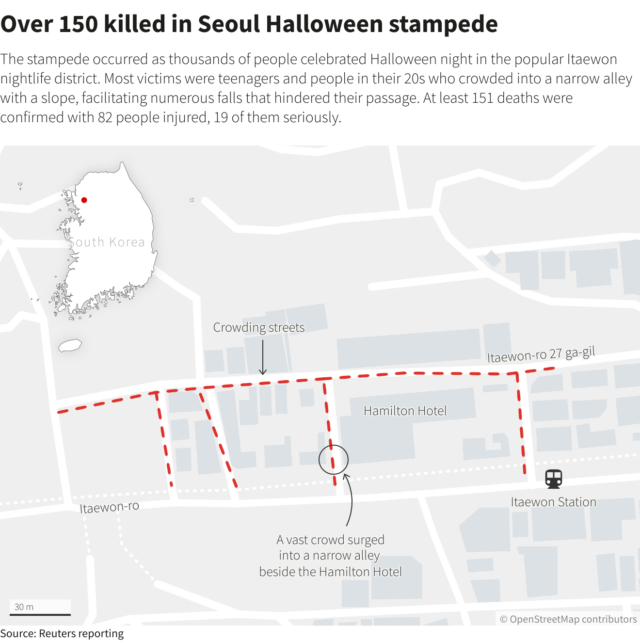
 – Young people flocking to Seoul’s popular Itaewon district on Saturday for the first virtually unrestricted Halloween festivities in three years instead found themselves caught up in a deadly crush that killed at least 153 people.

The crowd of partiers, some still in their teens and many clad in Halloween costumes, was ready to enjoy the bars, nightclubs and restaurants where the revelry routinely spills over into narrow and often steep side streets.

But the intimacy of Itaewon‘s backstreets turned sinister this Halloween weekend.

Twenty-four hours before, there were already warning signs that the festivities were attracting dangerous numbers of people. On Friday night, a Reuters witness saw crowds in the area packed toe-to-toe at a Halloween street fair with booths for face-painting and selling candy and costumes.

A day later those crowds returned.

Officials say there was no single organized event that drew thousands of revellers to the cramped alleyways where so many young people, including at least 22 foreigners, would die.

But social media posts showed nightclubs and bars advertising Halloween events and promotions, including collaborations at some of the hottest clubs for special performances.

Officials are still investigating what prompted the crowd to surge, but witnesses and social media footage showed people squeezing into the streets for several blocks surrounding the alley where many of the deaths would occur.

Just before 10:20 p.m. (1320 GMT), chaos erupted, with police at times struggling to control the crowds, witnesses said.

People poured into one particularly narrow and sloping alley, even after it was already packed wall-to-wall. Social media footage showed some people trying to scale the sides of the buildings to escape the increasing pressure, as others shouted, cried or cursed.

When those at the top of the slope fell, it sent people below them toppling over others, witnesses said.

“We arrived around 10 p.m. to go to a club but then saw people falling on the street,” said Moon Ju-young, 21. “Some were bleeding, others were crying out in pain.”

One student from France, who asked not to be identified because of the trauma of the event, said he became lodged in a crush of people for about an hour and a half.

“I wanted to go to a safe place but it wasn’t possible,” he told Reuters. “I was just pushed by everyone and I just couldn’t do anything.”

He said he came out with chest pain and a hurt ankle, but felt sorry for those who were killed or more seriously injured, as well as the emergency workers who desperately tried to free people.

He felt less sympathetic towards those who continued trying to push their way through the crowd, often complicating the task of rescue workers who told the throng to remain calm and in place.

“I’m upset against them because they pushed everyone and they didn’t realize,” he said.

Videos shared on social media showed a pile of bodies wedged between buildings, some at the bottom appearing unconscious, while others reached out to emergency workers who struggled to free them from the crush.

“A person right next to me fell, but then people behind me continued to push me, then more people fell down and kinda piled up on one another,” said a 30-year old graduate school student from Seoul. “I screamed at people who were pushing me: ‘Don’t push! People fell!'”

One woman said her daughter, pulled from the crush of people, survived after being trapped for more than an hour.

Moon, the young man who witnessed victims on the street, said onlookers appeared to add to the confusion as they sought to help friends.

“There were some people who tried to forcibly cross the police line saying they have friends over there, and they were dragged out by police,” Moon said.


CROWD CONTROL

Authorities had predicted up to 100,000 people would join the festivities, the first without major COVID-19 restrictions since the pandemic began in 2020.

But they said it wasn’t deemed necessary to deploy more officers to the area than usual for a Halloween weekend, which typically also draws TV stations to cover the crowds and colorful costumes. Witnesses said it was hard to detect a major police presence amid the throngs of people.

“Many people gather for Halloween every year but there were just so many last night, incomparably more than before COVID, so I could not identify who are police and who are not among the crowd,” said a woman in her 20s who said she lived in the neighborhood but declined to give her name.

The father of a woman in her 20s who died in the disaster said the city’s preparations for the gatherings were inadequate.

“It was expected that there would be a crowd of 100,000 or more in the Itaewon area this weekend,” he told Reuters as he stood in a Seoul funeral home to collect his daughter’s body.

“I think there was no preparation for this, which led to this disaster.”

Social media footage showed personal belongings and other debris scattered across the site of the incident, with firefighters administering CPR to people lying in the street and police fighting to keep crowds back.

“I managed to escape the scene,” the graduate student said. “But if I’d stayed there just a few more minutes, then I would not have made it out, but would have died there.” – Reuters


US plans to deploy B-52 bombers to Australia’s north-ABC report

 – The United States is planning to deploy up to six nuclear-capable B-52 bombers to an air base in northern Australia, the Australian Broadcasting Corp (ABC) reported on Monday, a move which could further inflame tensions with Beijing.

Dedicated facilities for the bombers will be set up at Australian air force’s remote Tindal base, about 300 km (190 miles) south of Darwin, the capital of Australia’s Northern territory, ABC‘s Four Corners program reported, citing US documents.

Australian Defense Minister Richard Marles’ office did not immediately respond to a request seeking comment.

The United States has drawn up detailed plans for what it calls a “squadron operations facility” for use during the Northern Territory dry season, an adjoining maintenance center and a parking area for the B-52s, the ABC report said.

The ability to deploy the long-range bombers to Australia sends a strong message to adversaries about Washington’s ability to project lethal air power, the US Air Force was quoted as saying in the report.

Australia’s Northern Territory already hosts frequent military collaborations with the United States. Thousands of US marines rotate through the territory annually for training and joint exercises, first started under President Obama.

Earlier this year, the US deployed four B-52s to its Andersen Air Force base in Guam.

Last year, the United States, Britain and Australia created a security deal that will provide Australia with the technology to deploy nuclear-powered submarines, riling China.

Putting B-52s in Australia, that could reach and potentially attack mainland China, will be a warning to Beijing, as fears grow on an assault on Taiwan, Becca Wasser, senior fellow at the Washington, DC-based Centre for a New American Security, told the ABC. – Reuters

U.N., Turkey, Ukraine press ahead with Black Sea grain deal despite Russian pullout

REUTERS

 – The United Nations, Turkey and Ukraine pressed ahead to implement a Black Sea grain deal and agreed on a transit plan for Monday for 16 vessels to move forward, despite Russia’s withdrawal from the pact that has allowed the export of Ukrainian agricultural products to world markets.

Russia, which invaded Ukraine on. Feb 24, on Saturday halted its role in the Black Sea deal for an “indefinite term”, cutting shipments from one of the world’s top grain exporters, because it said it could not “guarantee safety of civilian ships” travelling under the pact after an attack on its Black Sea fleet.

The move has sparked an outcry from Ukraine, NATO, the European Union and the United States, while the United Nations and Turkey, two main brokers of the July deal, scrambled on Sunday to save it.

UN Secretary-General Antonio Guterres was deeply concerned about Russia’s move and delayed a foreign trip to try and revive the agreement that was intended to ease a global food crisis, his spokesperson said.

Following Russia’s move, Chicago wheat futures jumped more than 5 percent on Monday as both Russia and Ukraine are among the world’s largest wheat exporters, analysts said.

More than 9.5 million tons of corn, wheat, sunflower products, barley, rapeseed and soy have been exported since July. Under the deal, a Joint Coordination Centre (JCC) – made up of UN, Turkish, Russian and Ukrainian officials – agrees on the movement of ships and inspects the vessels.

No ships moved through the established maritime humanitarian corridor on Sunday. But the United Nations said in a statement that it had agreed with Ukraine and Turkey on a movement plan for 16 vessels on Monday – 12 outbound and 4 inbound.

It said the Russian officials at the JCC had been told about the plan, along with the intention to inspect 40 outbound vessels on Monday, and noted that “all participants coordinate with their respective military and other relevant authorities to ensure the safe passage of commercial vessels” under the deal.

During Sunday’s session among the grain deal delegations, Russian officials said Moscow will continue the dialogue with the United Nations and the Turkish delegation on pressing issues, the UN said in its statement.

But there was no Russian reaction in response to Monday’s transit plan.

Turkish Defense Minister Hulusi Akar was in contact with his Russian and Ukrainian counterparts to try and salvage the agreement and had asked the parties to avoid any provocation, the Turkish defense ministry said.

NATO and the European Union have urged Russia to reconsider its decision. US President Joe Biden on Saturday called Russia’s move “purely outrageous” and said it would increase starvation. US Secretary of State Antony Blinken accused Moscow of weaponizing food.

On Sunday, Russia’s ambassador to Washington, snapped back, saying the US response was “outrageous” and made false assertions about Moscow’s move.


FALSE PRETEXT’

The Russian defense ministry said Ukraine attacked the Black Sea Fleet near Sevastopol with 16 drones early and that British navy “specialists” had helped coordinate what it called a terrorist attack. Britain denied the claim. Russia said it repelled the attack but that the ships targeted were involved in ensuring the grain corridor out of Ukraine‘s Black Sea ports.

Ukraine has neither confirmed nor denied it was behind the attack. The Ukrainian military suggested that Russians themselves may have been responsible for the explosions.

Ukrainian Foreign Minister Dmytro Kuleba said Moscow used the explosions 220 km (137 miles) away from the grain corridor as a “false pretext” for a long-intended move.

President Volodymyr Zelenskiy’s chief of staff accused Russia on Saturday of inventing attacks on its own facilities.

Ukraine often accuses Russia of using the Black Sea Fleet to fire cruise missiles at Ukrainian civilian targets, a charge supported by some military analysts who say that makes the fleet a legitimate military target.

Russia’s invasion has recently been dominated by a Ukrainian counteroffensive and Russian drone and missile attacks that have destroyed more than 30% of Ukraine‘s generating capacity and hit populated areas. Each side has accused the other of being prepared to detonate radioactive bombs.

Russia asked the UN Security Council to meet on Monday to discuss the Sevastopol attack, Deputy UN Ambassador Dmitry Polyanskiy wrote on Twitter.


SHIPS BLOCKED

The grain deal had restarted shipments from Ukraine, allowing sales on world markets, targeting the pre-war level of 5 million metric tons exported from Ukraine each month.

But ahead of its Nov. 19 expiry, Russia had said that there were serious problems with it and Ukraine complained that Moscow had blocked almost 200 ships from picking up grain cargoes.

The deal ensured safe passage in and out of Odesa and two other Ukrainian ports.

Ukrainian President Volodymyr Zelenskiy accused Russia of wanting to escalate the crisis, saying 218 ships were blocked and waiting to either carry food or enter Ukrainian ports.

A vessel carrying 30,000 tons of wheat chartered by the U.N. Food Program and intended for emergency response in the Horn of Africa was among those near the three Ukrainian ports, according to the UN

“We are ready to release this ship into the sea,” he said, but like other ships with agricultural products, it was being forced to wait, “because Russia is blackmailing the world with hunger,” he said. – Reuters

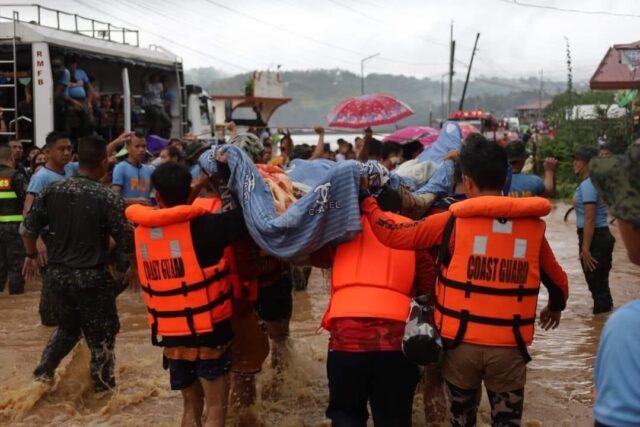
Marcos to inspect storm damage as death toll hits 98

Image via Philippine Coast Guard

President Ferdinand R. Marcos, Jr., is set on Monday to fly over flood-submerged districts to inspect the damage after Tropical Storm Nalgae barreled across the Southeast Asian country over the weekend, killing at least 98 people.

More than half the deaths were recorded in the southern autonomous region of Bangsamoro, often due to rain-induced landslides, the nation’s disaster agency said.

Some 63 people were reported missing, while 69 people were injured, the agency said.

The Bangsamoro region accounted for 53 deaths, with 22 people still missing, it said in a bulletin.

Damage to infrastructure due to heavy rains and strong winds was valued at P757.84 million ($13.07 million), while losses in agriculture were estimated at P435.46 million.

Mr. Marcos is scheduled on Monday to conduct aerial inspections of submerged villages in Cavite province, near the capital Manila. The leader has expressed shock over the number of deaths, particularly in Maguindanao province in Bangsamoro.

Nalgae, which made landfall five times, was expected to leave the Philippines later on Monday and head towards southern China. The Philippines sees an average 20 typhoons a year, with frequent landslides and floods blamed in part on the growing intensity of tropical cyclones. — Reuters


Car bombs at busy Somalia market intersection killed at least 100, president says

 – The two car bombs that exploded at Somalia‘s education ministry next to a busy market intersection killed at least 100 people and wounded 300, President Hassan Sheikh Mohamud said on Sunday, warning the death toll could rise.

Saturday’s attack was the deadliest since a truck bomb exploded at the same intersection in October 2017, killing more than 500 people.

The al Qaeda-linked Islamist group al Shabaab claimed responsibility, saying the ministry was at the center of a “war on minds” that teaches Somali children using a Christian-based syllabus. Members of the security forces were among the dead and injured, its statement emailed to media said.

Al Shabaab, which is seeking to topple the government and establish its own rule based on an extreme interpretation of Islamic law, frequently stages attacks in Mogadishu and elsewhere.

The first of the explosions hit the education ministry at around 2 p.m. on Saturday. The second hit minutes later as ambulances arrived and people gathered to help the victims.

Mohamed Moalim, who owns a small restaurant near the intersection, said his wife, Fardawsa Mohamed, a mother of six, rushed to the scene after the first explosion to try to help.

“We failed to stop her,” he said. “She was killed by the second blast.”

President Mohamud said some of the wounded were in a serious condition and the death toll could rise.

“Our people who were massacred … included mothers with their children in their arms, fathers who had medical conditions, students who were sent to study, businessmen who were struggling with the lives of their families,” he said after visiting the scene.

The K5 intersection normally teems with people buying and selling everything from food, clothing and water to foreign currency and khat, a mild narcotic leaf. But it was quiet on Sunday, with emergency workers still cleaning blood from the streets and buildings.

Somalia‘s international partners condemned the attack and sent condolences to affected families.

White House national security adviser Jake Sullivan said in a statement on Sunday the United States “strongly condemns the tragic terrorist attack” and it remains “committed to supporting the Federal Government of Somalia in its fight to prevent such callous terrorist acts.”

A spokesperson for United Nations Secretary-General Antonio Guterres said in a statement that he “strongly condemns these heinous attacks and reiterates that the United Nations stands in solidarity with Somalia against violent extremism.”

World Health Organization Director-General Tedros Adhanom Ghebreyesus tweeted that his organization was ready to provide support to the government to care for the injured.

“These senseless attacks against innocent civilians including women and children only serve to remind us of the group’s barbarity towards its own people and reveals the true hypocrisy of its intent,” the European Union’s foreign policy chief, Josep Borrell, said in a statement.

The chairperson of the African Union Commission, Moussa Faki Mahamat, urged the international community to “redouble its efforts to ensure robust international support to Somalia‘s institutions in their struggle to defeat terrorist groups”.

With support from the United States and allied local militias, the president has launched an offensive against the group, although results have been limited.

Abdullahi Aden said his friend, Ilyas Mohamed Warsame, was killed while travelling in his three-wheeled “tuk tuk” taxi to see relatives before returning to his home in Britain.

“We recognized the number plate of the tuk tuk, which was now rubble,” Aden said.

“Exhausted and desperate, we found his body at midnight last night in hospital,” he said. “I can’t get the image out of my mind.” – Reuters

Approval of Japan PM Kishida’s gov’t hits new low, no help from economic plan

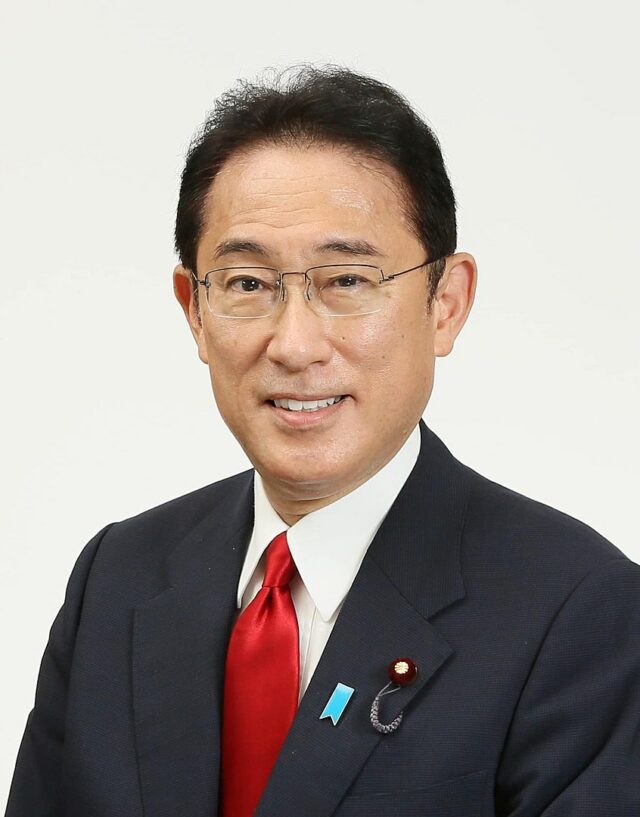
Fumio Kishida, Prime Minister of Japan | source: https://bit.ly/3p7NLDU CC BY 4.0

 – Public approval ratings for the government of Japan‘s Prime Minister Fumio Kishida touched a new low in one opinion poll and clung near lows in another, hit by his party’s ties to a controversial church and doubts about a massive spending plan.

Support slid to 42% in a poll conducted by the Nikkei newspaper at the weekend, the lowest since Kishida took office in October 2021. Approval edged up slightly in a Kyodo news agency survey to 37.6% from 35% at the start of October.

The announcement of a $200 billion economic stimulus package has not helped lift Kishida’s approval ratings significantly, nor has last week’s resignation of economic revitalisation minister Daishiro Yamagiwa for his connection to the Unification Church, whose ties to the ruling Liberal Democratic Party (LDP) are being investigated in connection with the July 8 assassination of former premier Shinzo Abe. Read full storyRead full story

The Unification Church, founded in South Korea in the 1950s and famous for its mass weddings, has been fending off criticism for the means by which it collects donations.

The suspect in Abe’s shooting bore a grudge against the church, alleging it bankrupted his mother, and blamed Abe for promoting it, according to his social media posts and news reports.

The LDP has since acknowledged that many lawmakers had individual ties to the church but said there was no organisational link to the party.

Kishida this month announced an investigation into the church, and 78% of respondents to the Nikkei poll said the government should call on the church to disband. Only 14% opposed such action.

In the Kyodo poll, nearly 80% of respondents thought the LDP should expand its investigation into the church. Asked about the stimulus plan, 71.1% said they did not expect much from it.

At its peak, support for Kishida’s government hovered over 60%. A poll earlier this month showed it had slid to 27.4%, a level low enough to make it difficult to carry out policy. – Reuters

Oct. inflation likely hit 7.2% — poll

A vendor sells vegetables at the Quinta Market in Quiapo, Manila, Oct. 6. — PHILIPPINE STAR/EDD GUMBAN

By Keisha B. Ta-asan, Reporter

INFLATION likely quickened beyond 7% in October amid surging food prices and broadening second-round effects, analysts said.

A BusinessWorld poll of 14 analysts conducted last week yielded a median estimate of 7.2% for the consumer price index (CPI) in October.

If realized, October inflation would be faster than the 6.9% seen in September and the 4% last year. It would also be the quickest pace in over 14 years or since the 7.8% in December 2008 at the height of the global financial crisis.

Analysts’ October 2022 inflation rate estimates

This would also mark the seventh straight month that inflation breached the central bank’s 2-4% target band.   

The Bangko Sentral ng Pilipinas (BSP) is scheduled to release its inflation forecast range for the month today (Oct. 31). The Philippine Statistics Authority will release the official inflation data on Nov. 4. 

Analysts noted that food prices, particularly meat, fish, and vegetables, continued to rise as a result of supply shortages caused by typhoons this month.

“For October inflation, I’m looking at 7%, driven by food prices as the recent typhoon Karding and current rain conditions have seen some supply tightness in food and food logistics challenges,” Sun Life Investment Management and Trust Co. economist Patrick M. Ella said in an e-mail.   

Agricultural damage due to Super Typhoon Karding (international name: Noru) reached P3.12 billion, while damage due to Tropical Depression Maymay and Typhoon Neneng stood at P594.02 million.

“Storm damage recently could have led to some temporary increase in the prices of food and other agricultural commodities, as well as on overall inflation, until supply chains normalize,” Rizal Commercial Banking Corp. Chief Economist Michael L. Ricafort said.

ING Bank N.V. Manila Senior Economist Nicholas Antonio T. Mapa said the follow-through price increase for food items likely pushed inflation beyond 7% in October.

“Transport fare adjustment also kicked in by October while pump prices increased for two weeks after successive price drops. We expect inflation to peak in November then only gradually decelerate going into 2023,” Mr. Mapa added.

Traditional and modern jeepneys recently raised the minimum fares to P12 and P14, respectively. Ordinary passenger buses also hiked the minimum fare to P13.

In October alone, oil companies increased pump prices for gasoline by P0.50 per liter, diesel by P8 per liter, and kerosene by P4.25 per liter, data from the Energy department showed.   

ANZ Research economist Debalika Sarkar said in an e-mail that lower electricity rates may have provided partial relief for consumers.

Manila Electric Co. lowered the overall electricity rate by P0.0737 per kilowatt-hour (kWh) to P9.8628 in October.

Also, the continued weakness of the peso may have fueled inflation as it made imports more expensive, Colegio de San Juan de Letran Graduate School Associate Professor Emmanuel J. Lopez said.   

“In our view, the pace of inflation will continue since the second-round impact of the global commodities increases and impact of the depreciating value of the peso against the US dollar will likely still be felt in the near term,” Philippine National Bank economist Alvin Joseph A. Arogo likewise said.   

The peso traded around P58 to P59 per dollar this month. It went back to the P57 level when it closed at P57.97 on Friday.

In October alone, the peso has strengthened by P0.655 or 1.13% from its Sept. 30 close of P58.625.

“Basic commodities prices also followed the upward trend in anticipation of the holiday season,” Mitzie Irene P. Conchada, an economist from De La Salle University, said.   

IS THE PEAK NEAR?
China Banking Corp. Chief Economist Domini S. Velasquez said inflation may likely peak this month. 

“Key risks would include the inability of the government to address current and potential shortages and possible increase in electricity rates. The proposed increase in water tariffs next year might push up 2023 average inflation above the high-end target of BSP after averaging by an estimated 5.6% this year,” Ms. Velasquez said.

Manila Water Co., Inc. has proposed a rate increase of P20 per cubic meter from 2023 to 2027.

“Although it seems like inflation is approaching its peak, it is still a long way from gravitating back into the official 2-4% target range,” ANZ Research’s Ms. Sarkar said.

Noting the strong domestic demand and volatility in the foreign exchange market, Ms. Sarkar said she expects the BSP to continue hiking rates until the second quarter of 2023.

“Our 2022 and 2023 year-end policy rate forecasts are 4.75% and 5.25%, respectively,” she added.   

The Monetary Board has so far raised 225 basis points (bps) to 4.25% since May.

“BSP has communicated clearly that it would like to match Fed point by point. Given our outlook for a 75-bp rate hike by the Fed in November and a 50-75 bp rate hike in December, expect that BSP can raise rates to 5.5-5.75% by yearend,” ING’s Mr. Mapa said.   

BSP Governor Felipe M. Medalla said last week the BSP may have to respond to the US Federal Reserve point by point to tame inflation and slow down the peso’s depreciation.   

He said the Monetary Board may hike by 75 bps at its next rate-setting meeting on Nov. 17 if the US central bank delivers its fourth 75-bp rate increase on Nov. 1-2. 

Digital economy contributed P1.9T to GDP in 2021

A WOMAN in a remote meeting via videoconference works from her living room. — REUTERS

THE DIGITAL ECONOMY contributed 9.6% to the country’s gross domestic product (GDP), an equivalent of P1.87 trillion in 2021, according to the Philippine Statistics Authority (PSA).

PSA data showed the digital economy in absolute terms grew by 7.8% or P134.754 billion last year from P1.735 trillion in 2020.

The country’s digital transactions have yet to recover to the pre-pandemic level of P1.955 trillion in 2019.

As a percentage of GDP, the digital economy has been on a decline since 2018 when it stood at 10.1%. It dipped to 10% in 2019 and dropped to 9.7% in 2020.

According to the PSA, the digital economy covers digital transactions such as e-commerce and online media/content.

The sector’s gross value-added (GVA) expanded by 7.8%, a reversal of the 11.3% contraction in 2020, and higher than the 6.1% GVA growth in 2019.

All sub-components posted growth, reversing the decline seen in 2020. Digital media and content grew by 10.3%, from a 10.8% contraction in 2020. E-commerce rose by 8.2% (-31.4% in 2020), while digital-enabling infrastructure expanded by 7.6% (-5.2% in 2020).

Digital-enabling infrastructure contributed 79.6% or P1.488 trillion to the economy, slightly lower than the 79.7% share in 2020. This sub-component covers computers, electronic products, telecommunications services, among others.

E-commerce’s share to the economy was unchanged at 17.6% (P329.675 billion) in 2021, while digital media/content’s share stood at 2.8% (P51.473 billion), up from 2.7% in 2020.

PSA data showed an 11.6% rise in the number of Filipinos employed in the digital economy to 5.59 million in 2021, from 5.01 million in 2020.

Broken down, 77% or 4.3 million were employed by companies involved in digital-enabling infrastructure, followed by e-commerce with 20.7% or 1.157 million, and digital media/content with 2.4% or 135,486.

UnionBank of the Philippines, Inc. Chief Economist Ruben Carlo O. Asuncion said the return to office of many workers may have partly contributed to the dip in the digital economy last year.

“I think it did play a role. Nevertheless, the difference is marginal and that people will continue to go digital in a lot of ways,” he said in a Viber message.

In the latest e-Conomy Southeast Asia Report 2022 by Google, Temasek, and Bain & Co., the Philippines’ digital economy is seen to reach a gross merchandise value (GMV) of $35 billion by 2025, from $20 billion this year.

The country’s overall digital economy is expected to hit a GMV of $100-150 billion by 2030, according to the report. 

“As long as the economy will robustly grow and grow higher than historical average (6%), I believe the projected growth are within reach. There seem to be an economic slowdown next year, but succeeding years may see the economy going back to average growth,” Mr. Asuncion said. — Bernadette Therese M. Gadon

Private schools bleed with exodus of students, teachers into public education

PHILIPPINE STAR/ WALTER BOLLOZOS
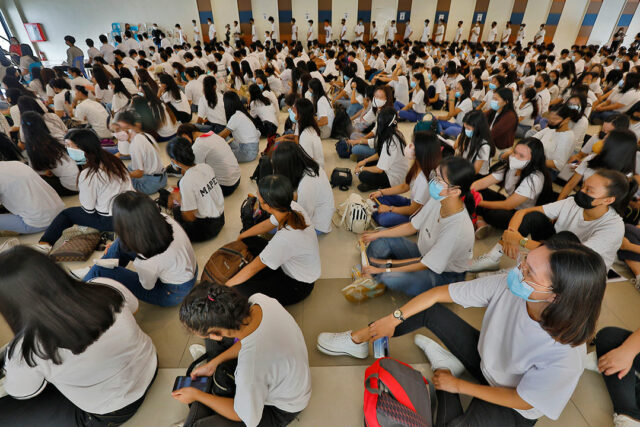
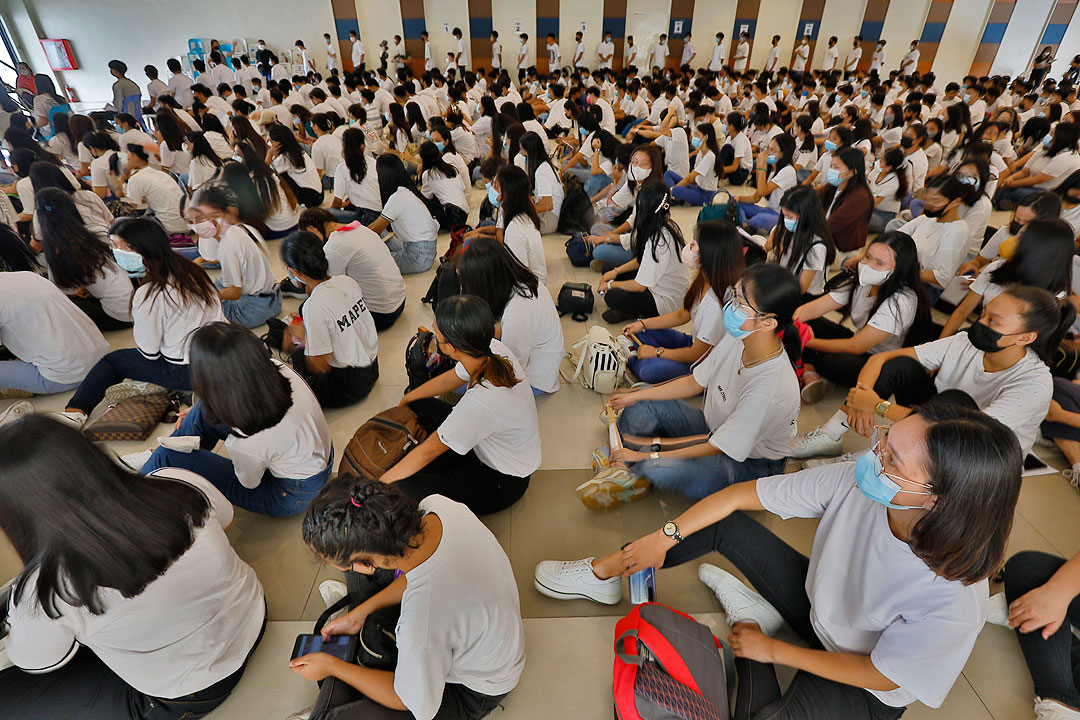
Students attend an event at Parang High School in Marikina City. The Education department said a quarter-million students moved from private to public schools in 2020 and 2021. — PHILIPPINE STAR/ WALTER BOLLOZOS

By Arjay L. Balinbin, Senior Reporter

NADINE CHANTALLE V. PONCE, 22, was an incoming third-year broadcasting student at the Colegio de San Lorenzo near the Philippine capital when it suddenly shut down amid a coronavirus pandemic. 

“We were all caught off guard,” she said by telephone. “My brothers and I grew up in that school. Teachers there were like family, so it was tough for me to accept that it had to end that way.” 

It was among the 425 private schools that have permanently closed since 2020, according to the Education department. About half of their 21,000 private school students have transferred to public schools where tuition is free.

St. Joseph Academy of San Jose, Northern Samar, Inc. in the Eastern Visayas Region also shut down its kindergarten department due to lack of enrollment. 

A quarter-million students moved from private to public schools in 2020 and 2021, according to the Education department, as many parents lost their jobs.

This seems to be the opposite of what’s happening in western countries including the United States where many parents increasingly sought out, regardless of the price tag, independent schools that offered physical rather than remote classes as the coronavirus crisis raged on, CNBC reported last year.

Reports of significant academic learning loss in school districts underscored concerns about the toll that virtual learning has had on education at every level. Private schools, which generally have larger campuses, smaller classes and greater autonomy, often demonstrated more flexibility when it came to reopening, it said.

As a result, families managed to send their children to school in person, alleviating the burden on parents and, in many cases, allowing them to go to work or pursue employment opportunities from home.

Filipino students who enrolled this year rose to 28.04 million from 27.23 million last year when physical classes were still banned.

The exodus of teachers from private to public schools, where the pay is said to be higher, had also spurred the closure of many independent schools, education specialist and school owner Elna Leah L. Fonacier said. 

“A large number of private school teachers have transferred to public schools because of the attractive salary offer, which is triple the price offered by small private schools,” she said in a Facebook Messenger chat. 

Big private schools offer an average monthly salary of P18,000, while the smaller ones pay P8,000 to 12,000, compared with a P25,000 starting salary offered by government schools, she said.

Private school closures could well have worsened the country’s joblessness during the pandemic.

Almost 2.7 million Filipinos were jobless in August, 79,000 more than in July, though 1.2 million down from a year earlier, according to the local statistics agency.

Ms. Fonacier said private schools have also found it hard to comply with the Department of Education’s (DepEd) pandemic school safety requirements for face-to-face classes.

The DepEd said it would allow private schools to continue offering online classes beyond Nov. 2, revising an order that would have forced them to enforce five days of face-to-face classes by next month.

“DepEd is cognizant of the current situation of the private sector due to the impact of the COVID-19 pandemic — the amount of investment in online learning technologies, the development and institutionalization of best practices on blended learning, and the unfortunate closure of small private schools because of losses,” it said in a statement.

School closures affect communities socially and economically, according to the United Nations Educational, Scientific and Cultural Organization (UNESCO).

Disruptions worsen disparities within the education system and result in interrupted learning, poor nutrition, gaps in childcare, rise in dropout rates and high economic costs, it added.

The Philippines had a learning poverty rate of 91% and a learning deprivation rate of 90.4%, among the highest in Southeast Asia, according to a 2022 report by the World Bank. 

Private school closures have also limited the choices of parents and students to access the “distinct education services that they provide,” University of the Philippines Diliman College of Education Dean Jerome T. Buenviaje said in an e-mailed reply to questions.

There were 47,144 public schools and 14,425 private schools before the pandemic, he pointed out. Out of 2,418 higher education institutions as of 2021, there were 1,734 private compared with 684 institutions under the Commission on Higher Education, he added.

The figures show that the quality of graduates joining the Philippine labor force is highly dependent on the private school sector, he said.

“The closure of private schools means fewer graduates that could join the labor sector,” Mr. Buenviaje said. “If this trend goes on, the government would have to establish more schools or further strengthen their existing programs, which would mean additional funding.”

LEARNING ‘TRAP’
Mr. Buenviaje also said it would take time for such changes to take place “while the demand for quality graduates joining the labor force continues.”   

The government should work with stakeholders to save private schools from collapse because they play a vital role in the country’s education system, he said.

Increasing teachers’ salaries could persuade them to stay. The state could also grant private institutions wage subsidies, Ms. Fonacier said.

“Tax relief for private schools will never be enough though it’s an initial reform to consider,” Mr. Buenviaje said.   

Under the law, private schools are eligible for a temporary 1% tax from July 2020 to June 2023, after which the rate will go back to 10%.

“To save private schools from collapse, there are existing policies abroad that support the sustainability of the private education sector through government funding,” Mr. Buenviaje said. “These models can be reviewed and adopted if they are suitable in our context and existing laws.”

“Congress can also pass a bill expanding the coverage of voucher programs for primary education and increase the voucher allocations for the tertiary level under the tertiary education subsidy fund or through other programs,” Anthony Jose M. Tamayo, chairman of the Coordinating Council of Private Educational Associations of the Philippines, said in an e-mail.

“Students will have the chance to go to their private schools of choice if the voucher system will be expanded to the tertiary level,” he said. It’s also better if the college voucher system has fewer restrictions so that more students can go to private schools.     

More students going to private schools also means savings for the state, Mr. Tamayo said. “They don’t have to build additional classrooms and private schools can help in decongesting public schools.”   

“Expanding productive engagement between the government and private education sector can help in getting the country out of the low learning proficiency trap.”

Ms. Ponce, the third-year broadcasting student, said schools should be more transparent to parents and students about their financial situation.

“Maybe we could have done something,” she said. “For us, it’s not just about the education, it’s the family that we’ve built inside the school.”

NG gross borrowings decline as of end-Sept.

BW FILE PHOTO

THE NATIONAL Government’s (NG) gross borrowings from January to September dropped by 28%, preliminary data from the Bureau of the Treasury (BTr) showed.

Total gross borrowings stood at P1.87 trillion as of end-September, lower than the P2.6 trillion a year earlier.

In the January to September period, gross domestic borrowings fell 27.4% to P1.52 billion.

The government raised P878.25 billion from retail Treasury bonds (RTBs), and P930.38 billion from fixed-rate Treasury bonds (T-bonds).

External gross borrowings declined 31.7% to P345.96 billion in the nine-month period.

In September alone, gross borrowings more than doubled to P488.64 billion, from P215.11 billion a year ago.

Domestic gross borrowings almost tripled to P480.48 billion in September, from P166.95 billion a year ago.

There was a net redemption of Treasury bills (T-bills) worth P19.97 billion in September. The government raised P80 billion in fixed-rate T-bonds during the month.

On the other hand, gross foreign borrowings slid 83% to P8.17 billion in September, which consisted only of project loans.

The government repaid P18.77 billion to foreign creditors during the month.

The government borrows from domestic and foreign sources in order to fund a budget deficit capped at P1.65 trillion this year, equivalent to 7.6% of gross domestic product (GDP).

The NG outstanding debt stood at P13.02 trillion at end-August, up 11.8% year on year.

As of end-June, the country’s outstanding debt as a share of GDP stood at 62.1%. — L.M.J.C. Jocson

Property sector seen to slow down on higher rates

REUTERS

THE property sector is expected to slow down next year because of incoming stock coupled with higher interest rates and commodity prices, Jones Lang Lasalle (JLL) said.

JLL Philippines Head of Research and Consultancy Janlo de los Reyes said that the office segment would move slower next year as new work spaces enter the market.

“We have a significant volume of stock coming in not only for the fourth quarter but also for 2023. We have 326,000 sq.m. that’s coming in the fourth quarter and if you will add that to the future stock, that’s going to bloat up what we have here,” Mr. De los Reyes said in a chance interview last week.

In the third quarter, the office market added 61,500 sq.m. of new space, bringing the total stock to 10.36 million sq.m.

Mr. De los Reyes expects the new office developments from the fourth quarter onwards to pull up the vacancy rate amid a weaker leasing volume and weaker leasing demand.

“So, we might see vacancy increase to around 17.5% to 18% or even north of that depending on what the volume of take-up we will see next year,” he added.

Meanwhile, Mr. De los Reyes said that the residential market is expected to slow down next year due to higher interest rates.

“I think residential will also slow down [and] the reason is that we think the interest rates will catch up now and will impact demand coming from consumers and buyers,” he said.

“I think the upscale and luxury market will continue to grow because they have the financial muscle or financial flexibility and are able to weather this pandemic,” he said, adding that higher interest rates will particularly hit the mid-scale market.

Mr. De los Reyes said that for the residential market, big developers are expected to be more resilient in facing the economic climate.

“They would be able to fund launches and the new projects that they have compared to boutique or small developers, which have limited cash to play with in terms of developing the projects,” he said.

Meanwhile, retail and hotel segments are expected to pick up in the fourth quarter this year on seasonal demand.

“I think for [the] fourth quarter, you’d see that it’s going to improve given the seasonality of demand,” Mr. De los Reyes said.

However, he said the property market’s performance will depend on how cases of the coronavirus disease 2019 (COVID-19) are contained.

“We’re seeing more foot traffic in terms of the malls and I think that will continue assuming that there is no significant surge or there will be no significant development on COVID-19,” Mr. De los Reyes said.

“But even if there were, I think we’ll have less restrictions now so it’s not as restrictive as before,” he added.

Mr. de los Reyes said that inflation could also affect the hotel and retail segment, as prices are expected to go higher.

“Also with inflation soaring, I think the non-essentials will be hit … but likely it’s still going to be resilient and stable now that we’ve opened the borders,” he said.

He said spending might be curbed because of inflation, “but I think it will be felt by 2023.”

“Overall, I think developers are still quite optimistic in terms of the retail market given that the market has been stabilizing,” he added. — Justine Irish D. Tabile

Alternergy taps foreign partner for wind project

ALTERNERGY Holdings Corp. has entered into a partnership with a foreign company for its Calavite Passage offshore wind project, a company official said last week.

“For the (Calavite) offshore project, there is already a definitive agreement for the partnership. We already executed a shareholders’ agreement with that company,” Alternergy’s Vice President and General Counsel Janina A. Bonoan told BusinessWorld in an interview.

Ms. Bonoan declined to identify the foreign company.

Vicente S. Pérez, Jr., chairman of Altenergy, said in a media release earlier in October that the power company received inquiries from foreign companies on renewable energy (RE) after the legal opinion of the Department of Justice that RE investments are not subject to foreign ownership restrictions.

The Calavite Passage offshore wind farm is among Alternergy’s renewables projects that are under early-stage development. It is located in Occidental Mindoro and has a potential capacity of 1,000 megawatts (MW).

“We have currently a 100% [ownership] of that (Calavite) project, but as I have said, we have a partner coming in,” she said, adding that “we are not at liberty to disclose it as of the moment.”

Ms. Bonoan said that Alternergy’s 28-MW-direct current Solana solar power project in Hermosa, Bataan is also among the company’s projects that are getting inquiries from foreign RE companies.

“For Solana, we also have foreign companies interested in developing Solana,” she said.

The construction of the Solana project is set to begin by the first quarter of 2023. The solar farm is expected to start operation by the last quarter of 2023.

Earlier in October, the Department of Energy (DoE) said foreign ownership restrictions on investments in the RE sector might be eased following the legal opinion of the Justice department. The move is expected to bring more foreign investments in RE projects.

“What’s good for the industry is also good for Alternergy and we think that opening up RE to foreign capital is good for the industry to reach our target to increase RE share,” Ms. Bonoan said.

Under the DoE’s National Renewable Energy Program, the government is targeting to increase the share of renewables in the power generation mix to 35% by 2030 and to 50% by 2040. — Ashley Erika O. Jose

ADVERTISEMENT
ADVERTISEMENT