Home Blog Page 5689

Trina Solar aims to supply more local groups

CHINESE company Trina Solar Co., Ltd. targets to partner with more Philippine companies for its solar modules, a company official said.

“We have a lot of partners in the Philippines to supply solar modules to local companies,” Todd Li, president of Trina Solar Asia-Pacific, said in a Viber message on Oct. 26.

Mr. Todd said that Trina Solar will be supplying solar modules to at least nine outlets of KFC Philippines, under Ramcar Food Group. In September, the company said it supplied solar modules to local companies under Ramcar.

The solar manufacturer also supplies modules for the 94-megawatt-peak solar project of Aboitiz Power Corp. in Pangasinan which is expected to be completed by the fourth quarter of 2022.

In a media release, Trina Solar said that KFC Philippines continues to ramp up its efforts toward more sustainable and environment-friendly operations with the installation of solar power systems.

Earlier, Trina Solar said that it sees the solar market thriving in the Philippines, as installing rooftop solar allows companies to meet rising electricity needs.

The Department of Energy is targeting to increase the share of renewable energy in the country’s power generation mix to 35% by 2030 and to 50% by 2040. — A.E.O. Jose

Climate activists glue themselves to dinosaur exhibit at Berlin museum

BERLIN — Two women glued themselves to the handrails around a dinosaur exhibit at Berlin’s Natural History museum on Sunday in the latest protest by climate activists, calling on the German government to scale up measures to fight climate change.

The two activists glued themselves to the handrails around the skeleton of a dinosaur that lived millions of years ago, holding a banner that read: “What if the government doesn’t have it under control?”

“The dinosaurs became extinct because they couldn’t withstand the massive climate changes. The same threatens us,” said Caris Connell, one of the women, aged 34.

The Last Generation group, which was behind the protest, said Germany must cut emissions immediately to stop mass extinction of species and called on Berlin to impose a speed limit on motorways.

The Germany government has set CO2 reduction targets to become carbon neutral by 2045 but has not set a speed limit on the country’s motorway network.

The protest continued for 20 minutes until police arrived. Releasing the women from the handrails took another 40 minutes.

The Natural History Museum said it had filed a criminal complaint for trespassing and property damage. — Reuters

Dovish FOMC to cause traders to scramble

FOR MONTHS, investors have been eagerly awaiting a US Federal Reserve policy pivot. But now, at least for some, it might come too soon.

The latest MLIV Pulse survey suggests that if the Fed Chair Jerome H. Powell gives any dovish signals during this week’s press conference, he might send investors scrambling.

Almost half of 250 respondents polled last week said they were buying the dollar ahead of the Nov. 1-2 Federal Open Market Committee (FOMC) meeting, and about 78% expected two-year Treasury yields to go up. These bets, which worked out well through the Fed’s aggressive tightening, could go sour if Mr. Powell suggests a step down toward a 50-basis-point (bp) rate increase in December, or quarter-point moves to finish off the Fed’s hiking cycle in early 2023.

The Fed is projected to raise rates by 75 bps on Nov. 2 as it wages its battle against relentless inflation. The aggressive tightening campaign, threatening to push the US into recession, has left Treasuries on pace for their worst annual decline on record and stocks for the biggest losses since 2008. To be sure, rising hopes of a dovish signal allowed for recovery of some of the losses last week.

As for the survey respondents, many are neither buying the short nor the longer end of the Treasury yield curve in advance of the Fed meeting. More than 60% of survey participants see the Bloomberg Dollar Spot Index higher a month from now.

That suggests potential for a major reaction in the currency and fixed-income markets on any strong signal of deceleration in rate hikes.

“The data does warrant a Fed pause,” Alec Young, chief investment strategist at MAPsignals, said in an interview. “Markets are hoping for that, and would rally if we actually get that — because there’s still a lot of skeptics.”

Recent moves by Fed peers suggest a dovish surprise isn’t impossible. The Bank of Canada and Reserve Bank of Australia each raised their benchmark rates by less than economists and traders had expected at their most recent policy meetings. The European Central Bank was also perceived by investors to have been less aggressive.

Some traders have seen enough to attempt front-running a softening in the Fed’s hawkish tone. The dollar is on pace for its first monthly decline since May and stocks have risen from their lows of earlier this month, despite disappointing earnings from a number of technology giants.

“If the Fed gives us a 50-basis-point rate hike in December, there is going to be a relief rally in the market,” Nicole Webb, SVP and financial advisor at Wealth Enhancement Group, said in an interview.

Mr. Powell will likely seek to keep his options open for December, according to Morgan Stanley economists led by Ellen Zentner. While some data point to further weakness in the economy, inflation remains historically elevated. Haunted by the lessons of the past and faulted for being too late on tackling price pressures, Mr. Powell has been reluctant to pin hopes on forecasts for inflation to ease and therefore warrant taking the foot off the pedal.

As borrowing costs rise and the ensuing economic downturn eats into profits, distress and a pickup in default rates in credit markets are emerging as a top concern for investors, according to 54% of respondents. Stress in corporate debt supersedes worries about liquidity strains in Treasuries, which have approached 2020 crisis levels after a year of steep losses for bonds, raising concerns about market functioning.

Shelved leveraged-buyout financings, plunging issuance and surging yields have recently raised fears of dysfunction in corporate bonds. Asia has suddenly come back in focus as more cracks opened up. The outlook for defaults looks grim. Growing concerns about credit — long seen as a canary in the coalmine for recession — would only add to expectations for a Fed pivot. — Bloomberg

Stemming the silent diabetes epidemic

PXHERE.COM

Long before the coronavirus disease 2019 (COVID-19) pandemic, a silent epidemic of diabetes was causing blindness, lower limb amputation, kidney failure, heart attack, stroke and death among hundreds of millions of people. Worse, the prevalence of diabetes continues to increase globally.  

Together with cardiovascular diseases, hypertension, cancers, and chronic respiratory diseases, diabetes is one of the world’s four major noncommunicable diseases (NCDs), presenting a major threat to global health.  

Today, an estimated 537 million adults around the world are living with diabetes, according to the 10th edition of the International Diabetes Federation (IDF) Diabetes Atlas. Four in five adults (80%) with diabetes live in low- and middle-income countries (LMICs), including almost 4 million Filipino adults. This number is predicted to rise to 643 million by 2030 and 783 million by 2045. Nearly 1 in 2 people who have diabetes are undiagnosed. Diabetes was responsible for 6.7 million deaths in 2021 — 1 every 5 seconds. It cost at least $966 billion in health expenditure — a 316% increase over the last 15 years.  

Diabetes is a chronic disease that occurs either when the pancreas does not produce enough insulin (hormone that regulates blood sugar) or when the body cannot effectively use the insulin it produces, a condition known as insulin resistance.  

Diabetes in its early stages is often asymptomatic. When symptoms do occur, these may include increased thirst and urination, increased hunger, fatigue, blurred vision, numbness or tingling in the feet or hands, sores that do not heal, and unexplained weight loss. Some people do not find out they have the disease until they have diabetes-related health problems, such as blurred vision or heart trouble. If you experience these symptoms, consult your doctor immediately.   

There are two types of diabetes, type 1 and type 2. The most common form is type 2 diabetes. One is more likely to develop type 2 diabetes if you are not physically active and are overweight or obese. Extra weight sometimes causes insulin resistance and is common in people with type 2 diabetes. Other risk factors include being 45 or older, a family history of diabetes, high blood pressure, and a low level of HDL (“good”) cholesterol or a high level of triglycerides.   

The good news is there are steps to lower one’s risk of developing diabetes. If one is overweight, it is best to shed the excess pounds and keep these off. A person may be able to prevent or delay diabetes by losing 5%–7% of their starting weight. For instance, if a person weighs 200 pounds, the goal would be to lose about 10–14 pounds. A person may get at least 30 minutes of physical activity or talk to a doctor about the best exercise regimen. Eat a high-fiber, low-fat diet rich in fruits, vegetables, and fish. Eat smaller portions and drink water instead of sweetened beverages.  

To improve access to diabetes care in LMICs, there is a need to provide increased and sustained financing for diabetes prevention and care; enact fit-for-purpose regulatory approval frameworks and policies to ensure the right products are readily available; establish or strengthen existing supply chain infrastructures; provide healthcare professionals with the right tools and training for the prevention, diagnosis and control of the disease; and finally, empower people with quality information so they can better manage their condition.  

In April 2021, the World Health Organization (WHO) launched the Global Diabetes Compact to unite stakeholders across sectors, including people living with diabetes, to shape a common agenda and drive action toward improved solutions to diabetes treatment and care in LMICs.  

The biopharmaceutical industry committed to collaborate with WHO, governments, civil society, health system stakeholders, and other private sectors to scale up existing initiatives and explore new collaborative models.   

The biopharmaceutical industry is likewise involved in numerous partnerships on the ground, focusing its efforts on disease awareness and prevention, diagnosis, treatment, and control. They are also engaged in several collaborations for the prevention, timely testing and diagnosis, access to medicines, and management of patients on a course of treatment for diabetes.  

But the work is not yet done. At present, there are more than 160 medicines in development to manage diabetes and related conditions to help save lives.   


Teodoro B. Padilla is the executive director of the Pharmaceutical and Healthcare Association of the Philippines (PHAP), which represents the biopharmaceutical medicines and vaccines industry in the country. Its members are at the forefront of research and development efforts for COVID-19 and other diseases that affect Filipinos. 

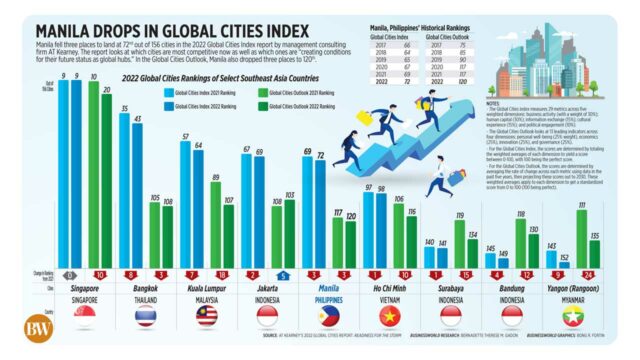
Manila drops in Global Cities Index

Manila fell three places to land at 72nd out of 156 cities in the 2022 Global Cities Index report by management consulting firm AT Kearney. The report looks at which cities are most competitive now as well as which ones are “creating conditions for their future status as global hubs.” In the Global Cities Outlook, Manila also dropped three places to 120th.

Manila drops in Global Cities Index

Cautious trade seen ahead of Fed meet, inflation

REUTERS

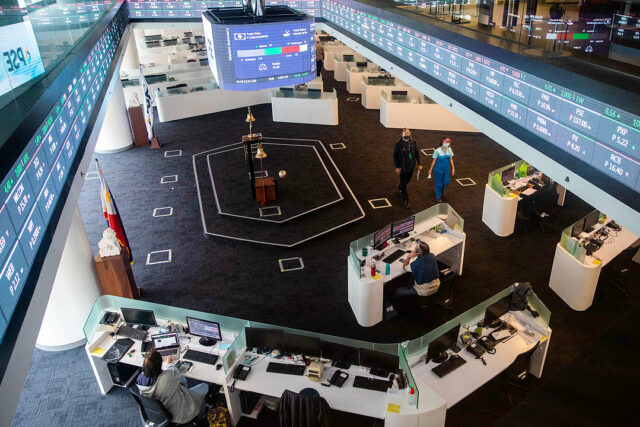
PHILIPPINE STOCKS will be range-bound as trading resumes this week ahead of the release of October inflation data and the US Federal Reserve’s policy meeting.

On Friday, the benchmark Philippine Stock Exchange index (PSEi) went down by 77.15 points or 1.23% to finish at 6,153.43, while the broader all shares index declined by 25.09 points or 0.76% to end at 3,257.29.

Still, week on week, the PSEi climbed by 169.87 points or 2.84% from its close of 5,983.56 on Oct. 21. 

China Bank Securities Corp. Research Director Rastine Mackie D. Mercado said in an e-mail that the PSEi went down on Friday on selling pressure as investors pocketed their gains after the market’s four-day rally.

“The index capped four straight days of gains with profit taking. The index surged throughout the week as sentiment got a boost from a strong start to the third-quarter earnings season, a Fed official’s pronouncement, which raised prospects of a scaling back in the pace of future rate hikes, and the peso’s strength against the greenback,” Mr. Mercado said in an e-mail on Friday.

The Fed has raised rates by 300 basis points (bps) since March and is expected to deliver a fourth straight 75-bp hike in its Nov. 1-2 meeting before considering slower increases by December.

Meanwhile, the peso closed at an over one-month high of P57.97 on Friday, rising by 25 centavos from its P58.22 finish on Thursday and by 78 centavos from its P58.75-per-dollar close on Oct. 21. 

For this week, Mr. Mercado said the Fed’s meeting and the release of October Philippine inflation data will drive sentiment.

The Bangko Sentral ng Pilipinas on Monday gave a 7.1% to 7.9% estimate for October headline inflation amid higher food prices and transport fares.

The Philippine Statistics Authority will release October inflation data on Nov. 4.   

First Metro Investment Corp. Research Head Cristina S. Ulang said investors are awaiting the result of the Fed’s policy meeting.

“If Fed signals a pivot to slower hikes, it will be cheered by the local market,” Ms. Ulang said in an e-mail on Friday. “A key risk is if the Fed surprises by more than 75 bps, which can trigger further profit taking.”

“The PSEi is likely to be range-bound in the coming week. Volatility may only resume Wednesday given the market’s two-day absence in light of the holiday,” COL Investment Management, Inc. President Marvin V. Fausto said in an e-mail on Friday.

Local financial markets were closed on Monday and Tuesday in observance of public holidays.

“The recent recovery in the peso should provide tailwind for local equities to be more buoyant, so long as it remains at the P58 level or lower,” he added.

First Metro Investment’s Ms. Ulang placed the PSEi’s support and resistance at 5,700 and 6,300, respectively, while COL Investment Management’s Mr. Fausto put support at 6,080 and resistance at 6,200. — A.E.O. Jose

Peso may weaken anew vs the dollar as large Fed hike looms

BW FILE PHOTO

THE PESO may decline anew against the dollar this week on expectations of another large rate increase from the US Federal Reserve at their monetary policy meeting.

The local unit closed at P57.97 on Friday, strengthening by 25 centavos from its P58.22 finish on Thursday, data from the Bankers Association of the Philippines showed.

This was the peso’s best close in over a month or since it finished at P57.48 a dollar on Sept. 20.

Week on week, the peso climbed by 78 centavos from its P58.75-per-dollar close on Oct. 21.

The peso opened Friday’s session at P58.30 per dollar. Its weakest showing was at P58.35, while its intraday best was at P57.82 versus the greenback.

Dollars exchanged dropped to $912.35 million on Friday from $1.077 billion on Thursday.

Philippine financial markets were closed for public holidays from Oct. 31 to Nov. 1.

Rizal Commercial Banking Corp. Chief Economist Michael L. Ricafort attributed the peso’s climb on Friday to an increase in remittances from overseas Filipino workers ahead of the long weekend.

MUFG Global Markets Research Currency Analyst Sophia Ng said the peso appreciated week on week on expectations of slower Fed hikes by next month.

“The peso’s 1.3% rebound against the dollar last week was its strongest weekly gain since the week ended July 29. This was mainly driven by dollar weakness as markets pared back expectations of Fed rate hikes in the near term, as well as exceptionally hawkish rhetoric by the authorities,” Ms. Ng said.

The dollar posted losses towards the end of last week due to expectations that the Fed could consider smaller interest rate hikes by December following dovish comments from some officials and weak data that indicated a slowing US economy.

Meanwhile, Bangko Sentral ng Pilipinas (BSP) Governor Felipe M. Medalla last week said the Philippine central bank could match the Fed’s rate hikes point by point to support the peso and prevent its depreciation from adding to inflation risks.

He said the Monetary Board may raise benchmark interest rates by 75 basis points (bps) at their Nov. 17 meeting if the Fed delivers a hike of the same magnitude at their Nov. 1-2 review.

“We now see the BSP hiking the benchmark overnight reverse repurchase rate by 75 bps in November and at least 50 bps in December after 225 bps of cumulative rate hikes so far this year,” Ms. Ng said. This will bring the policy rate to 5.50% by yearend, the highest since December 2008.

“Markets have pared back Fed rate hike expectations the past week, but if the FOMC (Federal Open Market Committee) turns out to be more hawkish than expected, [the exchange rate] is likely to rise again. The P59 mark still looks to be a good level of topside resistance for now,” she said.

However, the dollar’s recent weakness may only be temporary as market players will seek guidance on the Fed’s rate action in December after the central bank delivers another large rate hike at their meeting this week, UnionBank of the Philippines, Inc. Chief Economist Ruben Carlo O. Asuncion said in an e-mail. The FOMC’s last rate-setting meeting for the year is scheduled on Dec. 13-14.

Aside from the Fed’s policy meeting, Ms. Ng said investors will also look at October inflation and merchandise trade data releases for trading leads.

The BSP on Monday said October headline inflation could have settled at 7.1% to 7.9% in October, driven by rising food prices, higher transport fares and the peso’s depreciation. 

If realized, October inflation would exceed the central bank’s 2-4% target for the seventh straight month. This would also be faster than the 6.9% seen in September and 4% in the same month last year.

A BusinessWorld poll of 14 analysts conducted last week yielded a median estimate of 7.2% for annual inflation in October.

For this week, Mr. Ricafort sees the local unit moving from P57.50 to P58.25 per dollar, while Mr. Asuncion expects the peso to trade weaker at P57.80 to P58.60. — Keisha B. Ta-asan

DoTr issues notice to proceed on MRT-4 consulting services

PPP.GOV.PH
PPP.GOV.PH

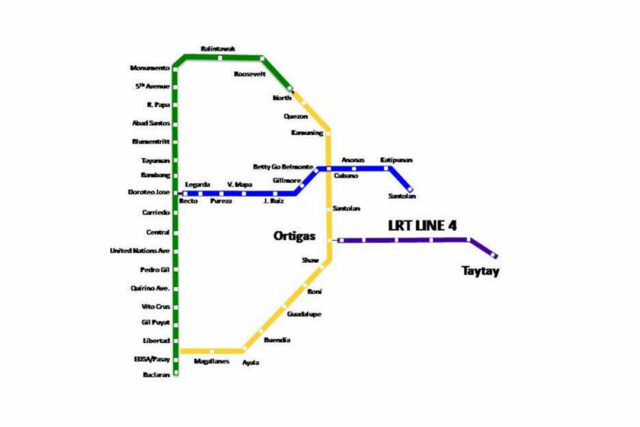
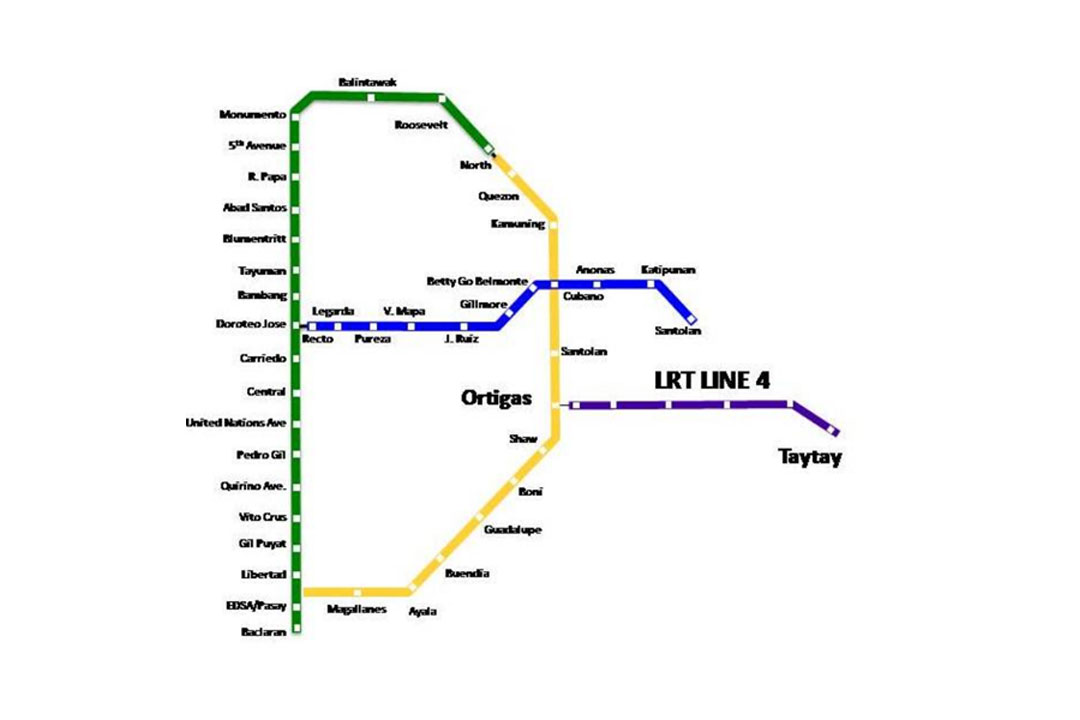
TRANSPORTATION Secretary Jaime J. Bautista recently issued a notice to proceed to Ove Arup & Partners Hong Kong Ltd. (ARUP) for consulting services to develop Metro Rail Transit Line 4 (MRT-4), a transit system that will serve the eastern section of Metro Manila, including parts of Rizal.

Mr. Bautista issued the notice to proceed on Sept. 16 to Thomas John Fergal Whyte, the authorized representative of ARUP, according to documents obtained by BusinessWorld.

“Pursuant to the conditions of the contract of the Metro Rail Transit Line 4, procurement of independent checking engineer, please be informed that the contract between the Department of Transportation (DoTr) and ARUP has been approved and concurred in by the concerned authorities,” Mr. Bautista said.

The contract, according to Mr. Bautista, is worth $4.18 million plus P38.90 million, or the equivalent of around P282.61 million.

“Accordingly, you are hereby directed to commence the work in accordance with the terms and conditions as stipulated in the contract, and the date of commencement shall be no later than 21 days upon receipt of this notice,” he added.

According to its website, ARUP has “over 40 years (of) presence in Greater China, providing a full spectrum of design, engineering, planning and consulting services.”

“We have worked on many of the region’s most iconic structures, including the Bird’s Nest and Water Cube in Beijing, Stonecutters Bridge in Hong Kong, and Taipei Performing Arts Centre in Taipei,” it said.

Multinational consulting, engineering, and architecture professional services firm IDOM will be the designer of the railway project.

The DoTr “has awarded IDOM the detailed design of the architecture and engineering of the new line, a project that addresses the design challenges of sustainable and inclusive transportation,” the company said on its website.

“This mobility system, financed by the Asian Development Bank (ADB), will connect the cities east of the capital with certain areas of Rizal, improving the conditions of mobility and general well-being of the citizens of Manila,” IDOM noted.

The ADB has said it would lend $1 billion for the project.

Along its 15.56-kilometer route, the project will feature 11 stations between Taytay and N. Domingo, near the Light Rail Transit Line 2 Gilmore station in Quezon City, IDOM added. — Arjay L. Balinbin

PSA estimates increase in third-quarter palay, corn output, yields

NEDA

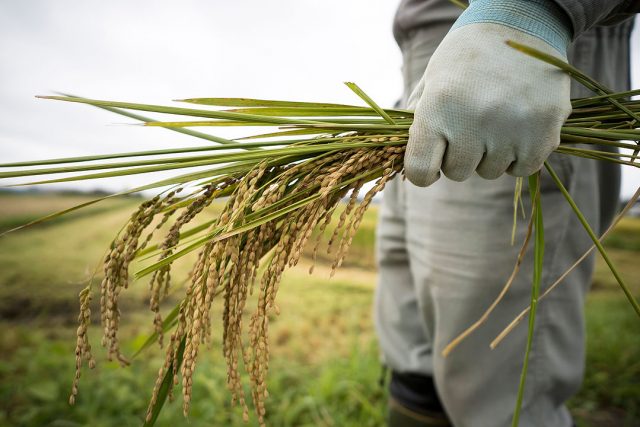
PRODUCTION of palay, or unmilled rice, and corn are estimated to have risen in the third quarter, according to the Philippine Statistics Authority (PSA).

In an Oct. 31 report, the PSA said palay output for the three months to September was estimated to have increased 2.2% year on year to 3.83 million metric tons (MT), based on the standing crop as of Aug. 1.

The projection compares with the 3.75 million MT estimate for the year-earlier period.

The estimated harvest area for rice was up 1.7% at 928,200 hectares while the yield per hectare is projected to climb 0.5% to 4.13 MT.  

“About 113,377 hectares or 12.2% of the 928,200 hectares updated area of standing crop have been harvested as of Aug. 1, 2022,” the PSA said.

“Of the standing palay yet to be harvested, 12.6% was in the vegetative stage, 56% at the reproductive stage, and 31.4% at the maturing stage,” it added.

Meanwhile, the PSA said corn production is estimated to have increased 3.3% year on year to 2.37 million MT in the third quarter.

The estimated area planted to corn during the quarter is thought to have declined 2.3% year on year to 790,467 hectares, while the yield per hectare is projected to have risen 6% to 3 MT.

“About 213,755 hectares or 27.0% of the 790,467 hectares updated area of standing crop have been harvested as of Aug. 1, 2022,” the PSA said.

“Of the total area of 576,712 hectares of standing crop yet to be harvested as of Aug. 1, 2022, 3.2% was at the vegetative stage, 47.9% at the reproductive stage, and 48.9% at the maturing stage,” it added. — Revin Mikhael D. Ochave

Property valuation reform seen unlocking housing potential, firming up LGU finances

By Luisa Maria Jacinta C. Jocson, Reporter

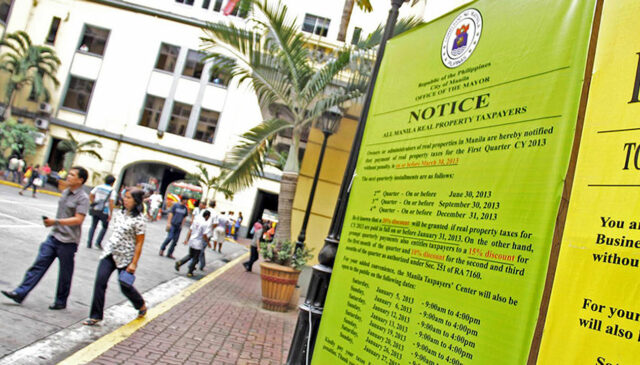
THE reform of the property valuation system and the digitalization of records is expected to drive growth in the housing industry, while simultaneously boosting the revenue of local governments through higher property tax assessments, economists said.

“This is consistent with addressing the housing backlog of about 6.5 million units of the country. Housing has a high multiplier effect on the economy as it supports many workers in the construction sector, and many businesses, industries for various construction materials, furniture, appliances, and the like,” Rizal Commercial Banking Corp. Chief Economist Michael L. Ricafort said in a text message.

“This is one powerful way to stimulate the economy from a fiscal policy standpoint,” he added.

The Department of Finance (DoF) is working to pass a Real Property Valuation and Assessment Reform bill, which forms the third package of the previous government’s Comprehensive Tax Reform Program.

The reforms aim to boost investor confidence in the real property sector through the adoption of internationally accepted valuation standards and professional real property valuation, according to the DoF.

“A key feature of the proposed reform is the establishment of a comprehensive and up-to-date electronic database to support local governments’ valuation functions. An electronically accessible database will allow for the study of trends and other analyses to support land use planning and development,” Finance Secretary Benjamin E. Diokno said at the Chamber of Real Estate and Builders’ Associations, Inc. forum last week.

Mr. Ricafort said that one of the key reform measures is the updating of property valuation methods as the basis for assessing property taxes.

“This would be able to structurally increase the property tax collections of the LGUs on a recurring basis, in view of the increase in property values over many decades,” he said.

The DoF is also working on streamlining the process of property tax collection in local government units (LGUs).

The government is monitoring the updating of real property tax base and rates in LGUs, Mr. Diokno added. 

Mr. Ricafort said that further digitalization of government transactions with the public will help increase LGU tax collections.

“Faster and streamlined processing of housing and building permits will also help stimulate growth in the sector,” he added.

John Paolo R. Rivera, an economist at the Asian Institute of Management, also called for the review of the Tax Reform for Acceleration and Inclusion (TRAIN) law.

“Does it stimulate growth in the property sector or is it just a source of tax revenue that is passed on to buyers? There is a need to make property investing in the Philippines more reasonable,” he said in a Viber message.

Mr. Rivera also called for the review of the Maceda Law (Republic Act 6552), which outlines protections for buyers of real estate via installment payments.

BFAR backs WTO ban on fisheries subsidies

PHILSTAR FILE PHOTO

THE Bureau of Fisheries and Aquatic Resources (BFAR) said the Philippines must comply with a World Trade Organization (WTO) ban on fishing subsidies, which is designed to deter illegal fishing, even amid pressure from fishing organizations to provide government support for fisherfolk.  

Demosthenes R. Escoto, BFAR officer-in-charge, said that the WTO agreement against subsidies seeks to deter illegal, unreported, and unregulated fishing (IUUF) and to restore overfished populations.

“The WTO agreement is good since the Philippines, as a country and a responsible fishing nation, we do not want IUUF. We also do not want subsidies targeting overfished stocks since it goes against fisheries management principles,” Mr. Escoto said in an interview last week.

“If fishing is contributing to IUUF, it should not be given a subsidy. If fishing targets overfished stock, there should be no subsidy,” he added.

During the 12th Ministerial Conference in June, the 164 members of the WTO approved a package of six agreements, which included the deal to curb fishing subsidies which harm the supply of fish.

The deal involves prohibiting subsidies that support IUUF, harvesting overfished stocks, and rules on fishing on the high seas beyond the jurisdiction of regional fisheries management organizations.

Fisherfolk organization Pambansang Lakas ng Kilusang Mamamalakaya ng Pilipinas (PAMALAKAYA), the Asia Pacific Research Network, and People’s Coalition on Food Sovereignty declared on Oct. 19 their opposition to the WTO agreement, claiming that small fishing communities will be disadvantaged by such a policy.

The groups said removing subsidies for commercial fishing fleets will not hamper IUUF and overfishing.

“The measure to cut fishing subsidies fails to identify who the real culprits are in the exploitation and exhaustion of the world’s seas and oceans,” PAMALAKAYA National Chairperson Fernando L. Hicap said.

They said around $35 billion has been spent by China, the European Union, the US, and Japan on fishing subsidies each year, citing a 2019 study by the Organisation for Economic Co-operation and Development. Of the total, $22 billion allegedly goes to “destructive fishing practices.”

“WTO’s measure to cut fishing subsidies will be highly detrimental to small fisherfolk who direly need concrete government support especially in the midst of inflation and its consequent economic crises. The fishing subsidies should be properly disbursed to small fishers who are never engaged in any destructive fishing practices, and in order to boost their productivity for food security,” Mr. Hicap said. — Revin Mikhael D. Ochave

Recovery prospects seen boosted by regional R&D, climate change collaboration

TRIVENITURBINES.COM

REGIONAL collaboration in research and development (R&D) and technology to mitigate climate change is expected to drive economic recovery, by making products and investment projects more viable, executives said at a virtual conference.

“Cross-border collaboration is vital… We look more broadly as to how we can further collaboration. People-to-people exchanges will lead to a greater degree of trust,” Nikhil Sawhney, vice-chairman and managing director of Indian energy equipment manufacturer Triveni Turbines Ltd. said on Tuesday at the Asian Association of Management Organisations conference.  

“I believe certain areas in terms of research and development has become a fast changing and important area for building reliable products and there needs to be a diversified base of talent. There is a world of technology and collaboration through R&D to establish platforms and standards would allow a greater degree of prosperity. It will also help bridge and build a more resilient ecosystem,” he added.

Pakistan Cables Ltd. Chief Executive Fahd K. Chinoy said that Asia needs to collaborate on climate financing, as the changing climate is one of the most pressing risks the region faces.

“The pandemic was a wakeup call. Climate change is definitely happening, and the horizon is pretty clear. It is key to build financial incentives for countries to shift into a carbon-neutral direction… There must be sort of financial incentive,” he said.

“Each country needs to build resilience around their food security and water situation. It’s all connected. There needs to be a collective narrative where the voice of the region is strongly felt, opposed to just one country. If we could collectively as a region, make more noise that would make more of an impact,” he added. 

Mr. Chinoy added: “There’s no reason why we can’t collaborate at a regional level. There could be opportunities to network. There’s no restriction on learning, which is a good starting point,” he added.

Mr. Chinoy also cited best practices that can be adapted in other countries.

“Pakistan was lucky with how the pandemic impacted us. The (infection) numbers were relatively better globally and in the region. The government acted quite fast and… subsidized financing for imported equipment, (which) encouraged investments in future projects,” he said. 

“The government also ensured no job losses, (providing) subsidized financing to keep people on versus letting people go. We kept unemployment relatively under control,” he added.

Mr. Sawhney also cited India’s own strategy in mitigating the impact of the pandemic.

“India’s government took a progressive view that there (should be) business continuity for essential industries; at the same time they took a humanitarian view and provided reassurances in terms of access to food and health,” he said.

“Now having come through it, the country managed well in terms of liquidity. It has the flexibility to use monetary measures to navigate through crises,” he added. — Luisa Maria Jacinta C. Jocson

ADVERTISEMENT
ADVERTISEMENT