Home Blog Page 5684

Fishing industry warns gov’t not to use storm as pretext for imports

BW FILE PHOTO

THE AQUACULTURE industry said the government should not us the recent storm as a pretext to authorize fish imports, saying that the domestic supply of fish is stable despite the damage inflicted by Tropical Storm Paeng (international name: Nalgae).

Mario G. Balazon, Taal Lake Aquaculture Alliance, Inc. director, said in a statement Wednesday that the fishing and aquaculture industries can meet domestic demand for fish.

“We want the government to know that our industry remains resilient regardless of the strong winds, rain, and flooding, despite Typhoon Paeng affecting many fish producers, it did not hinder our production. We can still supply the whole country without importing fish,” Mr. Balazon said.  

“Don’t use this calamity as a reason to justify imports. Support our producers first before turning to other countries for fish,” he added.

According to Mr. Balazon, the storm inflicted P22 million worth of losses for the aquaculture industry in Talisay, Batangas.  

“Approximately 200 tons of fish escaped the cages. In Calauan, Laguna, the supply of fingerlings was washed out. But we are confident that in three months we will be able to re-stock again and rest assured that this will not affect the supply of tilapia,” Mr. Balazon said.

Norberto O. Chingcuanco, Tugon Kabuhayan co-convenor, said a fish shortage is unlikely.

“When fish from aquaculture cages escape, municipal fishermen catch those fish. It doesn’t disappear. Our fishing industry is robust and we can always fill the demand. There is no need to import,” Mr. Chingcuanco said.

According to Philippine Tilapia Association President Jon G. Juico, the price of bangus and tilapia dropped last year because of imports.

“Our producers were forced to sell their fish for only P60 to P70 per kilogram, while the cost of production per fish was P90. It devastated the industry when the market was inundated by imports,” Mr. Juico said.

“There is not much damage here in Pampanga. We are always prepared here in Minalin since we don’t use nets. We use dikes, and we are affected more by dams releasing water, not by typhoons,” he added.

Tugon Kabuhayan Convenor Asis G. Perez said the industry knows how to adapt to typhoons.

  “While we are one in the call for immediate government action in providing the necessary support for the fisheries industry, we are also expressing that Filipinos — no matter the predicament — are inherently fighters. The effect of Typhoon Paeng is just one of the many bouts that can be surmounted with our own hands,” Mr. Perez said.

The Department of Agriculture (DA) estimates that as of 5 pm, Wednesday, agricultural damage due to the storm totaled P2.74 billion, affecting 74,944 farmers and fisherfolk, with lost production at 111,831 metric tons (MT) and affected farmland 82,380 hectares.

Fisheries damage was estimated at P201.64 million. — Revin Mikhael D. Ochave
Customs exceeds Oct. target

PHOTO COURTESY OF ICTSI

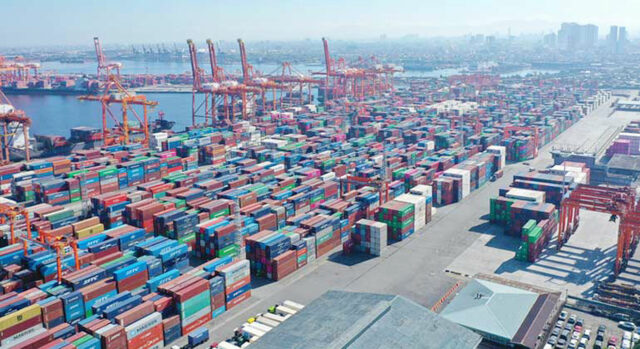
THE BUREAU of Customs (BoC) said Wednesday that it exceeded its collection target for a tenth straight month in October.

In a statement, the BoC reported collections of P75.5 billion in October, exceeding its target for the month by 18.6%.

Year on year, October collections were up 35%.

In the 10 months to October, collections hit P714.3 billion, exceeding the year-to-date target by 18.5% and the year-earlier performance by 37%.

The BoC said it will continue to address sources of revenue leakage, corruption, and smuggling, while modernizing its processes. — Luisa Maria Jacinta C. Jocson

Prime Infra to seek Malampaya service contract extension

PRIME INFRASTRUCTURE Capital, Inc. (Prime Infra) is seeking to extend the license for Service Contract (SC) 38 covering the Malampaya gas-to-power project, after Shell Petroleum N.V. (Shell Petroleum) announced the completion of the sale of its stake in the contract to a unit of Prime Infra.

“Prime Infra is committed to invest in critical infrastructure that supports the country’s urgent needs. We are excited to be part of the next phase of Malampaya, and to further the potential of SC 38 as we work on securing the license extension,” Prime Infra President and Chief Executive Officer Guillaume Lucci said in a statement.

The license expires in 2024.

In its own statement Tuesday, Shell Petroleum announced that its 100% stake in Shell Philippines Exploration B.V. (SPEX) was transferred to Malampaya Energy XE Pte. Ltd. (MEXP), a Prime Infra unit, effective Nov. 1.

“The Malampaya asset begins a new chapter as we continue to build on the legacy of this world-class installation in helping achieve national energy security and independence,” Enrique K. Razon, Jr., chairman of Prime Infra, said in the Prime Infra statement.

Prime Infra said it will work to sustain and expand gas production to meet growing domestic demand for power.

SC 38 covers the Malampaya project in northwestern Palawan. The other members of the SC 38 consortium are UC38 LLC holding, and PNOC Exploration Corp., which own a 10% and 45% interests, respectively.

Malampaya is approaching commercial depletion by 2027, with production dwindling starting this year.  

The Department of Energy (DoE) said Malampaya supplies up to 20% of Luzon’s power requirements. With MEXP’s assumption of full ownership and control of Malampaya operator, Prime Infra said it will also rename SPEX to Prime Energy Resources Development B.V. (Prime Energy).

“The renaming of SPEX is already in process following the acquisition of SPEX shares,” Prime Infra said.

The DoE approved the sale of the stake of SPEx to MEXP last month, finding Prime Infra technically, financially, and legally qualified as an operator of the Malampaya gas-to-power project. — Ashley Erika O. Jose

Japan to help improve Philippine mountain road safety

MOUNTAIN PROVINCE DRRM OFFICE

THE DEPARTMENT of Public Works and Highways (DPWH) said Wednesday that Japan will provide assistance in improving mountain road safety, particularly in the area of slope management.

Japanese experts will also help the Philippines “enhance (its) capability to establish hazard maps for road disaster risk reduction and improve… road disaster information management,” the department said in a statement.

The department said that it recently had the first of a series of meetings with Japan “to discuss the work plan in improving the capabilities of the DPWH and its engineers in incorporating the latest technology to address the problem of road disasters in mountainous areas.”

Public Works Secretary Manuel M. Bonoan recently ordered the creation of a joint coordinating committee chaired by Senior Undersecretary Emil K. Sadain to ensure the success of the technical cooperation project with the Japan International Cooperation Agency (JICA).

According to Mr. Sadain, the project will help facilitate the development, transfer and dissemination of relevant technology, not just in terms of mitigation but also in the reduction of risks posed by disasters.

“A work plan was presented by the JICA project team to establish coordination with the concerned technical working groups for effective collaboration and smooth conduct of the project,” the department said.

“Given the amount of expertise that is gathered, I am confident that the first meeting will be able to gather timely development outcomes,” Mr. Sadain said.

Twenty-seven sections of road were closed to traffic as of Nov. 1 due to a severe tropical storm.

Seven of those road sections were in the Cordillera Administrative Region, five in Region II, one in Region III, two in Region IV-A, five in Region VI, one in Region VIII, three in Region XII, and three in the Bangsamoro region. — Arjay L. Balinbin

Supermarkets facing higher costs even as revenues rise

PHILSTAR FILE PHOTO

SUPERMARKETS are dealing with higher operating costs as pandemic restrictions ease, with an industry official saying that the pickup in sales is sometimes not reflected in the resulting profits, especially for smaller stores.

Steven T. Cua, Philippine Amalgamated Supermarkets Association, Inc., president, told BusinessWorld Live on One News channel that supermarkets are still adapting to unpredictable conditions as a result of the coronavirus disease 2019 (COVID-19) outbreak.  

“It is difficult for us right now, those which are not big (supermarket) chains. It is difficult for us to make sure that the bottom line is clear in view of sales. Even if we have a spike in sales, sometimes our costs increase, our cost of operation increase. We’re still in transition,” Mr. Cua said.

Mr. Cua said some supermarkets expanded their operating hours in October in the hope of capturing more business.

“There are adjustments still made on our end to make sure that there is a balance between sales and bottom line,” Mr. Cua said.

“We have better sales (compared to 2021) because of the reopening of the economy. But again… there are new COVID-19 variants coming out,” he added. — Revin Mikhael D. Ochave

Trade deficit balloons to $29.8B in first half

PHILIPPINE STAR/EDD GUMBAN

The Philippines’ balance of trade deficit in the first half widened slightly more than initially reported due to higher import bill, latest data from the Philippine Statistics Authority (PSA) showed.

The trade deficit stood at $29.819 billion in the first semester, slightly higher than the $29.793 billion the agency reported previously. This deficit was also significantly wider than the $17.953 billion recorded in the first six months of 2021.

Exports during the period were kept at $38.527 billion while imports of goods were revised upwards to $68.346 billion (from $68.320 billion reported in August).

Meanwhile, the country’s total trade was revised to $106.874 billion against the earlier estimate of $106.847 billion. 

“Increased trade resulted from the reopening of the economy with mobility restrictions relaxed,” ING Bank N.V. Manila Branch Senior Economist Nicholas Antonio T. Mapa said in an e-mail.

He noted that increased costs for imports due to surging commodity prices pushed up the overall trade.

By major type of goods, manufactured goods still comprised the largest portion in total exports in the first half, accounting for 78.9%. This grew by 2.8% annually to $30.387 billion.

Electronic products, which made up 54.9% of the total export receipts, grew by 4.4% to $21.169 billion.

Semiconductors, which accounted for 41.7% of exports, increased by 7.3% to $16.060 billion.

Exports of mineral products climbed by 28.1% to $4.067 billion in the first six months. These goods accounted for 10.6% of the total exports.

Other mineral products grew by 41.2% to $2.114 billion while other manufactured goods rose 2.6% annually to $1.935 billion.

Meanwhile, imports of raw materials and intermediate goods, which accounted for 38.8% of the total import bill, grew 21.4% to $26.535 billion.

With a 27.9% share of the total, capital goods went up 12% to $19.099 billion.

This was followed by mineral fuels, lubricants and related materials, which accounted for about 17.5% of the total bill, surging 117.7% to $11.975 billion.

In a separate e-mail, Security Bank Corp. Chief Economist Robert Dan J. Roces said that imports improved on the back of sustained local demand on the back of economic reopening.

“However, data from June 2022 hence showed local trade balance go into deeper, record negative territory with international trade getting buffeted by spiking inflation, strong USD, and China’s slowdown. These latter factors we expect to continue pressuring the peso until end of the year,” he added.

China was the country’s main supplier of imported goods amounting to $13.499 billion with a 19.8% of the total imports. This was followed by South Korea which was valued at $6.957 billion with a share of 10.2% of the total and Japan with $6.371 billion, 9.3% of the total.

Meanwhile, the United States was the main destination of the country’s products, with a 15.4% share valued at $5.935 billion. It was followed by China (14.5% at $5.588 billion) and Japan (14.3% at $5.524 billion).

“We expect exports to struggle as global trade slows although imports could sustain gains as the economy continues to expand further,” Mr. Mapa said.

Export and import trade statistics are compiled by the Philippine Statistics Authority (PSA) from export and import documents submitted to the Bureau of Customs by exporters and importers or their authorized representatives as required by law.

Business restructuring at arm’s length

“It is not the strongest or the most intelligent who will survive but those who can best manage change.” This warning by Charles Darwin sends a clear message. With the world evolving so rapidly, we have to be quick to adapt. In business, it has become a necessity for multinational enterprises (MNEs) to adjust to the changing environment to remain competitive and relevant. As such, most MNEs make adjustments by restructuring their commercial and financial relations to adapt to these changes.

Cross-border reorganization in the commercial and financial relations between associated enterprises is called business restructuring. It may often involve centralization of intangibles, risks or functions, along with the profit potential attached to them. MNEs implement business restructurings for a number of reasons, typically to maximize synergies and economies of scale, to streamline the management of business lines, to improve the efficiency of the supply chain, or to preserve profitability or limit losses.

While business restructurings are not usually done for tax reasons, the changes that occur during restructuring may, however, warrant transfer pricing considerations for all the parties involved. As such, business restructurings pique the interest of tax authorities especially during transfer pricing audits. In fact, in the Philippines, the Bureau of Internal Revenue (BIR) included business restructuring as one of the factors to be considered in analyzing the transfer pricing risks and compliance of a taxpayer during an audit. In Revenue Audit Memorandum Order (RAMO) no. 1-2019, the BIR briefly discussed its key considerations in reviewing the transfer pricing implications of business restructurings entered into by associated enterprises.

According to the RAMO, the reduction in profit of an entity as a result of business restructuring may only be acceptable if the functions performed, assets employed, and risks assumed have actually been reduced. Otherwise, the revenue officer may make necessary adjustments to reflect an arm’s length arrangement. The rationale behind this is simple. In an arm’s length situation, an independent party will not restructure its business if it affects its results negatively, and where it has the option realistically available not to do so.

The RAMO did not provide further details on how to apply the arm’s length principle to business restructurings. Nonetheless, Chapter IX of the OECD Transfer Pricing Guidelines provide a thorough discussion on the application of the arm’s length principle to business restructurings.

Ultimately, there are three main points to consider in determining the arm’s length conditions of business restructurings. First, we must analyze the accurate delineation of the transactions comprising the business restructuring. We will ask questions like, “What are the functions performed, assets employed, and risks assumed before and after the restructuring?”, “Does the transferred function or risk carry with it a profit potential?”, “If so, does the transfer itself call for an arm’s length consideration?”.

For instance, let’s take the case of a full-fledged manufacturer that is converted into a toll manufacturer resulting in the elimination of inventory risk. In order to migrate from the pre-existing arrangement to the restructured one, the inventories that are on the balance sheet of the taxpayer at the time of restructuring are transferred to another associated enterprise. The question here is how to determine the arm’s length transfer price for the inventories upon the conversion.

Second, we must understand the business reasons for and the expected benefits from the restructuring. One of the most common reasons for restructuring is to have more centralized control and management of business functions. For instance, a business restructuring may involve centralizing the group’s procurement activities into a single entity to take advantage of volume discounts and potential savings from administrative costs. Thus, to determine the arm’s length nature of the transactions involved in the restructuring, it is equally important to determine the benefits derived from such reorganization. The question of who will benefit from the savings or profit derived from such reorganization should be raised. In the example, the central procurement company may be entitled to a profit for its performance of certain functions, and its assumption of the risks associated with buying, holding and reselling goods. However, it is not entitled to retain profits arising from the group’s purchasing power (e.g., savings from volume discounts) because it does not contribute to the creation of synergies.

Last, in analyzing whether the business restructuring itself is conducted at arm’s length, it is important to understand whether the entity involved in the reorganization has a more attractive alternative rather than to enter into a restructuring. Simply put, in applying the arm’s length principle, it would be important to know whether independent entities would be willing to enter into the same transaction. Otherwise, if the restructuring would make the independent entities worse off than their current situation, they would not restructure their business.

In view of the above, it is not surprising why business restructuring is one of the focus areas of tax authorities during transfer pricing audits. Aside from the potential sudden changes in the profitability of a restructured entity post-restructuring, the tax authorities would also be concerned about the transactions involved in carrying out the restructuring itself.

From the perspective of the taxpayers, robust documentation of the business restructuring would be helpful in supporting the arm’s length conditions of the reorganization. One of the major hurdles that taxpayers may face is the difficulty of finding comparable transactions. Nonetheless, every effort should be made to determine the pricing for the restructured transactions. In light of this, aside from transfer pricing documentation, an advance pricing agreement approved by the BIR (once this becomes available) should be helpful to minimize uncertainty and give taxpayers comfort on the tax treatment and transfer prices of the transactions involved in the restructuring.

The views or opinions expressed in this article are solely those of the author and do not necessarily represent those of Isla Lipana & Co. The content is for general information purposes only, and should not be used as a substitute for specific advice.


Leizelyn De Villa is a Manager at the Tax Services Department of Isla Lipana & Co., the Philippine member firm of the PwC network.

+63 (2)8845-2728

leizelyn.e.de.villa@pwc.com

Four Philippine regions placed under calamity state

PHILIPPINE STAR/ MIGUEL ANTONIO DE GUZMAN

PRESIDENT Ferdinand R. Marcos, Jr. on Wednesday placed four Philippine regions under a state of calamity after Typhoon Nalgae (Paeng) caused severe floods, killing more than a hundred people.

Covered by the six-month state of calamity under Proclamation 84 are Calabarzon, Bicol, Western Visayas and the Bangsamoro Autonomous Region in Muslim Mindanao, where more than 1.4 million people were affected by the typhoon.

Under a state of calamity, local governments and the private sector could hasten rescue, recovery, relief and rehabilitation efforts and quickly appropriate funds. A ceiling on prices of basic goods is also imposed to prevent hoarding and overpricing.

“All government departments, agencies and instrumentalities concerned are hereby directed to continue implementing and executing rescue, recovery, relief and rehabilitation measures in accordance with pertinent operational plans and directives,” according to a copy of the order.

The death toll from the typhoon has hit 120, while 103 people were hurt, according to the local disaster agency. Thirty-six people were still missing.

It said the typhoon had affected 3.18 million people from 927,822 families in 73 provinces.   

Typhoon Nalgae, which left the Philippines on Monday afternoon, affected 11,294 houses, 2,104 of which were totally destroyed. The cost of housing damage was estimated at P12.76 million.

Mr. Marcos also ordered agencies to coordinate with local governments to help augment basic services in affected areas.

“Law enforcement agencies, with support from the Armed Forces of the Philippines, are directed to undertake all necessary measures to ensure peace and order in affected areas,” he added.

The Philippines lies along the typhoon belt in the Pacific and experiences about 20 storms each year. It also lies in the so-called Pacific Ring of Fire, a belt of volcanoes around the Pacific Ocean where most of the world’s earthquakes strike.

Filipino scientists have been urging the government to increase the state weather bureau’s 2023 budget, citing increased threats from changing climate patterns.   

The bureau’s P1.3-billion budget this year is lower than its P1.6-billion allocation last year.

Meanwhile, the Senate will allot a P30-billion calamity fund for next year to let the government adequately respond to disasters, Senator Juan Edgardo “Sonny” E. Angara told reporters in a Viber message.

“The calamity fund budget is roughly P30 billion which is larger than in past years,” said the lawmaker, who heads the Senate finance committee. “Given the increased frequency and magnitude of recent typhoons, this is appropriate.”

The Senate committee is open to changes to help improve state response to these calamities, he added.

Agricultural damage caused by Nalgae was estimated at P49.54 million, according to the Agriculture department. The country’s 16th storm this year has affected more than 700 farmers and thousands of farm areas.

Mr. Angara plans to file the committee report for the 2023 proposed budget and sponsor it in plenary on Tuesday.

Senate President Juan Miguel F. Zubiri earlier said the Senate was on schedule to pass the budget bill, as it directs budget debates toward economic recovery, with funds focused on revenue generation and programs to tame inflation.   

He ruled out a reenacted budget, noting that there are few government offices whose budgets were yet to be heard.

The Senate plans to finish budget plenary debates in two weeks. “Maximum fourth week approval on second or third reading. Best effort, first week of December. Bicameral approval, the latest in the second week,” he said.

Mr. Zubiri said he does not expect major roadblocks in the passage of the P5.268-trillion budget because it is almost identical to this year’s budget.

“The difference is small, so the important thing here is that we fund the agencies that we think deserve to be given funds to improve the provision of assistance to our countrymen,” he said.

Next year’s budget is only 4.9% higher than this year and is equivalent to 22.2% of economic output.

The House of Representatives passed its version of the bill in September after President Ferdinand R. Marcos, Jr. certified the measure as urgent, allowing its approval on second and third reading on the same day. — Kyle Aristophere T. Atienza and Alyssa Nicole O. Tan

Philippines scraps pre-departure virus testing for travelers

STOCK PHOTO | Image by L.Filipe C.Sousa from Unsplash

PRESIDENT Ferdinand R. Marcos, Jr. has approved a pandemic task force recommendation to ease quarantine rules for foreigners and Filipinos entering the country, as it seeks to boost tourism recovery. 

Fully vaccinated inbound travelers, whether Filipinos or foreigners, will no longer undergo pre-departure testing for the coronavirus, according to a government memo.

Unvaccinated or partially vaccinated travelers still must get a negative antigen test taken within 24 hours before the departure from the country of origin.

They should be in a continuous travel to the Philippines, excluding layovers, and should remain in airport premises.

Those who fail to present a negative pre-departure testing with the conditions set should undergo a laboratory-based rapid antigen test upon arrival at the airport.

Under the memo, unvaccinated minors below 15 years should follow the quarantine protocols of their parents or guardians. Unaccompanied minors who are not vaccinated against the coronavirus should follow state rules.

An inbound traveler who tests positive for the coronavirus through rapid antigen testing will need to be quarantined.

Mr. Marcos is banking on the tourism industry to boost economic recovery.

Tourism arrivals in the Philippines has hit 1.7 million as of Oct. 17, exceeding the target for the full year, Tourism Secretary Maria Esperanza Christina Frasco said earlier this month.

Tourism accounted for 12.8% of the Philippines’ economic output in 2019, or about P2.48 trillion. Tourism’s economic contribution fell to 5.2% last year after most countries closed their borders during a global coronavirus pandemic.

Mr. Marcos last month did away with the face mask mandate indoors.

Health experts and advocates have said easing mask rules could trigger another wave of infections, especially amid threats from emerging coronavirus variants.

Meanwhile, COVID-9 cases in the Philippines might fall to fewer than 500 this month, the OCTA Research Group said, after the country posted its lowest daily case load since June 28 on Tuesday. 

“Cases could go down to around 500 per day, but it can change if there is a new subvariant,” OCTA fellow Fredegusto P. David said in a Facebook Messenger chat.

On Tuesday, the country posted 676 COVID-19 infections, the lowest daily count since June 28, when 576 cases were reported. Active cases declined to 19,340 from 20,227 on Monday, according to the Health department.

Party-list Rep. Raoul Danniel A. Manuel on Tuesday night asked school authorities to encourage the wearing of face masks in classrooms after the Education department said wearing masks would be optional.

“While there are public officials who reject the advice of health experts to impose masking, we urge school officials to still highly encourage the wearing of well-fitting masks because COVID-19 is an airborne disease,” he said in a statement.

Last week, President Ferdinand R. Marcos, Jr. signed an order allowing the optional wearing of face masks indoors. Earlier this year, he made face masks optional outdoors.

The Education department on Tuesday said it would follow the president’s order to allow students and teachers to choose whether they would wear masks inside the classroom.

Mr. Manuel said schools might not have safeguards in place, which could be unsafe for students and school staff.

He said full face-to-face classes that will begin this week is long overdue, but the absence of virus testing, low vaccination rates among students and optional masking could be a “recipe for disaster.”

The Education department had ordered both public and private schools to hold full face-to-face classes by Nov. 2. It later amended the order by letting private schools to offer online classes even after the deadline. — Kyle Aristophere T. Atienza and Matthew Carl L. Montecillo

Thousands affected by MRT-3, PNR rail problem after 4-day holiday weekend  

Commuters line up at the MRT-3 North Avenue Station, March 28, 2022. — PHILIPPINE STAR/ MIGUEL DE GUZMAN

TRANSPORT officials on Wednesday said about 3,600 passengers were affected when the Metro Rail Transit Line 3 (MRT-3) temporarily suspended its operations in the morning due to a signaling problem.   

When we started the operations as early as 5:00 a.m., when the train was about to reach Shaw Boulevard, it encountered a signaling problem,MRT-3 Director for Operations Oscar B. Bongon said during a press briefing.  

We suspended the operations in order to check the signaling problem,he noted. At about 6:52 a.m., the signaling team was able to normalize all the indications, and we resumed the normal operations at 6:58 a.m.”  

Schools and offices reopened on Wednesday after a four-day weekend with Monday declared as a special holiday this year while Nov. 1 is an annual holiday in observance of All SaintsDay.   

Mr. Bongon said they deployed additional trains on Wednesday following the glitch.   

Normally we deploy 18 trains; but to address the impact on passengers, we added two more trains to cater to the volume of the passengers,he said.  

Mr. Bongon admitted that the MRT-3 management was unable to immediately issue an advisory to inform incoming passengers about the suspension.  

The intervention took a while. They were thinking that operations could be immediately resumed,he said in a mix of English and Filipino.  

MRT-3 traverses over the main thoroughfare EDSA in the capital region. It has 13 stations with North and Taft Avenues as endpoints.   

PNR
Meanwhile, some trips of the Philippine National Railways (PNR) were also affected after a derailment incident that occurred at around 6:00 a.m.   

PNR Operations Department Manager Joseline A. Geronimo said around 500 passengers were affected by the incident.  

In the same briefing, Ms. Geronimo explained that the derailment at the Magsaysay Crossing near the Sta. Mesa Station was due to the softening of the soil base following days of rains, including those brought by Tropical Storm Nalgae, locally named Paeng.   

Six trips were affected: four going to Alabang, Bicutan, and Biñan; and two going to Tutuban. 

Normal operations resumed at around 8:00 a.m., she said.  

The state-run PNR has an operational line from Caloocan in the northern part of Metro Manila going south to Calamba, Laguna. Arjay L. Balinbin 

Bangsamoro public works ministry: All hands, equipment deployed in storm-hit areas 

MPW-BARMM

ALL available manpower and equipment have been deployed in Maguindanao and other areas in the Bangsamoro region affected by flooding and landslides since the weekend, the autonomous regions Ministry of Public Works (MPW) said.  

In times of calamities like this, MPW is doing its best to help alleviate the situation. We utilize our people and our equipment to assist our constituents in need, Minister Eduard U. Guerra said in a statement.   

The ministry said their work involved simultaneous rescue, retrieval and clearing operations to the residents of Cotabato City, Maguindanao and in different BARMM (Bangsamoro Autonomous Region in Muslim Mindanao) areas who are affected by flood and landslide due to the torrential rain which started last Thursday night brought by Tropical Storm Paeng.  

It added that the Maguindanao 1st District Engineering Office had been clearing massive amountof water hyacinth flowing along the Rio Grande de Mindanao in Cotabato City.  

MPW Maguindanao District Engineer Avila D. Abobakar said the accumulation of water hyacinth at Delta Bridge hampers the flow of water along the river coming from the Ligawasan Marsh.    

As of Nov. 2, a total of 12 bridges and roads have been cleared while 11 others were still not passable, according to the BARMMs monitoring update.   

Some bridges incurred major damage and will require reconstruction.   

Infrastructure programs, including asset management, in the new autonomous region were turned over by the national governments Department of Public Works and Highways (DPWH) last year in line with Republic Act 11054 or Bangsamoro Organic Law.   

After the formal handover ceremony in September last year, then DPWH secretary Mark A. Villar and Mr. Guerra also signed an agreement on the coordination plan and protocols for the transition of infrastructure projects from the national to the regional government.   

Meanwhile, Basilan Rep. Mujiv S. Hataman expressed support to President Ferdinand R. Marcos, Jr.’s suggestion to set up a DPWH office in the BARMM.  

Mr. Hataman said there would be no conflict with the Bangsamoro Organic Law  as there is no provision that expressly prohibits the government from creating a DPWH District Engineering office in the region. — Marifi S. Jara and Kyanna Angela Bulan

House donation drive for typhoon victims collects P75M in goods, cash

PHILIPPINE STAR/ MICHAEL VARCAS

A DONATION drive initiated by the House of Representatives has so far gathered P26.3 million worth of various relief goods and P49.2 million in cash, including pledges, for victims of the most recent typhoon to hit the country, the House leader said on Wednesday.   

We need all the help that we can get, we already reached many affected families nationwide and we vow to bring the remaining aid to the affected families as soon as possible, House Speaker Martin G. Romualdez said in a statement.  

He said they partnered with Social Welfare Secretary Erwin T. Tulfo for the relief mission, wherein beneficiaries will also receive aid through the departments Assistance to Individuals in Crisis Situations program.   

The in-kind donations include food items, blankets, and toiletries.   

Tropical Storm Nalgae, locally named Paeng, swept through a wide area of the Philippines, affecting more than 3.18 million people, based on latest data from the National Disaster Risk Reduction and Management Council.  

Assistance provided by the national and local governments and other institutions has reached at least P71.59 million, according to the council report as of Nov. 2. Matthew Carl L. Montecillo 

ADVERTISEMENT
ADVERTISEMENT